

*This first appeared on AP News
BANGKOK (AP) — They have been in a committed relationship for more than 13 years, and even had a wedding in 2019. Since then, Danaya Phonphayung and Sunma Piamboon, both women, have considered themselves a married couple, even if same-sex marriages were not legally recognized.
The walls of their home in suburban Bangkok are decorated with faded photos from their happy union, filled with joy and love from their families and friends. Come this Thursday, their wedded status will be recognized by the nation as well, when a law that allows members of the LGBTQ+ community in Thailand to get married and have the same legal rights as heterosexual couples takes effect.
The couple said they can’t wait to formalize their union. They plan to register their marriage at a district office near their home on the very first day that the law allows.
“I think I’ll cry,” Danaya, an office worker, said with a big smile, thinking about the moment that they will sign the paper. “I’m so happy. It’s something that was more than I could’ve dreamed of, that suddenly this day is happening.”
“We live together. We bought a house. We bought a car. But we cannot share these things together like a married couple. When this is happening, we feel that it’s our rights that we need to secure as quickly as possible,” she said.
The marriage equality bill, which sailed through both the House of Representatives and the Senate, amended the Civil and Commercial Code to change the words “men and women” and “husband and wife” to “individuals” and “marriage partners.” It would open up access to full legal, financial and medical rights for LGBTQ+ couples.
Sunma, who owns a travel agency, said that she had realized how crucial being legally married was when Danaya was hospitalized with dengue fever, as they don’t live close to her parents.
“The doctors asked me who I was, and I said I was the girlfriend, and they were like, ‘so what’?’ I couldn’t make any decision until her condition became quite serious,” she said. “I was so upset, like, if I had lost her … there would be nothing that could’ve made up for it. So, I think this is very important for both of us.”
How marriage equality became law
Thailand has a reputation for acceptance and inclusivity, but struggled for decades to pass a marriage equality law. Thai society largely holds conservative values. Members of the LGBTQ+ community say they face discrimination in everyday life, although they note that things have improved greatly in recent years.
The government led by the Pheu Thai party made marriage equality one of its main goals. It made a major effort to identify itself with the annual Bangkok Pride parade in June, in which thousands of people celebrated in one of Bangkok’s busiest commercial districts.
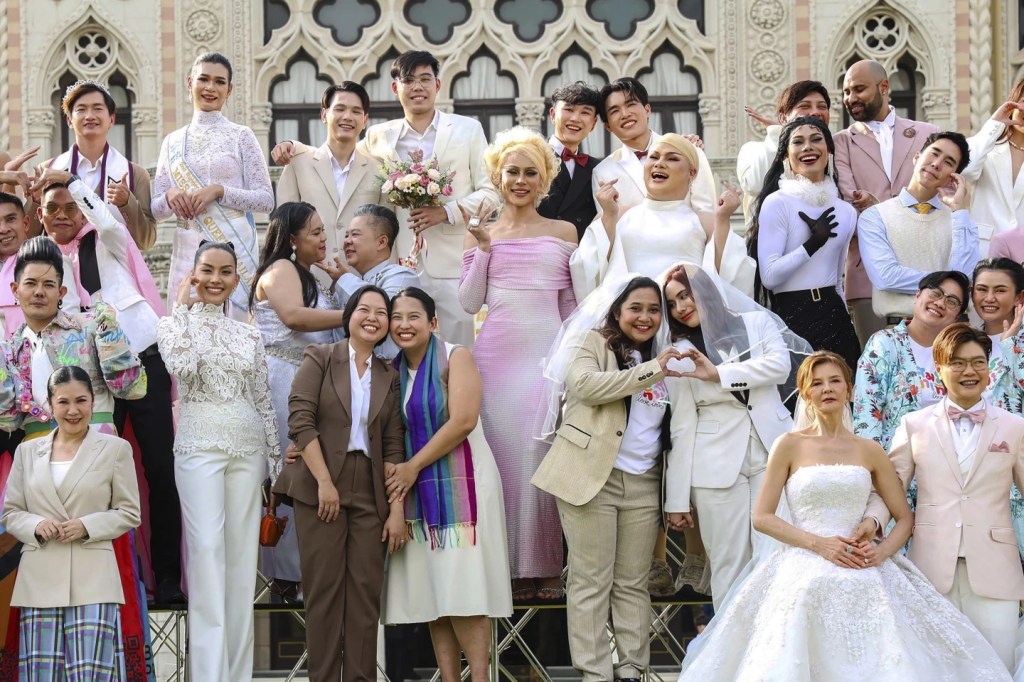
Last week, Government House invited dozens of LGBTQ+ couples and activists for a photo op and a meeting with Prime Minister Paetongtarn Shinawatra and several high ranking officials to celebrate the law coming into effect, making Thailand the first in Southeast Asia and the third place in Asia, after Taiwan and Nepal, to legalize same-sex marriage.
“It is almost like a dream, but it’s not. So, congratulations to all,” Paetongtarn said. “I think it’s very important that the world notice us, and know that in this small country we have this kind of thought. We have this kind of support for our people. So, we all should be proud.”
The organizers of Bangkok Pride have collaborated with relevant government agencies to hold a grand celebration in central Bangkok and facilitate couples who wish to register their marriage on the very first day. They said that more than 300 couples have registered to officially tie the knot on Thursday at the event.
“(The law) is about returning our dignity, and confirming that we also have dignity as a human being,” said Ann “Waaddao” Chumaporn, a gender equality activist and the lead organizer of Bangkok Pride. “That day is going to be meaningful to all the couples that have gone through this journey together. I’d like to thank everyone, every love, that has faithfully struggled so that today would finally happen.”
How the law will be implemented
The government and state agencies in Thailand are historically traditional in outlook. To prepare them for change, the Bangkok Metropolitan Administration said that it has organized workshops for staff of all Bangkok district offices who are in charge of handling marriage registration. They included lectures raising awareness about gender diversity and guidance on how to properly communicate with those who come for the service.
“It’s like a missing piece of the jigsaw,” Bangkok Deputy Gov. Sanon Wangsrangboon said at one of the workshops earlier this month. “Society is ready. The law is getting ready. But the last piece of the jigsaw is the understanding from officials.”
He acknowledged there that would be problems in the beginning, but said that he hoped they would gradually improve over time.
After they register their marriage, Sunma said that she’s looking forward to having a “real marriage celebration” with her and Danaya’s families.
“It’s not just the two of us that are happy, but both of our families feel it is a big deal, and it is what everyone has been waiting for. Everyone said they are waiting for Jan. 23,” she said.
 fleeredstates.blog
You must be logged in to post a comment.