Asia could outstrip Europe as key beneficiary of U.S. capital flight

*This is reported by Reuters. For corresponding graphs, check their original article.

 As global investors consider reducing their exposure to U.S. financial assets, the key question is where money flowing out of the U.S. will go. While Europe may be the obvious destination, relative value metrics may favour emerging Asia.

Even though U.S. equities have recovered from the steep losses suffered in the week following U.S. President Donald Trump’s announcement of his ‘Liberation Day’ tariffs, the same cannot be said of the U.S. bond market. Since hitting a recent low on April 4, the 10-year Treasury yield has spiked by around 50 basis points, with bond investors demanding more compensation for the risk of holding longer-dated U.S. debt. Worryingly, the benchmark Treasury yield has surged higher than nominal U.S. GDP growth – a key risk measure.

Additionally, the usual positive correlation between Treasury yields and the U.S. dollar has broken off, as rising yields are no longer attracting money to the “safest” asset in the world. Broad-based depreciation of the greenback suggests that – despite the equity rebound – many U.S. assets are being sold and the funds are flowing into markets whose currencies are appreciating.

EUROPEAN ALTERNATIVE

The euro’s almost 10% rise against the dollar this year suggests that a significant portion of the capital flowing out of the U.S. is going to Europe, likely driven both by concerns about U.S. policy as well as expectations of higher regional growth.

Further monetary easing by the European Central Bank should promote economic activity, as should the expected surge in fiscal spending following Germany’s recent constitutional reform, opens new tab, which approved partial removal of the “debt brake” for infrastructure and defence spending.

The fiscal splurge is already offering a boost to European equities – the surprise winner thus far in 2025 – especially defence, industrial and technology stocks.

DEBT WOES

But there are reasons to question the new ‘European exceptionalism’ narrative.

One likely cause of investors’ growing apprehension with U.S. assets is the Trump administration’s apparent inability to narrow the country’s gaping fiscal deficit or reduce its debt-to-GDP ratio, which has risen to more than 120%.

But elevated debt metrics are also an issue across the pond, as they are found in Italy (135% of GDP), France (113%) and the UK (96%). Importantly, both Italy and France have seen their 10-year bond yields rise above their nominal GDP growth rates.

While the latter metric is also true of Germany, the country’s debt load is modest at only 62% of GDP, so the statistic mostly reflects a stagnating economy that’s about to get a spending boost.

Fiscal expansion in Europe will likely continue to benefit the region’s equities, but whether it is good news for fixed income investment there is still an open question.

ASIAN OPTION

Meanwhile, in emerging Asia – another potential destination for U.S. capital outflows – the debt picture is better and the growth outlook is stronger.

Government debt in many Asian countries is low, ranging from 37% of GDP in Indonesia to around 85% in China and India.

Benchmark bond yields across the region have been declining since October 2023, speaking to fixed income investors’ limited concerns about Asian countries’ fiscal situations. In fact, yields in China, Thailand and Korea are all below those in the U.S., though those in Indonesia and India remain higher.

Modest debt burdens mean there is also plenty of room for more fiscal stimulus in many countries, which could improve consumption, while the benign inflation environment should enable central banks in the region to continue cutting rates to stimulate growth.

Emerging Asia also offers far more high-growth, technology companies than Europe. The release of the affordable Chinese artificial intelligence model, DeepSeek, Beijing’s focus on semiconductors and advanced manufacturing and the country’s electric vehicle dominance could all attract tech-focused investors looking for an alternative to the U.S..

RELATIVE VALUE

Even though European equities have outperformed their U.S. counterparts significantly in 2025, the twelve-month forward price-to-earnings multiple of the major European index, the STOXX50, is considerably lower than that of the S&P 500, at 15.4x and 21.0x, respectively, as of May 23. But the major emerging Asia equity index, the MSCI Asia ex Japan, is even cheaper at 13.4x.

Moreover, earnings growth forecasts are higher in Asia than in either the U.S. or Europe through 2026.

Finally, reallocation of assets from the U.S. could potentially have a bigger positive impact on Asia than on Europe because of their relative sizes. Let’s say 5% of the U.S. free floating market cap of around $58 trillion, or roughly $3 trillion, moves out. That would represent 36% of Asia’s market cap, but only 22% of Europe’s.

NO SLAM DUNK

Caution remains warranted, though. Asian nations’ ongoing trade negotiations with the U.S. will likely still encounter numerous twists and turns, and increasing protectionism could hinder the region’s more export-oriented economies. Moreover, Chinese economic growth remains tepid despite the monetary and fiscal stimulus delivered over the past eight months.

Finally, the capital flowing into emerging Asia is a double-edged sword because of the impact on Asian currencies versus the U.S. dollar. If Asian currencies strengthen much more, the region’s export engine could stutter.

Investors, thus, have to keep a close eye on macroeconomics, geopolitics and policy statements, not just valuation metrics.

But given emerging Asia’s benign debt environment and positive growth outlook, both the region’s equity and fixed income markets have the potential to benefit from the death of American exceptionalism.

(The views expressed here are those of Manishi Raychaudhuri, the founder and CEO of Emmer Capital Partners Ltd and the former Head of Asia-Pacific Equity Research at BNP Paribas Securities).

Angry pridegoers force administration to cave after it tried closing a queer park during WorldPride

*This is reported by LGBTQ Nation.

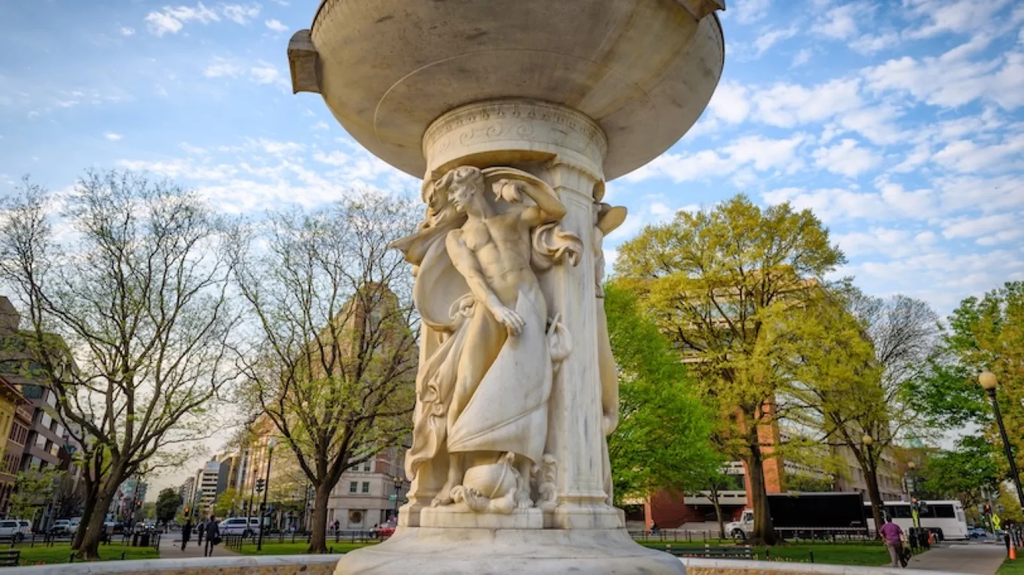
In less than 24 hours, the National Park Service (NPS) has rescinded its decision to close off Dupont Circle Park in Washington D.C. for WorldPride, citing “significant” damage to the park’s fountain during a previous pride event, costing nearly $200 thousand. The rescinding of their decision followed pushback from LGBTQ+ community leaders and advocates, as the area is a vibrant gathering place for queer people with many nearby LGBTQ+-owned shops and gay bars.

On Monday, the NPS announced that, “at the request of the [local] Metropolitan Police Department,” they would be closing off Dupont Circle Park for the final weekend of WorldPride 2025 to prevent “disorderly and destructive behavior” from WorldPride participants. The closure was set to occur from Thursday, June 5 to Monday, June 9, as a public safety measure and to protect park resources, the NPS’ statement added.

“This decision was based on a history and pattern of destructive and disorderly behavior from unpermitted activities happening in the park during past DC Pride weekends, including vaƋdalism in 2023 that resulted in approximately $175,000 in damage to the historic Dupont Circle fountain,” the statement claimed.

Indeed, $175,000 is a substantial amount of money, but it is unclear how they arrived at this figure. Despite $175,000 in damages to public property being a newsworthy story in itself, there is little to no reporting to suggest the fountain sustained critical damage during a Pride event in 2023. The event they are likely referencing was The Capital Pride Parade and Block Party in 2023. Most news coverage on the event paints it as a mainly peaceful event with no significant rioting having occurred.

It is worth noting that the fountain had been undergoing numerous repairs at the time, including waterproofing at the base, upgrades to the water pump system, and pressure testing for the pipes.

During the initial decision to close the park, reporters from The Washington Blade attempted to reach out to a spokesperson for the Metropolitan Police Department concerning the decision, but the spokesperson declined to comment and referred them to the NPS. Additionally, the office of D.C. Mayor Muriel Bowser also declined to comment.

“We have nothing else to add to the National Park Service statement at this time,” mayoral spokesperson Daniel Gleick told reporters.

In less than 24 hours after the announcement, the NPS rescinded their decision to close off the park this morning, according to D.C. Council member Zachary Parker. 

In the moments leading up to NPS changing its mind, local LGBTQ+ rights activists condemned the agency for blocking off a major historic community within the LGBTQ+ movement.

Jeffrey Ruegauer, a member of the Dupont Circle Advisory Neighborhood Commission (ANC), in a public meeting, proclaimed, “The circle belongs to everyone, it is the city’s town square. It is intimately linked with the gay community and the gay rights movement and so many other rights movements over the years,” The Washington Post reported.

Fellow ANC commissioner and official with D.C.’s Rainbow History Project told the aforementioned publication, “The community should be as outraged as I am.”

Ryan Bos, executive director of Capital Pride Alliance, the organization behind D.C.’s annual Pride events and that also helped organize this year’s WorldPride events, said no official WorldPride events were set to occur at Dupont Circle Park during the upcoming weekend, though he was unsure if independent individuals or groups had planned any events there.

Bos also said he felt certain that participants of Capital Pride events did not cause any damage to the park in past years.

In February, NPS removed all mentions of transgender people from its website for Dupont Circle to comply with the president’s executive orders prohibiting any federal recognition of trans people in any aspect of civic life.

Cadets who met all Air Force Academy graduation standards denied commissions because they’re transgender

*This is reported by The Advocate.

They stood in formation at Falcon Stadium, diplomas in hand, having met every standard of physical endurance, academic excellence, and military discipline. But, on Thursday, when the time came for the U.S. Air Force Academy’s class of 2025 in Colorado Springs, Colorado, to commission as second lieutenants, three cadets were quietly held back.

They are the first out transgender cadets to graduate from the Academy. And under a newly reinstated Trump administration ban, they will not be allowed to serve.

One of them, Hunter Marquez, had spent years preparing to become a combat systems officer. He earned dual degrees in aeronautical engineering and applied mathematics. He passed the Air Force’s fitness standards for men. And he did so as himself, having transitioned while enrolled at the Academy. “I really want to stay in for as long as possible, fight this out,” Marquez toldThe Colorado Springs Gazette.

But the rules changed. On May 6, the U.S. Supreme Court allowed the Trump administration to begin enforcing Executive Order 14183, which bans transgender people from military service. The unsigned order—issued without full argument and over the dissent of the Court’s three liberal justices—overturned a Washington state lower court’s preliminary injunction and gave the Pentagon the green light to begin separations.

Marquez, along with the two other graduates, was placed on administrative absence, barred from taking the oath, and warned he might need to repay the cost of his education if he refused to leave voluntarily, the paper reports. That education—funded by taxpayers—is valued in the hundreds of thousands of dollars. According to The Gazette, Marquez was later told by Air Force officials that if he is involuntarily separated, he won’t be billed. But the message was clear: his government does not want him in uniform.

And yet, there is no question he met the standard. “We want warfighters. We want people with grit, that are resilient. They have done all that,” a U.S. Air Force Academy staff member told The Gazette, speaking anonymously for fear of retaliation. All three cadets passed physical fitness tests for both men and women. All three graduated with distinction.

What disqualifies them is not their performance but their identity.

Marquez is a plaintiff in Talbott v. United States, one of the central legal challenges to the policy. In a sworn statement, he wrote that the executive order describes people like him as “undisciplined,selfish, and dishonest.” “None of those are correct descriptions of my character or my abilities,” he wrote. “I have achieved alongside my peers throughout my time at the Academy.”

The policy is not theoretical. It is personal. It has required cadets like Marquez to trek across dorms to find gender-compliant restrooms and showers. It has forced them to race through final semesters in case they’re expelled before graduating. And it has turned what should have been a joyful week of ceremonies into a lesson in resilience.

Marquez, now 23, is applying to the University of Colorado Boulder to earn an advanced degree in aerospace engineering. He is still receiving medical benefits and cadet pay, but he knows that may be temporary. “There’s still a lot of anger and frustration and sadness,” he said. “Just because I have worked so hard to be a second lieutenant in the Air Force, and at the very end that was taken from me.”

Academy alumni have responded with solidarity. Nearly 1,000 graduates have signed an open letter defending transgender cadets and midshipmen. “Being transgender is in no way incompatible with any of our Academies’ cherished virtues and values,” the letter reads, according to Military.com.

Puerto Rico Supreme Court recognizes ‘X’ as third gender for birth certificates in landmark decision

*This is reported by The Advocate.

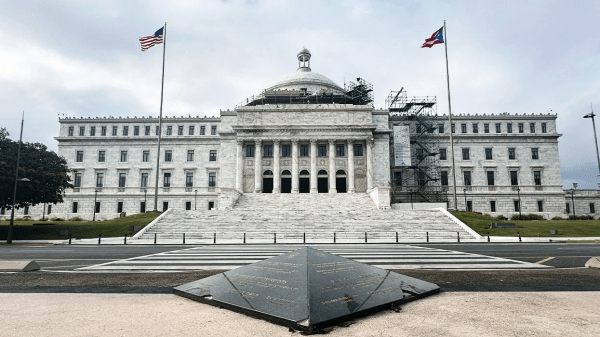
Puerto Rico’s Supreme Court has mandated that the government include an “X” gender marker on birth certificates in a ruling issued on Monday. A group of nonbinary Puerto Ricans filed the case, and the ruling allows for the representation of those who identify outside of the gender binary.

“Puerto Rico’s current Birth Certificate Policy is not supported by a rational basis, and therefore violates the Equal Protection Clause of the Fourteenth Amendment,” the justices wrote in their 19-page decision.

The court found that while the government might have a legitimate interest in maintaining an accurate record of each citizen’s sex assigned at birth, lawyers for the government “failed to articulate why this particular interest is furthered by treating nonbinary individuals differently than binary individuals.”

Puerto Rico’s Supreme Court has mandated that the government include an â€œX” gender marker on birth certificates in a ruling issued on Monday. A group of nonbinary Puerto Ricans filed the case, and the ruling allows for the representation of those who identify outside of the gender binary.

Keep up with the latest in LGBTQ+ news and politics. Sign up for The Advocate’s email newsletter.

“Puerto Rico’s current Birth Certificate Policy is not supported by a rational basis, and therefore violates the Equal Protection Clause of the Fourteenth Amendment,” the justices wrote in their 19-page decision.

The court found that while the government might have a legitimate interest in maintaining an accurate record of each citizen’s sex assigned at birth, lawyers for the government “failed to articulate why this particular interest is furthered by treating nonbinary individuals differently than binary individuals.”

RELATED: Trump’s ‘two genders’ executive order will hurt millions of Americans: study

A federal court in 2018 ordered Puerto Rico to permit transgender individuals to change their gender markers, but nonbinary individuals were left unable to accurately reflect their gender identity on official records. Six nonbinary plaintiffs filed suit in court, and the court on Monday ruled in their favor.

Puerto Rico’s Supreme Court has mandated that the government include an â€œX” gender marker on birth certificates in a ruling issued on Monday. A group of nonbinary Puerto Ricans filed the case, and the ruling allows for the representation of those who identify outside of the gender binary.

Keep up with the latest in LGBTQ+ news and politics. Sign up for The Advocate’s email newsletter.

“Puerto Rico’s current Birth Certificate Policy is not supported by a rational basis, and therefore violates the Equal Protection Clause of the Fourteenth Amendment,” the justices wrote in their 19-page decision.

The court found that while the government might have a legitimate interest in maintaining an accurate record of each citizen’s sex assigned at birth, lawyers for the government “failed to articulate why this particular interest is furthered by treating nonbinary individuals differently than binary individuals.”

RELATED: Trump’s ‘two genders’ executive order will hurt millions of Americans: study

A federal court in 2018 ordered Puerto Rico to permit transgender individuals to change their gender markers, but nonbinary individuals were left unable to accurately reflect their gender identity on official records. Six nonbinary plaintiffs filed suit in court, and the court on Monday ruled in their favor.

“Their request is simple: to be permitted to have a gender marker on their birth certificate that reflects their true gender identity, like everyone else,” the justices wrote of the plaintiffs in their decision. “Specifically, Plaintiffs request the Court to order the Demographic Registry of Puerto Rico to modify its application to amend a Puerto Rican birth certificate, to include an option to change one’s gender marker to an ‘X.’”

The justices found the government’s current birth certificate gender identification policy discriminatory and that there was no rational reason to deny the plaintiff’s request.

“The current Birth Certificate Policy of the Commonwealth of Puerto Rico arbitrarily distinguishes between binary and nonbinary individuals and subjects nonbinary individuals to disfavored treatment, without any justification for doing so,” the justices concluded in their ruling. “In such cases, it is the duty of the federal courts to intervene, to guarantee the equal protection of all persons under the law.”

Puerto Rico’s Republican Governor Jenniffer González Colón indicated that she would consult with government lawyers before determining her future course of action.

Puerto Rico Representative Jorge “Georgie” Navarro Suárez announced he was introducing a non-binding resolution condemning the ruling.

“The Federal Court’s ruling represents a challenge to the administrative and social stability of Puerto Rico,” Navarro SuĂĄrez said in a statement announcing the resolution. “While we fully respect human dignity and rights, we firmly believe that traditional gender identification based on male and female provides essential clarity and consistency in the administrative processes of the Demographic Registry.”

Navarro Suárez is a member of the New Progressive Party (PNP), which advocates for statehood with the U.S. Both of Navarro Suárez’s brothers were recently arrested on federal corruption charges. Edgardo Navarro Suárez and Ricardo Luis Suárez were arrested in April and charged with financial fraud and money laundering of federal funds meant for relief during the global economic shutdown. Prosecutors claim the two brothers and a third man attempted to bribe a bank official to help facilitate over $2 million in allegedly bogus COVID-19 relief funds.

What are the safest places for gay and trans people? See where your state ranks

*This is reported by USA Today.

As Oklahoman legislators push to restrict trans rights and overturn the 2015 Supreme Court decision legalizing gay marriage, Zane Eaves says his identity as a transgender man has put a target on his back in his home state.

One of 18,900 trans adults in Oklahoma, Eaves has received death threats as has his wife of 10 years and their two children.

“All the hatred and political stuff going on” are driving this Oklahoma lifer from the place he was born and raised, Eaves, 35, said. He has only crossed the state line three times in his life, but in recent weeks, he made the difficult decision to move his family to North Carolina to be closer to friends and allies. 

“I am just trying to stay alive and keep my marriage,” Eaves said.

Oklahoma ranks 44th in the nation on a list released Monday of the most and least welcoming states for lesbian, gay, bisexual, transgender and queer Americans.

More and more, the question of where LGBTQ+ people feel safe is one of blue vs. red, according to advocacy group Out Leadership.

LGBTQ+ equality fell across the board for the third straight year, according to Out Leadership’s State LGBTQ+ Business Climate Index shared exclusively with USA TODAY. But the sharpest declines came in Republican-led states. 

While progressive strongholds championed supportive policies and protections, conservative states elected a slate of leaders who openly oppose gay and trans rights and sponsored an unprecedented wave of anti-LGBTQ+ legislation, Out Leadership CEO and founder Todd Sears said.

So-called “Don’t Say Gay” bills, religious exemptions and other legislation tanked the rankings of 19 red states in the Out Leadership index, according to Sears. 

Today, the divide between states that roll out the welcome mat and less hospitable parts of the country is wider than ever, he said.  

The least and most welcoming LGBTQ+ states

Each year for the last seven, Out Leadership has released the State LGBTQ+ Business Climate Index to gauge the overall climate for gay and transgender people state by state, mapping out where they will face the most and the least discrimination and hardship. 

Out Leadership’s index measures the impact of state government policies and prevalent attitudes about the LGBTQ+ community, weighing factors such as support for young people and families, health access and safety, political and religious attitudes, work environment and employment and nondiscrimination protections.

The Northeast had six of the 10 highest-ranked states, while the Southeast had six of the lowest-ranked.

Massachusetts, led by the nation’s first openly lesbian governor, Democrat Maura Healey and New York, which guaranteed gender-affirming care and LGBTQ+ refugee protections, tied for first place in this year’s index, with Connecticut and New Jersey close behind.

The least LGBTQ+ friendly state was Arkansas, which ranked last for the third straight year. South Carolina, Louisiana, South Dakota and Alabama also received low scores.

The states that had the largest gains in the index were Kentucky and Michigan, which Out Leadership attributed to “pro-equality” leadership from governors Andy Beshear and Gretchen Whitmer, both Democrats. The steepest declines were in Ohio, Florida and Utah, all led by Republican governors.

Where are the safest places to live?

The Out Leadership index was created as a LGBTQ+ inclusion reference guide for business leaders. But gay and trans people soon began using it to figure out where they should – and should not – live and work, never more so than now as rights rollbacks from the Trump administration and red statehouses hit close to home.

Opposition to transgender rights was a central plank in Trump’s presidential campaign and since taking office he has signed a series of executive orders recognizing only male and female genders, keeping trans athletes out of women’s sports, banning trans people from serving in the military and restricting federal funding for gender-affirming care for trans people under age 19. 

Even states seen as safer for LGBTQ+ people have been navigating these edicts around trans athletes. Trump threatened to cut federal funding to California if a trans girl competed in a state track and field event held Saturday.

AB Hernandez, a junior from Jurupa Valley High School in Riverside County, shared first place in the high jump and triple jump and second in the long jump. She shared the awards podium with her cisgender competitors under a new rule drafted by state athletics officials days before the event to mollify critics.

Republican-led states have been in the vanguard of anti-trans legislation, causing greater geographic polarization and prompting fears among LGBTQ+ residents, even those who live in liberal cities.

Jordan McGuire, a 27-year-old gay man in North Dakota, said the years he spent living in the Deep South taught him about the repressive discrimination routinely faced by gay and genderqueer people. 

At the same time, socially progressive cities in conservative states like Fargo and Grand Forks are no longer the safe havens they once were, he said. 

Now that his fiancee is transitioning to female, the couple is exploring a move to a “sanctuary” state that will be safer for them. 

“It feels like five or 10 years ago, trans people were not under the same microscope they are now and that has definitely influenced our move,” McGuire said. “Yeah, people were prejudiced but it wasn’t a witch hunt. They weren’t looking for people in bathrooms and schools. But now things are so polarized.”

That rising anxiety was captured in a post-election survey from UCLA’s Williams Institute which found that nearly half of transgender people had already fled unsupportive communities and nearly 1 in 4 were considering uprooting their lives. 

The most frequently cited reasons for wanting to move were concerns about LGBTQ+ rights – 76% – the sociopolitical climate – 71% – anti-trans rhetoric and climate – 60% – and anti-trans laws and policies – 47%. 

LGBTQ+ Americans on the move

Interest in relocating to friendlier states is even higher today than it was after Trump’s reelection, say nonprofit workers who aid trans and gender-diverse people relocate to more liberal states with broader protections. 

So far in 2025, Rainbow Railroad in Canada has received more than 3,000 requests from LGBTQ+ people living in the United States, up more than 1,000% from the same time last year, according to communications director Timothy Chan.

Nearly all requested international relocation support. For now, Rainbow Railroad can’t aid Americans with resettlement services because of immigration restrictions, Chan said. 

TRACTION has heard from a record number of people from states as far away as Texas, Oklahoma and Arkansas with many of them reporting being threatened or feeling unsafe in their homes and neighborhoods, said Michael Woodward, the executive director of the trans-led organization in Washington state. 

Trans and gender-diverse people historically face financial hardship due to systemic oppression and discrimination, and need assistance finding jobs and housing as well as with interstate moving expenses that can run tens of thousands, Woodward said.

TRACTION used to get a few applications a week until Trump won a second term. In the two weeks following the election, “we received as many requests for assistance as we’d received in the entire life of the project thus far,” he said. 

After the inauguration, TRACTION started getting three to five applications every day. With one employee and a handful of volunteers, his organization is struggling to keep up with demand, Woodward said.

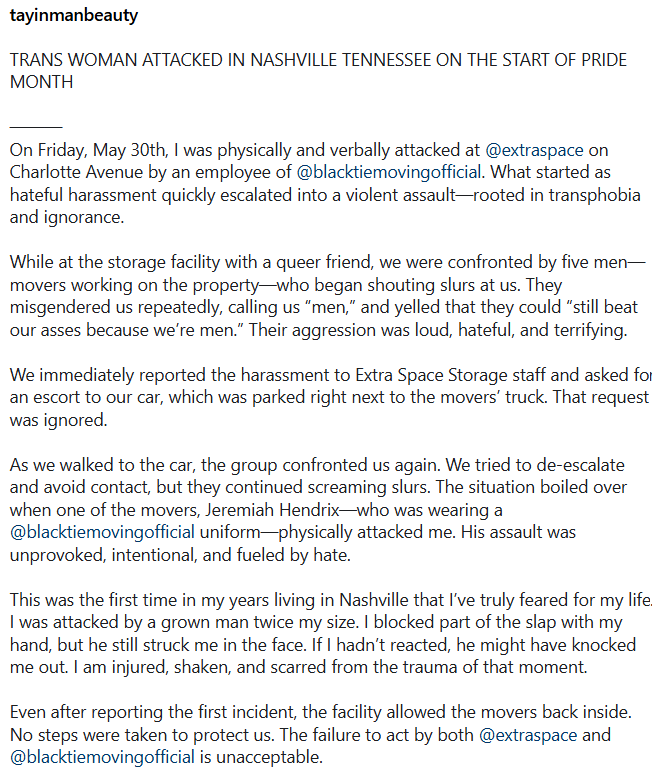
Moving company employee terminated after attacking trans woman in Nashville

*This is reported by WSMV 4. We have removed the repeated misuse of the word “allegedly” from the story.

 A Nashville moving company has confirmed to WSMV4 that it has terminated one of its employees after a recent attack against a transgender woman.

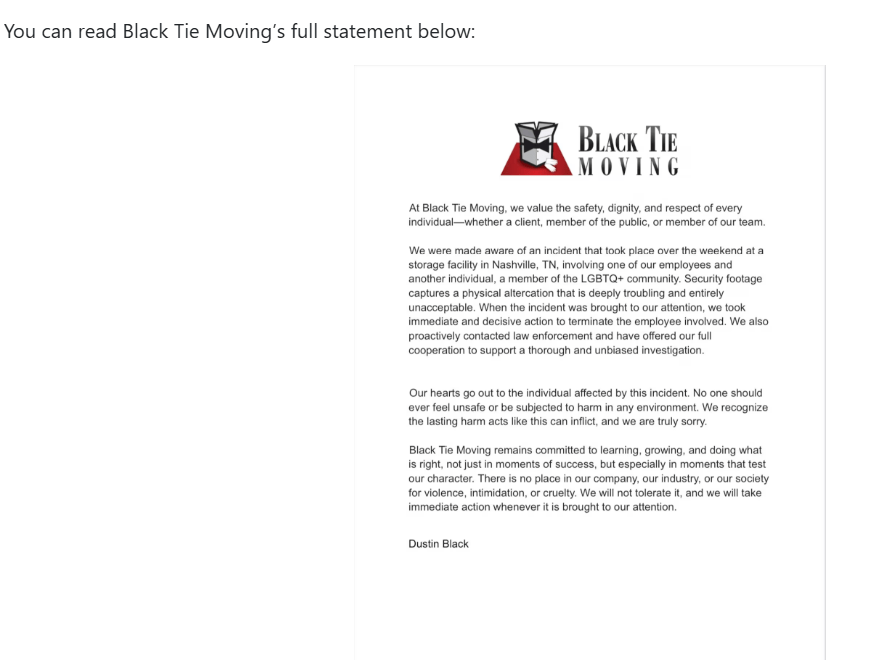
Black Tie Moving released a statement on Monday confirming the employee’s termination and condemning the assault.

“We were made aware of an incident that took place over the weekend at a storage facility in Nashville, TN, involving one of our employees and another individual, a member of the LGBTQ+ community,” Black Tie Moving said. “Security footage captures a physical altercation that is deeply troubling and entirely unacceptable.”

Black Tie Moving added that the employee was immediately terminated and the company is fully cooperating with the Metro Nashville Police Department’s investigation into the incident.

Following the incident, MNPD confirmed that its Specialized Division is investigating the attack at the Extra Space Storage facility on Charlotte Avenue on Friday.

Extra Space Storage confirmed to WSMV4 that it’s turned over the security camera footage of the incident to police for the Specialized Division’s investigation.

“While the property has security features like video surveillance, cylinder locks, and coded doors and gates, we do not have on-site security. At the time, the store was staffed by a single employee,” the facility told WSMV4.

The victim also made the following post about the assault:

A trans teen is fleeing the country after enduring years of hate for being good at track

*This is reported by LGBTQ Nation.

A teenage trans athlete is fleeing the country with her mother after experiencing severe bullying and harassment by right-wing media, fellow athletes, and politicians.

11th grader Ada Gallagher currently runs on the girls’ track team at Portland, Oregon’s McDaniel High School. She first became part of the national debate over trans athletes in 2023 when she won the state championship in the 200-meter race. A report from that time said the crowd met her victory with a chorus of boos, a sentiment that quickly spread across the country as the anti-trans right got its hands on the story.

Gallagher, who now competes with a security guard by her side, has endured years of death threats and vile insults, and she has also been a focal point of conservative media outlets.

Most recently, a video of Gallagher winning a March 19 400-meter race in a landslide was shared widely among conservatives. She also won the 200-meter race at the same meet.

Prominent anti-trans activist Riley Gaines – who has built an entire career off of tying for 5th place with a trans athlete three years ago – shared the video on X and misgendered Gallagher, writing, “Does he have no shame? Do his PARENTS have no shame?”

Gallagher’s mother, Carolyn, was not able to celebrate her daughter’s win like any mother should, as she knew the hate it would bring. She told Oregon Live she thought, “I know the optics of this are going to be horrible.”

But she wished people understood that the meet consisted of a total of three schools and that neither of the other two had strong competitors in the race Gallagher won so easily. She also wished people knew that, despite what Fox News claimed, Gallagher did not set a season record in the 400-meter race and actually ran a massive five seconds slower than she did in the same event at state the previous year, where she got second place.

For as long as she could, Gallagher tried to rise above it all, to keep her head in the game and just do what she loves: run.

But it has finally become too much.

“When they call me a predator, that’s the worst one. I hate it so much,” Gallagher told Oregon Live.

Only six days after Gallagher’s victory in March, the U.S. Department of Education’s Office for Civil Rights began investigating Portland Public Schools and the Oregon School Activities Association (OSAA), alleging the organizations are violating Title IX by allowing trans athletes to participate in sports on the teams that align with their gender (OSAA policy states it “endeavors to allow students to participate for the athletic or activity program of their consistently asserted gender identity while providing a fair and safe environment for all students”).

A statement from Portland Public Schools Superintendent Kimberlee Armstrong in the wake of the lawsuit expressed a dedication to protecting vulnerable students.

“I stand firm in our legal responsibilities, and I deeply value every student’s right to be treated with dignity, safety, and respect. PPS is in full compliance with Oregon state law, which may differ from federal guidance. We are actively working with our legal and state partners to navigate this complex legal landscape.”

“While I am limited in what I can share at this time due to the sensitive nature of the matter and our duty to protect student privacy, I want to be clear: my commitment—and our district’s commitment—to doing what’s right for all students, especially those most vulnerable, remains unwavering.”

But Gallagher and her mother hope all the noise will quiet down once they leave for Canada, where Carolyn was born and raised, despite the fact that Gallagher is devastated to leave her team, her friends, and especially, her girlfriend.

As Oregon Live states, Gallagher “joined the track team last spring not because she believed she would win, not out of some desire to manipulate the system and compete where she could win, but because her friends urged her to. Because they wanted her there.”

Now the team captain, she says the team is “the only place where people really know me.”

“I think people think I want to be this spotlight for trans people,” she said. “Not at all. I just like running.”

While competing is what also leads her to endure all this hate, she said it all goes away during the 23 or so seconds she is running.

“You hear the feet around you hit the ground,” she said. “Senses are heightened. There’s nothing to think about, it’s just track.”

Democrats lash out as Texas Legislature bans school clubs that support gay teens

*This is reported by the Texas Tribune

Democrats took to the floor of the Texas House on Saturday to label a ban on clubs that support gay teens the work of “monsters” and to say the ban endangers children and strips them of their dignity.

The Democratic representatives grew emotional in opposition to a bill that would ban K-12 student clubs focused on sexuality and gender identity.

Senate Bill 12, authored by Sen. Brandon Creighton, won final legislative passage Saturday after lawmakers in both chambers adopted the conference committee reports that specifically clarified that schools will be banned from authorizing or sponsoring student clubs based on sexual orientation or gender identity.

Backers proclaimed that the bill enshrines a parent’s rights and puts the parent not just at the table, but at the head of the table where the child’s best interests are decided. They also targeted diversity, equity and inclusion (DEI) policies, claiming that they project ideologies on students and put too much focus on race, sexuality and gender identity instead of the quality of education.

Rep. Gene Wu, D-Houston, emphasized that these clubs exist because of a long history of oppression against the LGBTQ+ community. He warned against demonizing students and teachers for discussing gender and sexuality.

“The real monsters are not kids trying to figure out who they are,” Wu said during the House discussion. “The monsters are not the teachers who love them and encourage them and support them. They are not the books that provide them with some amount of comfort and information. The real monsters are here.”

Lawmakers shared personal stories about LGBTQ+ youth. Rep. Rafael AnchĂ­a said his daughter was a vice president of a pride club at her school. He stressed that these clubs “are no more about sex than 4-H or ROTC or the basketball team.”

“It wasn’t a sex club,” AnchĂ­a said. “They’d get together and they’d watch movies. They’d color. They’d go to musicals. It was about a kid who felt weird who found her people and everything about it was good. I don’t know why grown-ups in this body are so triggered with my daughter getting together with her classmates in a school-sponsored activity.”

Anchía also told the Texas Tribune he “didn’t sign up for five anti-LGBT bills this session.”

Rep. Jolanda Jones, D-Houston, shared her experience as a Black woman and a lesbian, saying she didn’t come out until the age of 50 because she knew “the world wasn’t safe.” She warned that banning LGBTQ+ clubs could worsen bullying.

“And we have the nerve to say that we care about mental health,” Jones said. “We’ve passed bill after bill about access to care, about youth suicide, about prevention and treatment. But this bill makes kids sicker, sadder, more alone. This bill doesn’t protect children. It endangers them. It doesn’t give parents more rights. It strips children of their dignity.”

SB 12 is often referred to as the “Parental Bill of Rights” because it claims to give parents more control over their children’s schools. But Rep. Erin Zwiener, D-Driftwood, addressed those who are “afraid that your kids or your grandkids might grow up queer,” warning that the bill could harm family relationships.

“Getting silence in schools from the LGBTQ community, which is what this bill is designed to do, will not stop your kids from being gay,” Zwiener said. “It will just make them afraid to come out. It will make them afraid to live their lives as their full selves. It will make them afraid to tell you when they figure out that they’re LGBTQ and it might damage your relationship with them forever.”

Rep. Nicole Collier, D-Fort Worth, argued that allowing religious organizations in schools but banning “clubs that allow students to be who they are, is a double standard that flies in the face of the principles you say you support.”

“An LGBTQ person can’t change who they are any more than the fact that I can’t change that I’m Black,” Collier said. “What you’re saying to students today is that you will be accepted as long as you are who we say you should be.”

If signed by the governor, the bill will become law on Sept. 1.

Texas Senate approves bill strictly defining man and woman based on reproductive organs

*This is reported by The Hill.

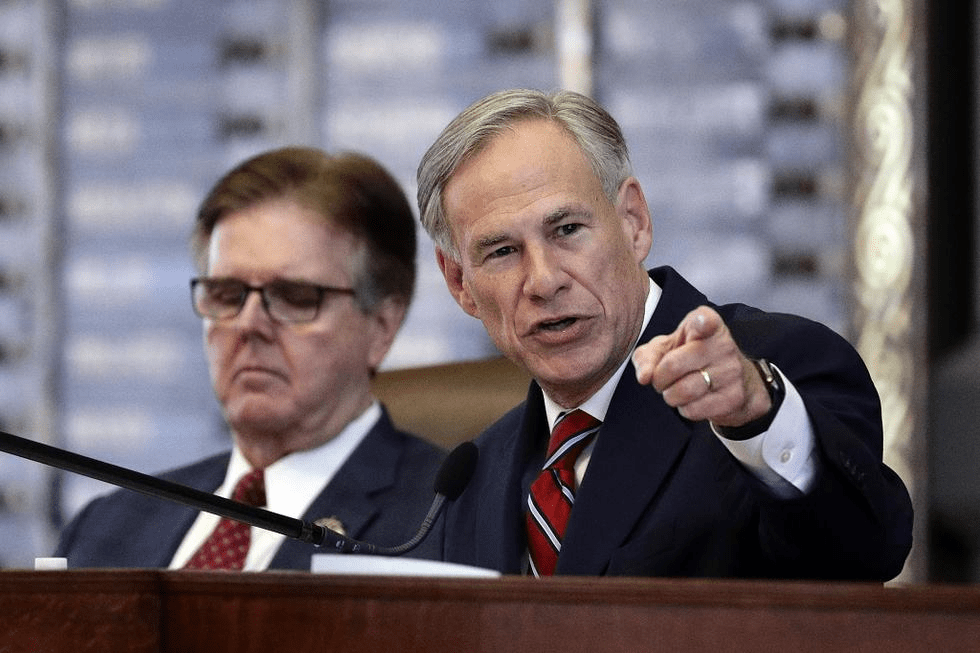
The Texas Senate has sent legislation to Gov. Greg Abbott (R) that would strictly define genders across state law based on male and female reproductive organs — potentially creating new hurdles for transgender and intersex Texans whose gender identity would revert to the sex they were assigned at birth in state records.

Abbott spokesman Andrew Mahaleris confirmed to The Hill on Wednesday that the governor plans to approve the measure.

“The State of Texas recognizes only two sexes — male and female,” Mahaleris said. “Governor Abbott looks forward to reaffirming this universal truth and signing HB 229 into law.”

Supporters of the legislation said that it follows a directive Abbot issued earlier this year that state government in “Texas recognizes only two sexes — male and female.”

Abbott cited in the directive an executive order that President Trump signed shortly after his January inauguration that designates male and female as the only sexes recognized by the federal government and on a biological basis.

“All Texas agencies must ensure that agency rules, internal policies, employment practices, and other actions comply with the law and the biological reality that there are only two sexes—male and female,” Abbott wrote in his January letter to state agencies.

The latest Senate-approved bill, dubbed the “Women’s Bill of Rights,” defines sex as “an individual’s biological sex, either male or female.” Under the legislation, a woman or female is an “individual whose biological reproductive system is developed to produce ova” and a male or man is “someone whose reproductive system is developed to fertilize the ova of a female.”

Additionally, it defines “mother” as “a parent of the female sex.”

Critics of the measure argue that the bill oversimplifies sex, gender and a broad spectrum of personal experiences.

“If a law forces non-binary Texans, who are real people, into categories that don’t reflect their lived experiences or identities 
 that would actually become discrimination in practice,” state Sen. JosĂ© MenĂ©ndez (D) said during the floor debate on the bill before its passage. “That’s a concern that I have.”

State Sen. Mayes Middleton (R), who sponsored the bill, said that it would preserve women’s designated spaces, like restrooms and prisons, based on “biological reality.” He noted that it carries no criminal or civil penalties.

“For our entire history we never had to define this because common sense dictated we didn’t, but unfortunately, that seems to have changed,” he said in the floor debate.

Abbott has previously pushed back against past criticism for signing laws that target LGBTQ people. He approved legislation in 2023 and 2021 to bar transgender athletes from competing in women’s and girls sports in Texas schools and colleges.

Trans man says he was detained after using women’s restroom in South Carolina

TRENDING

LGBTQ+ VoicesPoliticsTransgenderVideoBecome a MemberScroll To Top

By continuing to use our site, you agree to our Private Policy and Terms of Use.

Accept

News

Trans man says he was detained after using women’s restroom in South Carolina

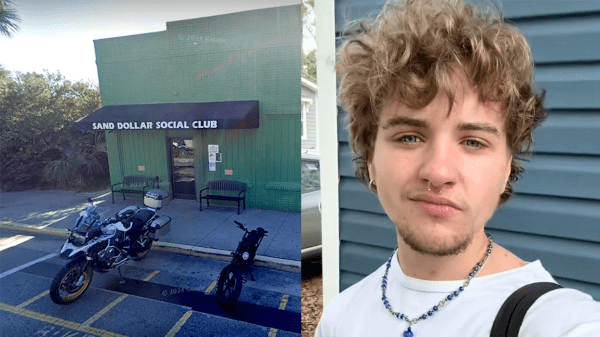
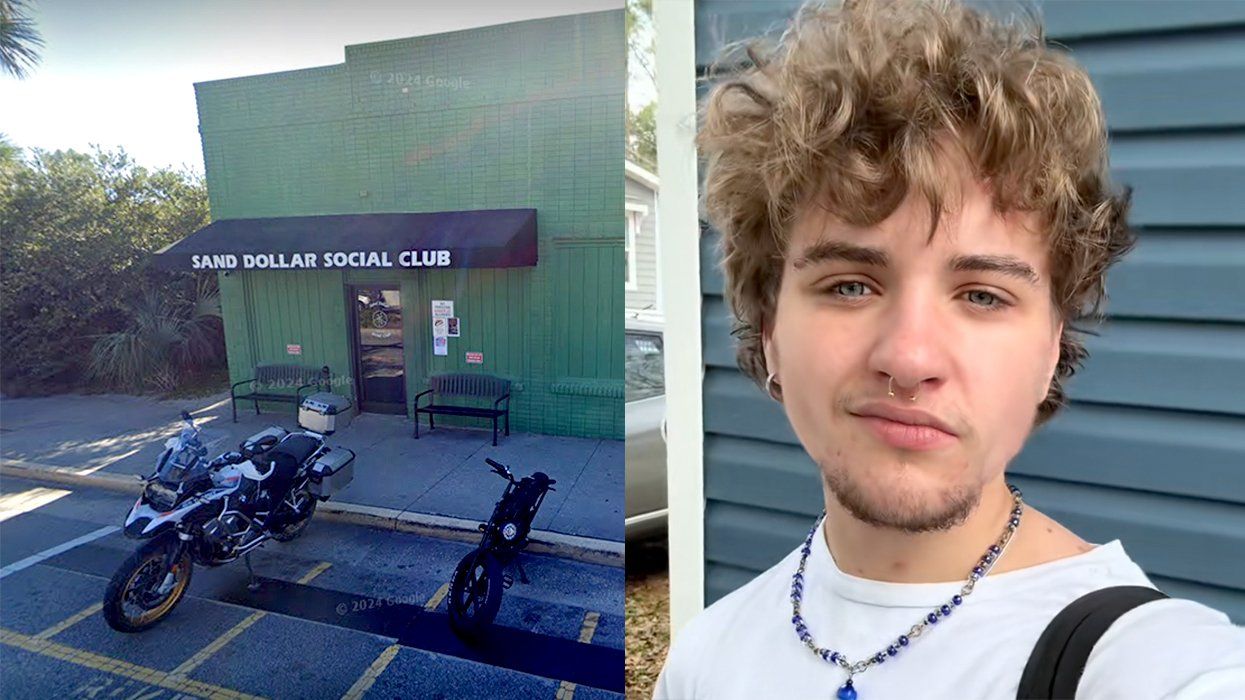
Sand Dollar Social Club Folly Beach South Carolina alongside footage still of trans man Luca Strobel

©2025 Google Maps Data; footage still via tiktok @fulltimecowboy

Sand Dollar Social Club (left) and Luca Strobel

Anti-trans lawmakers want to force trans men to use the women’s restroom. Here’s what happened when one did.

*This is reported by The Advocate.

A 25-year-old South Carolina trans man has gone viral on TikTok, saying he was accosted in a bar by staff, called slurs, and detained by police after using the women’s restroom.

Luca Strobel, who posts under the Tiktok handle @FulltimeCowboy, said he had gone to pick up his friend, Caroline Frady, also 25, at Sand Dollar Social Club in Folly Beach on the night of Friday, May 16, to be her “sober ride” home.

After a lengthy drive to the bar, Strobel said he stepped inside to use the men’s room. However, there were no stalls—only urinals, rendering it inaccessible to him as a trans man.

At first, an employee warned both Strobel and his friend against entering the bathroom of the “opposite” sex, but after a brief back-and-forth, Strobel said he believed he had permission to do so. He also said he and Frady were the only two people in the restroom, which Frady confirmed to Erin in the Morning.

That’s when a man who said he was the bar owner burst into the women’s room, peering over the stall to look at Strobel as he used the restroom.

“They’re looking over the top of the stall at me without my clothes on,” Strobel said in the video. “They can fully see me naked other than me having my shirt on, and they just start screaming that there’s ‘a man’ in here.”

He said the owner and employee ejected him and his friend from the bar — grabbing and pushing them out as they reportedly called Strobel anti-trans slurs. The police were waiting at the door, Strobel said.

The officer cuffed him “so tight that I can’t even feel my fingers,” Strobel said. “I still have a bruise on my knuckle.” Meanwhile, his arresting officer allegedly kept calling him a “little girl.”

“We didn’t get booked, but we did get cuffed, and when we got to the station, we were asking a bunch of questions that they refused to answer,” Strobel said. “They just kept saying, ‘Take it up in court, take it up in court, take it up in court.’”

Sand Dollar Social Club could not be reached for comment. The Folly Beach Public Safety Department did not respond to a request for comment.

In a follow-up video, Strobel said he was released on $500 bond, hit with a trespass notice barring him from entering Sand Dollar Social Club, and issued a ticket for public intoxication and disorderly conduct. Frady said she received the same.

In an interview with Erin in the Morning, Strobel emphasized that he had not consumed a single drink — he was there for the sole purpose of being the designated driver. He says officers did not breathalyze him.

There is no state law in South Carolina preventing a trans man (or any man) from using the women’s room in public accommodations, such as a bar. However, there has been an avalanche of anti-trans bills nationwide seeking such mandates, including in South Carolina, where lawmakers enacted a version of this policy targeting schools in 2024, and re-introduced it in 2025.

In other words, Strobel was using the bathroom that many conservative lawmakers and anti-trans pundits want to force him to use — and he got arrested anyway, seemingly because of the panic surrounding gendered bathrooms.

This kind of harassment is no stranger to trans and gender nonconforming people—in April, a trans girl in Florida was arrested for using the women’s bathroom in an act of protest against that state’s anti-trans bathroom bill. She washed her hands in the sink before being escorted out by police. In February, cisgender lesbian in Arizona made headlines after documenting her own experience having police interrogate her gender while she was using a women’s restroom.

Erin in the Morning’s 2025 anti-trans legislation risk map designates South Carolina as a “high risk” state to travel to. Last year, Republican Gov. Henry McMaster signed a trans-affirming health care ban for minors into law.

Strobel says he believes the bar staff knew he was trans because his shirt revealed his top surgery scars. Nonetheless, he said he refuses to “go stealth,” or hide his trans identity, because he believes that trans visibility in the South is important.

“Of course my safety is important to me, but at the end of the day, I want people to know that we exist,” Strobel told Erin in the Morning. “I want people to know that it’s OK, that just because you live here doesn’t mean that you can’t be who you are.”

On the other hand, Strobel said this recent incident has made him feel that he may no longer have a choice; that the risk of further transphobic violence is too great to remain. Strobel said he is raising funds to relocate somewhere that he can finally, after all these years, not just feel authentic, but be safe.

Blog at WordPress.com.

Up ↑