Kentucky’s legislature has overridden Gov. Andy Beshear’s veto of a bill that allows conversion therapy to resume in the state and that bans Medicaid funds from being used for gender-affirming care, including for adults. Beshear also allowed a bill banning incarcerated people from receiving or continuing to receive publicly funded gender-affirming care to pass into law without his signature.
On Wednesday, the Kentucky House and Senate, which are both controlled by Republicans, voted to override Beshear’s veto of House Bill 495, per the Lexington Herald-Leader. The bill reverses the governor’s September 2024 executive order, which banned so-called conversion therapy from being practiced on youth in the state. Though HB 495 was originally only meant to roll back the ban on the harmful, discredited practice, the bill was additionally amended to add a ban on the use of Medicaid funds for gender-affirming care for trans adults, per the Herald-Leader. HB 495 has an emergency clause, meaning that it takes effect immediately. According to the Kentucky Lantern, the House voted to override the veto 78-20, and the Senate voted 31-6.
However, Beshear did not veto Senate Bill 2, which bans gender-affirming care for incarcerated trans people. At a press conference in December, Beshear stated that “convicted felons do not have the right to have any and all medical surgeries paid for entirely by tax dollars, especially when it would exceed the type of coverage available to law-abiding citizens in the private sector,” according to The Hill. As the publication noted, though, the state has never provided a gender-affirming surgery for an incarcerated person. Even so, gender-affirming care, including surgery, is medically necessary. As the ACLU’s Chase Strangio told Them in September, “Courts have consistently held that blanket denials of medical care, including medical treatment related to gender dysphoria, are unconstitutional,” since the denial of that care could violate the Eighth Amendment, which prohibits cruel and unusual punishment.
According to the Kentucky Lantern, there are only 67 trans people incarcerated in Kentucky prisons, all of whom will be forced to stop gender-affirming hormone therapy if that care is paid for with public funds. At a February hearing, Louisville psychologist Jacks Gilles testified against the bill, stating that stopping that care “will result in negative outcomes, including increased anxiety, disturbances in social and familial relationships, depression, suicidality and death,” according to the Lantern. “Gender-affirming medical care is not experimental, it’s not elective, and it’s not cosmetic,” Gilles said.
Beshear has previously been hailed as an outspoken advocate for the trans community. In a November 2024 op-ed for the New York Times, the governor pleaded with his fellow Democrats to not scapegoat trans people for the party’s loss. Though the legislature overrode his veto, in 2023 Beshear did attempt to put a stop to a wide-sweeping anti trans bill that banned minors from receiving gender-affirming care, prohibited trans kids from using the bathrooms that align with their identities at school, and banned discussion of LGBTQ+ topics in elementary schools.
In a statement posted to Facebook, Chris Hartman, the executive director of statewide LGBTQ+ advocacy organization Fairness Campaign, called the passage of the bills “a sad day in Kentucky.”
“Two anti-LGBTQ+ bills will become law with devastating consequences for our community,” he said, calling both bills “cruel” and that they “have no place in our Commonwealth.”
Finnish Prime Minister Petteri Orpo (NCP) has told the Uutissuomalainen news group that he considers it unlikely a proposal to ban conversion therapy will move forward during his government’s term in office.
Conversion therapy is the practice of attempting to turn members of sexual minorities into heterosexuals using a variety of different methods. The practice is usually carried out by priests, pastoral care workers, youth workers and others in some conservative religious communities.
Among Finland’s coalition government’s parties, the ban was supported by the NCP and the Swedish People’s Party, while it was opposed by the Finns Party and the Christian Democrats.
“Since there is no government programme document about the matter, and government parties do not share a unified position about banning conversion therapy, I do not believe the matter will progress during this governmental term,” Orpo told Uutissuomalainen, according to the news group.
Justice Minister Leena Meri (Finns) said on Friday that the justice ministry does not have time to prepare legislation to ban conversion therapy, as there is a long list of projects listed in the government programme that are waiting to move forward.
Ohio’s “Parents’ Bill of Rights” won’t go into effect for two more weeks, but House Republicans are already proposing amendments, including one that would penalize districts that used students’ chosen names and pronouns without parent permission.
Reps. Jonathan Newman (R-Troy) and Josh Williams (R-Sylvania Township) introduced House Bill 190 on Monday, which would require public schools to have parent permission to refer to a student by a name or pronoun that differs from what is listed on their birth certificate. Schools that violate the “Given Name Act” would be denied state funding and open themselves to lawsuits.
“It’s to make sure that parents can exercise, reconstitute the right to control the upbringing of their children, even inside of school buildings,” Williams said.
The bill also bans public school employees or contractors from requiring students or staff to respect students’ chosen names or pronouns. Even with parent permission, schools would not be allowed to subject staff or students to “adverse action” for declining to use a student’s preferred name and pronouns.
Although students older than 18 could personally request to be addressed differently under HB 190, teachers could not. The proposed bill would ban school employees from sharing their pronouns or titles if they differ from what is listed on the employee’s personal birth certificate. Williams said requiring students to use teachers’ pronouns makes young students affirm that genders can be changed.
After Florida enacted a similar ban in 2023, the state faced lawsuits from transgender and gender variant teachers, including high school teacher Katie Wood. A federal judge issued a preliminary injunction that said the state’s ban on preferred pronouns violated Wood’s First Amendment rights, and a federal court heard oral arguments in October 2024. However, the court withdrew its interest in the case on Feb. 26, before a ruling was issued.
The law would not apply to derivatives, or generally accepted nicknames, of birth names. For instance, if director Spike Lee were an Ohio student, he could be called Shelton or Shel, from his given name Shelton Jackson Lee. However, he would need written permission to be called Spike under HB 190.
“We’ve got big problems and issues to deal with in our schools, in higher education,” Ohio House Minority Leader Rep. Allison Russo (D-Upper Arlington) said. “What we’re seeing and this sort of going back to pronouns and attacking diversity, equity and inclusion, it’s a distraction.”
The Given Name Act also establishes a complaint system through the Department of Education and Workforce. If the department determines a school district violated the law, the state would then withhold 10% of the school’s funding every month until the state determined they were now compliant. The bill also allows families to sue for monetary relief if a district or staff member knowingly violates it.
“There’s always discretionary funds that the Supreme Court has noted that we provide to school districts that we’re not constitutionally required to provide,” Williams said. “So that’s a funding mechanism that if school districts don’t want to comply with state law, there has to be some repercussions.”
HB 190 would update the Parents’ Bill of Rights, which will go into effect on April 9 and already requires schools to alert parents and guardians if a student requests to go by a name or pronoun that is different from what was assigned at birth.
Columbus City Schools students with preferred names in the district system had their names reverted back to what is on their birth certificate.
This mainly affected transgender and nonbinary students, and they were not notified that this was happening.
Students and teachers were caught off guard on March 19 when attendance was called and they realized preferred names were changed in the district’s system, called Infinite Campus.
“He found out about the rescinded name change policy at school,” one parent with a transgender son said. “His fourth-period teacher advised him to go to the office because his preferred name was not listed in Infinite Campus. My son started to go to the office and in a panic ran to the bathroom to call me at work.”
“To have that happen on such a grand scale and to not even see it coming, I don’t think that there are any words to describe the feelings that folks had when that happened,” said Izetta Thomas, the lead organizer with the Columbus Education Justice Coalition.
Thomas said she has been talking to parents and students since the day of the change.
“Those names that were in the system were actually there with parent consent and permission, because there was a form that parents had to fill out for that change to even be in the system at all,” Thomas said.
The parent said the past few weeks since the name changes have been long and difficult for their son and their family.
“My son has not physically been back to school since March 19,” the parent said. “For his safety, we unenrolled from his previous school. Now, his educational opportunities have been taken from him.”
Columbus Schools Superintendent Dr. Angela Chapman sent out a letter to students, parents and staff on Friday acknowledging that no warning was given. In the letter, Chapman said in part, “We did not provide prior notice this was occurring, nor did we ensure support was in place to prioritize the emotional well-being of everyone impacted.”
Chapman also apologized for how the district handled this situation.
The letter cited recent Ohio laws like the bathroom bill and the Parents’ Bill of Rights as reason why the names were changed, but Thomas said that none of these laws require school districts to revert trans students’ names.
“A lot of the information that we’ve been getting from folks at the district is that it was anticipatory,” Thomas said. “An apology is not enough. An apology is not accountability, and that’s what we’re looking for, is accountability.”
The parent did say Chapman called them personally to apologize, but they said she offered little in solutions.
Thomas said a number of people from the Columbus Education Justice Coalition will be at the next Columbus Board of Education meeting to show their support for impacted students and families.
Scrolling through Facebook is sometimes repetitive, thanks to an algorithm that feeds you what Mark Zuckerberg thinks is best for you. Sometimes, you get pleasantly surprised by pages that seemingly post things out of nowhere you would not expect.
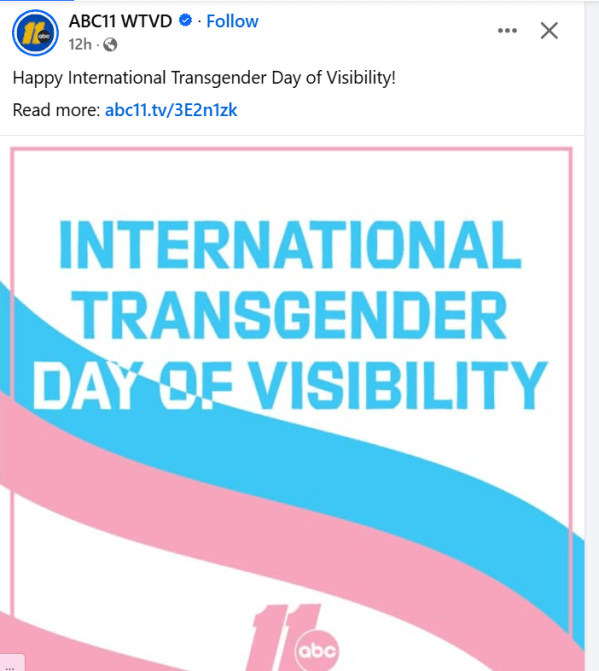
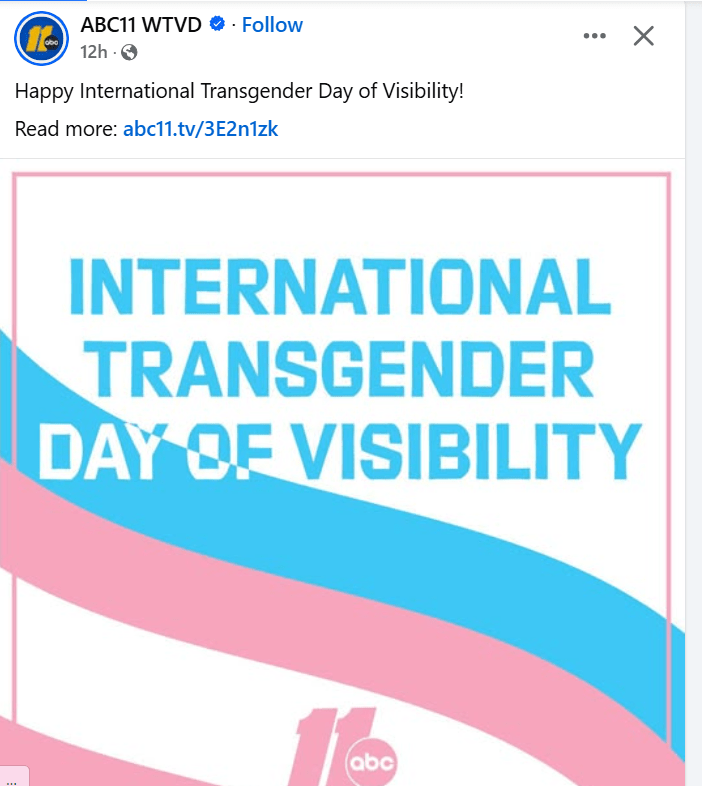
March 31 is the International Transgender Day of Visibility. You might expect the usual suspects, like HRC or your local LGBTQ organization to acknowledge it– maybe even hold a vigil. But would you expect a mainstream TV channel to post about it? And not just for the news of the day itself?
Local Raleigh North Carolina ABC affiliate channel 11 WTVD posted a Facebook message and photo wishing everyone a happy International Transgender Day of Visibility. The post then oddly links to a cushy story about a troupe of trans and nonbinary folks who are running an improv show in Hollywood at the Upright Citizens Brigade. Personally, I would have preferred a story about transgender folks in North Carolina and what they go through on a daily basis. But, we got something, dammit.
As one would imagine, the post has also earned over 11,000 comments and 16,000+ reactions. They go both directions and if you would like to read them you can on their Facebook post. Showing support as you read by clicking like or love, and a positive comment, would also be appreciated by many.
Texas Attorney General Ken Paxton announced in a press release today (Monday, March 31) that his office has filed a legal petition to “conduct depositions on key Dallas Independent School District officials as part of an ongoing investigation to ensure that the district is not violating Texas law by permitting biological males to participate in girls’ sports.”
In February, Paxton demanded that Dallas ISD turn over “extensive records … related to alarming evidence that the District had implemented an unwritten policy of encouraging students to alter their birth certificates to play sports in violation of the Texas law prohibiting a student from competing in interscholastic athletic competitions designated for the opposite biological sex.”
“Biological sex,” by the way, is the catchphrase that certain political elements living on the extreme right of the political spectrum to give a scientific-sounding cover for their basic transphobia. As Psychology Today notes: “What is biological sex? It seems like a question with an obvious answer: male and female, of course. You might point to internal or external sex organs, or sex chromosomes (XX for females, XY for males), or genes (such as SRY, the maestro responsible for kicking off male development).
“These answers are only part of the story — and they work well enough for most humans. But for all humans? Not quite. And when it comes to the rest of the biological world, those explanations crumble like sandcastles under the tide of nature’s diversity.”
But back to Paxton’s attack of the day: The AG’s press release says the list of individuals he intends to depose includes Dallas ISD Superintendent Stephanie Elizalde, LGBT Youth Program Coordinator Mahoganie Gaston and the members of the Board of Trustees.
Paxton claims that “Gaston has been filmed telling a parent that a male student would be allowed to participate in girls’ sports if the parent changed the birth certificate of their son to ‘female,’” that the district “find[s] the loopholes in everything” and that she is “willing to go to jail for defying Texas law.”
A statement attributed to Paxton in the press release declares, “School districts must follow the law, keep our children safe and end these insane ‘gender theory’ policies that ignore reality and encourage illegal actions. ISD officials who have participated in this madness will be held accountable.
“The systematic effort by Dallas ISD officials to circumvent Texas law will be exposed and stopped.”
Dallas Voice has reached out to Dallas ISD officials for comment.
(P.S. This press release came from the AG’s office on the same day Paxton sent a press release explaining how his office is going to make certain local district attorneys report to him so he can make sure they are doing things his way. We’re still waiting on a comment from Dallas District Attorney John Creuzot’s office for some sort of official response, but a quick Google search indicates that Ken Paxton has no supervisory authority of local DAs who, by the way, are themselves public officials elected by the public, same as Paxton.)
Trinidad and Tobago has reinstated its ban on homosexuality, which was lifted by the Caribbean nation’s High Court in 2018.
That year, the High Court in the Christian-majority nation ruled in a lawsuit brought by LGBTQ+ activist Jason Jones that Sections 13 and 16 of the Sexual Offenses Act are “irrational and illegal” because they violate the rights to privacy and freedom of expression.
“What I think the judge pointed out was ‘here every creed and race find an equal place,’ and I think we must all come together now and embrace each other in true love and respect,” Jones said at the time.
But on March 25, the Court of Appeals reversed that decision, saying that only Parliament can overturn the country’s ban on homosexuality. The Court of Appeals also reduced the maximum sentence associated with homosexuality to five years in prison. Prior to 2018, the maximum penalty was 25 years in prison.
“Judges cannot change the law,” Tuesday’s ruling states. “We give effect to Parliament’s intention…. It is, therefore, left to Parliament to repeal the criminalization of buggery and the related offense of gross indecency by legislation. It is an emotive issue which engages vibrant discussion in the court of public opinion.”
“Parliament is ultimately responsible for ensuring that laws reflect the evolving standards of a democratic society. That is their role and function. Any provisions found to be unconstitutional must be taken from the statute books by Parliament through legislative reform and not by judicial overreach.”
Jones spoke out against the Court of Appeals decision.
“We are talking about the rights of some 100,000 LGBTQIA+ citizens in [Trinidad and Tobago],” he told Trinidad and Tobago Newsday. “Why are we spending all this money and retaining these laws?”
“The modernization of our democracy is at stake here, and this is the beginning of this modernization.”
In the original 2018 case, religious conservatives argued that God’s wrath would be visited on Trinidad and Tobago if the anti-homosexuality laws were overturned. Conservatives argued that legalizing homosexuality would violate their religious beliefs.
The judge said the ruling “is not an assessment or denial of the religious beliefs of anyone.”
Christian conservatives also told the press that they’re worried about “homosexual rights trumping heterosexual rights.”
Utah became the first state to prohibit flying LGBTQ+ pride flags at schools and all government buildings after the Republican governor announced he was allowing a ban on unsanctioned flag displays to become law without his signature.
Gov. Spencer Cox, who made the announcement late Thursday night, said he continues to have serious concerns with the policy but chose not to reject it because his veto would likely be overridden by the Republican-controlled Legislature.
Starting May 7, state or local government buildings will be fined $500 a day for flying any flag other than the United States flag, the Utah state flag, military flags or a short list of others approved by lawmakers. Political flags supporting a certain candidate or party, such as President Donald Trump’s signature “Make America Great Again” flags, are not allowed.
The ban also prohibits teachers from hanging any restricted flag in their classroom.
The new law could stoke conflict between the state and its largest city. City buildings in liberal Salt Lake City typically honor Pride Month each June by displaying flags that celebrate its large LGBTQ+ population. Local leaders have illuminated the Salt Lake City and County Building in rainbow lights to protest the flag ban each night since the Legislature sent it to Cox’s desk.
Andrew Wittenberg, a spokesperson for Salt Lake City Mayor Erin Mendenhall’s office, said their attorneys are evaluating the law and the capital city does not yet have information on what it will do once the law takes effect.
The bill’s Republican sponsors, Rep. Trevor Lee and Sen. Dan McCay, said it’s meant to encourage “political neutrality” from teachers and other government employees. Opponents argued it aims to erase LGBTQ+ expression and take authority away from cities and towns that don’t align politically with the Republican Legislature.
In a letter to legislative leaders explaining his decision, Cox said he agreed with the “underlying intent” of the bill to make classrooms politically neutral but thought it went too far in regulating local governments. He also noted that by focusing narrowly on flags, the law does not prevent other political displays such as posters or lighting.
“To our LGBTQ community, I know that recent legislation has been difficult,” Cox said. “Politics can be a bit of a blood sport at times and I know we’ve had our disagreements. I want you to know that I love and appreciate you and I am grateful that you are part of our state. I know these words may ring hollow to many of you, but please know that I mean them sincerely.”
Cox’s decision came hours after the Sundance Film Festival announced it was leaving its home of four decades in Park City, Utah, for Boulder, Colorado. The flag bill created eleventh-hour tensions as some residents worried it would push the nation’s premier independent film festival out of state. Festival leaders said state politics ultimately did not influence their move from conservative Utah to liberal Colorado. They did, however. make “ethos and equity values” one of their criteria in a nationwide search for a new home and referred to Boulder in their announcement as a “welcoming environment.”
Utah’s flag law goes further than one signed last week in Idaho that only applies to schools. But Idaho Republicans are also advancing a separate bill to ban government buildings from displaying certain flags.
Florida lawmakers have advanced a proposal to ban pride flags and others that represent political viewpoints in schools and public buildings after similar measures failed in the past two legislative sessions. Some federal agencies, including the Department of Veterans Affairs, also have limited which flags can fly at their facilities.
Other flags permitted under the Utah law include Olympic and Paralympic flags, official college or university flags, tribal flags and historic versions of other approved flags that might be used for educational purposes.
The first nine residents of Mary’s House For Older Adults, D.C.’s first LGBTQ home for seniors, are expected to move into the newly built group home within the next week or two, according to Mary’s House founder and CEO Imani Woody.
Located at 401 Anacostia Rd., S.E. in the city’s Fort Dupont neighborhood, a write-up on its website says the house includes 15 single-occupancy residential units and more than 5,000 square feet of shared communal living space.
Woody said construction of the three-story house was completed in January and leases have been obtained by the first nine of the 15 residents, with the remaining six still available for interested seniors. She points out that Mary’s House, which is a nonprofit operation, is not an assisted living facility.
A large sign hanging near the top of the front wall of the Mary’s House building says, “Now Leasing! Single Bedroom Communal Living—LGBTQ+ Affirming Housing for Adults 62+”
The sign also includes the Mary’s House phone number and website address that Woody said interested seniors or those who may know a senior who would be interested should use to contact the LGBTQ supportive seniors residence.
Woody said each of the individual units or suites includes a sleeping area, living room, bathroom, and kitchenette with a sink, microwave, and refrigerator but no stove. According to the Mary’s House website, the shared communal areas of the house include a “fully equipped kitchen, separate dining area and living room.”
It says the communal area also includes a computer room, arts and crafts room, an exercise room, laundry facilities, community meeting space for gatherings, a “tranquil quiet room for relaxation,” and an outdoor terrace with seating.
Woody said the monthly rent for Mary’s House residents, depending on their income, is currently set at $812 or $886.
“Our mission extends beyond providing housing,” a statement on the Mary’s House website says. “We strive to build welcoming communities that address affordability, accessibility, and the unique needs of LGBTQ/SGL [Same Gender Loving] older adults.”
The statement adds, “Through health and wellness programs, connections to community services, and advocacy efforts, Mary’s House for Older Adults endeavors to ensure that all elders, regardless of identity, can enjoy fulfilling and secure lives in their golden years.”
Woody said a ribbon-cutting ceremony to celebrate the opening, to be led by D.C. Mayor Muriel Bowser is planned for early May, with a specific date to be announced soon.
Further information about Mary’s House, including a lease application, can be obtained at MarysHouseDC.org or at 240-972-2500.
The University of Michigan is immediately shutting down two offices and an effort dedicated to diversity, equity and inclusion, and shifting the resources to other student programs, university officials said Thursday, after the Trump administration had threatened to cut off funding.
The email announcement by top UM officials, including President Santa Ono, said UM is closing its Office of Diversity, Equity and Inclusion, the Office for Health Equity and Inclusion as well as discontinuing its DEI 2.0 Strategic Plan. The moves came as the university has taken other actions, such as ending diversity statements in faculty hiring, in a bid to stop “litmus tests” that restrict the diversity of thought.
It is unclear how many people are employed at UM in DEI work, but the conservative Heritage Foundation ranked UM in 2021 as having the most DEI staff members in the nation, with 163 employees. The regents told The Detroit News the number has since grown, but they are not sure by how much.
A report in 2024 by the New York Times on UM’s DEI initiatives estimated them to cost $250 million. UM Chief Diversity Officer Tabbye Chavous later said the New York Times story was “filled with misinformation, disinformation and, sadly, sexism.”
UM officials said Thursday they will shift the DEI resources to programs for students, “such as financial aid, mental health resources, pre-professional counseling and other efforts that strengthen community, promote a sense of belonging and expand accessibility.”
“These decisions have not been made lightly. We recognize the changes are significant and will be challenging for many of us, especially those whose lives and careers have been enriched by and dedicated to programs that are now pivoting,” said the message, which also was signed by Laurie McCauley, provost and executive vice president for academic affairs; Marschall Runge, executive vice president for medical affairs; and Geoffrey Chatas, executive vice president and chief financial officer.
“We are deeply grateful for the meaningful contributions of leaders, faculty and staff who have advanced our ongoing efforts to create an ever-moreinclusive and respectful community.”
But Robert Sellers, the James S. Jackson distinguished professor of psychology and an education professor at the University of Michigan, said he was extremely disappointed, angry and bewildered at the university’s decision.
“The university has framed diversity, equity and inclusion as a core set of values that resulted in many, many, many efforts that have been successful at the university to make it more welcoming,” Sellers said Thursday. “Every particular measure of importance the university has increased as its diversity increased.”
On X, UM Regent Sarah Hubbard posted a tweet announcing the change as she noted that the regents ended the use of diversity statements in faculty hiring, which is “now expanded university wide and statements related to a person’s identity or commitment to DEI will no longer be solicited or considered in admissions, hiring, promotion, awards or reviews for faculty and staff.” Hubbard supported the move as a way to promote ideological diversity on campus.
“We are eliminating bureaucratic overspending and making Michigan more accessible,” the Republican regent said. “I will continue to push for even greater financial support for talented students with financial need.”
Derek Peterson, a UM history professor and member of the Senate Advisory Committee on University Affairs, called the decisions “a pretty dramatic policy change put through without any attempt to engage faculty government.”
“It’s a capitulation, an embarrassment, a departure from our mission as a university,” Peterson said. “It turns the university’s back on what we thought were core values of this institution in the name of expediency.”
UM’s moves followed a mid-February Trump administration order giving Michigan schools and universities until the end of the month to dump diversity initiatives or risk losing federal money.
In a memo to educational institutions, the U.S. Education Department gave an ultimatum to stop using “racial preferences” as a factor in admissions, financial aid, hiring or other areas. Schools were given 14 days to end any practice that treats students or workers differently because of their race or lose their eligibility for federal money.
The Chronicle of Higher Education reported it has since tracked DEI changes at 270 college campuses in 38 states.
Among them are Ohio State University, which is closing its Office of Diversity and Inclusion and canceling some of its services. The University of Southern California, meanwhile, has announced plans to dissolve its university-wide Office of Inclusion and Diversity, the Los Angeles Times reported.
Other schools have said they will remain committed to building diversityon campus, while still nodding to the Trump administration’s push to dismantle DEI efforts.
Northeastern University’s Office of Diversity, Equity and Inclusion has changed its name to “Belonging in Northeastern.”
Some institutions are distancing themselves from the PhD Project, an organization that helps Black and Latino students pursue business degrees. The U.S. Education Department cited the nonprofit when it announced March 14 it was investigating dozens of universities, including UM, for alleged racial discrimination.
The University of Kentucky, the University of Wyoming and Arizona State University all said they were discontinuing support for the PhD Project.
Student: ‘My heart is broken’
The move in the progressive Ann Arbor community Thursday sparked a backlash. Some students, such as junior Pragya Choudhary, said they feel betrayed by the university.
“How do you say you’re removing the office of DEI, but pledging to continue all of these things as if that’s not what the office of DEI was there for?” said Choudhary, who was in class when he heard the news. “How are you going to say that ‘Oh, we’ll still have these cultural events,’ when clearly we’re not going to, because you’re getting rid of the office that would help us put those events on?”
Choudhary chose to attend UM because the university celebrated diversity and he had hoped this would continue. In his first address to the university community in 2022, Ono pledged his commitment to diversity and inclusion efforts, promising to invest in and develop staff.
“This is, it’s flying in the face of every value I held this university to. My heart is broken,” Choudhary said.
The UM’s Thursday email acknowledged progress since the launch of the university’s DEI strategic plan in 2016. First-generation undergraduate students have increased 46%, while undergraduate Pell recipients rose more than 32%, driven in part by programs such as the Go Blue Guarantee free tuition program and Wolverine Pathways, a free college readiness course offered by seventh through 12th graders in poorer areas such as Detroit and Ypsilanti, according to UM officials.
“Over the course of our strategic efforts, we have heard strong pride in the university’s support for student-facing programs,” the UM message said. “We have also heard concerns about the balance of resources between administration and direct student support. Some in our campus community have voiced frustration that they did not feel included in DEI initiatives and that the programming fell short in fostering connections among diverse groups.”
University web pages will be evaluated for compliance with federal executive orders and guidance, the Thursday release said, and theuniversity’s general counsel will start an “expedited review” to make sure policies, programs and practices comply with federal law.
UM professor Sellers said he found it particularly disappointing that the university insinuated that DEI programs were not as successful as the data shows.
“If they choose to run and hide from DEI, at least have the courage to say they’re running and hiding from DEI,” Sellers said.
The decision to disband DEI efforts will affect the university’s ability to serve the broader state of Michigan, he said.
“This is how we like to refer to ourselves as ‘leaders and best,’ when, in fact, we are not leading and we are definitely not the best,” Sellers said.
Where savings will go
Savings from the shuttering of the two DEI offices will be used for the Go Blue Guarantee and go to families with incomes of $125,000 or less as well as to expand efforts like the Blavin Scholars Program, which helps undergraduate students who have experienced foster care or kinship care, according to the UM release.
The university will also maintain multicultural student spaces and residence halls like the Trotter Multicultural Center and the Spectrum Center for gender and sexuality resources.
Another initiative is to explore ways to help student achievement through “improved advising, counseling and pre-professional guidance, as well as continue investing in innovative approaches, such as 24/7 AI tutors and a personal AI assistant for every member of the community,” the university said.
Hubbard emphasized that there are benefits to ending the DEI offices and moving the money elsewhere.
“Ending DEI programs will also allow us to better expand diversity of thought and free speech on our campus,” the regent said. “The end of litmus test hiring and curtailment of speech stops now. People from all walks of life, representing a variety of ideologies, will be welcome at Michigan.
Among the moves was the UM board’s decision in October to adopt an institutional neutrality policy that prohibits university officials from taking a stance on political or social issues unless they are related to the internal governance of the university. Critics disagreed, saying university policy-making requires leaders to take stances on issues.
“As we move forward with creation of the Institute on Civil Discourse, I look forward to hosting a variety of perspectives on campus,” Hubbard said. “Today’s announcement follows a number of policy and process changes that are making our campus safer and stronger as a place of learning and academic excellence. I’m honored to be a leader at this amazing institution.”


















You must be logged in to post a comment.