Why it matters: President Trump’s slew of executive orders and policies attacking LGBTQ+ people, including halting funding for HIV research and denying passports that adhere to a person’s gender, have forced LGBTQ+ people to seek legal help.
Driving the news: Launching Monday, IL Pride Connect is a hotline for LGBTQ+ people seeking help with questions about health care, including gender-affirming care, discrimination, identity documents, housing and other legal issues.
It was developed by Illinois Legal Council for Health Justice, with support from the Illinois Department of Human Services and private funding.
Context: Gov. Pritzker announced the hotline Thursday after declaring Illinois “one of the most comprehensive systems of legal protection and health equity in the entire nation.”
He continues to frame Illinois as a refuge for people under attack by Trump, a regular Pritzker foe.
How it works: Attorneys and legal advocates at the Council will field calls to the 855-805-9200 hotline from 9am–4pm Monday–Thursday. Services are available in English and Spanish.
Callers from out of state will be directed to pro-bono legal aid in their own states.
Case in point:Orr v. Trump involves the ACLU suing the Trump administration on behalf of a class of plaintiffs who were denied passports that did not adhere to the person’s sex designation assigned at birth.
A judge in April temporarily barred enforcement of the passport policy and this summer expanded who can be included in that lawsuit.
IL Pride Connect can tell callers whether they can be included in that class and direct them to the ACLU.
What they’re saying: “We’ve seen all these anti-trans laws percolating in the state houses, and as more of the problems have come to fruition under the new administration, I think the time is just essential,” Council executive director Julie Justicz tells Axios.
“We’ve been getting calls from folks saying, ‘What do I do? I’m scared,’ and the time was right, and the political will was there,” referring to Pritzker’s support.
The presidential administration has quietly ended federal employees’ insurance coverage for gender-affirming care. An LGBTQ+ legal advocacy organization called the policy “not only cruel, [but] illegal.”
A letter sent last Friday from the U.S. Office of Personnel Management Healthcare and Insurance to insurance companies said that the Federal Employees Health Benefits (FEHB) and Postal Service Health Benefits (PSHB) Programs will no longer cover “gender transition” services for people of all ages starting in 2026. The letter says that insurance companies can develop an exemption process for patients currently receiving gender-affirming care “on a case-by-case basis,” though it doesn’t specify how.
However, the programs will still cover “counseling services for possible or diagnosed gender dysphoria,” including “faith-based counseling,” which might be a euphemism for conversion therapy, a widely debunked pseudoscientific practice that purports to change a person’s gender identity or sexual orientation.
The letter also directs insurance companies not to “list or otherwise recognize” providers of gender-affirming care in directories of medical professionals and clinics covered by insurance, Them reported.
In a statement condemning the letter, the LGBTQ+ legal advocacy group Lambda Legal wrote that the “policy violates constitutional protections and multiple federal anti-discrimination laws.”
“This discriminatory policy… is not only cruel—it is illegal,” wrote Lambda Legal Counsel and Health Care Strategist Omar Gonzalez-Pagan.
“The federal government cannot simply strip away essential healthcare coverage from transgender employees while providing comprehensive medical care to all other federal workers,” Gonzalez-Pagan added. “Beyond the fundamental equal protection guarantees enshrined in our Constitution, which prohibit such animus-laden actions, multiple federal laws also prohibit this type of discrimination.”
Lambda Legal pledged to explore all options to respond to the discriminatory policy and asked federal employees harmed by the policy to contact their organization.
While the current presidential administration has sought to eradicate gender-affirming care for trans youth, something the administration calls “chemical or surgical mutilation,” this policy change is one of many that show the administration’s interest in ending gender-affirming care for trans people of all ages.
In January, the president issued an executive order (that has since been blocked by several courts) instructing the Department of Justice to use laws against false advertising to prosecute any entity that may be misleading the public about the long-term effects of gender-affirming care.
On February 7, the Department of Defense issued a memo halting gender-affirming medical procedures for adult military service members. In June, the administration finalized a rule modifying the Affordable Care Act to remove requirements that insurance providers cover gender-affirming care as an essential health benefit.
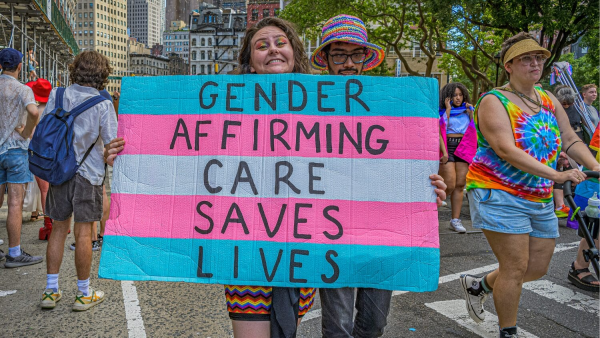
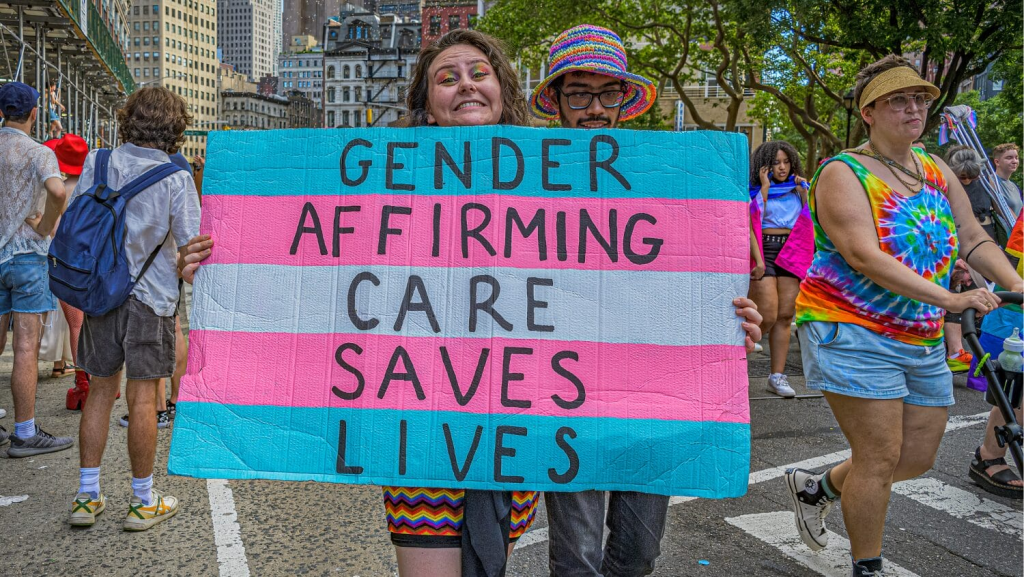
Gender-affirming care is supported by all major medical associations in the U.S., including the American Medical Association, the Endocrine Society, and the American Academy of Pediatrics, as safe and life-saving for young people with gender dysphoria.
The Department of Justice (DOJ) has issued subpoenas to medical providers who offer gender-affirming care to transgender youth, demanding that they provide private information on their young patients. The subpoenas demand “billing documents, communication with drug manufacturers, patient’s Social Security numbers, addresses, emails, Zoom recordings, voicemails, encrypted text messages, as well as every writing or record of whatever type” doctors have made from January 2020 to the current day, The Washington Post reported.
While Attorney General Pam Bondi admitted last month to sending 20 subpoenas to hold “medical professionals and organizations that mutilated children in the service of a warped ideology” accountable, she didn’t specify which organizations and individuals received the subpoenas. Anonymous informants told the aforementioned publication that some of the subpoena recipients (who got the subpoenas in June) operate in states with laws protecting gender-affirming care for youth. One trans civil rights activist called the incident an “unprecedented and disgusting violation of medical privacy.”
“[The government] is using its investigative powers to target medical providers based on a disagreement about medical treatment rather than violations of the law,” Jacob T. Elberg, a former federal prosecutor specializing in health care fraud, told The Washington Post. He added that the DOJ must show that the information it demanded is “relevant to a legitimate law enforcement probe.”
The publication contacted numerous clinics and professionals offering gender-affirming care for youth, but none would say whether they had received a subpoena, citing fears of violent threats or government retaliation. Other hospitals have been closing their trans youth clinics and erasing any mention of gender-affirming care from their web pages to avoid federal threats to cut funding or pursue prosecutorial charges.
“The subpoena is a breathtakingly invasive government overreach,” said Jennifer L. Levi, senior director of transgender and queer rights at the LGBTQ+ legal advocacy group GLAD Law. “It’s specifically and strategically designed to intimidate health care providers and health care institutions into abandoning their patients.”
Fewer than 3,000 teens nationwide receive puberty blockers or hormone replacement therapy, according to a 2025 JAMA analysis of private insurance data, The Post noted.
Responding to the news, transgender civil rights lawyer Alejandra Caraballo wrote via Bluesky, “This is an unprecedented and disgusting violation of medical privacy,” adding, “The fact that no lawsuit has been commenced challenging these subpoenas in court is ominous. My best guess is that many of the providers have complied and now DOJ is potentially sitting on the records of thousands of trans youth covering everything from therapy notes to pre- and post-op photos.”
Though there is no federal law banning gender-affirming care, the current presidential administration has sought to eradicate the practice through a January executive order (that has since been blocked by several courts). The order instructed the DOJ to extend the time that patients and parents can sue gender-affirming doctors and to use laws against false advertising to prosecute any entity that may be misleading the public about the long-term effects of gender-affirming care.
In April, Bondi issued a memo to DOJ employees, telling them to investigate and prosecute cases of minors accessing gender-affirming care as female genital mutilation (FGM); even though hospitals don’t conduct such female genital surgeries. The memo threatened to jail doctors for 10 years if they provide gender-affirming care to young people.
Gender-affirming care is supported by all major medical associations in the U.S., including the American Medical Association, the Endocrine Society, and the American Academy of Pediatrics, as safe and life-saving for young people with gender dysphoria.
One doctor interviewed by The Washington Post called the federal government’s crusade against gender-affirming care a “toxic plan” that will force some patients to detransition, potentially forcing them into adverse psychological and physical effects, including increased anxiety, depression, and the development of unwanted physical changes.
“This goes way beyond any degree of moral or ethical dilemma that any of us have ever experienced,” the doctor said. “It is completely scientifically and medically unfounded.”
Republican attorneys general in Texas and Tennessee have demanded similar patient information from providers of youth-centered gender-affirming care outside of their states, but they dropped their demands after courts blocked their efforts.
Uncover why Colombia is a must-visit for gay travelers. Explore destinations like Bogotá, Medellín, and Cartagena, plus learn about Colombian culture, cuisine, and essential safety tips for gay travelers.
As a frequent traveler to Colombia who has explored the country’s iconic destinations and scouted out its gay scenes firsthand, I’ll share my experiences and insights to help you plan the perfect trip. Whether you’re curious about the bustling gay nightlife in Bogotá, the charming streets of Cartagena, or the colorful vibes of Medellín, I’ve got you covered. My guide will combine practical tips making it easier for you to discover Colombia’s inclusivity, charm, and adventure.
Please read then entire guide from Tim at Out In Mexico.
A 28-year-old transgender woman from the U.S. began a legal challenge on Wednesday to the rejection of her asylum application in the Netherlands where she had sought political asylum saying she no longer felt safe in the United States.
Veronica Clifford-Carlos, a visual artist from California, came to the Netherlands — the first country to legalize same-sex marriage and known for its strong protections of LGBTQ rights — because the Trump administration’s policies towards transgender people made her feel unsafe, her lawyer’s office said.
The case, the first of its kind in the Netherlands, will be heard in a court in Amsterdam starting Wednesday, with a ruling expected in four to six weeks.
Since taking office in January, President Donald Trump has issued executive orders limiting transgender rights, banned transgender people from serving in the armed forces, and rescinded anti-discrimination policies for LGBTQ people.
Dutch advocacy group LGBT Asylum Support, which backs the lawsuit, is currently assisting around 20 U.S. trans individuals with pending asylum claims.
According to data from the Immigration and Naturalisation Service (IND), 29 Americans applied for asylum in the Netherlands during the first half of this year. In previous years there were between nine and 18 applicants per year, an IND spokesperson said.
“The IND generally states that discrimination by authorities and fellow citizens can be considered an act of persecution if it is so severe that victims can no longer function socially and societally,” LGBT Asylum Support said in a statement.
“But the IND maintains that there are no grounds for exceptional treatment of transgender and queer refugees from the U.S.”
Hungary’s parliament passed constitutional changes to clamp down on LGBTQ rights and potentially suspend some dual citizenships, bolstering Prime Minister Viktor Orban’s campaign to promote what he calls traditional values.
Facing a galvanized political opposition that has fueled large protests in Budapest in recent months, Orban has sought to stir his conservative base ahead of parliamentary elections next year.
The constitutional amendments passed Monday state that there are only two sexes, man and woman. The changes, said to intend protect children, have been interpreted as a broad crackdown on pride parades and other public displays that run counter to Orban’s traditional-values campaign.
Another change in the constitution allows for the suspension of citizenship for Hungarians who possess another citizenship outside of the European Union and could be deemed a threat to national security.
The amendments echo legislation passed last month. The constitutional amendments were passed with resounding support in parliament, where Orban’s Fidesz Party holds 135 of 199 seats.
“We’re protecting children’s development, affirming that a person is born either male or female, and standing firm against…foreign interference,” Orban wrote on X.
Orban, who has enjoyed unrivaled popularity in Hungary during his four consecutive terms since 2010, is facing his first possible challenge in opposition leader Peter Magyar. The politician has gained a following in the past year over accusations of corruption leveled at the prime minister and Fidesz.
Orban has denied any wrongdoing and has referred to opposition politicians, judges and journalists as bugs that needed to be removed from society.
A Lithuanian same-sex couple has been declared a legal family by a court in Lithuania, a historic victory for LGBTQ+ people in the Baltic nation.
The two women in the couple, whose identities have not been made public, were living together and wanted to have their cohabitation recognized by the government as a form of partnership. The Vilnius City District Court agreed and ruled that the state should create a way for them to register their relationship.
The Lithuanian constitution bans same-sex marriage, and the country’s Civil Code also bans the recognition of same-sex relationships as civil partnerships.
Nevertheless, the decision comes after the nation’s Constitutional Court ruled in April that the Lithuanian Civil Code unconstitutionally limits relationship recognition to relationships that are composed of one man and one woman. The ruling said that current law violates constitutional principles, including “the concept of the family derived from [the constitution], respect for human rights and dignity, as well as the values of equality, pluralism, and tolerance inherent in a democratic society.”
But that ruling isn’t self-implementing. The Lithuanian parliament, called the Seimas, needs to pass legislation to create a form of civil partnership recognition for same-sex couples. Meanwhile, lower courts can recognize same-sex couples for some benefits under the law.
This week’s ruling shows that ordinary people can use the courts to protect their rights, the couple’s attorney, Aivaras Žilvinskas, told LRT.
“For the first time in history, the family status is recognized,” Žilvinskas said. “All those laws and regulations that talk about people being members of a family – economic and social benefits, allowances, support – automatically apply to these couples.”
The outlet also reports that around 20 same-sex couples have also petitioned the court to have their relationships recognized.
“Since this ruling, we have been approached by some concerned people who wanted to learn how the litigation was done,” said Artūras Rudomanskis, the chair of the pro-LGBTQ+ organization Tolerant Youth Association (TJA). “Maybe there are more, but at least from what I could count, it’s around that number.”
“We are happy that more people will be equal, but there is still a long way to go,” he continued. “For people to be truly happy and feel equal, we need a functioning law-based system so we don’t have to go through the courts.” He explained that asking a court to recognize a relationship is a process that can take several months.
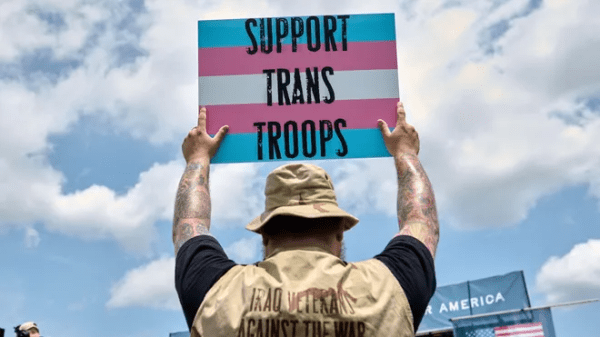
The Air Force says in a new memo that transgender airmen ousted under a recent Trump administration directive will no longer have the chance to argue before a board of their peers for the right to continue serving their country.
The memo dated Tuesday says military separation boards cannot independently decide whether to keep or discharge transgender airmen and instead “must recommend separation of the member” if the airman has a diagnosis of gender dysphoria — when a person’s biological sex does not match up with their gender identity.
Military legal experts who have been advising transgender troops told The Associated Press that the new policy is unlawful, and while they were not aware of the other services releasing similar memos, they fear it could serve as a blueprint across the military. Advocacy groups say the change threatens to weaken trust in the military’s leadership.
It is the second policy change the Air Force has taken in recent weeks to crack down on transgender service members. The Associated Press reported last week that the Air Force would deny transgender troops early retirement benefits and was moving to revoke requests already approved.
The Air Force declined to answer questions about the policy and its legal implications.
The service provided a statement saying the new guidance “is consistent with and responsive to Department of Defense policy regarding Service members with a diagnosis of, or history of, or exhibiting symptoms consistent with, gender dysphoria.”
How the boards usually work
The boards traditionally offer a quasi-legal hearing to determine if a service member set to depart is still of value to the military and should stay on. Fellow service members hear evidence of whatever wrongdoing occurred and about the person’s character, fitness and performance.
The hearings are not a formal court, but they have much the same structure. Service members are often represented by lawyers, they can present evidence in their defense and they can appeal the board’s findings to federal court.
The Pentagon’s policy on separating officers notes that they are entitled to “fair and impartial” hearings that should be “a forum for the officer concerned to present reasons the contemplated action should not be taken.”
This impartial nature means that the boards can sometimes reach surprising conclusions.
For example, the three active-duty Marines who were part of the mob that stormed the Capitol on Jan. 6, 2021, were retained.
The commanding officer of the USS McCain, a destroyer that collided with an oil tanker in the Pacific in 2017, killing 10, was not recommended for separation in 2019.
Military lawyers decry the Air Force change
Priya Rashid, a military lawyer who has represented service members before hundreds of separation boards, said she “has never seen an order like this.”
“I’ve seen people with three DUIs retained, I’ve seen people that beat their wives retained, I’ve seen all kinds of people retained because the board is empowered to retain anyone for any reason if they feel it’s in the best interest of the service,” she said.
Rashid said she and other lawyers working with transgender troops view the guidance as telling the boards to automatically order separation based solely on a diagnosis or symptoms of gender dysphoria.
She said that constitutes an unlawful command by the Air Force and upends impartiality.
“This instruction is essentially saying you will not make a determination of whether somebody has future potential in the service,” Rashid said.
The new Air Force guidance also prohibits recording the proceedings.
Rashid said the lack of an independent transcript would not only prevent Air Force leaders from reviewing the hearings to ensure they were conducted appropriately but would undercut any meaningful chance to appeal.
Stepped-up efforts to oust transgender troops
Pentagon officials say 4,240 troops have been diagnosed with gender dysphoria, which the military is using as an identifier of being transgender.
The Pentagon got the green light from Supreme Court in May to move forward with a ban on all transgender troops. It offered two options: volunteer to leave and take a one-time separation payout or be discharged at a later date without pay.
Some transgender troops decided to fight to stay by turning to the boards.
Senior Master Sgt. Jamie Hash, who has served in the Air Force since 2011, said she “wanted to face an objective board to be evaluated on my years of proven capability.”
“I wanted the board to see the assignments overseas and at the Pentagon, the deployments to different Combatant Commands, the service medals and the sustained operational and mission effectiveness,” she said in an interview.
But now, she said, that “the path ahead feels more uncertain than it ever has.”
Logan Ireland, a master sergeant in the Air Force with 15 years of service that includes a deployment to Afghanistan, was planning to retire early until his request was denied last week.
After that, he decided he would take a stand at the separation board.
“I chose the involuntary route because I believed in the promise of a fair hearing — judged on my service, my record and the facts,” he said.
“Now that promise is being ripped away, replaced with a process designed to decide my fate before I even walk in the room,” he said, adding that “all I’m asking for is the same fairness and justice every service member deserves.”
Both Ireland and Hash said they have yet to hear from their immediate superiors on what the new policy will mean for them.
Lawyers are worried it will set a precedent that will spread throughout the military.
Rashid said both the Army and Navy are “going to look at what the Air Force is doing as a standard of law … is this the minimum standard of law that we will afford our service members.”
Transgender troops warn the policy could have wider implications
Col. Bree Fram, a transgender officer in the Space Force who has long been seen as a leader among transgender troops, argued that the policy is a threat to other service members.
”Today it’s gender dysphoria; tomorrow it can be any condition or class the politics of the moment calls for,” she argued.
If the new policy is allowed to sideline “evidence of fitness, deployment history, awards, and commander input — the very material boards were built to evaluate,” Fram said, it sends a message that performance is no longer relevant to staying in the military.
Cathy Marcello, interim director for Modern Military Association of America, said the change adds to a “growing loss of trust” because outcomes are determined by politics, not performance. The organization advocates for LGBTQ+ service members, military spouses, veterans, their families and allies.
“It’s a signal that identity, not ability or achievement, determines who stays in uniform and who gets a fair shot,” she said.
Better Abroad? explores the lives of expatriates around the world who have uprooted their lives to move across physical and emotional boundaries in search of a better life. Through an artful lens, historical and cultural context, and engaging and authentic interviews, viewers will get to know each expat intimately—deeply feeling the experience of each character through their own narrative. Episodes will explore the critical moments or events that motivated their decisions as well as the peaks and valleys of their life-changing journeys. In this raw but beautiful look at the complexities of expat life, this series will provide viewers with a new thought provoking experience in each episode. Different expats on different paths. Different countries. One question. Is life Better Abroad?
We sit down and discuss this topic with Liz and Sarah.
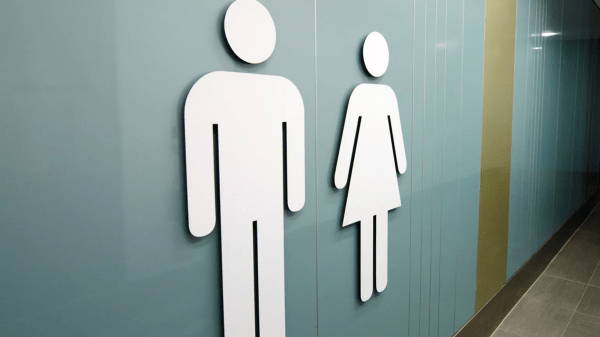
A public school district in northern Virginia voted yesterday to keep its current pro-trans policies despite the administration’s orders to ban trans students from using the restrooms and locker rooms associated with their gender.
The Loudoun County School Board voted to maintain its current policies regarding the facilities just days after the U.S. Education Department (ED) ordered the district – along with four nearby school districts – to ban trans students from using the facilities associated with their gender. The administration claimed that letting trans students use the appropriate facilities violated Title IX, the law that bans discrimination on the basis of sex in education.
The current administration reversed President Joe Biden’s interpretation of Title IX, which found the statute’s prohibition on discrimination “on the basis of sex” includes anti-LGBTQ+ discrimination. The rules rely on the Supreme Court’s 2020 decision in Bostock v. Clayton County, which found that sex-based discrimination necessarily covers discrimination on the basis of sexual orientation and gender identity, because it’s impossible to discriminate against LGBTQ+ people without taking sex into account.
That is, denying trans students use of restroom facilities or making use of such facilities difficult solely because of their sex assigned at birth was, to the Biden administration, a form of illegal sex-based discrimination. And since many students can’t last an entire day of school without using the restroom, such discrimination could effectively deny trans students an education.
The ED investigated the Virginia school districts, saying it had gotten complaints alleging “that students in the Divisions avoid using school restrooms whenever possible because of the schools’ policies, and that female students have witnessed male students inappropriately touching other students and watching female students change in a female locker room.”
There is no evidence that trans people are a threat to cisgender girls and women in restrooms, but a 2021 study from UCLA’s Williams Institute found that trans people are four times more likely than cis people to be victims of violent crime.
The ED then ordered the schools to rescind their trans-inclusive policies within 10 days and to “adopt biology-based definition of the words ‘male’ and ‘female’ in all practices and policies relating to Title IX.”
But the school board in Loudoun County voted 6-3 to keep its current policy, explaining in a statement that they are following precedent set by the U.S. Court of Appeals for the Fourth Circuit. In 2020, that court affirmed a lower court decision in favor of trans student Gavin Grimm, who had sued his school district after he was told to use the bathroom in a bucket in a converted janitor’s closet and was called a “freak” at a school board meeting about his bathroom usage. The court found that Title IX and the Equal Protection Clause of the Constitution prohibited his school district from discriminating against him.
“Our priority remains the same: doing what is right for Loudoun County’s young people; focusing on educating our students and ensuring our schools are places where every child feels they belong,” the Loudoun County School Board said in a statement.
The other four school districts ordered to end trans equality have not yet said how they will proceed, but they have to respond by Friday, which will be the end of the 10-day period. Prince William County School Board members met with lawyers last week and issued a statement saying that it “continues to review and work through legal issues related” to the ED’s order and that the board “remains firmly committed to fostering a safe, inclusive, and respectful learning environment for all students and staff.”












You must be logged in to post a comment.