Are you thinking about leaving the United States for safety, stability, or a better quality of life? In this powerful conversation, we sit down with Dan Brotman, an American expat based in Montreal who specializes in investment migration—including Golden Visas, Digital Nomad Visas, and residency-by-investment options tailored to the LGBTQ+ community.
With an academic background in immigration policy, multiple citizenships, and years of frontline experience helping people relocate, Dan brings unmatched insight into how Americans can legally, safely, and strategically build a future outside the U.S. Follow Dan on Instagram: @danbrotman linktr.ee/danbrotman
🏡 IN THIS VIDEO, WE COVER:
🌍 Why Americans—Especially LGBTQ+ People—Are Exploring Life Abroad
We discuss political extremism, threats to civil rights, financial instability, and what it means to live somewhere your rights are not up for debate.
💶 Golden Visas & Migration Pathways
Dan explains the residency-by-investment programs opening doors across Europe, Latin America, and beyond—and why securing a visa before your “red line” is crossed is essential.
❤️🩹 Healthcare Without Fear
Real stories from Spain, Uruguay, and Canada:
€80/month private healthcare in Spain
A 5-day ICU stay for $19
An emergency room visit in Canada that cost $0
A U.S. insurance premium high enough to rent an apartment in Valencia
🧠 Financial Relief & Peace of Mind
We explore how predictable, low-cost healthcare abroad reduces anxiety for families who worry about a single medical emergency derailing their finances.
🎓 Education & Opportunity
Why families are sending their children to Europe—especially the Netherlands—for nearly free, world-class university education.
🏳️🌈 Rights, Safety & Community
Dan discusses LGBTQ+ rights, abortion access, universal healthcare, and gun laws in Canada—issues considered settled and not weaponized politically.
🚨 Red Lines & Safety Planning
We explore how LGBTQ+ people can assess danger, decide their personal boundaries, and obtain the documentation needed to leave quickly if the situation in the U.S. deteriorates.
This is an essential conversation for anyone considering relocation for safety, rights, opportunity, or long-term stability.
🔔 Subscribe for more guides on LGBTQ+ migration, Golden Visa pathways, and global relocation options.
Explore how to choose countries where you can live authentically and safely. We’ll discuss rights, culture, and communities for LGBTQ+ expats worldwide. You’ll finish with both encouragement and practical strategies for finding your ideal destination.
The State Department quietly updated its website this week to signal that the Trump administration may move to invalidate passports held by transgender Americans, following a Supreme Court emergency ruling that overturned earlier protections on gender-marker updates. The change was first spotted by journalist Aleksandra, who writes as Transitics on Substack. Until recently, the website assured transgender passport holders that their documents would “remain valid until [their] expiration date.” As of Thursday morning, that language had been replaced with: “A passport is valid for travel until its date of expiration, until you replace it, or until we invalidate it under federal regulations.” The new phrasing has sparked alarm across the transgender community, with one government source telling Erin in the Morning that there is growing interest within the administration in exploring some level of revocations.
The change comes one week after the Supreme Court issued an emergency ruling allowing the Trump administration’s passport restrictions on transgender people to take effect. In that decision, the Court concluded that the administration is likely to prevail in ongoing litigation, and rejected the argument that the policy was driven by “a bare desire to harm a politically unpopular group.” This conclusion stands in stark contrast to the administration’s own executive orders enabling the passport crackdown, which describe transgender people as inherently “wrong,”“dishonorable,” and “socially coercive.”
“The Court ignores these critical limits on its equitable discretion today. The Government seeks to enforce a questionably legal new policy immediately, but it offers no evidence that it will suffer any harm if it is temporarily enjoined from doing so, while the plaintiffs will be subject to imminent, concrete injury if the policy goes into effect,” responded Justice Jackson in her dissent.
Previously, there were signs that a Trump administration victory in court could trigger efforts to invalidate transgender people’s passports. As first reported by Erin in the Morning, a single paragraph in a government filing stated that “if the government prevails in this case and the Department proceeds to revoke and replace passports issued pursuant to the preliminary injunction, the Department will incur additional administrative costs.” At the time, some observers dismissed this as routine legal positioning. But the State Department’s latest website change suggests the administration may, in fact, be preparing to take exactly that step.
One government source familiar with internal discussions said such conversations are indeed underway, though any revocation effort would be difficult to carry out and would almost certainly ensnare some cisgender people by mistake. According to the source, the most likely targets would be passport holders with X markers and those who updated their documents through the affidavit process—a temporary pathway created under lower-court rulings that allowed transgender people to obtain corrected passports if they signed a sworn statement attesting to their gender identity. At the time, EITM reported that the State Department was collecting data on every person who signed the affidavit in case a ruling like this arrived, enabling the government to potentially invalidate those passports. Now, that appears to be one of the avenues the administration is actively considering.
For those who updated their passports before this administration, any attempt to revoke those documents would be far more complicated. The process would be costly, the relevant information is not easily accessible, and such actions would almost certainly run into additional legal hurdles and face separate court challenges. And for anyone whose passport the government does seek to change, the law guarantees an appeal with a hearing on request—an extraordinarily expensive and resource-intensive process for an agency that is not equipped to handle a surge of such cases.
When asked what the process would look like for transgender people traveling overseas if their passports were revoked, the source told EITM that those individuals would likely be contacted and instructed to report to the nearest U.S. embassy or consulate to replace their passport or receive special guidance. Such a requirement could severely disrupt international travel for transgender people. For now, however, any move in this direction appears to be weeks or even months away—if the administration chooses to pursue it at all.
Meanwhile, the case will continue in the lower courts, a process that could drag on for years. And while those courts could, in theory, rule in favor of transgender plaintiffs, recent Supreme Court actions suggest the justices are prepared to side with the administration on virtually any policy targeting trans people. The Court is already set to hear a case in January that will determine whether transgender Americans receive equal protection under the law at all, and the memory of the Skrmetti decision—upholding bans on trans youth care—still hangs heavily over the legal landscape. In the meantime, transgender people in the United States are left to navigate shifting rules in nearly every aspect of daily life under an administration and a Republican Party intent on making that life as difficult as possible.
A Moscow court Friday found an LGBTQ travel agent who had killed himself in custody a year ago guilty of extremism, as Russia increasingly targets individuals it says undermine “traditional” values.
The posthumous ruling came a year after 48-year-old Andrei Kotov was found dead in his cell in a Moscow pre-trial detention centre.
Russia has heavily targeted the LGBTQ community under President Vladimir Putin, and Friday’s ruling against somebody who had died a year earlier is seen as a particularly symbolic example of how zealous the crackdown is.
Kotov, who ran a travel company called Men Travel, had said he was beaten by 15 men when he was arrested in November 2024.
The Moscow Golovinsky court found him guilty of taking part in “extremist activity” as well as using underage people for pornography, the independent Mediazona website reported from inside the court.
His lawyer had said in December 2024 that Kotov’s body was found in his cell and that investigators told her he died by suicide.
Rights groups have accused authorities of using the case as a show trial — not dropping it after his death to scare LGBTQ people.
In November 2024, Kotov described his arrest in court: “Fifteen people came to me at night, beat me, were punching me in the face.”
Putin has for years denounced anything that goes against what he calls “traditional family values” as un-Russian and influenced by the West.
In 2023, Russia’s Supreme Court banned what it called the “international social LGBT movement” as an “extremist organisation”.
Human Rights Watch has said that the ruling “opened the floodgates for arbitrary prosecutions of individuals who are LGBT or perceived to be, along with anyone who defends their rights or expresses solidarity with them”.
Russia has never been a hospitable environment for LGBTQ people, but has become far more dangerous since Moscow’s Ukraine offensive, which massively accelerated the country’s hardline conservative turn.
In 1980, Cuban police detained Fidel Armando Toboso-Alfonso without charge, encouraged co-workers to publicly shame him, and warned he faced four years in prison unless he fled the country. His “crime” was being gay. Having previously faced 60 days in a labor camp, Toboso-Alfonso chose exile. When he reached the United States, an immigration judge made a historic ruling: He granted Toboso-Alfonso refuge. That decision became a lifeline for countless LGBTQ people.
The United States was once considered a place where LGBTQ people could claim asylum. Today, under a harsher immigration system shaped by Trump-era judges, this image is slipping away.
In June, U.S. Citizenship and Immigration Services issued an alert reminding officers that marriages must be legally valid where celebrated to qualify for immigration benefits. For queer couples from countries that criminalize or refuse to recognize same-sex marriage, that’s an impossible standard. They must present a marriage certificate that, in their home country, they could be jailed or killed for attempting to obtain.
This is just one part of the Trump Administration’s broader rollback of protections for immigrants and LGBTQ people.
Under Presidents Barack Obama and Joe Biden, the United States resettled tens of thousands of refugees annually, including LGBTQ people fleeing persecution, arrest, torture, or death. Today, that number has been slashed to just 7,500—a fraction of its former scale and overwhelmingly skewed toward white applicants from South Africa.
The Trump Administration has also ordered federal agencies to remove recognition of transgender and nonbinary identities from official documents. Because the asylum process demands consistency across forms, nonbinary refugees now face an impossible choice: misrepresent themselves on paper or risk rejection for “inconsistency.”
These bureaucratic changes to passports, marriage certificates, and federal forms carry devastating consequences. By narrowing who counts as married or whose gender “exists” on paper, the White House has effectively barred countless queer individuals from asylum protections. Bureaucracy has become a new border wall, keeping the most vulnerable people out.
The United States does not jail or execute people for being LGBTQ. But the government is asking queer people to erase themselves to remain here—a quieter, procedural form of violence. A nation cannot call itself a refuge while demanding that those seeking safety deny who they are.
Last week, the Supreme Court allowed the Trump Administration to require that U.S. passports list only the sex assigned at birth. The decision halts lower-court efforts to block the policy, meaning the State Department may now refuse to process passports reflecting a person’s self-identified gender. The change may seem technical, but it signals something larger: When combined with other anti-LGBTQ measures, it threatens not only the rights of citizens, but also the safety of queer immigrants and refugees.
Meanwhile, some lawmakers are pushing to overturn Obergefell v. Hodges, the 2015 Supreme Court decision that recognized same-sex marriage as a constitutional right. The Court recently declined to hear one such challenge, but its mere consideration shows how precarious equality has become.
For queer asylum seekers already in the United States, the situation remains perilous. Claims based on sexual orientation or gender identity are often met with skepticism, as adjudicators demand “proof” of identity—an impossible expectation when visibility itself can be a death sentence. Instead of offering protection, the system pressures applicants to conform to stereotypes of what being “gay enough” looks like.
Worse still, immigration judges may now deny asylum applications without hearings, silencing stories that could save lives. Bureaucracy, once again, has become a weapon.
The next generation must do more than defend LGBTQ people—they must reclaim the promise of this country. A true refuge is defined not by paperwork or policy, but by the belief that every person deserves to live in truth and safety.
State Representative David Borrero (HB 347) and Senator Clay Yarborough (SB 426) filed the first anti-LGBTQ bill of Florida’s 2026 legislative session — the Pride Flag Ban. The legislation seeks to prohibit state and local government buildings from displaying any flag representing “race, gender, or sexual orientation,” including the Pride flag. The bill also attempts to strip cities and counties of the power to design or adopt their own municipal flags, while carving out protections for “historical” flags — including Confederate symbols. This proposal follows a summer of state action to remove LGBTQ visibility, when Governor Ron DeSantis ordered the removal of rainbow crosswalks and street murals in cities across Florida. Now being introduced for the fourth year, the legislation has been widely rejected three years in a row.
Statement from Joe Saunders, Senior Political Director, Equality Florida:
“This bill is a direct attack on LGBTQ visibility and a textbook example of government overreach and censorship. The Pride flag is a symbol of safety, inclusion, and community for millions of Floridians. After DeSantis spent the summer ripping up rainbow crosswalks and street murals for his own political agenda, legislative extremists are now attempting to finish the job by banning Pride flags in public facilities. These bills prevent local cities and counties from using flags to recognize their own communities or make them welcoming to residents and tourists. Floridians deserve leaders focused on solving real problems, not weaponizing government to erase LGBTQ people from public life. We’ve defeated this bill before, and we will defeat it again.”
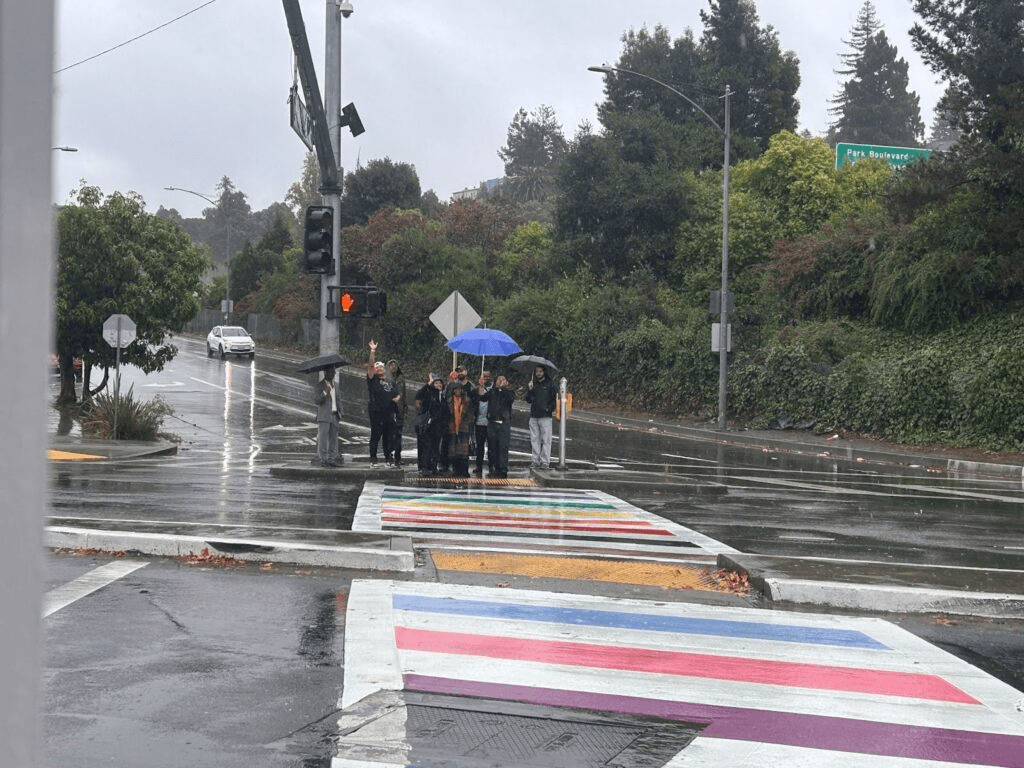
Dozens of local queer leaders, community members and allies gathered at the Oakland LGBTQ Community Center on a rainy Thursday afternoon to celebrate the unveiling of the city’s first permanent rainbow crosswalk and the second anniversary of the Lakeshore LGBTQ Cultural District.
The crosswalk was installed on Lakeshore Avenue, outside the LGBTQ center, symbolizing Oakland’s commitment to LGBTQ inclusion and visibility, the center said in a news release. Instead of paint, it is made from thermoplastic materials to ensure durability and safety.
“It tells every trans, queer and non-binary person who visits our LGBTQ district that they are welcome, seen, safe, and celebrated right here in Oakland,” said Jeff Myers, chair of the Lakeshore LGBTQ Cultural District Committee, which plans events and does community outreach in the neighborhood.
A two-hour indoor ceremony preceded the unveiling, hosted by center co-chairs Myers and Joe Hawkins and emcee MCYB. It featured music from flutist Piedpiper KJ, singer-songwriter Cadence Myles and the Oakland Gay Men’s Chorus, as well as remarks from elected officials and neighborhood business owners.
Speakers emphasized the importance of the Lakeshore District, which was established in 2023, and the new rainbow crosswalk as markers of queer visibility in Oakland during a time of fraught messaging from the federal government.
“The Lakeshore LGBTQ Cultural District is more than just geography,” said Kin Folkz, a visual artist, poet and founder of the neighborhood’s Queer Arts Center. “It is the way that we refuse to disappear.”
Mayor Barbara Lee presented Lakeshore District leaders with a placard proclaiming Nov. 13 as “Lakeshore LGBTQ Cultural District Day.”
“The rainbow crosswalk is a signal that you are part of the fabric of Oakland’s history and of Oakland’s future,” Lee said.
Hawkins thanked Lee for securing grant funding to support improvements at the center during her tenure in Congress. He also praised the Alameda County Supervisors for helping make up for the center’s recent loss of federal funding. The Supervisors approved $1.5 million for LGBTQ service providers, with the Oakland center getting some of that funding.
“Our city and county are helping,” Hawkins said. “I’m very confident this is more help than we’ve ever received.”
Bucking the trend
Councilmember Charlene Wang, who represents the Lakeshore District, applauded Oakland for installing the rainbow crosswalk, while lamenting the removal of such crosswalks in Florida and Texas cities. U.S. Transportation Secretary Sean Duffy launched a “roadway safety initiative” in July, urging governors to remove “political messaging and artwork” from intersections. Following that announcement, Orlando, Miami Beach, Gainesville, and Houston removed colorful crosswalks.
“While those cities caved, we are standing strong and we are adding crosswalks,” Wang said.
Megan Wier, an assistant director at the city’s Transportation Department, told Oakland North that the city worked with the LGBTQ center and Councilmember Rowena Brown’s office on a design that reflected diversity but also followed Americans with Disabilities Act requirements.
After the ceremony, everyone shuffled out of the building and into the rain for the crosswalk unveiling. Onlookers clustered under tents to watch Lee, Myers and Brown cut a ceremonial red ribbon, flanked by members of the Lakeshore District committee and the Transportation Department.
Oakland resident Darron Lewis said he was overjoyed to be there. Lewis, whose boyfriend works for the LGBTQ center, recently moved from Seattle and expressed his admiration for Oakland.
“It’s an adaptable place,” Lewis said. “There’s nothing more queer than a rainy day in Oakland.”
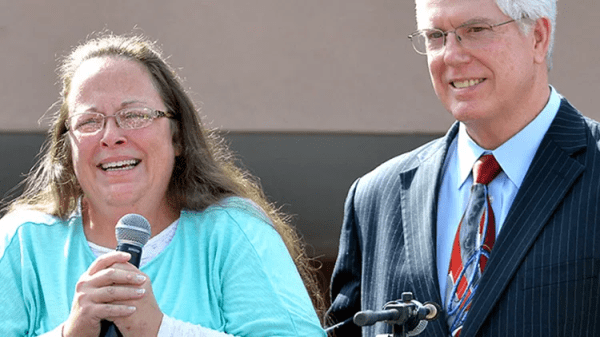
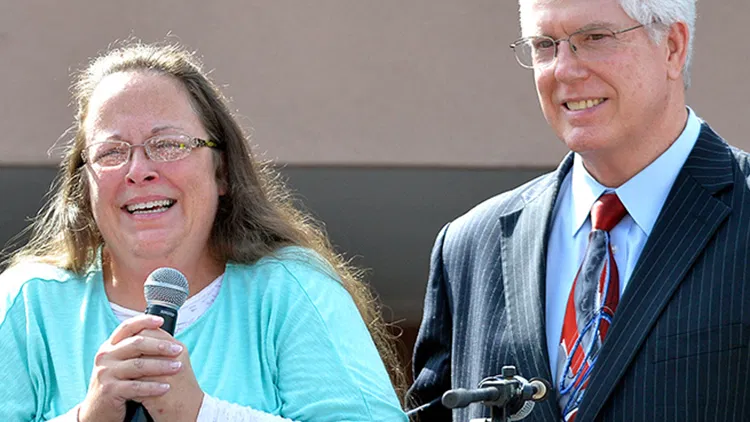
Liberty Counsel, the Christian hate group behind Kim Davis’s attempt to have the Supreme Court overturn its marriage equality decision, says their fight to end LGBTQ+ equality is far from over.
“I have no doubt that Davis’s resolve will serve as a catalyst to raise up many more challenges to the wrongly decided Obergefell opinion,” wrote Liberty Counsel President Mat Staver in a message on the group’s website. “Until then, we must pray, fight, and contend for when Obergefell is no longer the law of the land.”
The Supreme Court ruled in its 2015 Obergefell v. Hodges decision that people have a fundamental right to choose who to marry, regardless of their spouse’s gender. The decision legalized marriage equality in all 50 states.
A county clerk in Kentucky, Kim Davis, refused to issue marriage licenses to same-sex couples, which led to a lawsuit and ten years of legal fights.
This year, with help from the lawyers at Liberty Counsel, she filed an appeal to the Supreme Court to overturn a judgment against her that required her to pay $360,000 to a gay couple whom she had illegally denied a marriage license. In that petition, she asked the Supreme Court to end marriage equality, arguing that her case proved that LGBTQ+ equality was inherently a threat to the rights of Christians like herself.
Last week, the Supreme Court rejected her appeal, leaving its decision in favor of marriage rights in place for at least another year.
Anti-LGBTQ+ activists, though, aren’t going to give up.
“This time, Kim Davis is the victim of religious animus and is being deprived of her constitutional freedom of religion,” Staver wrote. “Tomorrow, it could be you.”
“This may mark the end of an era in litigating Davis’s case, but the fight to overturn Obergefell and protect religious liberty has just begun.”
Staver’s argument is similar to an argument that Justices Clarence Thomas and Samuel Alito made in 2020 that the mere existence of married same-sex couples is a violation of Christians’ religious freedom because seeing married same-sex couples encourages people to judge Christians “as bigots.” (That opinion was delivered in the context of a different appeal filed by Davis.)
“Since Obergefell, parties have continually attempted to label people of good will as bigots merely for refusing to alter their religious beliefs in the wake of prevailing orthodoxy,” Thomas wrote at the time.
A town in Maine voted Monday night to continue to comply with the state’s Human Rights Act, allowing a transgender grade-schooler to play on a girls’ recreational basketball team.
The 3–2 vote at the November 10 special meeting of the St. George, Maine, Select Board came after a group of parents submitted a letter at last week’s regular monthly meeting raising their “deep concern” about the St. George Parks & Recreation Department’s youth basketball program allowing a transgender girl to play on its third and fourth grade girls’ team.
“While we understand that Maine law allows children to participate [in sports] based on how they identify, we also believe that these policies have created a very uncomfortable situation for many families in our community,” local parent Emily Chadwick read from the group’s letter during the public comment portion of the November 4 meeting.
In video from the meeting, Chadwick and others who spoke initially seemed to go out of their way not to mention the trans child or indeed to even specify the reason for their “concerns” or to ask the board to take any specific action beyond considering “how these policies impact all the children involved, not just one.”
Noting that the group seemed to be referencing the Maine Human Rights Act (MHRA), which bars discrimination based on gender identity, Select Board Chair Jane Conrad told those in attendance that their proper course of action would be “to lobby your legislators” to change the law. The Select Board members, she explained, “are in charge of enforcing the law.”
The board ultimately decided to schedule the November 10 special meeting to discuss whether it would continue to comply with the law and to allow for the broader community to weigh in.
Monday night’s meeting opened with Colin Hurd, deputy counsel for the Maine Human Rights Commission, clarifying precisely what is covered by the state human rights law.
“Under the Maine Human Rights Act, it’s illegal to prevent a person from playing sports on the team of their gender identity solely because their sex assigned at birth is different from the people that they will be playing with or against,” Hurd explained. “Furthermore, under the same provision, it’s illegal to prevent a person from using the restroom or locker room that most closely corresponds with their gender identity. So, the law, the Human Rights Act, is pretty unequivocal on these matters.”
Following the meeting’s hour-long public comment period, Conrad once again reiterated that it is not the board’s role “to determine or debate the law,” adding that in recent years, the board has consistently voted to follow state law, even when individual members disagreed with it. While she encouraged board members to voice their objections to the law, she also expressed her hope that they would vote to follow it, as not doing so would likely invite a lawsuit that they would lose, “and the taxpayers of our town would have to foot the bill.”
While some speakers at both the November 4 and 10 meetings seemed to reference a February 5 executive order banning transgender women and girls from women’s and girls’ sports (which neither changed nor established any law) and his administration’s interpretation of Title IX, Conrad noted that no court has ruled so far that any federal law supersedes the Maine Human Rights Act. She also noted that attempts in the state’s most recent legislative session to restrict trans people’s participation in sports have all been rejected.
As Them notes, the dust-up in St. George follows Maine’s Democratic Gov. Janet Mills’s months-long feud with the president over her refusal to comply with his anti-trans executive order. Mills has argued that the state’s human rights law prevents her from banning trans athletes from women’s and girls’ sports. However, as Them notes, several school districts in the state have nonetheless opted to institute trans sports bans in compliance with the executive order. An anti-trans advocacy group recently launched a new effort to amend the MHRA via ballot referendum so that it is in compliance with the presidential administration’s anti-trans interpretation of Title IX.
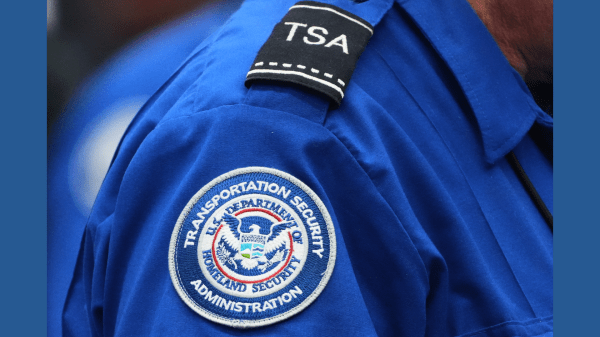
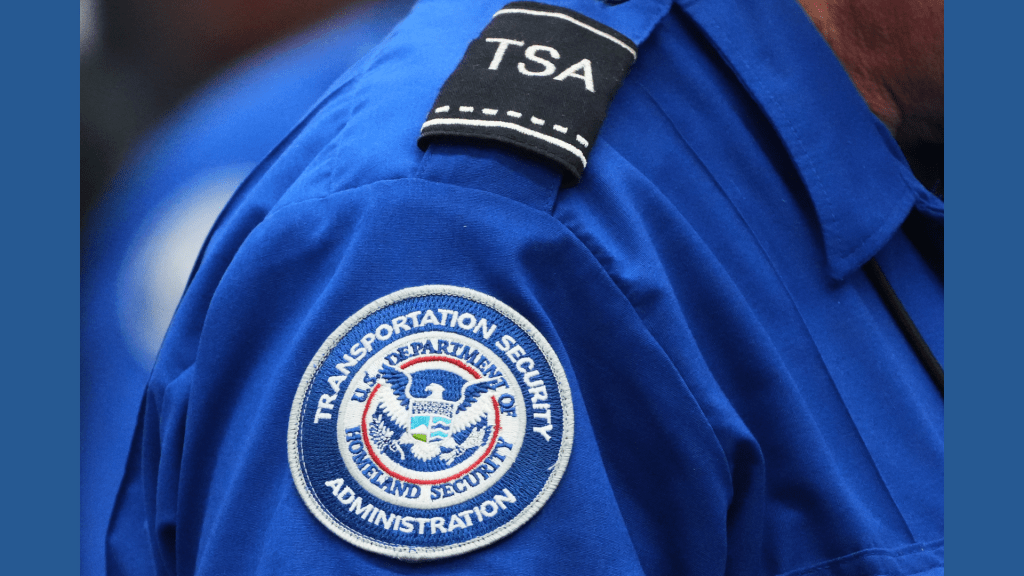
A Virginia transportation security officer is accusing the U.S. Department of Homeland Security of sex discrimination over a policy that bars transgender officers from performing security screening pat-downs, according to a federal lawsuit.
The Transportation Security Administration, which operates under DHS, enacted the policy in February to comply with President Donald Trump’s executive order declaring two unchangeable sexes: male and female.
According to internal documents explaining the policy change that The Associated Press obtained from four independent sources, including two current and two former TSA workers, “transgender officers will no longer engage in pat-down duties, which are conducted based on both the traveler’s and officer’s biological sex. In addition, transgender officers will no longer serve as a TSA-required witness when a traveler elects to have a pat-down conducted in a private screening area.”
Until February, TSA assigned work consistent with officers’ gender identity under a 2021 management directive. The agency told the AP it rescinded that directive to comply with Trump’s Jan. 20 executive order.
Although transgender officers “shall continue to be eligible to perform all other security screening functions consistent with their certifications,” and must attend all required training, they will not be allowed to demonstrate how to conduct pat-downs as part of their training or while training others, according to the internal documents.
A transgender officer at Dulles International Airport, Danielle Mittereder, alleges in her lawsuit filed Friday that the new policy — which also bars her from using TSA facility restrooms that align with her gender identity — violates civil rights law.
“Solely because she is transgender, TSA now prohibits Plaintiff from conducting core functions of her job, impedes her advancement to higher-level positions and specialized certifications, excludes her from TSA-controlled facilities, and subjects her identity to unwanted and undue scrutiny each workday,” the complaint says.
Mittereder declined to speak with the AP but her lawyer, Jonathan Puth, called TSA’s policy “terribly demeaning and 100% illegal.”
TSA spokesperson Russell Read declined to comment, citing pending litigation. But he said the new policy directs that “Male Transportation Security Officers will conduct pat-down procedures on male passengers and female Transportation Security Officers will conduct pat-down procedures on female passengers, based on operational needs.”
Other transgender officers describe similar challenges to Mittereder.
Kai Regan worked for six years at Harry Reid International Airport in Las Vegas, but retired in July in large part because of the new policy. Regan, who is not involved in the Virginia case, transitioned from female to male in 2021 and said he had conducted pat-downs on men without issue until the policy change.
“It made me feel inadequate at my job, not because I can’t physically do it but because they put that on me,” said the 61-year-old, who worried that he would soon be fired for his gender identity, so he retired earlier than planned rather than “waiting for the bomb to drop.”
Skye Perryman, president and CEO of Democracy Forward — a legal organization that has repeatedly challenged the second Trump administration in court — called TSA’s policy “arbitrary and discriminatory,” adding: “There’s no evidence or data we’re aware of to suggest that a person can’t perform their duties satisfactorily as a TSA agent based on their gender identity.”
DHS pushed back on assertions by some legal experts that its policy is discriminatory.
“Does the AP want female travelers to be subjected to pat-downs by male TSA officers?” Homeland Security spokesperson Tricia McLaughlin asked in a written response to questions by the AP. “What a useless and fundamentally dangerous idea, to prioritize mental delusion over the comfort and safety of American travelers.”
Airport security expert and University of Illinois Urbana-Champaign professor Sheldon H. Jacobson, whose research contributed to the design of TSA PreCheck, said that the practice of matching the officer’s sex to the passenger’s is aimed at minimizing passenger discomfort during screening. Travelers can generally request another officer if they prefer, he added.
Deciding where transgender officers fit into this practice “creates a little bit of uncertainty,” Jacobson said. But because transgender officers likely make up a small percent of TSA’s workforce, he said the new policy is unlikely to cause major delays.
“It could be a bit of an inconvenience, but it would not inhibit the operation of the airport security checkpoint,” Jacobson said.
TSA’s policy for passengers is that they be screened based on physical appearance as judged by an officer, according to internal documents. If a passenger corrects an officer’s assumption, “the traveler should be patted down based on his/her declared sex.” For passengers who tell an officer “that they are neither a male nor female,” the policy says officers must advise “that pat-down screening must be conducted by an officer of the same sex,” and to contact a supervisor if concerns persist.
The documents also say that transgender officers “will not be adversely affected” in pay, promotions or awards, and that TSA “is committed to providing a work environment free from unlawful discrimination and retaliation.”
But the lawsuit argues otherwise, saying the policy impedes Mittereder’s career prospects because “all paths toward advancement require that she be able to perform pat-downs and train others to do so,” Puth said.
According to the lawsuit, Mittereder started in her role in June 2024 and never received complaints related to her job performance, including pat-down responsibilities. Supervisors awarded her the highest-available performance rating and “have praised her professionalism, skills, knowledge, and rapport with fellow officers and the public,” the lawsuit said.
“This is somebody who is really dedicated to her job and wants to make a career at TSA,” Puth said. “And while her gender identity was never an issue for her in the past, all of a sudden it’s something that has to be confronted every single day.”
Being unable to perform her full job duties has caused Mittereder to suffer fear, anxiety and depression, as well as embarrassment and humiliation by forcing her to disclose her gender identity to co-workers, the complaint says. It adds that the ban places additional burden on already-outnumbered female officers who have to pick up Mittereder’s pat-down duties.
American Federation of Government Employees National President Everett Kelley urged TSA leadership to reconsider the policy “for the good of its workforce and the flying public.”
“This policy does nothing to improve airport security,” Kelley said, “and in fact could lead to delays in the screening of airline passengers since it means there will be fewer officers available to perform pat-down searches.”










 fleeredstates.blog
You must be logged in to post a comment.