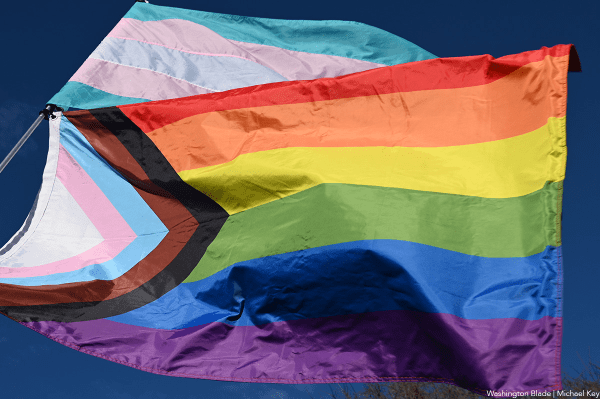
LGBTQ advocates warn of FBI plan to label trans people as ‘violent extremists’

Read more at the Washington Blade.

The nation’s leading LGBTQ advocacy groups are sounding the alarm over reports that the FBI may soon classify transgender people as a threat group — a move advocates say would be unconstitutional, dangerous, and rooted in political retribution.

At a joint press briefing held over Zoom last week, the heads of the Human Rights Campaign, Transgender Law Center, Equality Federation, GLAAD, PFLAG, and the Southern Poverty Law Center condemned the possibility that the FBI, in coordination with the Heritage Foundation, is working to designate transgender people as “violent extremists.”

The warning comes after a story earlier this month by independent journalist Ken Klippenstein, who reported that two anonymous national security officials said the FBI is considering treating trans subjects as a subset of its new threat category. That classification — originally created under the Biden administration as “Anti-Authority and Anti-Government Violent Extremists” (AGAAVE) — was first applied to Jan. 6 rioters and other right-wing extremists.

After pardoning all of the Jan. 6 insurrectionists, the Trump administration shifted the FBI’s terminology, replacing AGAAVE with “Nihilistic Violent Extremists (NVEs),” or, in some cases, “Transgender Ideology-Inspired Violent Extremism (TIVE).” The possibility of such a label follows several high-profile media errors in which reporters incorrectly linked Charlie Kirk’s shooter to the transgender community, fueling anti-trans rhetoric on the far-right.

For more than an hour last Wednesday, LGBTQ leaders denounced the reported FBI proposal and warned of the consequences of targeting one of the country’s most vulnerable communities. They emphasized that such a move would represent a violation of basic human rights, further fuel misinformation, and give legitimacy to political attacks already directed at transgender people.

Kelley Robinson, president of the Human Rights Campaign, warned of the broader danger for the LGBTQ community if this happens.

“Americans can no longer count on the right to life, liberty, and the pursuit of happiness, not when political violence runs rampant, not when political retribution goes unchecked, not when hate is being incited by our president.”

Robinson argued that claims of “Transgender Ideology-Inspired Violent Extremism” are not rooted in reality. For example, Gun Violence Archive Executive Director Mark Bryant has said that out of 5,000 mass shootings tracked by the archive, the number of trans or LGBTQ+ suspects is in “the single digit numbers.”

“Trans Americans are more likely to be the victim of a violent crime than a perpetrator of one… violence committed by trans Americans is a lie, a lie that only begets more violence.”

Shelby Chestnut of the Transgender Law Center warned that the federal government’s posture would escalate attacks on the community.

“Bullying communities and manufacturing chaos will never erase the truth that we are far more connected than divided,” Chestnut said. “In the coming days and weeks, you will see increased targeting of our organizations and our communities and mis and disinformation being weaponized at the highest level of government.”

Fran Hutchins of the Equality Federation described the move as a direct assault on trans people, echoing Chestnut’s points — but made it clear that this will not stop organizations supporting transgender people from continuing their work.

“This is a campaign that weaponizes fear and misinformation to isolate and harm our communities,” she said. “Let’s call it what it is. It’s political violence… We will not be erased.”

Sarah Kate Ellis, president of GLAAD, the LGBTQ media watchdog organization, urged the press not to fall into false equivalencies, reminding reporters that transgender people face the highest risk of violence, contrary to the narratives pushed by some MAGA Republicans.

“Trans people exist. They always existed, and they will continue to exist,” she said. “The truth is the real trans terrorism… is the terror experienced by trans people in this country.”

Ellis also emphasized that this is an issue of civil and human rights, not something abstract — with real consequences.

“Do not treat civil rights as a both sides issue.”

Brian Bond of PFLAG (Parents, Families, and Friends of Lesbians and Gays) framed the FBI’s proposal as a betrayal of American values, calling it “un-American” and “despicable,” while warning that even if it doesn’t immediately affect everyone, it represents a slippery slope.

“Every child in their family, every family member, every neighbor, transgender or not, is affected.”

He added: “PFLAG parents… will not back down.”

Beth Littrell of the Southern Poverty Law Center underscored the constitutional implications of these potential actions, their consequences for other marginalized groups, and the role of the media in calling out the Trump administration’s tactics.

“The real threat is when the government targets a group of people and those who support them for unequal treatment based only on who they are or what they believe,” Littrell said. “It should go without saying, but I say it anyway, transgender children do not threaten anyone’s ability to safely live and thrive in our nation or anywhere else.”

“What is being reported is unconstitutional. What is happening is dangerous,” she added. “We have seen this playbook before… We fought alongside the communities then, we will continue to do so now.”

Advocates closed the call with a unified demand: that political leaders, the media, and the public reject any attempt to label transgender people as extremists and instead hold accountable those responsible for spreading violence and misinformation.

Texas A&M President resigns over controversy in LGBTQ teachings

Read more at Yahoo.

The President of Texas A&M University, Mark Welsh, resigned last week amid controversy over a viral video between a professor and a student debating gender ideology.

Welsh stepped down officially on Friday, September 19, according to a press release where the Chancellor Glenn Hegar thanked Welsh for his service to the university and the nation.

“President Welsh is a man of honor who has led Texas A&M with selfless dedication,” said Hegar. “We are grateful for his service and contributions. At the same time, we agree that now is the right moment to make a change and to position Texas A&M for continued excellence in the years ahead.”

The former president resigned while the university faces heated backlash after a video was posted of a student calling out a professor for teaching gender ideology in the classroom.

Professor Melissa McCoul was sharing an image of a “gender unicorn” that demonstrates concepts of gender expressions, identity and sexuality while reading “Jude Saves the World,” a novel about a 12-year-old who comes out as nonbinary, according to The Texas Tribune.

The student said it was illegal according to an executive order signed by President Trump and went against her religious beliefs.

“[M]y Administration will defend women’s rights and protect freedom of conscience by using clear and accurate language and policies that recognize women are biologically female, and men are biologically male,” Trump wrote in the executive order.

State Rep. Brian Harrison, R-Texas, reposted the video on X.

“The governor and lieutenant governor and speaker have been telling everybody for two years now that we passed bans on DEI and transgender indoctrination in public universities,” Harrison wrote on his X account. “The only little problem with that? It’s a complete lie. … The state of Texas — despite what the governor said in his tweet yesterday, that this is a violation of law — there is no state law that we passed.”

Professor McCoul was later fired, according to press reports.

Former A&M President Welsh allegedly defended the inclusion of LGBTQ content in the classroom.

“Those people don’t get to pick who their clients are, what citizens they serve and they want to understand the issues affecting the people that they’re going to treat,” Welsh said in an audio recording posted by Harrison on X. “So there is a professional reason to teach some of these courses.”

In the past few years, Texas has been one of many states fighting LGBTQ and diversity, equity and inclusion efforts in schools.

Slovakia Enshrines Only Two Sexes in Constitution, Restricting Adoption and Surrogacy for LGBTQ People

Read more at Gayety.

Slovakia’s parliament, has approved a sweeping constitutional amendment that legally recognizes only two sexes—male and female, and imposes new limits on adoption and surrogacy, sparking alarm from human rights groups and LGBTQ+ advocates.

The amendment, passed in a narrow 90‑vote majority in the 150‑seat National Council, also restricts adoption to married heterosexual couples and bans surrogate pregnancies. It was framed by Prime Minister Robert Fico’s government as a defense of “sovereignty in cultural and ethical matters” and traditional values. Fico heralded the vote as “a great dam against progressivism.”

The constitutional change marks one of the most significant curbs yet on LGBTQ+ and reproductive rights in the country, critics say, aligning Slovakia more closely with Hungary’s conservative trajectory, and raising concerns about violations of international commitments and human rights.

What the Law Does

  • Defining Sex and Gender: The amendment states explicitly that only two sexes—male and female—are recognized under Slovak law. Legal definitions of gender identity beyond that framework are excluded.
  • Adoption Restrictions: Only married heterosexual couples will now be able to adopt children. Same‑sex couples are excluded from adoption rights under the new wording.
  • Ban on Surrogacy: The law prohibits surrogate pregnancies.
  • Assertion of “National Identity”: The amendment declares that Slovakia retains sovereignty over issues of national identity, culture, and state ethics, even potentially above European Union law in certain areas.

Passage and Political Dynamics

The vote was precariously close. Fico’s coalition controls fewer than the 90 votes required for constitutional amendments, but 12 opposition lawmakers from conservative parties defected last minute, providing the margin required for passage.

Some opposition figures expressed outrage, describing defectors as traitors, alleging the vote was a political maneuver to distract from declining public approval and other unpopular measures.

President Peter Pellegrini said he would sign the amendment into law, framing the constitutional majority as a signal of political consensus in deeply polarized times.

Responses and Broader Implications

Human rights organizations were quick to condemn the change. Critics warn it will lengthen the legal limbo for trans, non‑binary, and intersex people, reduce access to gender recognition, and further institutionalize discrimination.

There are also worries it will lead to clashes with EU law, which guarantees certain protections for minority and LGBTQ+ populations. Legal scholars suggest the amendments may violate international treaties and could become the subject of legal challenges.

For Slovak LGBTQ+ individuals, the change is deeply personal. It removes recognition for anyone who doesn’t fit neatly into “male” or “female,” and restricts family formation for non‑heterosexual parents.

Texas enacts controversial “bathroom bill” into law

Read more at CBS News.


Local News

Texas enacts controversial “bathroom bill” into law

By Marissa Armas

Updated on: September 27, 2025 / 1:01 PM CDT / CBS Texas

It’s a controversial new law that’s drawing sharp criticism from LGBTQ advocates across Texas.

Gov. Greg Abbott officially signed the so-called “bathroom bill” on Monday. While some are applauding the move, others say it unfairly targets transgender people and others.

On Monday, Abbott signed Senate Bill 8 into law, which requires people in government buildings and schools to use certain facilities based on the sex they were assigned at birth.

Impact on public institutions statewide

The law applies to restrooms, locker rooms, and other changing facilities in public schools, universities, prisons, jails, and other government-owned buildings. It also limits which family violence shelters transgender people can access.

The only exceptions are for children under 10 accompanied by an adult, as well as custodians, law enforcement, and medical workers.

Community leaders express concern

Because of the new law, community engagement strategist Gordy Carmona is having tough conversations with many of the people they serve.

“It’s just heartbreaking,” said Carmona. “I know how it’s going to impact so many of the people that I care about that I know, both personally and professionally.”

Brad Pritchett, CEO of Equality Texas, said the law’s intent is clear.

“Even though the letter of this law is plainly written, the intent of the law is really about trying to keep transgender, nonbinary, and intersex Texans from being able to participate in public life here in the state of Texas,” Pritchett said.

Supporters call it ‘common sense’

Abbott posted a video Monday about the bill signing, saying, “I signed a law banning men in women’s restrooms. It is a common-sense public safety issue.”

State Rep. Angelia Orr echoed that message, saying, “Let’s hope more states follow suit. This is common sense policy to protect the women and girls of Texas!”

Enforcement details remain unclear

Pritchett said there are still many questions about how the law will be enforced.

“We don’t really know what cities or school districts, or political subdivisions are going to do to try to enforce this bill,” said Pritchett. “There are things that are reasonable, and there are things that are unreasonable, and our goal is to ensure that no unreasonable things are taking place, with regards to how people are accessing essential spaces for themselves.”

Fines target institutions, not individuals

While individuals won’t be fined for violating the law, institutions can face steep penalties — $5,000 for a first offense and up to $125,000 for subsequent violations

The law takes effect on Dec. 4.

Slovakia Postpones Anti-LGBTQ Law Indefinitely

Read more at Barron’s.

The Slovak government on Wednesday indefinitely postponed a proposed constitutional amendment that would limit the rights of same-sex couples and toughen rules surrounding gender transition.

The amendment would also see national law take precedence over European Union law.

The government admitted to “not having secured enough votes” to pass the contentious text in parliament and postponed it indefinitely.

Following the amendment’s publication in late January, nationalist Prime Minister Robert Fico invoked “the traditions, the cultural and spiritual heritage of our ancestors” to construct a “constitutional barrier against progressive politics” and restore “common sense”.

“There are two sexes, male and female”, defined at birth, the proposal states — an echo of US President Donald Trump’s inauguration speech.

“Sex cannot be modified except for serious reasons, according to procedures that will be established by law,” it continues.

The amendment only authorises adoption for married couples, with rare exceptions.

It also states that Slovakia’s “sovereignty” regarding “cultural and ethical questions” should override EU law.

Do foster parents have to affirm LGBTQ+ kids? Massachusetts says ‘yes.’

Read more at WGBH.

A pair of Christian couples in Massachusetts are suing the state, saying their rights were violated when they lost their foster licenses over their views on gender and sexuality.

The couples — Audrey and Nick Jones, in Worcester County, and Greg and Marianelly Schrock, in Middlesex County — argue their First Amendment rights to freedom of religious exercise and freedom of speech are being violated in the lawsuit filed in federal court this month.

Their argument hinges on a state requirement that foster parents sign an agreement that they will “support, respect, and affirm the foster child’s sexual orientation, gender identity, and gender expression” — and that refusing to do so forced them out of the foster parent role.

The case comes as Massachusetts faces a dire shortage of families willing to serve as foster parents. The Joneses and Schrocks would provide a loving home for any child — including a gay or transgender child, their attorney told GBH News.

But, as Audrey Jones told their licensing agent, she and her husband “cannot support a child dating someone of the same sex or affirm a child who wanted to use different pronouns.” They argue the policy is unconstitutionally restrictive and ultimately harms foster children who have no place to go.

LGBTQ+ advocates told GBH News they were saddened and outraged by the case and worry it will test the strength of anti-discrimination laws. They specifically point to the vulnerability of LGBTQ+ youth in foster care: Nationally, 40% have run away or have been kicked out of their homes for being LGBTQ+, and LGBTQ+ youth who are in foster care are three times more likely to attempt suicide than LGBTQ+ youth who are not, according to the Trevor Project.

“These are already traumatized kids facing additional trauma because of their identity — and this isn’t about the foster parents,” said Tanya Neslusan, the executive director of MassEquality. “When you are parenting children, it is never about the parents — it is about the children and making sure that their needs are prioritized. And if you can’t in good conscience do that, then that’s really what it comes down to.”

This lawsuit follows a similar case filed two years ago by Mike and Kitty Burke, a Catholic couple from Southampton. They sued after being denied a foster care license because they would “not be affirming to a child who identified as LGBTQIA,” per court filings. Attorneys for the state recently asked the court to dismiss that case since the Burkes have since moved to Florida.

“Because it’s a state-run system, the state has to have some leeway to make some decisions about … what it means to keep a child emotionally safe and healthy while that child is in state custody.”

Josh Gupta-Kagan, Columbia Law School

Mallory Sleight, an attorney on the Jones-Schrock case who works for the Alliance Defending Freedom’s parental rights team, says her organization has been contacted by six Massachusetts families about this issue. The Joneses and Schrocks, she says, previously served as foster parents without issue and want their licenses back. But she said requiring them to sign the agreement violates their religious beliefs.

“DCF has said that these families are required to agree ahead of time that they would use any chosen pronouns,” she said. “And by using chosen pronouns, you are agreeing that a boy is in fact a girl, or a girl is in a fact a boy. And biblically, these families simply do not hold that belief. And by speaking that belief, especially to a child, they are violating their own religious convictions.”

Legal experts say this case follows more than a century of legal battles and legislation about the role religion can play in the foster care system — and, in the last few years, how that overlaps with LGBTQ+ foster children. Experts agreed that the U.S. Supreme Court’s recent openness to religious discrimination lawsuits could give the plaintiffs reason to hope.

In the lawsuit, the families suggested a less restrictive policy that would give the Department of Children and Families discretion about which children are placed with which parents. Department leadership could choose to not revoke foster parents’ licenses and instead just give social workers leeway to not place gender non-conforming children with such parents — a stance the Boston Globe Editorial board endorsed last week.

“If the department wants to, the department can specifically match them with children that they think would be good fits for their homes. So that could be religious children — because there are religious foster children who would love to be with religious foster parents who they could go to church with and be in Sunday school and read the Bible with,” Sleight told GBH News.

“By using chosen pronouns, you are agreeing that a boy is in fact a girl, or a girl is in a fact a boy. And biblically, these families simply do not hold that belief.”

Mallory Sleight, an attorney representing the Joneses and Schrocks

Still, some experts doubt the merits of the case. They say the rights of the legal parent or guardian and the child’s right to health and safety will outweigh the rights of a foster parent acting as a temporary caretaker.

“This is not like going to speak in the town square,” said Josh Gupta-Kagan, a Columbia Law School professor who focuses on children and families issues. “Because it’s a state-run system, the state has to have some leeway to make some decisions about … what it means to keep a child emotionally safe and healthy while that child is in state custody.”

And advocates say they want LGBTQ+ children to feel safe and comfortable in their foster homes.

“We would hope that the goal of every foster parent coming into the system to help … we hope that everyone comes in thinking: ‘I will affirm every child no matter their race, their gender identity, their sexual and their sexual orientation,’” said Shaplaie Brooks, executive director of the Massachusetts Commission on LGBTQ Youth.

Brooks said the Department of Children and Families has been “moving the needle” on helping LGBTQ+ youth in the foster care system — but says that big steps still need to be taken. Her commission has been helping support couples fostering LGBTQ+ children, connecting them with gender-affirming care resources.

“Especially as of late … DCF has tried to center the needs of each child as best as possible in their care,” she said.

In fact, Gupta-Kagan imagines a hypothetical lawsuit if the policy didn’t exist and the state allowed foster parents to not affirm or support LGBTQ+ youth — a lawsuit “that the state is not fulfilling its obligation to keep children in its custody safe.”

A spokesperson for DCF told GBH News it does not comment on pending litigation. State attorneys have not responded to the complaint in court, and an initial hearing hasn’t been set yet in the case.

Iowa must pay $85K because state troopers blocked trans students from Capitol restrooms

Read more at LGBTQ Nation.

Six months after Iowa removed gender identity as a protected class from its civil rights laws, the state now must pay $85,000 to LGBTQ+ students ejected from the Iowa Capitol in 2020, among them trans students who were denied access to the building’s bathrooms.

Iowa Safe Schools, an LGBTQ+ youth advocacy group, sponsored the visit of about 150 Iowa students and chaperones to the Capitol to meet with legislators in 2020. The group’s then-executive director, Nate Monson, told the Iowa Register that, at the time, Iowa State Patrol troopers told several transgender students they couldn’t use one of the bathrooms and had to use a gender-neutral restroom instead.

When Monson intervened, arguing that the troopers’ directions were inconsistent with state law, the entire group was ordered to leave

“I went up to the trooper and said, ‘No, that’s not what the law says,’” Monson said. “The civil rights code includes gender identity. He told me it did not. Then I told him yes, it did. And he said, ‘Well it doesn’t include bathrooms.’”

The students were then told to leave the Capitol altogether, that they had been banned from the Capitol grounds, and they would be arrested if they returned.

The students and several Iowa Safe Schools leaders filed suit in 2022, alleging sex-based discrimination, harassment, and unlawful retaliation.

Under terms of a settlement agreement — filed in July and approved by the Iowa State Board of Appeals on Tuesday — the state will pay the students and group leaders to settle the case without admitting any wrongdoing. 

“These individuals were exercising their constitutional and civil rights when they were singled out and removed from the Iowa Capitol solely because of their identity and their affiliation with an LGBTQ+ organization,” said Devin C. Kelly, an attorney for the plaintiffs, following the Board of Appeals approval.

“At a time when LGBTQ+ Iowans and their families continue to face growing challenges, this settlement reaffirms a simple truth: all Iowans are equal under the law,” Kelly added.

In a letter to the Board of Appeals, state attorney Jeffrey Peterzalek made it a point to say that the plaintiffs’ legal claims “would now not be allowed” under the updated Civil Rights Act.

With Republican Gov. Kim Reynolds’ signature in February, Iowa became the first state in the nation to remove a previously protected class from its civil rights laws. The change took effect July 1.

Bipartisan Bill Seeks to Restore LGBTQ Youth Crisis Hotline Services

If you or a loved one are in crisis, please call or text 988 or text HOME to 741741 to connect with a live volunteer crisis counselor.

Read more at OutSmart Magazine.

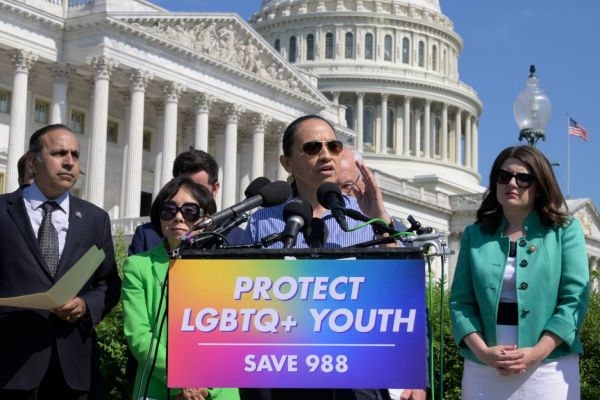
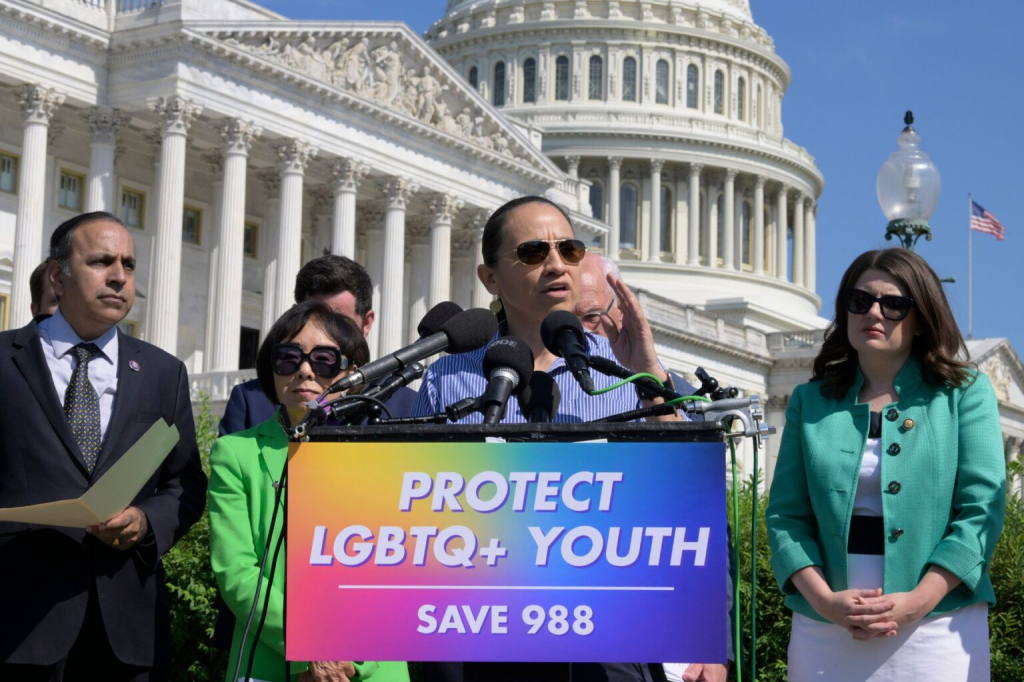
Sens. Tammy Baldwin, a Democrat, and Lisa Murkowski, a Republican, introduced a bipartisan bill on Wednesday to re-establish national emergency suicide prevention services for LGBTQ+ youth — which have been stripped by the Trump administration at a time when the vulnerable group needs it most. 

In July, the Trump administration terminated the 988 hotline’s LGBTQ+ services, which connected young people in crisis with counselors trained in supporting LGBTQ+ youth. This new bill, backed by the LGBTQ+ youth suicide prevention organization Trevor Project as well as the American Foundation for Suicide Prevention, would modify the Public Health Service Act to reinstate those services and require the Secretary of Health and Human Services to maintain them. The bill now moves to committee.

The Trevor Project estimates that more than 1.8 million LGBTQ+ young people seriously consider suicide each year in the United States, as they face high rates of bullying, assault and discrimination. And when the 2024 presidential race was called for Donald Trump, calls and texts to the Trevor Project’s own crisis hotlines spiked by 700 percent, as LGBTQ+ youth felt afraid about the outcome of the election. 

“Given that LGBTQ+ youth are more than four times as likely to attempt suicide than their peers, the need for these services remains pressing,” said Jaymes Black, CEO of The Trevor Project, in a statement. “This is not about politics, or identity; this is about doing what is best to support our country’s highest risk populations — and save young people’s lives nationwide.”

During his first term in 2020, President Trump signed a bipartisan law to create 988 as a more accessible resource for mental health emergencies. The free hotline launched in July 2022. Since then, millions of people in crisis have turned to 988. And nearly 1.5 million of those calls, texts and chats were sent by young Americans seeking specialized LGBTQ+ services. 

“We are in the middle of a mental health crisis, and the 988 lifeline saves lives, plain and simple,” said Baldwin, who wrote the original legislation to create the 988 hotline. Cutting funds for specialized services within 988 puts the lifeline in jeopardy, she said in a statement. 

“There is absolutely no good reason that Donald Trump took away this specialized help for our LGBTQ youth. Mental health does not see partisan lines or geography,” the Wisconsin Democrat added.

California lawmakers approve measure protecting medical data of transgender people 

Read more at The Hill.

California lawmakers passed legislation this week to prevent health providers from releasing transgender patients’ confidential medical records in investigations of gender-affirming care in states that ban treatment for minors. 

Senate Bill 497, introduced in February by Sen. Scott Wiener, a Democrat representing San Francisco, builds upon a 2022 state law that established California as a state of refuge for transgender people. That law, also authored by Wiener, prevents states that have banned gender-affirming care for minors from taking legal action against trans youth, their families and their doctors over treatment administered in California. 

The latest bill would require law enforcement requesting health information about transgender people in California to provide a warrant, according to Wiener’s office. It would also bar medical providers from complying with out-of-state requests, including subpoenas, for information related to gender-affirming care. 

“California must do everything in our power to protect the transgender community, and I’m confident that the Governor will continue his longstanding leadership on trans issues,” Wiener said in a statement on Thursday after the bill passed. 

The California Senate voted 30-10 on Wednesday to pass Wiener’s bill, which the state Assembly passed earlier this week. A spokesperson for California Gov. Gavin Newsom (D) declined to comment, saying the governor’s office does not typically remark on pending legislation. 

Newsom must sign or veto the measure by Oct. 13. 

The vote on Wiener’s bill comes after the Justice Department announced in June that it had sent more than 20 subpoenas to doctors and clinics “involved in performing transgender medical procedures on children” in investigations of alleged health care fraud and false statements. A subpoena sent to the Children’s Hospital of Philadelphia that was made public in a court filing last month requested patients’ birth dates, Social Security numbers and home addresses, as well as “every writing or record of whatever type” from doctors related to the provision of gender-affirming care to adolescents younger than 19 years. 

The subpoena requested information dating back to January 2020, more than a year before transition-related care was banned anywhere in the U.S. 

On Tuesday, a federal judge blocked an effort by the Trump administration to subpoena medical records of transgender patients who received gender-affirming care at Boston Children’s Hospital, calling the Justice Department’s investigation improper and “motivated only by bad faith.” 

In an email on Friday, a spokesperson for Wiener said Senate Bill 497, if signed, would “strengthen the case for any medical provider who wishes to fight Trump’s vicious assault on the transgender community.” 

President Trump and administration officials have broadly sought to ban gender-affirming care for minors. A Jan. 28 executive order states that the U.S. “will rigorously enforce” laws that ban transition-related care for anyone younger than 19. 

Federal judges have blocked parts of the order threatening funding for hospitals. 

Laws adopted by more than half the nation since 2021 ban gender-affirming care for minors, which major professional medical groups say is medically necessary and often lifesaving for transgender youth and adults. In June, the Supreme Court ruled that states can ban treatment for minors, finding that Tennessee’s prohibition on puberty blockers, hormones and rare surgeries for adolescents does not constitute sex discrimination. 

Blog at WordPress.com.

Up ↑