Supreme Court forces California to allow teachers to out trans kids

Read more at LGBTQ Nation.

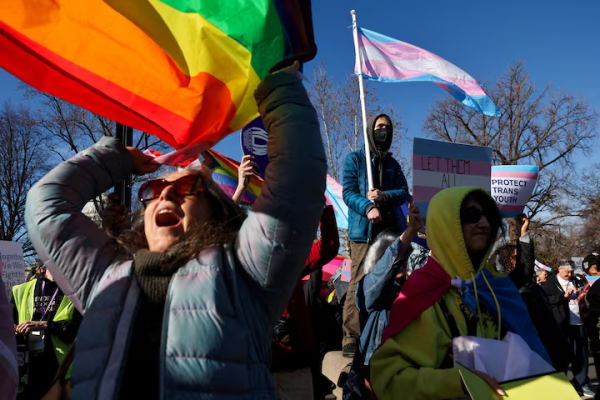
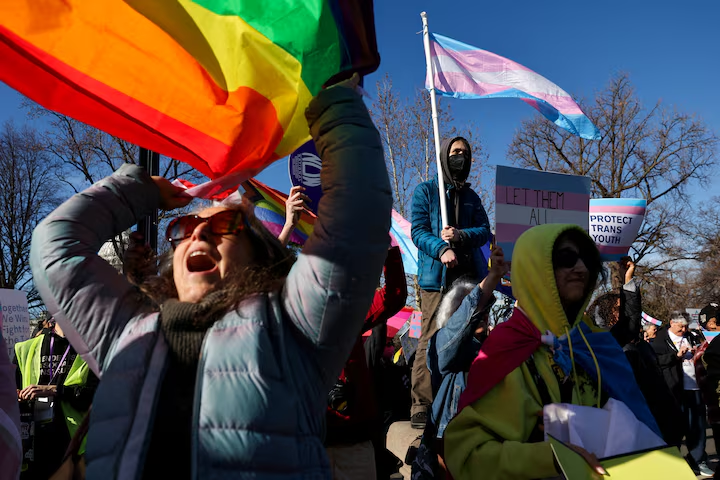
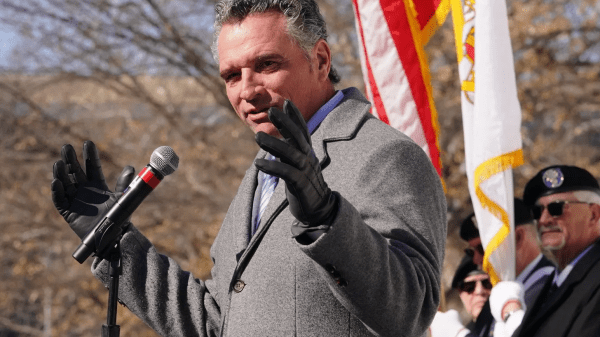
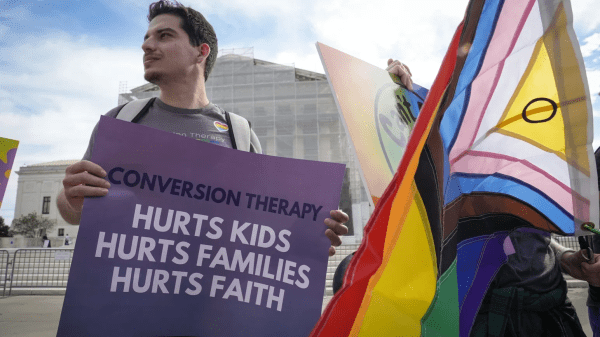
The Supreme Court yesterday blocked a law in California that bans teachers from outing trans kids to their parents from going into effect. The decision was 6-3, with the six Republican appointees opposing trans rights and the three Democratic appointees taking the side of trans kids.

The case involves teachers from Escondido Union School District who claim that their Christian faith requires them to out trans kids to their parents. They argue that their “right to exercise [their] own religious beliefs” is being violated by the district policy, which was established in response to 2016 legal guidance from the California Department of Education advising districts not to out students.

Trans and nonbinary youth can be put at risk of parental rejection and homelessness if outed to their parents.

The teachers, who were later joined by several parents in their lawsuit, won their case in a lower court in December, where Bush-appointed Judge Roger Benitez said that California should “trust parents to do the right thing for their child” and let teachers out trans kids to their parents, even in cases where the child fears abuse, neglect, or homelessness as a result. Trans and nonbinary youth are much more likely to experience homelessness compared to cisgender youth.

In early January, a panel of judges on the Ninth Circuit U.S. Court of Appeals issued a stay to Benitez’s injunction, allowing California to enforce its trans youth protections as appeals work their way through the legal system.

But the teachers appealed to the Supreme Court, which sided with them and granted their emergency request for a stay.

The Court issued an 18-page unsigned ruling that said they believe that the parents are “likely to succeed on the merits” of their religious freedom claim, which was that there is a “right of parents to guide the religious development of their children” that also implies a right to know how their children are presenting their gender at school. The Court said that not outing kids to their parents is an even “greater… intrusion on the parents’ free exercise rights” than schools letting kids read books with LGBTQ+ characters, which the Court also ruled schools couldn’t do in its Mahmoud v. Taylor ruling last year.

In her dissent, Justice Elena Kagan wrote that this case shows how the “emergency docket can malfunction” because the case involved “novel legal questions” that the Court is ruling on with “inadequate briefing.”

“The Court is impatient: It already knows what it thinks, and insists on getting everything over quickly,” she wrote, noting that the federal appeals court hasn’t even ruled on the appeals in the case yet.

On the more substantive issues, Kagan wrote that the Constitution makes no mention of parental rights and that the conservatives on the Court relied on the Due Process Clause, which they usually read narrowly. She pointed out that the idea that women have a right to control their own bodies elicits “outright hostility” from her conservative colleagues when it’s suggested to be part of the Constitution’s due process protections. But now the same conservatives found that that clause gives parents the right to know how their children are presenting their genders at school.

She added that parents’ rights have to be balanced against the “critical interests in the care and education of children” that the state has, and that they needed to follow “ordinary processes” to address that balance.

Outing trans youth to their parents puts them at increased risk of homelessness, according to the Williams Institute. Not only that, they might still be exploring their identities and need to exercise control over their coming-out process.

“Transition isn’t a flick of a switch; it’s a complex, gradual, weaving journey of identity,” Connie Walden, a trans woman, wrote to the New York Times in 2023.

“My own transition started in high school. At what stage between my experimenting with makeup now and then to asking specific friends to call me Connie would I have officially, suddenly, socially transitioned? When should I have been robbed of the right to come out to my own family, to decide when to include them in my own process?”

“I recognize the pain of well-meaning parents who feel that their child kept such a large ‘secret’ from them. Yet with transition being a gradual process of experimentation, there is no big secret. There’s only kids slowly figuring out who they are, like all other kids.”
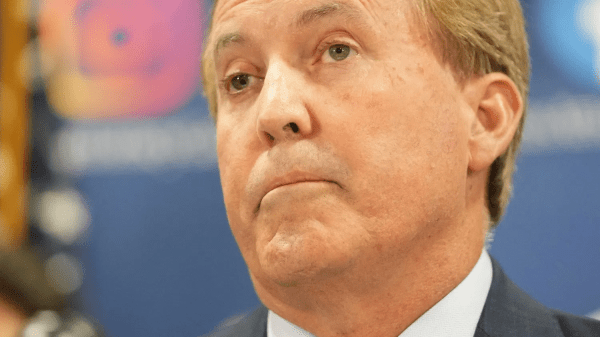
Republican TX AG sues chest binding company & claims its making “a fortune by hurting kids”

Read more at LGBTQ Nation.

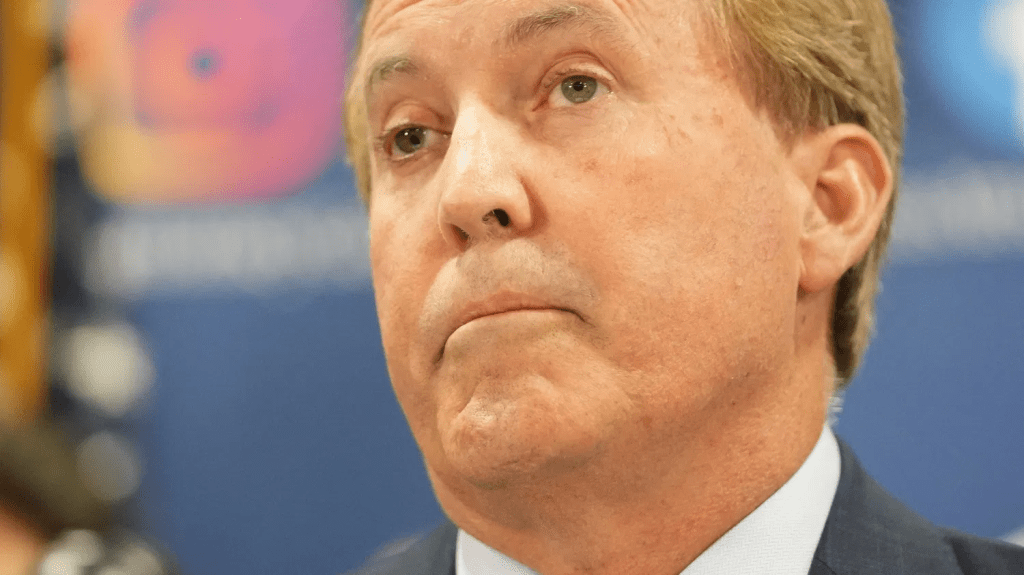
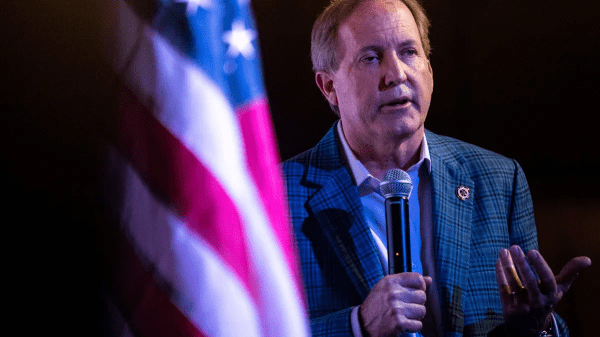
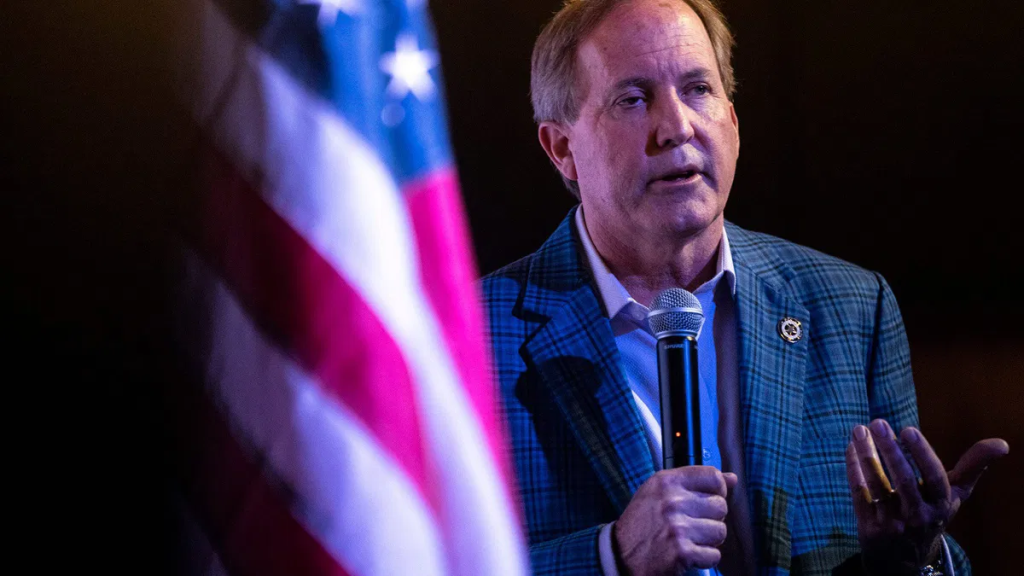
Texas Attorney General and U.S. Senate candidate Ken Paxton (R) is suing a New York-based company for marketing chest binders to minors.

Paxton has accused trans and nonbinary-inclusive youth undergarment brand Lola Olivia of violating his state’s consumer protection laws banning false, misleading, or deceptive advertising. The company, he claimed in a February 20 press release, sells chest binders “to Texas girls as young as nine-years-old to ‘transition’ them” without “informing them that they could be subjected to no less than twenty-eight different medical conditions.”

According to the World Professional Association for Transgender Health’s (WPATH) 2022 Standards of Care for the Health of Transgender and Gender Diverse People, trans masculine young people who bind their chests — described as a reversible, nonmedical practice that involves “compression of the breast tissue to create a flatter appearance” — report benefits including “increased comfort, improved safety, and lower rates of misgendering.” Risks such as back/chest pain, shortness of breath, and overheating are common. However, more serious risks, such as those Paxton cites in his lawsuit, like skin infections, respiratory infections, and rib fractures, are rare and more common among adults.

WPATH does recommend that healthcare professionals provide trans and gender diverse adolescents with “accurate and reliable information about the potential benefits and risks of chest binding,” and recommend the use of binders specifically designed for gender diverse people.

Paxton’s complaint includes multiple misrepresentations of medical research. Them notes it cites WPATH’s acknowledgement of certain risks associated with chest binding, but fails to note the infrequency of those risks among young people or the benefits when done properly.

The lawsuit also cites research published in the International Journal of Sexual Health last year, which found a “significant number of negative health implications” reported among trans and nonbinary people who bind. However, researchers also noted that “some studies also found positive effects on dysphoria, life satisfaction, and mental health,” and noted that several studies indicated a lack of knowledge about binding among healthcare providers. Researchers recommended further research “on long-term effects, safer methods, and promoting education” on chest binding.

The complaint also cites the U.S. Food and Drug Administration’s recent interpretation of chest binders as Class I medical devices under section 201(h) of the Federal Food, Drug, and Cosmetic Act because they are “intended for use in the diagnosis of disease or other conditions, or in the cure, mitigation, treatment, or prevention of disease, or to affect the structure or any function of the body.” Under this interpretation, Paxton alleges Lola Olivia is in violation of the Federal Food, Drug, and Cosmetic Act by not registering its products with the FDA. But the Dallas Voice notes that the FDA has said class 1 medical devices, which include items like manual stethoscopes and bedpans, “are generally exempt from premarket notification and approval.”

In his press release, Paxton falsely described “transitioning” minors as “child abuse” and accused Lola Olivia of making “a fortune by hurting kids.”

The lawsuit seeks a temporary restraining order, injunctive relief, and over $1,000,000 in monetary relief, including civil penalties.

Republican TX AG bans “radical” mental health workers from affirming trans youth: It’s “child abuse”

Read more at LGBTQ Nation.

Texas Attorney General Ken Paxton (R) has declared that it is illegal for mental health care providers licensed by the state to affirm trans youth and that doing so is child abuse.

The virulently anti-trans official issued the opinion on Monday to explain that the state’s gender-affirming care ban applies to mental health care as well. In a press release, Paxton’s office referred to the practice of affirming someone’s gender as “‘transitioning’ our kids.”

“Any radical facilitating the ‘transitioning’ of our kids is committing child abuse,” Paxton said in a statement. “The law is clear that these radical procedures are illegal and in no world should Texans’ tax dollars be used to permanently harm children. This opinion should send a clear warning there will be consequences for any medical professional, whether a doctor or a therapist, who is illegally ‘transitioning’ Texas kids.”

Trans news site Transitics said the opinion can be interpreted as essentially requiring mental health professionals to either refuse to see young trans patients or else engage in conversion therapy. The opinion states that therapists have an obligation to help children with “overcoming” an “underlying… condition,” which in this case is gender dysphoria.

“Even if they want to, they can no longer affirm a trans kid’s identity, offer alternatives in another state, or encourage parents to accept their kids for who they are,” Aleksandra Vaca at Transitics explained. “Under Paxton’s opinion, doing anything other than push a child to accept being their assigned sex at birth will result in providers losing their license and/or being imprisoned. This is conversion therapy, which is recognized by the United Nations as being tantamount to torture.”

Paxton has spent his tenure as attorney general terrorizing the trans community. In 2022, he issued a non-binding opinion calling gender-affirming health care a form of child abuse, which led Gov. Greg Abbott (R) to order the Texas Department of Family and Protective Services (DFPS) to investigate for child abuse any parents who allow their trans children to access gender-affirming medical care prescribed by their doctors.

In a post at the time, Paxton called gender affirming care and puberty blockers – which have been shown to reduce lifetime suicide risk for transgender people who have access to them before puberty – “monstrous and tragic.”

Paxton has also argued it should be legal to discriminate against trans people at work, and he once tried to force a school to cancel its Pride week. He has sued for the right to discriminate against LGBTQ+ students, sued a group that highlighted the rise in hate speech on Elon Musk’s social media platform X, and sued the National Collegiate Athletic Association (NCAA) to force it to inspect every athlete’s gender before allowing them to play.

He has also said consensual encounters between consenting same-sex adults should be illegal, and that state workers can deny marriage licenses to same-sex couples. 

Paxton was previously impeached by the Texas House in 2023 for 16 counts of bribery but was later acquitted by the Texas Senate. The FBI also investigated him for years for securities fraud, but the Department of Justice eventually dropped its investigation. He also settled a state securities fraud case against him, paying $300,000 and participating in community service to avoid legal charges.

In July, it came to light that his wife filed for divorce from him due to adultery.

Paxton told his staff about an extramarital affair in September 2018 while holding hands with his wife, The Texas Tribune reported. But while he recommitted to their marriage during that confession, he continued to cheat on her, the publication reported, even going through great lengths to hide affairs from her: using burner phones, secret email addresses, and secret rideshare accounts to meet with his mistress.

Kansas sued over transgender ID and bathroom law that invalidated driver’s licenses, birth certificates

Read more at Reuters.

Two transgender men in Kansas filed a lawsuit on Friday seeking to strike down a new state law that invalidated the driver’s licenses and birth certificates of more than 1,000 transgender people.

The American Civil Liberties Union is representing the plaintiffs, who claim in the lawsuit, opens new tab, filed in Kansas state court, that the law violates their rights to equality, due process and privacy under the state constitution.

The law makes Kansas the only U.S. state to invalidate previously approved changes to gender markers on identification documents, part of a broader push by Republican-led legislatures to restrict the rights of transgender people.

The sweeping law, which took effect on Thursday, requires state residents to change their gender identification on driver’s licenses and birth certificates to the sex they were assigned at birth, and bans them from changing their gender on those documents in the future.

The law also prohibits transgender people from using multi-occupancy bathrooms in government buildings that do not correspond to their sex assigned at birth, and authorizes private citizens to sue people who violate the law.

The plaintiffs, who filed the lawsuit under pseudonyms, said the law will require them to disclose their transgender status each time they present identification and expose them to harassment and violence when they use public bathrooms. They said they would seek an order temporarily blocking the law while the case proceeds.

Kansas officials on Thursday said identification documents had been invalidated for more than 1,000 state residents. Affected residents must pay for new driver’s licenses.

The office of Kansas Attorney General Kris Kobach, a Republican, did not immediately respond to a request for comment. The defendants in the lawsuit are Kobach’s office and state agencies that issue identification documents and maintain government buildings.

At least eight other states, including Texas, Florida and Indiana, have prohibited such changes moving forward, and several of those laws are being challenged in court.

Transgender people in the United States have faced increasing restrictions at the state and national levels. Republican President Donald Trump has issued a series of executive actions targeting transgender rights since returning to office last year.

One Trump directive stated that the U.S. government will recognize only two sexes: male and female. Others sought to exclude transgender athletes from female sports and require applicants for U.S. passports to list the sex they were assigned at birth.

Kobach’s office in 2023 filed a lawsuit claiming that changing the gender markers on driver’s licenses, which had been permitted up to that point, was already unlawful under state law. A state court rejected those arguments, opens new tab last year.

State lawmakers then introduced the bill later enacted into law after the Kansas legislature overrode Democratic Governor Laura Kelly’s veto.

Scouting America says transgender kids are still welcome after Pete Hegseth claimed they weren’t

Read more at Advocate.

Scouting America on Friday pushed back on claims by Defense Secretary Pete Hegseth that the organization would limit membership based solely on sex assigned at birth, insisting that transgender youth remain welcome in its programs.

“We have transgender people in our program, and we’ll have transgender people in our program going forward,” President and CEO Roger Krone told The Associated Press.

The statement contradicts Hegseth’s claims that the organization is rolling back participation rules amid the Trump administration’s dismantling of diversity, equity, and inclusion initiatives across federal agencies.

In a social media video posted Friday, Hegseth said Scouting America would “modify its policy to make clear that membership will be based solely on biological sex at birth and not gender identity,” adding that “the application must match the applicant’s birth certificate.”

He also said the organization would ensure “biological boys and girls will not be allowed to occupy or share intimate spaces together, toilets, showers, tents.”

Earlier in the video, Hegseth criticized the organization for having “welcomed the destructive myth of gender fluidity and transgenderism to infiltrate their membership.” In a memo to members issued after the Department of Defense announcement, Krone wrote that “Scouting America will continue to welcome and serve all youth. That commitment is unwavering.”

The memo does not specifically mention transgender youth. Instead, it emphasizes that eligibility requirements are unchanged. Under a section titled “What Is Not Changing,” the organization states that “Scouting will continue to welcome and serve all youth,” and that existing registration and youth-protection policies remain in place.

“It is important that our leadership – every one of you – recognize and reinforce Scouting’s unwavering commitment to delivering programs that benefit all youth,” Krone wrote.

Several programmatic changes are coming. Scouting America will waive registration fees for children of active-duty, Guard, and Reserve service members beginning June 1. According to the statement, it will introduce a Military Service merit badge and discontinue the Citizenship in Society merit badge “to align with Executive Order 14173,” Trump’s “Ending Illegal Discrimination and Restoring Merit-Based Opportunity” mandate. The organization will also dissolve its DEI committee to comply with the administration’s directive.

But the rules governing who can join, according to Krone, are not being altered.

The Advocate contacted Scouting America’s communications team for clarification on its policy regarding transgender scouts and how it reconciles that policy with Hegseth’s remarks. “Scouting America remains steadfast in our commitment to providing a place for all young people to learn, grow, and thrive. We will continue to welcome all youth into our programs,” a spokesperson responded.

In recent years, Scouting America, formerly the Boy Scouts of America, lifted bans on gay youth and leaders, opened its flagship program to girls, and, in 2024, rebranded as a coeducational organization. Those changes marked a significant shift for one of the nation’s oldest youth institutions.

“Importantly and unchanged, every family is welcome in Scouting,” Krone wrote. “Today, Scouting serves nearly one million youth from every corner of American life.”

Kansas Sends Letters To Trans People Demanding The Immediate Surrender Of Drivers Licenses

Read more at Erin in the Morning.

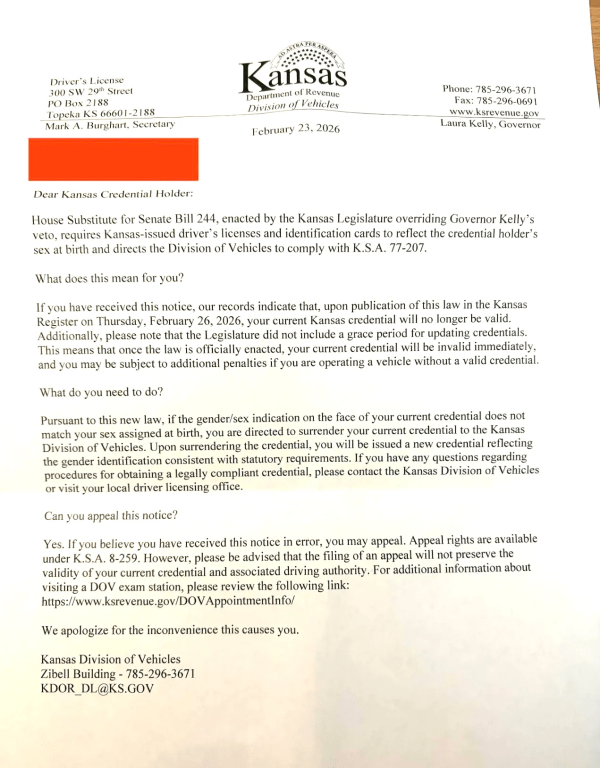
Today, transgender people across Kansas are reporting receiving letters from the Kansas Division of Vehicles stating that they must surrender their driver’s licenses and that their current credentials will be considered invalid upon the law’s publication in the Kansas Register on Thursday. Should any transgender person be caught driving without a valid license, they could face a class B misdemeanor carrying up to six months in jail and a $1,000 fine. Kansas already requires county jails to house inmates according to sex assigned at birth. The letter, obtained by Erin in the Morning, marks one of the most significant erosions of transgender civil rights in the United States to date.

The letter, which has been reported to Erin In The Morning by a Kansas-based activist, states that under House Substitute for Senate Bill 244, Kansas-issued driver’s licenses and identification cards must now reflect the credential holder’s “sex at birth.” It warns that upon the law’s publication in the Kansas Register on Thursday, February 26, current credentials for affected individuals “will no longer be valid.” The Legislature, the letter notes, “did not include a grace period for updating credentials,” and anyone operating a vehicle without a valid credential “may be subject to additional penalties.” Those whose gender marker does not match their sex assigned at birth are directed to surrender their current credential to the Division of Vehicles for reissuance.

SB 244, also known as the “bathroom bounty” bill, contained heavy identification document bans as well. The bill was rushed through the Kansas Legislature in January using a “gut and go” procedure that bypassed nearly all public input on its key provisions. Governor Laura Kelly vetoed the bill on February 13, calling it “poorly drafted,” but the Legislature overrode her veto days later. In addition to the driver’s license provisions, the law bans transgender people from using bathrooms matching their gender identity in public buildings and creates a bathroom bounty hunter system allowing citizens to sue transgender people they encounter in restrooms for at least $1,000 in damages, including potentially in private restrooms. The bill takes effect immediately upon publication in the Kansas Register rather than the standard July 1 effective date—giving transgender Kansans just days between the override and the invalidation of their identity documents.

The consequences for noncompliance could escalate quickly. Under Kansas law, driving without a valid license is a class B misdemeanor punishable by up to six months in jail and a $1,000 fine—though first-time offenders are more likely to face a citation and fine. A conviction, however, triggers an automatic 90-day license suspension. If a person drives during that suspension, they face a charge of driving on a suspended license, which carries a mandatory minimum of five days in jail. Kansas already requires county jails to house inmates by sex assigned at birth.

The Kansas letters arrive amid an accelerating nationwide campaign to strip transgender people of accurate identification documents. The Trump administration has barred transgender Americans from obtaining passports that reflect their gender identity, a policy the Supreme Court allowed to take effect in November. The Social Security Administration has similarly stopped permitting gender marker updates. At the state level, FloridaTexasIndiana, and other states have moved to block gender marker changes on driver’s licenses or birth certificates. But Kansas appears to be the first state to go further than simply blocking future changes—it is actively invalidating previously issued documents and demanding their surrender.

As a result of this extreme anti-transgender law, the state of Kansas has seen its status deteriorate to a “Do Not Travel” warning in the EITM Trans Risk Map. Transgender people should exercise extreme caution when traveling through the state, and those already living there should take immediate steps to legally protect themselves in the face of laws that could strip their driving privileges, expose them to criminal penalties, and subject them to thousand-dollar bounties simply for using a restroom. For most transgender people who do not already live in Kansas, the risk is now too great to travel there at all.

Court shuts down “nakedly hateful” law banning LGBTQ+ student clubs in Texas

Read more at LGBTQ Nation.

In a win for LGBTQ+ Texans, a federal judge has temporarily barred a group of public school districts from enforcing the nation’s first law explicitly banning LGBTQ+ student clubs.

Judge Charles Eskridge of the U.S. District Court for the Southern District of Texas ruled that the state’s Houston, Plano, and Katy school districts could not enforce state law S.B. 12, which passed last year and was called “one of the most nakedly hateful bills we have had on the floor of this House” by out state Rep. Erin Zwiener (D).

Republicans who supported the bill claimed LGBTQ+-supportive clubs are “sexualizing” children.

“We’re not going to allow gay clubs, and we’re not going to allow straight clubs,” said state Rep. Jeff Leach (R). “We shouldn’t be sexualizing our kids in public schools, period. And we shouldn’t have clubs based on sex.”

S.B. 12 was billed as a “Bill of Parental Rights” and also restricted diversity initiatives in public schools and required more parental notification when it comes to mental and physical health in schools.

It also bans teachers from referring to trans students by their preferred first names, even if their parents support their child’s transition. Students have been deadnamed in some school districts while others have complied with the law by calling trans kids by their last names only.

The lawsuit was filed by the ACLU of Texas, Transgender Law Center, and Baker McKenzie on behalf of the Texas American Federation of Teachers (AFT), the Genders & Sexualities Alliance (GSA) Network, Students Engaged in Advancing Texas (SEAT), a teacher, and two students.  

The plaintiffs argued that the law “censors huge swaths of constitutionally protected speech.”

“This win is bigger than me,” said plaintiff Adrian Moore, a Katy ISD student. “It’s a win for all trans students, and students from all backgrounds in my district. Schools should be places where all students feel safe and supported. I hope this lawsuit sends the message that when the LGBTQIA+ community and our allies work in solidarity, we can make a difference.”

Julie Johnson, Moore’s parent, said the ruling is “evidence that justice can sometimes prevail, that speaking up matters, and that it can have a positive impact in the broader community.”

“In a world that feels like basic human dignity is no longer a given right, it means something to my child that their voice was heard,” Johnson said. “In the weeks to come, Adrian will have a name at school. He will no longer be referred to by only his last name, while other students are referred to on a first-name basis. I will see my child’s name listed on programs and playbills at school events. My child will be seen and recognized as the worthy human being he is.”

J. Gia Loving and Maya LaFlamme, co-executive directors at Genders & Sexualities Alliance Network, said the decision “strengthens Texan trans, queer and Two Spirit youth’s right to gather, build connection and safely exist in their schools.”

“GSAs enable students with the skills to build confidence through leadership roles, create spaces of belonging for their peers, and advocate for justice,” they added. “While this is one battle won, our efforts to protect students’ right to safe, inclusive learning spaces and communities will continue. Today and every day, GSAs are here to stay!”

SEAT executive director Cameron Samuels also celebrated the temporary injunction. “Today’s ruling reminds us that queer and trans students’ resilience and joy are here to stay,” Samuels said. “We won’t stop fighting until all Texas students are guaranteed safe and welcoming school environments.”

The federal Equal Access Act requires federally funded public secondary schools to provide equal access to extracurricular student clubs. While that law was passed in 1984 because Christian activists worried that schools might stop Bible clubs from meeting, it has long been used by GSAs to protect their right to meet on school campuses.

GSAs – Gay-Straight Alliances or Gender-Sexuality Alliances – have been targeted by conservatives ever since they were first formed in the 1980s.

In the late 1990s, when Salt Lake City tried to shut down a local school’s GSA, and when they were told they were legally required to give all clubs equal access to school resources, the school board decided to cancel all extracurricular clubs just to stop the GSA, which eventually led to a federal lawsuit. A federal judge ruled that the school district had violated the Equal Access Act and students’ First Amendment rights, which resulted in the district allowing the GSA to meet again.

Hate incidents against LGBTQ+ community on the rise in Texas, across the U.S.: Report

Read more at CBS News.

Hate incidents against the LGBTQ+ community are increasing across the country, including in Texas.

That’s according to a new report by GLAAD, one of the largest LGBTQ+ advocacy organizations in the country.

Data from GLAAD’s 2025 Anti-LGBTQ Extremism Reporting Tracker desk shows that in Texas alone, there were over 60 incidents against members of the community. Those incidents include violent assaults, vandalism, and threats of mass shootings.

“We unfortunately found that there were more than 1,000 of these incidents, and in Texas specifically, we found that Texas was ranked third highest in the U.S.,” said GLAAD’s Sarah Moore. “It’s a snapshot of what LGBTQ people are going through, and not a total, you know, all-encompassing number. We know so many of these stories are not going reported, and if they are being reported, they might be uninvestigated, or they might be dismissed by local police departments.”

The report comes as Texas lawmakers advance policies that advocates said directly impact the LGBTQ+ community, like the so-called “bathroom bill,” which requires people in government buildings and schools to use certain facilities based on the sex they were assigned at birth, as well as the removal of rainbow and decorative crosswalks.

“This isn’t just, you know, something that people are putting into comment sections on Facebook. It’s not just something that we’re using to win political campaigns, but this type of rhetoric is having a very real impact on the lived experience of LGBTQ folks,” Moore said.

In Arlington, organizers of Arlington Pride cancelled this year’s celebration after the city council’s vote to revise the ordinance over concerns it could jeopardize federal funding. Critics said the new version strips away protections for the LGBTQ+ community and other marginalized groups.

“There’s a very strategic political agenda out there to make people feel other,” said Deejay Johannessen, the CEO at the Help Center for LGBTQ+ Health. “It’s showing that they’re less than and people then act upon that because they’re taking the lead from the political leaders.”

Johannessen said while members of the LGBTQ+ community have long faced challenges, the current climate is especially difficult.

“We can have our differences, but everybody has the right to live their lives. and feel safe in their own community,” Johannessen said.

Ken Paxton sues Children’s Health and Dallas doctor for allegedly providing transgender youth care

Read more at KERA News.

Attorney General Ken Paxton sued Children’s Health System of Texas and a Dallas doctor Wednesday for allegedly violating a Texas ban on gender-affirming care for minors.

The AG asked a Collin County judge for a temporary injunction to stop the two defendants from providing any gender-affirming care or filing any claims to Texas Medicaid for that care.

The suit alleges Jason Jarin, a pediatric and adolescent gynecologist at Children’s Health and associate professor at UT Southwestern Medical Center, violated the law with 19 patients. It alleges he violated a 2023 law that prevents health care providers from giving transgender youth puberty blockers, hormone replacement therapy or surgery for the purpose of transitioning — one of a number of Texas laws aimed at limiting the type of care transgender adults and children can receive.

Paxton also argues Jarin filed claims for these services with Texas Medicaid, which doesn’t cover any gender-affirming care.

“This criminal extremist not only permanently harmed children, but he also then defrauded Medicaid and stuck Texas taxpayers with the bill for this insanity,” Paxton wrote in a statement. “Experimental ‘transition’ procedures on minors are illegal, unethical, and will not be tolerated in Texas.”

Jarin told KERA News Wednesday morning he had just learned of the lawsuit, and declined to comment.

Children’s Health told KERA in a statement its “top priority is the health and well-being of the patients and families we serve.”

“We comply with all applicable local, state and federal health care laws. Due to ongoing legal proceedings, we are unable to comment further at this time,” the statement read.

Jarin became an assistant professor at UT Southwestern in 2016 and has published studies on transgender children, according to his faculty profile.

Many of the lawsuit allegations claim he intentionally prescribed extra hormones for transgender kids leading up to Sept. 1, 2023, when the law took effect, so that they could continue to get treatment.

The law, known as Senate Bill 14, did allow for prescriptions to continue for children who were “already subject to a continuing course of treatment that began prior to June 1, 2023,” and children who “attended at least 12 mental health counseling or psychotherapy sessions over a period of at least six months prior to starting treatment,” according to Paxton’s suit. But those prescriptions had to be for the purpose of weaning the patient off the drug.

Jarin is accused of violating SB 14 with 12 of the 19 patients. If found liable, he could lose his medical license — SB 14 requires the Texas Medical Board to revoke the license of any physician who provides gender-affirming care to a child.

Kansas GOP overrides gov’s veto to enact bill that could ban “husbands from wives’ shared hospital rooms”

Read more at LGBTQ Nation.

Republican lawmakers in Kansas overrode Gov. Laura Kelly’s (D) veto of an extreme bathroom bill that Democrats say will ban people from visiting loved ones in hospitals, nursing homes, and dorms if they aren’t of the same sex.

“As I said in my veto statement, this is a poorly drafted bill with significant, far-reaching consequences,” Kelly said in a statement. “Not only will this bill keep brothers from visiting sisters’ dorms and husbands from wives’ shared hospital rooms, it will cost Kansas taxpayers millions of dollars to comply with this very vague legislation.”

Kelly vetoed S.B. 244 last Friday. But, because Republicans have supermajorities in both chambers of the legislature, they were able to override her veto in a party-line vote. The Kansas House of Representatives voted 87-37 in favor of overriding her veto, and the state Senate voted 31-9 in favor. Both votes occurred in the last 24 hours.

“Kansas Democrats are for They/Them,” Senate President Ty Masterson (R) said in a statement. “I will continue to fight for you, and protect women and girls across our state.”

Republicans in the state legislature passed S.B. 244 last month. The bill was originally about gender markers on drivers’ licenses, but Republicans used a sneaky maneuver called “gut-and-go” to hold hearings on the drivers’ license part of the bill and then change the text to include bathroom provisions, without holding hearings on those bathroom provisions.

The bathroom provisions will ban trans people from using facilities that do not align with their sex assigned at birth in government buildings.

The law “obviously discriminates against transgender people in ways that make our lives exponentially more difficult and dangerous,” said state Rep. Abi Boatman (D), who is transgender.

Democrats stressed that the bathroom provisions were poorly written and would affect any situation where people are being housed in shared living spaces, like dorms, nursing homes, and hospitals.

“If your grandfather is in a nursing home in a shared room, as a granddaughter, you would not be able to visit him. If your sister is living in a dorm at K-State, as a brother, you would not be able to visit her in her room,” Kelly said in a statement when vetoing the bill. “I believe the Legislature should stay out of the business of telling Kansans how to go to the bathroom and instead stay focused on how to make life more affordable for Kansans.”

“If you feel you have to accompany your nine-year-old daughter to the restroom at a sporting event, as a father, you would have to either enter the women’s restroom with her or let her use the restroom alone.”

State Sen. Kellie Warren (R) said that the unintended consequences won’t happen because, she told CJ Online, they’re “not the subject of the bill.”

The bill will also ban trans people from getting the gender markers updated on their driver’s licenses. The Kansas Department of Revenue will have to invalidate licenses where the gender marker has been corrected, and the same applies to birth certificates.

Blog at WordPress.com.

Up ↑