Mace faces accusations of staging a “self-serving publicity stunt.”
A 33-year-old man has been arrested for allegedly assaulting Rep. Nancy Mace (R-SC) in retaliation for her recent opposition to trans rights.
“I was physically accosted at the Capitol tonight by a pro-tr*ns man,” Mace wrote on X. It’s unclear why she chose to censor the word “trans,” but given her outspoken anti-trans views, she may be signaling that she considers it a term to be stigmatized.
“One new brace for my wrist and some ice for my arm and it’ll heal just fine,” she continued. “The Capitol police arrested the guy. Your tr*ns violence and threats on my life will only make me double down. FAFO. #HoldTheLine.”
A statement from U.S. Capitol Police confirmed that foster youth advocate James McIntyre of Illinois was arrested for allegedly assaulting Mace after lawfully entering the building through security. According to sources who spoke to Axios, the incident occurred during an event for the Foster Youth Caucus, of which Mace is a co-chair.
However, three eyewitnesses have accused Mace of fabricating the assault, claiming that she and McIntyre simply exchanged a standard handshake, during which he asked the Congresswoman to protect trans rights.
“From what I saw, it was a normal handshake and interaction that I would expect any legislator to have with a constituent,” former foster youth and LGBTQ+ rights advocate Elliot Hinkle told Imprint.
Hinkle further noted that McIntyre’s arrest – he is also a former foster youth – sends a troubling message: “It sends a chilling effect of, you’re not actually safe to go to Capitol Hill and share an opinion that is true for you, that isn’t violent — because right now if you do, a congressperson might say that they were physically assaulted and call the police on you. So how would a young person in care feel safe?”
In a Facebook post, foster youth advocate Lisa Dickson expressed her frustration with Mace’s actions at the event: “I want to express deep disappointment in the fact that Congresswoman Nancy Mace came to a national foster youth event, told participating youth that it was a safe space — and literally had one of them arrested by Capitol police for simply shaking her hand and asking about trans rights.”
She added in a follow-up: “Today was not the day or the time for a self-serving publicity stunt – especially not a politician lashing out at a vulnerable young person who just took her at her word that, when helping foster youth, ‘all suggestions are welcome.’”
Mace, who has long espoused anti-trans views, has escalated her rhetoric since trans Rep.-elect Sarah McBride (D-DE) won her race for Congress in November.
In response to McBride becoming the first trans person ever elected to Congress, Mace introduced a resolution to ban trans women from using women’s facilities at the Capitol, as well as legislation to bar trans people from using restrooms on all federal property. This comes despite the fact that trans people have been working at and visiting the Capitol for years without incident, and McBride, as a member of Congress, would receive her own private bathroom.
Although Mace’s resolution has not yet been voted on, Speaker Mike Johnson (R-LA) has already instituted a rule prohibiting trans people from using restrooms that correspond with their gender at the Capitol complex.
Over the past several weeks, Mace has continued to escalate her anti-trans rhetoric, even casually using an anti-trans slur in reference to protestors.
After a group of trans rights protestors demonstrated against her, she filmed a social media video in which she said, “Alright, so some tr***y protestors showed up at the Capitol today to protest my bathroom bill, but they got arrested, poor things. So I have a message for the protestors who got arrested. You ready?”
She then took out a bullhorn, despite already being audible through her microphone, and proceeded to read the standard Miranda rights into the bullhorn while facing a police officer. “You have the right to remain silent. Anything you say can and will be used against you in a court of law.”
Her use of the slur sparked widespread backlash.
And now, it appears that Mace is regularly using the bigoted term in her rhetoric.
“My staff has arrived to another wonderful morning in Washington, DC. Good morning, tr*nnies. #HoldTheLine” — Rep. Nancy Mace (@RepNancyMace), December 9, 2024.
Mace has been leveraging transphobia as a cornerstone of her political career since before she was elected to Congress. In her first campaign, she falsely claimed that a law requiring “transgender equality in the military” existed, blaming her Democratic opponent for it and suggesting that it would result in a Marine Corps base in her district being shut down. The claim was entirely fabricated—no such law existed, and the Marine base remains operational today—but it helped her secure a seat in Congress.
In her second run for office, Mace ran an ad accusing her opponent of providing “SEX CHANGE SURGERY. PUBERTY BLOCKERS. GENDER CHANGING HORMONES. FOR CHILDREN?” Despite the fact that her opponent was a doctor at a hospital that did not provide gender-affirming care, the smear campaign was effective, leading to the opponent’s forced resignation.
Mace’s record on LGBTQ+ rights is abysmal, scoring just 15 and 14 out of 100 on the Human Rights Campaign’s Congressional Scorecard. She has voted against the Equality Act, which would ban federal discrimination against LGBTQ+ people, and opposed the reauthorization of the Violence Against Women Act because it included protections for transgender inmates.
In her ongoing crusade against trans rights, Mace has referred to Rep.-elect Sarah McBride (D-DE) as “it” and as a “man,” and has made efforts to block McBride from using women’s restrooms at the Capitol. In addition, she has started selling anti-trans t-shirts and has stated that it’s “offensive” for McBride to believe she is “equal” to other congresswomen.
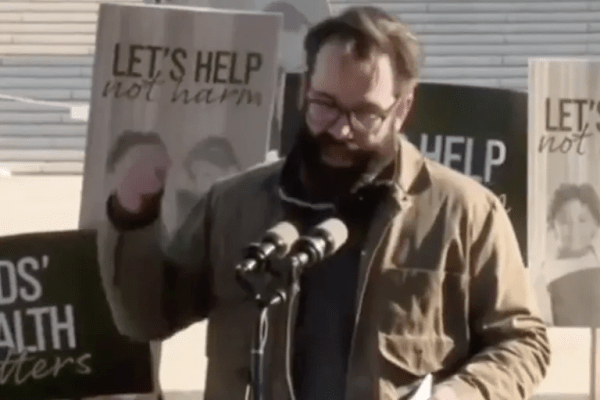
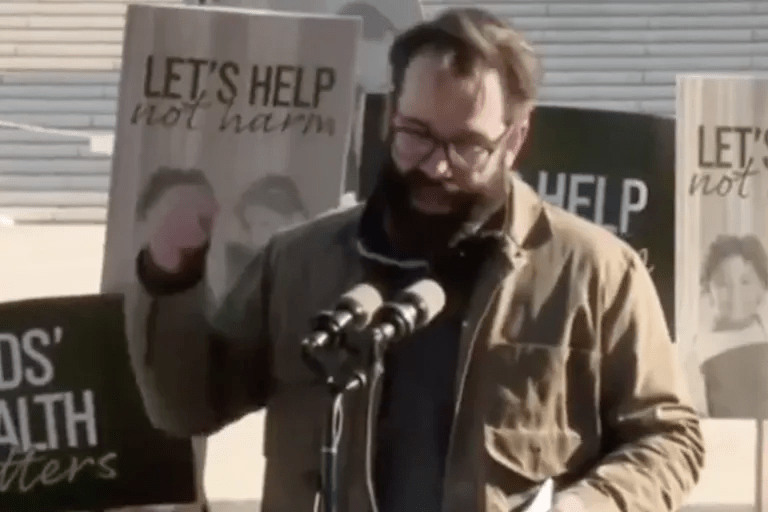
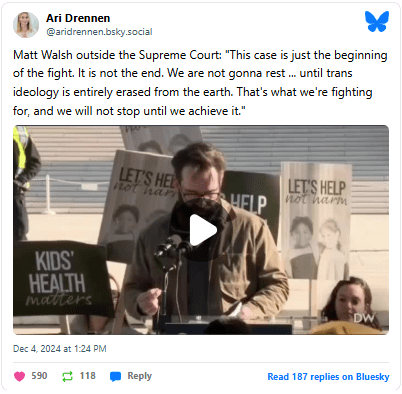
Anti-trans activist and far-right provocateur Matt Walsh demanded that transgender individuals be “completely erased from the earth” during an anti-trans rally outside the Supreme Court on Tuesday.
That morning, oral arguments commenced in the case of United States v. Skrmetti, which challenges Tennessee’s ban on gender-affirming care for transgender minors. The outcome of this case is expected to shape the future of gender-affirming care access across the country.
Walsh was joined by other anti-trans figures, including Rep. Marjorie Taylor Greene (R-GA), as they spoke outside the Supreme Court while pro-trans rights activists attempted to drown out their message. The New Republic reports that there were approximately four times as many pro-trans protesters as anti-trans ones.
“Children have a right to be protected from all of those people over there who want to harm them and damage them and destroy them, and they will be,” Walsh declared.
“So to the trans activists over there who are claiming this is all about the rights of children, I say again: Yes, you’re right, it is. They have a right to be protected from you. Children have a right to be protected from all of those people over there who want to harm them and damage them and destroy them.”
“They are gonna lose,” he continued. “They are losing right now. We are not going to let them harm our children. This case is just the beginning of the fight. It is not the end. We are not gonna rest until every child is protected, until trans ideology is entirely erased from the earth. That’s what we’re fighting for, and we will not stop until we achieve it.”
Walsh also stated, “There’s no such thing as a ‘trans kid.’ That doesn’t exist. Those kids are not trans. They are confused, and their confusion has been exploited by quacks and abusers. They are abuse victims. They are not trans kids.”
Walsh, the author of Church of Cowards, is known for producing anti-trans documentaries and promoting harmful rhetoric online. He has advocated against no-fault divorce and compared raising gay children to human trafficking or amputating limbs. He has also faced accusations of defending those who commit child sexual abuse.
Moreover, Walsh has stated that “two men shouldn’t be allowed to adopt,” opposed diversity initiatives within the Republican National Committee, and has relentlessly attacked transgender people. His actions include starring in a feature-length comedy film intended to mock trans women and girls fighting for the right to compete in sports in alignment with their gender.
In a November 7, 2022, appearance on conservative podcaster Joe Rogan’s show, Walsh described homosexuality as a result of humans being a “fallen species,” attributing it to “our fallen human nature” and “proclivities towards sin,” explaining his opposition to same-sex marriage.
She had to slog through deep snow to remove them herself.
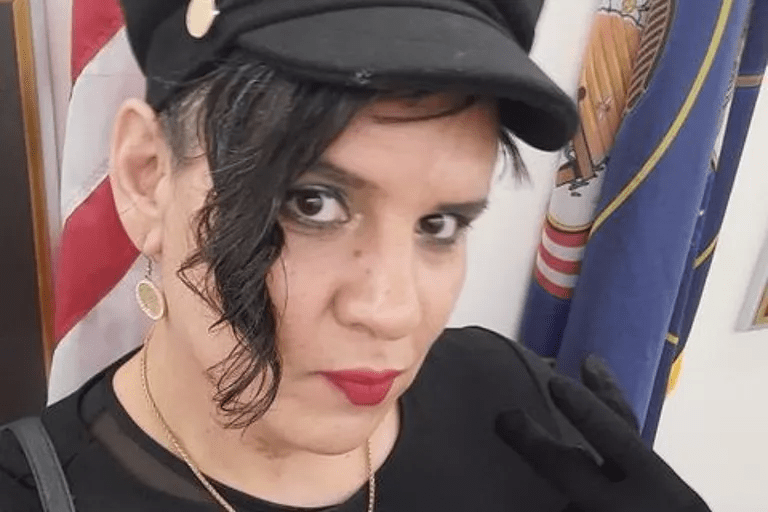
Hateful flyers circulated in Billings, Montana, falsely accusing local trans activist Adria Jawort of “grooming children,” according to local news outlet KTVQ. The flyers, which perpetuate the false narrative from the anti-trans right that all trans people are pedophiles, were posted near schools in Jawort’s neighborhood just days before Thanksgiving.
Jawort had to travel across town in heavy snow to remove the flyers herself.
“I was annoyed about it,” she told KTVQ, describing how the flyers misgendered her and made hateful claims about her life and sexuality. “I was just thinking, why am I doing this? Why do I have to do this? Why do people think this is okay?”
“The thing the flyer said, calling me a groomer and stuff, and basically labeling me as a danger to the community,” Jawort added. “It’s like one of the most awful things you can say. How does that become normalized?”
Billings police are currently investigating the incident. Lt. Matthew Lennick spoke on what constitutes hate speech: “Once someone transitions from making a general statement about their beliefs or another group to a targeted attack on an individual… a victim could take civil action against someone attempting to defame them.”
Possible criminal charges could include disorderly conduct, stalking, intimidation, or harassment, among others.
While Jawort knows the group responsible, she says she’s more frustrated by the ongoing attacks on state Rep. Zooey Zephyr (D-MT). Recently, Republicans unsuccessfully attempted to ban her from women’s bathrooms.
Jawort has been targeted before. Last year, a lecture she was set to give at a library was canceled after a drag ban, with staff citing concerns that hosting a transgender person posed “too much of a legal risk.” This led her to file a lawsuit against the state.
A proposed bill in Congress seeks to prohibit transgender individuals from using bathrooms in museums, national parks, and other federal properties. How would this ban be enforced, and what potential consequences could arise?
Congress faces a long list of urgent priorities, including securing funding to prevent a government shutdown, many of which are expected to be postponed until 2025. One new addition to that agenda is legislation introduced by GOP Rep. Nancy Mace, which seeks to ban transgender women from women’s restrooms and transgender men from men’s restrooms on all federal property.
The South Carolina lawmaker introduced this bill after launching a campaign to remove newly-elected Rep. Sarah McBride of Delaware from women’s restrooms on Capitol Hill. Following House Speaker Mike Johnson’s announcement of a rule that aligned with Mace’s initial proposal, she expanded the bill to restrict all transgender Americans from using restrooms, locker rooms, and changing rooms on federal property nationwide.
If the bill were to become law, how would it be enforced, and what consequences would follow? What is the current atmosphere like for transgender lobbyists and advocates on Capitol Hill? The 19th spoke with several experts to learn more.
Where would such a law apply? This sweeping legislation would lead to widespread discrimination against transgender individuals, experts warn, even though Mace’s rhetoric has primarily targeted transgender women. It could expose trans and nonbinary people to harassment and discrimination at national parks, courthouses, IRS buildings (such as taxpayer assistance centers), Social Security Administration offices, certain post offices, and Native American lands.
If enforceable, this federal ban would prevent transgender individuals from accessing spaces that are intended to be among the most accessible to all Americans, said Kelly Dittmar, an associate professor of political science at Rutgers-Camden University and director of research at the Center for American Women and Politics (CAWP).
“I would assume this includes Smithsonians and other federal buildings, museums, landmarks—places that should be accessible to the public, partly because they are government-funded or operated,” she explained.
The language in Mace’s proposed bill would limit bathroom access in “any building, land, or other real property owned, leased, or occupied by any department, agency, or instrumentality of the United States (including the Department of Defense and the United States Postal Service), or any other instrumentality wholly owned by the United States, or by any department or agency of the District of Columbia or any territory or possession of the United States.”
How likely is it that this ban will become law? Mace’s bill is unlikely to advance until the new Congress is sworn in this January, as the Senate is currently adjourned until December 2, and members are focused on major defense and agricultural measures. When and if the bill does come up for consideration, it will likely face a potential filibuster by Senate Democrats, despite Republicans holding a majority in both chambers. It also remains unclear how much support Mace’s bill has within the Republican Party.
How would this law be enforced? Mace’s proposal lacks details on how nationwide restrictions on bathroom use for transgender Americans would be enforced, and her office did not respond to a request for comment. To understand how such a ban might function in practice, experts point to state-level bathroom bans, many of which have surfaced since 2015 but have largely failed to become law.
State bathroom bans often provide few, if any, specifics on enforcement, as they rely on private citizens to act as enforcers. Logan Casey, director of policy research at the Movement Advancement Project, a nonprofit that tracks LGBTQ+ legislation, explains that these laws are de facto enforced by emboldening individuals to police others’ bathroom use.
“There’s no written enforcement because the proponents of these bills know that just by talking about this, let alone enacting these laws, they are emboldening individual people themselves to enforce these bathroom bans,” Casey said.
A recent extreme example of this can be seen in Odessa, Texas, where a new ordinance allows citizens to sue transgender people using bathrooms that match their gender identity, with damages of “no less than $10,000.”
Deputizing private citizens to enforce such laws can result in high rates of harassment and violence, particularly targeting transgender individuals and cisgender women who do not conform to traditional gender norms, Casey added.
What’s going on at Capitol Hill? Are trans people banned from bathrooms there? “All single-sex facilities in the Capitol and House Office Buildings — such as restrooms, changing rooms, and locker rooms — are reserved for individuals of that biological sex,” said House Speaker Mike Johnson in a statement. This policy appears to apply to all transgender individuals working at or visiting the Capitol complex. Johnson’s office did not respond to a request for clarification.
Johnson’s statement also does not clarify how the new policy will be enforced. Mace’s original bill proposed that the House sergeant-at-arms would be responsible for enforcing a bathroom ban, but Johnson’s announcement did not reference this. His office did not respond to a request for comment regarding the enforcement of the new rule.
Without clear guidance on enforcement, transgender lobbyists and advocates like Caius Willingham, a senior policy analyst at Advocates for Trans Equality, are left to wait and see if they will be policed for simply trying to do their jobs and what the consequences of noncompliance might be. Unlike members of Congress, these employees don’t have access to private facilities, and when working on the Hill, alternative options are often scarce.
“The Capitol grounds are massive. Some buildings don’t even have a single, single-occupancy bathroom. So practically, if I’m going to spend the day on the Hill meeting with legislators and staff, which is core to my job, I may have to be strategic about what bathrooms I use,” Willingham said. “I might have to run outside to find a restroom outside the Capitol building.”
The broader implications of a federal bathroom ban would extend this restriction to all of D.C., Willingham added, considering how many people work in federal buildings.
Is this legal? Court opinions on this matter have been divided. Last year, the 11th U.S. Circuit Court of Appeals upheld a Florida policy banning transgender students from using bathrooms that align with their gender identity. However, in 2021, the Supreme Court sided with trans advocates by upholding a 4th U.S. Circuit decision that found a Virginia bathroom ban unconstitutional.
Two states—Utah and Florida—ban transgender individuals from using bathrooms and facilities that match their gender identity in all government-owned buildings, K-12 schools, and colleges, according to the Movement Advancement Project. Violating these laws is a criminal offense in both states. Seven other states have passed laws restricting trans Americans’ bathroom access only in K-12 schools.
Article I of the Constitution grants Congress broad jurisdiction over its own internal rules and procedures. However, Mace’s proposed federal bathroom ban could conflict with recent Supreme Court precedent, according to Barbara Comstock, a former Republican congresswoman from Virginia. The majority opinion in the Supreme Court’s 2020 decision in Bostock v. Clayton County, written by conservative Justice Neil Gorsuch, ruled that discrimination based on sexuality or gender identity constitutes unconstitutional sex discrimination.
“I don’t think they’ve looked at this in light of the law whatsoever,” Comstock said. “So I think this is just an embarrassing stunt — which does raise attention to the challenges and discrimination faced by transgender Americans.”
Who is actually endangered by trans people using the bathroom? Research shows that it is transgender people, not cisgender individuals, who are most at risk of violence and discrimination when using the restroom. Transgender people often face harassment, verbal abuse, and even physical violence when trying to use restrooms that align with their gender identity.
The 2015 U.S. Transgender Survey found that many transgender people avoid public restrooms due to fear of mistreatment. Of over 27,000 respondents, 26 percent said that in the previous year, they had been denied access to restrooms, had their presence questioned, or were verbally harassed, physically attacked, or sexually assaulted while using a restroom.
Research from the Williams Institute at the University of California, Los Angeles School of Law, conducted in 2018, found that expanding non-discrimination laws to include transgender people does not increase the frequency of criminal incidents in restrooms, locker rooms, or changing rooms. While Mace and other Republican lawmakers have argued that banning trans women from women’s restrooms will protect cisgender women, empirical evidence does not support the claim that including transgender people in these spaces leads to safety or privacy issues.
Willingham shared his experience working in the House as a legislative assistant to Rep. Pramila Jayapal of Washington from 2021 to 2023, noting that his identity as a transgender person was never an issue. Despite witnessing transphobic rhetoric from some members of Congress during hearings and debates, he was treated with respect by colleagues. It was a jarring and frustrating experience for him.
“It’s really frustrating to see things go backwards in Congress,” Willingham said. “My experience working even across the aisle was extremely positive.”
Trump has pledged to eliminate gender-affirming care for trans youth, ban trans kids from participating in sports, and erase trans people from public life. Is he actually able to carry out these promises?
As the second Trump administration starts to take form, civil rights advocates are bracing for a new wave of attacks on the LGBTQ+ community. During his first term, Trump’s White House enacted over 200 policies that harmed LGBTQ+ equality, including the ban on openly trans individuals serving in the military, cuts to HIV/AIDS funding, and the repeal of protections for trans patients seeking healthcare and trans individuals in need of emergency shelter.
Trump has made it clear that he intends to continue reversing LGBTQ+ rights once he returns to the White House in January. On his 2024 campaign website, the president-elect outlined an aggressive agenda targeting fundamental rights and protections for LGBTQ+ people. This includes a ban on gender-affirming medical care for trans youth, federal “Don’t Say Gay” policies restricting LGBTQ+ discussions in schools, a nationwide ban on trans student-athletes competing according to their gender identity, and a federal law defining gender as binary and assigned at birth—measures that would have far-reaching consequences for trans, nonbinary, and intersex Americans.
Civil rights groups say they are already bracing for the upcoming battle as Trump assembles a diverse group of anti-LGBTQ+ nominees for his Cabinet. What will bolster his administration’s power to push its far-right agenda is the GOP’s control over all three branches of government: six of the nine Supreme Court justices were appointed by Republican presidents, and conservatives will hold majorities in both houses of Congress for the first time since 2016.
Them spoke with legal experts to assess how feasible Trump’s anti-LGBTQ+ threats are and what strategies advocates might use to fight back. Despite the challenges ahead, Ezra Cukor, co-interim legal director of Advocates for Trans Equality, remains hopeful, believing this is merely “one chapter in a story of trans folks being a part of civil society in the United States.”
“There have been moments of joy, and there have been moments of challenge,” he tells Them. “In this moment, I’m just grateful to be part of a broader civil rights fabric, knowing that there’s a long history of trans folks insisting on our basic rights and working for our liberation and that there are many of us in this together.”
Ending Gender-Affirming Care for Trans Youth
In a January 2023 video posted on his Truth Social platform, Trump vowed to launch an all-out assault on gender-affirming healthcare for trans youth. He called on Congress to pass a law banning “child sexual mutilation” in all 50 states and pledged to cut Medicaid and Medicare funding to any hospital providing gender-affirming care to minors. Trump also promised to instruct the Department of Justice to investigate whether medical providers had “deliberately covered up horrific long-term side effects” of transition care for youth, and he vowed to support a “private right of action” for patients who might later regret the transition treatments they received as children. (This, despite the fact that rates of transition regret are notably low.)
Civil rights groups are already preparing for the fight ahead as Trump selects a range of anti-LGBTQ+ nominees for his Cabinet. What will strengthen his administration’s ability to push its far-right agenda is the GOP’s control over all three branches of government: six of the nine Supreme Court justices were appointed by Republican presidents, and conservatives will hold majorities in both houses of Congress for the first time since 2016.
Them spoke with legal experts to gauge how feasible Trump’s anti-LGBTQ+ threats truly are and what actions advocates might take to resist them. Despite the significant challenges, Ezra Cukor, co-interim legal director of Advocates for Trans Equality, remains hopeful, viewing this moment as “one chapter in a story of trans folks being a part of civil society in the United States.”
“There have been moments of joy, and there have been moments of challenge,” Cukor tells Them. “In this moment, I’m just grateful to be part of a broader civil rights fabric, knowing that there’s a long history of trans folks insisting on our basic rights and working for our liberation, and that there are many of us in this together.”
Ending Gender-Affirming Care for Trans Youth
In a January 2023 video posted on his Truth Social platform, Trump promised to launch a full-scale assault on gender-affirming healthcare for trans youth. He called on Congress to pass a law banning “child sexual mutilation” across all 50 states and vowed to eliminate Medicaid and Medicare funding for hospitals providing gender-affirming care to minors. Trump also pledged to direct the Department of Justice to investigate whether medical providers had “deliberately covered up horrific long-term side effects” of transition care for youth, and he expressed support for a “private right of action” for patients who might later regret their transition treatments. (This, despite the fact that regret rates for transition treatments are extremely low.)
Sasha Buchert, a senior attorney with Lambda Legal, argues that the push for a national trans sports ban exposes the hypocrisy of Republicans’ long-standing stance that LGBTQ+ educational policies should be decided at the state and local level. “Once the far right gets in power, suddenly they feel like they should be imposing their beliefs on the rest of the country,” Buchert tells Them, pointing to the 26 state attorneys general who opposed the Biden administration’s interpretation that Title IX protects trans students from discrimination. “These issues aren’t in isolation. They’re part of a widespread onslaught of attacks targeting the trans community and specifically trans youth.”
Given the potential for a filibuster, Buchert predicts Trump will not wait for Congress to act, instead seeking “immediate gratification” to appease his base. She expects him to issue an executive order that would bar trans students from protection under Title IX, echoing the early days of his first term, when his Department of Education repealed Obama-era guidance that required schools to treat trans students in accordance with their gender identity.
Buchert vowed that Lambda Legal would challenge such an order in court, pointing out that courts have consistently ruled against targeted sports bans, which they view as discriminatory toward trans athletes. Anti-trans sports laws in Arizona and Idaho have been blocked by the courts for now, while the Fourth Circuit Court of Appeals blocked West Virginia from preventing a trans student, Becky Pepper-Jackson, a 14-year-old middle school runner, from competing. (West Virginia intends to appeal that ruling to the Supreme Court.)
“The federal courts have agreed that it really does deprive [trans student athletes] and harm them by not allowing them to participate,” Buchert says. “The argument that they can still play on a boys’ team or intramural team doesn’t hold any water. The courts have seen right through that. It’s like saying before marriage equality: ‘You can still get married. You just can’t get married to somebody of the same gender.’”
Enacting National “Don’t Say Gay” Policies
Trump has also pledged to implement broader policies targeting LGBTQ+ students in schools, including “Don’t Say Gay”-style restrictions in the classroom and regulations that would force teachers to out trans students to their parents. His 2024 platform promises to “protect the rights of parents from being forced to allow their minor child to assume a gender” without their consent, frequently repeating false claims that schools are transitioning children without their families’ knowledge. “Can you imagine you’re a parent and your son leaves the house and you say, ‘Jimmy, I love you so much. Go have a good day in school,’ and your son comes back with a brutal operation?” Trump asked at a Wisconsin rally. “Can you even imagine this? What the hell is wrong with our country?”
Should Trump push his proposed policies through Department of Education regulations or an executive order, Chris Erchull, a staff attorney with the LGBTQ+ advocacy group GLAD, believes the legal system will stand with queer students. He points out that courts have long held that all students are “entitled to a full education.” “You go all the way back to the promise of Brown v. Board of Education, which said that separate education is not equal education,” he tells Them, referencing the landmark 1954 Supreme Court ruling that desegregated schools by race. “Those principles apply when we’re talking about the rights of LGBTQ+ students today. For students to get a complete education, they need to see themselves represented. You can’t suppress their identities in the classroom, or you’ll be depriving them of that.”
Erchull also notes that in the past year, advocates have won several key victories in the fight against anti-LGBTQ+ restrictions in schools. In March, Florida settled a lawsuit that rolled back parts of its “Don’t Say Gay” law, narrowing the scope of the state’s regulations. The law was so broadly worded that school districts, fearing lawsuits for noncompliance, had applied it to nearly all aspects of campus life, including student clubs like Gender-Sexuality Alliances. Just two months later, a New Hampshire district court ruled that an anti-LGBTQ+ law restricting classroom discussions in the state was “unconstitutionally vague.”
“Those are really powerful examples of how the courts can step up and be a voice of reason amidst attempts to undermine public education,” Erchull says. “There’s this zero-sum thinking where, if LGBTQ+ students are represented and seen, that’s depriving other people of something, and that’s not true at all. What research shows is that inclusive and supportive school environments benefit all students.”
Federal Law Erasing Trans People
Trump’s campaign website promises that, if re-elected, he will push Congress to pass a law defining gender as strictly male and female, assigned at birth. This pledge echoes a policy from his first presidency, when the Department of Health and Human Services (HHS) attempted to narrow the federal definition of gender to “immutable biological traits identifiable by or before birth.” A 2018 memo reportedly circulated within HHS stated that “the sex listed on a person’s birth certificate, as originally issued, shall constitute definitive proof of a person’s sex unless rebutted by reliable genetic evidence.”
Passing a federal bill through Congress to define trans people out of existence would be unprecedented, requiring support from both houses to succeed. Sarah Warbelow, legal director at the Human Rights Campaign, notes that LGBTQ+ advocates have already seen the potential impact of such policies through laws enacted at the state level. In May 2023, Montana Gov. Greg Gianforte (R) signed a law redefining sex as strictly male or female in portions of the state code. While that statute was struck down by a district court earlier this year, Kansas and Tennessee still have similar mandates in place.
Warbelow emphasizes that these types of restrictions have far-reaching consequences on trans people’s daily lives, impacting their ability to obtain identity documents and access spaces that align with their identities. However, she also points out that the full implications of such laws are unclear. After Kansas passed its 2023 law redefining gender, Attorney General Kris Kobach (R) claimed that schools were required to out trans students to their parents, even though the law did not explicitly state this. Warbelow notes that “there are huge unknowns” about how a federal law erasing trans identities would be interpreted or applied, whether by the courts, individual states, or schools.
“It becomes unclear how it would be operationalized,” she tells Them. “To the extent that it is interpreted broadly, it could have ramifications for non-discrimination laws. In Bostock, the Supreme Court interpreted the term ‘sex’ to be broadly understood as including LGBTQ+ people in the context of non-discrimination laws, so it could potentially eliminate those legal protections for LGBTQ+ people in the future.”
That’s why Warbelow says that the Human Rights Campaign, as the nation’s largest LGBTQ+ organization, is exploring “every option” to counter Trump’s anti-trans agenda. She adds that if litigation becomes necessary, the organization will likely invoke constitutional protections related to free speech, equal protection under the law, and due process to challenge a federal redefinition of gender. “We know it’s going to be incredibly tough work, but we have no choice but to fight,” she asserts. “We’ve got to throw our all at preserving democracy and the rights of LGBTQ+ people.”
A new report sheds light on the “epidemic of violence” targeting transgender and gender non-conforming individuals.
This article addresses violence against transgender individuals and includes references to graphic content.
The epidemic of fatal violence against transgender individuals in the United States shows no signs of slowing down, with the Human Rights Campaign (HRC) documenting at least 36 killings over the past year. Half of these victims, including Honee Daniels, Kassim Omar, Redd, Vanity Williams, and others, were Black trans women.
The Human Rights Campaign (HRC), which has been tracking the murders of transgender individuals since 2013, released its 2024 report on the “Epidemic of Violence Against the Transgender & Gender-Expansive Community in the U.S.” on Tuesday. The report covers deaths between the day after Trans Day of Remembrance 2023 (November 21, 2023) and November 20, 2024. HRC highlighted that a disproportionate number of victims in the past year were young people of color—75% of all victims were people of color, and 54.3% were under the age of 35. Among the youngest victims was 14-year-old Pauly Likens, a trans girl who was tragically killed and dismembered in her Pennsylvania hometown in June, marking the youngest recorded death. Other young trans victims included 18-year-old Jazzlyn Johnson and 17-year-old Tayy Dior Thomas.
Tori Cooper, Director of Community Engagement for the Transgender Justice Initiative at HRC, stated that transphobia is fueled by disinformation, rhetoric, and ideologies that treat the transgender community as political tools, ignoring their right to live free from fear of harm or death. She pointed out the “disturbing reality” that half of the victims were Black trans women, a reflection of the ways in which racism, misogynoir, sexism, transphobia, and other societal issues disproportionately affect the trans community.
Cooper concluded, “In spite of these tragedies, I choose to remember the beauty brought to the world by those victims who left this earth far too soon and will celebrate their memories by continuing to fight for them through the Trans Justice Initiative’s advocacy and our leadership development work.”
While the statistics in the report are bleak, there was one slightly positive development. According to the report, 41.7% of victims were initially misgendered by the media or law enforcement. While still a significant number, this is the lowest percentage the Human Rights Campaign (HRC) has recorded since it began tracking this data in 2013. However, the report also highlights some alarming “firsts.” For the first time since 2013, transgender individuals were killed in Minnesota, Utah, and Nevada.
The HRC notes that the report is released at a critical moment for the transgender community in the U.S. Last June, for the first time in its history, the organization declared a state of emergency for LGBTQ+ Americans, citing the unprecedented number of anti-LGBTQ+ bills introduced in state legislatures across the country that year. The report also reflects the broader political climate, with former President Donald Trump, who ran on a platform that scapegoated trans people and pledged to ban gender-affirming care for trans youth, recently re-elected. His administration has appointed numerous anti-trans figures, such as Elon Musk, JD Vance, and Matt Gaetz, to key positions in the White House.
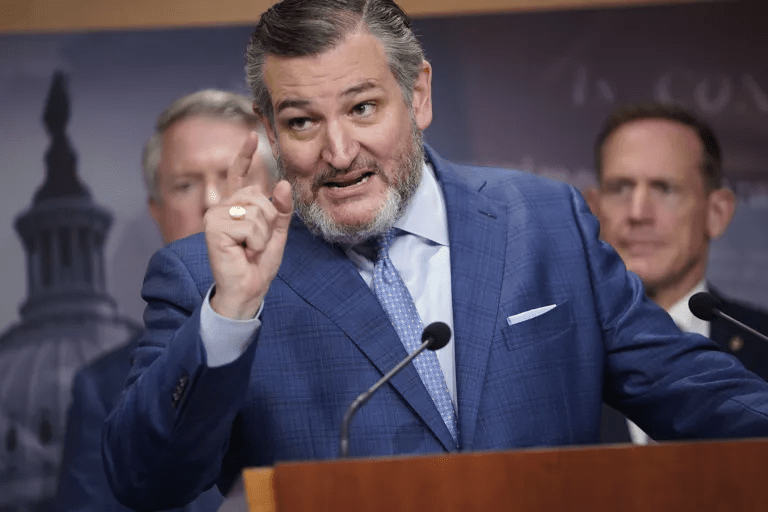
Ted Cruz exploited the images of two minors without their parents’ consent, misrepresenting them as “boys in girls’ sports.” This misleading tactic serves his narrative while disregarding basic respect for privacy and accuracy.
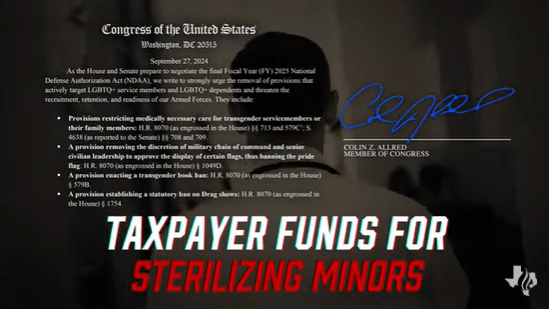
Republican Senator Ted Cruz’s relentless pursuit of transgender targets in a series of hateful attack ads aimed at his Democratic opponent, Colin Allred, has backfired. Cruz has landed in controversy after using the images of two cisgender teenage girls without their parents’ permission. The girls appear in at least two fear-mongering ads that attack both the trans community and Allred, where they are pictured alongside former University of Pennsylvania swimmer Lia Thomas and CeCé Telfer, a Jamaican-born sprinter and the first openly transgender woman to win an NCAA title. The use of their likenesses has sparked outrage from the girls’ parents and their high school.
In one of the ads, a photo of the two teens at an Oregon high school track and field event is shown, while a narrator ominously declares, “Boys in girls’ sports.” This misleading and inflammatory statement further fuels the attack on transgender athletes, misrepresenting the two girls and distorting the issue.
A representative from the Beaverton School District has demanded that the ads be removed “from any and all distribution platforms,” following an email sent to the Cruz campaign and shared with The Hill. The district’s representative emphasized that the two athletes pictured are minors and made clear that neither the family, the school, nor the district had given permission for the photo to be used.
“It is alarming that your campaign would have produced, distributed, or promoted this ad with false information, especially with minor children involved,” the representative wrote.
The photo originally appeared in an April report by Central Oregon Daily News, which covered a controversy involving a transgender high school athlete in the state. In response, a Cruz campaign spokesperson claimed the image depicted “a female athlete who spoke out against boys playing in girls’ sports after participating in a track meet where a biological male beat female athletes and impacted individual and team medal results.” However, the spokesperson did not address the misleading labeling of the two young women as “trans boys.”
Despite the campaign’s focus on anti-trans rhetoric, Cruz and his fellow MAGA Republicans continue to push this divisive messaging, even as they ignore voters’ top priorities, such as the economy and healthcare. This strategy echoes the failure of 2022, when the GOP’s massive ad campaign centered on similar anti-trans tropes and failed to produce the expected “red wave” in the midterm elections.
Democratic nominee Colin Allred, who is locked in a tight race with Cruz, has condemned the senator’s anti-trans attack ads as a “disgusting, false attack,” accusing Cruz of trying to “divide Texans.” Josh Stewart, a spokesperson for Allred, added, “Cruz will say anything to distract from his dangerous abortion ban that is putting women’s lives at risk, his efforts to raise the retirement age for Social Security and Medicare, and his shameful escape to Cancun during a deadly winter storm.”
This marks the first instance of a city allowing individuals to sue trans people for using public restrooms.
The city of Odessa, Texas, has implemented a $10,000 bounty for anyone who reports a transgender person using a restroom that matches their gender identity, according to independent journalist Erin Reed.
Under this ordinance, individuals—excluding local and state government officials—are allowed to sue transgender people for using such facilities. The rewards for successful claims include “injunctive relief” to prevent further violations, nominal and compensatory damages if the plaintiff can prove harm, statutory damages of at least $10,000 per violation, as well as court costs and attorney’s fees.
While the bounty is set at a minimum of $10,000, there is no maximum limit on how much the reward can grow.
In addition to the bounty, Odessa’s ordinance includes criminal penalties for individuals who use restrooms that align with their gender identity. Those found in violation of the law can be charged with a Class C misdemeanor, punishable by a fine of up to $500. Anyone who refuses to use a bathroom corresponding with what the city considers their biological sex—after being asked to leave by a building owner—could also face misdemeanor trespassing charges.
The law defines “biological sex” based on birth certificates, either the original or a corrected version in cases of clerical errors. This means that even if a transgender person has updated their birth certificate to reflect their gender identity, they could still be in violation of the ordinance if they use a bathroom that aligns with their gender.
There are no exceptions for disabled individuals who may be accompanied by someone of a different gender, and the law could potentially lead to lawsuits targeting people who are gender non-conforming or whose gender expression doesn’t fit societal norms.
Similar bathroom bans with criminal penalties have been enacted in states like Utah and Florida, while other states, like North Dakota, have laws without clear penalties or enforcement mechanisms. Erin Reed compared Odessa’s bounty system to the anti-abortion bounty laws in Texas, where private citizens are empowered to sue anyone who aids in an abortion. This strategy shifts the responsibility of enforcement from government officials to private individuals, circumventing the usual legal processes.
Johnathan Gooch, communications director for Equality Texas, condemned the ordinance, telling the Texas Tribune, “It’s a very aggressive way to alienate trans people from public life, and I think it is counter to the spirit of friendship that most Texans embody.”
He added, “It enables vigilantes to target anyone they don’t think matches the gender expression they expect to see in the bathroom, and that is truly insane.”
This is the first instance of a city allowing individuals to sue transgender people for using public restrooms.
The city of Odessa, Texas, has implemented a $10,000 bounty on any transgender individual who uses a restroom that corresponds with their gender identity, according to independent journalist Erin Reed.
The ordinance allows individuals—excluding local and state government officials—to sue transgender people for using bathrooms that align with their gender. The rewards for successful lawsuits include “injunctive relief sufficient to prevent the defendant from violating the provisions of this ordinance,” along with potential “nominal and compensatory damages” if the plaintiff claims to have suffered harm. The law also stipulates statutory damages of at least $10,000 for each violation, as well as court costs and reasonable attorney’s fees.
While the bounty is set at a minimum of $10,000, there is no maximum limit on how much the reward could ultimately be.
In addition to the $10,000 bounty, the ordinance imposes criminal penalties on individuals who use restrooms that align with their gender identity. According to the provision, anyone violating the ordinance will be guilty of a Class C misdemeanor, subject to a fine of up to $500. If a person refuses to leave a restroom after being asked by a building owner, they could also face charges of misdemeanor trespassing.
The law defines “biological sex” based on the gender listed on birth certificates—either at birth or corrected in the case of clerical errors. This means that even if a transgender individual updates their birth certificate to reflect their gender identity, they would still be in violation of the law if they use a restroom that matches their gender.
The ordinance makes no exceptions for disabled individuals who may be accompanied by a person of a different gender, and it could open the door to lawsuits targeting anyone who appears gender non-conforming.
While bathroom bans with criminal penalties have been enacted in states like Utah and Florida, other states, such as North Dakota, have passed similar bans without clear penalties or enforcement mechanisms. Erin Reed has drawn comparisons between the Odessa bounty and Texas’ anti-abortion bounties, which allow private citizens to sue anyone who aids someone seeking an abortion. Both strategies rely on private individuals to enforce the law, bypassing government enforcement mechanisms.
Johnathan Gooch, communications director for Equality Texas, criticized the measure in an interview with the Texas Tribune: “It’s a very aggressive way to alienate trans people from public life, and I think it is counter to the spirit of friendship that most Texans embody.”
He continued, “It enables vigilantes to target anyone they don’t think matches the type of gender expression they expect to see in the bathroom, and that is truly insane.”









 fleeredstates.blog
You must be logged in to post a comment.