California must stand strong in support of our trans community members.
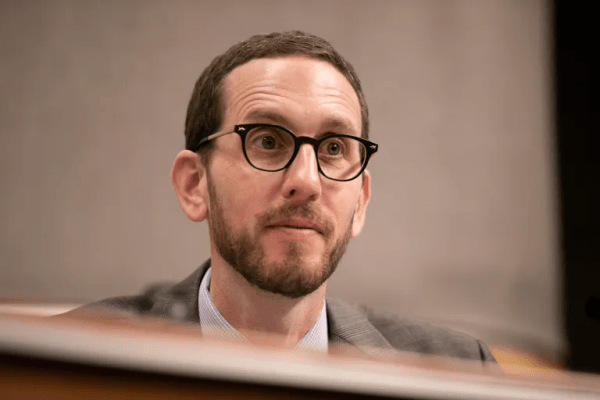
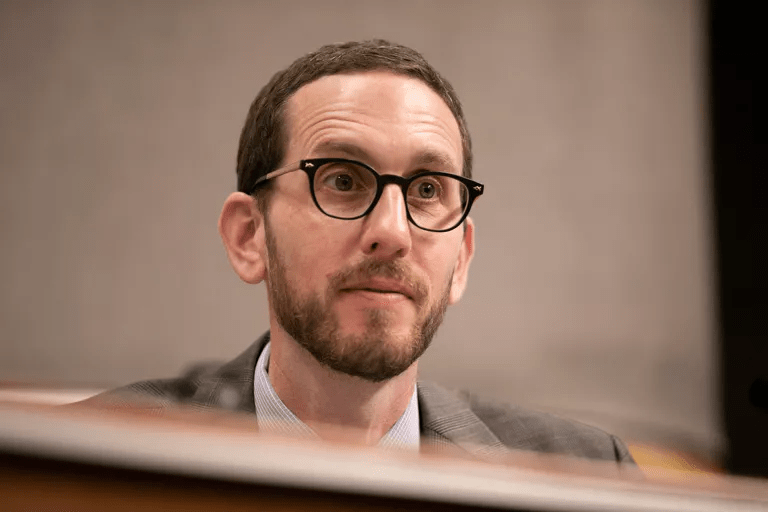
Out California State Sen. Scott Wiener (D) has introduced a bill aimed at protecting the privacy of trans people in anticipation of the incoming Trump administration. Wiener warned that Trump’s hostility toward trans individuals and his planned rollback of their rights would “only embolden abusive right-wing extremists.”
The proposed legislation, S.B. 59, known as the Transgender Privacy Act, seeks to create an automatic process to seal all court records related to an individual’s gender transition in the state. This would include retroactively sealing existing records. The bill also ensures that any gender transition records that reference a person’s dead name or sex assigned at birth would be kept sealed.
A similar law protecting youth was passed in 2023, but Wiener’s bill specifically targets individuals over 18.
“The incoming Trump administration and Republican congressional leadership have made it clear that targeting and erasing trans people is one of their highest policy priorities, and California must stand by our trans community members,” Wiener said in a statement. “Making personal identifying information public after someone transitions—such as their dead name or the fact that they are trans or nonbinary—needlessly exposes trans and nonbinary Californians to harassment and potential violence.”
If passed, California would join Washington, Oregon, and New York in enacting privacy laws that protect trans people from being forcibly outed through state records.
“When I learned I was unable to change my name in California without being forcibly outed online and exposed to harassment, I was appalled,” said Hazel Williams, a trans activist who worked with Wiener on the legislation, according to the Bay Area Reporter. “I’m proud to help rally community members and advocacy organizations to fix this. There are 220,000 transgender and nonbinary adults in California. All of us deserve privacy and safety, and this legislation is a vital step in that direction.”
The bill follows a ruling last year by Fresno’s 5th District Court of Appeal, which granted a trans woman the right to seal her transition-related records after being outed on social media, harassed by anonymous users, and forced to close all her accounts. While the decision set a precedent for judges to allow requests to seal such records, it does not mandate it in the way Wiener’s bill would.
“As Trump and his cronies continue their cynical incitements of violence against transgender people, it’s critical that we fight back with progressive protections at the state level,” said Syd Simpson, co-chair of the Harvey Milk LGBTQ+ Democratic Club’s Transgender Caucus, in an interview with the Bay Area Reporter.
“It’s really scary to know that there are people out there who want to hurt you, and that your personal information is just sitting there for them to exploit. The right to privacy and the right to be safe are precious to our community, and we’ve got to fight for them.”
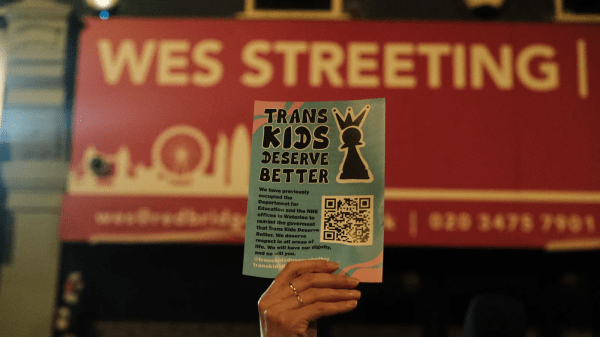
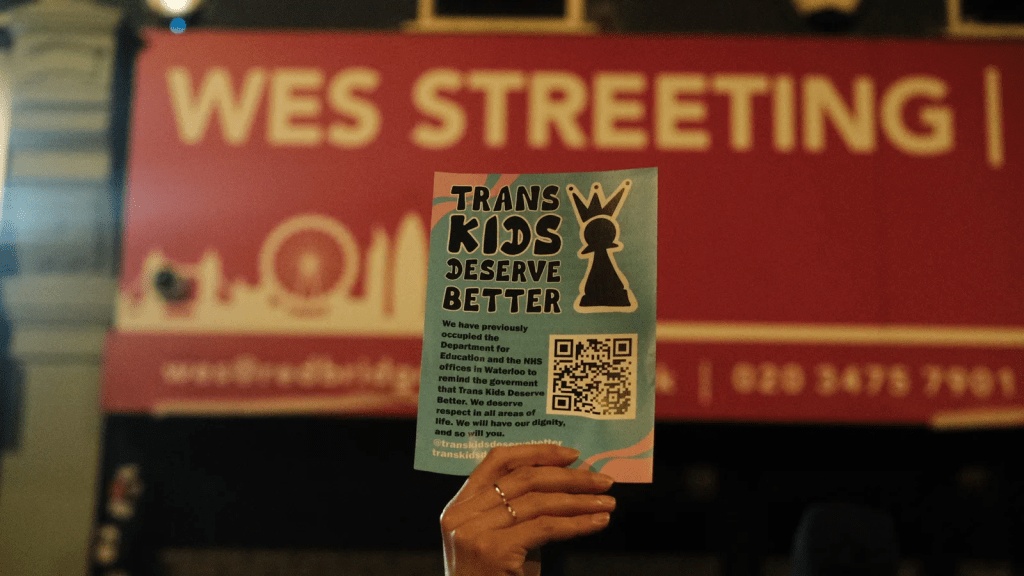
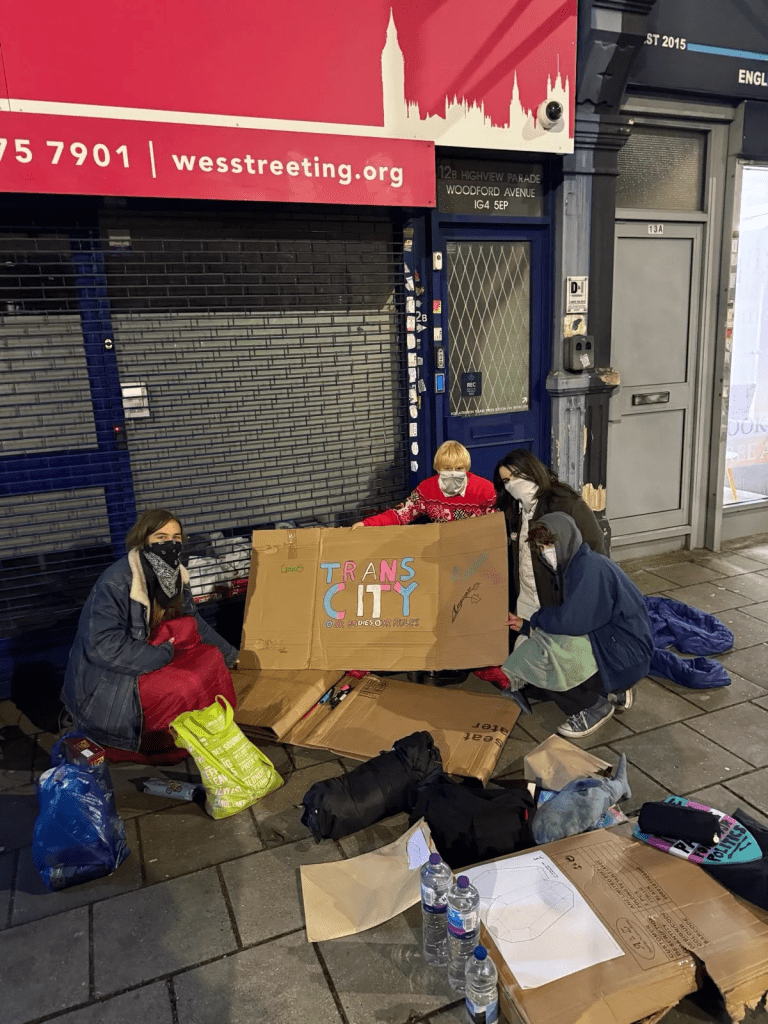
The activists, part of the group Trans Kids Deserve Better, staged an overnight protest outside the Department of Health and Social Care offices.
In response to the announcement by Health Secretary Wes Streeting and the Department of Health and Social Care that puberty blockers for treating gender dysphoria in trans youth would be banned “indefinitely,” a group of trans youth activists set up a temporary encampment outside Streeting’s office. On December 11, Trans Kids Deserve Better and their supporters set up camp outside Wes Streeting’s office, remaining there overnight until the following day, according to an Instagram post from the group. While puberty blockers have effectively been banned in the U.K. since May, when the Department of Health and Social Care imposed an “emergency ban” on the medication for trans youth, Streeting’s recent announcement on Wednesday further extended the ban. He stated that the National Health Service (NHS) and private doctors are prohibited from prescribing or supplying puberty blockers to trans youth for gender dysphoria treatment until 2027. However, existing prescriptions for trans youth will continue to be honored. In contrast, cisgender youth experiencing precocious puberty are still permitted to receive prescriptions for the blockers.
In an article for Huck Magazine, one of the group’s activists, known as Grin, wrote that “while today isn’t a big change, it is a sign that the denial of our healthcare is now institutionalized.” Gender clinics in the U.K. have faced criticism for notoriously long waiting times, with an August study revealing that trans youth wait an average of two years to begin receiving gender-affirming care.
Grin wrote that Streeting “has promised ‘clinical trials’ on the effects of hormone blockers.” However, many clinical studies on the subject already exist, and the overwhelming majority conclude that hormone blockers are beneficial to the well-being of trans youth.
“But we already know what happens when we get them. We get to live happier, healthier lives because our bodies won’t be permanently altered in ways we don’t want,” Grin continued. “The real trial or experiment he has now created is to keep us from our healthcare and see what happens when an entire generation of trans people grows up knowing the trauma they’ve gone through was avoidable. I’ve not consented to be part of that experiment — I just wanted healthcare.”
The group has been targeting Streeting since August as part of a separate campaign called Trans Kids Are Dying, Wes Streeting. According to Grin’s article in Huck Magazine, the group has visited the secretary’s office daily since July, delivering “handmade paper coffins” to symbolize the lives of trans people already lost and those still at risk. Grin also mentioned that the group had received an invitation to meet with Streeting, but that it “never happened,” despite “constant emails to follow up on his invitation.”
On this occasion, the activists left a life-sized cardboard coffin outside Streeting’s office, as detailed in an Instagram post by Jude Guitamacchi, who participated in the overnight protest.
In their Instagram caption, they wrote, “This healthcare ban starts with trans+ kids but won’t end with them. This is about all of us. We must work together and do everything we can to challenge the ban and fight for the human rights of the trans+ community in the UK.”
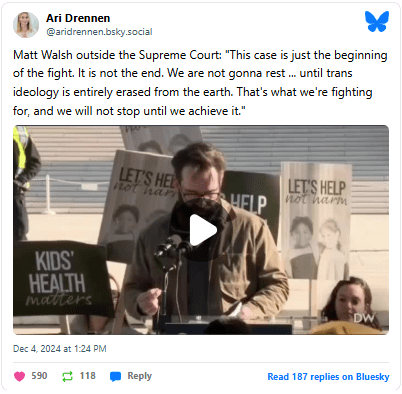
Anti-trans activist and far-right provocateur Matt Walsh demanded that transgender individuals be “completely erased from the earth” during an anti-trans rally outside the Supreme Court on Tuesday.
That morning, oral arguments commenced in the case of United States v. Skrmetti, which challenges Tennessee’s ban on gender-affirming care for transgender minors. The outcome of this case is expected to shape the future of gender-affirming care access across the country.
Walsh was joined by other anti-trans figures, including Rep. Marjorie Taylor Greene (R-GA), as they spoke outside the Supreme Court while pro-trans rights activists attempted to drown out their message. The New Republic reports that there were approximately four times as many pro-trans protesters as anti-trans ones.
“Children have a right to be protected from all of those people over there who want to harm them and damage them and destroy them, and they will be,” Walsh declared.
“So to the trans activists over there who are claiming this is all about the rights of children, I say again: Yes, you’re right, it is. They have a right to be protected from you. Children have a right to be protected from all of those people over there who want to harm them and damage them and destroy them.”
“They are gonna lose,” he continued. “They are losing right now. We are not going to let them harm our children. This case is just the beginning of the fight. It is not the end. We are not gonna rest until every child is protected, until trans ideology is entirely erased from the earth. That’s what we’re fighting for, and we will not stop until we achieve it.”
Walsh also stated, “There’s no such thing as a ‘trans kid.’ That doesn’t exist. Those kids are not trans. They are confused, and their confusion has been exploited by quacks and abusers. They are abuse victims. They are not trans kids.”
Walsh, the author of Church of Cowards, is known for producing anti-trans documentaries and promoting harmful rhetoric online. He has advocated against no-fault divorce and compared raising gay children to human trafficking or amputating limbs. He has also faced accusations of defending those who commit child sexual abuse.
Moreover, Walsh has stated that “two men shouldn’t be allowed to adopt,” opposed diversity initiatives within the Republican National Committee, and has relentlessly attacked transgender people. His actions include starring in a feature-length comedy film intended to mock trans women and girls fighting for the right to compete in sports in alignment with their gender.
In a November 7, 2022, appearance on conservative podcaster Joe Rogan’s show, Walsh described homosexuality as a result of humans being a “fallen species,” attributing it to “our fallen human nature” and “proclivities towards sin,” explaining his opposition to same-sex marriage.
She had to slog through deep snow to remove them herself.
Hateful flyers circulated in Billings, Montana, falsely accusing local trans activist Adria Jawort of “grooming children,” according to local news outlet KTVQ. The flyers, which perpetuate the false narrative from the anti-trans right that all trans people are pedophiles, were posted near schools in Jawort’s neighborhood just days before Thanksgiving.
Jawort had to travel across town in heavy snow to remove the flyers herself.
“I was annoyed about it,” she told KTVQ, describing how the flyers misgendered her and made hateful claims about her life and sexuality. “I was just thinking, why am I doing this? Why do I have to do this? Why do people think this is okay?”
“The thing the flyer said, calling me a groomer and stuff, and basically labeling me as a danger to the community,” Jawort added. “It’s like one of the most awful things you can say. How does that become normalized?”
Billings police are currently investigating the incident. Lt. Matthew Lennick spoke on what constitutes hate speech: “Once someone transitions from making a general statement about their beliefs or another group to a targeted attack on an individual… a victim could take civil action against someone attempting to defame them.”
Possible criminal charges could include disorderly conduct, stalking, intimidation, or harassment, among others.
While Jawort knows the group responsible, she says she’s more frustrated by the ongoing attacks on state Rep. Zooey Zephyr (D-MT). Recently, Republicans unsuccessfully attempted to ban her from women’s bathrooms.
Jawort has been targeted before. Last year, a lecture she was set to give at a library was canceled after a drag ban, with staff citing concerns that hosting a transgender person posed “too much of a legal risk.” This led her to file a lawsuit against the state.
With Trump potentially returning to office, I’m concerned that more transgender people will be denied the right that had such a profound impact on my life.
When I learned on August 21st that the Texas Department of Public Safety had quietly revoked the ability to change your gender on driver’s licenses and birth certificates, I was stunned. Devastated. The already daunting process of officially changing one’s name and gender marker had just been taken away. Trans Texans are now stripped of a right that once allowed me to live with less fear. And as Donald Trump nears a potential return to office, many are fearful that trans Americans nationwide could face the same loss.
On a random Tuesday in December 2020, I made the decision to start hormone replacement therapy (HRT). By then, I had been using they/them pronouns for two years and had undergone top surgery eight months earlier. For years, I had thought about beginning HRT, hoping it would help me escape a life where people assumed I was a woman based solely on my appearance. That day, I finally felt ready to silence the voices in my head telling me I’d be letting others down by embracing who I truly was. I was ready to step out of the shadows—out of the expectations others placed on me—and into my own light. I went to an LGBTQ+ clinic, got a prescription for testosterone, and, in that moment, I felt like my life was finally beginning.
And then everything changed.
By April 2021, my voice had deepened, stubble began appearing on my face, and I no longer had a period—physical changes I embraced with open arms. Strangers began noticing too, and suddenly, I was being treated differently. The looks I once got as a perceived butch lesbian shifted to confused stares, discomfort, and sometimes, outright disdain.
‘Dropping off flowers for your wife?’ a receptionist at a gynecologist’s office asked me that same April. ‘Not quite,’ I replied with a nervous laugh. ‘I’m here for an appointment.’ As is customary, I handed over my ID. She glanced at it—name: [something I no longer go by], sex: F—then looked back at me, clearly unsure how to reconcile the mismatch. She called over a coworker, whispering about what to do in this ‘situation.’ I stared at my phone, trying to stay calm as the coworker muttered, ‘Just check her in.’ And she did. I sat down, feeling that familiar discomfort of my presence unsettling others.
Throughout that entire doctor’s appointment, I was treated as though my body was something entirely unique—as if I were the only person who had ever transitioned. In moments like these, I try to chalk it up to ignorance, reminding myself that 71% of Americans say they’ve never met a trans person. But at what point does ‘ignorance’ become too generous?
This same scenario unfolded at the club when bouncers checked my ID, when people hesitated to call me ‘sir’ or ‘ma’am’ as they guided me to a table at restaurants, or when customer service reps asked me twice as many security questions as they did for others. And every time I needed to use the bathroom, I had to make the decision: men’s or women’s? At best, I was made uncomfortable for a few seconds. At worst, I was subjected to slurs or threats of violence. In all those moments, I told myself, ‘It’s no big deal’—as though it were no big deal for my mere existence to constantly puzzle or disturb people. The very fact of my body made others treat me as if I were a problem. I came to expect discomfort every time I stepped outside my door.
Every time I grabbed my keys, phone, and wallet, I weighed the emotional and physical risks of venturing out into the world. This constant calculation is why some trans people delay medical care or feel disconnected from the world around them. It’s also why, after two years on HRT, I finally decided to change the name and gender marker on my ID. But this was not a decision I made lightly.
Until August, changing your name and gender marker in Texas cost $350 (plus lawyer fees, unless you could prove you couldn’t afford it). You also needed a doctor’s note stating that you were ‘receiving clinically appropriate treatment related to your gender identity.’ (The pathologizing of transness is its own burden.) Once you had those documents and filled out a ‘Petition to Change the Name and Sex/Gender Identifier of an Adult’ form, you had to appear before a county judge. That judge could deny your petition for any reason—or no reason at all. It was a request, not a guarantee. In Texas, trans people often seek advice from other trans folks about which counties to target, because not all judges are inclusive. Many travel from across the state to Austin, the third-queerest city in the U.S., in hopes of a more supportive judge. Even then, judges can demand more ‘proof’ than the law requires. In a state where anyone can change their last name after marriage with minimal hurdles, trans people are forced to jump through countless hoops just to have their gender recognized.
It took a month for me to get a letter from a doctor. Another month passed before I could find time to go to the courthouse, which was only open during regular work hours—a schedule that most people can’t easily accommodate. When I finally arrived at the Travis County office, I sat for two hours waiting to be helped. A county clerk, who had warmly greeted other patrons, glanced at my petition and abruptly told me, ‘If you aren’t finished with your papers, we can’t help you.’ Despite the cold reception, I was determined to get this done—to untangle the mess of living as a visibly trans person. I handed in my request, and six weeks later, I received an email with a PDF confirming that my petition had been approved.
Afterward, I spent months updating my name and gender marker on my driver’s license, social security card, passport, and a slew of other official documents. One might ask, ‘Why would anyone willingly sign up for such a cumbersome and clearly prejudiced process?’ The answer is simple: I needed it. My body not matching the letters on my ID had become a life-threatening issue. Without the change, I’d still be trapped in the daily hell of being put in emotional and physical danger. Not all trans people feel the need to change their name and gender marker, but for me, it was crucial. Because this option was available, I’ve been able to build a new life.
The difference between my life from April 2021 to September 2022—when I didn’t ‘look like a girl’ but still had a feminine name and sex on my ID—and now is like night and day. I can hand over my ID and no longer feel like I’m putting myself in harm’s way. It says ‘Kaybee,’ Sex: M (though that still doesn’t feel right, since Texas hasn’t offered an X gender marker yet). Now, when I pass over a piece of plastic, I no longer feel like I’m outing myself or offering my life up for judgment.
In the same month that Texas reversed the right to change your name and gender marker, Trump announced he would sign an executive order banning gender-affirming care for trans youth on his first day back in office. As if it isn’t enough that Governor Greg Abbott, Lieutenant Governor Dan Patrick, Texas Attorney General Ken Paxton, and a whole host of other Texas politicians have pushed so much misinformation about the trans community that people now feel emboldened to mistreat us. As if it’s not enough that Texas attempts to pass transphobic laws every year.
Everything about this group of people—who could never understand what it’s like to hand over an ID that doesn’t match how the world sees you—fills me with disgust. They don’t know even a fraction of what people like me go through, just to live authentically.
Yes, I still have to explain to medical providers that my legal sex and my sex assigned at birth are not the same. Yes, I still out myself every time I take off my shirt, revealing the two beautiful top surgery scars that are part of my journey. My goal was never to ‘pass’ as cis, or to meet the ridiculous expectations that transphobes project onto us. My goal has always been to be myself. Safely.
Trump’s inauguration is on January 20th, and the next Texas legislative session—the period when most anti-trans laws will be debated—starts just a week earlier, on January 14th. In preparation, Texas lawmakers have already prefiled 34 anti-trans bills for the 2025 session. Now is the time to act, to support and defend the psychological and physical safety of trans people. I will be contributing both money and volunteer hours to the Transgender Education Network of Texas. This BIPOC-led organization fights anti-LGBTQ+ laws daily, and they offer a wealth of resources on their website, including guidance on how to file discrimination complaints with the U.S. Department of Health and Human Services.
Despite the wishes of those who seek to erase us, trans people like me will be part of the future of Texas—and beyond.
I long for a Texas where trans people don’t just survive, but thrive. We deserve safety here, in the Lone Star State, and anywhere else we choose to be. I spent too much time living under an identity that wasn’t mine, but I was able to change it. Everyone else deserves the same right to do so.
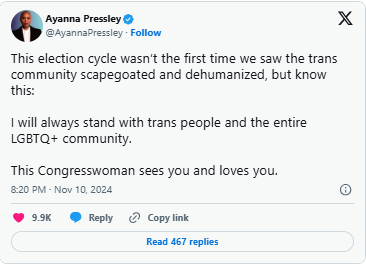
“‘I will always stand with trans people and the entire LGBTQ+ community. This Congresswoman sees you and loves you,’ said Rep. Ayanna Pressley.”
It’s clear that a potential second term for Donald Trump would have devastating consequences for queer and trans Americans.
The accused rapist and his party have been outspoken in their opposition to trans rights. According to data from Ad Impact, reported by Washington Post’s Casey Parks on November 5, Republicans spent nearly $215 million on anti-trans ads during the 2024 election cycle. On Trump’s 2024 campaign website, he pledged to redefine gender at the federal level, recognizing only male and female as assigned at birth, and to push for a nationwide ban on gender-affirming care for minors.
To make matters worse, Democrats like New York Rep. Tom Suozzi and Massachusetts Rep. Seth Moulton chose to scapegoat trans people for their party’s failure to win the presidency, House, or Senate.
Despite the troubling implications of the 2024 elections, many Democratic politicians have made it clear that supporting the trans community is a top priority, regardless of what the next four years bring.
From calling out transphobia within their own party to working to enshrine LGBTQ+ protections at the state level, these leaders are standing up for trans rights.
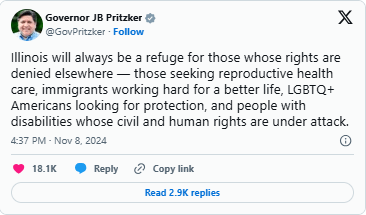
Gov. JB Pritzker and State Rep. Kelly Cassidy (Illinois) Illinois Gov. JB Pritzker reaffirmed his commitment to LGBTQ+ Americans in a tweet, declaring that Illinois would remain “a refuge for those whose rights are denied elsewhere.”
Pritzker went on to specifically highlight the communities he’s standing with, including “those seeking reproductive healthcare, immigrants working hard for a better life, LGBTQ+ Americans looking for protection, and people with disabilities whose civil and human rights are under attack.
Meanwhile, Illinois State Rep. Kelly Cassidy recently told the Chicago Sun-Times that a coalition of state lawmakers has been working to protect access to trans and reproductive healthcare since the Supreme Court’s decision to overturn Roe v. Wade in 2022. Now, this coalition is examining Project 2025 to assess what additional protections they can put in place in the near future.
Cassidy mentioned that one key issue the coalition hopes to address before the fall legislative session concludes is the use of geolocators to track individuals who access healthcare facilities.
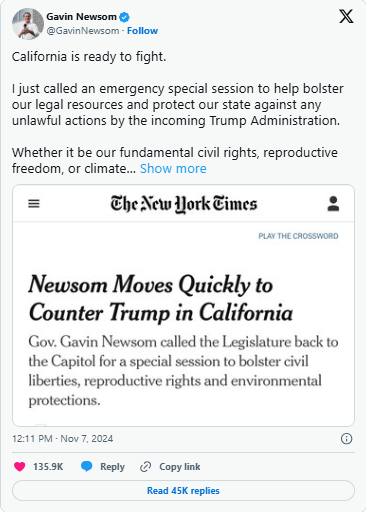
Gov. Gavin Newsom (California)
On November 7, California Gov. Gavin Newsom announced a special session of the California Legislature, set to begin on December 2. This session will focus on strengthening California’s legal resources to safeguard climate action, civil rights, immigrant families, and reproductive freedom in response to Trump’s reelection.
According to a release from Newsom’s office, this special session is a direct response to the public statements and proposals made by President-elect Trump and his advisors, as well as actions taken during his first term. These efforts, Newsom’s office warns, could threaten essential freedoms and individual rights, including women’s rights and LGBTQ+ rights.
In 2023, Gov. Gavin Newsom signed nine LGBTQ+ rights bills into law in just a few days, despite vetoing a bill that would have provided stronger protections for trans children in custody and visitation cases. Earlier this year, he also signed the Support Academic Future and Educators for Today’s Youth Act (SAFETY Act), which prohibits schools from implementing policies that require staff to out students to their parents. The law also mandates the California Department of Education to create resources for LGBTQ+ students and their families.
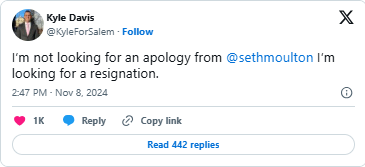
Salem City Councilor Kyle Davis (Massachusetts) Salem, Massachusetts City Councilor Kyle Davis called out Massachusetts Rep. Seth Moulton in a series of X posts after Moulton made transphobic remarks to the New York Times.
In an interview with the Times on November 7, Moulton stated, “I have two little girls, I don’t want them getting run over on a playing field by a male or formerly male athlete. But as a Democrat, I’m supposed to be afraid to say that.”
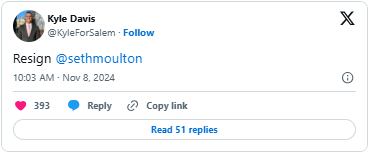
The following day, Davis responded strongly on X, not holding back in his critique.
‘Resign @sethmoulton,’” he tweeted on November 8. Shortly after, he followed up with a second post, stating, “I’m not looking for an apology from @sethmoulton, I’m looking for a resignation.
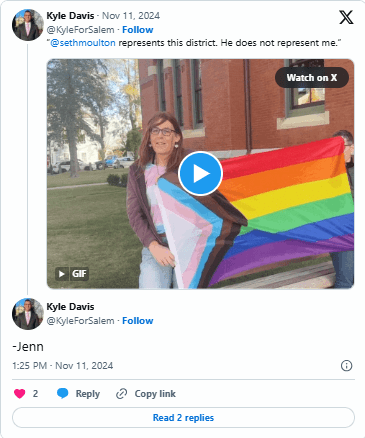
On November 11, Davis posted a gif of a woman named Jenn holding the progress Pride flag, with the caption, ‘@Sethmoulton represents this district. He does not represent me.’
The city councilor went on to question the timing of Moulton’s remarks in an interview with the Boston Globe last week.
“With all the things Trump has said about trans people, this is a time when the trans community is feeling a lot of fear,” Davis said.
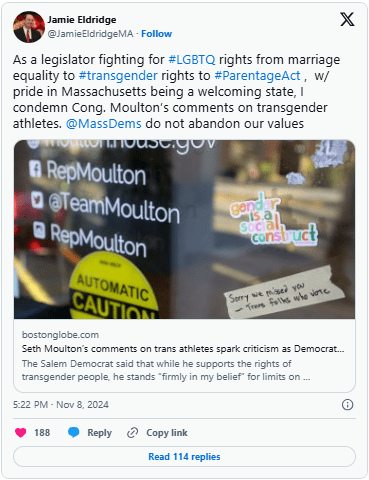
State Senator Jamie Eldridge (Massachusetts) Massachusetts Senator Jamie Eldridge also spoke out against Moulton’s transphobic comments. On November 8, Eldridge took to X to share a link to a Boston Globe article highlighting local Democrats who were condemning Moulton’s remarks.
As a legislator fighting for #LGBTQ rights—from marriage equality to #transgender rights to the #ParentageAct—and with pride in Massachusetts being a welcoming state, I condemn Cong. Moulton’s comments on transgender athletes,” Eldridge wrote. “@MassDems do not abandon our values.”
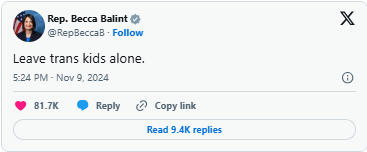
Rep. Becca Balint (Vermont) Vermont Rep. Becca Balint succinctly summed up the sentiment in a November 9 X post, writing, “Leave trans kids alone.
When Balint was elected in 2022, she made history as the first openly LGBTQ+ person and the first woman elected to Congress from Vermont.
Rep. Ayanna Pressley (Massachusetts) Massachusetts Rep. Ayanna Pressley reinforced her commitment to the trans and LGBTQ+ communities in a November 10 X post, reaffirming her unwavering support.
This election wasn’t the first time we’ve seen the trans community scapegoated and dehumanized, but know this: I will always stand with trans people and the entire LGBTQ+ community,” she wrote. “This Congresswoman sees you and loves you.
Attorney General Rob Bonta (California) On November 5, California Attorney General Rob Bonta—who, last year, sued a school district in his state to block a policy requiring teachers to out trans students to their parents—told Cal Matters that his office is already preparing legal challenges to the incoming Trump administration. Bonta’s team has preemptively drafted briefs and tested arguments to counter policies they anticipate Trump will push during his second term, including those that could undermine civil rights for trans youth.
“Unfortunately, it’s a long list [of issues],” the attorney general said. “We are and have been for months developing strategies for all of those things.”
This marks the first instance of a city allowing individuals to sue trans people for using public restrooms.
The city of Odessa, Texas, has implemented a $10,000 bounty for anyone who reports a transgender person using a restroom that matches their gender identity, according to independent journalist Erin Reed.
Under this ordinance, individuals—excluding local and state government officials—are allowed to sue transgender people for using such facilities. The rewards for successful claims include “injunctive relief” to prevent further violations, nominal and compensatory damages if the plaintiff can prove harm, statutory damages of at least $10,000 per violation, as well as court costs and attorney’s fees.
While the bounty is set at a minimum of $10,000, there is no maximum limit on how much the reward can grow.
In addition to the bounty, Odessa’s ordinance includes criminal penalties for individuals who use restrooms that align with their gender identity. Those found in violation of the law can be charged with a Class C misdemeanor, punishable by a fine of up to $500. Anyone who refuses to use a bathroom corresponding with what the city considers their biological sex—after being asked to leave by a building owner—could also face misdemeanor trespassing charges.
The law defines “biological sex” based on birth certificates, either the original or a corrected version in cases of clerical errors. This means that even if a transgender person has updated their birth certificate to reflect their gender identity, they could still be in violation of the ordinance if they use a bathroom that aligns with their gender.
There are no exceptions for disabled individuals who may be accompanied by someone of a different gender, and the law could potentially lead to lawsuits targeting people who are gender non-conforming or whose gender expression doesn’t fit societal norms.
Similar bathroom bans with criminal penalties have been enacted in states like Utah and Florida, while other states, like North Dakota, have laws without clear penalties or enforcement mechanisms. Erin Reed compared Odessa’s bounty system to the anti-abortion bounty laws in Texas, where private citizens are empowered to sue anyone who aids in an abortion. This strategy shifts the responsibility of enforcement from government officials to private individuals, circumventing the usual legal processes.
Johnathan Gooch, communications director for Equality Texas, condemned the ordinance, telling the Texas Tribune, “It’s a very aggressive way to alienate trans people from public life, and I think it is counter to the spirit of friendship that most Texans embody.”
He added, “It enables vigilantes to target anyone they don’t think matches the gender expression they expect to see in the bathroom, and that is truly insane.”
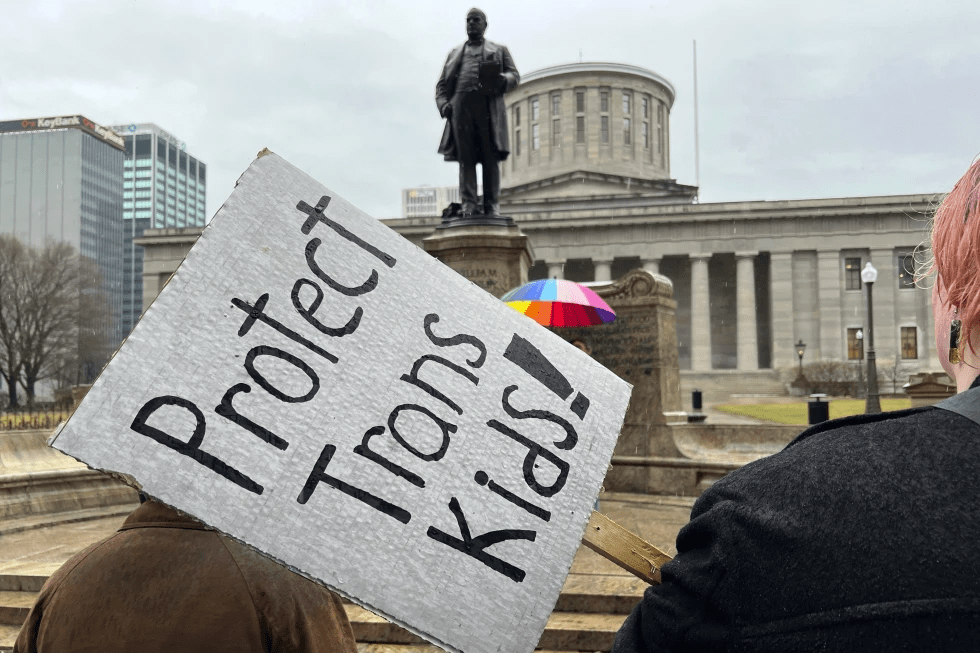
COLUMBUS, Ohio (AP) — On Tuesday, a county judge ruled that an Ohio law restricting gender-affirming health care for minors can go into effect.
The American Civil Liberties Union of Ohio has announced plans to file an immediate appeal.
The law prohibits transgender surgeries and hormone treatments for individuals under 18, except for those already undergoing such treatments where discontinuation could pose a risk, as determined by a doctor. It also imposes limitations on the types of mental health services available to minors.
Passed by state lawmakers in January, the law also bans transgender athletes from participating in girls’ and women’s sports, following an override of a veto by Republican Governor Mike DeWine.
In his ruling, Franklin County Judge Michael Holbrook stated that the ban “reasonably limits parents’ rights to make decisions about their children’s medical care” in line with the state’s legitimate interest in regulating medical practices and treatments.
The organizations challenging the law argue that it denies essential health care to transgender youth and specifically discriminates against their access to such care. The lawsuit also contends that combining the two bans breaches Ohio’s single-subject rule for legislation.
“This decision is not only a blow to our courageous clients but also to countless transgender youth and their families throughout the state who depend on this essential, life-saving health care,” said Freda Levenson, Legal Director at ACLU of Ohio.
In response, the office of Republican Ohio Attorney General Dave Yost stated that “this case has always centered on the legislature’s authority to enact laws aimed at protecting children from making irreversible medical and surgical decisions about their bodies.”
Ohio Governor Mike DeWine vetoed the law at the end of 2023 after visiting children’s hospitals and speaking with families affected by gender dysphoria. DeWine described his decision as thoughtful, limited, and “pro-life,” highlighting the suicide risks associated with not receiving appropriate treatment for gender dysphoria.
DeWine also announced plans to implement an administrative ban on transgender surgeries for individuals under 18 and to enhance state regulation and monitoring of gender-affirming treatments for both children and adults. He hoped these measures would address concerns from Republican colleagues in the Ohio Statehouse. However, the administration quickly abandoned this plan after transgender adults expressed significant worries about how such regulations could impact their lives and health.
Following DeWine’s veto, Ohio lawmakers remained resolute, successfully overriding it and making Ohio the 23rd state to enact a ban on gender-affirming health care for transgender youth.
The Nebraska Supreme Court has upheld a law that restricts access to both medical care for transgender youth and abortion.
OMAHA, Neb. — The Nebraska Supreme Court has ruled that a state law combining abortion restrictions with measures limiting gender-affirming health care for minors does not breach a state constitutional amendment requiring bills to address only one subject.
The court acknowledged that abortion and gender-affirming care are distinct types of medical care but concluded that the law falls under the broad category of medical care, thus complying with Nebraska’s single-subject rule. Chief Justice Mike Heavican, writing for the majority, referred to an 1895 ruling, emphasizing that a bill with a general object and a title that fairly expresses the subject does not violate the single-subject rule.
The ruling came in response to a lawsuit filed by the American Civil Liberties Union (ACLU) on behalf of Planned Parenthood of the Heartland. The lawsuit challenged the law, which restricts abortion to 12 weeks of pregnancy, bans gender-confirming surgery, and limits hormone treatments for transgender minors. The ACLU’s arguments that the hybrid law violated Nebraska’s single-subject rule were rejected by the high court.
Originally, Nebraska lawmakers proposed separate bills: one banning abortion at around six weeks of pregnancy and another restricting gender-affirming treatments for minors. The Legislature combined these measures into a single bill after the six-week abortion ban faced a filibuster. This combination was one of the most controversial pieces of legislation in the 2023 session, leading to an extended filibuster by some lawmakers.
A district judge had previously dismissed the lawsuit, prompting the ACLU to appeal. During the high court arguments, state attorneys argued that combining the measures under health care did not breach the single-subject rule, while Planned Parenthood contended that the Legislature had recognized abortion and transgender care as separate issues by introducing them as distinct bills.
Justice Lindsey Miller-Lerman’s dissent criticized the majority for applying inconsistent standards, accusing the court of giving undue leeway to the Legislature. She argued that the bill should have adhered strictly to the constitutional requirement for a single subject.
Opponents of the ruling expressed disappointment. ACLU Nebraska Executive Director Mindy Rush Chipman and Planned Parenthood North Central States President and CEO Ruth Richardson criticized the decision, emphasizing its potential negative impacts on Nebraskans, particularly in rural areas and among marginalized communities.
Nebraska Governor Jim Pillen and the state’s attorney general praised the ruling. Pillen highlighted his role in advocating for the bill’s passage.
Since the U.S. Supreme Court overturned Roe v. Wade in 2022, many Republican-controlled states have enacted abortion bans. Currently, 14 states have bans at all pregnancy stages, while Nebraska and North Carolina have implemented 12-week bans. Similarly, many GOP-controlled states have restricted gender-affirming care for minors, with 22 states enforcing such measures.
In contrast, several Democratic-controlled states have adopted policies to protect abortion and gender-affirming care access, including efforts to shield healthcare providers from out-of-state investigations.
Nebraska voters may have the final say on abortion access with two potential ballot questions in November: one proposing to add a right to abortion to the state constitution and another to enshrine the 12-week ban in the state constitution.








 fleeredstates.blog
You must be logged in to post a comment.