In authoritarianism, dictators come for LGBTQ+ people first. Here’s why.

Read more at LGBTQ Nation.

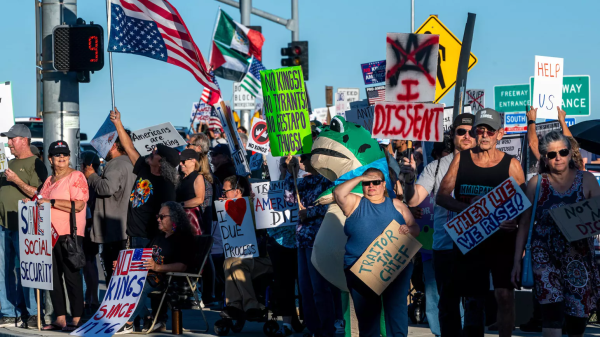
“Hey hey, ho ho, Donald Trump has got to go,” protestors chanted in the middle of Times Square, among a sea of signs that read “love reigns not kings,” “gays against faux-king Trump,” “we stand with … our trans family,” and “the future is coming.”

On Saturday, independent analysts estimated that the No Kings March drew between 5 and 8 million people, and organizers say over 7 million people attended 2,700 events across all 50 states. The event, which was organized to push against the rise of authoritarianism in the U.S., was the largest single-day protest in America since 1970.

Among the crowd were countless LGBTQ people, fighting back against an administration that has introduced a litany of anti-LGBTQ executive orders and used vile rhetoric to denigrate queer people. This backsliding of LGBTQ rights, according to experts, has a deep connection to authoritarianism, with research showing that when governments weaken protections for queer and trans people, they often turn to broader democratic institutions next.

“Threats to democratic institutions and threats to LGBTQ rights are mutually reinforcing, generating a vicious cycle that strengthens authoritarian control,” Ari Shaw, director of International Programs at the Williams Institute, told Uncloseted Media. “Increased persecution of minority groups, including LGBTI people, is itself evidence of democratic backsliding by indicating the erosion of liberal democratic norms [meant to protect] minority rights.”

Legal Abuse of Power

One of the ways the Trump administration’s abuse of power has been most evident is through its legal actions.

On Jan. 20, Trump signed 26 executive orders, the most signed by any president on their first day. Since then, he’s penned hundreds of additional executive orders—more than President Joe Biden signed during his entire four-year term. In many cases, he bypassed Congress in the process, leaving elected legislators on the sidelines.

Many of these actions have been in an effort to roll back LGBTQ rights. Trump has used executive orders to ban transgender people from serving in the military, limit participation of transgender students in school sports, and direct federal agencies to recognize only two sexes.

He’s also slashed HIV funding at a staggering rate. Uncloseted Media estimates that the National Institutes of Health has terminated more than $1 billion worth of grants to HIV-related research, including 71% of all global HIV grants.

It was these cuts that prompted Brooklynite Jeffrey Cipriano to turn out to protest. “The specific reason that I’m protesting is actually on the shirt I’m wearing,” says Cipriano, referring to his red “This is what an HIV advocate looks like” t-shirt.

“My best friend works for an organization called AIDS United. … His job is to travel the country and help people get AIDS medication, specifically trans and unhoused community members. But his job is at risk,” he says. “The end outcome of his work is that people who have issues in their lives have the issues resolved, and that’s going away under the current administration.”

Executive orders are based on powers granted to the president by the U.S. Constitution or by Congressional statutes. The president cannot use an executive order to create new laws or spend money unless Congress has authorized it. They are meant to direct how existing laws are implemented. But Trump has ignored democratic norms, often filling agencies with loyal supporters, using orders to go after political opponents, and pushing the limits of what the law allows.

In some cases, he has moved illegally. “The President is directing various executive branch officials to adopt policy that has either not yet been adopted by Congress or is in violation of existing statutory law,” says Jodi Short, professor of law at UC Law San Francisco. “The analogy to a king and what has troubled many about this presidency is the sheer consolidation of executive branch power in one individual.”

Short’s colleague, Dave Owen, agrees. “Illegality has been rampant,” he told Uncloseted Media in an email. “People are often cynical about the government, and they might think what Trump’s doing is nothing new. But most of the time, the executive branch takes the law seriously, and both legal constraints and norms of good governance matter,” he wrote. He says that through history, there’s been “a lot more integrity and a lot less lawlessness than most people realize.”

“This administration has broken with those traditions,” he adds.

Revolt Against Executive Orders

Many Americans have recognized this. A survey from April found that 85% of Americans agreed or strongly agreed that the president should obey federal court rulings even if he doesn’t like them.

In response to Trump’s overreach, more than 460 legal challenges have been filed across the country challenging his executive actions. One of these is a federal lawsuit by Lambda Legal and the Human Rights Campaign Foundation that challenges the constitutionality of the Trump administration’s ban on military service by transgender people. Another lawsuit challenges Trump’s order directing federal agencies to withhold funds from medical providers and institutions that provide gender-affirming medical treatments for people under 19.

Both of those lawsuits are one reason 17-year-old Zoe Boik came out to protest with her friends and her dad. “Obviously, I’m disappointed and kind of helpless because there’s nothing I can directly do to change or impact anything that’s going on,” says Boik, who identifies as pansexual and gender fluid and is not legally allowed to vote.

Boik—who was seven years old when Trump announced his run for presidency in 2015—says she’s doing a research paper on Trump’s trans military ban and is frustrated because she sees it as inexplicable discrimination. “They’re not letting trans people serve… which doesn’t make any sense.”

LGBTQ Rights and Democratic Backsliding

This type of blatant discrimination is often a key sign of a country moving closer to authoritarianism and away from democracy. According to a 2023 research paper by Shaw and his colleagues, anti-LGBTQ stigma may contribute “to the erosion of democratic norms and institutions.”

The paper found that when a country with relatively high acceptance of LGBTQ rights introduces anti-LGBTQ legislation, it clashes with what most people believe and can weaken public trust in democracy, deepen political divides, and make it easier for populist or extremist movements to gain power.

“The level of acceptance of LGBTQ people is closely associated with the strength of democracy in a country,” Shaw says. “In some cases, we even saw that rising anti-LGBTQ rhetoric or policies preceded a broader decline in democracy.”

In Brazil, for example, early democratic gains coincided with rising LGBTQ acceptance, including legal recognition of same-sex unions and workplace protections. But as populist President Jair Bolsonaro came into power in 2019, he began questioning—without evidence—the security of Brazil’s voting systems, saying he would only lose his re-election campaign if there were fraud. He was also accused of trying to intervene in operations held by the Federal Police about the alleged criminal conduct of his sons, and he told his ministers that he had the power and he would interfere—without exception—in all cabinet ministries. At the same time, LGBTQ protections were rolled back, and schools and civil society faced censorship, suggesting that falling LGBTQ acceptance may have “preceded Brazil’s democratic erosion,” according to Shaw’s paper. In September of this year, Bolsonaro was sentenced to 27 years in prison for plotting a military coup.

Another example is Poland’s democracy weakening since 2015 under the Law and Justice Party, which consolidated power by undermining the Constitutional Tribunal, installing loyal judges, and restricting independent media. Anti-LGBTQ rhetoric became central to the party’s nationalist platform, fueling the creation of nearly 100 “LGBT ideology-free zones,” inciting violence against LGBTQ individuals, and stymying legal recourse through politicized courts.

When it comes to LGBTQ rights, Trump has mimicked the moves of these leaders even though most of his constituents don’t want it: A 2022 survey from the Public Religion Research Institute found that 80% of Americans favor laws that would protect LGBTQ people against discrimination.

“The definition of an authoritarian system is a system where power is consolidated in one individual whose power is unchecked by any other institution. And I fear that in certain domains, that’s the direction in which this administration is trying to move us,” says Short. “I think it’s incredibly dangerous.”

Attacks on Higher Education

Another common tool in the authoritarian playbook is attacking higher education.

In the U.S., Trump has done just that by pressuring top universities to get rid of their Diversity, Equity, and Inclusion (DEI) programs and inclusive policies for transgender athletes, which he has called “ideological capture.” If they don’t obey, Trump has threatened to freeze millions of dollars in funding.

While many universities are rejecting Trump’s demands, others are experiencing a chilling effect, changing their policies before the administration tries to hold up funds.

“I’m here because I’m angry and I feel that we aren’t angry enough,” Maddy Everlith, a sophomore gender studies major at Pace University, told Uncloseted Media as she marched with her friends. “Being a woman of color in America and having so many intersectional identities is also what affects me.… I want to stand up and advocate for other people.”

Everlith’s university responded to Trump’s threats in September by renaming its DEI office to the “Division of Opportunity and Institutional Excellence.”

“I am beyond horrified how quickly our university was willing to bend the knee on this decision,” Austin Chappelle, a senior at Pace, told the student newspaper. This change comes in the midst of uncertainty under the Trump administration, which has already caused many LGBTQ students to feel uneasy on campus.

Scapegoating Transgender People

Beyond the laws and policies lies a vile rhetoric used to scapegoat trans Americans. During the 2024 federal election campaigns, Trump spent roughly $215 million on anti-trans ads, more than five times as much as he spent on ads focused on the economy. In addition, he’s monstrified the community, saying, “These people are sick. They are deranged.” He’s also said Democrats are “pushing the transgender cult” on children and has aligned with groups trying to designate transgender Americans as terrorists.

“It’s part of an electoral strategy to try to mobilize right-wing voters to distract from other sorts of political or economic scandals,” Shaw says, adding that this tactic is another way to gain power.

The pain of this rhetoric has affected millions of trans Americans and allies alike, including Lars Kindem, a 64-year-old retired pilot from Minnesota who was marching to support his transgender sister.

“What Trump has done is he’s taken people that haven’t done anything wrong and has turned them into scapegoats,” he says, adding that Trump’s language is “hateful, petty, mean, and hurtful.”

He says his sister and her partner are having issues getting the correct gender markers issued on their passports. Because of the Trump administration’s treatment of the community, they are making plans to move to Denmark, where “there’s a lot more acceptance.”

Christian Nationalism

This scapegoating has played into the hands of Trump’s voter base of white evangelical Protestants, the only major Christian denomination in the U.S. in which a majority believes society has gone too far in accepting transgender people.

Since 2020, Trump has increasingly embraced Christian nationalism in his rhetoric and imagery. He’s sold Bibles, created a federal task force on anti-Christian bias, and been intrinsically linked to Project 2025, the 920-page plan calling for the establishment of a government imbued with “biblical principles” and run by a president who holds sweeping executive powers.

Experts say that “a strong authoritarian streak” runs through conservative Christianity. A 2023 study found that supporters of Christian nationalism tend to support obedience to authority and the idea of authoritarian leaders who are willing to break the rules. Nearly half of Christian nationalists support the notion of an authoritarian leader.

“They are trying to use the language of Christianity, but they are abusing it and misusing it constantly,” Rev. Chris Shelton, a gay pastor at the protest, told Uncloseted Media. “Our faith is all about reaching out to the marginalized, reaching out to the people who are ostracized by society and embracing them and offering love and welcome and a sense of dignity and worth. And to see any human being’s worth being denied is just a mockery of our faith.”

Heidi Beirich, the vice president and co-founder of the Global Project Against Hate and Extremism, says that “the LGBTQ community is the prime target of modern authoritarian regimes.”

“For Christian nationalists, attacking LGBTQ rights is the first pillar in destroying civil rights for all. This has happened in countries like Hungary and Poland as authoritarianism consolidated, and now it’s happening here,” Beirich told Uncloseted Media.

Moving Forward

As the country bleeds toward authoritarianism, LGBTQ protestors are encouraging people to use their voice, something the queer community is familiar with doing: One 2012 survey found that queer folks are 20 times more likely to be active in liberal social movements than their straight, cis counterparts.

“It is imperative that people continue to pay attention,” Short says. “There is so much going on, a lot of it is disturbing and intense, and there’s such a strong impulse to look away. But we have to engage in political action and resist inappropriate assertions of authority and continue to show up and vote for our democracy.”

17-year-old Zoe Boik is ready. She remembers being in second grade and crying the day after Trump won his first election in 2016. She couldn’t believe how he could lead the country despite “all the bad things he said.”

Boik can’t wait until the midterm elections, when she will be 18 and finally able to vote. “If we don’t vote, then our voices won’t be heard,” she says.

Despite this, she’s also concerned about her freedom to exercise that right being jeopardized.

“My fears about Trump don’t stem specifically from me being queer, but from his authoritarianism as a whole,” she says. “I am scared about how far he will move into dictatorship, [and] my biggest fear is that our right to vote will be compromised, leaving us no recourse.”
Donald Trump ends LGBTQ+ health programs under the cover of the shutdown

Read more at LGBTQ Nation.

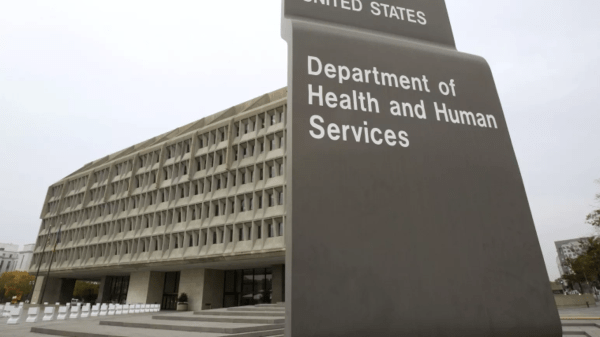
On Friday, the Trump administration began massive layoffs throughout the Department of Health and Human Services (HHS). As part of that, they completely removed the Office of Population Affairs, which was responsible for a wealth of public health programs, including specific initiatives for the LGBTQ+ community.

“This wasn’t a budget decision — it was ideological,” a former member of the Biden administration told The Advocate.  “These are the programs that centered reproductive and queer health, and now they’re gone.”

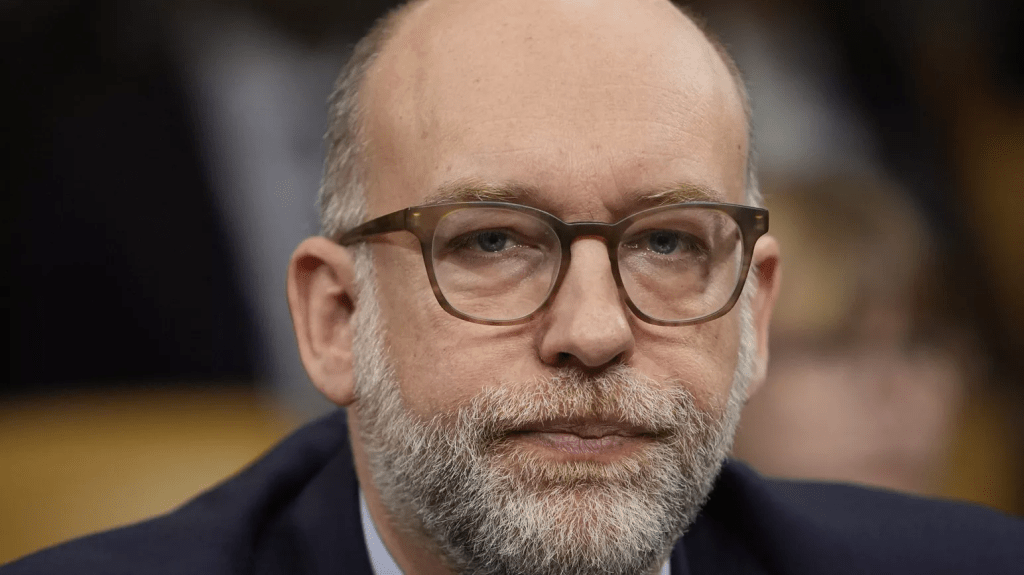
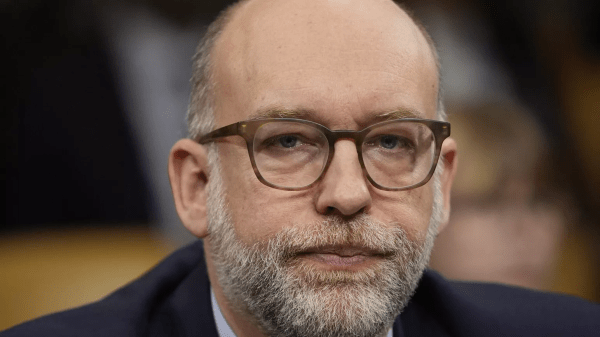
Donald Trump has welcomed the government shutdown as an opportunity to cut what he has called “Democrat Agencies” to shrink the government. The process is being led by Russ Vought, the head of the Office of Management and Budget (OMB) and key author of Project 2025, which advocated for such cuts. However, he has also tried to blame those government cuts on the Democrats.

Vought took to X/Twitter on Friday to announce the start of the “Reduction in Force,” or RIF. His office confirmed via Politico that federal employees were being permanently fired, not temporarily furloughed for the duration of the shutdown: “Can confirm RIFs have begun and they are substantial. These are RIFs, not furloughs.”

Adrian Shanker, who served as deputy assistant secretary for Health Policy during the Biden administration, told The Advocate that while the Office of Population Affairs often had its programs politicized, this is “the first time that the office itself is being cut.”

The Office of Population Affairs manages a huge range of public health initiatives. Those include Title X family planning services and grants; programs for adolescents that cover issues such as pregnancy prevention, mental health, and substance abuse; the Embryo Adoption Awareness and Services program; screenings and treatment for sexually transmitted infections and information on preventing the spread of HIV; and LGBTQ+ health initiatives, including information on gender-affirming care.

As well as restricting programming targeted specifically at the LGBTQ+ community, these cuts will restrict access to family planning programs that LGBTQ+ people are more likely to make use of to grow their families.

The cuts to the Office of Population Affairs will leave us lacking when it comes to sex education and with less support for LGBTQ+ youth, Shanker noted, saying it “leaves us more vulnerable to health inequities and worsened health outcomes.”

Wider cuts to the HHS will have broader effects as the CDC is losing over a thousand employees, including the elimination of entire departments. “CDC is over. It was killed,” said Dr. Demetre Daskalakis, the out gay former director of the CDC’s National Center on Immunization and Respiratory Diseases, after 1000 scientists, doctors, and public health officials were fired from HHS on Friday. Daskalakis, an infectious diseases expert, resigned in protest of the administration’s war on science-based public health earlier this year.

“This administration only knows how to break things. They have made America at risk for outbreaks and attacks by nefarious players. People should be scared.”

Some reports have suggested that some laid-off employees have been contacted and told that their reduction-in-force notices are being rescinded. This happened with federal layoffs from DOGE in the past, with some employees being rehired after DOGE cut their jobs. However, reports are unclear on how many RIFs have been rescinded.

Previous federal layoffs have been litigated in court, with some resulting in court rulings that the people cannot be fired, while other courts have allowed the dismissals to proceed. That process, if it occurs here, will take time, during which public health will suffer a setback.

“Without these people in place, it’s unlikely that a lot of these programs will be able to continue even after the government reopens,” predicted Shanker.

Antifa expert at Rutgers University flees US amid death threats

Read more at The Hill.

Mark Bray, an assistant professor of history at Rutgers University who was nicknamed “Dr. Antifa” by students, left the U.S. for Spain Thursday night due to death threats he has received after he was accused of antifa membership.  

The campus chapter of Turning Point USA and other conservative groups accused Bray of involvement with antifa and started a petition to get him fired, The Associated Press reported.  

Bray has studied the history of the left and is considered an expert in anti-fascist movements but denies any involvement with antifa, which the Trump administration has labeled as a terrorist organization 

“I am not now, nor have I ever been, part of any kind of antifascist or anti-racist organization – I just haven’t. I’m a professor,” Bray told The Guardian

He took off on Thursday for Spain from Newark Liberty International Airport with his family, according to his social media, after initially being told his reservation had been canceled.

Conservative students labeled Bray a danger to campus.

“You have a teacher that so often promotes political violence, especially in his book ‘Antifa: The Anti-Fascist Handbook,’ which talks about militant fascism, which is on term with political violence,” student Megyn Doyle told Fox News

The Hill has reached out to Rutgers for comment.  

Conservatives said Bray donated to antifa when he committed 50 percent “of the author’s proceeds would go to the International Anti-Fascist Defense fund” from his 2017 book.

He countered those funds go “to help with the legal or medical costs of people facing charges for organizing pertaining to anti-fascism or anti-racism” and that the antifa group referenced does not have a centralized committee or leader, according to The Guardian.  

Bray said the threats to him picked up with the petition and President Trump’s executive order to designate antifa as a terrorist group, prompting him to leave the country.  

In his order, Trump said antifa is a “domestic terrorist organization” and gave the government authority to investigate anyone who provides “material support” to the group. 

“Individuals associated with and acting on behalf of Antifa further coordinate with other organizations and entities for the purpose of spreading, fomenting, and advancing political violence and suppressing lawful political speech,” the order states. “This organized effort designed to achieve policy objectives by coercion and intimidation is domestic terrorism.” 

When Bray first tried to leave the country with his family on Wednesday, they were not allowed on the plane and their reservation was canceled.  

“‘Someone’ cancelled my family’s flight out of the country at the last second,” Bray posted on Bluesky. “We got our boarding passes. We checked our bags. Went through security. Then at our gate our reservation ‘disappeared.’” 

The news he was trying to leave the country was first reported by NJ.com. The airline rescheduled them for the Thursday flight, which they successfully boarded.

Turning Point says it doesn’t support threats or doxing to any person, but students who have rallied in support of Bray are calling for its Rutgers chapter to be shut down.  

“The Rutgers chapter of Turning Point USA (TPUSA) has been continuously promoting hate speech and inciting violence against our community. This disturbing behavior has created a toxic environment that has already led to tragic consequences,” a petition against the chapter reads.

The Hill has reached out to Turning Point for comment. 

The president was sued for deleting “radical” LGBTQ+ webpages. He just lost.

Read more at LGBTQ Nation.

As part of a legal settlement with medical associations and advocacy groups, the current presidential administration has agreed to restore more than 100 websites and online resources related to gender identity and diversity, equity, and inclusion (DEI).

“I am extremely proud of the health care community in Washington state and our partners in this case for pushing back on this egregious example of government overreach” said Dr. John Bramhall, president of the Washington State Medical Association (WSMA), the lead plaintiffs in the lawsuit. “This was not a partisan issue-open data benefits everyone and ensuring its availability should be a bipartisan priority.”

In January, the president issued an executive order directing federal agencies to eliminate references to “gender” and “gender identity” from federal policies, documents, and public-facing materials. In response, the Department of Health and Human Services (HHS) removed public health data from federal websites, including information on pregnancy risks, painkiller addiction, and the AIDS crisis. Hundreds of webpages addressing health concerns relevant to the LGBTQ+ community, including the National Institutes of Health’s (NIH) HIV risk-reduction tool, were removed.

“This action proves the … administration’s goal of making it as difficult as possible for LGBTQ Americans to find federal resources or otherwise see ourselves reflected under his presidency,” GLAAD’s President and CEO Sarah Kate Ellis said in January.

Physicians, scientists, and other medical professionals who relied on these resources were left scrambling. The Washington State Medical Association (WSMA) and other groups filed suit, arguing that the removals were “arbitrary, capricious, and unreasoned,” and violated federal transparency laws.

“This was trusted health information that vanished in a blink of an eye-resources that, among other things, physicians rely on to manage patients’ health conditions and overall care,” said Dr. Bramhall. “Not only was our ability to provide care to our patients compromised, but our trust in our federal health institutions has also been badly shaken.”

As part of the agreed settlement finalized earlier this month, the government must restore these webpages and cease deleting other resources. Graham Short, a spokesperson for WSMA, told the Associated Press that the organization expects the websites to be fully restored in the coming weeks.

Despite the settlement, HHS stated that it “remains committed to its mission of removing radical gender and DEI ideology from federal programs, subject to applicable law, to ensure taxpayer dollars deliver meaningful results for the American people.”

Separately, in July, a judge overseeing a similar lawsuit brought by Doctors for America ordered the government to restore additional websites that were removed. The Associated Press reported that 167 of those sites had been reinstated, while 33 were still under review.

House Republicans file bill to bar trans students from bathrooms, sports teams

Read more at The Hill.

House Republicans introduced legislation Tuesday to ban transgender girls from participating in girls’ school sports, moving to advance one of the Trump administration’s top priorities. 

The measure, titled the Safety and Opportunity for Girls Act, would define “male,” “female” and “sex” by reproductive function in Title IX, the federal civil rights law against sex discrimination in education. Schools receiving federal funds would be barred from allowing transgender students to use restrooms or locker rooms or play on sports teams that match their gender identity, according to the bill, sponsored by Rep. Mary Miller (R-Ill.). 

Miller introduced a similar measure to block locker room access for transgender students in March and spearheaded an earlier effort to reverse former President Biden’s expanded nondiscrimination protections for transgender students under the Congressional Review Act last summer. 

A news release from Miller’s office says the latest bill, which has 11 Republican co-sponsors, would preserve Title IX’s “original intent” and shield the decades-old law from reinterpretation “by radical leftists or activist judges.” 

President Trump’s administration has argued repeatedly that Title IX already prohibits transgender girls from competing on girls’ sports teams or using girls’ bathrooms and changing rooms at school. More than two dozen investigations into states, schools and athletic associations that accommodate transgender students have been opened since Trump’s return to office in January. 

School officials in states including California, Maine, Minnesota and Virginia assert their policies are compliant with state and federal law. 

A February executive order signed by Trump states that the U.S. opposes “male competitive participation in women’s sports” as a matter of “safety, fairness, dignity, and truth.” Trump warned schools at a signing ceremony that his administration was putting them “on notice.” 

“If you let men take over women’s sports teams or invade your locker rooms, you will be investigated for violations of Title IX and risk your federal funding,” he said. 

The Supreme Court agreed in July to decide whether states can ban transgender athletes from competing in girls’ and women’s school sports. Since 2020, more than half the nation has adopted laws barring trans students from participating on teams that match their gender identity. 

Laws in four states — Arizona, Idaho, Utah and West Virginia — are blocked by court orders, and New Hampshire’s ban on trans athletes is partially blocked. In February, the two New Hampshire high schoolers suing the state expanded their challenge to include the Trump administration. 

House Republicans, joined by two Democrats, passed legislation in January to ban transgender student-athletes from girls’ sports teams — an effort ultimately thwarted by Senate Democrats. 

Americans seeking refugee status in Canada have spiked since Donald Trump’s return to office

Read more at KRLD.

Referral claims for refugee protection in Canada from people in the U.S. have already surpassed last year’s total, based on data from Immigration and Refugee Board of Canada (IRB). These referrals also spiked the last time President Donald Trump was in office.

While there were 204 U.S. claim referrals to the board’s Refugee Protection Division total last year, 245 claims were referred to the RPD from January through June of this year. Trump was inaugurated in January.

For some perspective, there were 216 referrals listed from Afghanistan during that same time period this year, 62 listed from El Salvador, 2,784 listed from Mexico, 265 listed from Palestine, 260 listed from Syria, 403 listed from Venezuela and 131 listed from Yemen.

At the start of former President Joe Biden’s term in 2021, there were 118 claim referrals from the U.S., with the same number the following year – both a drop from 154 in 2020. In 2023, the number of referrals increased to 157.

However, back in 2013 – the first year that the IRB has data for – there were just 69 referrals. That was during the second term of former President Barack Obama, and while he was in office during 2014 and 2015 referrals were at 88 and 69 respectively. They increased to 129 in 2016, when Trump was campaigning against Democratic candidate and former Secretary of State Hillary Clinton.

During Trump’s first year in office in 2017, the referrals skyrocketed to 869. In 2018, they were still higher at 642, followed by 423 in 2019.

When asked by Newsweek about the referral increase this year, White House Deputy Press Secretary Anna Kelly said: “Why does Newsweek care about this .00007 percent of the population who want higher taxes, worse health care, and anti-American trade policies?”

Since the start of his second term, Trump has pushed hard for strict new immigration policy, with Immigration and Customs Enforcement (ICE) raids in major cities, the establishment of “Alligator Alcatraz” and more. He has also engaged in tariff wars with countries across the world, including Canada, Mexico and China. Those are particularly notable since they are some of the country’s major trading partners, and these tariffs are expected to raise prices here in the U.S. Republicans have also blamed Canada for bad air quality in the U.S.

Bloomberg reported this week that officials from the U.S. and Canada are expected to discuss tariffs soon. That outlet has also reported on an influx of people from the U.S. attempting to cross the border into Canada. It said that “during the first six days of July, Canadian officials at the Saint-Bernard-de-Lacolle border crossing – the busiest land port between New York and Quebec – received 761 asylum claims, a more than 400% increase from the same period a year ago.”

In Canada, refugee advocates, federal government departments and immigration lawyers were already bracing for asylum claimants from the U.S. in January, according to the CBC.

“With Trump, crystal balls are hard to keep clear,” said Gabriela Ramo, past chair of the Canadian Bar Association’s immigration section, per the outlet.

In addition to the crackdown on illegal immigration, reasons why people might be seeking to leave the U.S. cited by Newsweek include U.S. policy shifts and court rulings have restricted access to gender-affirming care, limited who can serve in the military, and imposed rules on participation in sports and the use of certain facilities. This month, Audacy reported that the president’s approval rating even among his own party was slipping. This Tuesday, Gallup reported that Trump’s polling was “tepid” this month at 40%. Economist approval tracking updated Tuesday showed that his rating was up slightly compared to the previous week at 41%.

States must ax transgender references from sex ed or risk losing funds, Trump admin says

Read more at NBC News.

The Trump administration directed 40 states, five territories and Washington, D.C., to remove references to transgender people from their sex education programs or risk losing federal funding.

The Administration for Children and Families (ACF), a division of the Department of Health and Human Services, sent letters Tuesday demanding that the health departments in these states and territories remove “all references to gender ideology” from their Personal Responsibility Education Program, or PREP. The program is a federally funded initiative created in 2010 to help prevent teen pregnancy and sexually transmitted infections.

“Accountability is coming,” acting Assistant Secretary Andrew Gradison said in a statement. “Federal funds will not be used to poison the minds of the next generation or advance dangerous ideological agendas. The Trump Administration will ensure that PREP reflects the intent of Congress, not the priorities of the left.”

The 40 states that received letters are: Alabama, Alaska, Arizona, Colorado, Connecticut, Delaware, Georgia, Hawaii, Illinois, Iowa, Kentucky, Louisiana, Maine, Maryland, Massachusetts, Michigan, Minnesota, Mississippi, Missouri, Montana, Nebraska, Nevada, New Jersey, New Mexico, New York, North Carolina, Ohio, Oklahoma, Oregon, Pennsylvania, Rhode Island, South Carolina, South Dakota, Tennessee, Utah, Vermont, Washington, West Virginia, Wisconsin and Wyoming. The five U.S. territories are: Guam, Northern Mariana Islands, Palau, Puerto Rico and the U.S. Virgin Islands.

Links to all 46 letters were included in the administration’s press statement. The ACF’s four-page letter to New York, for example, includes a bulleted list of course content that was flagged during a “medical accuracy review” earlier this year and “must be removed from New York’s PREP curricula and program materials.”

The content flagged for removal includes definitions of gender identity and gender expression and directives that program facilitators allow students to share their pronouns and “demonstrate acceptance and respect for all participants, regardless of personal characteristics, including race, cultural background, religion, social class, sexual orientation or gender identity,” according to the letter.

If New York’s health department declines to comply, it could lose more than $6 million in federal funds, according to data provided by ACF. The other states and territories stand to lose $300,000 to $4.6 million each.

The letters come just days after the ACF terminated $12 million of California’s remaining PREP funding after the state’s health department declined to remove references to trans people from the curriculum, arguing that the references had already been approved by the agency, the materials were medically accurate and relevant to the statute, and ACF does not have the authority to take such an enforcement action, according to ACF’s termination letter to the state.

California’s health department has 30 days to appeal. A spokesperson for the department said in a statement that the state maintains its position that its PREP curriculum “is medically accurate, comprehensive, and age-appropriate.”

“CA PREP sexual health education curriculum promotes healthy relationships and reduces the rates of sexually transmitted infections (STIs) and unintended pregnancy, as well as leads to delayed sexual activity in youth — all outcomes that lead to a healthier state,” the spokesperson said.

In an emailed statement, Elana Ross, a spokesperson for California Gov. Gavin Newsom, said, “If it’s a day ending in y, President Trump is attacking kids’ safety, health, and access to education as part of his culture war.”

The action from ACF is part of the Trump administration’s ongoing effort to prohibit federal recognition of trans people and penalize the use of federal funds for any program that includes or mentions them.

In the first few weeks of his presidency, Trump issued executive orders declaring that there are only two unchangeable sexesprohibiting trans people from enlisting and serving in the military; barring trans girls and women from competing on female sports teams in federally funded K-12 schools and colleges; and barring federal funding from going to hospitals that provide transition-related care to minors. The federal government has taken several actions against providers of transition care, resulting in more than 20 hospitals over the last few months rolling back or ending their gender-affirming care programs for minors and some young adults.

Federal officials have also removed mentions of trans or intersex people from agency websites, including from the website for the Stonewall National Monument commemorating the site of the 1969 Stonewall uprising in New York, which is widely considered a turning point in the modern gay rights movement.

U.S. Air Force to deny retirement pay for transgender troops being separated from service

Read more at PBS.

The U.S. Air Force said Thursday it would deny all transgender service members who have served between 15 and 18 years the option to retire early and would instead separate them without retirement benefits. One Air Force sergeant said he was “betrayed and devastated” by the move.

The move means that transgender service members will now be faced with the choice of either taking a lump-sum separation payment offered to junior troops or be removed from the service.

An Air Force spokesperson told The Associated Press that “although service members with 15 to 18 years of honorable service were permitted to apply for an exception to policy, none of the exceptions to policy were approved.” About a dozen service members had been “prematurely notified” that they would be able to retire before that decision was reversed, according to the spokesperson who spoke on condition of anonymity to discuss internal Air Force policy.

A memo issued Monday announcing the new policy, which was reviewed by the AP, said that the choice to deny retirement benefits was made “after careful consideration of the individual applications.”

All transgender members of the Air Force are being separated from the service under the Trump administration’s policies.

Separation process has hit some bumps

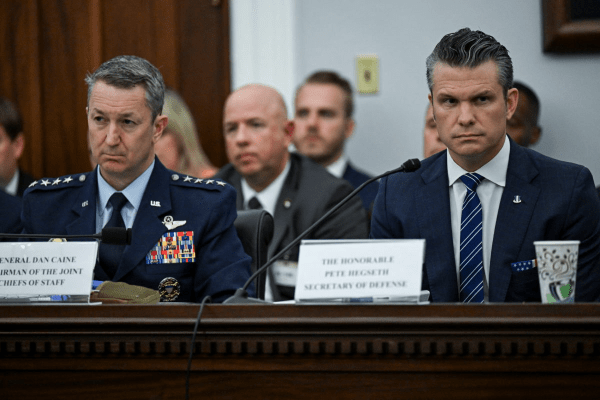
The move comes after the Pentagon was given permission in early May by the Supreme Court to move forward with a ban on all transgender troops serving in the military. Days later, Defense Secretary Pete Hegseth announced a policy that would offer currently openly serving transgender troops the option to either volunteer to leave and take a large, one-time separation payout or be involuntarily separated at later date.

A Pentagon official told reporters in May that they viewed the policy as treating “anyone impacted by it with dignity and respect.”

However, in late July, transgender troops told Military.com that they were finding the entire separation process, which has included reverting their service records back to their birth gender, “dehumanizing” or “open cruelty.”

Shannon Leary, a lawyer who represents LGBTQ+ people in employment discrimination cases, says she expects lawsuits to challenge Thursday’s decision. “It seems quite arbitrary on its face and cruel,” she said. “These military members have dedicated their lives to serving our country.”

Normally, Leary said, when early retirement is offered in the military, it’s available to all members who have served over 15 years. She said she expects other service branches to follow the Air Force’s path.

One Air Force service member says he’s ‘devastated’

Logan Ireland, a master sergeant in the U.S. Air Force who has 15 years of service, including a deployment to Afghanistan, is one of the airmen impacted by the policy. “I feel betrayed and devastated by the news,” he said.

Ireland said he was told that his retirement was being denied on Wednesday when his chain of command, “with tears in their eyes,” told him the news.

Officials have said that as of Dec. 9, 2024, there were 4,240 troops diagnosed with “gender dysphoria” on active duty, National Guard and Reserve. Pentagon officials have decided to use the condition and its diagnosis as the main way to identify troops who are trans.

However, the two are not an exact match — not every transgender person has the condition. As a result, there is an understanding that the actual number of transgender people within the military’s roughly 2 million troops may be higher.

Under the latest policy, active duty troops had until June 6 to voluntarily identify themselves and receive a payout while troops in the National Guard and Reserve had until July 7. Pentagon officials previously told reporters that they plan to lean on commanders and existing annual medical screenings to find any transgender service members who do not come forward.

State Department Removes Anti-LGBTQ+ Violence From Human Rights Report Draft

Read more at Huff Post.

The Trump administration has removed all references to violence against LGBTQ+ people and gender-based violence in drafts of the State Department’s much anticipated annual report on international human rights.

The draft of the report, which was leaked to and first reported by The Washington Post on Wednesday, scales back its critiques of abuses in countries with a record of human rights abuses. In particular, the Post learned of drafts of human rights reports for El Salvador, Israel and Russia that completely excise references of LGBTQ+ people and violence toward those communities.

The erasure of LGBTQ+ people and the abuses they face in the draft report underscores the Trump administration’s intention to scale back references to human rights broadly and take its anti-LGBTQ+ agenda worldwide.

“The 2024 Human Rights report has been restructured in a way that removes redundancies, increases report readability and is more responsive to the legislative mandate that underpins the report,” a senior State Department official, speaking on the condition of anonymity to brief the news media, told reporters on Wednesday. “The human rights report focuses on core issues.”

The State Department did not immediately respond to HuffPost’s request for comment.

In a section about El Salvador, the draft report notes the country had “no credible reports of significant human rights abuses.” In a previous report from 2023, the State Department found “significant human rights issues” in El Salvador, including “politically motivated killings” and “harsh and life-threatening prison conditions.”

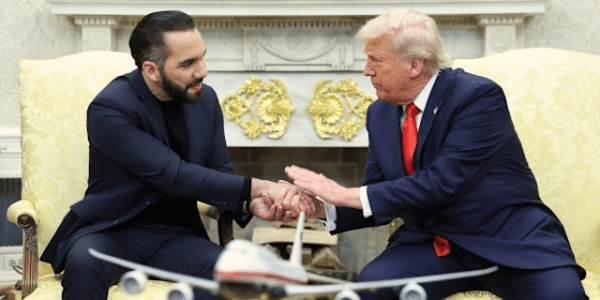
This spring, President Donald Trump secured a multimillion-dollar deal with El Salvador’s President Nayib Bukele to allow 252 Venezuelan men in the U.S. to be deported and housed within the country’s notorious new Terrorism Confinement Center, known as CECOT.

After being jailed for more than 120 days at CECOT, the men, most of who had no criminal history, told stories of being physically and mentally abused for days on end.

Jerce Reyes Barrios, one of the men held at CECOT, told HuffPost reporters Jessica Schulberg and Matt Shuham about his harrowing experience inside the prison. Reyes Barrios recalled a prison official saying, “Welcome to hell on earth, where you’ll be condemned to spend the rest of your lives; where I’m going to make sure that you never eat chicken or meat again.”

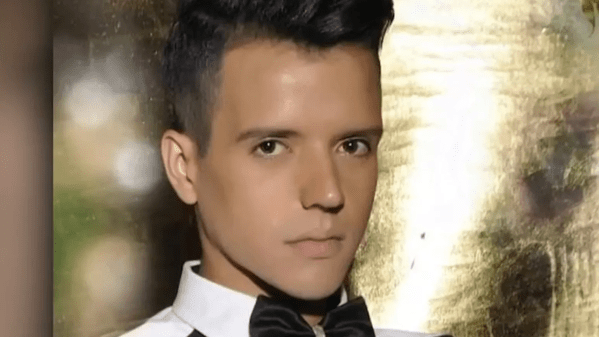
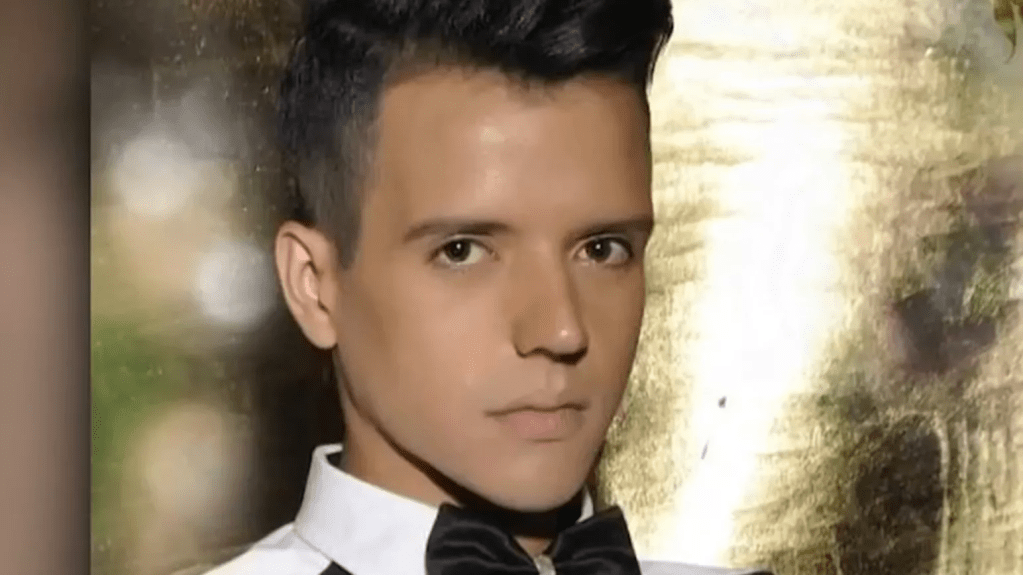
Andry José Hernández Romero, a gay Venezuelan makeup artist, alleged that CECOT guards groped him and forced him to perform oral sex while he was in solitary confinement.

A former State Department employee, Keifer Buckingham, said the removal of references to violence against LGBTQ+ people was a “glaring omission,” especially when it comes to Russia. In 2023, Russia’s supreme court deemed what it called an “international LGBT public movement” as extremist, and the courts began their first convictions of people last year under the order.

In February of 2024, a man in Volgograd was found guilty of “displaying the symbols of an extremist organisation” after posting a photo of the LGBTQ pride flag on social media. That same month, a woman near Moscow was sentenced to five days detention for wearing frog-shaped earrings that were rainbow colored.

The drafts of the reports for El Salvador and Russia were marked “finalized,” and the draft for Israel was marked “quality check,” according to the Post. It is still unclear when the reports, which are typically released to the public each March or April, will be sent to Congress and then the public, and if they will include these omissions.

U.S. diplomats have released the State Department’s annual human rights reports for nearly 50 years. Historically their findings have been widely read and anticipated by foreign leaders and diplomats, and have been used in legal proceedings both domestically and abroad.

However, this year human rights advocates decried the news about the ways in which the Trump administration has softened the descriptions of human rights abuses, especially the violence against LGBTQ+ people.

Uzra Zeya, the CEO of Human Rights First, an international human rights nonprofit, said in a statement that the changes were “a radical break” from the original goal to “objectively and even-handedly describe the human rights situation in every country and territory in the world.”

“This severely undermines their credibility and value in guiding U.S. decision-making on a wide range of critical foreign policy issues. Purging mention of elections, corruption, and global human rights abuses against LGBTQI+ persons, persons with disabilities, women and girls, refugees and other vulnerable groups runs counter to American interests and values and makes Americans abroad less safe and informed,” she continued.

Amanda Klasing, the national director of government relations for Amnesty International, said in a statement that she believes the mandate to scale back the report came from Secretary of State Marco Rubio, who instructed employees to delete sections that included stories from survivors of human rights violations and to ignore instances of repression in certain countries.

“The secretary’s instructions were to cut everything not legislatively mandated, but the leaked documents appear to show effort to narrow the scope of what the world hears about human rights abuses around the world,” she wrote.

“The downplaying or exclusion of key issues, such as discrimination and attacks on civil society, from this year’s report will hinder efforts from governments and civil society organizations around the world to respond to these abuses,” she continued.

The Trump administration’s erasure of LGBTQ+ people and gender-based violence has continued on other international stages. At a United Nations meeting in June, a U.S. delegate spent much of her time in a routing meeting on pollution to discuss the United States’ new “national position” on gender.

“Use of the term ‘gender’ replaces the biological category of sex with an ever-shifting concept of self-assessed gender identity and is demeaning and unfair, especially to women and girls,” the delegate said.

In at least six speeches before the United Nations, U.S. delegates have condemned what it calls “gender ideology,” and pushed the Trump administration’s support for recognizing so-called “biological sex,” according to ProPublica.

During his first day in office, Trump signed an executive declaring that the federal government only recognizes “two sexes, male and female,” and signaled that all references to “gender” would thus be replaced with the term “biological sex.”

Congressional coalition demands wellness check on gay makeup artist held in torture camp

*This is reported by LGBTQ Nation.

Out gay Rep. Robert Garcia (D-CA) talked to LGBTQ Nation about a new letter signed by a coalition of 50 other Democratic congress members demanding that the State Department conduct a wellness check on Andry José Hernández Romero, an openly gay 32-year-old Venezuelan makeup artist who was detained by Immigration and Customs Enforcement (ICE) on March 15 despite legally applying for asylum in the U.S. after fleeing anti-gay persecution in his home country.

Hernández Romero legally entered the U.S. last year via San Diego and passed a credible fear interview for his official asylum process but was arrested by ICE two days before his scheduled court hearing. For the last 86 days, he has been imprisoned at the Centro de Confinamiento del Terrorismo (CECOT), an El Salvador prison known for its human rights abuses. The letter’s signatories are demanding that the State Department facilitate his access to legal counsel and immediately facilitate his release, having presented no evidence of any crimes or wrongdoing.

Romero’s family and lawyers have had no contact with him in more than a month,” the letter states. “His mother does not even know whether he is alive. Given both the well-documented concerns about conditions at CECOT and the history of anti-LGBTQI+ persecution in El Salvador, there is serious cause for concern about Mr. Hernández Romero’s well-being.”

Romero was among 260 Venezuelans accused by the presidential administration of being members of Tren de Aragua, a terrorist group. A disgraced former police sergeant’s report accused Hernández Romero of having crown tattoos associated with the transnational Tren de Aragua gang. But both the Venezuelan government and Hernández Romero’s lawyer have said he has no connections whatsoever to the gang, and his family has said that his crown tattoos are in honor of his hometown’s annual Three Kings Day festival.

“The idea that our country said, ‘Come to your asylum appointment,’ and then we send him to a country he’s not even from — and we’re unwilling to check how he’s doing — is so wrong, and more people need to know Andrew’s story,” Garcia told LGBTQ Nation. “Our Constitution is clear that both citizens and non-U.S. citizens in the United States have a right to due process, and he has never even had a chance to see a judge or for anyone to rule. No one can prove that he was gang-affiliated, because he was not. He was described as a very sweet and gentle person by his family, and we just need to bring attention to his case.”

On April 21, Garcia and three other Congress members sent a letter to Secretary of State Marco Rubio and U.S. Ambassador William Duncan, urging them to confirm Hernández Romero’s safety through a wellness check inside CECOT. That month, Garcia visited El Salvador with a delegation of three other Democratic lawmakers. Though the delegation met with U.S. Embassy officials, the ambassador, and human rights advocates, they weren’t allowed to see Hernández Romero.

In a May 14 hearing, Homeland Security Secretary Kristi Noem refused Garcia’s request to let Romero’s mother know if he’s still alive — Noem callously claimed that prison is outside of her “jurisdiction” and told Garcia to ask the President or the Salvadoran government instead.

Political pundits have noted that the administration could proactively negotiate for Hernández Romero’s release but has so far refused to. In late May, a federal judge dismissed Hernández Romero’s asylum case, making it even harder to ensure his return to the United States. Hernández Romero’s deportation violated his constitutional rights to due process and his sexual orientation puts him at grave risk inside CECOT, Garcia says.

While Garcia admits that the State Department ignored his first letter, he told LGBTQ Nation, “With this [new] letter … a much broader coalition of folks are signed on, and so we’re hopeful that that continues to get more attention.”

The new letter’s signatories include Garcia and other out Democratic Congress members including Rep. Mark Takano (CA), Rep. Becca Balint (VT), Rep. Mark Pocan (WI), Rep. Sarah McBride (D-DE), and notable congressional allies like Rep. Alexandria Ocasio-Cortez (D-NY), Rep. Rashida Tlaib (MI), Rep. Jasmine Crockett (D-TX), and Sen. Adam Schiff (CA).

Garcia added that the American Civil Liberties Union (ACLU) has been actively involved with Hernández Romero’s legal team and hopes to pressure the administration to ensure that Hernández Romero is still alive.

Though LGBTQ+ people from all over the world have long come to the U.S. for the freedom to live authentically as themselves, Garcia acknowledges that queer would-be asylum seekers are currently scared and don’t see the U.S. as a place of refuge at the moment.

As an immigrant to the U.S. himself, Garcia told LGBTQ Nation, “What’s important is that the United States fight for folks that fight for a country that can still be welcoming of other people…. Our asylum system right now is broken and it we need to get back to a place where asylum is done as it has been in the U.S. We have a history in this country of welcoming people that are being persecuted in other countries, and that seems to be not the case right now, and I think it’s really horrible to see.”

Garcia has warned that — by kidnapping Hernández Romero and other undocumented immigrants off U.S. streets — the president has violated due process, the Constitution, and democratic norms in an attempt to intimidate immigrant communities. Federal courts and the U.S. Supreme Court have agreed, demanding that the administration return some detainees stateside and provide greater transparency about its immigration processes and possible defiance of court orders.

“If they’re going to break the Constitution, to illegally take someone that was in an asylum process to a foreign country, then that means that they’re going to continue to break due process, and that means that everyone is at risk in our country,” Garcia told LGBTQ Nation. “I think it’s a slippery slope — now we know that U.S. citizens have been deported, [including] children without any sort of due process. So this is only going to get more difficult if people aren’t engaged.”

“I think Pride Month, especially in Andrea’s case, provides an opportunity for more folks to hear his story,” he added.

Blog at WordPress.com.

Up ↑