The summer of 1985, I turned 16. In Belgium. While I lived primarily in rural, red Florida, summers sometimes had me staying with Dad’s family. At the time, my Army father was assigned to the American embassy in Brussels. With $100 in American Express “travelers’ cheques,” our go-to global currency of the time, it was a thrilling summer.
In Florida, I would’ve spent those months mopping floors or working the grill at a mall job. Instead, I had urban mass transit and could drink in bars. Granted, my Euro ’80s summer was more Depeche Mode than anything as explicit as Call Me By Your Name. Though virginal, at least I passed for something seedier one afternoon.
On a gray August Sunday, I was to meet my pal, Alex. Forget texting, as we didn’t even have email yet. Phone tag was possible, but nobody wanted to leave a message with somebody’s parents. We’d usually just make a vague plan in person. Probably, the previous Friday, it was, “Let’s meet by Rainbow Sunday round 4.” Ironic that a bar in 1985 could be called “Rainbow,” yet have no LGBTQ connection whatsoever. It was, loosely, an American-themed bar, popular with the small cohort of American teens in the city.
As I stood outside in whatever place of Brussels was near Rainbow, I did not know I was to be stood up. In what I thought was my coolest new piece of clothing, a plaid blue-and-white sport coat I’d bought in a cheap-chic bin in Italy, I waited. I checked my Swatch as the minutes passed. At least an hour went by before two Brussels police officers approached me. They wanted to see my “papers.” This was a new experience. The two suspicious policemen were asking me questions in French, which I did my best to translate. Was I meeting someone? Where did I live? How long had I been waiting? It seemed rather invasive, but they were cops, and I was 16.
Back home, my dad told me bluntly that the cops obviously thought I was a sex worker. I knew that new coat looked hot! Then again, the only attention I got was from the police. Ouch.
A few weeks later, I told this story to my mom. Her own upbringing took her from Baltimore to Switzerland to Brazil. With that background, she rather patriotically told me that being asked for your “papers” was relatively common outside of the U.S. We Americans, she opined, were used to a degree of anti-authoritarian freedom not found elsewhere. So, “land of the free” was more than jingoistic marketing? Great!
While I’d never been asked for my papers in my home country, I’m not sure I’d ever perceived it as free as my mother had. Sure, there were plenty of scary Soviet stories during the Cold War, the nightmare of the Khmer Rouge my father had seen firsthand…. But I was familiar with Reagan’s arguably racist drug war, kid-glove approach to Apartheid, and support for dictators like Augusto Pinochet and Ferdinand Marcos. At 16, I was definitely more cynical than my mother.
Sadly, today I have more reason than ever to be. Though I guess it’s not cynicism so much as disgust, anger, and resistance to our government’s new police state. A few years ago, I interviewed a man, Butch Merritt, who told tales of working clandestinely for Nixon’s citizen-surveillance machine. I was shocked when he recalled scooping up protest petitions and sign-up sheets from shops and venues around Dupont Circle, which he’d turn over to his FBI or police handlers.
The tools the federal government — along with several other governments around the world — is setting on America makes stealing a petition from Community Bookshop on P Street seem quaint. Hello, Facial-Recognition Technology.
Sure, so many of us use facial recognition to get into our phones and think nothing of it. It did not seem so innocent, however, when Hungary’s authoritarian government passed a law in March allowing it to use the tech to identify anyone who dared to show their face, literally, at Budapest Pride this year. At least Pride-goers threw that threat back in the horrible government’s face, with attendance hitting more than 100,000.
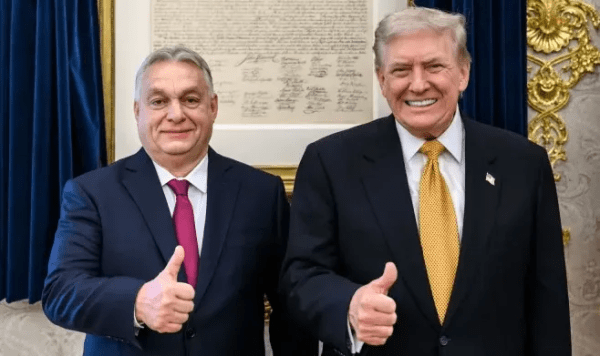
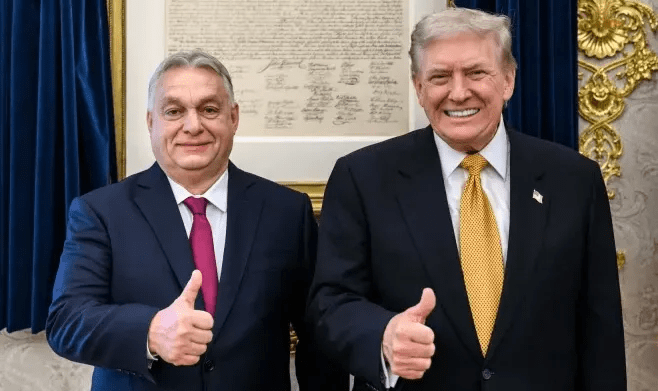
It is a very short line from Budapest to the “Ballroom,” considering the current regime of Viktor Orbán is celebrated in Trump World. The administration’s attacks on universities, media, and law firms reek of Orbán.
So, while I’m shocked to learn that ICE and its adjacent goons have rolled out handheld facial recognition tech across the country, to what is likely an unprecedented level, I’d be embarrassingly naive to be surprised.
Rep. Bennie Thompson (D-Miss.), a veteran of the civil rights movement and ranking member of the House Homeland Security Committee, last month told 404 Media, as reported by Common Dreams, “ICE using a mobile biometrics app in ways its developers at CBP never intended or tested is a frightening, repugnant, and unconstitutional attack on Americans’ rights and freedoms.” Amen.
Now that Trump has issued National Security Presidential Memorandum 7, we are all suspects. “There are common recurrent motivations and indicia uniting this pattern of violent and terroristic activities under the umbrella of self-described ‘anti-fascism,’” reads NSPM-7, in part. “Common threads animating this violent conduct include anti-Americanism, anti-capitalism, and anti-Christianity; support for the overthrow of the United States Government; extremism on migration, race, and gender; and hostility towards those who hold traditional American views on family, religion, and morality.”
Are my views on gender “extreme”? Am I “hostile” toward systems that have long been used to oppress me? Are you? Who knows? Who defines these vague, subjective terms? I’m guessing it’s the folks who have decided to throw facial-recognition tech into the surveillance mix, with little, if any, legal restraint. The use of this technology is apparently new enough, that no one has bothered to set down laws to restrain it. Instead, we have protocols and suggestions as the only limits on an administration that delights in destroying whatever stands in its way.
COVID has waned, but this new Big Brother era may soon have us all masking up again for our personal safety, whether for Pride or protests.
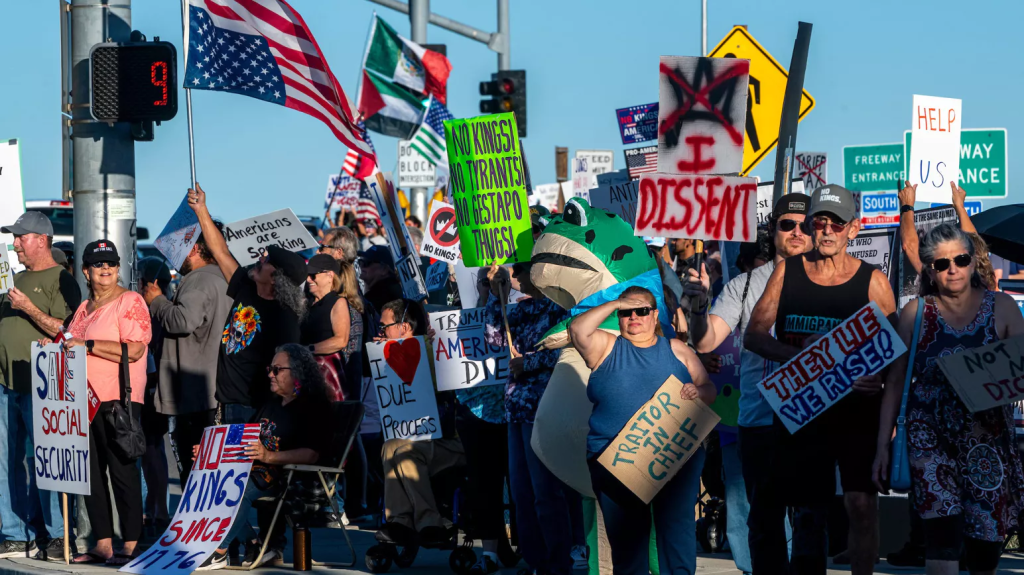
“Hey hey, ho ho, Donald Trump has got to go,” protestors chanted in the middle of Times Square, among a sea of signs that read “love reigns not kings,” “gays against faux-king Trump,” “we stand with … our trans family,” and “the future is coming.”
On Saturday, independent analysts estimated that the No Kings March drew between 5 and 8 million people, and organizers say over 7 million people attended 2,700 events across all 50 states. The event, which was organized to push against the rise of authoritarianism in the U.S., was the largest single-day protest in America since 1970.
Among the crowd were countless LGBTQ people, fighting back against an administration that has introduced a litany of anti-LGBTQ executive orders and used vile rhetoric to denigrate queer people. This backsliding of LGBTQ rights, according to experts, has a deep connection to authoritarianism, with research showing that when governments weaken protections for queer and trans people, they often turn to broader democratic institutions next.
“Threats to democratic institutions and threats to LGBTQ rights are mutually reinforcing, generating a vicious cycle that strengthens authoritarian control,” Ari Shaw, director of International Programs at the Williams Institute, told Uncloseted Media. “Increased persecution of minority groups, including LGBTI people, is itself evidence of democratic backsliding by indicating the erosion of liberal democratic norms [meant to protect] minority rights.”
Legal Abuse of Power
One of the ways the Trump administration’s abuse of power has been most evident is through its legal actions.
He’s also slashed HIV funding at a staggering rate. Uncloseted Media estimates that the National Institutes of Health has terminated more than $1 billion worth of grants to HIV-related research, including 71% of all global HIV grants.
It was these cuts that prompted Brooklynite Jeffrey Cipriano to turn out to protest. “The specific reason that I’m protesting is actually on the shirt I’m wearing,” says Cipriano, referring to his red “This is what an HIV advocate looks like” t-shirt.
“My best friend works for an organization called AIDS United. … His job is to travel the country and help people get AIDS medication, specifically trans and unhoused community members. But his job is at risk,” he says. “The end outcome of his work is that people who have issues in their lives have the issues resolved, and that’s going away under the current administration.”
Executive orders are based on powers granted to the president by the U.S. Constitution or by Congressional statutes. The president cannot use an executive order to create new laws or spend money unless Congress has authorized it. They are meant to direct how existing laws are implemented. But Trump has ignored democratic norms, often filling agencies with loyal supporters, using orders to go after political opponents, and pushing the limits of what the law allows.
In some cases, he has moved illegally. “The President is directing various executive branch officials to adopt policy that has either not yet been adopted by Congress or is in violation of existing statutory law,” says Jodi Short, professor of law at UC Law San Francisco. “The analogy to a king and what has troubled many about this presidency is the sheer consolidation of executive branch power in one individual.”
Short’s colleague, Dave Owen, agrees. “Illegality has been rampant,” he told Uncloseted Media in an email. “People are often cynical about the government, and they might think what Trump’s doing is nothing new. But most of the time, the executive branch takes the law seriously, and both legal constraints and norms of good governance matter,” he wrote. He says that through history, there’s been “a lot more integrity and a lot less lawlessness than most people realize.”
“This administration has broken with those traditions,” he adds.
Revolt Against Executive Orders
Many Americans have recognized this. A survey from April found that 85% of Americans agreed or strongly agreed that the president should obey federal court rulings even if he doesn’t like them.
In response to Trump’s overreach, more than 460 legal challenges have been filed across the country challenging his executive actions. One of these is a federal lawsuit by Lambda Legal and the Human Rights Campaign Foundation that challenges the constitutionality of the Trump administration’s ban on military service by transgender people. Another lawsuit challenges Trump’s order directing federal agencies to withhold funds from medical providers and institutions that provide gender-affirming medical treatments for people under 19.
Both of those lawsuits are one reason 17-year-old Zoe Boik came out to protest with her friends and her dad. “Obviously, I’m disappointed and kind of helpless because there’s nothing I can directly do to change or impact anything that’s going on,” says Boik, who identifies as pansexual and gender fluid and is not legally allowed to vote.
Boik—who was seven years old when Trump announced his run for presidency in 2015—says she’s doing a research paper on Trump’s trans military ban and is frustrated because she sees it as inexplicable discrimination. “They’re not letting trans people serve… which doesn’t make any sense.”
LGBTQ Rights and Democratic Backsliding
This type of blatant discrimination is often a key sign of a country moving closer to authoritarianism and away from democracy. According to a 2023 research paper by Shaw and his colleagues, anti-LGBTQ stigma may contribute “to the erosion of democratic norms and institutions.”
The paper found that when a country with relatively high acceptance of LGBTQ rights introduces anti-LGBTQ legislation, it clashes with what most people believe and can weaken public trust in democracy, deepen political divides, and make it easier for populist or extremist movements to gain power.
“The level of acceptance of LGBTQ people is closely associated with the strength of democracy in a country,” Shaw says. “In some cases, we even saw that rising anti-LGBTQ rhetoric or policies preceded a broader decline in democracy.”
In Brazil, for example, early democratic gains coincided with rising LGBTQ acceptance, including legal recognition of same-sex unions and workplace protections. But as populist President Jair Bolsonaro came into power in 2019, he began questioning—without evidence—the security of Brazil’s voting systems, saying he would only lose his re-election campaign if there were fraud. He was also accused of trying to intervene in operations held by the Federal Police about the alleged criminal conduct of his sons, and he told his ministers that he had the power and he would interfere—without exception—in all cabinet ministries. At the same time, LGBTQ protections were rolled back, and schools and civil society faced censorship, suggesting that falling LGBTQ acceptance may have “preceded Brazil’s democratic erosion,” according to Shaw’s paper. In September of this year, Bolsonaro was sentenced to 27 years in prison for plotting a military coup.
Another example is Poland’s democracy weakening since 2015 under the Law and Justice Party, which consolidated power by undermining the Constitutional Tribunal, installing loyal judges, and restricting independent media. Anti-LGBTQ rhetoric became central to the party’s nationalist platform, fueling the creation of nearly 100 “LGBT ideology-free zones,” inciting violence against LGBTQ individuals, and stymying legal recourse through politicized courts.
When it comes to LGBTQ rights, Trump has mimicked the moves of these leaders even though most of his constituents don’t want it: A 2022 survey from the Public Religion Research Institute found that 80% of Americans favor laws that would protect LGBTQ people against discrimination.
“The definition of an authoritarian system is a system where power is consolidated in one individual whose power is unchecked by any other institution. And I fear that in certain domains, that’s the direction in which this administration is trying to move us,” says Short. “I think it’s incredibly dangerous.”
Attacks on Higher Education
Another common tool in the authoritarian playbook is attacking higher education.
While many universities are rejecting Trump’s demands, others are experiencing a chilling effect, changing their policies before the administration tries to hold up funds.
“I’m here because I’m angry and I feel that we aren’t angry enough,” Maddy Everlith, a sophomore gender studies major at Pace University, told Uncloseted Media as she marched with her friends. “Being a woman of color in America and having so many intersectional identities is also what affects me.… I want to stand up and advocate for other people.”
Everlith’s university responded to Trump’s threats in September by renaming its DEI office to the “Division of Opportunity and Institutional Excellence.”
“I am beyond horrified how quickly our university was willing to bend the knee on this decision,” Austin Chappelle, a senior at Pace, told the student newspaper. This change comes in the midst of uncertainty under the Trump administration, which has already caused many LGBTQ students to feel uneasy on campus.
“It’s part of an electoral strategy to try to mobilize right-wing voters to distract from other sorts of political or economic scandals,” Shaw says, adding that this tactic is another way to gain power.
The pain of this rhetoric has affected millions of trans Americans and allies alike, including Lars Kindem, a 64-year-old retired pilot from Minnesota who was marching to support his transgender sister.
“What Trump has done is he’s taken people that haven’t done anything wrong and has turned them into scapegoats,” he says, adding that Trump’s language is “hateful, petty, mean, and hurtful.”
He says his sister and her partner are having issues getting the correct gender markers issued on their passports. Because of the Trump administration’s treatment of the community, they are making plans to move to Denmark, where “there’s a lot more acceptance.”
Christian Nationalism
This scapegoating has played into the hands of Trump’s voter base of white evangelical Protestants, the only major Christian denomination in the U.S. in which a majority believes society has gone too far in accepting transgender people.
Since 2020, Trump has increasingly embraced Christian nationalism in his rhetoric and imagery. He’s sold Bibles, created a federal task force on anti-Christian bias, and been intrinsically linked to Project 2025, the 920-page plan calling for the establishment of a government imbued with “biblical principles” and run by a president who holds sweeping executive powers.
Experts say that “a strong authoritarian streak” runs through conservative Christianity. A 2023 study found that supporters of Christian nationalism tend to support obedience to authority and the idea of authoritarian leaders who are willing to break the rules. Nearly half of Christian nationalists support the notion of an authoritarian leader.
“They are trying to use the language of Christianity, but they are abusing it and misusing it constantly,” Rev. Chris Shelton, a gay pastor at the protest, told Uncloseted Media. “Our faith is all about reaching out to the marginalized, reaching out to the people who are ostracized by society and embracing them and offering love and welcome and a sense of dignity and worth. And to see any human being’s worth being denied is just a mockery of our faith.”
Heidi Beirich, the vice president and co-founder of the Global Project Against Hate and Extremism, says that “the LGBTQ community is the prime target of modern authoritarian regimes.”
“For Christian nationalists, attacking LGBTQ rights is the first pillar in destroying civil rights for all. This has happened in countries like Hungary and Poland as authoritarianism consolidated, and now it’s happening here,” Beirich told Uncloseted Media.
Moving Forward
As the country bleeds toward authoritarianism, LGBTQ protestors are encouraging people to use their voice, something the queer community is familiar with doing: One 2012 survey found that queer folks are 20 times more likely to be active in liberal social movements than their straight, cis counterparts.
“It is imperative that people continue to pay attention,” Short says. “There is so much going on, a lot of it is disturbing and intense, and there’s such a strong impulse to look away. But we have to engage in political action and resist inappropriate assertions of authority and continue to show up and vote for our democracy.”
17-year-old Zoe Boik is ready. She remembers being in second grade and crying the day after Trump won his first election in 2016. She couldn’t believe how he could lead the country despite “all the bad things he said.”
Boik can’t wait until the midterm elections, when she will be 18 and finally able to vote. “If we don’t vote, then our voices won’t be heard,” she says.
Despite this, she’s also concerned about her freedom to exercise that right being jeopardized.
“My fears about Trump don’t stem specifically from me being queer, but from his authoritarianism as a whole,” she says. “I am scared about how far he will move into dictatorship, [and] my biggest fear is that our right to vote will be compromised, leaving us no recourse.”
Throughout Ali’s childhood in Iraq, he was repeatedly bullied by students and teachers for what he described as his feminine behavior. During his pre-teen and teenage years, men sexually assaulted him, but he couldn’t report it to the police for fear that he’d be thrown into jail for years since Iraq has criminalized homosexuality.
Ali was afraid to come out or talk about these assaults to his family. Although he wasn’t sure if his father knew he was gay, his dad knew other LGBTQ+ people from his travels abroad for work. His father used to tell him, “One day, we’re gonna go to travel to Europe or America and have a good life,” adding, “You’re gonna be safe and you’re gonna be happy.” But then his father died of a heart attack in 2014, and Ali’s abusive older brother (10 years his senior) assumed control of the family, making Ali terrified for his future.
In November 2023, Ali went out with another man for ice cream. While they were out in the rain, five Iraqi police officers suddenly surrounded and arrested them, believing they were romantically involved. Though Ali lied and told the officers they were just cousins, the officers accused them of being prostitutes and slapped, kicked, and hit them in the streets, eventually taking them to the police station.
At the police station, they took Ali’s phone and found images of male models and some men kissing. Police said that the images confirmed Ali’s intent to conduct sex work. They forced him to sign a confession that he had had sex with another man; one officer tried to coerce Ali into performing oral sex; and the police eventually threw him in jail, leaving his family with no clue as to his whereabouts.
In the remote jail, far from the city where Ali lived, he shared a cold, small, crowded cell with about 15 other people, ranging in age from 15 to 60. The police took Ali’s clothes and gave him dirty ones to wear, along with a small blanket.
“Everyone’s sleeping next to each other [on the floor] so close, and it was just so scary,” he told LGBTQ Nation. “Like, I was thinking an animal can’t even live there.” One guard suggested that he tell other inmates that he was arrested for using counterfeit money, because if he admitted he was gay, they might mistreat him.
“I was ultimately released, but I was terrified for my safety because the police had my home address and personal information and had accused me of being gay. I believed I could be imprisoned at any time,” Ali said in a court document explaining his situation. “After my arrest, I knew I had to leave the country to survive. I did not feel that I could trust anyone.”
Ali’s experiences mirror that of other LGBTQ+ Middle Easterners who are entrapped, harassed, detained, and tortured under suspicion of being queer. Ali considered taking his own life to escape the persecution, but he couldn’t go through with it.
A second chance, but with the U.S. government working against him
Ali eventually applied for aid under the U.S. Refugee Admissions Program (USRAP), a 1980 federal program that has helped millions of refugees fleeing persecution in their home countries to relocate safely in the United States and build lives, families, and businesses.
Refugee processing and resettlement are lengthy processes requiring participation from numerous governmental and nongovernmental entities. Ali, like thousands of refugees, first underwent extensive security checks and referrals before being approved under USRAP and resettling into a single apartment in the United States.
“When I learned I would be resettled in Dallas, I was so excited that I began screaming with happiness and jumping and dancing,” Ali said.
It’s hard to know exactly how many LGBTQ+ people seek asylum in the U.S., but a 2021 study by the Williams Institute estimated that 11,400 LGBTQ+ individuals did so between 2012 and 2017. Approximately 4,385 of them made asylum claims specifically related to their LGBTQ+ status.
I am very concerned that if people back in Iraq learned about my sexual orientation and my interactions with the police, my family would be in danger.Ali, a gay Iraqi refugee currently living in Dallas, Texas
He came to the U.S. with only $120 to his name. Upon arrival, Catholic Charities provided him with a case manager and financial assistance for his first three months, as well as help in finding other programs to assist him in getting a job and obtaining basic necessities. Ali soon applied for a matching grant program that would cover one year of rent and utilities and provide him a monthly allowance, as well as a Refugee Cash Assistance program to provide a monthly stipend for six months and potentially longer.
However, by early February, he was notified that both programs had shut down due to an executive order signed by Donald Trump on January 20, entitled “Realigning the U.S. Refugee Admissions Program.” The order claimed that federally funded programs for admitting refugees aren’t in the country’s best interests because they “compromise the availability” of “taxpayer resources” for American citizens.
Trump’s order effectively halted refugee admissions indefinitely, ending USRAP and freezing millions in congressionally appropriated USRAP funding. Trump’s order threw Ali’s life into disarray, stranded thousands of other refugees and separated families who had already been approved under USRAP, and ended the funding of various groups and charities that used federal funding to provide vital survival benefits to refugees.
Ali learned that the case manager helping him secure benefits had been laid off after Trump’s order, and his apartment managers told him he might be evicted if he couldn’t pay the rent. Running out of food, he subsisted on peanut butter.
In response to the chaos, the International Refugee Assistance Project (IRAP) filed Pacito v. Trump on February 10 in the Western District of Washington. The case is a class action lawsuit filed on behalf of the individuals and major resettlement agencies harmed by Trump’s order. It asserts that, by indefinitely ending USRAP, Trump and federal agencies exceeded their lawful authority and violated both federal law – and rulemaking procedures required under the Administrative Procedure Act – as well as the Constitution. The lawsuit seeks to block the order, restore funding, and enforce long-established protections for refugees.
In March, a district court agreed with IRAP’s lawsuit and granted a preliminary injunction against Trump’s order, writing, “The results have been harrowing.” The court noted that refugees have few (if any) rights – they have no right to work; limited access to healthcare, housing, or education; and often face discrimination.
Luckily, a charity helped Ali find a job at a local coffee shop, and he also secured a second job at a local mall. He had learned English, he said, by watching old episodes of Keeping Up with the Kardashians, a reality TV show about an ethnically Armenian celebrity family living in the United States. Now, he has made several good friends and has started building a community by attending a local church.
But other individual refugees who had been approved to come to the U.S. under USRAP after years of processing have either been stranded in the U.S. without homes or work or else trapped in their home or host countries as their scheduled flights to the U.S. were abruptly canceled, the district court wrote in its May decision. This has left the refugees vulnerable to physical danger and financial hardship without stable housing, income, basic necessities, alternative paths to refuge, or access to integration services that would help them become self-sufficient.
Furthermore, Trump’s order effectively defunded congressionally mandated resettlement-support services, making them unable to pay their employees and keep their offices open and undermining decades of work building up infrastructures, relationships, and the associated goodwill to facilitate refugee integration in local communities. The order required these services to furlough or lay off hundreds of staff all over the United States, threatening their continued existence.
The courts are trying to restrain Trump, but he has other plans
In April, the Ninth Circuit Court of Appeals granted the federal government a partial emergency stay of the district court’s injunction. While the appeals court has required the government to reinstate resettlement and placement services to refugees for 90 days after their admission into the United States, the court also appointed a magistrate judge to help review individual cases of refugees harmed by Trump’s order, while IRAP’s class action suit continues to be heard by the courts.
“Iraq is a very unsafe place for LGBTQ+ people,” Ali said in his court filing. “When I speak to people back in Iraq, I hide the fact that I’m gay and that the police arrested and abused me for being gay… I am very concerned that if people back in Iraq learned about my sexual orientation and my interactions with the police, my family would be in danger.”
I want to help everyone in my situation because it is difficult for me now, and I know there are other refugees who recently arrived and are struggling even more than me.Ali, a gay Iraqi refugee currently living in Dallas, Texas
Ali also worries that, if he criticizes the Trump Administration for ending USRAP, conservative organizations could somehow locate his name and personal information for harassment or violent retaliation. If his name is made public, it could make it even more difficult for him to find employment or could lead to other kinds of anti-immigrant and anti-gay discrimination.
Ali understands that, in this case, he’s not only representing himself, but thousands of other refugees nationwide and across the world. “I want to help everyone in my situation because it is difficult for me now, and I know there are other refugees who recently arrived and are struggling even more than me.”
The Trump Administration is considering a radical overhaul of USRAP that would continue to largely defund the program and reduce the number of refugees allowed annually into the U.S. from 125,000 (the number established by former President Joe Biden) to 7,500. Trump’s plan would give preferred relocation assistance to English speakers, white South Africans, and Europeans who have left their countries after making anti-immigrant statements or supporting anti-immigrant political parties, The New York Times reported on October 15.
“[Trump’s plan reflects] a preexisting notion… as to who are the true Americans,” said Barbara L. Strack, a former chief of the refugee affairs division at Citizenship and Immigration Services during the Bush, Obama and Trump administrations. “And they think it’s white people and they think it’s Christians.”
In a statement, IRAP wrote, “These actions reflect a broader pattern of President Trump attempting to strong-arm other branches of government into rubber-stamping his political agenda, sidestepping the checks and balances Congress established to ensure refugee policy serves humanitarian – not partisan- ends. Such departures from established process and principle undermine the United States’ legal obligations and moral leadership, sending a dangerous message that access to refuge may depend on identity rather than need.”
The presidential administration has quietly ended federal employees’ insurance coverage for gender-affirming care. An LGBTQ+ legal advocacy organization called the policy “not only cruel, [but] illegal.”
A letter sent last Friday from the U.S. Office of Personnel Management Healthcare and Insurance to insurance companies said that the Federal Employees Health Benefits (FEHB) and Postal Service Health Benefits (PSHB) Programs will no longer cover “gender transition” services for people of all ages starting in 2026. The letter says that insurance companies can develop an exemption process for patients currently receiving gender-affirming care “on a case-by-case basis,” though it doesn’t specify how.
However, the programs will still cover “counseling services for possible or diagnosed gender dysphoria,” including “faith-based counseling,” which might be a euphemism for conversion therapy, a widely debunked pseudoscientific practice that purports to change a person’s gender identity or sexual orientation.
The letter also directs insurance companies not to “list or otherwise recognize” providers of gender-affirming care in directories of medical professionals and clinics covered by insurance, Them reported.
In a statement condemning the letter, the LGBTQ+ legal advocacy group Lambda Legal wrote that the “policy violates constitutional protections and multiple federal anti-discrimination laws.”
“This discriminatory policy… is not only cruel—it is illegal,” wrote Lambda Legal Counsel and Health Care Strategist Omar Gonzalez-Pagan.
“The federal government cannot simply strip away essential healthcare coverage from transgender employees while providing comprehensive medical care to all other federal workers,” Gonzalez-Pagan added. “Beyond the fundamental equal protection guarantees enshrined in our Constitution, which prohibit such animus-laden actions, multiple federal laws also prohibit this type of discrimination.”
Lambda Legal pledged to explore all options to respond to the discriminatory policy and asked federal employees harmed by the policy to contact their organization.
While the current presidential administration has sought to eradicate gender-affirming care for trans youth, something the administration calls “chemical or surgical mutilation,” this policy change is one of many that show the administration’s interest in ending gender-affirming care for trans people of all ages.
In January, the president issued an executive order (that has since been blocked by several courts) instructing the Department of Justice to use laws against false advertising to prosecute any entity that may be misleading the public about the long-term effects of gender-affirming care.
On February 7, the Department of Defense issued a memo halting gender-affirming medical procedures for adult military service members. In June, the administration finalized a rule modifying the Affordable Care Act to remove requirements that insurance providers cover gender-affirming care as an essential health benefit.
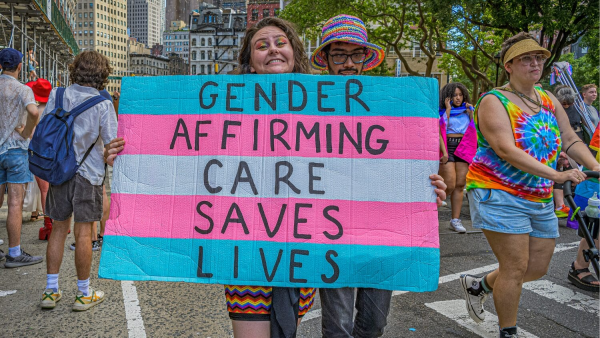
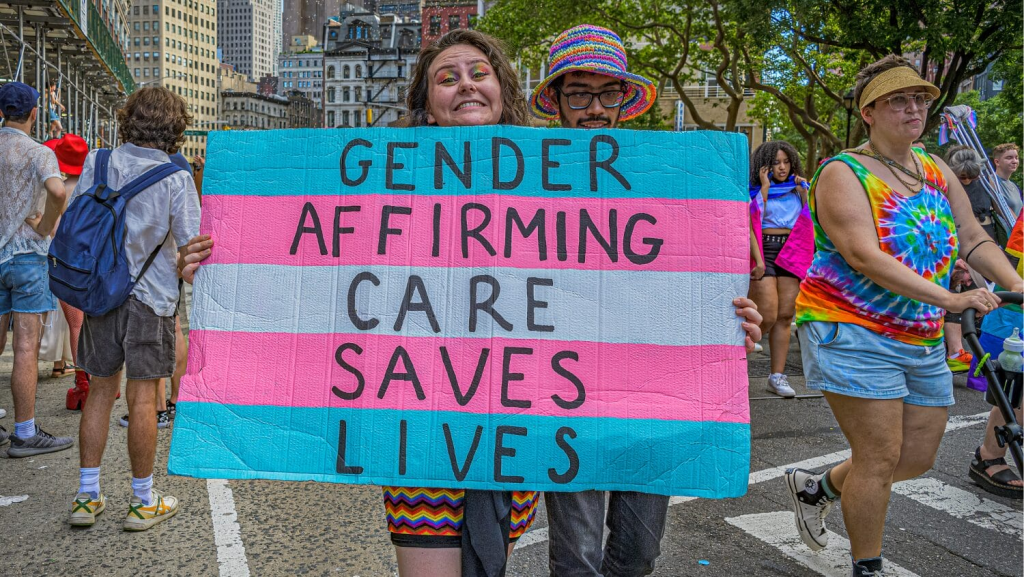
Gender-affirming care is supported by all major medical associations in the U.S., including the American Medical Association, the Endocrine Society, and the American Academy of Pediatrics, as safe and life-saving for young people with gender dysphoria.
The Department of Justice (DOJ) has issued subpoenas to medical providers who offer gender-affirming care to transgender youth, demanding that they provide private information on their young patients. The subpoenas demand “billing documents, communication with drug manufacturers, patient’s Social Security numbers, addresses, emails, Zoom recordings, voicemails, encrypted text messages, as well as every writing or record of whatever type” doctors have made from January 2020 to the current day, The Washington Post reported.
While Attorney General Pam Bondi admitted last month to sending 20 subpoenas to hold “medical professionals and organizations that mutilated children in the service of a warped ideology” accountable, she didn’t specify which organizations and individuals received the subpoenas. Anonymous informants told the aforementioned publication that some of the subpoena recipients (who got the subpoenas in June) operate in states with laws protecting gender-affirming care for youth. One trans civil rights activist called the incident an “unprecedented and disgusting violation of medical privacy.”
“[The government] is using its investigative powers to target medical providers based on a disagreement about medical treatment rather than violations of the law,” Jacob T. Elberg, a former federal prosecutor specializing in health care fraud, told The Washington Post. He added that the DOJ must show that the information it demanded is “relevant to a legitimate law enforcement probe.”
The publication contacted numerous clinics and professionals offering gender-affirming care for youth, but none would say whether they had received a subpoena, citing fears of violent threats or government retaliation. Other hospitals have been closing their trans youth clinics and erasing any mention of gender-affirming care from their web pages to avoid federal threats to cut funding or pursue prosecutorial charges.
“The subpoena is a breathtakingly invasive government overreach,” said Jennifer L. Levi, senior director of transgender and queer rights at the LGBTQ+ legal advocacy group GLAD Law. “It’s specifically and strategically designed to intimidate health care providers and health care institutions into abandoning their patients.”
Fewer than 3,000 teens nationwide receive puberty blockers or hormone replacement therapy, according to a 2025 JAMA analysis of private insurance data, The Post noted.
Responding to the news, transgender civil rights lawyer Alejandra Caraballo wrote via Bluesky, “This is an unprecedented and disgusting violation of medical privacy,” adding, “The fact that no lawsuit has been commenced challenging these subpoenas in court is ominous. My best guess is that many of the providers have complied and now DOJ is potentially sitting on the records of thousands of trans youth covering everything from therapy notes to pre- and post-op photos.”
Though there is no federal law banning gender-affirming care, the current presidential administration has sought to eradicate the practice through a January executive order (that has since been blocked by several courts). The order instructed the DOJ to extend the time that patients and parents can sue gender-affirming doctors and to use laws against false advertising to prosecute any entity that may be misleading the public about the long-term effects of gender-affirming care.
In April, Bondi issued a memo to DOJ employees, telling them to investigate and prosecute cases of minors accessing gender-affirming care as female genital mutilation (FGM); even though hospitals don’t conduct such female genital surgeries. The memo threatened to jail doctors for 10 years if they provide gender-affirming care to young people.
Gender-affirming care is supported by all major medical associations in the U.S., including the American Medical Association, the Endocrine Society, and the American Academy of Pediatrics, as safe and life-saving for young people with gender dysphoria.
One doctor interviewed by The Washington Post called the federal government’s crusade against gender-affirming care a “toxic plan” that will force some patients to detransition, potentially forcing them into adverse psychological and physical effects, including increased anxiety, depression, and the development of unwanted physical changes.
“This goes way beyond any degree of moral or ethical dilemma that any of us have ever experienced,” the doctor said. “It is completely scientifically and medically unfounded.”
Republican attorneys general in Texas and Tennessee have demanded similar patient information from providers of youth-centered gender-affirming care outside of their states, but they dropped their demands after courts blocked their efforts.
More than three-quarters of scientists in the U.S are weighing leaving the country and are looking at Europe and Canada as their top relocation spots, according to a survey released Thursday.
The scientific journal Nature poll found that 75.3 percent of scientists are considering leaving the U.S. after the administration cut funding for research. Nearly a quarter of respondents, 24.7 percent, disagreed.
The highest contingent of researchers who are looking to move out of the country were those who are early in their careers. Nearly 550, out of 690 who responded to the survey, said they are considering leaving the U.S. Out of the 340 Ph.D. students, 255 shared the same inclination, the poll found.
The administration, along with tech billionaire and close Trump adviser Elon Musk, with the help of the Department of Government Efficiency, has terminated entire agencies and made cuts in the last two months in an effort to shrink the size and scope of the federal government.
Some of those reductions were felt at the National Institutes of Health (NIH), where all grants for equity issues, which encompass studying Black maternal health and HIV, were canceled. The cap on indirect costs of NIH grants was capped at 15 percent.
The NIH was also ordered recently to halt efforts to terminate the funding for grants intended for hospitals, universities and other institutions by a federal judge after numerous lawsuits.
Former Health and Human Services (HHS) Secretary Kathleen Sebelius said she was concerned about the recent cuts to grants flowing through the NIH.
“I’m worried on a lot of fronts,” Sebelius said Wednesday. “The kinds of cuts that were just announced are devastating and will set science back and set research back.”
These cuts have also affected the National Oceanic and Atmospheric Administration (NOAA), which has been hit with layoffs.
More than three-quarters of Americans, 76 percent, said they have a great or fair amount of confidence in scientists to do what is best for the public, according to a Pew Research Center survey that was published in mid-November last year. The figure was a minor uptick from October 2023, when 73 percent of respondents said the same.
Around 1,650 people responded to Nature’s survey. The margin of error and the dates the survey was conducted were not available to The Hill.



 fleeredstates.blog
You must be logged in to post a comment.