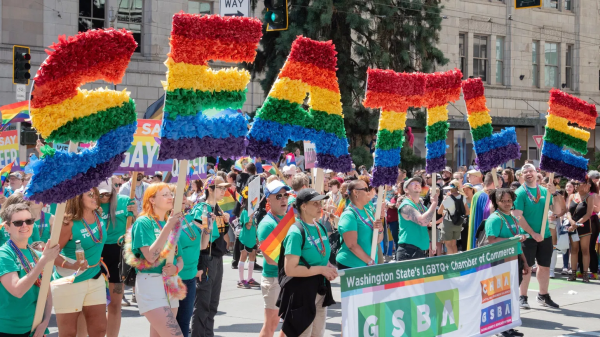
World Cup Pride Match in Seattle will feature… Egypt and Iran. Say what?

Read more at Outsports.

When the full schedule was confirmed the next day, Vancouver was selected for New Zealand’s clash with Belgium, leaving Seattle with the awkward situation of its “Pride Match” featuring Egypt and Iran — two nations with atrocious LGBTQ human rights records.

Both Egypt and Iran criminalize gay relationships. In Iran, capital punishment is still the maximum penalty under the law.

According to the Human Dignity Trust, there is evidence in recent years of the enforcement of their respective laws in each of the two nations.

A match between countries that vociferously oppose Pride presents a complex scenario for Seattle organizers, who have set up a Pride Match Advisory Committee (PMAC) to “shape the communications, community activations, and cultural programming” for the festivities.

With Lumen Field hosting six World Cup fixtures in total, there might have been scope to alter the Pride Month plans.

However, the USMNT’s match with Australia on June 19 has already been designated to mark Juneteenth, while the other group matches in Seattle on June 15 and June 24 feature either Egypt or Qatar, which is another country that imprisons gay people.

There will also be a round-of-32 game featuring the winner of Group G at Lumen Field on July 1, and a last-16 match on July 6.

World Cup Pride Match with Egypt and Iran could be ‘good thing’

Despite the obvious challenges, Seattle FWC26 have indicated they will proceed with their plans for the Pride Match on June 26.

In a statement provided to Outsports, a spokesperson for the PMAC said: “The Pride Match has been scheduled to celebrate and elevate Pride events in Seattle and across the country, and it was planned well in advance.

“It is a Host City–led expression of Seattle and Washington State’s commitment to creating a welcoming and inclusive environment where everyone belongs: players, fans, residents, and visitors alike.

“Soccer has a unique power to unite people across borders, cultures, and beliefs. We are honored to host a Pride Match and to celebrate Pride as part of a global football community. This match reflects our ongoing commitment to respect, dignity, and unity for all.”

Eric Wahl, the brother of the late soccer journalist Grant Wahl, is a member of the Seattle PMAC. He is an advocate for public health and human rights, an out gay man, and a public speaker.

Following the fixture announcement, Wahl said on social media that the match-up of two countries where it is illegal to be gay is actually a “good thing” for the Pride Match.

City organizers do not want to pass up the opportunity to send out a strong message of welcome to LGBTQ people everywhere, having stated that with “hundreds of thousands of visitors and billions of viewers worldwide, this is a once-in-a-lifetime moment.”

Hedda McLendon is Seattle FWC26’s Senior Vice President of Legacy. She told Outsports that organizers are “working with small businesses so the region’s LGBTQ+-owned enterprises are ready to benefit from the tournament’s unprecedented visitor surge.”

Katie Wilson, the Democratic mayor-elect of Seattle who will assume office on Jan. 1, expressed similar hopes on social media after Saturday’s fixture confirmation. She referred to the Juneteenth and Pride themed matches, saying: “We get to show the world that in Seattle, everyone is welcome. What an incredible honor for our city!”

Last month, three finalists were announced for a Pride Match artwork competition, with the designs carried on the official SeattleFWC26 website.

Created by local artists from Washington State, the designs capture “Seattle’s identity as a diverse, inclusive community and a leader in LGBTQ+ rights,” according to organizers.

It is understood that the PMAC’s preparations are not being made in conjunction with FIFA. On a webpage carrying information about the Pride Match Design Contest, a disclaimer stated that the creation “is not affiliated with or endorsed by FIFA.”

Plans to celebrate LGBTQ Pride Month at a FIFA World Cup match are set to continue, even though the two countries selected for the fixture both have draconian anti-gay laws.

Seattle’s local organizing committee for World Cup 2026 has been preparing to stage a historic “Pride Match” at Lumen Field on June 26, the Friday of Pride Weekend. The themed fixture would be the first of its kind at a FIFA World Cup. The anniversary of the Stonewall riots is on June 28.

Friday’s tournament draw allocated the slot in the city’s schedule to one of two Group G games — New Zealand v Belgium, or Egypt v Iran.

The Pride Match would certainly stand in stark contrast to the Qatar 2022 World Cup, where the “OneLove” armband in support of diversity was banned by FIFA, and where some LGBTQ fans and allies had rainbow-colored items confiscated by security forces.

A few were even temporarily detained and harassed while being questioned about the items, including Grant Wahl. The journalist was told by guards to remove his T-shirt at a stadium and later reported on his distressing experience.

In recent days, a coalition of groups and organizations including the Sport and Rights Alliance has raised serious concerns about FIFA’s approach to human rights at World Cup 2026, including on the issue of LGBTQ safety.

As part of this, Athlete Ally ambassador Matt Pacifici, a former pro goalkeeper with Columbus Crew who came out publicly as gay in 2019, has criticized FIFA’s lack of anti-discrimination messaging at last summer’s Club World Cup tournament in the U.S. and also called for “enforceable protections” for LGBTQ players and fans.

Outsports has approached FIFA for comment, but by the time of publication, no response had been received.
Spokane passes LGBTQ+ rights ordinance to protect trans folks from the federal government

*This is reported by LGBTQNation.

The City Council of Spokane, Washington, has passed an ordinance enhancing protections for LGBTQ+ people, with a focus on protecting trans folks.

Council members voted 5-2 to implement the ordinance, which updates the city’s human rights code to define gender-affirming care and ensure equal protections for LGBTQ+ people.

A press release explained that both Spokane Municipal Code and state law already provide protections for LGBTQ+ people, but the ordinance adds language to “acknowledge the inherent risks faced by the LGBTQIA2S+ community in Spokane, particularly due to federal policies and interjurisdictional legal processes from states that do not recognize LGBTQIA2S+ rights or are working to deny such individuals access to essential medical care, including gender-affirming care.”

The policy “prohibits the city from collecting or disseminating information about anyone’s sex assigned at birth, unless it’s related to a criminal investigation.”

The ordinance also adds a definition of gender-affirming care to the human rights code’s glossary of terms and adds a section requiring city-provided healthcare to cover it. It also requires the Spokane Police Department to keep an LGBTQ+ liaison officer on staff.

“LGBTQIA2S+ people deserve the freedom to make their own health care decisions and deserve to feel safe in our community,” Council Member Zack Zappone said in a statement.  “That freedom and safety are under threat across the country. This ordinance ensures the City continues to protect LGBTQIA2S+ people and that they know that in Spokane, we all belong.”

“I want to thank all the powerful and heartfelt testimony in support of this ordinance that is about supporting safety, freedom, and dignity,” added Council Member Paul Dillon.  “Spokane is a city where diversity is not just accepted but celebrated, and this ordinance shows our commitment to our city motto that in Spokane, we all belong, especially in a time of targeting and discrimination…”

Councilmembers Jonathan Bingle and Michael Cathcart voted against the ordinance, with Bingle attempting to add five amendments, including measures to ban trans people from using the bathrooms and playing on sports teams that align with their genders and to ban those under 18 from receiving gender-affirming care through city insurance. None of the amendments passed.

During the city council meeting, Bingle defended his position, claiming he doesn’t want anyone in the city to be discriminated against, including those “who have sincerely held religious, moral, or ethical objections to this.”

“It’s a live and let live situation that I’m totally cool with,” he said. “I think that’s a great idea.”

Dozens of people showed up at the meeting to advocate for passing the ordinance.

One mother of an adult trans son said she fled to Spokane from Idaho with her son and his wife after her son experienced horrific mistreatment by doctors in Idaho.

In Spokane, she said, they found support, dignity, and a “welcoming spirit.” But she said hostility has been growing in the city in the wake of the federal government’s anti-trans policies. “We are feeling the fear and stress we thought we left behind,” she said.

The ordinance, she said, “is not just about symbolism; it’s about real protections, real care, real safety for people who are just trying to live their lives.”

I talked to 4 trans refugees to find out how they’re building new lives in blue states

*This is being reported by LGBTQNation.

Karma Yoakum had been part of a community of political activists in Texas for years. However, as the relentless tide of anti-trans legislation kept rising, it became clear that it was time for them to relocate, recover their energies, and take on a different role in the larger fight. 

Finding a new home in the Pacific Northwest, Karma was able to do just that. But the road wasn’t without its challenges, and finding their new community required intention and perseverance once they had recovered a little bit of who they were by living in a state that wasn’t trying to persecute them for their existence.

As anti-trans sentiment and legislation have been on the rise across the United States in recent years, many trans and nonbinary people have made the difficult decision to flee red states. In moving to a bluer state, trans people are making a choice based on safety, but that doesn’t make it an easy choice. It means leaving behind a home and community you have built over years or your whole life because of the machinations of people who hate you. While a new state can fix a lot of problems, building a new community doesn’t happen overnight. The president’s re-election and the introduction of federal anti-trans bills have created a flashpoint for even more trans people to seek safer pastures in states that might protect them.

I wanted to understand the challenges and opportunities that trans people face when starting over and building a new community in a blue state. I spoke with four trans and nonbinary people who have relocated in the last six to twelve months. They shared the challenges, the successes, and advice for others who are considering relocating to a sanctuary state.

Why trans people are leaving their red state communities

Major relocations often happen around an institution, such as going to college or starting a new job. But moves like those come with some built-in community-building support. 

Relocating as a refugee from a red state can be a more lonely affair. Most of the people I spoke with found that building a new community felt like work exacerbated by not having the same connections and support systems they had in the communities they left behind.

Clark Roman had been well-established in St. Louis. Both Clark and his boyfriend had owned their own houses and had a strong community of friends and chosen family in the city. But he says he saw the writing on the wall in 2023 when the Missouri attorney general enacted a de facto ban on trans hormones and trans healthcare that included adults. While his emergency rule was blocked by a judge and then withdrawn, the legislature went on to pass a gender-affirming care ban for trans youth. It was clear where things were headed, and Clark moved to Minneapolis a few months later.

Leaving behind a large community, both queer-centric and otherwise, Clark has found it hard to make more connections in his new city. At the center of it is the challenge of the modern age: balancing work and social life. “The honest truth is I have a very, very stressful job and I have not had the space in my life to build community the way I want.” He noted that it felt like he had to “treat building a new community as a second job.”

Karma also struggled to make connections when they first relocated from Texas to Washington state. After living in Texas for years, they reached a point where they found themselves saying, “I’m feeling scared and trapped and there’s absolutely nothing keeping me in Texas anymore.”

Karma moved 2,000 miles to Seattle but found a problem when they arrived. While their new home was more welcoming to the gender diverse, there was still culture shock to get over. “Where is everybody? I heard it was this wonderful panacea, a place where I would be welcomed. So, I looked around and I learned what the Seattle chill was. And it’s not a horrible thing, it’s just a difference in culture, because I’m used to southern culture.”

Chris (his name has been changed to protect his privacy)  echoed Karma’s frustrations over Washington state’s laid-back attitude to building community. Like Clark, Chris was living in St. Louis, saw the anti-trans legislation in Missouri in 2023, and concluded that “living in Missouri as a trans human, [he] was at risk.” He made the move to Washington state in 2024 while watching the coming election without much hope.

While St. Louis had its flaws, Chris was leaving behind a lot of queer community and resources. He had worked with the St. Louis Metro Trans Umbrella Group for nearly 20 years, enjoyed events and meetups, and collected queer friends through meets at clubs, bars, and drag shows. But the same culture shock that Karma experienced has made it hard to build new connections: “It’s been honestly a huge struggle, much more than I anticipated.”

While it’s important to know that people are struggling with finding new communities in their new states, it’s not all doom and gloom. Clark and Chris have both been able to stay in touch with parts of their communities from before their moves through travel and online communication. While that’s not always the same, it’s a nice option to have. I also spoke with Mira Lazine – an LGBTQ Nation contributor – who relocated from Cincinnati to Minneapolis and had a different sort of experience.

While the Ohio governor vetoed HB 68, which banned gender-affirming care for minors, he then introduced care guidelines for the state. “These rules were basically going to amount to a total care ban for all adults in Ohio,” explained Mira. “And it even would include some aspects of conversion therapy and mental health treatment.” 

It was time to relocate, and someone recommended Minneapolis. For Mira, finding a new community in this queer-friendly space came a lot easier.

“Within the first week of moving here, I went to a few coffee shops, and everyone, like the baristas, were trans, and they were recommending me support groups to join, discord servers I can join, like the whole nine yards. And it’s just been way easier to meet people and meet other queer people and form connections here.” 

While Karma and Chris suffered from culture shock, Mira found herself among other transplants to the state who had their relocation in common: “Probably like 80% of the queer people I’ve met aren’t originally from Minnesota, so we’re all like, yeah, we need community, let’s build one.”

Finding new communities in blue states

All of the people that I spoke with had been in their new homes for less than a year. While there have been struggles, they have been able to find resources and spaces to start that community-building process and are in different places in their journeys.

Clark noted that his struggle to find community in Minneapolis is probably the biggest dissatisfaction in his life right now. But he can see a light at the end of the tunnel through some of the community spaces that he is attending. “The synagogue I go to is very open and trans-friendly. So that was helpful.” Clark is also looking at getting more involved with Transplants, a group for LGBTQ+ people who have relocated to Minneapolis and St. Paul. 

Chris has found that his work at a university in Washington provides some space for community building. “Their DEI office held a holiday event for, I guess, everyone, but the folks who showed up to that event were primarily queer folks and persons of color. And that was fantastic.” 

Chris still faces challenges, even at the events. He told me that he has been going to meet-up groups, Portland Pride, the Ingersoll Gender Center, and more, but he wasn’t satisfied with the results. Chris suggested that part of that problem might be visibility: “I am stealth, so at my workplace, I’m not fully out [as trans]. Where I landed is sort of a purple city in a blue state. I’m typically able to pass as male and not be questioned at all, which is, is nice, but at the same time, it’s hard because I think visibility might help me connect with more queer people.”

For Karma, their initial struggles with community-building in Seattle began to bear fruit around the one-year mark. “I did the things that I’ve tried before, and I figured, if they’ve worked everywhere else, they ought to work here. Maybe it just takes a little longer. And yeah, that was it. It takes a little longer.”

Karma found that organizations were the key. They found like-minded people when they returned to playing music with the local band that is part of the LGBTQ+ band organization, Pride Bands Alliance, an international group that Karma has worked with since the 1990s. Similarly, local chapters of a national support network have provided success in community building: “PFLAG, all you have to do is show up to a meeting. There are people there that if you need a hug, they are instant family. And people that aren’t instant family are there because they want support.”

Karma also reached into her past in political activism and found that, post-move, they had the energy to continue in their new home. “The third place that I decided to get involved was the Gender Justice League. Dealing with legislation, dealing with victims of violence here in the Seattle area. So, supporting our community, advocating like crazy.” After months of struggling to find their people, Karma now finds that barely a day on their calendar doesn’t include a community event, a catch-up, or a coffee meet.

No regrets

Everyone’s experience with relocating to a bluer state will be unique. However, there was one ringing agreement amongst all the people that I spoke with: no regrets. When asked what advice they had for someone considering a move, Clark, Chris, Mira, and Karma all urged people to relocate if they felt it might help.

Clark grieves what he left behind but recognizes that it was the right call for him, and he’s going to keep trying to find his new community. “I think it’s dissatisfying at first. But it’s important to [show] up repeatedly because I think that repeated showing up [is] how I made my community originally in St. Louis.” 

Chris echoed those sentiments, noting that he has no regrets and that it has been “completely worth it.” Watching recent election results come in wouldn’t have been fun anywhere, but he was glad to be in a safe space for it all “despite challenges and some loneliness.”

Karma isn’t even considering going back. “I would say do it. The relief that I felt by at least being in a community where I know that I’d no longer have to deal with local politics.”

“In Texas, the local politics were against me,” they said. “At least here, I know locally and statewide, my representatives really do represent everybody, and they have my back. And that has made so much a difference in my life.”

Blog at WordPress.com.

Up ↑