The mother of a transgender child who tried to speak out against proposed changes to her school district’s diversity, equity, and inclusion (DEI) policies was forcibly removed by four police officers when she said one word at a meeting of the City Schools of Decatur Board of Education on Tuesday evening.
That word was “cowards.”
“I’m practicing my rights as a parent. I’m in no way resisting,” she said as she was carried out. “I’m not resisting, and this is what fascists do!”
Kotler went to the emergency board meeting to speak against changes to the district’s DEI policy, which used to require that “all learning environments… be inclusive, safe, secure, and supportive while also ensuring that no student group is marginalized.” This policy, as well as four others, was changed to remove words like “equity” and “Americans with Disabilities Act.” Two of the policies were rescinded completely.
The district’s DEI policy now states that it is “designed to achieve fair and just access to opportunity and resources that provide all humans the ability to thrive.”
Kotler, who is the mother of three children, including one transgender daughter and one nonbinary child, went to the meeting and shouted “Cowards!” at the board. Advocate reports that Board Chair Carmen Sulton asked her to leave.
“I said one word, I have already stated I have no intention of speaking again until public comment,” she responded. “I’m going to sit here. I have offered that if it makes the board feel comfortable, you, as a security employee, are welcome to sit next to me. If I speak again outside of public comment, I will leave. I have the right to be here, I have not used harsh language or threats.”
Police then approached her, but she didn’t get up. So they lifted her out of her seat and dragged her away, dropping her off on the stairs in front of the building.
“I’m practicing my rights as a parent. I’m in no way resisting,” she said as she was dragged off. “I’m not resisting and this is what fascists do!”
“It’s beyond evil that anyone is threatening these programs,” she later told Atlanta News First. “Our children spend a huge chunk of their lives at school. Their own sense of self and self-worth is developed at school. If we stop policies and programs that make those spaces inclusive and safe for everyone, we know what happens.”
“There are marginalized children and economically disadvantaged children in our district who rely on these programs.”
Decatur’s is one of many school districts across the country rewording their DEI policies in light of the new presidential administration’s antipathy towards promoting equal rights for minority students, particularly those who are transgender and nonbinary.
A Florida teacher has lost her job for calling a student by their preferred name without obtaining parental consent. Melissa Calhoun has taught in Brevard County for 11 years and is thought to be the first to fall prey to a new state policy requiring parents to sign a consent form for a student to go by something other than their legal name at school.
Administrators at Brevard County’s Satellite High School decided not to renew Calhoun’s contract for the 2025-2026 school year after a parent complained she’d been calling their child something other than their legal name. The student’s gender identity has not been revealed, but Florida Today reported that “community members believe” the case is “related to the student’s gender identity.”
The parental consent rule—which was signed by Gov. Ron DeSantis (R) in 2023—does not specify the consequences for breaking it, but the school chose not to renew Calhoun’s contract since the state will now be reviewing her teaching contract due to the parent’s complaint, district spokeswoman Janet Murnaghan explained to the Washington Post. She has, however, been permitted to finish the school year.
“Teachers, like all employees, are expected to follow the law,” Murnaghan said.
But many in the Brevard County community are not on board with the school’s decision. Many people showed up to advocate for Calhoun at a recent school board meeting, even though her issue was not on the agenda.
“There was no harm, no threat to safety… Just a teacher trying to connect with a student. And for that her contract was not renewed, despite her strong dedication and years of service,” the school’s media specialist, Kristine Staniec, whose kids were taught by Calhoun, reportedly told the board.
Over 12,000 people have signed a Change.org petition to reinstate Calhoun, calling her “a cherished teacher” and “dedicated educator” who “is being punished merely for showing respect to a student’s choices.”
“Ms. Calhoun is an embodiment of what proper education should be: inclusive, understanding, and respectful of individuality,” the petition continued. “Losing her would be a significant loss to Brevard County’s education community.”
Brian Dittmeier, director of public policy for LGBTQ+ student advocacy organization GLSEN, told the Post that Calhoun’s firing “is an indicator of bureaucratic overreach of antitransgender policy,” in addition to the blatant anti-trans attacks it represents.
“A teacher could potentially be fired for calling a student Tim instead of Timothy,” he emphasized, pointing out how anti-trans laws hurt everyone in the end.
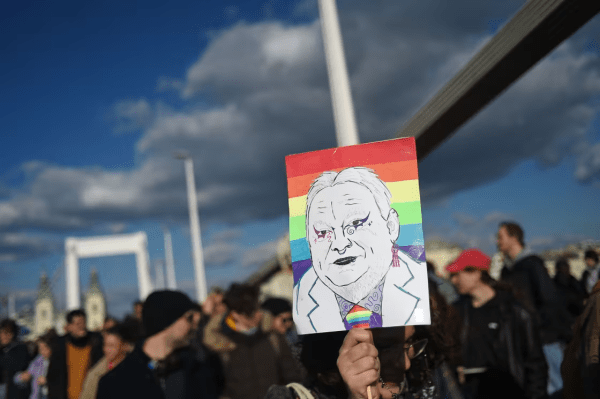
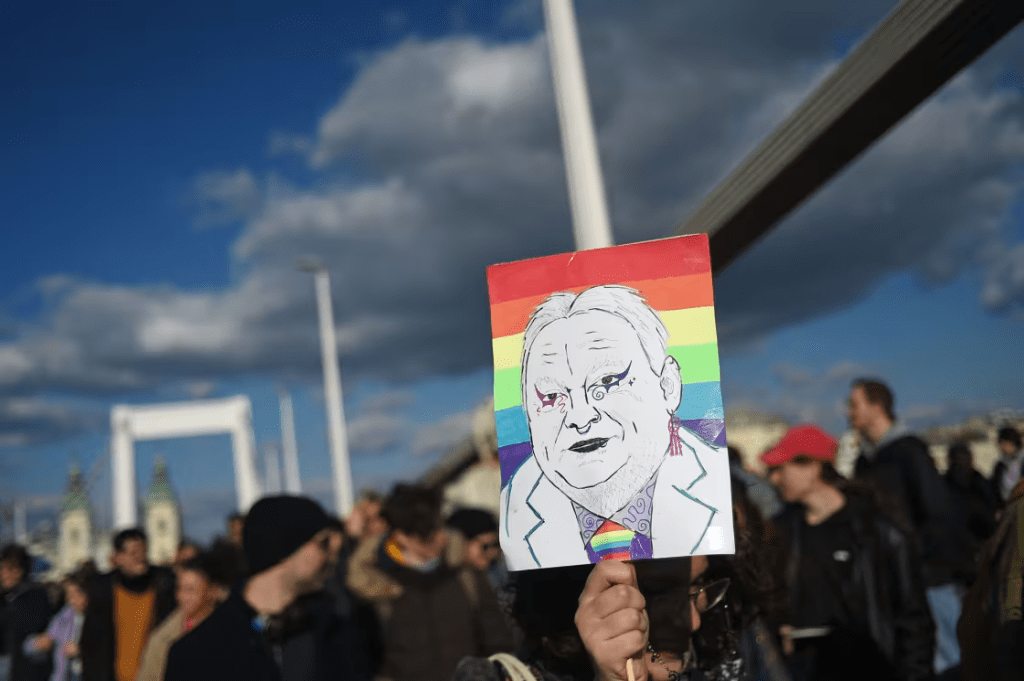
Thousands of protesters rallied for the fourth week in Hungary’s capital on Tuesday, denouncing a new law passed by populist Prime Minister Viktor Orbán’s nationalist government banning LGBTQ Pride events.
The legislation, fast-tracked through parliament in March, prohibits events depicting homosexuality to those under the age of 18 and has drawn comparisons to Russia’s anti-LGBTQ policies. It comes as Orbán’s administration is increasingly accused of democratic backsliding ahead of national elections next year.
The weekly protests in Budapest have persisted, and on Tuesday, demonstrators filled the Erzsébet Bridge over the Danube, demanding the withdrawal of the law. Some planned to remain on the bridge throughout the night and said there were plans to shut down all five central Danube bridges.
No violence was immediately reported.
The law makes it an offense to hold or attend events such as Pride, which some legal experts and human rights groups say is Orbán’s latest crackdown on Hungary’s LGBTQ community and an arbitrary restriction on the right to assembly.
Viktória Vajda, one of the protesters, said the time for trying to find common ground with Orbán’s government “has passed.”
“If we don’t stand up for the rights of minorities and for our own fundamental rights, then who will when they come for us?” she said. “We’ve reached the point where we have to stand up and say, ‘No more’.”
The protests have defied police orders to disperse from bridges and main thoroughfares in Budapest. And in a rare instance of a street protest outside the Hungarian capital, several hundred demonstrators in the eastern city of Miskolc also protested on Tuesday against the law.
Orbán, who critics say has eroded Hungary’s democracy and overseen widespread corruption, has in recent years taken aim at the country’s LGBTQ community, prohibiting same-sex adoption and — in a 2021 “child protection” law — banning any LGBTQ content including in television, films, advertisements and literature that is available to those under 18.
As part of the new law, authorities may use facial recognition tools to identify those who attend prohibited events — such as the popular Budapest Pride, which draws tens of thousands each year — and can issue fines for violators of up to 200,000 Hungarian forints ($545).
Orbán’s party is pushing for a constitutional amendment next week that will codify the ban on public LGBTQ events. The Hungarian leader has also pledged to introduce new legislation that will ban demonstrators from blocking traffic on bridges and busy roads, arguing the right of assembly and expression cannot override the rights of commuters.
János Stummer, a member of the opposition Momentum party who was at the protest, said that while the ban on Pride was harmful to members of the LGBTQ community, the law is also about “Orbán unilaterally, arbitrarily deciding which events can be held in this country and which cannot.”
Orbán’s government argues that it’s protecting children from “sexual propaganda.”
But with Orbán’s party lagging in polls, critics views the legislation as part of a broader effort to scapegoat sexual minorities and mobilize his conservative base.
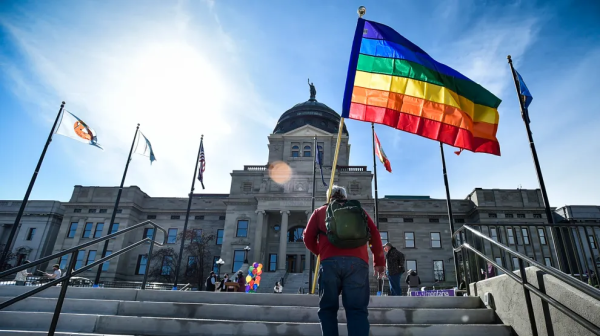
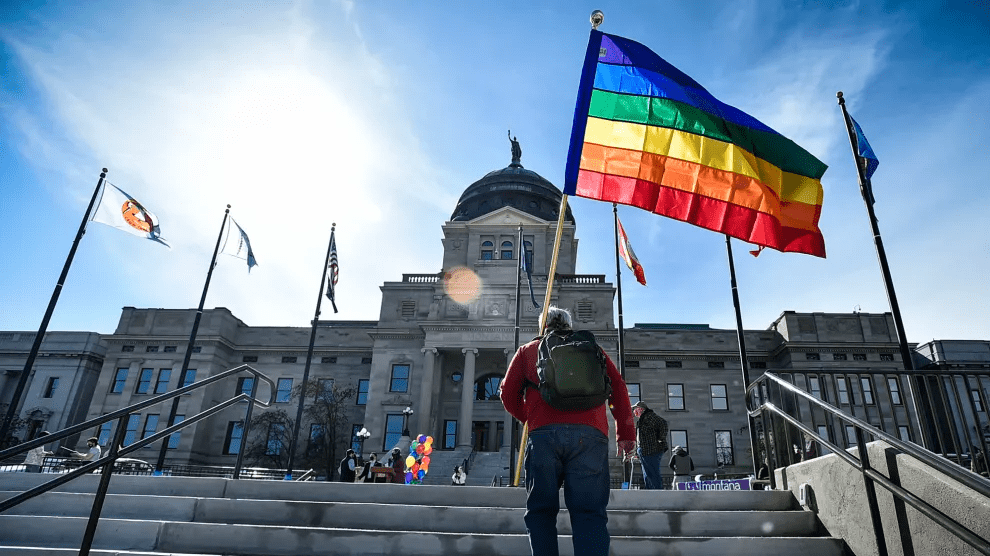
Five days after President Donald Trumpdeclared “gender ideology” to be “one of the most prevalent forms of child abuse,” Montana’s Republican-controlled House of Representatives killed a bill that would have enshrined much the same idea into state law by criminalizing parents and medical providers.
Montana Senate Bill 164 would have made it a felony for any adult to help transgender children under 16 to gain access to gender-affirming medical care—including hormones, puberty blockers, and surgeries—classifying such help as child endangerment. On Tuesday, House lawmakers voted 58-40 to reject the proposed law, with 17 Republicans joining Democrats to block it from advancing to its final reading.
“I think it’s overly broad,” the lone Republican to speak against the bill, Rep. Brad Barker, said Tuesday. Barker said that while he generally opposes gender-affirming care for trans youth, SB164 was “the wrong approach.”
“I don’t like the thought of criminalizing parents,” Barker added, entreating fellow Republicans to “vote with your conscience.”
The bill carried penalties of up to five years in prison and $10,000 in fines for any adults, including parents and doctors, who provided children with surgery, puberty blockers, or hormone replacement therapy for the purpose of “altering the appearance” of the child or affirming the child’s gender. If “serious bodily injury” occurred, the maximum punishment was 10 years imprisonment and $25,000 in fines.
“Turning parents and doctors into felons is absolutely not the approach that best serves this state,” Democratic Rep. SJ Howell, the first non-binary person to be elected to the Montana legislature, said on the House floor.
The bill cleared the Senate in February, 30-20, with two Republicans voting against it. In that floor debate, the legislation’s sponsor, Republican Sen. John Fuller, called it a “simple bill” to protect Montana’s children. “The state does have a compelling interest, a very compelling interest, to avoid the sterilization and sexual mutilation of children,” he said. In 2023, Fuller sponsored a law that threatened medical providers’ licensing if they offered gender-affirming care to minors, a law that courtshave blocked while litigation proceeds.
“This bill is not about politics, it’s about safeguarding the health and innocence of Montana youth,” one of SB164’s House supporters, Republican Rep. Braxton Mitchell, said Tuesday. But more than a quarter of members of his own party disagreed, suggesting a potential turning point for the Montana legislature, at least on trans issues.
Tuesday’s vote was the second time this year a large swath of Republicans crossed party lines to block an anti-trans bill. Last year, Montana’s first openly transgender lawmaker, Rep. Zooey Zephyr, said her Republican colleagues often privately bemoan the transphobic culture wars and apologize to her for their votes on anti-LGBTQ legislation.
Even so, Republican Gov. Greg Gianforte signed two anti-trans bills into law last month—a bathroom ban and a law prohibiting trans girls and women from playing on women’s sports teams from kindergarten through college. The bathroom ban has been temporarily blocked. A state law that prohibited trans women from participating in female collegiate sports was ruled unconstitutional in 2022.
The right to privacy is enshrined in the Montana constitution, and state courts have strongly affirmed its application to healthcare laws. Last December, the Montana Supreme Court upheld a lower court’s preliminary injunction on a law that would have made gender-affirming medical care providers vulnerable to licensing board disciplinary proceedings. And last summer, it ruled that a parental consent law for minors seeking abortion was unconstitutional. (In January, Montana Attorney General Austin Knudsen asked the U.S. Supreme Court to declare that ruling an unconstitutional infringement on parental rights. The Supreme Court has not decided whether to hear the case.)
If it had passed, SB164 would have become the first law in the country defining gender-affirming care as a form of felony child endangerment. (Child endangerment and abuse fall under different statutes, but both evoke the same myth that gender-affirming care is dangerous for youth.)
Montana, however, wouldn’t have been the first state to direct child welfare workers to investigate families of trans children. In 2022, Texas Republican Gov. Greg Abbott ordered the state’s Department of Family and Protective Services to open child abuse investigations into parents who seek gender-affirming care for their children. That directive remains partially blocked after families of trans children and the LGBTQ advocacy group PFLAG sued.
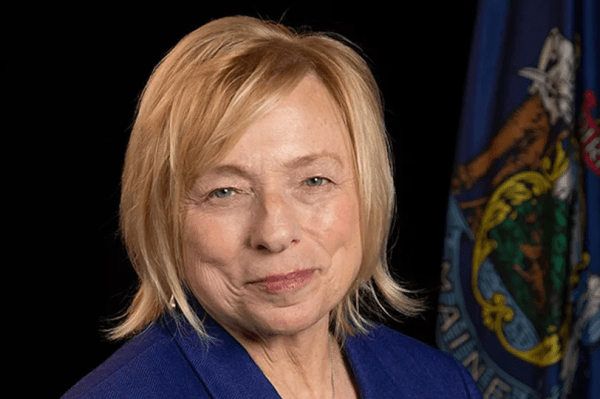
When Maine Gov. Janet Mills (D) told President Donald Trump, “See you in court,” she meant it.
On Monday, Maine sued the U.S. Department of Agriculture (USDA) and Secretary of Agriculture Brooke Rollins over the department’s halt on federal funding for education programs in the state in retaliation for its refusal to ban transgender women and girls from school sports.
As Reuters notes, Rollins announced the funding freeze in an April 2 letter to Mills, saying that the decision was “only the beginning” but that the governor could “end it at any time by protecting women and girls in compliance with federal law.” The funding freeze jeopardizes programs that provide free or reduced-price meals to children in Maine schools, childcare centers, and after-school programs.
Mills has publicly clashed with the administration, and with Trump specifically, over its assertion that allowing transgender women and girls to participate in women’s and girls’ sports violates Title IX, the federal civil rights law that prohibits discrimination on the basis of sex in schools that receive federal funding.
In February, the Maine Principals Association announced that it would not comply with Trump’s February 5 executive order banning transgender student-athletes from participating in girls’ and women’s sports. After Trump threatened to cut off the state’s funding, Mills and Maine Attorney General Aaron Frey accused the president of using school children “as pawns in advancing his political agenda” and vowed to “take all appropriate and necessary legal action to restore that funding and the academic opportunity it provides.”
“The State of Maine will not be intimidated by the president’s threats,” Mills said.
During a February 21 meeting with Democratic and Republican governors at the White House, Trump singled out Mills, asking whether she planned to comply with his anti-trans executive order. Mills said that her state was “complying with the state and federal laws.” When Trump continued to petulantly insist that Mills comply with his order, the governor told the president she would see him in court.
In its lawsuit, Maine calls the USDA’s funding freeze a “blatantly unlawful action” in violation of the Administrative Procedures Act. Rollins, the state argues, “took this action without following any of the statutory and regulatory requirements that must be complied with when terminating federal funds based on alleged violations of Title IX.”
The state argues that Rollins provided no legal basis for her assertion that by allowing trans students to participate in women’s and girls’ sports, Maine is in violation of Title IX and that her interpretation of the law is wrong. “Indeed, several federal courts have held that Title IX and the Equal Protection Clause require schools to permit transgender girls and women to play on girls’ and women’s teams,” the complaint reads.
However, the state is not asking the court to interpret Title IX. It merely asks the court to vacate Rollins’s “arbitrary, capricious” funding freeze for failing to meet the “statutory and regulatory requirements that the federal government must comply with before it may freeze federal funds owed to a state.”
In a statement, Frey said that Trump “and his cabinet secretaries do not make the law, and they are not above the law, and this action is necessary to remind the president that Maine will not be bullied into violating the law.”
English teacher Rosia Sandri was left “heartbroken” after submitting her resignation on March 31 following a campaign of hate against her that followed a TikTok video she posted highlighting her experience as a trans woman in education. That video was shared by transphobes, who called for her to be fired.
Sandri came out as a trans woman seven years ago and taught English for three years at Red Oak High School in Ellis County, Texas. Sandri said her colleagues at the Red Oak Independent School District (ROISD) supported her, and she didn’t directly come out to her class but instead started dressing differently.
Students who noticed asked if they should call her by a different name or use certain pronouns; she told them they could call her “whatever they were comfortable with” but preferred she/her pronouns.
Sandri also has a TikTok account where she posts informative videos educating people on what it is like to be trans, and she filmed some videos after hours in her classroom.
Many of her former students follow her on that account and express their support in comment section, writing “best teacher ever” and “We miss you, stay strong. Lovely makeup.”
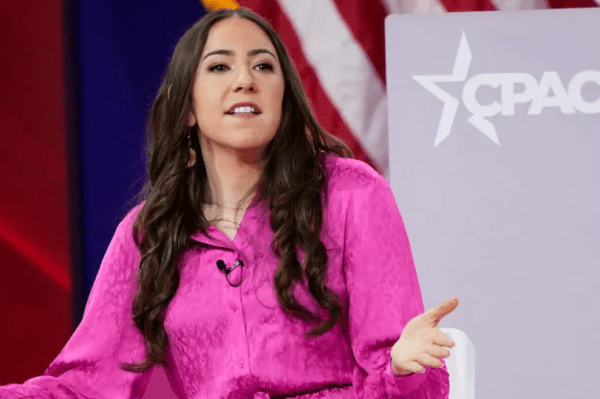
These videos, unfortunately, caught the attention of anti-trans influencer Chaya Raichik, who runs LibsOfTikTok. Raichik reposted one of Sandri’s videos, deadnaming and misgendering her. In the clip, Sandri talked about her pupils being supportive of her journey.
“They call me ‘ma’am. ’ They call me ‘miss,’” she said. “They use my correct pronouns and know my correct name, and it’s incredibly affirming.”
Raichik asked her over 4 million followers, “Would you feel comfortable with this person teaching your kid?”
Raichik is notorious for using her social media following to single out LGBTQ+ people and allies, presenting their innocuous interactions with children as “grooming.” Her followers harass and threaten businesses and institutions that support LGBTQ+ people, some going as far as to send bomb threats to children’s hospitals for providing gender treatment to trans youth. Schools targeted by Libs of TikTok faced similar repercussions.
Sandri was out sick when Libs of TikTok reposted her video but stated that she started receiving threats and harassment on her personal and school email. The human resources department at ROISD and the deputy superintendent reported that they have also received threats and have placed Sandri on administrative leave for two days while the school launches an investigation.
Texas state Rep. Brian Harrison (R) shared the Libs of TikTok post and called for Sandri to be fired.
“As the State Representative for Red Oak ISD, I am demanding that THIS TEACHER BE IMMEDIATELY TERMINATED!” Harrison tweeted.
On Monday, Sandri agreed with the school that she would resign.
“When I signed that resignation, it felt like my dream was being taken away from me,” Sandri told NBC. “I’m not going to get hired again as a teacher in Texas, and that hurts. It hurts I have to leave my students in the middle of the year…they keep on messaging me and asking if it’s illegal to be a trans teacher.”
Harrison later told NBC News that he was proud to have helped remove Sandri from her job.
“Any teacher who claims to get gender euphoria from their minor students and teaches them that boys can become girls should be terminated immediately,” Harrison said.
Despite this, Sandri has stated that she still wants to be a teacher and hopes to find a way.
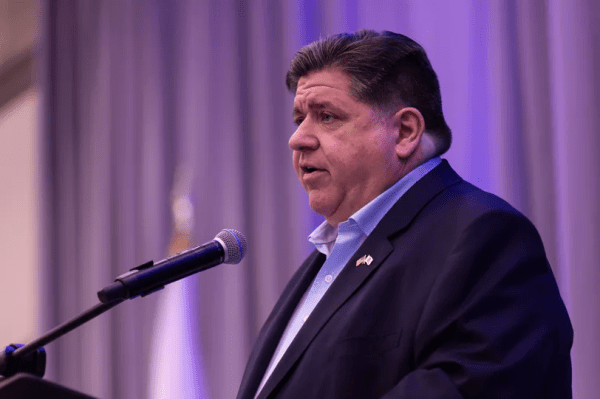
Illinois Gov. J.B. Pritzker (D) has never shied away from standing up to Donald Trump, and he has also made it clear he supports the LGBTQ+ community.
At a recent Human Rights Campaign dinner in Los Angeles, Pritzker reaffirmed his commitment to supporting queer folks and resisting Trump.
“The Trump administration and his Republican lackeys in Congress are looking to reverse every single victory this community has won over the last 50 years,” Pritzker said. “And right now it’s drag queens reading books and transgender people serving in the military. Tomorrow, it’s your marriage license and your job they want to take.”
“Bending to the whims of a bully will not end his cruelty. It will only embolden him. The response to authoritarianism isn’t acquiescence. Bullies respond to one thing, and one thing only, a punch in the face.”
He also spoke directly to transgender youth to tell them they are not alone.
“And in the midst of this existential fight, this battle that seems to consume everything, well, let’s not take the soul-sucking path of sacrificing the most persecuted for that which we deem to be most popular.”
“I know that there are transgender children right now looking out at this world and wondering if anyone is going to stand up for them and for their simple right to exist. Well, I am. We are. We will.”
He also spoke about his mother’s activism for LGBTQ+ rights and reproductive rights and declared, “I have to laugh when I hear the right-wing carry on about the dangers of exposing kids to trans people or same-sex couples, because I’m living proof that introducing your kids to the gay agenda might result in them growing up to be governor.”
Pritzker has long advocated for LGBTQ+ people as governor. In 2023, he signed a landmark bill making Illinois the first state to make it illegal for libraries to ban books.
President Trump‘s decision to target transgender care in a proclamation declaring April National Child Abuse Prevention Month “betrays” the month’s purpose, LGBTQ advocates said.
Why it matters: Framing the trans youth experience as “abuse” further stigmatizes an already vulnerable community, as the Trump administration tries to erase trans people from American life through policies limiting access tohealth care, careers, sports, education and more.
Driving the news: Trump’s Thursday proclamation singled out transgender care, labeling it a form of child abuse without acknowledging the most common risk factors for neglected or abused children.
“It is deeply disingenuous for Trump to use National Child Abuse Prevention Month as a platform to attack and stigmatize the trans community,” Ash Lazarus Orr, a spokesperson for Advocates for Trans Equality, told Axios.
Reality check: Gender-affirming care is supported as both medically appropriate and potentially life saving for children and adults by major medical associations, including the American Medical Association, the American Academy of Pediatrics and the American Psychiatric Association.
Drugs like puberty blockers are temporary and reversible. They are given to trans youth and non-trans youth who experience early onset puberty.
What they’re saying: Trump’s proclamation “is vile and upsetting but importantly it is just a press release,” Chase Strangio, co-director of the ACLU’s LGBT & HIV Project said in a statement on Instagram.
“It does not change the law or direct any agency action. But it does continue to suggest that the government is moving towards efforts to explicitly criminalize trans life and support of trans people.”
“Using the language of ‘child protection’ to justify the oppression of trans youth betrays the very values this month is meant to uphold,” Orr said.
“Denying trans youth medical care won’t change who they are.”
“Supporting a child — regardless of their gender identity — is an act of love, period,” Jarred Keller, a Human Rights Campaign spokesperson, said.
“The idea that affirming a child’s gender identity constitutes something harmful is an insult to the parents who support their transgender children with compassion and understanding.”
Threat level: Trump wrote that “a stable family with loving parents” is a safeguard against child abuse, but most victims are abused by a parent, according to the National Children’s Alliance.
By the numbers: In 2022, a reported 434,000 perpetrators abused or neglected a child, per the alliance.
76% of children were victimized by a parent or legal guardian in substantiated child abuse cases, meaning that child protective services agencies determined that abuse or neglect occurred.
Zoom out: Trump in January signed an executive order to defund youth gender-affirming care and a separate one threatening funding for K-12 schools that accommodate transgender children.
American hostility toward trans people has prompted U.S. allies to issue travel advisories for trans travelers, warning them that they must designate one “sex” on their travel forms and it has to reflect the gender they were assigned at birth.
Several European countries have updated their travel guidance for citizens visiting the U.S., including recent guidance for transgender and nonbinary travelers.
It’s common for countries to issue travel advisories or warnings for things like crime levels, terrorism threats, current conflicts, health concerns or natural disasters.
The U.S. issues its own travel advisories for Americans traveling abroad, but a number of other countries are doing the same for the U.S. These new advisories come as the Trump administration is tightening U.S. borders, cracking down on undocumented migrants and implementing a new federal policy to recognize male and female, rather than gender identity, as the only legitimate sexes.
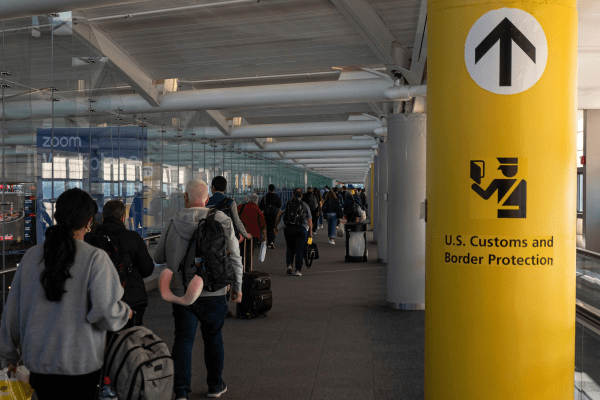
Canada, the United Kingdom and Germany have also updated their travel guidance for their citizens planning to travel to the United States after several tourists were detained by U.S. immigration authorities in recent months.
Travelers from many European countries and the U.K. can travel to the U.S. for business or tourism and stay for up to 90 days without a visa under the Department of Homeland Security’s Visa Waiver Program. But several travelers from countries within the program — like Canada, Germany, the U.K. and France — have been stopped and detained by U.S. immigration authorities within recent months.
Here’s what has transpired.
Nations with LGBTQ advisories for the U.S.
President Trump signed an executive order in January that says the federal government only recognizes two biological sexes: male and female. Per that order, a visitor applying for a visa or an Electronic System for Travel Authorization (ESTA) must declare their sex assigned at birth on the application forms.
European allies, including Denmark, Finland, Germany, Ireland, the Netherlands and Portugal, issued guidance that advises transgender and nonbinary travelers to contact the U.S. Embassy in their respective countries for more information on how to proceed if they wish to travel to the U.S.
Nations with other travel advisories for the U.S.
Canada
Recent tensions between the U.S. and Canada have risen over Trump’s trade war, not to mention his musings that he would make the northern ally the U.S.’s 51st state. Canada added new information under its U.S. travel advice page regarding the requirements for foreign nationals visiting for more than 30 days.
“Canadians and other foreign nationals visiting the United States for periods longer than 30 days must be registered with the United States Government. Failure to comply with the registration requirement could result in penalties, fines, and misdemeanor prosecution,” according to the Canadian government’s website.
The rule, enforced starting April 11, comes as part of an executive order signed by Trump, which requires all visitors staying for 30 days or longer to register with the U.S. government.
Germany
Last month, Germany updated its guidelines for its citizens looking to travel to the U.S. The European nation is investigating the cases of three of its citizens being denied entry and placed into detention by U.S. immigration authorities.
“Neither a valid [ESTA] authorization nor a valid U.S. visa constitutes a right to entry into the USA,” according to a translation of the German Foreign Office website. “The final decision regarding entry is made by the U.S. border official. It is recommended that you bring proof of your return journey (e.g., flight booking) upon entry.”
The office also warns of potential legal consequences. “Criminal records in the United States, false information about the purpose of their stay, or even a slight overstay of their visa upon entry or exit can lead to arrest, detention, and deportation.”
Two German nationals were detained in January as they were separately trying to cross the San Ysidro border between San Diego and Tijuana, Mexico, the New York Times reported. They have since returned to Germany with their cases resolved. A third remaining case involves a German national — who is a legal permanent U.S. resident who received a green card residency permit in 2008 — who was detained by ICE at Boston International Airport on March 7. He is now being held at the Wyatt Detention Center in Central Falls, R.I., NBC News reported.
The United Kingdom
The U.K. Foreign Office has updated guidance on its website in recent weeks for its citizens traveling to the U.S. It currently states, “You should comply with all entry, visa and other conditions of entry. The authorities in the U.S. set and enforce entry rules strictly. You may be liable to arrest or detention if you break the rules.”
Archived versions of the same website did not include potential legal consequences at the beginning of February and only stated, “The authorities in the U.S. set and enforce entry rules,” Reuters reported.
The Foreign, Commonwealth and Development Office did not explain the reason for the change.
The update comes around the same time a British tourist said she was held for more than two weeks in Washington state. Becky Burke, a 28-year-old from Wales, was backpacking through North America when she was allegedly denied entry into Canada on Feb. 26 “due to an incorrect visa,” according to a Facebook post by her father, Paul Burke. She was subsequently denied reentry into the U.S. and was detained at a facility in Tacoma, Wash.
Burke had stayed with a host family in Oregon, where she performed chores in exchange for food and lodging. She was told she violated her visa even though she was never paid. Travelers using a temporary visitor visa cannot accept work or employment in the country. Burke was repatriated back to the U.K. on March 18, according to U.S. Immigration and Customs Enforcement.
New Zealand
Last November, New Zealand updated its travel guidelines to the U.S. to “Exercise increased caution in the United States of America (US) due to the threat of terrorism (level 2 of 4).” The nation’s government travel website points to higher active shooter incidents and violent crime in the U.S. compared to New Zealand.
The law, which will take effect on July 1, 2025, prohibits state universities like Iowa State from starting, maintaining or funding DEI offices or positions unless required by law or for accreditation. The Iowa Board of Regents imposed directives and a Dec. 31 deadline to eliminate functions like the Center.
Holding a ‘funeral’ for a community resource
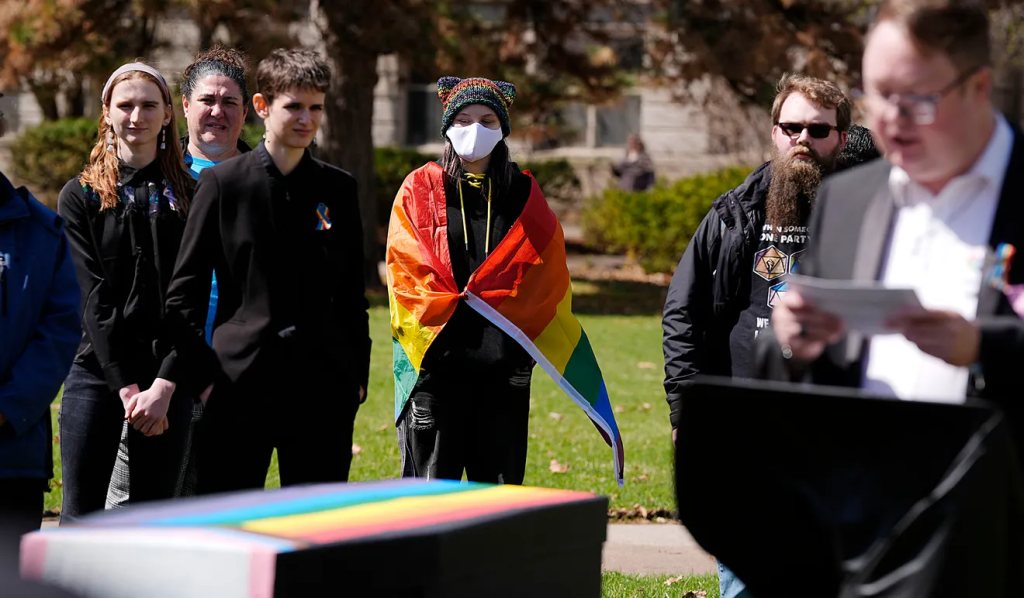
ISU Students Against SF 2435 Coalition published a mock obituary and shared it with the Ames Tribune prior to Wednesday’s event. The obituary said the Center was “killed” on Dec. 31, “with the assistance of Iowa State University.”
“This marks a great loss for the community, and we encourage those impacted to join us and find community in these trying times,” the mock obituary reads.
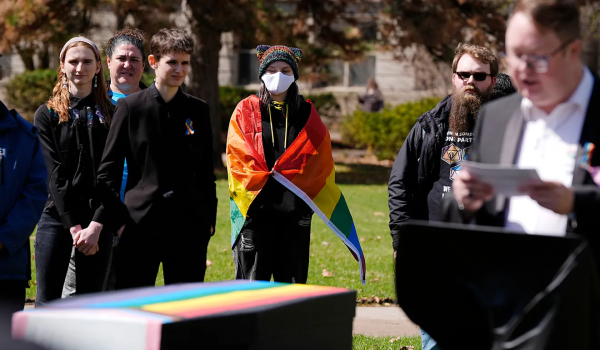
Several students addressed the crowd on Wednesday, noting how the Center provided them with a safe space to connect with their community. They said they are frustrated that it’s closing. Several said the presence of the Center was a key factor in attending the university.
The Center is a place where LGBTQIA+ students could go for safety and support, Iowa State student Silvera Dudenhoefer said on Wednesday.
“It was a space that celebrated queer joy and accomplishment, academically and personally,” Dudenhoefer said. “Above all, it was a clear mark that LGBTQIA+ students mattered to this school.”
By removing the LGBTQIA+ from the Center, Dudenhoefer said the Board of Regents has “shown who they’re willing to push aside in an effort to comply.”
The Center, according to Iowa State’s website, is still open from 8 a.m. to 5 p.m., Monday through Friday, on the fourth floor of the Iowa State Memorial Union. Iowa State now lists The Center under the umbrella of multicultural student affairs.
‘The Center’ has been a LGBTQIA+ student resource for more than 30 years
Iowa State University’s Lesbian Gay Bisexual and Transgender Student Services (LGBTSS) opened on Nov. 8, 1992, and was housed above Student Services. It was initially staffed by student volunteers until 1997, when four full-time staff members were brought on.
The LGBTSS was rebranded as The Center for LGBTQIA+ Student Success in 2019 and relocated to the Memorial Union.
The Center is “a space for you to be yourself, find and build community, get involved, and explore lesbian, gay, bisexual, transgender, queer, intersex, asexual, and ally life at Iowa State University,” according to the school’s website.
Senator Quirmbach voices support for ‘encouraging’ campus environment
Senator Herman Quirmbach of Ames attended Wednesday’s gathering and addressed the crowd. He said Iowa State has a responsibility to provide a supportive and encouraging environment for every student, regardless of their background.
“This university is failing in its moral responsibility,” Quirmbach said. “The members of the Board of Regents are failing. And the legislature? Don’t get me started.”
Iowa State graduate student Amanda Thomas assured the gathered students that they have allies willing to support them.
“When attacks like this hurt my friends, my family, my coworkers and my peers, it hurts me and that’s not okay,” Thomas said. “Allies are here, even if you can’t see them.”
Reverand Kelli Clement from the Unitarian Universalist Fellowship of Ames said students are learning to take the “stone in their shoe” that came with Senate File 2435 being passed.
“When you find your people, it is a holy moment,” Clement said. “And the loss of this center does not mean that your people go away.”









 fleeredstates.blog
You must be logged in to post a comment.