Florida cities fly Pride flags after the GOP’s failed attempt to ban them | LGBTQNation

This blog originally appeared at LGBTQ NATION.

“I hope it stands as a beacon for the rest of the state and the entire country.”

After Florida Republicans tried unsuccessfully to pass a law banning government buildings from flying Pride flags earlier this year, several cities around the state hoisted the rainbow stripes over the weekend to mark the start of Pride Month.

Late last year, state Rep. David Borrero (R) introduced legislation aimed at banning flags “that represent a political viewpoint, including, but not limited to, a politically partisan, racial, sexual orientation and gender, or political ideology viewpoint.” House Bill 901 would have prohibited such flags from being displayed not only at schools but also above government buildings and universities.

But the bill died during the most recent legislative session, leaving local governments free to fly Pride flags this month.

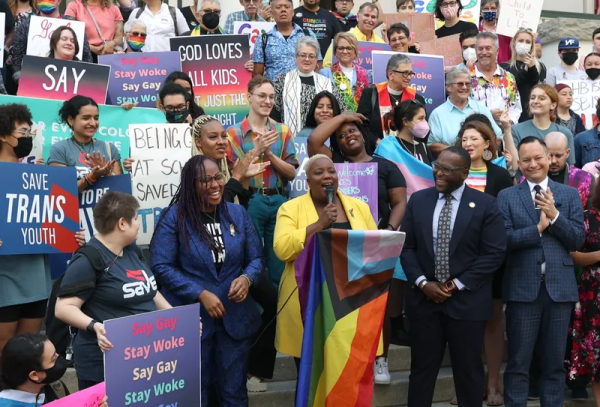
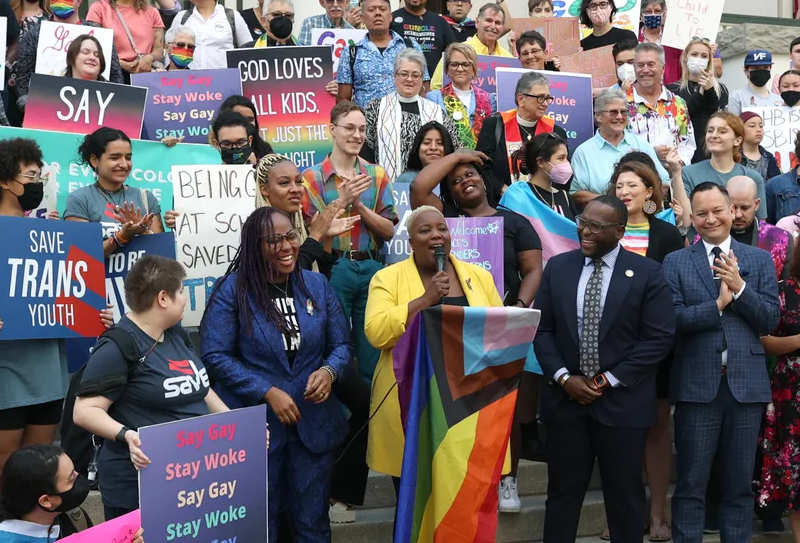
On Friday, the city of St. Petersburg got an early start to Pride Month by raising the Progress Pride flag at City Hall. U.S. Rep. Kathy Castor (D-FL), state Reps. Lindsay Cross (D) and Michele Rayner (D), Mayor Ken Welch (D), and the St. Petersburg City Council attended the flag-raising ceremony.

“Together, by raising the Pride flag at City Hall, our city boldly and unapologetically acts on its commitment to inclusivity, the celebration of diversity, and the simple but profound idea that people should have the freedom to love who they love,” Cross said. “This is in stark contrast to attempts at the state level to stifle our celebrations and to dim the light of beautiful members of our community.”

Cross noted the proposed flag ban and her vote against it. “Gratefully, due to the loud and proud voices that opposed the bill, it did not pass,” she said. “So, this year, as we stand under this Pride flag, we celebrate this small but important victory. Because we should not live in fear of repercussions from safe self-expression.”

“This marks the beginning of a celebration for equal rights for all across St. Petersburg, and I hope it stands as a beacon for the rest of the state and the entire country,” Castor told the crowd.

On Saturday morning, nearly 100 people gathered to see the Progress Pride flag hoisted above the Gulfport Public Library in the city of Gulfport, Pinellas County. The ceremony was attended by Vice Mayor and City Council member Ian O’Hara, members of the city council, Pinellas County Commissioner Charlie Justice, Pinellas County School Board member Caprice Edmond, Gecko Queen Robert Daunch, and candidates for Florida’s 13th Congressional District Whitney Fox and John Liccione.

The same day, the City of Miami raised the Progress Pride flag over its City Hall. “It’s important to understand that it’s a celebration because of how far the LGBTQ community has come,” Commissioner Damian Pardo said in a video posted to the City of Miami’s official X account. “It’s incredibly important to thank the city of Miami for creating a safe space for us in the LGBTQ community.”

The flag-raisings continued on Monday in Tampa and Orlando.

“During Pride Month and year-round, Orlando will continue to show that inclusion, kindness, and compassion are more powerful than divisiveness, hatred, and fear,” Orlando Mayor Buddy Dyer wrote in an X post, along with a photo of the intersex-inclusive Progress Pride flag flying over City Hall. “As Mayor, I am proud that our city is a place that values, supports, and welcomes LGBTQ+ residents and visitors.”

“The colors of love and progress are flying high in Orlando as we raise the Progress Pride Flag at Orlando City Hall in celebration of our LGBTQ+ community and their ongoing fight for equality,” read a post on the city’s official X account.

In Tampa on Monday morning, Mayor Jane Castor (D) gave a brief history of the original rainbow Pride flag’s origins before raising the rainbow-striped flag above the city’s Old City Hall.

“It really is a wonderful definition and proclamation of our community and the pride that we have,” Castor said of the flag. Members of Tampa’s LGBTQ+ community “are our police officers, our firefighters, our paramedics, the individuals that protect our country down at MacDill Air Force Base, they are our teachers, our nurses. They are our neighbors, our friends, and our family. It is our community, and we’re very, very proud of that.”

Castor also called on those gathered to “continue to stay focused on ensuring that everyone is treated with dignity and respect” in the face of the recent rise in anti-LGBTQ+ rhetoric in Florida and across the nation.

On Tuesday morning, Miami-Dade County Mayor Daniella Levine Cava (D), County Commissioner Eileen Higgins, and other local leaders will raise the Pride flag about the city’s Stephen P. Clark Government Center. According to a press release, this will mark the fourth consecutive year that the Miami-Dade County government has raised the Pride flag “to reaffirm our commitment to making Miami-Dade an inclusive, welcoming County that celebrates our rich diversity.”

Black Trans Lives Matter | THEM

Michelle Henry, a beacon in San Francisco’s transgender community, tragically lost her life.

The San Francisco LGBTQ+ community is grieving the loss of a transgender woman who was killed on May 15th.

“Michelle’s passing is an immense loss for our community,” said Rebecca Rolfe, executive director of the organization, in an email statement. “There are no words to express the depth of our collective grief right now. We extend our gratitude to those who cherished Michelle, and our thoughts are with everyone who had the privilege of truly knowing, loving, and caring for her.”

On Tuesday, friends and family gathered to honor Henry at a memorial vigil held at San Francisco’s bar, Mother. The LGBT Center is currently creating an altar to honor her memory.

Veronica Pritipaul, a navigation specialist at the LGBT Center, described Henry as a “beacon of light in our community” who dedicated her life to transgender liberation. “With her passing, we have not only lost a beloved sister, but also a mentor and steadfast advocate for the trans community,” Pritipaul told the Reporter.

Jackson Asher, a close friend, remembered Henry as “incredibly loving” and a constant source of support over the years. “She was there for me at my lowest points, especially during my struggles with addiction,” Asher recalled. “Her love was unwavering, and her vibrant energy drew people to her.”

Friends suspect that Henry’s death may have been a hate crime targeting a transgender person. However, the San Francisco Police Department is currently not investigating the incident as a bias-motivated killing. “At this time, we do not have evidence indicating that this incident is hate-related,” police stated in a release.

Authorities have arrested 33-year-old Raymani Yuhashi, who faces charges of murder with premeditation, according to the Reporter. As of May 21, Yuhashi’s name did not appear in the county jail’s online records.

Henry’s death has been classified as a homicide, confirmed by David Serrano Sewell, executive director of the city’s Office of the Chief Medical Examiner, according to the Reporter.

A spokesperson for the San Francisco District Attorney’s office stated that the investigation is ongoing. “The police had sufficient cause to make an arrest based on evidence gathered at the scene. However, further investigation is necessary to make informed decisions about criminal charges,” the representative informed the Reporter. “Once the investigation concludes, all evidence will be thoroughly evaluated. If we determine we can meet the burden of proof, appropriate charges will be filed.”

The district attorney’s office extended condolences to Henry’s family and friends, offering support through their Victim Services Division as they navigate this difficult time.

Henry is at least the 15th trans or gender nonconforming person killed this year due to violent incidents, as reported by the Human Rights Campaign (HRC). The HRC’s current database, which lists 14 individuals, has yet to be updated to include Henry’s death. Nearly four out of five of those killed this year have been people of color, with almost a third being Black trans women. The majority of these deaths involved firearms.

As the LGBTQ+ community grieves another tragic loss, San Francisco’s Transgender District honored Henry in an Instagram post, describing her as a “beautiful soul taken from us too soon.” “At 25, she had her whole life ahead of her,” the post reads. “She was a friend to everyone and always ready to lend a helping hand.”

Honey Mahogany, recently named director of the city’s Office of Transgender Initiatives, described Henry as a “beloved member of our community.” Mahogany emphasized that her tragic death serves as a stark reminder that, even in San Francisco, ongoing advocacy is crucial to ensure the safety and welfare of all transgender individuals.

https://www.them.us/story/michelle-henry-trans-san-francisco-killed?utm_source=nl&utm_brand=them&utm_mailing=Them_Weekly_052324&utm_campaign=aud-dev&utm_medium=email&bxid=647003a05dfaff5d630fbb31&cndid=74113754&hasha=90d5433b1347095329a6ab5df0bd392d&hashb=555b342b6918faf1a5515da1bc4cf5731fa62fa0&hashc=f4ee38a7ae4ef690cecccbdd27678ec522f6d3c6f45bef0cc5001fd7abe7557b&esrc=bouncex-test&utm_term=THEM_Daily

SCOTUS Will Not Hear a Case From Indiana Parents Who Lost Custody of Their Trans Child | Them

This blog originally appeared at THEM.

The Attorney General’s office of the state has stated that the child was taken out of custody due to the development of a severe eating disorder, stemming from their parents’ refusal to acknowledge the child’s transgender identity.

On Monday, the Supreme Court declined to review the appeal of two Indiana parents who lost custody of their transgender child in 2021. The parents, who hold the belief that children should be raised according to their assigned sex at birth, had their case dating back to 2019. Mary and Jeremy Cox from Anderson, Indiana, revealed that their then 14-year-old child identified as a trans girl. Despite being devout Christians, the Coxes refused to acknowledge their child’s identity, leading to prolonged conflict. Attorneys for the Department of Child Services (DCS) stated that this conflict ultimately resulted in the child developing a severe eating disorder, leading to both parents losing custody in 2021.

In 2022, the Indiana Court of Appeals upheld the decision by the Department of Child Services (DCS) to remove a child from her parents’ care. The court found that her eating disorder stemmed directly from emotional distress and lack of support at home. According to the ruling, Mary Cox made comments to her child such as “[child’s preferred name] is the bitch that killed my son.” The court concluded that a custody order was necessary to safeguard the child’s physical and emotional well-being, emphasizing that while the Coxes are entitled to their religious beliefs, they cannot exercise them in a manner that harms their child.

On Monday, the Supreme Court declined to hear the Coxes’ petition, affirming the 2022 Court of Appeals decision. The Court provided no explanation for its rejection. Attempts to obtain comment from the Indiana Attorney General’s office were unsuccessful prior to publication.

Recent studies suggest that rates of disordered eating are elevated among transgender individuals compared to cisgender people, particularly affecting trans youth aged 18-22. As noted by essayist Aerin Cho in a 2021 piece for Them, eating disorders can serve as a means of exerting control over one’s body, especially for young trans individuals facing parental reinforcement of shame and negative body image. Research also indicates a correlation between parental shaming and abuse and increased rates of eating disorders, irrespective of transgender identity.

The Coxes faced another setback in court following the failure of a bill they supported, which was grounded in arguments for parental religious freedom. The bill, HB 1407, championed by the couple, did not advance through the state legislature last year and was shelved in committee in 2023. HB 1407 aimed to affirm Indiana parents’ authority to oversee the upbringing, education, healthcare, and mental health of their children without interference from the government.

The Supreme Court’s decision coincides with the beginning of LGBTQ Health Awareness Week, organized annually by the National Coalition for LGBTQ Health. This year, the event spans from March 18 to 22. Additionally, on Monday, the Court rejected the appeal of Couy Griffin, co-founder of the right-wing activist group “Cowboys for Trump,” who was ousted from public office in New Mexico after his involvement in the failed coup attempt on January 6, 2021.

https://www.them.us/story/supreme-court-will-not-hear-case-from-parents-who-lost-custody-their-trans-child

Parents upset after Keller ISD trustees brought an Evangelist film crew into schools and filmed students

This originally appeared at NBCDFW.

The involvement of school board trustees in apologizing suggests a recognition of responsibility for the incident involving Evangelische Omroep (EO) filming students. Their apologies likely aim to address any concerns or distress caused by the filming and to reassure the community that steps will be taken to prevent similar incidents in the future. The apologies may also reflect a commitment to transparency and accountability in addressing the situation.

Click here to watch video: https://www.wfaa.com/article/news/local/parents-upset-keller-isd-trustees-evangelist-film-crew-february16/287-674d69f1-3dc1-40db-a806-f5761dfadae4?s=09

The gathering of parents near Keller ISD’s Central High School likely signifies a unified response to a specific issue or concern within the school district. Their anger and frustration suggest that they feel strongly about the matter and are seeking to voice their discontent publicly. This kind of collective action often serves as a way for community members to express their grievances and advocate for change within educational institutions.

“I’m livid,” said Laney Hawes, a parent whose child attends Central HS. “Our rights and our kids rights have been violated.”

The district’s confirmation of events on February 9 likely brought to light an incident or situation that has caused significant distress among the parents. The specificity of the date suggests that something notable occurred on that day, prompting the parents’ reaction.

The involvement of school board trustees in bringing an Evangelical-based film crew into the high school without obtaining consent from students and parents is likely the source of the anger and frustration expressed by the group of parents near Keller ISD’s Central High School. This breach of privacy and potential violation of consent rights could have serious implications for the trustees involved and has understandably elicited strong reactions from the community.


It seems there might be some confusion. Evangelische Omroep (EO) is indeed a Netherlands-based Evangelical broadcast television network, but there is no known documentary titled “God, Jesus, Trump” produced by EO. It’s possible that another production company or network created such a documentary. However, it’s essential to verify the accuracy of the information before drawing conclusions about the involvement of EO or any other organization in specific documentary productions.

“We don’t want politics in our kids schools,” Hawes said. “If kids wanna bring God into schools, beautiful, but it cannot be the administration. There is a separation of church and state.”

Thank you for providing additional context. Elliot Mullaney’s eyewitness account sheds light on the situation at Central High School.

“It’s an invasion of privacy,” said Mullaney. “I think that it’ll be used to spread hate and spread untrue opinions.”

It’s crucial to address such incidents transparently and responsibly, especially given the concerns raised by parents and students.

alker apologized in a post, saying: “I recently participated in a foreign documentary focused on public schools in Texas. Some filming took place while students were present. I take safety and privacy of our students seriously. I apologize for allowing students to be captured on film.”

Young, who said he “briefly assisted my colleague in an interview about Texas public schools,” said in a Facebook post: “I regret if any students were captured on film. My understanding is the District has been assured by the crew that no student will appear in the footage. The safety and privacy of our students is of utmost importance to me.”


Parents rightfully expect accountability from school officials, particularly when their actions compromise student privacy and well-being.

The absence of the principal on the day of the incident underscores the need for clear protocols and supervision to ensure that such breaches of student privacy do not occur in the future.

“If they’re bypassing certain rules, it’s time that they need to resign,” Mullaney said.

Friday evening, Keller ISD Superintendent Dr. Tracy Johnson sent a letter to Central HS parents. In the letter, Johnson confirmed that a production company from the Netherlands visited the campus to film an interview with trustees Walker and Young. Johnson confirmed the crew toured the school and talked to some students and employees.

According to Johnson, “the district and the board were not aware of the scheduled interview.”

Despite district officials’ saying they weren’t aware of the scheduled interview, the film crew said in a statement to WFAA that it “obtained permission to record at the school in advance.”

“The Evangelical Broadcasting, a channel that broadcasts on National Television in the Netherlands, has recorded at Central High School, part of Keller ISD, for a program called ‘God, Jesus, Trump!’. This program is a neutral journalistic program that examines Christian culture in the USA,” the statement from the film crew read. “The film crew obtained permission to record at the school in advance. The film crew went through all standard registration and administration procedures upon entering the building, and the crew was warmly welcomed by the staff that day. As stated prior, all children will be unrecognizable, and all ethical and journalistic guidelines were applied during the recording and will be applied in the process of making this program.”

Johnson’s letter said the matter is under review and that the district is “taking proactive steps to safeguard the privacy and security of our students. KISD administrators have been in contact with the film company who have assured us that no students or teachers would be visible in the video they are producing.”

Hawes said she spoke about the incident with the school’s principal, Liz Russo.

“Russo apologized. She let me know that policies were broken and this wasn’t done with permission, and it would’ve never been allowed,” Hawes said.


It’s concerning that the school board members and the principal did not respond to inquiries about the incident. Transparency and accountability are essential in addressing such breaches of protocol and maintaining trust within the school community.

It’s distressing to hear that a parent’s request for privacy was seemingly disregarded by the district, especially considering the circumstances they described. Respecting the privacy and safety of students should be a top priority for schools, and any failure to uphold such requests erodes trust and can have serious consequences for individuals’ well-being.

“It’s sickening, the parent said. “It’s very concerning. Now she’s being exposed. “It’s already tough enough trying to make sure our kids are safe, and if you can’t trust the people in the school building are gonna keep your kids safe, who can?”


It’s understandable that parents would demand accountability from the trustees involved and seek to address the situation through official channels such as filing grievances with the district. Trust in school leadership is crucial for maintaining a safe and respectful learning environment, and actions that undermine this trust must be addressed promptly and transparently.

A major LGBTQ+ activist was brutally stabbed & Uganda’s anti-gay law is to blame

This blog originally appeared at LGBTQ Nation.

Police treated the activist as a criminal, raiding his home while he was still recovering in search of evidence to prove he was gay.

The resurgence of anti-LGBTQ+ bills and draconian laws in Africa has led to a surge of homophobic attacks across the continent, further endangering LGBTQ+ people whose lives were already at risk.

These anti-LGBTQ+ laws not only criminalize same-sex relationships but also systematically target LGBTQ+ activists. Steven Kabuye, a prominent Ugandan LGBTQ+ rights activist, was recently stabbed and left for dead outside his home by two men on a motorcycle who had been following him for a number of days. Graphic video footage shared on X shows Kabuye writhing in pain, a visible laceration stretched across his arm and a knife embedded in his abdomen.

Kabuye, an activist and editor of Coloured Voices Media Foundation-Truth to LGBTQ Uganda, was ambushed on his way to work. His helmet-wearing assailants swung the knife at him, aiming at his neck, which he shields with his right arm in the video. As he attempted to flee, the attackers chased him and stabbed him in the stomach. Kabuye was discovered by residents and taken to a nearby hospital for emergency surgery.

Uganda’s president, Yoweri Museveni, recently signed into law one of the most severe anti-gay bills in the world. The Anti-Homosexuality Act of 2023 stipulates long prison sentences and capital punishments for “aggravated homosexuality.” It has also intensified homophobic sentiment nationwide. A surge in attacks and arrests has been reported all over the country since the signing of the law. LGBTQ+ rights activists said the bill has led to a rise in abuse, including torture, rape, and evictions, against LGBTQ+ Ugandans by private citizens.

Kabuye, who is still recovering, disclosed on X that he’s already been harassed by the police since the attack. He said they forcefully entered his house searching for lubricants, rainbow flags, or any other incriminating items they could use as evidence to charge him under the Anti-Homosexuality Act. He said he believes the failed attempt on his life was a planned assassination.

A similar incident happened in 2011 in the tragic story of David Kato, a Ugandan teacher and LGBTQ+ rights activist. Considered a father of Uganda’s gay rights movement, Kato was murdered in cold blood after winning a court victory over a tabloid that called for homosexuals to be killed.

Kabuye went on to reveal that after being denied entry into his home, police arrested his flatmate and tortured and threatened him with forced anal examinations in a bid to get him to confess that he and Steven were lovers – at the same time asking him to stop the international community from putting pressure on them or he would be falsely charged with attempted murder.

Kabuye wrote on X, “When they came to get a statement from me, they kept on asking me questions like, ‘Who sponsors you?, How and when did you become gay? Have you ever engaged in any sexual activities with any man?’ Questions unrelated to the case at hand. They just didn’t want to accept it was a hate crime or an attempted murder/assassination.”

Another LGBTQ+ activist, Ronald Agaba, who has been speaking up and demanding justice for Kabuye, said the Ugandan police are trying to cover up the crime and are busy blaming the victim. He went on to post screenshots of the death threats he’s been receiving since he spoke up.

“Police won’t help you. Uganda is not for homosexuals” one X user said. 

“Look at this Gay, run for your life in Uganda because we’re killing the so-called LGBTQ,” another added.

Other victims around the country include Arianna, a transgender woman who was falsely accused in a viral TikTok video of forcing young men to take hormones. She came home after shopping one day to find an angry mob gathered outside her front door. “When they saw me, they started grabbing me and shouting that I needed to die,” she told The Guardian. “The only thing I remember next was waking up in a hospital.”

The new law also targets activists with 20 years of imprisonment for promoting homosexuality, leading to a crackdown on human rights organizations and the criminalization of any LGBTQ+ advocacy. A Ugandan MP, Hon. Cecilia Ogwal, who was one of the 387 members of Uganda Parliament to support the Anti-Homosexuality Act, called LGBTQ+ advocates “A force from the bottom of Hell” and urged Ugandans to “destroy” these LGBTQ+ forces.

Jane, a 24-year-old Ugandan activist, told LGBTQ Nation she is scared for her life and has been in hiding. “I’ve been receiving death threats online lately. One person promised to hunt me down, rape me, and slit my neck “ she said. “The disheartening part about this is that I can’t even report this to the police. The police are even the ones terrorizing us and encouraging this behavior.”

LGBTQ+ activists and campaigners in Africa have made no secret of their stance and how they feel about the new law. A petition was filed in the Constitutional Court to challenge it, but it’s uncertain if there will be a positive outcome. Court hearings began last month, but no ruling has been made yet.

Among the people to file the petition were the only two MPs who voted against the bill, Fox Odoi-Oywelowo and Paul Kwizera Bucyana, as well as prominent rights activists Pepe Onziema and Frank Mugisha. Additional petitions were filed by the Ugandan Human Rights Awareness and Promotion Forum and a host of international groups.

Activist Jackline Kemigisa wrote in OpenDemocracy that she joined the petition “because the law’s vaguely defined offense of ‘promotion of homosexuality’” endangers her “work and freedom as a journalist and researcher covering queer and feminist movements in Uganda.”

“Should my work, in which I write about minority communities with fairness and dignity, be deemed ‘promotion of homosexuality’ under Section 11 of the new law, I would face up to 20 years in prison,” she said.

Another Ugandan activist, Kira, explained how the new law has changed her life. “Uganda has always been homophobic,” she told LGBTQ Nation, “but since this new bill was signed things have changed. Prior to the new law, getting catcalled was the worst thing that could happen to you in public as people rarely attack you unprovoked. But the new law has emboldened them.”

“They publicly attack us now based on perception, some of them even go as far as stalking and ambushing us in our homes. Being a masculine-presenting woman, I’m scared to go out in public these days because not being traditionally feminine enough could possibly get me killed. We almost lost a friend last month after he was beaten up by a mob in the market for his feminine mannerisms.”

According to Reuters, Uganda’s Constitutional Court began hearing a challenge on December 18th that says the law violates constitutionally protected rights. A panel of five judges told the petitioners they would be notified when a ruling was reached.

“To be honest I don’t have any faith in our judiciary or this entire case having a positive outcome,” John Mukasa, a queer rights activist and medical officer living in Uganda told LGBTQ Nation. “Homosexuality is a very controversial subject in Africa and homophobia has eaten deeply into our society.”

“Our politicians are exploiting this hate for their own benefit in the disguise of protecting African cultures and would continue to do so no matter the cost. Uganda has a myriad of problems from insecurity to multidimensional poverty and hunger, these anti-laws are just being used to distract people from the problems that actually matter.”

This set of laws was pushed by American Evangelical ministers

Oklahoma appoints Libs of TikTok creator – who allegedly inspired school bomb threats – to library committee

An announcement in Oklahoma caused shockwaves in educational and political circles as the individual behind the anti-LGBTQ+ social media account “Libs of TikTok” was appointed to a government position.

Even after Oklahoma schools suffered a series of bomb threats after she posted about them, the state government is bringing her in to advise about books in libraries.

Chaya Raichik, the individual associated with the controversial “Libs of TikTok” account, has been appointed to the Library Media Advisory Committee of the Oklahoma State Department of Education. The appointment has sparked widespread criticism, raising concerns about Raichik’s lack of educational background, her involvement in stirring controversies, and potential implications of stochastic terrorism.

State Superintendent Ryan Walters, a Republican, announced Chaya Raichik’s appointment to the Library Media Advisory Committee of the Oklahoma State Department of Education last week. Walters praised Raichik for being on the “front lines” against what he referred to as “the radical left’s” agenda in schools.

“Her unique perspective is invaluable as part of my plan to make Oklahoma schools safer for kids and friendly to parents,” Walters said in a statement.

Chaya Raichik, a former Brooklyn real estate agent, has been a full-time right-wing online provocateur since her Libs of TikTok account gained attention and support, amassing more than 2.8 million followers. Despite being labeled as a right-wing extremist, she was temporarily removed from the Anti-Defamation League’s glossary of extremism due to a legal threat. Raichik neither resides in Oklahoma nor has a background in education or children’s development.

Raichik has made false and inflammatory assertions, including labeling the LGBTQ+ community as an “evil cult” and suggesting that teachers, particularly those who identify with the community, aim to “groom kids.”

Mickey Dollens, a Democratic state representative in Oklahoma, raised concerns about the appointment, questioning State Superintendent Ryan Walters’ decision.

“Why did Superintendent Walters appoint a social media influencer to the state’s Library Media Advisory Committee? What are her qualifications? Is she a librarian? No. Education background? No. Does she even live in Oklahoma?” Dollens asked.

The appointment has faced criticism from various quarters, including GLAAD and the Human Rights Campaign.

GLAAD president and CEO Sarah Kate Ellis shared her thoughts on the matter in a statement to The Advocate.

“Book bans are at a record high because a fringe few extremists are deliberately gaming the system at everyone else’s expense, including students, educators, and taxpayers. It’s obvious that education advisory committee members should have an education background, a close connection to the community they serve, and a record that does not include spreading lies and encouraging disparagement and violence that endangers every student, school, and family,” Ellis said, noting “Oklahomans should see this for the farce it is: an appointment that deserves an F on its face, and an A for trolling, which this particular social media extremist excels at for her own profit.”

The Human Rights Campaign (HRC) also criticized the selection of Chaya Raichik.

Oklahoma State Superintendent Walters’s decision to legitimize an internet troll who takes glee in causing direct harm to innocent people is a violation of his duty to the citizens of his state, particularly the LGBTQ+ community of Oklahoma,” HRC spokesperson Delphine Luneau told The Advocate.

“This is just another example of the MAGA mindset that prioritizes antagonizing marginalized people over actually doing the true work of government to make lives better for everyone,” she continued.

The Library Media Advisory Committee, to which Raichik has been appointed, is tasked with the goal of “removing pornographic or sexualized content” from public school libraries. The committee operates on a voluntary basis, with no compensation provided to its members, all of whom are appointed by Superintendent Ryan Walters, according to Oklahoma public radio station KOSU.

According to the state education department, the committee is composed of parents, active and retired librarians, and English literature teachers.

Following Libs of TikTok posts, a USA Today investigation revealed a pattern of threats, including bomb threats to schools, libraries, and hospitals across the United States. Collaborating with Media Matters for America, the investigation confirmed dozens of threats linked to Raichik’s posts since February 2022, indicating an escalating pattern of hostility and danger following her attention.

In Oklahoma, there have been alarming instances of bomb threats following posts by Libs of TikTok. For example, in August, Union Public Schools in Tulsa faced a series of bomb threats over six days, which began shortly after Raichik shared a critical post about one of its school librarians. The threats significantly disrupted school operations and caused widespread fear and anxiety in the community.

Experts have accused Raichik’s account and social media activity of engaging in what’s known as stochastic terrorism—an allegation Raichik has mocked.

Stochastic terrorism refers to public speech that incites random acts of violence, which is statistically predictable but unpredictable for individuals. Raichik’s posts have been linked to threats that, according to experts, fit the pattern of stochastic terrorism.


In response to a post by Walters on X (formerly Twitter), Alejandra Caraballo, a clinical instructor at the Harvard Law School Cyberlaw Clinic and trans rights activist, criticized the appointment.

“You named a terrorist to your advisory board who incited bomb threats for weeks against a school library in Tulsa,” Caraballo wrote in a comment to Walters.

The Advocate reached out to Walters’ office to inquire about Racihik’s new role, but did not receive a response.

Unhinged dad banned from high school basketball games after accusing player of being trans

This blog originally appeared at LGBTQ Nation.

Following an incident where a Utah dad became belligerent at his high school-aged daughter’s recent junior varsity basketball game, alleging that a player on the opposing team was transgender, he has been banned from attending future games.

“I wasn’t born yesterday, I know that’s a boy!” the dad shouted at the principal.

Jeff Haney, spokesperson for Canyons School District, informed The Salt Lake Tribune that during a game on January 19, the dad in question was actively challenging the eligibility of a player, vocally expressing concerns based on his perception of the student-athlete’s gender.

The man, whose identity remains undisclosed, allegedly confronted the principals of both his daughter’s school and the opposing school after the incident. Both principals reassured him that every player on the court, including the 17-year-old girl in question, had met the eligibility requirements outlined by the Utah High School Athletics Association (UHSAA). UHSAA mandates that student-athletes provide a birth certificate to verify their gender, and for transgender students, proof of undergoing at least one year of hormone therapy is required.

“I wasn’t born yesterday, I know that’s a boy and you better be able to prove yourself because I am going to the top,” the man insisted after the game, according to one principal.

Haney said the man became so belligerent that he was asked to leave, and the principal of his daughter’s school banned him from future games. “We do not tolerate people coming into our community and our schools and harassing our student-athletes,” Haney said.

The incident on January 19 is the most recent case of parents challenging a student athlete’s gender in Utah since the passage of H.B. 11 in 2022. This law prohibits transgender girls in grades K–12 from participating in girls’ sports. However, the law is currently on hold due to a legal challenge initiated by the families of three transgender students. The legal proceedings are ongoing in court.

In 2022, the parents of two girls who secured second and third place in a Utah track event lodged complaints urging the Utah High School Athletics Association (UHSAA) to investigate the gender of the girl who claimed first place. David Spatafore, a spokesperson for UHSAA, disclosed that additional complaints had been received, asserting that the student did not “look feminine enough.” However, Spatafore clarified that upon investigation, it was found that the student had consistently identified as female since kindergarten.

According to The Salt Lake Tribune, there have been additional similar incidents in Utah, but the Utah High School Athletics Association (UHSAA) has not disclosed the frequency or the specific number of such occurrences.

Marina Lowe, policy director at Equality Utah, commented that these incidents offer a glimpse into what might become more common, especially with the enactment of legislation that allows the public to pass judgment on individuals’ physical characteristics, determining whether they are deemed feminine or masculine enough to participate in certain spaces.

Advocates for the LGBTQ+ community have cautioned that transgender sports bans and bathroom bills may lead to policing people’s gender presentation. In some states, such as Idaho, sports bans have included requirements for genital examinations. This stipulation could subject students under investigation to unnecessary and invasive examinations.

“This doesn’t just harm the trans community. It really harms us all,” Lowe said. “Because once we get in the business of policing someone’s appearance… all of us are going to be subject to this sort of inquiry potentially.”

As group voices concerns, Tyler Public Library remains committed to serving diverse population

This blog originally appeared at Tyler Morning Telegraph.

Newcomer Randell Gillaspy, a concerned father who has never attended before, found himself in Taylor Auditorium, the venue for board meetings held every fourth Wednesday at the Tyler Public Library. His presence reflects an attempt to comprehend the ongoing community discussions.

“I’ve heard the counter from both sides, and I just kind of want to see what’s going on in person,” Gillaspy said. “The opposition seems to think there’s inappropriate material in children’s books. The flip side of that is, I guess, freedom of speech.”

Amidst national headlines about book challenges, certain Tyler residents allege the presence of explicit reading material accessible to minors in the library’s adult section. This has sparked a divisive debate, with some advocating for an ongoing battle on the matter, while others contend that it’s a non-issue.

“This is not a one-sided library. They’re going to provide books for the Christians, and they’re also going to provide books for everybody else,” said Erin Bailey, a local LGBTQ+ youth leader.

The library is structured into five distinct sections. The juvenile section houses books recommended for junior high readers and younger, while the young adult section caters to readers aged 14 and 15. The adult section features books recommended for readers aged 16 and older. For parenting topics, there is a dedicated parenting section in the library, and books addressing issues that require adult explanation, such as death and family dynamics for children, are available in the family section.

Arrangements within the City of Tyler library are guided by recommendations from professional organizations such as Publishers Weekly and Kirkus. Any discrepancies in age appropriateness are addressed by staff members who read the book to determine the suitable age range.

The library policy explicitly states that providing access to material does not constitute an endorsement of it.

“People are sort of saying, ‘I can’t believe that you would support this book,’” City Manager Edward Broussard said. “The book in our collection is not an endorsement of the book or material. The book being in the library indicates that this idea is present for people to read and share, agree with or disagree with, but it is not an endorsement by the City.”

In the young adult section, designed for ages 14 and above, certain books may contain scenes or material that could be interpreted as sexual, as per Broussard. However, it’s emphasized that there is no sexually explicit material in the children’s section. The library underscores the importance of context, explaining that while there might be mature content, the narrative in these instances is intended for a younger demographic with the aim of imparting valuable lessons.

“When I ran for mayor, my slogan was ‘For All of Tyler,’ and when I think of the library, it’s the same slogan,” Mayor Don Warren said. “It’s for all of Tyler, and you see the community — it’s a diverse community. The library is the community.”

Residents gather at a Tyler Public Library board meeting. Residents have different views about the contents of books within the library and their section placement. Some believe in relocation to protect minors while others advocate for books that can educate and share experiences with others. The library, however, states it is a place for “all of Tyler,” which Mayor Don Warren says is a “diverse community.”

Books challenged

The Tyler Public Library officially reported a total of 189,942 books in print and a comprehensive physical collection of 228,693 circulating items, encompassing audio, video, and various other physical materials. This data is submitted to the Texas State Library and Archives Commission, which plays a crucial role in granting and maintaining the library’s accredited status.

In 2023, the library has received a total of 11 requests to reconsider the placement of certain books within its collection.

Regarding the 11 requests made in 2023, opinions diverge among library users. Some advocate for the removal or relocation of certain books, while others argue for their retention in their original sections. This statement was provided by the City of Tyler.

A Banned Books Week display at the Tyler Public Library on Wednesday October 4, 2023.

“Children, students, minors, everyone has a right to receive information,” City Attorney Deborah Pullman said. “The reason a book is kept in a library location is because that book provides something other than the prurient interest. There might be sexual content, but some other literary, art, social, political reason that the content is there.”

Pullman stated that the Supreme Court has delineated what qualifies as unprotected First Amendment speech, establishing the guidelines reflected in the Tyler Public Library policy.

The Supreme Court ruled in Board of Education v. Pico that government officials may not remove books from school library shelves “simply because they dislike the idea contained in those books and seek by their removal to ‘prescribe’ what shall be orthodox.”

“I was raped. I talked to other rape survivors to ensure I’m not alone. We share stories, we read books, and that’s how we recover. That’s how we heal. Don’t take that away from these kids,” Bailey said.

Broussard clarified that the sexual content present in young adult books is not intended to arouse. When addressing disturbing or confronting elements, such as a rape scene, the material aims to convey the gravity of the situation, devoid of any intention of salaciousness or titillation.

“The books that they put forward are not meant to intrigue or be salacious in that way. There may be sexual content within some of the books. However, it’s definitely taken out of context,” City Librarian Ashley Taylor said.

Click here to see full blog: https://tylerpaper.com/premium/as-group-voices-concerns-tyler-public-library-remains-committed-to-serving-diverse-population/article_ddc1222a-62d0-11ee-9fdd-33ac1fd0cecf.html

The Supreme Court is avoiding cases related to transgender rights.

This blog originally appeared at VOX.


For the third instance in the past year, the Supreme Court declined a chance to significantly worsen the situation for transgender youth.


Protesters advocating for transgender rights outside the Supreme Court building in 2019.

For the third occasion in the past year, the Supreme Court surprisingly declined a case seeking to curtail the rights of young transgender individuals in a significant portion of the country.


On Tuesday, the Court declared its decision not to consider Metropolitan School District v. A.C., a case questioning whether public school districts can mandate transgender students to use bathrooms corresponding to their assigned birth sex rather than their gender identity.

In the A.C. case, the United States Court of Appeals for the Seventh Circuit sided with three transgender students, allowing them to use bathrooms that align with their gender identity. With the Supreme Court opting not to review this case, the Seventh Circuit’s decision will remain in effect, at least for the time being. The Seventh Circuit holds authority over federal legal matters in Illinois, Indiana, and Wisconsin.


Despite meeting the usual criteria the justices typically use to determine which cases to consider, the Court declined to take up this case. Notably, the issue of whether transgender students have the right to use bathrooms aligning with their gender identity has generated division among federal appeals courts, prompting the Supreme Court to often intervene and address such conflicts.


The opposition to transgender rights was also advocated by Republican attorney Paul Clement, a highly influential figure with considerable sway over the conservative wing of the Court, who previously served as the US Solicitor General.


A.C. marks the second occasion in slightly over a month where the Court has abstained from a significant LGBTQ rights dispute causing discord among lower court judges. In December, the Court similarly declared that it would not review Tingley v. Ferguson, a case challenging Washington state’s limitations on “conversion therapy” — a practice attempting to convert LGBTQ individuals into cisgender heterosexuals or hinder them from expressing their authentic sexual orientation or gender identity.


The lower court, which affirmed Washington’s restrictions, emphasized in its opinion that “every significant medical, psychiatric, psychological, and professional mental health organization opposes the utilization of conversion therapy.


Furthermore, in April of the previous year, in a case known as West Virginia v. B.P.J., the Court chose not to remove a transgender student from her middle school girl’s cross-country team. A lower court had halted a West Virginia state law preventing her from competing with other girls, and the Supreme Court declined a petition to temporarily reinstate that law during the ongoing litigation. (There remains a possibility that this case may return to the justices in the future.)


These rulings are unexpected for three main reasons. First, Republican appointees hold six out of the nine seats on the Supreme Court, and this Court has typically been highly receptive to concerns raised by the religious right. As recently as last June, the Court decided that a conservative Christian website designer possesses a constitutional right to discriminate against LGBTQ customers.


Moreover, both A.C. and Tingley met the standard criteria that justices typically employ to decide which cases to consider. In each instance, lower courts were in disagreement regarding the interpretation of federal law concerning LGBTQ rights.


Furthermore, in all three cases, the anti-LGBTQ side presented a plausible argument asserting that current law aligns with their desired result. The Tingley case hinges on conflicting language in a 2018 Supreme Court decision, which could be interpreted to endorse either outcome in Tingley. Meanwhile, the A.C. and B.P.J. cases pose questions that the Court left unresolved in its pivotal LGBTQ rights decision in Bostock v. Clayton County (2020).


In essence, it seems that, for the time being, the Court is avoiding cases related to transgender rights.


Cases involving transgender rights related to bathrooms and sports pose particularly intricate questions under the existing legal framework.


In the case of Bostock, the question revolved around whether a federal law prohibiting workplace discrimination based on “sex” also encompasses discrimination against LGBTQ individuals. Six justices determined that it does, and the Court affirmed that “it is impossible to discriminate against a person for being homosexual or transgender without discriminating against that individual based on sex.” For instance, if an employer dismisses a male employee for dating a man while allowing female employees to date men, it constitutes ordinary sex discrimination, as the employer permits women to engage in an activity not allowed for men.


Likewise, Bostock established that if an employer punishes an “employee who was identified as female at birth” for presenting as a man or participating in stereotypically male behavior, while not penalizing “a person identified as male at birth” for the same actions, it constitutes sex discrimination prohibited by federal law.

Although this marked a historic triumph for transgender rights, it also left unanswered one of the crucial questions in such cases: whether the legal concept of “gender” is distinct from the “status as either male or female [as] determined by reproductive biology.” Bostock, indeed, was decided under the assumption that the term “sex” exclusively pertains to “biological distinctions between male and female.”

Nevertheless, even under the assumption that the law pertains solely to “biological” sex, Bostock still determined that most forms of discrimination against transgender individuals contravene that law. This is because such discrimination inherently involves treating men (or individuals assigned male at birth) differently from women (or individuals assigned female at birth).


Federal law, nevertheless, allows for sex discrimination in specific restricted situations. For instance, the law prohibiting sex discrimination in most educational institutions permits these institutions to have “separate living facilities for the different

Likewise, longstanding interpretations of federal prohibitions against sex discrimination acknowledge the allowance of sex-segregated sports teams, as otherwise, women-only teams would not be viable.


Cases such as A.C. and B.P.J., in essence, pose a question that Bostock did not conclusively address. Bostock did not take a definitive stance on whether a transgender man is considered a man. In contrast, the Seventh Circuit had to determine, in deciding the A.C. case, “who counts as a ‘boy’ for the boys’ rooms, and who counts as a ‘girl’ for the girls’ rooms.”


If you seek a more in-depth examination of the legal arguments supporting and opposing the obligation for schools to treat transgender girls and boys equivalently to their cisgender counterparts, I delved into those arguments in greater detail in this piece. Presently, it’s worth noting that the Supreme Court seems resolute in avoiding a definitive resolution to this question, despite the ongoing divergence of opinions in lower courts on how it should be addressed.

DeSantis disseminated misinformation while advocating for a ban and restrictions on trans health care, according to a judge’s statement.

This blog originally appeared at AP News.

In a federal court on Wednesday, December 13, 2023, a transgender girl’s mother broke down in tears as she considered the possibility of relocating away from her Navy officer husband to access healthcare for her 12-year-old.

A federal judge presiding over a case challenging a ban on transgender health care for minors and restrictions for adults observed on Thursday that Republican Florida Governor Ron DeSantis has consistently disseminated misinformation about doctors mutilating children’s genitals, despite no documented cases supporting such claims.


Judge Robert Hinkle remarked to Mohammad Jazil, a lawyer for the state, that the law was presented as a measure to protect children from mutilation, whereas, in reality, it is aimed at obstructing transgender children from accessing healthcare.

Judge Hinkle inquired, “When I’m examining the governor’s motivation, how should I interpret these statements? This appears to go beyond mere exaggeration.”


Hinkle stated that he will issue a ruling in the coming year regarding whether the Legislature, the Department of Health, and presidential candidate DeSantis intentionally singled out transgender individuals with the new law. Expressing some doubt about the state’s motives, he did so as lawyers presented their concluding arguments.

The trial revolves around contesting Florida’s prohibition on medical interventions for transgender children, encompassing treatments like hormone therapy or puberty blockers—legislation championed by DeSantis in his presidential bid. The law also imposes limitations on transgender healthcare for adults.


Jazil argued that the intent behind the law was primarily to ensure public safety in an area that requires greater oversight and can have lasting consequences.


“It’s about addressing a medical condition; it’s not about singling out transgender individuals,” Jazil stated.


Jazil argued that if the state intended to target transgender people, it could have prohibited all treatments for both adults and children. Hinkle promptly countered that defending such a law would pose challenges.


Hinkle, appointed by former President Bill Clinton, has temporarily halted the enforcement of the law concerning minors until the trial concludes. The legal challenge also questions restrictions on adult transgender care, which have been permitted to be in effect during the trial.


Laws limiting or prohibiting gender-affirming medical care for transgender minors have been enacted in at least 22 states. Several of these states are confronting legal challenges, and court decisions have been varied. The initial law in Arkansas, the first of its kind, was invalidated by a federal judge who asserted that the prohibition on care violated the due process rights of transgender youth and their families.


The enforcement of similar laws has been blocked in two states aside from Florida. In seven other states, enforcement is either currently allowed or set to go into effect soon.


Thomas Redburn, representing trans adults and families of trans children, argued that Governor DeSantis and the Legislature have consistently targeted transgender people. He pointed to recent laws affecting the community, such as restrictions on pronoun use and the teaching of gender identification in schools, regulations on public bathrooms, and the prohibition of trans girls from participating in girls’ sports.

Blog at WordPress.com.

Up ↑