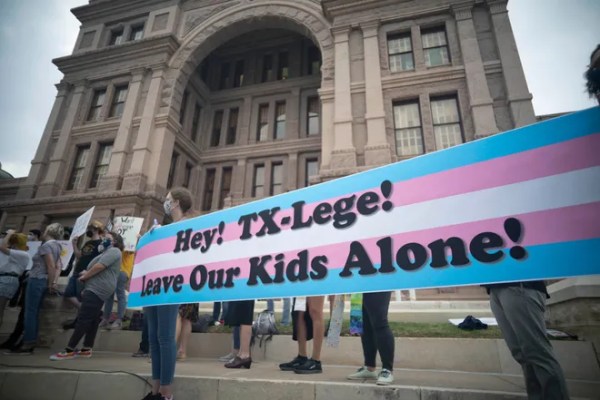
Study: LGBTQ youth, family relocate amid increasing anxiety over laws directed at them

*This was published on USA Today

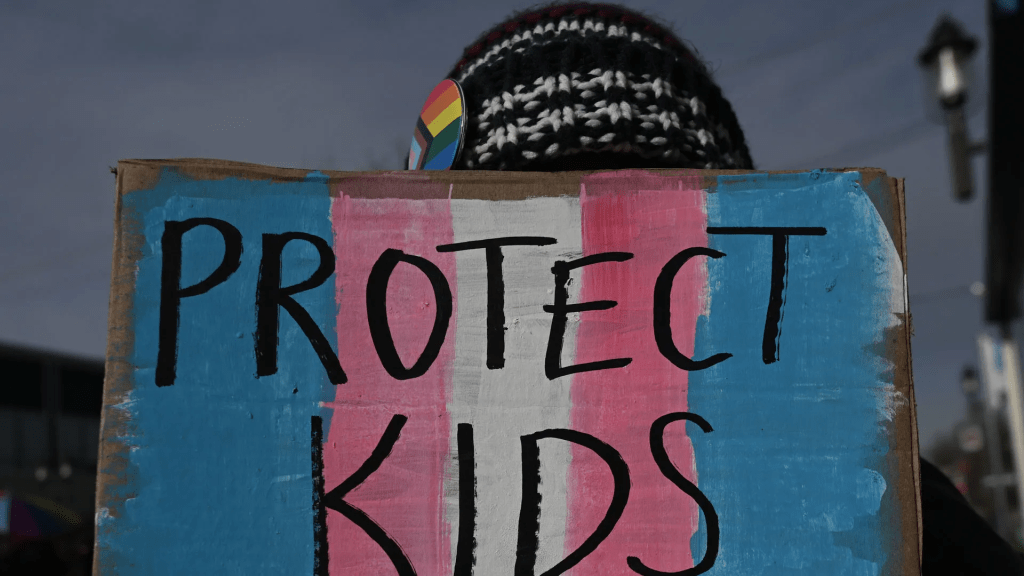
More than a quarter million LGBTQ+ young people and family members in the U.S. have relocated to other states because of LGBTQ+-related politics or laws, according to estimates outlined in a new report exploring the population’s response to hostile policy environments.

According to the brief compiled by The Trevor Project and Movement Advancement Project, 9 in 10 LGBTQ+ young people say politics have impacted their well-being, while 4 in 10 say they’ve thought about moving to another state because of unfriendly LGBTQ+ politics or laws at home.

The portion was even higher for transgender and nonbinary youth, 94% of whom said politics had affected their well-being and nearly half (45%) who said they’d considered relocating.

“For many LGBTQ+ young people in the U.S., the steady stream of anti-LGBTQ+ news may feel overwhelming right now,” said Steven Hobaica, a research scientist for the Trevor Project, a national LGBTQ+ youth advocacy group focused on suicide prevention. “It’s heartbreaking to see that nearly half of transgender and nonbinary youth have considered moving due to anti-LGBTQ+ policies.”

While just 4% of LGBTQ+ young people ages 13 to 24 reported uprooting because of anti-LGBTQ+ policies, that translates to roughly 266,000 young people and family members based on LGBTQ+ youth population estimates, the groups said.

Trump administration presents new threats

The report comes as President Donald Trump returns to the White House after making gender identity issues a focal point of his campaign. On Monday, after being sworn in, Trump issued a spate of executive orders that included seeking to remove legal protections for transgender people in federal spaces, laying the groundwork to potentially bar transgender individuals from military service and declaring that the U.S. government will only recognize two sexes, male and female.

“No matter a person’s political beliefs, we know, from our research and from what LGBTQ+ young people tell us, that policies like these take a damaging toll on LGBTQ+ young people’s mental health,” said Janson Wu, The Trevor Project’s senior director of state advocacy and government affairs. 

The organization said its crisis services saw a 33% increase on Inauguration Day compared to typical volume. But that still paled, it noted, to the sevenfold increase in crisis services experienced the day after the 2024 election.

“No matter your political beliefs or how you feel about the current administration, one thing must be made clear to all of us living in the United States: Real young people’s lives are at risk,” said Trevor Project CEO Jaymes Black.

Recent years have already seen increasing numbers of state laws and proposed legislation targeting the LGBTQ+ community, especially measures aimed at curbing the rights of transgender youth.

“It’s critical that we not only call attention to the negative impact of these divisive political attacks but also highlight that this research supports the idea that more inclusive policy environments lead to better outcomes for LGBTQ young people across a range of measures,” said Logan Casey, director of policy research for Movement Advancement Project.

Hostile climates raise mental, emotional health risk

The organizations said they compiled the report given a lack of research into how LGBTQ+ young people respond to hostile policy environments, despite studies showing that those youths experience greater mental health challenges and higher suicide risk in such environments.

“By gaining more knowledge of how LGBTQ+ young people respond to their policy environment, advocates and policymakers can create or modify policy to better support LGBTQ+ young people and their families,” the report said.

Their joint report is based on data gleaned from The Trevor Project’s 2024 U.S. National Survey on the Mental Health of LGBTQ+ Young People, which collected responses from more than 18,600 LGBTQ+ individuals between the ages of 13 and 24. It also incorporates data from Movement Advancement Project, a Boulder, Colorado-based group that tracks LGBTQ+-related laws and policies throughout the U.S. and its territories and assigns each a negative or positive policy index.

More than a quarter (27%) of respondents lived in states with negative policy indexes, the report said. Those individuals were more likely than their counterparts to consider moving to other states and also likelier to travel to other states to receive health care.

The report noted that not all LGBTQ+ young people and their families desiring to relocate have the resources to do so.

“Notably, the same factors that might preclude the ability of LGBTQ+ young people and their families from moving, such as poverty, housing discrimination, and employment access, are the same ones that disproportionately affect LGBTQ+ people of color and increase their risk of mental health and suicide,” the report said.
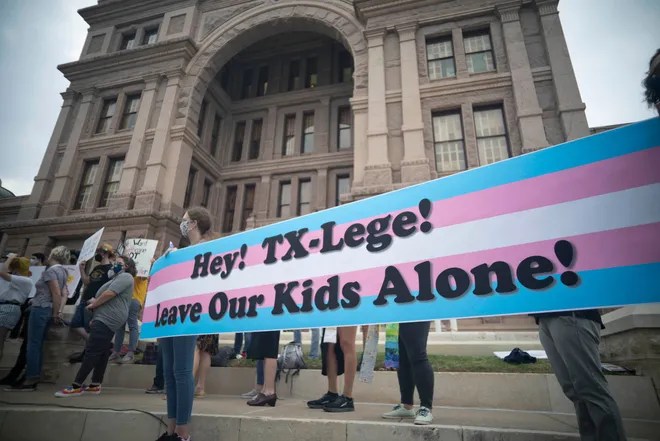

Bob Daemmrich, USA TODAY NETWORK

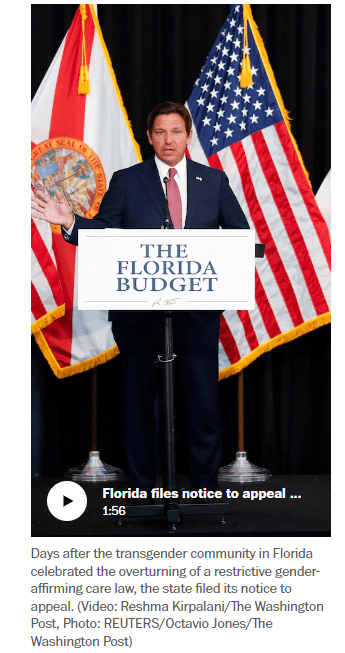
Judge rules that DeSantis’s ban on transgender care is unconstitutional

This blog originally appeared at WASHINGTON POST.

A federal judge blocked most provisions of the law pushed by Florida Gov. Ron DeSantis that banned gender-affirming care for children and restricted it for adults.

“The decision, issued on Tuesday, struck down most of a law supported by Florida Governor Ron DeSantis (R) that severely restricted transgender healthcare for adults and completely banned it for children.

U.S. District Judge Robert L. Hinkle rejected a prevailing argument from the DeSantis administration that denied the existence of transgender individuals, emphasizing in his ruling that “gender identity is real” and that the state cannot withhold treatment from them. Hinkle drew parallels between prejudice against transgender people and discrimination rooted in racism and misogyny.

“Florida has enacted legislation and regulations that prohibit gender-affirming care for minors, even when it is medically necessary,” Hinkle wrote. “This ban violates the Constitution.”

The decision, which arose from a lawsuit filed by parents of transgender children and adults, was celebrated by many in the LGBTQ community as a significant triumph. While several states have recently banned gender-transition care for minors, Florida’s law was the first to restrict care for adults.”

Under the legislation, nurse practitioners were prohibited from prescribing hormones to transgender adults. Although doctors could technically provide care, a shortage of physicians meant that many transgender adults struggled to find accessible treatment. Some individuals left the state, while others went without necessary medical care.

Joey Knoll, who established Spektrum Health in Orlando in 2018 to provide healthcare to transgender individuals, stated that Hinkle’s ruling allows him and his team to promptly address a backlog of over 300 patients awaiting hormone prescriptions.

“Judge Hinkle clearly identified this as a situation involving bias and discrimination,” Knoll remarked. “He thoroughly examined the evidence and acknowledged that fact.”

Jeremy Redfern, press secretary for Governor DeSantis, indicated that the state plans to appeal the decision.

“In an email, Redfern wrote, ‘Under Governor Ron DeSantis, Florida will continue to fight to ensure children are not chemically or physically mutilated in the name of radical, new age ‘gender ideology.’ He added that the law limiting transgender care was passed by elected representatives to protect the children of this state and that Hinkle was wrong to override their wishes.”

“These procedures do permanent, life-altering damage to children, and history will look back on this fad in horror,” Redfern wrote.

In his decision, Hinkle, appointed by President Bill Clinton, referenced statements from DeSantis and Republican legislators regarding “mutilating our children,” yet noted the state provided no evidence that such surgeries have ever occurred in Florida.

The plaintiffs in the lawsuit did not contest the restrictions on surgeries.

Judge Hinkle also criticized the “frenzied rhetoric” from Tallahassee, highlighting a lawmaker who publicly referred to transgender witnesses during a committee hearing on a related bill as “mutants” and “demons,” which he described as “direct evidence of that member’s animosity.”

Furthermore, the law, in conjunction with regulations from the state’s Health Care Administration board, mandated that healthcare providers obtain patient signatures on lengthy forms that Hinkle deemed “inaccurate and misleading in significant ways.”

One of the Floridians who sued, Lucien Hamel, said the decision was a relief.

“The state has no place interfering in people’s private medical decisions, and I’m relieved that I can once again get the healthcare that I need here in Florida,” Hamel said in a statement released by the lawyers who represented him and others in the case.

The mother of another plaintiff, who sued under the name Susan Doe to protect her daughter’s identity, also cheered the ruling.

One of the plaintiffs in the lawsuit, Lucien Hamel, expressed relief at the decision.

“The state has no right to interfere in people’s private medical decisions, and I’m relieved that I can once again access the healthcare I need here in Florida,” Hamel said in a statement issued by the attorneys representing him and others involved in the case.

The mother of another plaintiff, identified as Susan Doe to protect her daughter’s identity, also celebrated the ruling.

“This decision means I won’t have to witness my daughter suffering unnecessarily because I couldn’t provide her with the care she needs,” she remarked in a statement. “Seeing Susan’s anxiety over this ban has been one of the most difficult challenges we’ve faced as parents. All we ever wanted was to alleviate that fear and support her in continuing to be the happy, confident child she is today.”

Judge calls DeSantis ban on transgender care unconstitutional https://www.washingtonpost.com/nation/2024/06/11/florida-lgbtq-trans-health/

Every Louisiana Public School Classroom Now Required to Display the Ten Commandments

This blog originally appeared at THEM.

All Public School Classrooms in Louisiana Are Now Required to Display the Ten Commandments

The law went into effect this week and applies to all public K-12 schools as well as private schools that receive government funding.

Louisiana Governor Jeff Landry signed a new law this week requiring all public and state-funded schools to prominently display the “Ten Commandments,” making Louisiana the first U.S. state to implement such a policy.

Landry, a Republican, signed House Bill 71 into law on Wednesday, following its approval in the House by a 79-16 vote late last month. The law, which takes effect immediately, mandates that all public schools and private educational institutions receiving government funding display the Ten Commandments in every classroom and office building. The law specifies the language to be used for each commandment, requires the displays to be at least 11 by 14 inches in size, and ensures the text is the “central focus of the poster” and “printed in a large, easily readable font.” (Perhaps they’ll make an exception for Papyrus.)

Louisiana is now the only U.S. state requiring schools to display the Ten Commandments. However, since 2001, Mississippi has mandated state schools to post the motto “In God We Trust,” a requirement Louisiana matched last year.

HB 71 was authored by GOP Rep. Dodie Horton, who has been in office since 2015. Horton is also the chief sponsor of HB 122, which recently passed both chambers of the state legislature and awaits Governor Landry’s signature. This bill would prohibit K-12 teachers from discussing sexual orientation or gender with students under most circumstances, an effort Horton first attempted unsuccessfully in 2022.

During the debate on HB 71 in April, Horton expressed her intent to integrate more conservative Christian principles into state law, as reported by the Times-Picayune.

“I’m not concerned with an atheist. I’m not concerned with a Muslim,” Horton said, referring to non-Christian teachers. “I’m concerned with our children looking and seeing what God’s law is.”

However, Horton’s rhetoric contrasts with other Republicans, such as Sen. J. Adam Bass, who argued that the bill’s purpose was “not solely religious.” According to the Times-Picayune, Bass maintained that the commandments hold “historical significance” to the U.S. as “one of many documents that display the history of our country and foundation of our legal system.”

On Wednesday, the same day Landry signed HB 71 into law, representatives from the American Civil Liberties Union, the ACLU of Louisiana, Americans United for Separation of Church and State, and the Freedom from Religion Foundation announced their intention to challenge the law in a joint statement.

“The displays mandated by HB 71 will result in unconstitutional religious coercion of students, who are legally required to attend school and are thus a captive audience for school-sponsored religious messages,” the groups wrote. “Even among those who may believe in some version of the Ten Commandments, the particular text that they adhere to can differ by religious denomination or tradition. The government should not be taking sides in this theological debate, and it certainly should not be coercing students to submit day in and day out to unavoidable promotions of religious doctrine.”

https://www.them.us/story/ten-commandments-law-louisiana

Utah’s Anti-Trans Bathroom Snitch Line Got 12,000 Tips. None Could Be Verified.

This blog originally appeared at THEM.

Utah’s Anti-Trans Bathroom Snitch Line Got 12,000 Tips. None Could Be Verified

Six Weeks After Launch, Utah’s Anti-Trans Bathroom Tip Line Received 12,000 Reports, None Verified

Six weeks after Utah Republicans introduced a public “snitch form” to report transgender individuals using bathrooms in government facilities, the state auditor’s office has received over 12,000 reports—none of which could be verified.

The tip line was established following the passage of HB 257, sponsored by second-term GOP Rep. Kera Birkeland. The law mandates that all government bathrooms and locker rooms be designated based on a person’s assigned sex at birth. It also requires government institutions to create their own “privacy compliance plan” in accordance with the law. Violations are classified as criminal trespass offenses, a class A misdemeanor in Utah.

However, shortly after the form went live in early May, it was inundated with spam, including numerous memes and at least one picture of bull testicles.

Since its launch, the form has received more than 12,000 submissions, Utah Auditor John Dougall confirmed to the Salt Lake Tribune this week. Just five of those were deemed “plausible,” Dougall said, but his office was “unable to substantiate” any of them. In essence, the tip line has produced no verifiable cases.

The closest Dougall reportedly came to finding a case to pursue was from a report against the state Department of Corrections, which did not come through the online form. According to the Tribune, Dougall’s office received a letter earlier this month alleging that an employee in the administrative offices allowed an individual to use a sex-designated restroom that did not align with their sex. However, Dougall confirmed he was unable to substantiate the complaint.

Dougall also noted that he has instructed state agencies to adopt “privacy compliance plans,” but there has been significant confusion about how to implement these plans. According to a statement from Dougall’s office to the Tribune, “there is a lack of clarity regarding which entity has the duty to adopt a privacy compliance plan in situations when multiple entities either share use or control of facilities for which a plan is required.” Essentially, the overlapping jurisdiction of government facilities complicates the establishment and oversight of these policies.

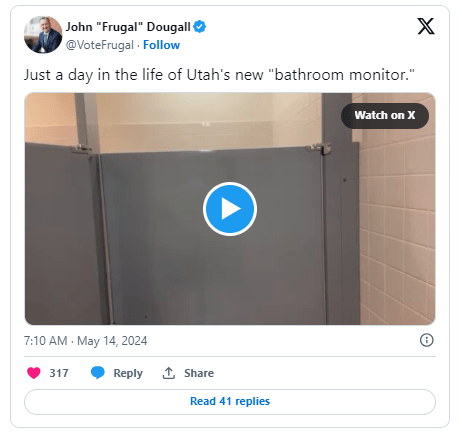
In summary, Utah Republicans have likely invested hundreds of work hours and significant taxpayer dollars on a tip line that, in a month and a half, has primarily been used for trolling. Utah Auditor John Dougall has been particularly critical of this debacle. He has released multiple videos on social media mocking his new role as a government “bathroom monitor” and criticizing Rep. Kera Birkeland and other legislators for enacting HB 257.

“It seems like this part of the bill was more about show than substance,” remarked John Dougall in a video filmed in a public bathroom and released in mid-May. “But it wouldn’t be the first time the legislature did something like that, would it?”

https://www.them.us/story/utah-anti-trans-bathroom-tipline-none-verified

Supreme Court to decide whether states can restrict gender-affirming care for minors | CNN Politics

This blog originally appeared at CNN.

Supreme Court to rule on states’ ability to limit gender-affirming care for minors

CNN – The Supreme Court agreed on Monday to hear the Biden administration’s challenge to Tennessee’s transgender care ban, addressing the contentious issue of gender-affirming care in depth for the first time.

The Tennessee law, enacted last year, prohibits hormone therapy and puberty blockers for minors and imposes civil penalties on doctors who violate these prohibitions. This law is part of a growing trend of state legislation targeting transgender care.

According to the Human Rights Campaign, nearly half of U.S. states have enacted bans on transgender care for minors.

The case is scheduled to be heard this fall.

“The Supreme Court was always going to have to resolve how state bans on gender-affirming medical care can be reconciled with its approach to sex-based discrimination,” said Steve Vladeck, CNN Supreme Court analyst and professor at the University of Texas School of Law. “Today’s grant sets up this issue as one of the early blockbusters for the Court’s upcoming term.”

Laws in Kentucky and Tennessee were challenged by the Biden administration and families of transgender minors. However, the Supreme Court only agreed to hear the Biden administration’s challenge against the Tennessee law.

In September, the 6th US Circuit Court of Appeals in Cincinnati reversed a district court ruling that had blocked the enforcement of the gender-affirming care ban. This decision allowed the ban to take effect.

Republican lawmakers supporting the ban argue that decisions about gender-affirming care should be made once an individual reaches adulthood. Opponents contend that these laws not only violate the civil rights of transgender youth but also infringe on parents’ rights to make medical decisions for their children.

Tennessee’s law prohibits medical providers from performing procedures that “enable a minor to identify with, or live as, a purported identity inconsistent with the minor’s sex” or “treat purported discomfort or distress from a discordance between the minor’s sex and asserted identity.”

Legal battles over similar bans have been progressing through federal courts for over a year. In April, the Supreme Court temporarily allowed Idaho officials to enforce a strict statewide ban on gender-affirming care for most minors, though it did not resolve the underlying legal questions.

Several advocacy groups for transgender youth have urged the Supreme Court to strike down Tennessee’s law.

“It’s simple: Everyone deserves access to the medical care that they need, and transgender and non-binary young people are no exception,” said Kelley Robinson, president of the Human Rights Campaign. “No politician should be able to interfere in decisions that are best made between families and doctors, particularly when that care is necessary and best practice.”

Lucas Cameron-Vaughn, an attorney with the American Civil Liberties Union of Tennessee, criticized state lawmakers for using the bans to “fuel divisions for their own political gain.”

“It’s crucial to recognize that for trans youth and their families, this isn’t about politics,” Cameron-Vaughn said. “It’s about the fundamental freedom to access vital, life-saving healthcare.”

Tennessee Attorney General Jonathan Skrmetti, a Republican, expressed his eagerness to defend the law.

“This case will bring much-needed clarity to whether the Constitution contains special protections for gender identity,” he said.

Texas risks losing billions in federal funds over LGBTQ directive, Democrats say

Democrats warn that Texas could forfeit billions in federal funds due to Abbott’s LGBTQ directive.

Texas colleges and universities face the imminent risk of losing billions in federal funding if they adhere to Governor Greg Abbott’s directive to disregard a new federal rule strengthening nondiscrimination protections for LGBTQ students, according to Democrats who addressed a state education board on Monday.

In a letter of congressional inquiry to Texas’s Higher Education Coordinating Board, which oversees public post-secondary education, four House Democrats from Texas cautioned that public colleges could jeopardize students’ civil rights and forfeit government funding by following Abbott’s orders to ignore amendments to Title IX. This federal civil rights law prohibits sex discrimination in schools and educational programs receiving federal funding and was updated by the Education Department in April to include protections based on sexual orientation and gender identity.

The rule, set to take effect on August 1, has faced temporary injunctions in ten states led by Republicans, including Texas, where Abbott labeled the changes as “illegal” in an April letter to President Biden.

Led by Rep. Jasmine Crockett (D-Texas) and signed by Democratic Reps. Sylvia Garcia, Al Green, and Sheila Jackson Lee, the letter accused Abbott and other officials of using educational institutions as “political pawns.”

“If Texas educational institutions fail to adjust their policies in accordance with the forthcoming Title IX revisions, the consequences would be devastating,” the lawmakers wrote. “Losing billions of dollars of federal funding would prevent institutions from offering scholarships crucial for students to afford and access higher education. Hundreds of thousands of potential Texas students would face a threat to their educational opportunities.”

Democrats argued that failure to comply with the Biden administration’s rule, which also strengthens protections for pregnant students and changes how schools handle sexual misconduct claims, could undermine students’ civil rights. They referenced a recent lawsuit by University of Texas at Austin professors challenging provisions allowing student absences for out-of-state abortions and mandating respect for transgender and gender-nonconforming students’ pronouns.

“A federal judge recently sided with Texas Attorney General Ken Paxton (R) by blocking similar changes proposed by the Biden administration last year,” the letter noted. Despite Title IX being a federal law, enforcement methods vary by administration, impacting schools that receive federal funding.

Efforts by House and Senate Republicans to challenge the rule through disapproval resolutions and lawsuits in numerous Republican-led states remain ongoing, reflecting broader opposition to the Biden administration’s regulatory changes.

Trans Teen in Minnesota Has a Broken Jaw After Alleged Attack Outside a School Bathroom | THEM

This blog originally appeared at THEM.

Authorities in Minnetonka, Minnesota are currently investigating the reported assault on 17-year-old Cobalt Sovereign as a potential hate crime.

The following contains graphic descriptions of violence against a transgender child.

Last week, a 17-year-old transgender student in Minnesota found herself hospitalized following an attack by a classmate in the school restroom. The disturbing incident, captured on video, unfolded at Hopkins High School in Minnetonka, MN.

Cobalt Sovereign, a junior at the school, recounted to NBC affiliate KARE that on May 30, she encountered verbal abuse from a fellow student while attempting to use the restroom. Despite the availability of gender-neutral facilities, Sovereign, who prefers she/they pronouns, opted for the boys’ restroom due to convenience, though it caused considerable discomfort.

Recalling the ordeal, Sovereign shared how the assailant peered over the stall and hurled derogatory slurs, including the use of the word “faggot,” which was allegedly repeated several times. Upon leaving the restroom, Sovereign was confronted by three students, one of whom initiated an unprovoked attack. Subsequent examination revealed Sovereign suffered a broken jaw in two places, with a shattered molar and potential traumatic brain injury (TBI). Hospitalized for two days, Sovereign continues to grapple with the physical and psychological aftermath, including recurring nightmares.

Hopkins High School promptly addressed the situation, initiating disciplinary measures against the alleged attacker. Further legal action rests with the Hennepin County attorney’s office, while local authorities are investigating the incident as a possible hate crime. Citing student privacy laws, the identity of the alleged perpetrator remains undisclosed.

Reflecting on the incident, Cobalt’s brother, Wilder Sovereign, expressed dismay over the escalation of transphobia, emphasizing the severity of the assault as an unprecedented manifestation within their community.

At Hopkins High on Wednesday, another segment of Sovereign’s community gathered in solidarity, demanding justice and accountability. Local LGBTQ+ organizations, such as the Queer Equity Institute, mobilized alongside Minnesota Rep. Leigh Finke, the state’s pioneering openly transgender legislator.

Addressing the assembly, Finke underscored the fundamental right to restroom usage without fear of violence, lamenting the fact that such a basic act has become perilous for marginalized communities. “The simplest act imaginable for a human is to just pee in peace, and our community is beaten and killed because that’s what we are trying to do,” Finke articulated, emphasizing the pervasive nature of such incidents. “We are here at Hopkins because this happened here, but this happens everywhere.”

In an Instagram post shared on Wednesday, Rep. Leigh Finke drew attention to what they described as “frightening similarities” between the violence endured by Cobalt Sovereign and the February assault on Oklahoma teenager Nex Benedict. While officials have stated that Benedict’s subsequent death was attributed to suicide, purportedly linked to medications found in their system, this narrative has been met with skepticism by some LGBTQ+ advocates, who demand further investigation.

Highlighting the disparities in official response, Finke expressed concern over the lack of immediate action taken by the school following both incidents. “The school did not call an ambulance. The school did not file a police report. Students and families were not notified. It wasn’t until our rally was announced yesterday that authorities began to move,” Finke wrote, juxtaposing the contrasting reactions to the two attacks. “Cobalt lived. Thank goddess. Nex did not. Please help us make sure there is no next time.”

CBS News: Texas man details wife’s miscarriage amid state’s abortion laws | Khou

This blog originally appeared at CBS NEWS.

A Texas father told CBS News that he and his wife are living a nightmare after she suffered a miscarriage following multiple unsuccessful attempts to receive medical treatment.

DALLAS — Some families are experiencing medical challenges due to Texas’ abortion law, as highlighted in a CBS News report that featured one family’s struggles.

A Texas father shared with CBS News that he and his wife are enduring a nightmare after she suffered a miscarriage following numerous attempts to obtain medical treatment.

Ryan Hamilton, a 43-year-old radio host, garnered significant attention on social media after sharing about his wife’s miscarriage.

CBS News did not reveal his wife’s name in their report, and she remains not ready to discuss the incident publicly.

“When you find out your baby doesn’t have a heartbeat, that’s only the beginning,” Hamilton told CBS News. “So, the conversation becomes, what do we do?”

On May 16, Hamilton’s wife, over three months pregnant with their second child, learned that the baby no longer had a heartbeat.

Medical records obtained by CBS News indicate that Hamilton’s wife was treated at a North Texas emergency room, where doctors informed her that the baby had no heartbeat.

“We were told she could take medication to start the process to finish… to finish what had already started at home,” Hamilton explained to CBS News.

Doctors prescribed misoprostol, a labor-inducing drug used for miscarriages and abortions. She was instructed to take the medication at home and return if it did not work within two days.

Hamilton told CBS News that the medication didn’t work, and when they returned to the hospital, the doctor said they couldn’t prescribe the medicine.

Confused, Hamilton and his wife sought other options and went to another hospital, only to be denied treatment once again.

“You want to panic, but you can’t,” Hamilton told CBS News. “At this point, you’re just thinking, ‘Get my wife safe.'”

While waiting for answers at the second hospital, Hamilton sensed that the doctors were uncertain about what they were permitted to do.

“That’s what it feels like. They feel scared. The doctors feel scared,” he said in the interview.

Texas law prohibits abortions once a fetal heartbeat is detected, except in medical emergencies. Hamilton explained that the doctors told them it wasn’t a significant enough emergency to perform the procedure.

The procedure they were denied is called “dilation and curettage,” but the law does not require a medical emergency for it to be performed if there is no cardiac activity.

In a statement to CBS News, the hospital said they follow Texas and federal laws in accordance with national standards of care.

Hamilton and his wife still didn’t know what to do. Doctors gave her stronger medication and sent her home. In the following days, Hamilton found his wife unconscious on the bathroom floor, surrounded by blood. He rushed her to the hospital, where doctors confirmed the medication had worked.

Hamilton told CBS News they are not planning to sue any of the hospitals involved, but he hopes his story will help others in the future. He said his wife is focused on healing and therapy.

Florida cities fly Pride flags after the GOP’s failed attempt to ban them | LGBTQNation

This blog originally appeared at LGBTQ NATION.

“I hope it stands as a beacon for the rest of the state and the entire country.”

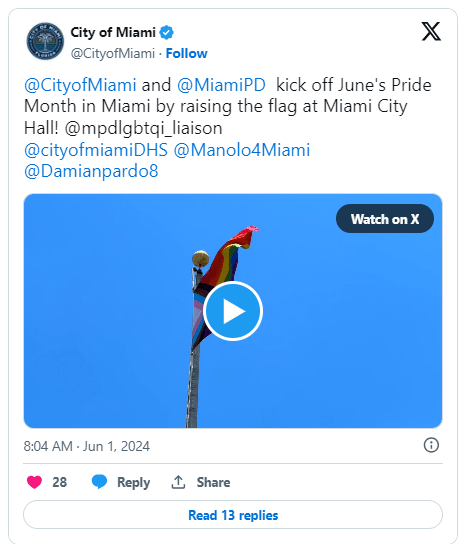
After Florida Republicans tried unsuccessfully to pass a law banning government buildings from flying Pride flags earlier this year, several cities around the state hoisted the rainbow stripes over the weekend to mark the start of Pride Month.

Late last year, state Rep. David Borrero (R) introduced legislation aimed at banning flags “that represent a political viewpoint, including, but not limited to, a politically partisan, racial, sexual orientation and gender, or political ideology viewpoint.” House Bill 901 would have prohibited such flags from being displayed not only at schools but also above government buildings and universities.

But the bill died during the most recent legislative session, leaving local governments free to fly Pride flags this month.

On Friday, the city of St. Petersburg got an early start to Pride Month by raising the Progress Pride flag at City Hall. U.S. Rep. Kathy Castor (D-FL), state Reps. Lindsay Cross (D) and Michele Rayner (D), Mayor Ken Welch (D), and the St. Petersburg City Council attended the flag-raising ceremony.

“Together, by raising the Pride flag at City Hall, our city boldly and unapologetically acts on its commitment to inclusivity, the celebration of diversity, and the simple but profound idea that people should have the freedom to love who they love,” Cross said. “This is in stark contrast to attempts at the state level to stifle our celebrations and to dim the light of beautiful members of our community.”

Cross noted the proposed flag ban and her vote against it. “Gratefully, due to the loud and proud voices that opposed the bill, it did not pass,” she said. “So, this year, as we stand under this Pride flag, we celebrate this small but important victory. Because we should not live in fear of repercussions from safe self-expression.”

“This marks the beginning of a celebration for equal rights for all across St. Petersburg, and I hope it stands as a beacon for the rest of the state and the entire country,” Castor told the crowd.

On Saturday morning, nearly 100 people gathered to see the Progress Pride flag hoisted above the Gulfport Public Library in the city of Gulfport, Pinellas County. The ceremony was attended by Vice Mayor and City Council member Ian O’Hara, members of the city council, Pinellas County Commissioner Charlie Justice, Pinellas County School Board member Caprice Edmond, Gecko Queen Robert Daunch, and candidates for Florida’s 13th Congressional District Whitney Fox and John Liccione.

The same day, the City of Miami raised the Progress Pride flag over its City Hall. “It’s important to understand that it’s a celebration because of how far the LGBTQ community has come,” Commissioner Damian Pardo said in a video posted to the City of Miami’s official X account. “It’s incredibly important to thank the city of Miami for creating a safe space for us in the LGBTQ community.”

The flag-raisings continued on Monday in Tampa and Orlando.

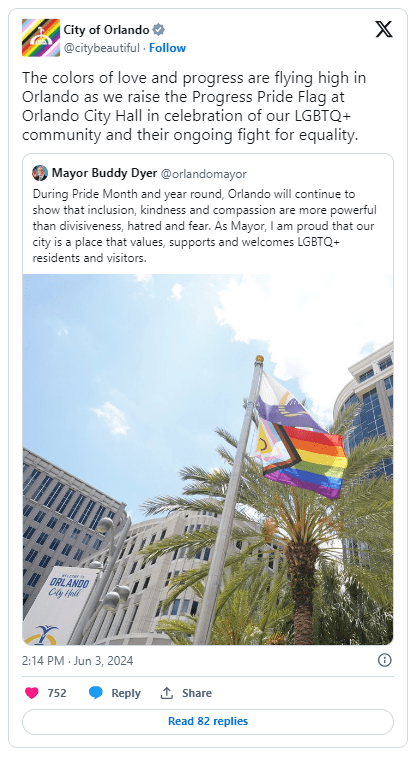
“During Pride Month and year-round, Orlando will continue to show that inclusion, kindness, and compassion are more powerful than divisiveness, hatred, and fear,” Orlando Mayor Buddy Dyer wrote in an X post, along with a photo of the intersex-inclusive Progress Pride flag flying over City Hall. “As Mayor, I am proud that our city is a place that values, supports, and welcomes LGBTQ+ residents and visitors.”

“The colors of love and progress are flying high in Orlando as we raise the Progress Pride Flag at Orlando City Hall in celebration of our LGBTQ+ community and their ongoing fight for equality,” read a post on the city’s official X account.

In Tampa on Monday morning, Mayor Jane Castor (D) gave a brief history of the original rainbow Pride flag’s origins before raising the rainbow-striped flag above the city’s Old City Hall.

“It really is a wonderful definition and proclamation of our community and the pride that we have,” Castor said of the flag. Members of Tampa’s LGBTQ+ community “are our police officers, our firefighters, our paramedics, the individuals that protect our country down at MacDill Air Force Base, they are our teachers, our nurses. They are our neighbors, our friends, and our family. It is our community, and we’re very, very proud of that.”

Castor also called on those gathered to “continue to stay focused on ensuring that everyone is treated with dignity and respect” in the face of the recent rise in anti-LGBTQ+ rhetoric in Florida and across the nation.

On Tuesday morning, Miami-Dade County Mayor Daniella Levine Cava (D), County Commissioner Eileen Higgins, and other local leaders will raise the Pride flag about the city’s Stephen P. Clark Government Center. According to a press release, this will mark the fourth consecutive year that the Miami-Dade County government has raised the Pride flag “to reaffirm our commitment to making Miami-Dade an inclusive, welcoming County that celebrates our rich diversity.”

Black Trans Lives Matter | THEM

Michelle Henry, a beacon in San Francisco’s transgender community, tragically lost her life.

The San Francisco LGBTQ+ community is grieving the loss of a transgender woman who was killed on May 15th.

“Michelle’s passing is an immense loss for our community,” said Rebecca Rolfe, executive director of the organization, in an email statement. “There are no words to express the depth of our collective grief right now. We extend our gratitude to those who cherished Michelle, and our thoughts are with everyone who had the privilege of truly knowing, loving, and caring for her.”

On Tuesday, friends and family gathered to honor Henry at a memorial vigil held at San Francisco’s bar, Mother. The LGBT Center is currently creating an altar to honor her memory.

Veronica Pritipaul, a navigation specialist at the LGBT Center, described Henry as a “beacon of light in our community” who dedicated her life to transgender liberation. “With her passing, we have not only lost a beloved sister, but also a mentor and steadfast advocate for the trans community,” Pritipaul told the Reporter.

Jackson Asher, a close friend, remembered Henry as “incredibly loving” and a constant source of support over the years. “She was there for me at my lowest points, especially during my struggles with addiction,” Asher recalled. “Her love was unwavering, and her vibrant energy drew people to her.”

Friends suspect that Henry’s death may have been a hate crime targeting a transgender person. However, the San Francisco Police Department is currently not investigating the incident as a bias-motivated killing. “At this time, we do not have evidence indicating that this incident is hate-related,” police stated in a release.

Authorities have arrested 33-year-old Raymani Yuhashi, who faces charges of murder with premeditation, according to the Reporter. As of May 21, Yuhashi’s name did not appear in the county jail’s online records.

Henry’s death has been classified as a homicide, confirmed by David Serrano Sewell, executive director of the city’s Office of the Chief Medical Examiner, according to the Reporter.

A spokesperson for the San Francisco District Attorney’s office stated that the investigation is ongoing. “The police had sufficient cause to make an arrest based on evidence gathered at the scene. However, further investigation is necessary to make informed decisions about criminal charges,” the representative informed the Reporter. “Once the investigation concludes, all evidence will be thoroughly evaluated. If we determine we can meet the burden of proof, appropriate charges will be filed.”

The district attorney’s office extended condolences to Henry’s family and friends, offering support through their Victim Services Division as they navigate this difficult time.

Henry is at least the 15th trans or gender nonconforming person killed this year due to violent incidents, as reported by the Human Rights Campaign (HRC). The HRC’s current database, which lists 14 individuals, has yet to be updated to include Henry’s death. Nearly four out of five of those killed this year have been people of color, with almost a third being Black trans women. The majority of these deaths involved firearms.

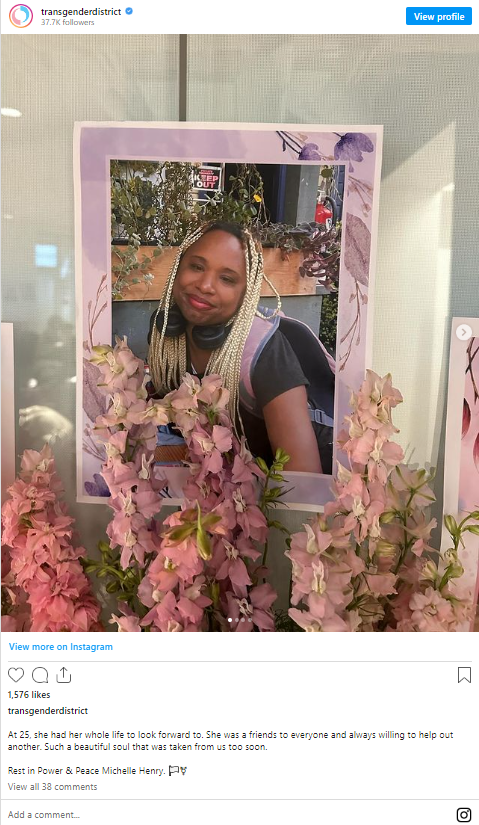
As the LGBTQ+ community grieves another tragic loss, San Francisco’s Transgender District honored Henry in an Instagram post, describing her as a “beautiful soul taken from us too soon.” “At 25, she had her whole life ahead of her,” the post reads. “She was a friend to everyone and always ready to lend a helping hand.”

Honey Mahogany, recently named director of the city’s Office of Transgender Initiatives, described Henry as a “beloved member of our community.” Mahogany emphasized that her tragic death serves as a stark reminder that, even in San Francisco, ongoing advocacy is crucial to ensure the safety and welfare of all transgender individuals.

https://www.them.us/story/michelle-henry-trans-san-francisco-killed?utm_source=nl&utm_brand=them&utm_mailing=Them_Weekly_052324&utm_campaign=aud-dev&utm_medium=email&bxid=647003a05dfaff5d630fbb31&cndid=74113754&hasha=90d5433b1347095329a6ab5df0bd392d&hashb=555b342b6918faf1a5515da1bc4cf5731fa62fa0&hashc=f4ee38a7ae4ef690cecccbdd27678ec522f6d3c6f45bef0cc5001fd7abe7557b&esrc=bouncex-test&utm_term=THEM_Daily

Blog at WordPress.com.

Up ↑