Massachusetts foster parents lose license after refusing to sign gender affirming policy: “We simply can’t agree to go against our Christian faith”

Read more at CBS News.

A couple from Woburn, Massachusetts has lost their license to foster children after they refused to sign a gender affirming policy form from the Department of Children and Families (DCF).

Lydia and Heath Marvin have three kids in their teens, but they have fostered eight different children under the age of 4 since 2020. Their most recent foster child was a baby with complex medical needs who stayed with them for 15 months.

“Our Christian faith, it really drives us toward that. James says that true undefiled religion is to care for the fatherless,” said Heath.

The couple said they were prepared to care for more foster children until DCF pulled their license to foster in April.

Foster parents cite religious beliefs

That’s because the Marvins refused to sign the agency’s LGBTQIA+ Non-Discrimination Policy because of their Christian faith. Starting in 2022, the policy said that foster families must affirm the LGBTQIA+ identity of foster children.

“We asked, is there any sort of accommodation, can you waive this at all? We will absolutely love and support and care for any child in our home but we simply can’t agree to go against our Christian faith in this area. And, were ultimately told you must sign the form as is or you will be delicensed,” Lydia said.

The Marvins appealed the loss of their license, but lost. They’re considering their options but two other Christian foster families are plaintiffs in a federal lawsuit filed by the Massachusetts Family Institute and Alliance Defending Freedom against DCF.

The lawsuit alleges the policy forces parents to “accept[ ] a child’s assertion of their LGBTQIA+ identity”, “address[ ] children by their names and pronouns,” and “support[ ] gender-neutral practices regarding clothes and physical appearance.”

“There is a speech component and also a religious liberty component to the lawsuit,” said Sam Whiting, an attorney with the Massachusetts Family Institute.

Letter from Trump administration

Last week, the Trump administration sent a letter to DCF, addressing the lawsuit and specifically mentioning the Marvins.

“These policies and developments are deeply troubling, clearly contrary to the purpose of child welfare programs, and in direct violation of First Amendment protections,” wrote Andrew Gradison, Acting Assistant Secretary for the Administration for Children and Families.

LGBTQ+ advocates argue the policy was developed to protect kids. Massachusetts foster parents also receive a monthly stipend.

“The state has an obligation to children to make sure that they’re safe and well protected. And foster parents, they’re not parents. Foster parents are temporary. They’re a stop gap to make sure children can safely go back to their families of origin,” said Polly Crozier, Director of Family Advocacy at GLBTQ Legal Advocates and Defenders.

Data collection by DCF is poor but a report by the Massachusetts Commission on LGBTQ youth suggests that roughly 30 percent of foster children in the state could identify as LGBTQ, similar to data collected in California and New York.

The Marvins argue that DCF has been flexible about child placements in the past for a number of reasons.

“We would love and care and support any child but if there was an issue where we knew that we would have a different position than DCF, we would just be open and talk to them about it,” Heath said.

A DCF spokesperson said in a statement to WBZ-TV, “The Department does not comment on matters related to pending litigation.” 

20-year-old targeted by MAGA for political beliefs and trans identity

Read more at LGBTQ Nation.

A student activist at Louisiana State University in Baton Rouge says her arrest at a campus public hearing was a targeted attack based on her political views, and alleges police became menacing when they learned she’s transgender.

Gabriela Juárez, 20, was swarmed by campus police after she exceeded her allotted speaking time of three minutes at a campus presidential search forum last week.

At least a dozen other students leapt from their seats in support of Juárez as LSU cops dragged her from the room, Louisiana Illuminator reports.

Six other students were charged with misdemeanors and released from the campus police station after they blocked the police car taking Juárez away.

Juárez was charged with resisting arrest and “interference with educational process,” which is a felony. She was taken to East Baton Rouge Parish Prison.

All of the students involved are members of the LSU chapter of Students for a Democratic Society. The group claims Louisiana Gov. Jeff Landry (R) is secretly steering the process to hire the university’s next president to align with the governor’s far-right, Trump-inspired political agenda, while disenfranchising campus leaders, faculty and students. 

Several students at the forum wore T-shirts with the slogan “No MAGA President.” 

LSU cops initially referred to Juárez as “she” or “her,” the activist said in an interview, but began treating her differently when she shared her legal name. Then they turned hostile and referred to her as “he” and “him,” she said. 

At the parish prison, Juárez was strip-searched and forced to stand naked while officers discussed where she should be kept.

“They said to the officer, ‘I have someone here who is bottom parts male but up top fully female,’” Juárez recounted. “And so they had no idea what to do with me.” 

Juárez said she was put into a cell by herself and given a women’s uniform, along with a warning she’d be sexually assaulted anywhere else. Other cops interrogated Juárez about her gender and loudly referred to her as a man, she said.

Juárez said she was denied the opportunity for a phone call after her arrest, but fellow SDS members were able to post a $1000 bond to obtain her release late the same night.

The meeting that led to Juárez’s arrest was chaotic.

She and six other members of SDS made public comments, eviscerating the 20 search committee members and calling them illegitimate.

Several made profane comments, including Juárez, who alleged the only criteria for serving on the committee was to “be a millionaire and suck off the governor.”

“Don’t f**king touch me,” Juárez shouted as the first LSU cop grabbed her arm. 

“Am I being detained?” she shouted as two officers dragged her out of the room and fellow SDS members shouted down cops and committee members in her support.

“Shame on you!” they shouted after Juárez was removed. Those students were also ejected from the meeting.

Outside, as her fellow SDS members and other students shouted and aimed their phones at officers, Juárez was searched, handcuffed, and placed in the back of an LSU Police cruiser.  

Juárez says she was targeted.

“In a moment where they are actively cultivating a panic around the presence of Latinos and the presence of trans people, and especially transgender women,” Juárez said, “I do believe that that – combined with the fact that I have a high profile on campus – led to them wanting to make an example out of me, and wanting to intimidate me specifically, and to use me as a show of force to scare other students into being silent.”  

The 20-year-old has political enemies, she said.

In September, Juárez was called out by the Louisiana Republican Party, which demanded that LSU discipline the activist for comments critical of slain conservative podcaster Charlie Kirk.

Juárez shared an Instagram story that referred to Kirk as a “world famous fascist” with the caption “rejoice.” 

Loudoun (VA) School Board approves LGBTQ proclamation despite opposition

Read more at Loundon Times-Mirror.

Loudoun County School Board proclamations are typically noncontroversial, but a proclamation recognizing October as LGBTQ+ History Month drew three no votes at the board’s Sept. 30 meeting.

Language in the proclamation says it honors the “history, achievements, and contributions of lesbian, gay, bisexual, transgender, and queer people” and celebrates “the strength, resilience, and impact of the LGBTQ+ community, whose contributions have enriched the cultural, educational, and civic life of Virginia and the world.”

The proclamation — whose approval comes as some 600 Republican-sponsored, anti-LGBTQ billsincluding 17 in Virginia, have been proposed around the nation — includes a repudiation of discrimination.

“We reject discrimination based on gender identity, sexual orientation, and gender expression, and instead affirm kindness, acceptance, and respect as the foundation of our learning community,” the proclamation states. “Our school division is stronger when every student and staff member can live authentically and feels a true sense of belonging, and when we embrace the full diversity of our community.”

April Chandler, Algonkian; Linda W. Deans, Broad Run; board Vice Chair Anne P. Donohue, At Large; Arben Istrefi, Sterling; board Chair Melinda M. Mansfield, Dulles; and Sumera Rashid, Little River, voted yes.

Deana L. Griffiths, Ashburn; Karen “Kari” LaBell, Catoctin; and Lauren E. Shernoff, Leesburg, voted no.

The proclamation was initially included in the board’s consent agenda, which has items that are approved en masse.

However, Griffiths, who typically has abstained from voting on proclamations since taking office in 2024, wrote in an email that she moved the proclamation to the regular agenda, so she could speak about why she was voting against it.

“There is a meaningful difference between formally recognizing a group in history and promoting that group for its lifestyle to our students,” Griffiths said at the meeting. “It crosses the line into advocacy and raises serious concerns under the (Trump) executive order protecting our children from inappropriate content in our schools.

“Our communications must remain age appropriate and leave conversations about sensitive information to parents. Schools exist to teach children how to read, write, and think critically. Not engage them in conversations about sexuality at any age where they are far too young to process it.”

The January executive order from President Donald J. Trump that Griffiths referred to says people cannot identify as the opposite sex they were born as. It says the administration will “enforce all sex-protective laws to promote this reality,” including cutting federal funding used to “promote gender ideology.”

The Trump administration said in August it was suspending or terminating funding to Loudoun County Public Schools over its policy allowing transgender students to choose which bathroom or locker room they use. Federal money accounts for about $47 million of the current $2 billion LCPS budget.

Shernoff wrote in an email that some constituents complained to her after she voted for the proclamation last year about the way LGBTQ+ History Month was celebrated in schools. Specifically, their complaints were about how “certain spirit days” were celebrated and the effect on young students.

“I did some research into it and that in conjunction with knowing that LCPS also proclaims LGBTQ+ Pride Month in June, I decided to not support this,” Shernoff said. “I did however support the anti-bullying proclamation which specifically names and protects students based on their gender identity. I remain committed to ensuring all students are protected, safe, and can achieve to their fullest potential.”

LaBell said in an interview that she supported the proclamation last year because it was on the consent agenda and voting against it would’ve meant voting against everything on the agenda.

She said she opposed the proclamation because some of the issues it raises are “too political”  to promote in school and might be inappropriate for young students to discuss.

Like Shernoff, LaBell said she voted for the Pride Month and anti-bullying proclamations, but believes one proclamation related to LGBTQ issues annually is enough.

“You want history? Put it in Pride Month,” she said. “It just seems to me it’s being pushed more so than anything else in our school system at this point in time. And it’s a family issue. It shouldn’t be a political issue in our schools.”

Two groups that support LGBTQ rights criticized the rationale of Griffiths, LaBell and Shernoff.

Candice Tuck, an Equality Loudoun board member, said the proclamation isn’t about promoting sexuality.

“There have been many brave queer pioneers throughout history who have fought for civil rights, who have been inventors, and who have moved our democracy forward,” Tuck said in an interview. “There is no reason that the queer community cannot be recognized for those accomplishments without individuals in our community perverting their history.”

Meredith Ray, the head of Loudoun4All, noted in an email that Griffiths previously said she wouldn’t vote for any proclamations, but chose to single out the LGTBQ+ proclamation for criticism.

Ray called Griffiths’ decision “malicious” and said her remarks were “ignorant commentary” on the issue.

“Recognition of history is not ‘promotion of a lifestyle.’ LGBTQ+ students, staff, and families exist in Loudoun and deserve the same dignity as everyone else. Griffiths’ attempt to frame recognition as ‘inappropriate content’ is harmful, especially to young people who already face higher rates of bullying and mental health struggles when leaders stigmatize them,” Ray said. “In fact, decades of research show that inclusive education that teaches respect and representation is one of the most effective ways to prevent bullying and improve school climate.”

Appeals court rules for Colorado and LGBTQ rights and against Catholic parishes in state preschool case

Read more at KUNC.

Preschoolers with LGBTQ parents or who identify as LGBTQ can’t be shut out of religious preschools that are part of Colorado’s state-funded preschool program, a federal appeals court ruled Tuesday.

The decision, which upholds a key part of a lower court decision, represents a major win for the state and a defeat for the two Denver-area Catholic preschools at the center of the case.

Tuesday’s decision provides the latest answer to a question being asked in several cases percolating in state and federal courts: Can private religious schools that accept public education dollars refuse to enroll certain kids based on religious principles?

Along with the 10th Circuit Court of Appeal, a Maine federal district court and a Utah state court are among those who have said no.

It’s possible the U.S. Supreme Court could eventually weigh in, though it’s not clear which case will advance to the high court.

In its 54-page ruling, the 10th Circuit Court of Appeals wrote that it found no proof that the Colorado Department of Early Childhood took actions that “evidence religious hostility” as the two Catholic preschools claimed.

The state’s universal preschool program “went to great effort to be welcoming and inclusive of faith-based preschools’ participation,” the decision said.

The three-judge panel also found that the early childhood department, which runs the preschool program, had applied its nondiscrimination policy in a neutral way to both religious and non-religious preschools.

The policy bars preschools from discriminating based on a variety of factors, including sexual orientation and gender identity. State officials cited the policy in denying the Catholic preschools a waiver that would have allowed them to keep LGBTQ children or children from LGBTQ families from enrolling.

In a statement Tuesday, Gov. Jared Polis said, “We are building a Colorado for all, where every student is free from discrimination and this voter-approved initiative continues to enroll approximately 70% of all eligible four-year-olds each school year and many faith based and secular providers are operating terrific preschools that serve parents and children well.”

Tuesday’s ruling essentially upholds the status quo in the universal preschool program, meaning that participating preschools can’t shut out LGBTQ children or children with LGBTQ parents.

The three appeals court judges who ruled Tuesday were Gregory Phillips, Veronica Rossman, and Richard Federico. Phillips was appointed by President Barack Obama, and Rossman and Federico were appointed by President Joe Biden.

Nick Reaves, senior counsel at The Becket Fund for Religious Liberty, which is representing the Catholic preschools in the case, sent Chalkbeat a short statement about the ruling.

“Colorado is punishing religious schools and the families they serve for following their faith. The Tenth Circuit’s decision allows the state’s anti-religious gamesmanship to continue. We will keep fighting to ensure that every preschooler in Colorado can access quality, affordable education.”

Conflict arose as state preschool program rolled out

The Colorado case began in 2023 as the state was launching its new universal preschool program, which provides tuition-free preschool to 4-year-olds statewide. The $349 million program serves more than 40,000 children and allows families to choose from public, private, or religious preschools.

Of more than 2,000 preschools participating in the program this year, about 40 are religious.

St. Mary Catholic Virtue School in Littleton and Wellspring Catholic Academy in Lakewood wanted to join the program when it started, but didn’t want to admit LGBTQ children or children from LGBTQ families.

They asked for an exemption from state rules banning discrimination based on sexual orientation and gender identity, but the Colorado Department of Early Childhood refused. The two preschools never joined the program, and in August 2023, the parishes that ran the preschools sued the state. (Wellspring Catholic Academy closed in December 2024.)

In June 2024, a federal district court judge appointed by President Jimmy Carter largely ruled in the state’s favor.

He wrote of Colorado’s non-discrimination rules: “The purpose of the requirement is not to invade religious freedom but to further the implementation of a strongly embraced public value.”

The parishes quickly appealed.

Unfolding alongside the Catholic preschool case is a separate lawsuit over universal preschool brought by an evangelical Christian preschool in southern Colorado. Unlike the Catholic preschools, that school, Darren Patterson Christian Academy, joined the universal preschool program when it launched.

While officials there never sought to keep LGBTQ children or families out, their lawsuit said state non-discrimination rules could force the preschool to hire employees who don’t share its faith or to change school policies related to restrooms, pronouns, and dress codes.

In February, a federal judge appointed by Donald Trump ruled in favor of Darren Patterson Christian Academy.

The state appealed the ruling in March. The case is ongoing.

Texas A&M President resigns over controversy in LGBTQ teachings

Read more at Yahoo.

The President of Texas A&M University, Mark Welsh, resigned last week amid controversy over a viral video between a professor and a student debating gender ideology.

Welsh stepped down officially on Friday, September 19, according to a press release where the Chancellor Glenn Hegar thanked Welsh for his service to the university and the nation.

“President Welsh is a man of honor who has led Texas A&M with selfless dedication,” said Hegar. “We are grateful for his service and contributions. At the same time, we agree that now is the right moment to make a change and to position Texas A&M for continued excellence in the years ahead.”

The former president resigned while the university faces heated backlash after a video was posted of a student calling out a professor for teaching gender ideology in the classroom.

Professor Melissa McCoul was sharing an image of a “gender unicorn” that demonstrates concepts of gender expressions, identity and sexuality while reading “Jude Saves the World,” a novel about a 12-year-old who comes out as nonbinary, according to The Texas Tribune.

The student said it was illegal according to an executive order signed by President Trump and went against her religious beliefs.

“[M]y Administration will defend women’s rights and protect freedom of conscience by using clear and accurate language and policies that recognize women are biologically female, and men are biologically male,” Trump wrote in the executive order.

State Rep. Brian Harrison, R-Texas, reposted the video on X.

“The governor and lieutenant governor and speaker have been telling everybody for two years now that we passed bans on DEI and transgender indoctrination in public universities,” Harrison wrote on his X account. “The only little problem with that? It’s a complete lie. … The state of Texas — despite what the governor said in his tweet yesterday, that this is a violation of law — there is no state law that we passed.”

Professor McCoul was later fired, according to press reports.

Former A&M President Welsh allegedly defended the inclusion of LGBTQ content in the classroom.

“Those people don’t get to pick who their clients are, what citizens they serve and they want to understand the issues affecting the people that they’re going to treat,” Welsh said in an audio recording posted by Harrison on X. “So there is a professional reason to teach some of these courses.”

In the past few years, Texas has been one of many states fighting LGBTQ and diversity, equity and inclusion efforts in schools.

Do foster parents have to affirm LGBTQ+ kids? Massachusetts says ‘yes.’

Read more at WGBH.

A pair of Christian couples in Massachusetts are suing the state, saying their rights were violated when they lost their foster licenses over their views on gender and sexuality.

The couples — Audrey and Nick Jones, in Worcester County, and Greg and Marianelly Schrock, in Middlesex County — argue their First Amendment rights to freedom of religious exercise and freedom of speech are being violated in the lawsuit filed in federal court this month.

Their argument hinges on a state requirement that foster parents sign an agreement that they will “support, respect, and affirm the foster child’s sexual orientation, gender identity, and gender expression” — and that refusing to do so forced them out of the foster parent role.

The case comes as Massachusetts faces a dire shortage of families willing to serve as foster parents. The Joneses and Schrocks would provide a loving home for any child — including a gay or transgender child, their attorney told GBH News.

But, as Audrey Jones told their licensing agent, she and her husband “cannot support a child dating someone of the same sex or affirm a child who wanted to use different pronouns.” They argue the policy is unconstitutionally restrictive and ultimately harms foster children who have no place to go.

LGBTQ+ advocates told GBH News they were saddened and outraged by the case and worry it will test the strength of anti-discrimination laws. They specifically point to the vulnerability of LGBTQ+ youth in foster care: Nationally, 40% have run away or have been kicked out of their homes for being LGBTQ+, and LGBTQ+ youth who are in foster care are three times more likely to attempt suicide than LGBTQ+ youth who are not, according to the Trevor Project.

“These are already traumatized kids facing additional trauma because of their identity — and this isn’t about the foster parents,” said Tanya Neslusan, the executive director of MassEquality. “When you are parenting children, it is never about the parents — it is about the children and making sure that their needs are prioritized. And if you can’t in good conscience do that, then that’s really what it comes down to.”

This lawsuit follows a similar case filed two years ago by Mike and Kitty Burke, a Catholic couple from Southampton. They sued after being denied a foster care license because they would “not be affirming to a child who identified as LGBTQIA,” per court filings. Attorneys for the state recently asked the court to dismiss that case since the Burkes have since moved to Florida.

“Because it’s a state-run system, the state has to have some leeway to make some decisions about … what it means to keep a child emotionally safe and healthy while that child is in state custody.”

Josh Gupta-Kagan, Columbia Law School

Mallory Sleight, an attorney on the Jones-Schrock case who works for the Alliance Defending Freedom’s parental rights team, says her organization has been contacted by six Massachusetts families about this issue. The Joneses and Schrocks, she says, previously served as foster parents without issue and want their licenses back. But she said requiring them to sign the agreement violates their religious beliefs.

“DCF has said that these families are required to agree ahead of time that they would use any chosen pronouns,” she said. “And by using chosen pronouns, you are agreeing that a boy is in fact a girl, or a girl is in a fact a boy. And biblically, these families simply do not hold that belief. And by speaking that belief, especially to a child, they are violating their own religious convictions.”

Legal experts say this case follows more than a century of legal battles and legislation about the role religion can play in the foster care system — and, in the last few years, how that overlaps with LGBTQ+ foster children. Experts agreed that the U.S. Supreme Court’s recent openness to religious discrimination lawsuits could give the plaintiffs reason to hope.

In the lawsuit, the families suggested a less restrictive policy that would give the Department of Children and Families discretion about which children are placed with which parents. Department leadership could choose to not revoke foster parents’ licenses and instead just give social workers leeway to not place gender non-conforming children with such parents — a stance the Boston Globe Editorial board endorsed last week.

“If the department wants to, the department can specifically match them with children that they think would be good fits for their homes. So that could be religious children — because there are religious foster children who would love to be with religious foster parents who they could go to church with and be in Sunday school and read the Bible with,” Sleight told GBH News.

“By using chosen pronouns, you are agreeing that a boy is in fact a girl, or a girl is in a fact a boy. And biblically, these families simply do not hold that belief.”

Mallory Sleight, an attorney representing the Joneses and Schrocks

Still, some experts doubt the merits of the case. They say the rights of the legal parent or guardian and the child’s right to health and safety will outweigh the rights of a foster parent acting as a temporary caretaker.

“This is not like going to speak in the town square,” said Josh Gupta-Kagan, a Columbia Law School professor who focuses on children and families issues. “Because it’s a state-run system, the state has to have some leeway to make some decisions about … what it means to keep a child emotionally safe and healthy while that child is in state custody.”

And advocates say they want LGBTQ+ children to feel safe and comfortable in their foster homes.

“We would hope that the goal of every foster parent coming into the system to help … we hope that everyone comes in thinking: ‘I will affirm every child no matter their race, their gender identity, their sexual and their sexual orientation,’” said Shaplaie Brooks, executive director of the Massachusetts Commission on LGBTQ Youth.

Brooks said the Department of Children and Families has been “moving the needle” on helping LGBTQ+ youth in the foster care system — but says that big steps still need to be taken. Her commission has been helping support couples fostering LGBTQ+ children, connecting them with gender-affirming care resources.

“Especially as of late … DCF has tried to center the needs of each child as best as possible in their care,” she said.

In fact, Gupta-Kagan imagines a hypothetical lawsuit if the policy didn’t exist and the state allowed foster parents to not affirm or support LGBTQ+ youth — a lawsuit “that the state is not fulfilling its obligation to keep children in its custody safe.”

A spokesperson for DCF told GBH News it does not comment on pending litigation. State attorneys have not responded to the complaint in court, and an initial hearing hasn’t been set yet in the case.

Iowa must pay $85K because state troopers blocked trans students from Capitol restrooms

Read more at LGBTQ Nation.

Six months after Iowa removed gender identity as a protected class from its civil rights laws, the state now must pay $85,000 to LGBTQ+ students ejected from the Iowa Capitol in 2020, among them trans students who were denied access to the building’s bathrooms.

Iowa Safe Schools, an LGBTQ+ youth advocacy group, sponsored the visit of about 150 Iowa students and chaperones to the Capitol to meet with legislators in 2020. The group’s then-executive director, Nate Monson, told the Iowa Register that, at the time, Iowa State Patrol troopers told several transgender students they couldn’t use one of the bathrooms and had to use a gender-neutral restroom instead.

When Monson intervened, arguing that the troopers’ directions were inconsistent with state law, the entire group was ordered to leave

“I went up to the trooper and said, ‘No, that’s not what the law says,’” Monson said. “The civil rights code includes gender identity. He told me it did not. Then I told him yes, it did. And he said, ‘Well it doesn’t include bathrooms.’”

The students were then told to leave the Capitol altogether, that they had been banned from the Capitol grounds, and they would be arrested if they returned.

The students and several Iowa Safe Schools leaders filed suit in 2022, alleging sex-based discrimination, harassment, and unlawful retaliation.

Under terms of a settlement agreement — filed in July and approved by the Iowa State Board of Appeals on Tuesday — the state will pay the students and group leaders to settle the case without admitting any wrongdoing. 

“These individuals were exercising their constitutional and civil rights when they were singled out and removed from the Iowa Capitol solely because of their identity and their affiliation with an LGBTQ+ organization,” said Devin C. Kelly, an attorney for the plaintiffs, following the Board of Appeals approval.

“At a time when LGBTQ+ Iowans and their families continue to face growing challenges, this settlement reaffirms a simple truth: all Iowans are equal under the law,” Kelly added.

In a letter to the Board of Appeals, state attorney Jeffrey Peterzalek made it a point to say that the plaintiffs’ legal claims “would now not be allowed” under the updated Civil Rights Act.

With Republican Gov. Kim Reynolds’ signature in February, Iowa became the first state in the nation to remove a previously protected class from its civil rights laws. The change took effect July 1.

LGBTQ clubs, teachers’ union sue to block parts of Texas DEI ban in public schools

Read more at the Dallas Morning News.

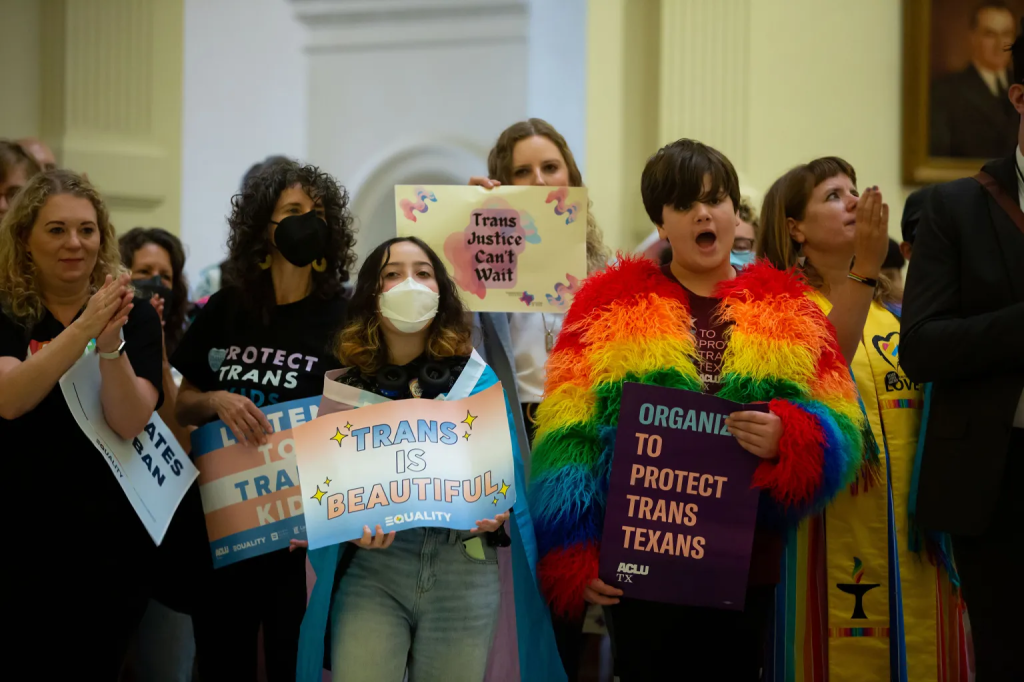
A Plano teacher, a Houston high schooler, the Texas teachers’ union and a network of LGBTQ clubs filed a federal lawsuit in August to block parts of a new Texas law that bans certain student groups from public schools.

The law, which took effect Sept. 1, bars schools from sponsoring a “student club based on sexual orientation or gender identity.” It also forbids schools from providing instruction, guidance or programming on sexual orientation or gender identity. Schools are barred from helping in the social transitioning of a transgender child, which can include using new names or pronouns.

A former faculty sponsor for a Gender and Sexuality Alliance in Plano ISD; a Houston high schooler; the Gender and Sexuality Alliances Network, a nonprofit that represents GSA clubs in Texas schools; and advocacy group Students Engaged in Advancing Texas say their freedom of speech and expressive association “will be irreparably suppressed” under the new law.

Texas AFT, the teachers’ union, joined the lawsuit as a plaintiff Sept. 15.

“S.B. 12 is one of the most extreme education censorship laws in the country, undermining the free speech rights of Texas students, parents, and educators,” said Brian Klosterboer, senior staff attorney at the ACLU of Texas, who filed the suitin the U.S. District Court for the Southern District of Texas.“We’re challenging this law in court because our schools should be places of truth, inclusion, and opportunity — not fear and erasure.”

The lawsuit names Texas Education Commissioner Mike Morath as a defendant, as well as Plano, Katy and Houston ISDs.

“Plano ISD is obligated to comply with the law as written unless or until the courts provide further direction,” said Zoheb Hassanali, the district’s assistant director of communications, public relations and social media.

He said district staff have received training to ensure compliance with the law.

“Our focus continues to be on educating and supporting our students, and we will not allow external litigation to distract us from that responsibility,” he added.

Houston ISD’s press office said the district does not comment on pending litigation.

Representatives from Katy ISD and the Texas Education Agency did not respond to emailed requests for comment.

The legal action comes as school districts across Texas are adopting policies to comply with the state law, which prohibits diversity, equity and inclusion efforts in K-12 schools.

Rep. Jeff Leach, R-Allen, who introduced the legislation, said it ensures parents are at the “head of the table when it comes to their kids’ education.”

In addition to the ban on LGBTQ clubs, the legislation requires schools to get a parent’s permission before a child can join any school club.

“Our schools should be about teaching history and reading, writing and math and civic responsibility,” Leach said as he advocated for the bill in the Legislature. “We need to get away from some of the more toxic social issues.”

If the law is not blocked, all 22 student-run Gender and Sexuality Alliance clubs registered with the GSA Network will likely shut down, according to the filing.

Leach criticized the organizations during legislative discussions, calling them “school-sponsored and school-sanctioned sex clubs.” Supporters and members of the clubs say they provide safe and welcoming spaces for students.

The groups in the lawsuit say the ban “ostracizes” students “who have a sexual orientation or gender identity that differs from other students.” It also “harms allies of LGBTQ+ students who seek to learn about issues impacting their friends and advocate for a safer and more inclusive school environment,” according to the filing.

At least one Gender and Sexuality Alliance in Plano ISD disbanded ahead of the law’s implementation date, according to court documents. Students tried to start a new club, but school administrators said it would not be allowed.

One student decided to be homeschooled because the club shut down “and the fact that their affirming name and pronouns will no longer be respected by teachers and staff,” court documents read.

The law has created “a climate of fear and discrimination” in the Plano ISD school, “where the voices of LGBTQ+ students and educators are suppressed.” The school is not identified in the lawsuit, and the teacher and student plaintiffs go by pseudonyms to protect them from retaliation.

The Plano ISD teacher, who was also the faculty sponsor of the now-disbanded Gender and Sexuality Alliance, said the law’s “vague and broad” requirements create “a massive gray area about how and whether she can support her transgender students.”

Texas AFT, the teachers’ union, said it has already received a “high volume of inquiries” from members on its grievance hotline about what the law means, its “harsh professional consequences and the harm it is causing their relationships with their students and concerned parents.”

For a Houston high schooler at Kinder High School for the Performing and Visual Arts, the law could mean she can’t join or start a Gender and Sexuality Alliance at her new school.

The high schooler participated in GSA in middle school, where she “found community and support in her own experience of coming out as an LGBTQ+ student and felt safer and happier,” the filing reads.

Under the law, she worries she won’t have that same experience. She already feels the law “is suppressing her ability to speak with teachers” about certain topics, including social transitioning.

Bipartisan Bill Seeks to Restore LGBTQ Youth Crisis Hotline Services

If you or a loved one are in crisis, please call or text 988 or text HOME to 741741 to connect with a live volunteer crisis counselor.

Read more at OutSmart Magazine.

Sens. Tammy Baldwin, a Democrat, and Lisa Murkowski, a Republican, introduced a bipartisan bill on Wednesday to re-establish national emergency suicide prevention services for LGBTQ+ youth — which have been stripped by the Trump administration at a time when the vulnerable group needs it most. 

In July, the Trump administration terminated the 988 hotline’s LGBTQ+ services, which connected young people in crisis with counselors trained in supporting LGBTQ+ youth. This new bill, backed by the LGBTQ+ youth suicide prevention organization Trevor Project as well as the American Foundation for Suicide Prevention, would modify the Public Health Service Act to reinstate those services and require the Secretary of Health and Human Services to maintain them. The bill now moves to committee.

The Trevor Project estimates that more than 1.8 million LGBTQ+ young people seriously consider suicide each year in the United States, as they face high rates of bullying, assault and discrimination. And when the 2024 presidential race was called for Donald Trump, calls and texts to the Trevor Project’s own crisis hotlines spiked by 700 percent, as LGBTQ+ youth felt afraid about the outcome of the election. 

“Given that LGBTQ+ youth are more than four times as likely to attempt suicide than their peers, the need for these services remains pressing,” said Jaymes Black, CEO of The Trevor Project, in a statement. “This is not about politics, or identity; this is about doing what is best to support our country’s highest risk populations — and save young people’s lives nationwide.”

During his first term in 2020, President Trump signed a bipartisan law to create 988 as a more accessible resource for mental health emergencies. The free hotline launched in July 2022. Since then, millions of people in crisis have turned to 988. And nearly 1.5 million of those calls, texts and chats were sent by young Americans seeking specialized LGBTQ+ services. 

“We are in the middle of a mental health crisis, and the 988 lifeline saves lives, plain and simple,” said Baldwin, who wrote the original legislation to create the 988 hotline. Cutting funds for specialized services within 988 puts the lifeline in jeopardy, she said in a statement. 

“There is absolutely no good reason that Donald Trump took away this specialized help for our LGBTQ youth. Mental health does not see partisan lines or geography,” the Wisconsin Democrat added.

Texas drops lawsuit against doctor accused of providing gender-affirming care to youth

Read more at LGBTQ Nation.

Texas Attorney General Ken Paxton withdrew the state’s lawsuit against pediatric endocrinologist Dr. Hector Granados on Thursday after finding no evidence that he violated the state’s ban on gender affirming care for trans youth.

Paxton sued Granados in October 2024, accusing him of providing puberty blockers and hormones to patients as young as 12 in treatment for gender dysphoria. Paxton accused Granados of falsifying medical and billing records to mislead pharmacies and insurance providers into covering the care.

Paxton initially called Granados a “scofflaw who is harming the health and safety of Texas children,” and Granados wasn’t notified before the lawsuit’s filing, in worries that he might try to destroy relevant records, The Hill reported.

However, Granados said he stopped providing gender-affirming care in May 2023, after the state’s legislature passed the law. Now that Paxton’s office has dropped its charges against him, Paxton’s office will now “focus on other ongoing cases against doctors who illegally provided harmful ‘transition’ treatments and drugs to children,” an attorney general spokesperson said, according to The Hill.

The state has also sued May Lau and M. Brett Cooper, two medical providers from the University of Texas’ Southwestern Medical Center in Dallas. If found guilty, both could possibly lose their medical licenses and face hundreds of thousands of dollars in fines.

Despite Paxton’s claim about gender-affirming care being “harmful,” the medications used in such care have been used safely in children for decades for the purposes of gender transition and to treat other medical issues in cisgender children as well. In fact, Texas’ law stands in opposition to the best care practices for treating gender dysphoria recommended by every major American medical association. These associations agree that such care is safe, effective, and essential for the overall well-being of trans people.

Blog at WordPress.com.

Up ↑