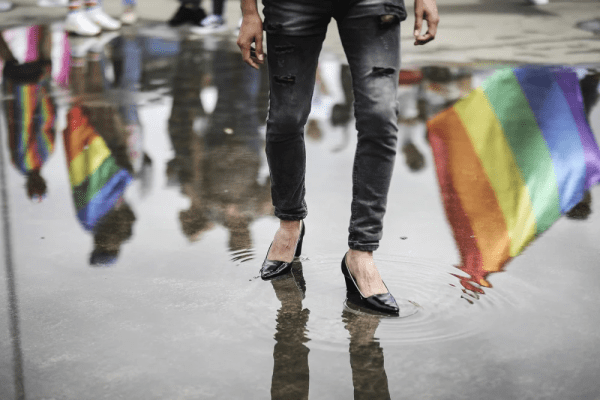
Trans refugee speaks about fleeing brutal anti-LGBTQ+ persecution in Russia-occupied territories

Read more at LGBTQ Nation.

Six months into Russia’s invasion of Ukraine in 2022, Lilia Khvylka had a decision to make.

The transgender Ukrainian, who grew up on the Crimean Peninsula, was already living under Russian occupation; Vladimir Putin invaded and annexed that Ukrainian territory in 2014.

Now Khvylka was under house arrest for posting pro-Ukrainian messages on social media, she told Mezha, an independent Ukrainian news outlet.

“They opened a case against me under Article 207.3 of the Criminal Code of the Russian Federation – discrediting the Armed Forces of the Russian Federation. This is a very serious crime, which they classify as terrorism. They were going to set a preventive measure for me literally in the coming days.”

Khvylka had already been outfitted with an ankle bracelet to monitor her movements.

She recalled taking part in the Revolution of Dignity in 2014, which ousted pro-Russian President Viktor Yanukovych and restored the 2004 Constitution of Ukraine.

The same year, Putin invaded Crimea.

“When the Russian authorities arrived, freedom of speech completely disappeared. Ukrainian activists and journalists immediately began leaving or disappearing,” Khvylka said.

At the same time, Khvylka was navigating her transition.

“At 16, I already knew I would undertake a transgender transition, because I am a girl. But I was very afraid to go to doctors in Russia or talk to anyone about it.”

In Crimea, she was forced to hide her identity; there, she was known as Illya Gantsevskyi.

Facing the prospect of 15 years in prison for her posts and terrified her true identity would come to light, Khvylka fled. The so-called head of the Republic of Crimea, Sergey Aksyonov, had already declared war on LGBTQ+ people.

“I cut off my bracelet and ran away,” she said.

Khvylka left the peninsula through Russia and Belarus, holding only a Ukrainian birth certificate. Volunteers, whom she found online through an underground network of supporters, helped in her getaway.

With her flight to freedom, Khvylka avoided a fate that other LGBTQ+ Ukrainians have been unable to escape.

“This included torture, torment, public humiliation, bodily injuries, and sexual violence,” said human rights lawyer Karolina Palaychuk.

Documented testimonies from people in the Kherson region, occupied by Russia for nine months at the start of the war, confirm the terror inflicted on LGBTQ+ people in the Russian-occupied territory.

“One of the people who gave these testimonies said that he was stopped at a checkpoint, his phone was checked, they saw the relevant content, and they immediately threw him into a basement,” said Iryna Yuzyk, manager for the Center for Human Rights, ZMINA. “There, they beat him, forced him to wear a red dress, took him to interrogations in a red dress, naked, they tormented him. He was lucky to survive.”

Another captive was Diana, a 24-year-old lesbian.

“She used to work as a shop assistant. She had colorful hair; they drew attention to her. They came with searches to her home, found a rainbow flag, and also threw her into the basement, where there were another 15 people. Then they lined them up and shot them at random. Only four survived.”

Human rights advocates are advising all LGBTQ+ Ukrainians — in particular activists who have a history of advocacy in conflict with Russia’s 2023 Supreme Court ruling declaring the LGBTQ+ community a “terrorist organization” — to leave the occupied territories, where protection under Ukrainian law no longer applies.

According to NGO Prozhektor, at least 50 people who’ve left the occupied territories have endured torture and violence due to their LGBTQ+ identity.

Seven victims have filed statements; thirteen are witnesses to other crimes.

Supreme Court allows trans kids in South Carolina to use the right bathrooms in school

Read more at LGBTQ Nation.

The U.S. Supreme Court said Wednesday that South Carolina cannot enforce its anti-trans bathroom ban against one transgender student while his challenge to the law moves through the courts.

The law, which went into effect in 2024, requires students in South Carolina public schools to use bathrooms that align with their “biological sex … as objectively determined by anatomy and genetics existing at the time of birth.”

Last year, a 13-year-old transgender boy identified in court documents as John Doe was suspended for using the boys’ restroom at his Berkeley County school. Despite none of his peers objecting to his use of the boys’ restroom, when Doe returned from suspension, school staff were instructed to police his bathroom use, and teachers began dividing students into “boys” and “girls” lines before restroom breaks to enforce the policy.

Faced with constant harassment by teachers and the threat of another suspension, Doe’s parents withdrew him from the school and enrolled him in an online program.

The following November, Doe’s family, along with LGBTQ+ advocacy group Alliance for Full Acceptance, filed a class action suit challenging the South Carolina law. As MSNBC notes, a district court judge in the state halted the case in July after the Supreme Court announced it would hear two cases related to transgender women’s participation in sports. Doe appealed to the U.S. Court of Appeals for the Fourth Circuit, which issued an injunction in the boy’s favor in August, preventing the state, the school district, and other defendants from enforcing the law against him while the appeal proceeds through the courts.

According to MSNBC, the three-judge panel cited the court’s 2020 ruling in Grimm v. Gloucester County School Board that trans students are entitled to use restrooms aligned with their gender identity. However, George W. Bush-appointee Steven Agee stipulated that the Grimm decision was the only reason he sided with Doe and expressed hope that the Supreme Court would overturn that case, which he described as having been decided wrongly.

That same month, South Carolina asked the Supreme Court to lift the Fourth Circuit’s injunction, arguing in its emergency relief application that Grimm was wrongly decided and that the Fourth Circuit should have considered the Supreme Court’s recent decision in United States v. Skrmetti, which upheld Tennessee’s restrictions on gender-affirming care for trans youth. The state argued that it, the school district, and students were “suffering actual, ongoing, material harms” due to Doe being allowed to use the boys’ restroom at school.

On Wednesday, a six-justice majority denied South Carolina’s request, with Republican appointees Clarence Thomas, Samuel Alito, and Neil Gorsuch saying they would have sided with the state, according to HuffPost.

In its order, the Court wrote that its denial of South Carolina’s application was “not a ruling on the merits of the legal issues presented in the litigation.” Rather, the justices wrote, “it is based on the standards applicable for obtaining emergency relief from this Court.”

House Republicans file bill to bar trans students from bathrooms, sports teams

Read more at The Hill.

House Republicans introduced legislation Tuesday to ban transgender girls from participating in girls’ school sports, moving to advance one of the Trump administration’s top priorities. 

The measure, titled the Safety and Opportunity for Girls Act, would define “male,” “female” and “sex” by reproductive function in Title IX, the federal civil rights law against sex discrimination in education. Schools receiving federal funds would be barred from allowing transgender students to use restrooms or locker rooms or play on sports teams that match their gender identity, according to the bill, sponsored by Rep. Mary Miller (R-Ill.). 

Miller introduced a similar measure to block locker room access for transgender students in March and spearheaded an earlier effort to reverse former President Biden’s expanded nondiscrimination protections for transgender students under the Congressional Review Act last summer. 

A news release from Miller’s office says the latest bill, which has 11 Republican co-sponsors, would preserve Title IX’s “original intent” and shield the decades-old law from reinterpretation “by radical leftists or activist judges.” 

President Trump’s administration has argued repeatedly that Title IX already prohibits transgender girls from competing on girls’ sports teams or using girls’ bathrooms and changing rooms at school. More than two dozen investigations into states, schools and athletic associations that accommodate transgender students have been opened since Trump’s return to office in January. 

School officials in states including California, Maine, Minnesota and Virginia assert their policies are compliant with state and federal law. 

A February executive order signed by Trump states that the U.S. opposes “male competitive participation in women’s sports” as a matter of “safety, fairness, dignity, and truth.” Trump warned schools at a signing ceremony that his administration was putting them “on notice.” 

“If you let men take over women’s sports teams or invade your locker rooms, you will be investigated for violations of Title IX and risk your federal funding,” he said. 

The Supreme Court agreed in July to decide whether states can ban transgender athletes from competing in girls’ and women’s school sports. Since 2020, more than half the nation has adopted laws barring trans students from participating on teams that match their gender identity. 

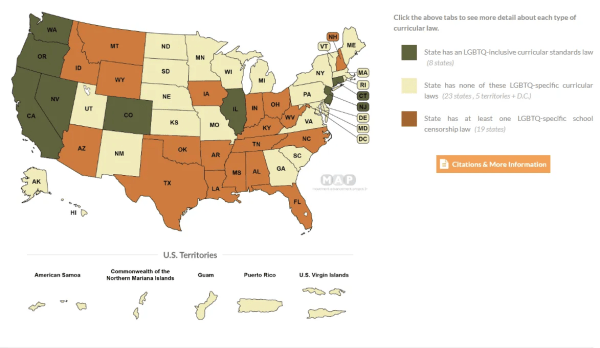
Laws in four states — Arizona, Idaho, Utah and West Virginia — are blocked by court orders, and New Hampshire’s ban on trans athletes is partially blocked. In February, the two New Hampshire high schoolers suing the state expanded their challenge to include the Trump administration. 

House Republicans, joined by two Democrats, passed legislation in January to ban transgender student-athletes from girls’ sports teams — an effort ultimately thwarted by Senate Democrats. 

States must ax transgender references from sex ed or risk losing funds, Trump admin says

Read more at NBC News.

The Trump administration directed 40 states, five territories and Washington, D.C., to remove references to transgender people from their sex education programs or risk losing federal funding.

The Administration for Children and Families (ACF), a division of the Department of Health and Human Services, sent letters Tuesday demanding that the health departments in these states and territories remove “all references to gender ideology” from their Personal Responsibility Education Program, or PREP. The program is a federally funded initiative created in 2010 to help prevent teen pregnancy and sexually transmitted infections.

“Accountability is coming,” acting Assistant Secretary Andrew Gradison said in a statement. “Federal funds will not be used to poison the minds of the next generation or advance dangerous ideological agendas. The Trump Administration will ensure that PREP reflects the intent of Congress, not the priorities of the left.”

The 40 states that received letters are: Alabama, Alaska, Arizona, Colorado, Connecticut, Delaware, Georgia, Hawaii, Illinois, Iowa, Kentucky, Louisiana, Maine, Maryland, Massachusetts, Michigan, Minnesota, Mississippi, Missouri, Montana, Nebraska, Nevada, New Jersey, New Mexico, New York, North Carolina, Ohio, Oklahoma, Oregon, Pennsylvania, Rhode Island, South Carolina, South Dakota, Tennessee, Utah, Vermont, Washington, West Virginia, Wisconsin and Wyoming. The five U.S. territories are: Guam, Northern Mariana Islands, Palau, Puerto Rico and the U.S. Virgin Islands.

Links to all 46 letters were included in the administration’s press statement. The ACF’s four-page letter to New York, for example, includes a bulleted list of course content that was flagged during a “medical accuracy review” earlier this year and “must be removed from New York’s PREP curricula and program materials.”

The content flagged for removal includes definitions of gender identity and gender expression and directives that program facilitators allow students to share their pronouns and “demonstrate acceptance and respect for all participants, regardless of personal characteristics, including race, cultural background, religion, social class, sexual orientation or gender identity,” according to the letter.

If New York’s health department declines to comply, it could lose more than $6 million in federal funds, according to data provided by ACF. The other states and territories stand to lose $300,000 to $4.6 million each.

The letters come just days after the ACF terminated $12 million of California’s remaining PREP funding after the state’s health department declined to remove references to trans people from the curriculum, arguing that the references had already been approved by the agency, the materials were medically accurate and relevant to the statute, and ACF does not have the authority to take such an enforcement action, according to ACF’s termination letter to the state.

California’s health department has 30 days to appeal. A spokesperson for the department said in a statement that the state maintains its position that its PREP curriculum “is medically accurate, comprehensive, and age-appropriate.”

“CA PREP sexual health education curriculum promotes healthy relationships and reduces the rates of sexually transmitted infections (STIs) and unintended pregnancy, as well as leads to delayed sexual activity in youth — all outcomes that lead to a healthier state,” the spokesperson said.

In an emailed statement, Elana Ross, a spokesperson for California Gov. Gavin Newsom, said, “If it’s a day ending in y, President Trump is attacking kids’ safety, health, and access to education as part of his culture war.”

The action from ACF is part of the Trump administration’s ongoing effort to prohibit federal recognition of trans people and penalize the use of federal funds for any program that includes or mentions them.

In the first few weeks of his presidency, Trump issued executive orders declaring that there are only two unchangeable sexesprohibiting trans people from enlisting and serving in the military; barring trans girls and women from competing on female sports teams in federally funded K-12 schools and colleges; and barring federal funding from going to hospitals that provide transition-related care to minors. The federal government has taken several actions against providers of transition care, resulting in more than 20 hospitals over the last few months rolling back or ending their gender-affirming care programs for minors and some young adults.

Federal officials have also removed mentions of trans or intersex people from agency websites, including from the website for the Stonewall National Monument commemorating the site of the 1969 Stonewall uprising in New York, which is widely considered a turning point in the modern gay rights movement.

Whitehall, Ohio passes LGBTQ-inclusive nondiscrimination protections, bans conversion therapy on minors

Read more at the Buckeye Flame.

The Whitehall City Council voted unanimously to pass an LGBTQ-inclusive nondiscrimination ordinance and a conversion therapy ban at their regular meeting on Tuesday. 

The Columbus suburb became the 37th location in Ohio to pass LGBTQ-inclusive nondiscrimination protections and the 14th location to ban conversation on minors.

Joseph Soza, Equality Ohio’s Central Ohio organizer, lives right on the border of Columbus and Whitehall. 

“I was previously living with the awkward scenario of having legal protections at home, but not in many of the public spaces I frequent in Whitehall,” Soza said in a statement. “Until we achieve statewide nondiscrimination protections, I know that most Ohioans find themselves in a similar situation. While I’m grateful for the initiative taken by cities like Whitehall, it continues to be disappointing that we don’t have these protections statewide.”

Whitehall’s nondiscrimination ordinance covers a range of identities – including sexual orientation, gender identity and gender expression – with protections extending to employment, housing and public accommodations. The ordinance contains an exception for religious institutions to give preference to those who share their religion, provided that such “offerings are not for commercial purposes or supported by public funds.”

Whitehall’s conversion therapy ban prohibits mental health professionals from engaging in “any practices or treatments that seek to change a [minor’s] sexual orientation or gender identity, including efforts to change behaviors or gender expressions or to eliminate or reduce sexual or romantic attractions or feelings toward individuals of the same gender.”

Both the nondiscrimination protections and the conversion therapy ban are housed under Whitehall’s prohibition on “unlawful discriminatory acts or practices.” Violations could result in a civil penalty of up to $2,500. 

Ohio does not have statewide LGBTQ-inclusive nondiscrimination protections, despite decades of attempts by legislators. The Ohio Fairness Act, which would grant these protections, currently sits in the Ohio House (HB 136) and Senate (SB 70), but has not been scheduled for a hearing in either chamber. 

There also is no statewide ban on conversion therapy on minors, despite many years of attempts by legislators. A bill to ban conversion therapy on minors currently sits in the Ohio House (HB 300) and Senate (SB 71), but has not been scheduled for a hearing in either chamber. 

LGBTQ+ advocates point to Whitehall as an example of what can be achieved locally, despite the lack of movement in the Columbus Statehouse.

“Equality Ohio is embarking on a journey to flip the state back to equality through our bold new local advocacy strategy,” said Dwayne Steward, executive director of Equality Ohio. “We have won before. And we will win again. But only if we do so together.” 

Illinois debuts legal hotline for LGBTQ+ support

Read more at Axios.

Illinois continues to buck the federal trend of stripping rights from LGBTQ+ people.

Why it matters: President Trump’s slew of executive orders and policies attacking LGBTQ+ people, including halting funding for HIV research and denying passports that adhere to a person’s gender, have forced LGBTQ+ people to seek legal help.

Driving the news: Launching Monday, IL Pride Connect is a hotline for LGBTQ+ people seeking help with questions about health care, including gender-affirming care, discrimination, identity documents, housing and other legal issues.

  • It was developed by Illinois Legal Council for Health Justice, with support from the Illinois Department of Human Services and private funding.

Context: Gov. Pritzker announced the hotline Thursday after declaring Illinois “one of the most comprehensive systems of legal protection and health equity in the entire nation.”

  • He continues to frame Illinois as a refuge for people under attack by Trump, a regular Pritzker foe.

How it works: Attorneys and legal advocates at the Council will field calls to the 855-805-9200 hotline from 9am–4pm Monday–Thursday. Services are available in English and Spanish.

  • Callers from out of state will be directed to pro-bono legal aid in their own states.

Case in point: Orr v. Trump involves the ACLU suing the Trump administration on behalf of a class of plaintiffs who were denied passports that did not adhere to the person’s sex designation assigned at birth.

  • A judge in April temporarily barred enforcement of the passport policy and this summer expanded who can be included in that lawsuit.
  • IL Pride Connect can tell callers whether they can be included in that class and direct them to the ACLU.

What they’re saying: “We’ve seen all these anti-trans laws percolating in the state houses, and as more of the problems have come to fruition under the new administration, I think the time is just essential,” Council executive director Julie Justicz tells Axios.

  • “We’ve been getting calls from folks saying, ‘What do I do? I’m scared,’ and the time was right, and the political will was there,” referring to Pritzker’s support.

DOJ demands private info on trans youth patients from 20 gender-affirming medical providers

Read more at LGBTQ Nation.

The Department of Justice (DOJ) has issued subpoenas to medical providers who offer gender-affirming care to transgender youth, demanding that they provide private information on their young patients. The subpoenas demand “billing documents, communication with drug manufacturers, patient’s Social Security numbers, addresses, emails, Zoom recordings, voicemails, encrypted text messages, as well as every writing or record of whatever type” doctors have made from January 2020 to the current day, The Washington Post reported.

While Attorney General Pam Bondi admitted last month to sending 20 subpoenas to hold “medical professionals and organizations that mutilated children in the service of a warped ideology” accountable, she didn’t specify which organizations and individuals received the subpoenas. Anonymous informants told the aforementioned publication that some of the subpoena recipients (who got the subpoenas in June) operate in states with laws protecting gender-affirming care for youth. One trans civil rights activist called the incident an “unprecedented and disgusting violation of medical privacy.”

“[The government] is using its investigative powers to target medical providers based on a disagreement about medical treatment rather than violations of the law,” Jacob T. Elberg, a former federal prosecutor specializing in health care fraud, told The Washington Post. He added that the DOJ must show that the information it demanded is “relevant to a legitimate law enforcement probe.”

The publication contacted numerous clinics and professionals offering gender-affirming care for youth, but none would say whether they had received a subpoena, citing fears of violent threats or government retaliation. Other hospitals have been closing their trans youth clinics and erasing any mention of gender-affirming care from their web pages to avoid federal threats to cut funding or pursue prosecutorial charges.

“The subpoena is a breathtakingly invasive government overreach,” said Jennifer L. Levi, senior director of transgender and queer rights at the LGBTQ+ legal advocacy group GLAD Law. “It’s specifically and strategically designed to intimidate health care providers and health care institutions into abandoning their patients.”

Fewer than 3,000 teens nationwide receive puberty blockers or hormone replacement therapy, according to a 2025 JAMA analysis of private insurance data, The Post noted.

Responding to the news, transgender civil rights lawyer Alejandra Caraballo wrote via Bluesky, “This is an unprecedented and disgusting violation of medical privacy,” adding, “The fact that no lawsuit has been commenced challenging these subpoenas in court is ominous. My best guess is that many of the providers have complied and now DOJ is potentially sitting on the records of thousands of trans youth covering everything from therapy notes to pre- and post-op photos.”

Though there is no federal law banning gender-affirming care, the current presidential administration has sought to eradicate the practice through a January executive order (that has since been blocked by several courts). The order instructed the DOJ to extend the time that patients and parents can sue gender-affirming doctors and to use laws against false advertising to prosecute any entity that may be misleading the public about the long-term effects of gender-affirming care.

In April, Bondi issued a memo to DOJ employees, telling them to investigate and prosecute cases of minors accessing gender-affirming care as female genital mutilation (FGM); even though hospitals don’t conduct such female genital surgeries. The memo threatened to jail doctors for 10 years if they provide gender-affirming care to young people.

Gender-affirming care is supported by all major medical associations in the U.S., including the American Medical Association, the Endocrine Society, and the American Academy of Pediatrics, as safe and life-saving for young people with gender dysphoria.

One doctor interviewed by The Washington Post called the federal government’s crusade against gender-affirming care a “toxic plan” that will force some patients to detransition, potentially forcing them into adverse psychological and physical effects, including increased anxiety, depression, and the development of unwanted physical changes.

“This goes way beyond any degree of moral or ethical dilemma that any of us have ever experienced,” the doctor said. “It is completely scientifically and medically unfounded.”

Republican attorneys general in Texas and Tennessee have demanded similar patient information from providers of youth-centered gender-affirming care outside of their states, but they dropped their demands after courts blocked their efforts.

Virginia school board votes to refuse to follow administration’s anti-trans order

Read more at LGBTQ Nation.

A public school district in northern Virginia voted yesterday to keep its current pro-trans policies despite the administration’s orders to ban trans students from using the restrooms and locker rooms associated with their gender.

The Loudoun County School Board voted to maintain its current policies regarding the facilities just days after the U.S. Education Department (ED) ordered the district – along with four nearby school districts – to ban trans students from using the facilities associated with their gender. The administration claimed that letting trans students use the appropriate facilities violated Title IX, the law that bans discrimination on the basis of sex in education.

The current administration reversed President Joe Biden’s interpretation of Title IX, which found the statute’s prohibition on discrimination “on the basis of sex” includes anti-LGBTQ+ discrimination. The rules rely on the Supreme Court’s 2020 decision in Bostock v. Clayton County, which found that sex-based discrimination necessarily covers discrimination on the basis of sexual orientation and gender identity, because it’s impossible to discriminate against LGBTQ+ people without taking sex into account.

That is, denying trans students use of restroom facilities or making use of such facilities difficult solely because of their sex assigned at birth was, to the Biden administration, a form of illegal sex-based discrimination. And since many students can’t last an entire day of school without using the restroom, such discrimination could effectively deny trans students an education.

The ED investigated the Virginia school districts, saying it had gotten complaints alleging “that students in the Divisions avoid using school restrooms whenever possible because of the schools’ policies, and that female students have witnessed male students inappropriately touching other students and watching female students change in a female locker room.”

There is no evidence that trans people are a threat to cisgender girls and women in restrooms, but a 2021 study from UCLA’s Williams Institute found that trans people are four times more likely than cis people to be victims of violent crime.

The ED then ordered the schools to rescind their trans-inclusive policies within 10 days and to “adopt biology-based definition of the words ‘male’ and ‘female’ in all practices and policies relating to Title IX.”

But the school board in Loudoun County voted 6-3 to keep its current policy, explaining in a statement that they are following precedent set by the U.S. Court of Appeals for the Fourth Circuit. In 2020, that court affirmed a lower court decision in favor of trans student Gavin Grimm, who had sued his school district after he was told to use the bathroom in a bucket in a converted janitor’s closet and was called a “freak” at a school board meeting about his bathroom usage. The court found that Title IX and the Equal Protection Clause of the Constitution prohibited his school district from discriminating against him.

“Our priority remains the same: doing what is right for Loudoun County’s young people; focusing on educating our students and ensuring our schools are places where every child feels they belong,” the Loudoun County School Board said in a statement.

The other four school districts ordered to end trans equality have not yet said how they will proceed, but they have to respond by Friday, which will be the end of the 10-day period. Prince William County School Board members met with lawyers last week and issued a statement saying that it “continues to review and work through legal issues related” to the ED’s order and that the board “remains firmly committed to fostering a safe, inclusive, and respectful learning environment for all students and staff.”

Charlotte LGBTQ groups condemn Atrium ending gender-affirming meds for youths

Read more at the Charlotte Observer.

Atrium Health recently stopped providing gender-affirming medication for people 18 and younger, a move that transgender rights and other LGBTQ organizations around the Charlotte region immediately decried. They claimed that the Charlotte area’s largest health care provider buckled under political pressure.

Four LGBTQ rights groups issued a blistering statement on Facebook late last week condemning the move. The statement was on the page for Time Out Youth, a Charlotte nonprofit providing resources for LGBTQ+ people ages 13 to 24. The group was joined by Charlotte Trans Health, the Gender Education Network, and PFLAG Charlotte. The groups said Atrium and its parent company, Advocate Health, are making a decision “based on fear of retaliation by hostile federal agencies or funding cuts.”

Atrium refused to make anyone available for an interview with The Charlotte Observer. Instead, it emailed a statement from parent company Advocate Health confirming it no longer provides or prescribes gender-affirming care medications for patients younger than 19. That’s a departure from a 2023 state law, which restricted gender-affirming care for minors, defined as people younger than 18. In January, President Donald Trump issued an executive order limiting youth access to gender-affirming care nationwide. It defines individuals under 19 as “children” and directs federal agencies to take action to restrict care. Advocate Health said it has been closely following the evolving health care regulatory environment, and acknowledged a “changing federal environment.”

“We recognize that this is a deeply complex issue, and this decision was made after a multi-disciplinary team spent numerous hours carefully considering the options and outcomes,” Advocate Health stated. “This new policy allows our hospitals, clinics and pharmacies to continue caring for all patients’ health needs in the changing federal environment.” Advocate leaders announced the policy change to Atrium-affiliated clinicians and pharmacists during what they called a “difficult” Microsoft Teams meeting on July 31. A doctor associated with Atrium Health who was in that meeting provided an audio recording of it to The Charlotte Observer, and asked not to be named because they were not authorized to share the recording. “We understand the complexity of this, we understand the emotion, the real concern around it. We share it, which is why there has been so much time and so many people weighing in on this,” Dr. Scott Rissmiller, chief clinical officer of Advocate, said on the recording. “And at the end of the day, ultimately, it is to protect our clinicians, our patients and our organization as we move forward.” The Justice Department also issued a new policy memo that could have significant implications for healthcare professionals, Advocate leaders said during the meeting.

It suggested that doctors and other clinicians who provide specific types of gender-affirming care, both medical and surgical, to individuals under 19 may face criminal charges. The memo also includes provisions that encourage and protect whistleblowers who report violations within their healthcare organizations. Atrium Health had not previously provided surgical gender transition procedures for minors under age 18, the company told the Observer. About gender-affirming care Advocate Health defines gender-affirming care as services including social, psychological, behavioral or medical interventions (including hormonal treatment or surgery) designed to support and affirm an individual’s gender identity. That’s according to the draft of a policy shared with physicians in July and provided to the Observer by the doctor associated with Atrium Health. Advocate reviewed protocols for gender-affirming care and considered the potential impacts of federal actions on patients, clinics and employees before deciding to end the medications for people younger than 19, according to the draft policy. “Gender-affirming care is medical care,” the advocacy groups stated. “It is endorsed by every major medical and behavioral health association. It saves lives.”

Gender-affirming care is a supportive form of health care, according to the U.S. Department of Health and Human Services. That may include medical, surgical and mental health services as well as non-medical services for transgender and nonbinary people. Atrium’s policy change wasn’t just about Trump’s executive order, but also took into consideration actions coming from the Federal Trade Commission, the Centers for Medicaid and Medicare, and other “elements,” according to Advocate officials on the audio recording. While health care companies may face regulatory threats, executive actions and other risks, the LGBTQ groups said “the real harm will fall on young people who already face disproportionate rates of depression, anxiety and suicidality when affirming care is withheld.” Advocate Health physicians have been reaching out to patients affected by the policy change so they are aware of what it means for their care and to provide support, according to the company. In its statement to the Observer, Advocate said it recognized “that this will be difficult news” for patients affected by the policy change, and created a 24/7 hotline to assist them, focusing on providing personalized counseling that might be needed.

‘Operating out of fear’ Dr. Holly Savoy, executive director for Charlotte Trans Health, an advocacy group for transgender people, expressed concern and disappointment over Atrium’s decision.

“One of the biggest challenges for trans people is stigma and discrimination,” Savoy said. “(Atrium) is operating out of fear, rather than standing up for evidence-based care,” Savoy said. “It’s not standing behind the science of gender-affirming care and their values of being an organization that says that they support health care for all.” Advocate Health will focus on alternative, non-invasive care, such as behavioral health and peer support for patients, health care officials said at the July meeting. The company is the third-largest nonprofit health system in the U.S. It serves about 6 million patients. More than 155,000 employees work in 68 hospitals and more than 1,000 locations. Novant Health is the second largest health care provider in the Charlotte region. The Winston-Salem-based company did not respond to an Observer request about the status of gender-affirming care for youths.

Concerns over resources LGBTQ advocates feared that Atrium’s decision could make it harder for patients to find new care in the area. “Our kids are now having to suffer because they are struggling now to find care that they’ve had at Atrium, some of them for a couple of years now,” said Joshua Jernigan, founder of the Gender Education Network, a nonprofit providing support and resources to transgender and gender-diverse children. “And it’s just very, very sad to us.”

The state law enacted in 2023, N.C. House Bill 808, prohibits puberty blockers and surgical gender transition procedures for minors who had not already started treatment as of Aug. 1, 2023. And it created penalties for doctors who perform those procedures or who prescribe, provide or dispense puberty-blocking drugs or cross-sex hormones to a minor. Atrium Health hasn’t provided surgical gender transition procedures for minors under 18 since the law passed and has followed the law, Advocate Health told The Charlotte Observer. Advocate’s medication changes went into effect Aug. 4, and also impacts patients previously grandfathered in to receive gender-affirming care services under the N.C. law, according to the draft policy. Gender-affirming care medications can still be prescribed for patients 19 and older, according to the policy. For patients under 19, these same medications can be prescribed for other medical reasons, such as post-chemotherapy needs, tumor removal surgery or to treat precocious puberty (when a child goes through puberty too early). Jernigan said transgender patients deserve access to care, regardless of age. “I would hope that major medical systems would treat their patients first and not act like the patient’s medical needs are not important,” Jernigan said.

Joshua Dumas, a board member of PFLAG Charlotte, said Advocate Health’s decision to cut gender-affirming care medication is a business decision based on the current political climate. The four advocacy groups want Atrium to rescind its decision. “To every trans and gender-diverse young person and their families: You are not alone,” they said. “We are fighting for you. And we will not stop.”

NC Dems’ defection fuels the passage of several harmful Republican bills

Read more at NC Voices.

Four North Carolina Democratic lawmakers broke with their party in voting to override Governor Josh Stein’s veto of eight bills, a move that helped push several harmful measures into law.

The four Democrats who voted with state Republican lawmakers on one or more of the override votes were:

  • Cecil Brockman (D-Guilford) – Helped override 2 bills
  • Carla Cunningham (D-Mecklenburg) – Helped override 5 bills
  • Nasif Majeed (D-Mecklenburg) – Helped override 2 bills
  • Shelly Willingham (D-Edgecombe) – Helped override 6 bills

In both of the state’s legislative chambers, a 60% threshold is required to override a governor’s veto of a bill. Due to the four democratic lawmakers going against their party, House Democrats were unable to sustain Governor Stein’s vetoes on eight bills, including House Bill 805, House Bill 318, Senate Bill 266, and House Bill 193.

Here is a breakdown of the bills and how the four lawmakers voted:

Senate Bill 266 is a harmful bill that will raise utility bills for North Carolinians, roll back clean energy progress, and shift costs onto working families so that large corporations pay less. 

The veto override passed 74-46, with Cunningham, Majeed, and Willingham being the deciding votes.

House Bill 193 is a dangerous policy that allows nearly anyone with minimal training to carry a concealed firearm at a private school, creating a serious safety risk for students, teachers, and school support staff. 

The Republican veto override passed 72-48, with Willingham being the deciding vote.

In an interview with Bryan Anderson, Willingham stated that Governor Stein personally called him on Monday night to ask him to sustain his vetoes of several harmful bills. 

Willingham declined, saying, “Governor Stein, he’s just getting to know me. I think now he knows that whatever I say I’m going to do, that’s what I’m going to do. So he could take that to the bank.”

“They say, ‘Well, we want you to sustain the governor’s veto,’” Willingham said. “My thing is I sustain my vote.”

House Bill 805 was originally a bipartisan bill that would have helped people who appeared in sexually explicit photos and videos online to have them removed. However, state Republicans changed the bill to attack transgender North Carolinians along with other controversial provisions. 

In his veto statement, Governor Stein said that while he agreed with the portions of House Bill 805 protecting women and minors  from sexual exploitation on websites, the attacks towards transgender North Carolinians are “mean-spirited.”

Governor Stein wrote, “My faith teaches me that we are all children of God no matter our differences and that it is wrong to target vulnerable people, as this legislation does.”

Ultimately, state Republicans overrode Governor Stein’s veto, 72-48, with Majeed being the deciding vote.

House Bill 318 is an anti-immigration measure that will force sheriffs to cooperate with Immigration and Customs Enforcement (ICE). 

In a statement following his veto of HB 318, Governor Stein stated, “My oath of office requires that I uphold the Constitution of the United States. Therefore, I cannot sign this bill because it would require sheriffs to unconstitutionally detain people for up to 48 hours after they would otherwise be released. The Fourth Circuit is clear that local law enforcement officers cannot keep people in custody solely based on a suspected immigration violation. But let me be clear: anyone who commits a serious crime in North Carolina must be prosecuted and held accountable regardless of their immigration status.”

Despite the bill setting up a dangerous precedent, state Republicans overrode Stein’s veto, 72-48.

Rep. Carla Cunningham, who was the deciding vote, gave a speech on the House floor defending her action to help Republicans override Gov. Josh Stein’s veto of the anti-immigration bill. 

In what Rep. Cunningham referred to as sharing her “unapologetic truth”, the Mecklenburg lawmaker went on to state, “First, as a people, we need to recognize that it’s not just the numbers that matter, but also where the immigrants come from and the culture they bring with them to another country. As the social scientists report, all cultures are not equal.”

 “Some immigrants come and believe they can function in isolation, refusing to adapt,” Cunningham stated. “They have come to our country for many reasons, but I suggest they must assimilate, adapt to the culture of the country they wish to live in.”

She added, “It’s time to turn the conveyor belt off.”

North Carolina Democratic Leaders Push Back

Several Democrats decried the override vetoes on the eight bills, including the Duke Energy bill, attacks towards transgender North Carolinians, and allowing concealed carry on private school grounds. 

On the floor, Rep. Marcia Morey, D-Durham, a former judge, pushed back against Cunningham’s remarks, stating, “We all agree we want safe communities. That’s no longer the issue with this bill — it is scapegoating. It is scapegoating immigrants.”

“Research has shown us that the immigrant community is less likely to commit crimes than the US citizen. That is a fact. We need to work towards finding solutions, not creating divisiveness and ignoring community concerns. This is furthering an anti-immigrant agenda no matter the cost. And when police act as immigration agents, witnesses or victims of crime are going to be less likely to report crime.”

According to the News & Observer, Senate Democratic Leader Sydney Batch called Cunningham’s remarks “absolutely uncalled for.”

“The very fact that you would say that not all people, or not all immigrants, are equal, is just – one, it’s contrary to our Constitution. It’s contrary to how this country was formed. This country was formed because of Native Americans, Blacks that were enslaved, and immigrants, including every single person that was here other than Native Americans,” Batch told reporters

“To say that we are not equal goes and flies in the face of anything that a Democrat, in my opinion, believes and holds, near and dear.”

In a statement last week, the Young Democrats of North Carolina joined Democratic members in condemning Cunningham’s remarks, saying that the lawmaker “disgraced her office with a hate-filled speech attacking the very immigrant communities she was elected to serve.”

“You will be held accountable by your community,” the group stated. “Good luck.”

Blog at WordPress.com.

Up ↑