
This blog originally appeared at Facing South.
In an increasingly divided America, where political ideologies often clash and social justice issues take center stage, a small Illinois town has emerged as a symbol of hope, compassion, and unity. Nestled amidst the heartland of the nation, this town has quietly opened its arms to those seeking refuge from the far-right tyranny that has gripped several Southern states. In this blog, we explore the remarkable story of how an unlikely hero, an Illinois community, is stepping up to provide sanctuary and support to gender migrants facing discrimination, oppression, and persecution in their homelands. Join us on a journey of resilience, humanity, and the enduring spirit of solidarity as we delve into the inspiring narrative of “Facing South.”
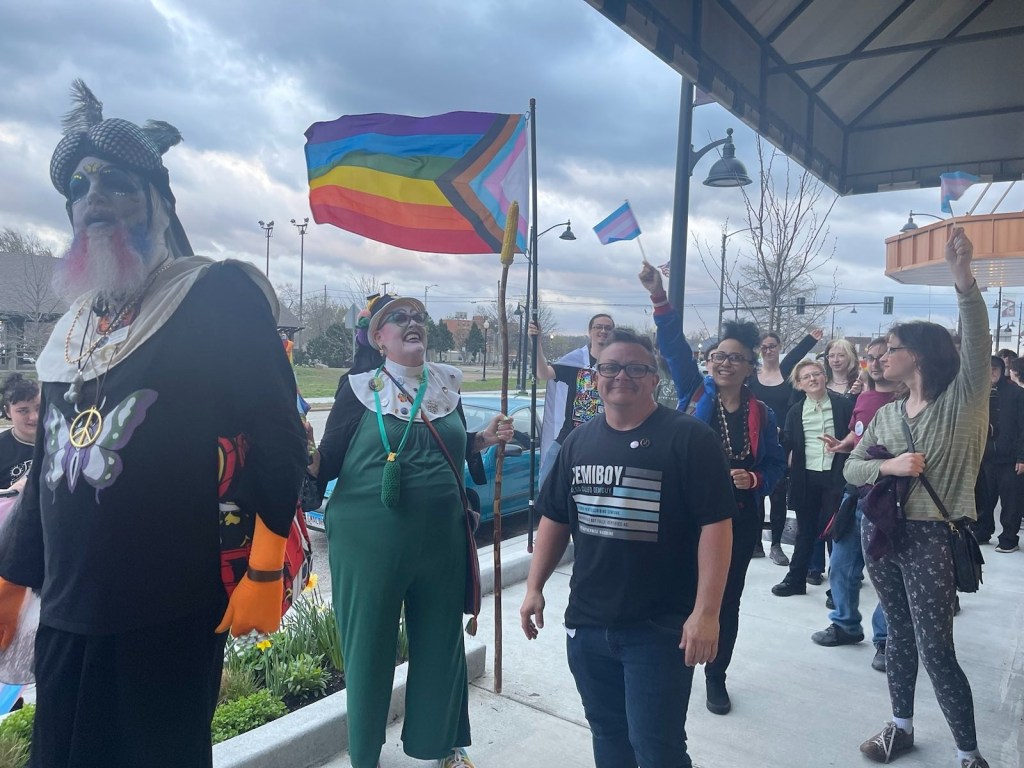
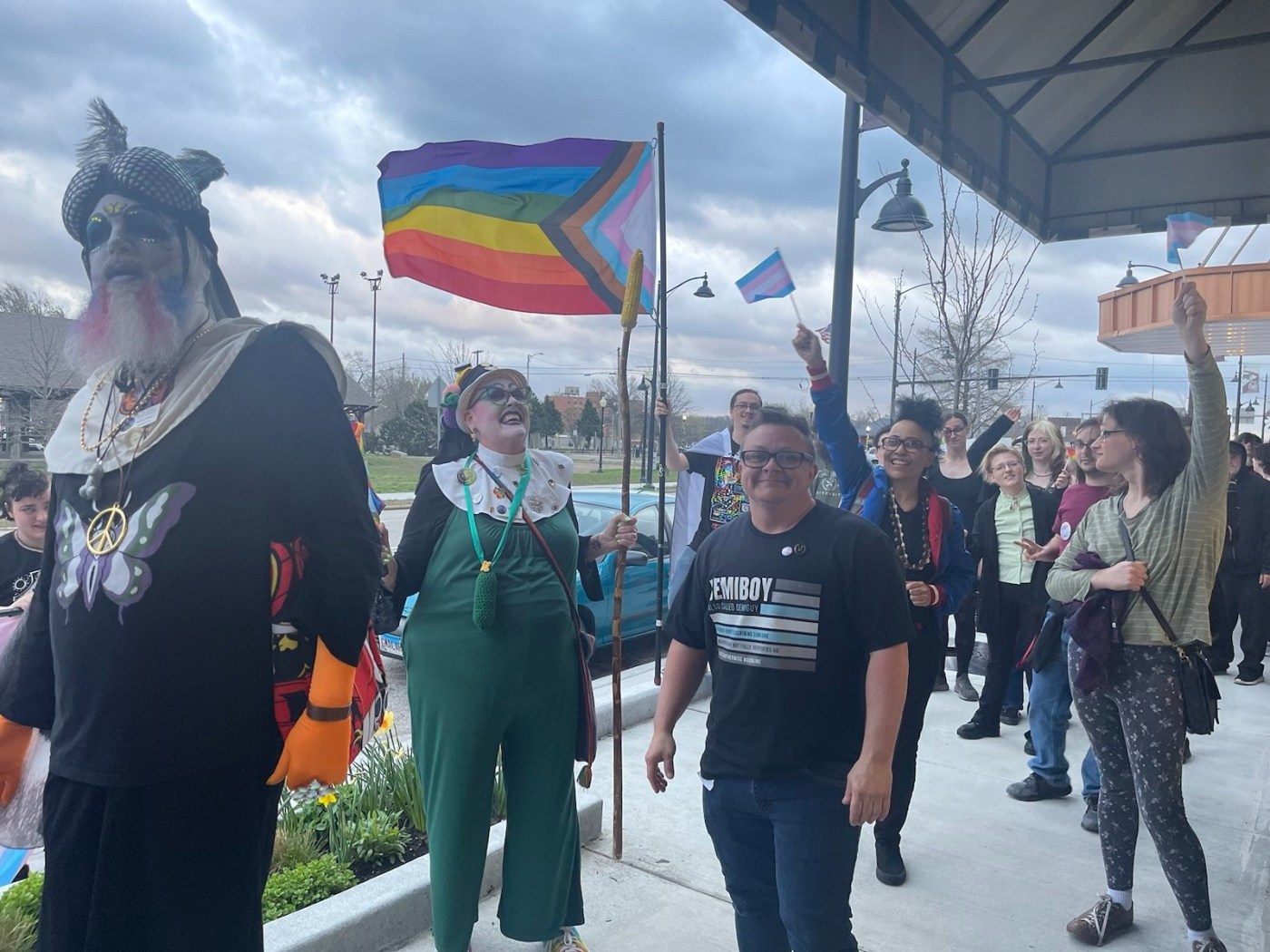
A group takes part in Transgender Day of Visibility and the Southern Illinois Trans Resource Fair in Carbondale on March 31, 2023. The Illinois town’s trans-welcoming reputation and resource groups like the Carbondale Assembly for Radical Equity have drawn transgender people from across the country, who are being forced to leave their home states due to anti-trans legislative policies and health care bans.
When the time came for Ellie Winter*, a 34-year-old transgender woman in a lesbian relationship, to leave Florida, she had to leave behind not just her bed but also a job she cherished, a close-knit circle of friends, and cherished memories.
Florida was where Ellie had met her fiancée, fallen in love, and become engaged. However, it was also where she experienced her worst fears of discrimination as a series of oppressive measures, collectively known as the “slate of hate,” were signed into law this spring. These included the infamous “Don’t Say Gay” bill, restrictions on healthcare and restroom access, attacks on gender and race education, and permission to discriminate in healthcare.
“I was especially concerned because I worked at a school, and with all the rhetoric and false accusations targeting queer individuals as pedophiles, I didn’t know whom I could trust,” Winter shared with Facing South. “Basically, I thought, ‘I’ve got to get out of here.'”
In June, Ellie and her partner left Florida with only their clothing, books, and guitars, and very little in their wallets or bank accounts. They embarked on a journey to Carbondale, Illinois, a place they had never visited before. While they were fleeing danger, they also felt they were moving toward a more welcoming and accepting environment. They had chosen the college town of Carbondale, with its 21,000 residents on the edge of the Shawnee National Forest, primarily because they knew that the Carbondale Assembly for Radical Equity (C.A.R.E.) would be there to welcome them with open arms.
For the founders of C.A.R.E., Cassandra Coffey, Carrie Vine, and Mattie Stearns, establishing the organization was a crucial response to the increasing persecution and injustice faced by LGBTQ+ individuals. “I’ve heard comrades in Texas and Florida say they’re digging in, they’re not leaving, it’s their home, and they’re going to fight,” Stearns told Facing South. “But if you’re someone who feels unsafe, get in touch with us. We focus on connecting people with communities to figure out where to go (or not go), where to rent or buy a house, or find jobs. And we can do that all day long.”
Currently, C.A.R.E. is assisting 16 “cases” through its subsidiary, Rainbow Refuge, primarily from Florida, with others coming from Texas, Oklahoma, and Tennessee, according to Carrie Vine, one of C.A.R.E.’s founders and volunteer case managers. Across the United States, states with bans on gender-affirming healthcare are disproportionately located in the South. Organizations like the Campaign for Southern Equality have established the “Southern Trans Youth Emergency Project,” a regional initiative in response to anti-trans healthcare bans in the South, which includes providing support to families with transgender children through emergency grants for travel expenses.
As the far-right intensifies its rhetoric around “parental rights,” organizers at C.A.R.E. anticipate a surge in demand for support. In preparation for further assaults on transgender rights, Carbondale City Council unanimously passed bodily autonomy and human rights ordinances during its July meeting. Clare Killman, a transgender city council member who initiated these ordinances, has described the city as “the last hope for a lot of people in any one direction.”
Self-help, mutual aid, and a spirit of resilience
Cassandra Coffey, a 40-year-old transgender woman who stands at an impressive 6 feet 6 inches, and whose voice remains deep despite years of transition and hormone replacement therapy, shared her experience with Facing South. She relocated to Carbondale from Indiana in 2015 and found it to be a haven.
“I used to live in a nice neighborhood in Evansville, and I could walk to the corner store and back wearing a dress without any issues. But if I ventured into the middle-class Christian, conservative neighborhood, my experience was different,” Coffey recounted. “In contrast, walking around presenting as femme in Carbondale feels safe.”
Carbondale’s reputation as a welcoming place for transgender individuals attracted Ellie Winter and her partner, who embarked on a 15-hour journey, fueled by energy drinks, to reach the town they had never visited before.
The first surge of emotion came when they crossed into Georgia. “I remember feeling so elated when we crossed the Florida border,” Winter said. The second surge of emotion occurred while driving through the Great Smoky Mountains, as her fiancée had never seen mountains before. The third surge came when they reached the “Welcome to Illinois” sign. “We screamed in relief, letting go of the anxiety, but also brimming with excitement about starting a new life here,” Winter explained.
Upon their arrival, they encountered what Winter described as “classic Midwestern hospitality” and, with the assistance of C.A.R.E., were able to secure housing, employment, and a sense of community. Once settled, Winter became actively involved, joining the welcoming committee at Rainbow Refuge. She expressed that she had never felt safer or more comfortable anywhere else.
Coffey, an experienced organizer in radical queer spaces, had foreseen a backlash against LGBTQ+ communities following the Supreme Court’s legalization of gay marriage in 2015. She described C.A.R.E.’s organizing as a collective effort. “We identified the need, pooled our resources, sought out individuals with relevant skills, and everyone worked together,” she explained during an interview on Locust Radio.
C.A.R.E.’s inaugural meeting in April 2023 was marked by a sense of urgency. Coffey had observed an acceleration of violent rhetoric in far-right online groups she had been monitoring for years. “They discussed seeing signs of genocide on a Holocaust Museum’s posts and would say, ‘Let’s escalate it further,'” she revealed.
Of the 30 people who attended C.A.R.E.’s first meeting, 26 remain “very active,” according to Coffey. They convene monthly at the Rainbow Cafe LGBTQ Center, with security being a top priority. Communication takes place over Signal’s encrypted platform, and only individuals personally met and vetted are allowed to join their Signal threads.
Since its inception, C.A.R.E. has hosted several successful events, including a music festival and art auction, a brunch and variety show, and several concerts, all aimed at raising funds for mutual aid. Now, they are looking to expand their efforts and hope to enlist the support of Chicago-based trans punk star Laura Jane Grace for Rainbow Refuge.
The group’s consistent but understated presence has led to unsolicited acts of generosity. For instance, Carbondale Starbucks Workers United organized a Drag Bingo event in June, donating the proceeds to C.A.R.E. A local grandmother of a trans teenager spontaneously wrote them a $500 check. On September 23, a touring troupe of performers named Fine and Bawdy Wenches plans to hold a pirate-themed pub crawl in honor of “Talk Like a Pirate Day,” with the proceeds benefiting Rainbow Refuge.
The time to help people is now
C.A.R.E. and Rainbow Refuge view their organizing efforts as a means of building community and keeping each other informed, while remaining responsive and avoiding organizational bureaucracy.
Coffey emphasized the importance of getting to know one another to form the foundation for community defense. “No invisible people. We have to establish lines of communication, do check-ins, educate the public about the issues, and the importance of taking action,” she said.
Mattie Stearns, who identifies as nonbinary, also adopts an inclusive approach in their work with C.A.R.E. and Rainbow Refuge. “Now is the time to help people,” Stearns told Facing South. “When you don’t know what to do, gather your friends and start figuring out what you can do. Then, someone else might say, ‘I can do something similar,’ and things start to grow and gain synergy.”
The group avoids rigid structures and prefers to act flexibly. According to Stearns, the essential question is: “If a transgender child approached you and said they felt unsafe, what would you do?”
For Kimberly Reynolds, a 39-year-old mother from Pensacola, Florida, with an 11-year-old transgender son named Joe, this question is not hypothetical.
“I know everyone obviously feels this way about their own child, but Joe is the light of our life,” Reynolds shared with Facing South.
“Unfortunately, Joe is an early bloomer, already developing a prominent chest at 11. My child is dealing with severe depression, which is heartbreaking,” Reynolds continued. “And now, they feel like their state is against them, their school is against them, that there’s no protection, and any of the teachers could use their deadname [previous name] at any time, which makes them even more self-conscious.”
When Reynolds discussed the option of staying or leaving with Joe, there was no hesitation. Joe immediately said, “Let’s get out of here.”
They hope to relocate to Carbondale by Christmas, although financial constraints have delayed their move. Reynolds gave birth seven months ago, and they also care for their 11-year-old nephew, who is likely to accompany them.
“We are living below the poverty level. Honestly, I’m not working because of the baby,” she explained. Childcare costs are prohibitive, and while her husband works in a bar and restaurant kitchen, he earns a modest salary. Nevertheless, they are determined, selling their possessions and starting a GoFundMe campaign to raise funds for their move to Illinois. An Associated Press report from June revealed that since the beginning of the year, individuals have contributed over $200,000 to GoFundMe campaigns started by transgender individuals seeking to leave Florida.
“Now that I’ve made this decision for the sake of my child, I’ve realized that Florida has been oppressive to me for a long time,” Reynolds reflected. “I hadn’t realized how much state policies can vary.”
In 2023, Illinois Governor J.B. Pritzker signed protections for gender-affirming care into law, alongside measures prohibiting library book bans and mandating the teaching of Native American history in public schools — all issues that hold significance for Reynolds.
However, Reynolds ultimately chose Carbondale because of a single factor: Carrie Vine, co-founder of C.A.R.E., and her deep love for the city. Vine has provided job leads to Reynolds’ husband, information about tuition at Southern.
 fleeredstates.blog
You must be logged in to post a comment.