
This blog originally appeared at Blade Southern California’s LGBTQ News Source.
Opponents of gender-affirming care say children are too young to make transition decisions and claim medical interventions are not safe.

Shigeru Nightengale, 15, recently moved from Iowa to Illinois for protections as a transgender teen and student. Shigeru loves collecting rocks and picked up a stone before sitting down at a swing set in the Nightengales’ new backyard.
By Max Lubbers | CHICAGO, Ill. – In the spring, Kimberly Reynolds found herself gazing at a map of the United States, each state shaded with a gradient of colors. Red represented states with the strictest active anti-transgender laws, while bright blue indicated those with the most comprehensive protections for transgender individuals.
The sight of Florida, her home state, bathed in a sea of red was disheartening. The nearest state painted in blue? Illinois.
Reynolds took a deep breath, then allowed herself some time to grapple with the growing panic in her chest.
She had embarked on this daunting journey of researching a new place to call home when lawmakers in Florida introduced a wave of anti-transgender bills, many of which directly targeted transgender youth — including her 11-year-old son.
“Something inside me just broke,” she shared. “I’ve dealt with a lot of policies in Florida that are not okay. But now they’re coming after my child. So that’s why we’re done. We’re getting out, one way or another.”
She approached her son with the weighty question: “How do you feel about moving?”
Joseph Reynolds, her 11-year-old, didn’t hesitate. “I was like, ‘Yeah, let’s move. Let’s get out of this place. Let’s get out of this climate,'” he recalled thinking. “‘Let’s get out of this house. Get away from these people.'”
In May, Florida’s Republican Governor, Ron DeSantis, signed several of the anti-trans bills into law. Reynolds revisited that map she’d stared at before, and this time, her state had a new, ominous designation — marked with black stripes: “Do Not Travel.”
Three months later, as the new school year began, the Reynolds family still found themselves in Florida, but they were determined not to stay. The impact of the laws on her child was already profound, and she was eager to relocate her family to Illinois as swiftly as possible.
Florida is far from the only state grappling with or enacting anti-transgender legislation. This year, according to an analysis by Chalkbeat using data from the American Civil Liberties Union (ACLU), at least 14 states passed laws that specifically regulated issues like bathroom access, sports participation, and pronoun and name changes in K-12 schools. Additionally, at least 18 states approved laws that restricted gender-affirming health care, primarily for minors but not exclusively.
For many families striving to shield their transgender children in the school environment and retain control over their medical choices, moving appears to be the only recourse — and Illinois stands out as a safe haven.
Restrictions Impacting K-12 Schools During This Year’s Legislative Sessions: Chalkbeat meticulously reviewed and categorized 494 bills from the ACLU’s tracker of LGBT-related state legislation. The focus was on identifying those that aimed to regulate K-12 schools and students, offering a comprehensive assessment of the landscape confronting trans and nonbinary students.
Approximately 45% of the proposed bills sought to change policies or procedures within K-12 schools.
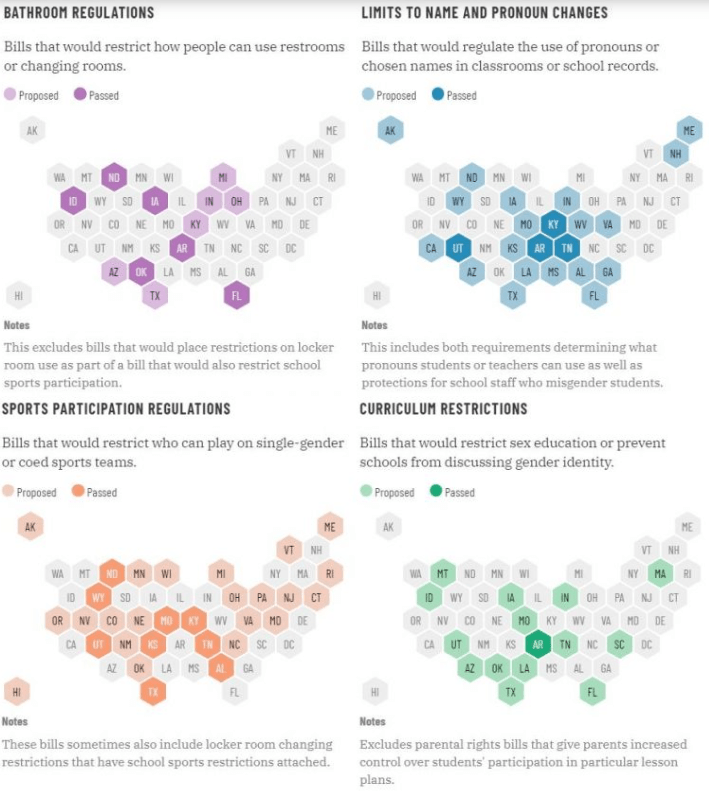
Notes: The analysis excludes bills that utilize variations of “parental rights” language, which sometimes encompass broad restrictions across multiple categories. The ACLU’s 2023 legislative tracker also encompasses bills proposed in 2022 that extend into 2023.
Source: This information is derived from a Chalkbeat analysis of ACLU data obtained from the tracker as of August 18, 2023.
Credit: Kae Petrin & Thomas Wilburn / Chalkbeat
Bills Impact School Policies and the Sense of Safety for Trans Students Illinois stands as a stark contrast to many states across the nation where anti-transgender policies are unfolding within the educational system. In Illinois, state laws safeguard students against discrimination based on their gender identities. State guidance mandates that students must be granted access to bathrooms, locker rooms, and sports teams that align with their gender identities.
The Reynolds family’s desire to relocate is significantly influenced by changes in educational policy.
For instance, Florida’s board of education has enacted policies that forbid public schools from educating students about sexual orientation or gender identity. State law also prohibits school staff from inquiring about students’ pronouns or requiring their usage. Furthermore, a law compels K-12 schools and postsecondary institutions to take disciplinary actions against students who use restrooms that do not correspond to their assigned sex at birth.
In 2023, Anti-LGBTQ Legislation Frequently Targeted School Policy More than 4 in 10 bills categorized as anti-LGBTQ by the American Civil Liberties Union (ACLU) would directly impact policies and procedures in K-12 schools if they were to become law.
Click here to see full blog: https://www.losangelesblade.com/2023/09/03/illinois-becomes-magnet-for-trans-students-seeking-protections/
 fleeredstates.blog
You must be logged in to post a comment.