
This blog originally appeared at Support The Guardian.
In under 48 hours following the ban on the ‘global LGBTQ+ movement’ for alleged extremism, LGBTQ+-friendly bars experienced police raids.
Scarcely after Russia declared the “international LGBT public movement” as extremist, masked police conducted a raid on a bar in central Moscow where Vasili and his friends used to gather for LGBTQ+ parties on Friday nights.
“It was an ordinary Friday evening until the police suddenly stormed in,” recounted Vasili, who requested a name change due to safety concerns.
Vasili detailed how he and approximately 100 others were instructed to face a wall while the police conducted searches for drugs and photographed their passports.
“The police alleged it was a drug raid, but everyone knew they targeted the club because it was a queer night,” he expressed. “Standing against that wall, you realize how limited your rights are as a gay person in this country.”
On the evening of December 1, at least two other LGBTQ+-friendly establishments in the Russian capital were subjected to raids, occurring within less than 48 hours of the country’s top court, in a landmark ruling, outlawing the “global LGBTQ+ movement” as an extremist organization.
Although sexual minorities have confronted enduring social exclusion and prejudice in both the Soviet Union and its Russian successor, the Kremlin initiated its legal assault on Russia’s LGBTQ+ community in 2013. This began when Vladimir Putin signed the infamous law prohibiting the “propaganda of nontraditional sexual relations” among minors.
However, in major cities like Moscow and St. Petersburg, gay Russians and their allies managed to find avenues for self-expression despite prevailing laws. A lively LGBTQ+ party scene flourished, to which authorities largely turned a blind eye.
“Before the [Ukraine] war, there was a recognition that within one’s home or at a queer gathering, you could still be true to yourself,” remarked Karen Shainyan, a prominent Russian gay rights advocate and journalist.
“We genuinely believed that attitudes towards sexual minorities were getting better, with more people openly discussing queer topics,” Shainyan, who initiated a popular LGBTQ+-themed YouTube channel in 2019, further commented.
Surveys also suggested that positive sentiments toward the queer community were slowly improving over the last five years, progress that Shainyan is concerned might be reversed.
“The conflict in Ukraine altered everything,” he remarked.
Since Putin’s full-scale invasion of Ukraine in 2022, the Russian leader has initiated a renewed campaign to champion what he terms “traditional values,” with anti-gay rhetoric becoming a cornerstone of his political agenda.
Shainyan stated that the Kremlin is explicitly connecting the suppression of LGBTQ+ expression to its rationale for the war. The government asserts to its citizens that Russia is not only engaged in a conflict with Ukraine but is also part of a broader, existential struggle against Western liberal values, often characterized as “satanic.”
In the preceding year, Putin enacted a law prohibiting “LGBT propaganda” among adults, criminalizing any action deemed an effort to endorse what Russia terms “non-traditional sexual relations” — whether in film, online, advertising, or public spaces. Following the implementation of this law, bookstores and cinemas removed all content featuring LGBTQ+ themes.
The real-world repercussions of labeling the “international LGBT public movement” as “extremist” at the end of November are still not entirely evident.
Historically, the authorities have employed the extremist designation to pursue legal action against human rights organizations, religious groups, and political opposition figures, including associates of Kremlin critic Alexei Navalny and members of the Jehovah’s Witnesses. Some individuals in these groups have been handed extended prison sentences.
According to human rights activists, the language used in the ruling, which targets the “international LGBT public movement” as a broad and ambiguous umbrella term rather than a specific entity, provides Russian authorities with the latitude to target any individual or organization they deem to be associated with the “movement.”
Activists mentioned that there will be less overt consequences as well, with institutional oppression adversely affecting the mental well-being of the queer community.
“The rapidity of the crackdown is difficult to comprehend,” remarked the Russian queer performance artist Gena Marvin.
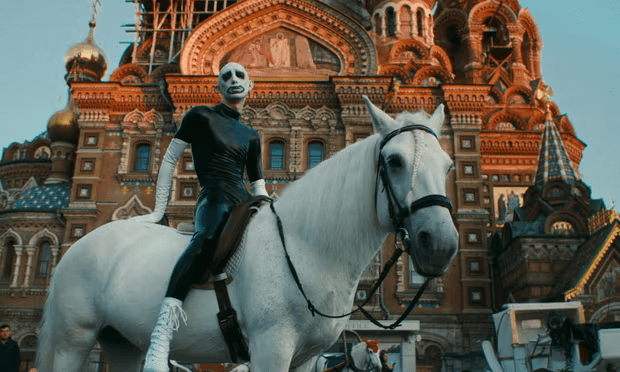
Prior to the conflict in Ukraine, Marvin defied the gender norms set by the Putin regime and confronted the Russian state’s homophobic stance through a series of bold public performances, documented in the critically acclaimed film “Queendom.”
In her final performance in Russia shortly after the commencement of the war, she strolled through the streets of Moscow, adorned in barbed wire, delivering a potent statement against the conflict.
“We have entered a grim new era where some Russians are branded outlaws from the day they are born,” remarked Marvin.
Both Marvin and Shainyan departed the country following the commencement of the war and are currently residing in other parts of Europe. On the day of the extremism ruling on November 30, Shainyan co-founded a LGBTQ+-focused media outlet named “I Just Got Lucky” with the aim of “uniting Russian queers and providing them with a platform of support.”
Numerous individuals from the queer community are actively seeking avenues to leave the country, as stated by Evelina Chaika, who leads the NGO Equal Post, an organization that assists queer Russians in the relocation process.
Chaika mentioned that her organization recorded a sixfold surge in relocation requests following the “extremist” ruling by the supreme court.
“We currently receive an average of 12 requests per hour on how to leave Russia, which amounts to more than 100 requests a day,” she stated.
Those opting to depart for the Western countries often encounter an uncertain and arduous journey. Harlem, who leads LGBTQ World Beside, an organization specialized in assisting queer individuals with the asylum process in the Netherlands, mentioned, “The asylum process for Russian LGBTQ+ members in Europe is very challenging and can easily take over a year.”
Harlem, who altered his name due to safety concerns after arriving in the Netherlands, shared this information with The Guardian during the funeral in Amsterdam for Mikhail Zubchenko. Zubchenko, a 24-year-old queer Russian, tragically took his own life while awaiting the processing of his asylum application in a Dutch refugee camp.
Zubchenko became the fourth Russian LGBTQ+ asylum seeker to take their own life in the Netherlands last year, highlighting the especially precarious circumstances faced by sexual minorities in refugee camps, according to Harlem.
“LGBTQ+ refugees are highly vulnerable; many had to hastily flee the country for safety reasons, leaving everything behind,” noted Harlem, a gay man who personally left Russia seven years ago.
“We observe that many individuals in the community are experiencing significant mental distress due to the prolonged asylum process, challenging living conditions, and the escalating oppressive situation back home,” expressed Harlem.
The recent extremism ruling in Moscow will compound the stress for those awaiting a decision from their host country.
“You understand the critical importance of these interviews,” remarked Dzam, who departed from a Muslim-majority region in Russia where he faced threats to his life. “If you don’t succeed in the asylum process, you can’t simply go back home. There is no life there for you,” he emphasized.
However, most of Russia’s LGBTQ+ community either cannot or choose not to leave their homes.
“This is my country. I don’t know where else to go,” expressed Vasili, who was still dealing with emotional recovery from the police raid.
Vasili made the decision to cease attending LGBTQ+ events and only discuss his sexuality with his closest friends.
“Many in this country do not endorse the war in Ukraine but choose to remain silent to avoid trouble,” he commented. “It will be the same for my sexuality. I will just pretend not to be me.”
 fleeredstates.blog
You must be logged in to post a comment.