

This blog originally appeared at The Gaurdian.
Members of the 300-seat parliament cast their votes in favor of the bill put forth by the center-right government, a decision made in the face of opposition voiced by church officials.
Greece has made history as the world’s inaugural Christian Orthodox nation to legalize same-sex marriage, a groundbreaking reform ushered in by the Athens parliament amidst a blend of elation and discord throughout the nation.
In a remarkable demonstration of parliamentary unity, 176 lawmakers spanning the political spectrum lent their support to the bill on Thursday, while 76 opposed the reform. Two legislators refrained from voting, and 46 were absent during the session.
From the vantage point of the galleries above, members of the LGBTQ+ community, many overwhelmed with emotion, bore witness to this pivotal moment.
“We have yearned for this moment for years,” expressed Stella Belia, a prominent advocate for the LGBTQ+ community, emphasizing the significance of legislation that not only grants same-sex couples the right to wed in civil ceremonies but also to embark on the journey of adoption.
“It’s a historic moment. A lot of us weren’t sure it would ever come,” she remarked, her voice echoing the sentiments of countless individuals.
The parliamentary vote came after two days of fervent debate, coupled with weeks of intense public discord. Supporters hailed the reform as “bold” and “long overdue,” while opponents, including the influential Orthodox church, condemned it as “antisocial” and “unchristian.”
Prime Minister Kyriakos Mitsotakis stood firm in his support for the bill, despite encountering significant resistance from within his own center-right New Democracy party. He asserted that the legislation would rectify a “serious inequality for our democracy.”
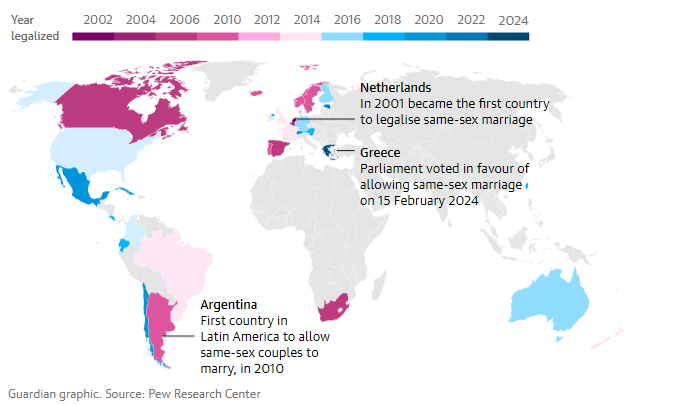
In a stirring address preceding the vote, the 55-year-old leader, a member of the liberal wing within his party, passionately advocated for the measure, emphasizing that it would bring Greece in line with the 36 countries worldwide that had already taken legislative action on the issue. He urged against conflating conservatism with outdated perspectives that no longer resonate with modern society.
“The reform that we are enacting today… will significantly improve the lives of some of our fellow citizens without – and I stress this point – detracting anything from the lives of the majority,” Mitsotakis asserted, underlining that the law would grant full parental rights to same-sex couples.
“We are bridging a gap by providing everyone the opportunity, if they so desire, to formalize their relationships institutionally… just as heterosexual couples do.”
However, resistance from within New Democracy had been robust, with MPs mindful of their constituents’ socially conservative leanings in the nation.
Underlining the opposition, former Prime Minister Antonis Samaras had voiced his dissent in parliament earlier on Thursday, contending that same-sex marriage did not constitute a human right and labeling the “dangerous” law as unwarranted.
The passage of the reform would not have been possible without the support of Syriza, the principal opposition leftist party led by Stefanos Kasselakis, Greece’s first openly gay political leader, along with other smaller factions.
Marriage equality globally
Countries that allow same-sex couples to marry
“The legislation itself is deeply problematic, and the offensive rhetoric that has permeated the discourse has left many feeling not inclined to celebrate, but rather numb,” remarked Elena Christidi, a psychologist and co-founder of the Orlando group, dedicated to advocating for LGBTQI mental health services.
However, despite the endorsement from three opposition parties, the law encountered scrutiny for its perceived limitations. Syriza, characterizing the bill as “imperfect,” lamented its failure to address the prohibition on same-sex couples seeking parenthood through surrogacy—a provision that Stefanos Kasselakis, alongside his American spouse, Tyler McBeth, has openly expressed interest in pursuing.
In addition to political critiques, LGBTQ+ advocacy organizations voiced their disappointment with the bill, arguing that far from mitigating discrimination, its restrictions exacerbated inequalities. The law’s provision permitting only single women and heterosexual couples access to assisted reproduction, coupled with what they described as pervasive “hate speech” throughout the debate, left many within the community feeling deeply distressed.
The repercussions of the bill’s limitations were particularly profound for gay men and transgender individuals aspiring to parenthood, leaving them with a profound sense of being deemed unworthy of equal rights by the state.
Amidst the debate, Orthodox bishops issued threats of excommunication against lawmakers supporting the measure, while the leader of the far-right Spartans party vehemently denounced the law as a gateway to “hell and perversion.”
Joining forces with the communist KKE party, these four parties resoundingly rejected the bill, vowing to nullify what they deemed a “monstrous” piece of legislation if given the opportunity.
Prime Minister Mitsotakis, however, remained resolute, asserting that come Friday, barriers would indeed be dismantled.
In a deeply emotional address to MPs, Mitsotakis highlighted the long-standing invisibility and oppression faced by gay individuals, particularly in rural communities. “For far too long,” he declared, “gay people have been relegated to the shadows, oppressed by familial and societal pressures, treated as the ‘children of a lesser god.’ Let us not deceive ourselves,” he implored, visibly moved by the gravity of the moment.
Within moments of the bill’s successful passage on Thursday evening, the Greek leader took to social media, sharing on X: “The vote has been approved: as of tonight, Greece stands proudly as the 16th EU nation to legalize marriage equality.
“This marks a significant milestone for human rights, showcasing the essence of today’s Greece—a nation that is progressive, democratic, and wholeheartedly dedicated to upholding European values.”
 fleeredstates.blog
You must be logged in to post a comment.