

This blog originally appeared at LGBTQ NATION.
The forthcoming inclusive curriculum is scheduled for implementation in the academic year of 2025–2026, aiming to provide a more diverse and equitable educational experience for all students. Additionally, it seeks to foster a greater sense of belonging and understanding among learners from various backgrounds.

Washington state Governor Jay Inslee (D) has officially enacted a bill mandating the inclusion of LGBTQ+ history in school curricula across the state.
Initially proposed in January, S.B. 5462 necessitates that school districts integrate inclusive content and adopt materials that encompass the histories, contributions, and viewpoints of historically marginalized and underrepresented communities. This encompasses individuals from diverse racial, ethnic, religious backgrounds, those with diverse learning needs, disabilities, LGBTQ individuals, as well as those from various socioeconomic and immigration backgrounds, as outlined in the bill.
According to the new legislation, the Washington Office of the Superintendent of Public Instruction and the Washington State School Directors’ Association are tasked with developing the inclusive curriculum by June 1, 2025, to be implemented in the 2025–2026 academic year.
The Washington State LGBTQ Caucus expressed its support for the bill in a recent post, affirming that the inclusion of LGBTQ+ history in public education is essential for the representation and affirmation of LGBTQ+ youth. With the enactment of #SB5462, this representation will soon be realized in schools statewide.
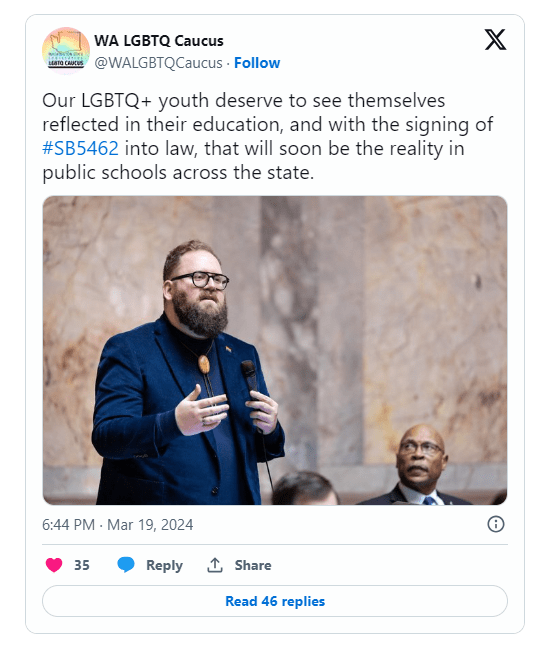
According to reports from KOMO News, Sen. Marko Liias (D), the bill’s sponsor, and Danni Askini, Executive Director of National Programs for the Gender Justice League, highlighted studies indicating that students who find representation in their school curriculum tend to have improved attendance and academic performance.
However, Brian Noble, Executive Director of the Family Policy Institute of Washington, voiced opposition to the bill, expressing concerns about what he perceived as the potential “sexualization of children.”
In response, Askini disputed this assertion, arguing that merely acknowledging LGBTQ+ individuals in educational materials is no more about discussing explicit sexual matters than mentioning mothers is about sexual reproduction.
Askini emphasized that recognizing the existence of LGBTQ+ individuals does not inherently sexualize anyone or promote sexual behavior. She also stressed the importance of including LGBTQ+ parents in discussions about education, pointing out that they make up a significant portion of the population and should be reflected in the curriculum.
She rejected the notion that LGBTQ+ people are separate from the broader community, labeling it as “absolutely false.” Acknowledging the diversity within communities, she asserted, does not equate to advocating for particular behaviors or beliefs.
 fleeredstates.blog
You must be logged in to post a comment.