
This blog originally appeared at NBC NEWS.
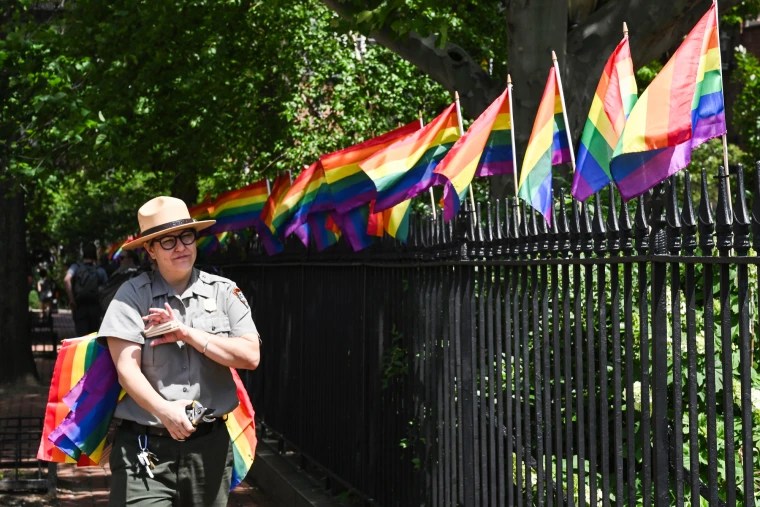
In recent years, uniformed park rangers have marched in some of the country’s largest Pride parades, including those in New York City and San Francisco.
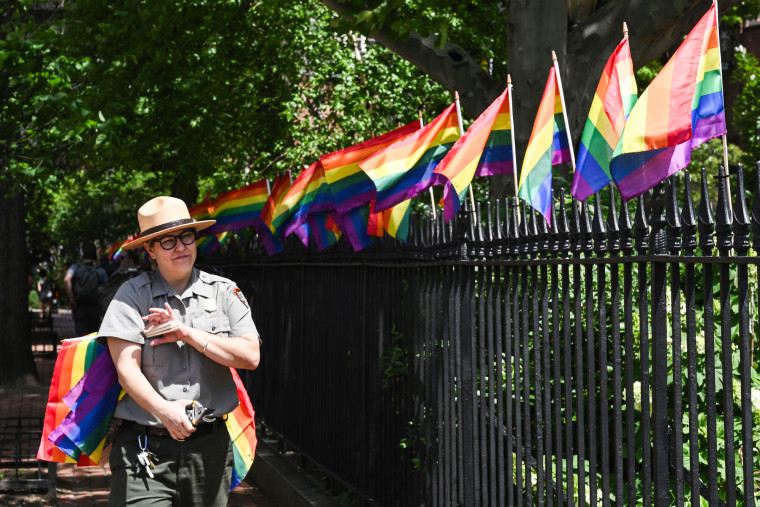
A park ranger at the Stonewall National Monument in New York City in 2019. (Angela Weiss / AFP – Getty Images file)
Pride revelers will likely see fewer, if any, National Park rangers marching in uniform at LGBTQ Pride events across the country this year.
The National Park Service is effectively prohibiting uniformed employees from participating in public events that “could be construed as agency support for a particular issue, position, or political party,” according to internal memos and documents shared with NBC News. This restriction would extend to Pride marches, according to those documents.
The memo, which an NPS spokesperson described as a “reminder” of existing guidelines, marks a departure from the agency’s traditional enforcement of the policy and has caused confusion among staff. The NPS, which oversees the country’s national parks and monuments, has long permitted uniformed rangers to participate in LGBTQ Pride marches, including some of the largest events in New York City and San Francisco. In these cities, uniformed police officers, firefighters, military service members, and other government employees are also commonly seen in attendance. Notably, a ranger from the Stonewall National Monument — commemorating the historic 1969 uprising pivotal to the gay rights movement — has participated in many Pride events in uniform.
The NPS spokesperson confirmed the authenticity of three internal documents shared with NBC News: the initial memo clarifying the agency’s existing policy, a follow-up Q&A document, and an email sent to staff on Monday. However, the spokesperson did not confirm that the policy amounted to an outright ban.
“Official NPS participation in community events directly related to a park’s mission can be approved by the park superintendent, as long as it complies with applicable laws, rules, regulations, and NPS policies,” the spokesperson said in an email to NBC News on Tuesday.
Another NPS staffer, involved in this year’s employee Pride march planning and who has previously participated in uniform in a Pride parade and multiple Pride events nationwide, told NBC News they were “appalled” by the agency’s “lack of professionalism” and mishandling of the policy clarification. The employee, who requested anonymity due to fear of job loss for speaking to the media, emphasized the importance of the agency’s participation in Pride events. This participation honors the thousands of LGBTQ employees fired or forced to resign from the federal government during the Lavender Scare of the late 1940s to ’60s and serves as crucial outreach to a historically underrepresented community in the nation’s parks.
“I see Pride as a key service to the public, and stepping away from that as a political statement,” the employee said. “Denying this decades-long tradition is cowardly and validates the far-right provocateurs who are trying to question the existence of queer people in political discourse.”
The debate surrounding the uniform policy and its potential impact on Pride involvement started on May 9, when Frank Lands, NPS’ deputy director of operations, stated in a memo to all staff that the service had received numerous requests from employees seeking to participate in various non-NPS events in uniform. Additionally, there were requests to wear ornaments such as pins, ribbons, and buttons on their uniforms.
The surge in requests led NPS to reevaluate its policy, with plans to update it later this year, as outlined in the memo initially reported by Politico’s Environment & Energy News. In the interim, Lands advised employees to adhere to the existing uniform policy, abstaining from “participating in or attending any demonstration or public event wherein the wearing of the uniform could be construed as agency support for a particular issue, position, or political party.” He also reiterated the current policy’s restriction on ornaments, permitting only the NPS-issued badge, name bar, American flag pin, and, for dress uniforms, a collar insignia.
While Lands did not explicitly reference Pride events, an internal follow-up Q&A document, provided to NBC News by the anonymous employee and corroborated by another involved with NPS’ LGBTQ employee resource group, clarified that out-of-park Pride events are encompassed within the prohibition.
The Q&A document also addresses the question: “Isn’t a Pride event more related to identity than a political issue or cause?” The response in the document states, “When considering First Amendment implications, the courts do not differentiate between events that celebrate or endorse an ‘identity’ and events that advocate for a ‘cause.’ Parades and similar events are regarded as a means of communication, both for the organizers and participants, so the participation of uniformed employees would be perceived as communication on behalf of the NPS.”
According to Lands’ email, the majority of the internal inquiries from employees regarding the clarification have centered on questions such as “What has prompted this change?” and “Why is this happening now?”
In his message, Lands clarified, “To put it plainly, there has been no alteration in policy. We issued this reminder because an increasing number of employees have sought to participate in non-NPS events while in uniform, advocating for various causes and topics. Past interpretations of our uniform policy lacked consistency and were not subjected to the thorough review we are currently undertaking.”
When NBC News inquired about whether prior involvement of uniformed employees in public Pride parades aligned with policy, the NPS spokesperson echoed Lands’ email nearly verbatim in response.
The NPS employee involved in organizing the Pride march participation expressed disappointment with Lands’ email, noting its lack of apology or resignation.
LGBTQ staff, employee resource groups, and employees involved in community outreach “deserve an apology for the grief, turmoil, and distraction caused by this situation, especially considering their commitment to the work and mission of the Park Service.”
The NPS staffer involved in Pride planning expressed uncertainty about the waiver process for uniformed employees marching in Pride parades, stating that there has been no clarity on the matter. Internal emails shared by the employee indicate that park superintendents are seeking approval from their managers for such waivers, suggesting that superintendents cannot approve waivers independently as the spokesperson implied. Additionally, the employee noted that they had never previously encountered such an approval process for participating in Pride events in uniform.
Amid a backdrop of heightened political hostility towards LGBTQ individuals, the NPS policy clarification comes at a crucial time. Conservative lawmakers nationwide have introduced over 500 bills targeting the LGBTQ community this year alone, as reported by the American Civil Liberties Union. Furthermore, in the past month, various government agencies including the FBI, Department of Homeland Security, and State Department have issued warnings about potential terrorist threats against events during Pride Month, traditionally celebrated in June. Additionally, Pride events have increasingly faced threats from various groups, including white nationalist organizations, highlighting the ongoing challenges to LGBTQ rights and safety.
The NPS employee engaged with the LGBTQ employee resource group is fielding inquiries about the policy from colleagues across the country.
“People are asking, ‘Can we still join Pride parades? What’s the future of our participation?’ With Pride Month just nine days away, and many having planned for months, the main concern is, ‘How is being queer linked to a specific issue, position, or political party?’ We’re not getting a clear answer. It’s about identity, not ideology, and there’s a significant confusion between the two.”
 fleeredstates.blog
Leave a comment