A blog for LGBTQIA+ migrating to more welcoming states or counties
Author: Bob McCranie
I am so proud to run Texas Pride Realty Group. We set out on a mission in 2009 to serve the diverse communities of Texas and to hire kick-ass agents who practice the highest ethics and professionalism. I believe that the agent's role is to help the consumer make well-educated decisions, even if those decisions lead away from a purchase or sale.
I believe that education is vital in this industry. I currently have over 1300 hours of real estate courses on my transcript with the State of Texas. Additionally, I am a Real Estate Business Coach at Tom Ferry International, the largest-real-estate specific coaching company in the world. I coach agents in the US and Canada, and have coached clients in Australia, New Zealand, Brazil, and Switzerland. I also have knowledge of the UK and Irish markets.
Opening Texas Pride Realty was always a goal of mine and I am working night and day to be sure it is successful. The best way to do that is to be sure clients are satisfied and agents are busy. What better legacy could someone leave in this industry than a group of well-trained, high-quality brokers who do your job better than you?
Beyond Horizons: Crafting and Expanding Your Global Venture
Building and expanding an international business involves more than just selling homes; it requires strategic vision, partnerships, and effective marketing.
Nick Fong, a U.S.-born entrepreneur, has achieved tremendous success in Mexico through strategic moves, such as collaborating with developers, leveraging online lead generation, and utilizing AI for optimal search results. As the top-performing agent in all of Baja, Nick manages eight offices and leads a team of 92 agents, catering to a diverse clientele.
In this podcast episode, I delve into Nick’s journey of scaling an international business and provide insights on how you can embark on a similar path.
If you’ve ever envisioned starting, diversifying, or expanding an international business, this episode is a must-listen for valuable tips and inspiration.
Alabama has been granted the ability to enforce its felony ban on gender-affirming health care for minors, as per a federal court ruling on Thursday.
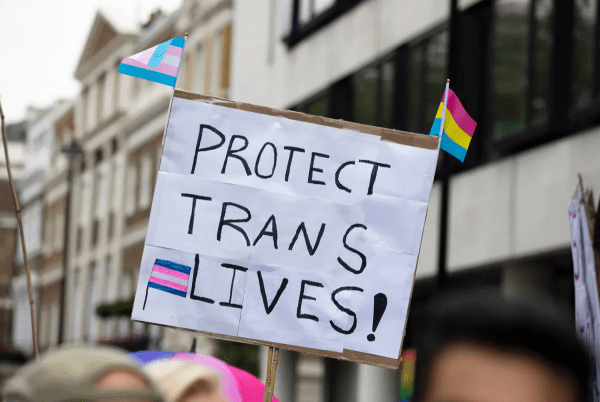
A transgender pride flag is displayed.
The decision allows the state to proceed with the ban, lifting a preliminary injunction that had prevented officials from enforcing it for over a year.
On Thursday, the U.S. 11th Circuit Court of Appeals lifted the injunction against Alabama’s 2022 law, turning it into a felony for physicians to prescribe puberty blockers or hormones to transgender individuals under 19. Convictions could lead to sentences of up to a decade in prison.
When the injunction was issued in 2022, U.S. District Judge Liles C. Burke stated that Alabama failed to provide credible evidence demonstrating that gender-affirming treatments are “experimental.”
In August, a federal appeals court reversed this decision, stating, “The use of these medications in general—let alone for children—almost certainly is not ‘deeply rooted’ in our nation’s history and tradition,” referencing the Supreme Court’s decision overturning Roe v. Wade.
In November, Alabama’s attorneys requested the 11th Circuit stay the enforcement of the district court’s preliminary injunction, which was granted Thursday in a brief unsigned order.
A September request for a rehearing made by the Alabama families challenging the law is still pending, and a full trial on the constitutionality of the ban is slated for August.
Alabama Attorney General Steve Marshall praised Thursday’s decision as “a significant victory for our country, for children, and for common sense.”
In a joint statement, lawyers representing the families challenging the law said the ruling will cause significant harm to children and parents in Alabama.
“Alabama’s transgender healthcare ban will harm thousands of transgender adolescents across the state and will put parents in the excruciating position of not being able to get the medical care their children need to thrive,” according to the statement, issued Thursday by the National Center for Lesbian Rights, GLBTQ Legal Advocates & Defenders, the Southern Poverty Law Center, and the Human Rights Campaign.
Including Alabama, 23 states have enacted laws or policies that heavily restrict or ban gender-affirming health care for transgender minors. Laws passed in five states — Alabama, Florida, Oklahoma, North Dakota, and Idaho — include provisions that make it a felony crime to provide treatment to trans youth under 18.
Democrats argue that it could aid prosecutors in states with strict abortion restrictions or bans.
Pharmacies disclose prescription records to law enforcement.
Lawmakers reveal that Americans’ prescription drug records are being shared with law enforcement without customer consent or a judge’s warrant in certain instances.
Democrats express concern over the disclosure, fearing that the policies of prominent retail pharmacy chains, permitted under federal regulations, might aid prosecutors in states with abortion restrictions to pursue individuals assisting women traveling for abortion procedures.
Lawmakers are urging Health and Human Services Secretary Xavier Becerra to enhance regulations, proposing that pharmacies should only disclose medical records to investigators upon judicial approval, seeking tighter control over the release of such sensitive information.
HHS has announced its efforts to finalize a rule that would reinforce current privacy regulations, especially safeguarding records linked to reproductive health.
“In our discussions with major pharmacies, it became evident that law enforcement agencies annually acquire the prescription records of numerous Americans in a clandestine manner, lacking a warrant,” they stated. “In numerous instances, pharmacies are disclosing confidential medical records without scrutiny by legal authorities. Despite the legal permission for pharmacies to notify customers about government requests for their data, most opt not to do so.”
Containers of abortion medications mifepristone (left) and misoprostol (right) at a clinic in Des Moines, Iowa, on September 22, 2010.
A letter, initially reported by The Washington Post, comes after an extensive congressional inquiry by Democrats into medical privacy following the U.S. Supreme Court’s decision to overturn Roe vs. Wade. It was endorsed by Senate Commerce Committee Chairman Ron Wyden, D-Oregon, and Democratic Representatives Pramila Jayapal of Washington and Sara Jacobs of California.
Pharmacies cited in the letter assert compliance with privacy laws and federal health regulations, which presently don’t necessitate a warrant signed by a judge. Frequently, law enforcement provides subpoenas endorsed by a government agency but not subjected to judicial review.
The CVS Pharmacy logo is visible on the building in Los Angeles, dated November 13, 2023.
CVS Health, one of the mentioned pharmacies, has proposed that regulators consider requiring a warrant or judge-issued subpoena. The company emphasizes that it depends on a legal team to ensure that all requests comply with the law.
“By law, we are obligated to keep most investigative requests from regulatory agencies and law enforcement confidential,” CVS stated in a response to ABC News. “For requests without a confidentiality directive, we assess on a case-by-case basis whether it is appropriate to inform the individual who is the subject of the request.”
According to the letter addressed to Becerra, pharmacies are contending with tens of thousands of requests annually, predominantly linked to civil litigation rather than criminal cases.
The matter is expected to gain heightened importance for Democrats as states continue to grapple with differing perspectives on abortion access, with some jurisdictions enacting laws targeting what they term “abortion trafficking,” or aiding a woman in traveling out of state for an abortion.
A generic image representing a medical prescription.
Federal regulations permit the prescription of mifepristone for patients up to 10 weeks of gestation, allowing them to pick it up at a local pharmacy under specific guidelines. Although the patient must be in a state where abortion is legal to obtain the drug, pharmacy access has helped abortion providers in states like California, Colorado, and Illinois serve more patients through virtual clinics.
Anti-abortion rights groups have filed lawsuits in an attempt to remove mifepristone from the market. The Supreme Court recently agreed to hear the case, with a likely ruling expected by next summer.
Lawmakers and privacy experts are concerned that large pharmacy chains, with access to a person’s medical records across multiple states, could be exploited by prosecutors seeking to target individuals assisting women in traveling for abortions.
Lawmakers are urging the Biden administration to mandate, under the Health Insurance Portability and Accountability Act (HIPAA), that pharmacies require a warrant before sharing sensitive information. They also advocate for notifying customers, unless a judge deems it would impede an investigation.
Recent studies reveal that the poorest fifth of households pay, on average, a tax rate 60% higher than the top 1% of households.
An analysis has determined that 44 out of the 50 US states contribute to inequality by imposing a lower share of income taxes on the wealthy compared to lower-income individuals.
The latest research reveals that state and local tax systems are ‘upside-down,’ with inadequate or absent personal income taxes in several states enabling wealthier Americans to evade taxes. This imbalance is exacerbated by a dependence on regressive sales and excise taxes, which disproportionately affect lower-income individuals.
When surveying public opinion on a fair tax code, the consensus is overwhelmingly against the idea that the wealthiest should pay the least,” remarked Carl Davis, Research Director of the Institute on Taxation and Economic Policy (ITEP), the organization behind the analysis.
“But despite this public sentiment, a significant disparity exists between what citizens desire and the tax systems currently in place in most states. It’s a concerning mismatch between public preferences and the actions taken by state legislators,” highlighted Carl Davis, Research Director of the Institute on Taxation and Economic Policy (ITEP).
“Out of the 50 states, along with the District of Columbia, merely six states boast tax systems designed to alleviate rather than exacerbate inequality. On average, the poorest fifth of individuals face a tax rate 60% higher than the top 1% of households in the majority of states,” emphasized the report.
“The ultra-wealthy receive notably favorable treatment from the tax system, with the top 1% contributing less than any other income group in 42 states. Additionally, in 36 states, the most impoverished residents are subjected to a higher tax rate than any other demographic,” highlighted the analysis.
Ranked in order of regressive taxation, the states with the most inequitable tax systems are Florida, Washington, Tennessee, Pennsylvania, and Nevada. Conversely, the least regressive jurisdictions are the District of Columbia, Minnesota, Vermont, New York, and California.
State-level policies, including tax cuts benefiting the affluent under the guise of stimulating economic activity, have exacerbated this issue, according to the report. In recent decades, inequality in the US has surpassed that of comparable countries. While certain pandemic-era measures, like a child tax credit, temporarily alleviated the burden on the poorest, many of these interventions have expired.
“But we know this doesn’t have to be the case,” stated Aidan Davis, ITEP’s state policy director.
“There’s a clear path to reverse regressive tax systems, and we’ve seen several states come close to achieving it. The regressive state tax laws we witness today are a deliberate policy choice, and it’s evident that lawmakers have better options available,” expressed Aidan Davis, ITEP’s state policy director.
This article was updated on January 11, 2024. Due to inaccurate information provided to us, an earlier version incorrectly listed New Jersey as the fifth least regressive tax jurisdiction according to the ITEP report, when it should be California.
Estonia has become the inaugural former Soviet state to legalize marriage equality.
Commencing this week, same-sex couples in Estonia can enter into marriage, marking the country as the first among the former Soviet nations to legalize marriage equality.
Marriage equality legislation was approved by the parliament of the Baltic state with a vote of 55 to 34 in June of the previous year. This decision followed the election of progressive Prime Minister Kaja Kallas in February 2023. The law officially came into effect on January 1, this past Monday.
Presently, same-sex couples have the option to submit marriage applications online. Typically, these applications take between one to six months to process, with the initial ones not anticipated to be finalized before February 2.
“Laws offer clarity and shape our perspectives,” remarked Minister of Social Protection Signe Riisalo. “I trust that baseless concerns will diminish, and critics of this decision will recognize that what is perceived as a loss is, in fact, a significant gain for many of us.”
In June of the previous year, LGBTQ+ individuals in Estonia expressed their appreciation to the parliament for passing the law. Numerous couples, who were previously in civil unions, are now planning to solemnize their marriages.
“For the LGBT+ community, this is a crucial message from the government, signaling that, at last, we are equal to other couples; that we are valued and entitled to the same services and opportunities,” conveyed Keio Soomelt, the manager of the Baltic Pride festival, to The Guardian.
In 1991, the year Estonia gained independence from the Soviet Union, homosexuality was decriminalized. However, it is only in recent times that a majority of the country has backed same-sex marriage. A decade ago, only 34% of Estonians supported marriage equality, while a slim majority—53%—now supports it, as indicated by a poll from the Estonian Human Rights Center.
“A decade ago, I didn’t witness as many same-sex couples openly holding hands in public,” noted Marielle Tuum, a Tallinn resident and teacher. She mentioned that people in Estonia are now more open, revealing her plan to marry her girlfriend in the spring and host a wedding in the fall.
“I’m thrilled that I can have a meaningful wedding here at home, rather than somewhere else with less significance,” she expressed.
The legislation was scheduled to be enforced starting January 1, 2024.
A federal judge has provisionally halted the implementation of an Idaho law that prohibited gender-affirming healthcare treatments for transgender individuals under the age of 18. The law, initially scheduled to become effective on January 1, 2024, would have criminalized the provision of such care.
On Wednesday, District Court Judge Lynn Winmill declared that the limitations imposed by the law violate the Due Process Clause and the Equal Protection Clause within the Fourteenth Amendment of the U.S. Constitution.
“Transgender children deserve fair treatment within legal frameworks,” expressed Winmill in his verdict. “Parents should possess the right to make fundamental decisions regarding the care of their children.”
He went on to say, “Repeatedly, these cases highlight that the primary function of the Fourteenth Amendment is to safeguard disadvantaged minorities and uphold our essential rights against legislative overreach… and this remains equally valid for transgender children and their parents in the 21st Century.”
Governor Brad Little signed HB 71 into law in April. This legislation prohibits the use of puberty blockers, which enable children to explore their gender identity and temporarily halt the development of permanent sex characteristics. Additionally, the law bans hormone therapies and surgeries. Medical professionals interviewed by ABC News have emphasized that surgeries on adolescents are infrequent and are only considered after careful consideration on a case-by-case basis.
The law includes a provision for children with a “medically verifiable genetic disorder of sex development,” commonly referred to as intersex.
Restrictions on access to gender-affirming care have been enforced in at least 20 states, with many of them encountering legal challenges. The legislation in Arkansas, the inaugural of its kind in the U.S., was also deemed unconstitutional by a federal judge.
Advocates for these limitations assert that they safeguard children from “medically unnecessary interventions that result in irreparable infertility, chronic health problems, and mutilated reproductive organs,” as stated in a press release by the conservative Christian lobbying group Idaho Family Policy Center after the bill was signed.
The adolescent plaintiffs central to this legal action, who stand to be affected by the legislation, emphasize that gender-affirming care has been crucial for their mental well-being. This sentiment aligns with findings from several studies.
According to the CDC, transgender youth are at a higher risk of facing anxiety, depressed mood, and suicidal ideation and attempts, primarily linked to gender-related discrimination and gender dysphoria. A recent study in the New England Journal of Medicine has established that gender-affirming hormone therapy is effective in enhancing the mental health of transgender adolescents and teenagers.
A plaintiff noted that puberty blockers had “near immediate positive effects” on her. Winmill’s decision highlights that by interrupting the physical changes contributing to her depression and anxiety, her mental health significantly improved.
The second plaintiff initiated puberty blockers following “several months of therapy, additional visits with her doctor, and lab work.” As per the filing, after a few months, she commenced low-dose hormone therapy.
“As a pseudonym for the plaintiff, the filing stated, ‘Since receiving gender-affirming medical care, Jane’s mental health has significantly improved, but the debate over HB 71 and other anti-transgender bills has affected her mental health and her grades.’ ‘When the bill passed, Jane wept in the hallway at school, and her parents had to take her home. The passage of the bill has also caused the Doe family to consider leaving Idaho so that Jane can continue to access the medical care that has helped her so significantly.”
Prominent national medical associations, including the American Academy of Pediatrics, the American Medical Association, the American Academy of Child and Adolescent Psychiatry, and over 20 others, concur that gender-affirming care is safe, effective, beneficial, and medically necessary.
In alignment with a House bill introduced in November, a Senate Republican presented a proposal on Thursday that aims to impose limitations on the use of personal pronouns by government agencies.
Senator Jonathan Martin, representing Fort Myers and a member of the Republican party, submitted the proposal (SB 1382) for deliberation in the upcoming 2024 legislative session, commencing this Tuesday. The identical House bill (HB 599) has been filed by Representative Ryan Chamberlin, a Republican from Belleview.
The introduction of these bills may contribute to ongoing legislative debates on matters concerning gender identity. The bills assert, in essence, that the state policy recognizes a person’s sex as an unchangeable biological characteristic. It further states that assigning a pronoun not corresponding to the person’s sex is considered inaccurate.
These bills would prohibit state and local government agencies from mandating employees and contractors to use a person’s preferred personal title or pronouns if they don’t align with the sex assigned to that person at birth.
Furthermore, these bills would bar employees of government agencies and contractors from presenting preferred pronouns to their employers that “do not correspond to his or her sex.” Additionally, employers would be prohibited from requesting workers to provide personal pronouns.
“If you choose to target our communities, be prepared to face competition from within our community.”
A transgender woman is seeking to replace an Ohio legislator who endorsed the state’s anti-drag bill. If successful, she would also become the first openly transgender individual to hold a position in the state’s House of Representatives.
Arienne Childrey is presently the sole candidate in the unopposed March 19 Democratic primary election for the representation of Ohio’s District 84. The 40-year-old shared with the local Cincinnati outlet CityBeat that her decision to run was driven by the intention to challenge state Rep. Angela King (R).
During the previous summer, King and her fellow Republican state Rep. Josh Williams presented House Bill 245. This bill aimed to alter the legal definition of “adult cabaret performances” in the state, encompassing “performers or entertainers who exhibit a gender identity that is different from the performer’s or entertainer’s gender assigned at birth using clothing, makeup, prosthetic or imitation genitals or breasts, or other physical markers.”
The introduced legislation is among numerous bills in state legislatures nationwide that seek to prohibit drag performances in the presence of children. During testimony last month, King referenced a video of a drag performance that occurred in her community.
While King asserted that under HB 245, transgender individuals would still have the freedom to “express their gender as they go to a grocery store, the post office, and live their daily lives,” critics argue that the bill would disproportionately impact the transgender community. In a statement during the summer, Densil Porteus, the executive director of Stonewall Columbus, mentioned that the proposed law “aims to give power to others as to when they believe gender impersonation/drag is being performed.”
As highlighted by writer Joy Ellison in an August editorial for Matter, the current version of the bill explicitly states that transgender entertainers would face a prohibition on performing in locations other than adult venues in Ohio.
Childrey, a resident of Ohio since 2014 and the founder of Northwest Ohio Trans Advocacy, expressed to CityBeat that she couldn’t passively observe King running unopposed in the imminent November election.
“If you’re going to target our communities, then you’ll need to contend with someone from within our community,” she asserted.
“It’s long overdue for us to have someone at the Statehouse genuinely dedicated to addressing those issues—matters that truly affect people and can enhance our lives—rather than someone more focused on causing harm rather than providing assistance,” she added.
Childrey stands against Ohio’s recently enacted prohibition on gender-affirming care. Additionally, her campaign emphasizes education-related matters such as boosting teacher salaries, expanding broadband access in rural areas, and fortifying unions throughout the state.
“Arienne’s dedication to public service and her ability to persevere in the face of challenges set a compelling example for everyone,” stated the transgender advocacy organization TransOhio. “As she confronts the hurdles that come with this groundbreaking journey, we also want to recognize the importance of her candidacy and the influence it will have in paving the way for future generations of trans leaders.”
“The only thing that could bring me more joy than being the first trans woman elected in the state of Ohio,” Childrey expressed, “is to not be the only trans person elected in the state of Ohio.”
Contradictory information on a driver’s license results in heartbreak for the victim’s family and friends.
The killing of a transgender man in August has transformed into a learning opportunity in the progressive Wayne County, Michigan. Bereaved friends and family found themselves compelled to advocate for his gender identity posthumously.
The tragic slaying of 26-year-old Jean Butchart, who was shot in the head by a stranger on a warm August evening in Belleville, deeply disturbed his close ones. However, their grief was compounded by a series of misinformation fueled by conflicting reports about his gender.
During the search for Butchart’s murderer, inconsistent details on the victim’s driver’s license resulted in both law enforcement and the media misidentifying his gender as female.
“It was an inadvertent error,” Julisa Abad, a transgender woman and the director of transgender outreach for the advocacy group Fair Michigan, shared with the news outlet MLive.
On the day of his tragic death, Butchart had just commenced a new job in landscape maintenance at a mobile home park. Responders discovered him lifeless on the ground, with no pulse and a gunshot wound to the head. He was pronounced dead at the scene.
Although Butchart’s driver’s license indicated male, his name had not yet been updated on the document, resulting in his deadname being reflected. While Michigan has streamlined the process of changing gender on identity documents, altering a name is more intricate, time-consuming, and, for some, financially challenging.
Eyewitnesses at the crime scene identified Butchart as Jean, utilizing the French pronunciation common in the Great Lakes region near Quebec. Consequently, the police were informed about the victim’s male gender identity.
“He was referred to as Jean,” stated Van Buren Township Police Chief Jason Wright. “That’s how we were informed.”
In the subsequent days, as the incident was reported both internally and to the public, the contradictory details on his driver’s license became a cause of sorrow.
Initially, the Van Buren Township Police Department issued a news release regarding Butchart’s death in connection with the apprehension of Matthew Torrey Tiggs Jr., 22. Tiggs faced charges related to Butchart’s murder, as well as attempted murder and assault in two other incidents spanning ten days in August.
The release specified the victim as “26-year-old Jean Butchart” without any mention of gender.
Subsequently, when the prosecutor’s office released a statement, Butchart was identified by their deadname, with “Jean” included in quotes, following the convention for nicknames.
“Due to the use of female names without clarification of the victim’s gender identity, the entry ‘male’ [for Butchart] was mistakenly assumed to be an error,” clarified Maria Miller, the director of communications for the prosecutor’s office.
The dissemination of this misinformation was magnified in news coverage and across social media platforms, causing frustration and anger among Butchart’s friends and family. They inundated officials with an email campaign, urging a correction and a formal apology.
“We extend our apologies to his family, friends, and the transgender community,” stated Miller in an email. “We promptly rectified this error upon confirming Mr. Butchart’s gender identity. There was never any intention to misgender Mr. Butchart.”
Although the error was distressing for Butchart’s friends and family, Miller described the case as “beneficial” in prompting cultural competence training for officials in Wayne County.
Presently, 18 local police departments have participated in a dedicated training session, and additional sessions are scheduled for other Wayne County police departments and the sheriff’s office.
“We need to recognize that not everything originates from a malicious intent,” remarked Julisa Abad of Fair Michigan. “We’re all continually learning about the complexities of the LGBTQ+ umbrella—I don’t even know all of it.”
Examine the data-backed rationale for emphasizing content at the bottom of the marketing funnel, optimizing return on investment, and leveraging SEO resources effectively.
Ring in the holiday season by revisiting some of the standout articles from SEJ in 2023.
The Festive Flashback series, spanning from December 21 to January 5, offers a daily revisit to noteworthy events, foundational principles, practical strategies, and insights from thought leaders.
The year 2023 has been marked by significant developments in the SEO industry, and our contributors have crafted exceptional articles to capture and elucidate these transformative shifts.
Dive into the top articles of 2023, providing ample food for thought as you navigate your way into the new year, 2024.
The SEO landscape firmly recognizes the importance of search intent, advising marketers to closely align their strategies with this concept, especially when targeting organic keywords.
However, while many SEO articles delve into explaining search intent (as seen in these insightful SEJ pieces on crafting content that meets search intent and comprehending user search patterns), most don’t explicitly outline how companies should strategically prioritize keywords.
In particular, the majority of discussions on search intent acknowledge the spectrum of search queries, spanning from informational (individuals seeking to acquire knowledge about a topic) to comparative (individuals comparing solutions to their problem) to transactional (individuals intending to make a purchase).
This is commonly represented as a marketing funnel.
But when it comes to advising on how to leverage search intent for SEO success, the prevailing suggestion is to ensure you possess a range of content that addresses the entire spectrum of search intent—encompassing informational, mid-funnel, and transactional content.
We hold a different perspective.
In our experience collaborating with numerous brands over several years to develop SEO-focused content, we’ve discovered that most companies benefit from prioritizing bottom-of-the-funnel content. It’s often more effective to concentrate efforts on content aimed at users closer to making a transaction and then gradually extend the focus to upper-funnel content.
Why?
As SEO resources are limited, prioritizing bottom-of-funnel content (such as search queries with “transactional” search intent) becomes crucial due to its significantly higher return on investment (ROI) for SEO expenditure.
In this article, we will elucidate our rationale and present data substantiating this thesis.
SEO Resources Are Limited: Not All Keywords Can Be Effectively Targeted
The common advice to “ensure you create content for every stage of the funnel” would be feasible if businesses had unlimited SEO resources—such as an abundance of writers for content creation, a surplus of SEO strategists for keyword selection and SERP analysis, and an extensive budget for link building.
However, no brand possesses such unlimited resources.
Furthermore, the notion that AI-assisted writing simplifies the production of vast amounts of content doesn’t change this reality.
Certainly, while AI tools can generate thousands of pieces much faster than humans, it doesn’t guarantee that all of them will rank well or meet the quality standards necessary to engage potential customers and drive conversions.
Certainly, if multiple websites are creating similar AI-assisted content to target the same keywords, Google will likely rely on factors such as content quality and backlinks to differentiate and determine which sites to rank higher.
When it comes to content quality, the articles that stand out for a particular keyword are likely those with the highest degree of originality and specific personal expertise. Google has explicitly expressed a preference for such traits, requiring human input.
Backlinks have long been recognized as a key ranking factor in SEO. In a landscape where numerous sites generate similar AI-generated content for the same keywords, it’s reasonable to assume that backlinks will remain, if not become more, crucial.
Irrespective of the content production method, SEO resources are limited. There’s a finite amount of employee hours, a capped writing budget (even with AI use), and a constrained link-building budget for everyone.
This necessitates prioritizing the keywords you intend to target.
The most logical approach to prioritization is directing SEO efforts toward activities that yield the highest return on investment, specifically in terms of leads and sales.
In our experience, prioritizing bottom-of-funnel and transactional keywords has proven to be the most effective strategy.
Keywords at the bottom of the funnel consistently demonstrate significantly higher conversion rates compared to other search intents.
In conclusion, to affirm that bottom-of-the-funnel content converts substantially more than any other type, the initial step involves measuring and diligently tracking SEO-driven conversions.
This might seem evident, but in reality, many SEO and content teams neglect this; they often presume that more traffic is better, and their entire strategy revolves around traffic growth.
You can assess SEO conversion using various analytics tools, but generally, the process involves the following steps:
Clearly outline what constitutes a conversion. For SaaS or sales-oriented enterprises, this might involve actions like completing a lead form or initiating a trial. For e-commerce businesses, an actual transaction would be considered a conversion.
Establish a goal within your analytics platform to track this conversion event.
Generate reports indicating the number of conversions associated with various landing pages on your site. This can be achieved through different attribution models, such as first or last click, depending on your analytics platform. Nonetheless, having any data in this regard is better than having none.
By doing this, you will inevitably discover what we’ve learned through over 5 years, working with dozens of brands and creating hundreds of SEO pieces.
Pages on your site that rank for bottom-of-funnel keywords typically convert at multiple single-digit percentages (1% – 5%), while pages ranking for top-of-funnel, informational keywords usually convert at a fraction of a percent (0.01% – 0.5%).
In essence, the disparity in conversion rates between bottom-of-funnel and top-of-funnel keywords isn’t just a marginal 10%, 20%, or 50% — it’s several times over.
This is highlighted by data from over 60 content pieces for a software client. On average, pages targeting bottom-of-funnel queries converted at a rate 25 times higher than articles focusing on mid to top-of-funnel queries.
Bottom-of-funnel posts demonstrated a 4.78% conversion rate, in stark contrast to the 0.19% conversion rate observed for top-of-funnel posts. This analysis is derived from over 60 posts created for a client.
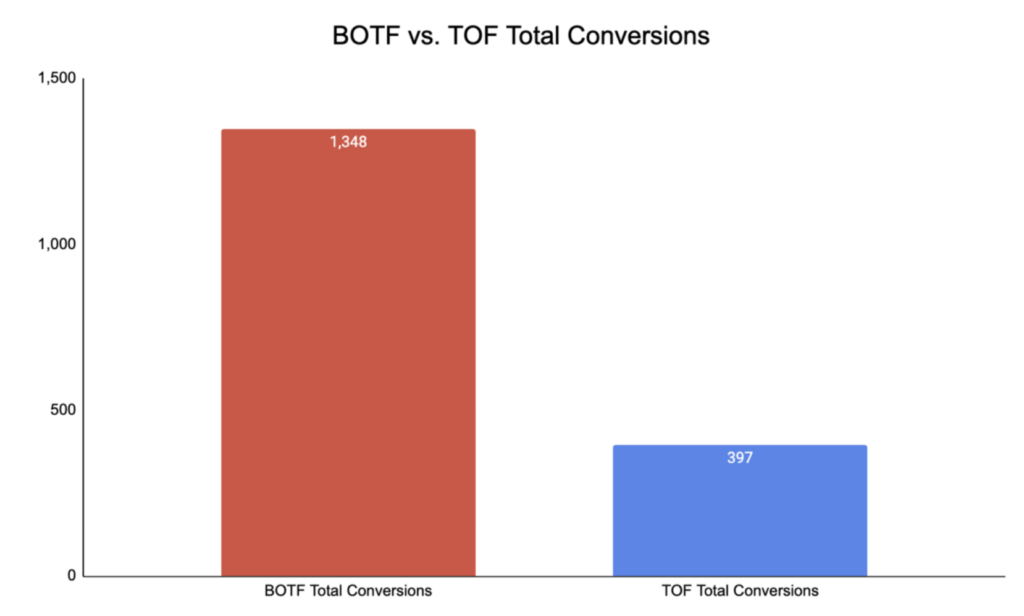
Even when factoring in the higher traffic volume for top-of-funnel pieces, the absolute number of conversions from only 20 bottom-of-funnel pieces exceeded that of 40 top-of-funnel pieces by threefold:
Twenty bottom-of-funnel posts yielded 1,348 conversions, surpassing the 397 conversions generated by 40 top-of-funnel posts.
To underscore, the 1,350 conversions from bottom-of-funnel content were derived from only 22 pieces, whereas the 400 conversions from top-of-funnel content were from 42 articles.
Moreover, it’s worth noting that the articles categorized as “top of funnel” in this study still retained some purchase intent. We pursued them only after exploring most bottom-of-funnel keywords and selected the keywords strategically to guarantee they still held some potential for conversion.
Hence, it’s reasonable to consider them more as “mid-funnel” rather than strictly “top of funnel.” Many companies focus the majority of their content and SEO efforts solely on top-of-funnel keywords that convert to leads or sales at or below the conversion rates mentioned earlier.
It’s a regrettable misallocation of SEO efforts, in our view.
Why Do Top-of-Funnel, Informational Keywords Have Such Low Conversion Rates?
The rationale for pursuing top-of-funnel keywords often centers on their high search volumes.
Therefore, the idea is that by targeting top-of-funnel keywords, you can expose your brand to a large audience that may eventually require a product or service similar to yours.
However, as indicated by the data and supported by our extensive experience, the number of steps needed to convert top-of-funnel traffic into actual conversions is so substantial that the conversion rates are extremely low.
More precisely, the path from an individual searching for an informational top-of-funnel query on Google to becoming a customer involves:
They initiate a search on Google for the query.
They click on your search result.
They read the article.
Some fraction of these users either return to your site on pure memory or give their email to download a white paper or gated resource.
Some fraction of those users open subsequent drip emails.
Then at some point, some fraction of those users will need your product or service and reach out.
Each of these steps has a small conversion rate, so in combination, the entire journey has an absolutely minuscule conversion rate.
To the extent that the data above indicates a potentially greater search volume for these top-of-funnel queries compared to transactional queries, the minuscule conversion rates fail to compensate.
There exist a greater number of bottom-of-funnel keywords than one might realize.
If you subscribe to the idea that focusing on bottom-of-the-funnel keywords is a more effective utilization of limited SEO resources than dispersing content evenly across the entire range of search intent, the crucial next step is to address the question: “Which keywords in my domain indicate bottom-of-the-funnel intent and boast high conversion rates, and how abundant are they?”
We’ve observed that a significant number of SEO professionals and marketers possess a narrow perspective on which keywords indicate bottom-of-the-funnel intent, meaning they exhibit some degree of transaction or buying intent.
From our experience, bottom-of-the-funnel keywords can be categorized into three common buckets, with only the first one being widely recognized as indicative of a bottom-of-the-funnel intent.
1. Keywords Reflecting Product Categories If we consider a hypothetical business that’s widely known, such as SEO software, the evident transactional keywords include phrases like “SEO software” or “best SEO tools.”
Certainly, these are highly effective keywords at the bottom of the sales funnel, and they are crucial for any SEO software brand to target.
In our approach to Bottom of the Funnel (BOTF) SEO, which we refer to as Pain Point SEO, these are termed “category keywords.” This designation stems from users directly searching for the name of the product or service category on Google.
The majority of SEO and marketing teams are cognizant of these keywords and typically direct their efforts toward them, often optimizing the homepage or a couple of landing pages.
However, what we’ve discovered is that numerous teams perceive this as covering the entirety of bottom-of-funnel or transactional keywords. They concentrate on a handful of category keywords and allocate the remaining effort to producing blog content aimed at ranking for top-of-funnel search terms.
Yet, there exist numerous other high-converting search terms that we’ve observed many brands tend to overlook. Instead, they prioritize creating content to target top-of-funnel keywords with lower conversion rates.
2. Keywords for Comparisons
More precisely, another category of keywords that yields exceptionally high conversion rates is what we term as comparison keywords.
These keywords indicate that the searcher is evaluating various options, like “salesforce vs pipedrive” or “adidas vs nike women’s running shoes.”
In various discussions about search intent, this is often classified as a mid-funnel query. According to this perspective, the searcher might not be ready for a transaction but is engaged in product research.
In discussions about search intent, this is frequently labeled as a mid-funnel query. The rationale is that the searcher, at this point, might not be prepared for a transaction but is primarily conducting product research.
However, based on our analysis of the conversion rates of numerous pages ranking for comparison keywords, they frequently exhibit conversion rates just as high as the category keywords mentioned earlier.
Consequently, from my perspective, companies aiming to optimize ROI from SEO should actively pursue comparison keywords.
They ought to pinpoint every comparison keyword associated with their top competitors, with any noticeable search volume, and guarantee the existence of a dedicated page on their site to rank for each one.
3. Keywords Associated with Jobs To Be Done
The last category among the three that we’ve identified as capable of generating conversions through SEO is keywords related to Jobs To Be Done.
This is the most extensive among these three categories of high-buying-intent keywords, implying that there are typically a significantly larger number of jobs to be done keywords than category or comparison.
Brands often overlook or don’t prioritize this category as conversion-generating. This is because these queries don’t overtly express a user’s search for or comparison of product options but indicate that the user has a problem your product happens to solve.
In the context of our SEO software example, these would encompass queries such as “how to conduct competitor keyword research,” “how to determine the search volume of keywords,” or “how to track the keywords a site ranks for.”
If your SEO software product includes features that enable users to perform these tasks, our experience suggests that achieving a ranking for keywords like these will result in conversions.
Usually, the conversion rate of these keywords is slightly lower than that of category or comparison keywords.
Nevertheless, they still outperform top-of-funnel queries like “SEO strategy,” “best SEO tips,” or even “digital marketing strategies.” These are the common top-of-funnel keywords that companies pursue, but they often lack significant buying intent.





















 fleeredstates.blog
You must be logged in to post a comment.