Texas A&M System to vote on requiring prior approval for lessons on “race and gender ideology”

Read more at Texas Tribune.

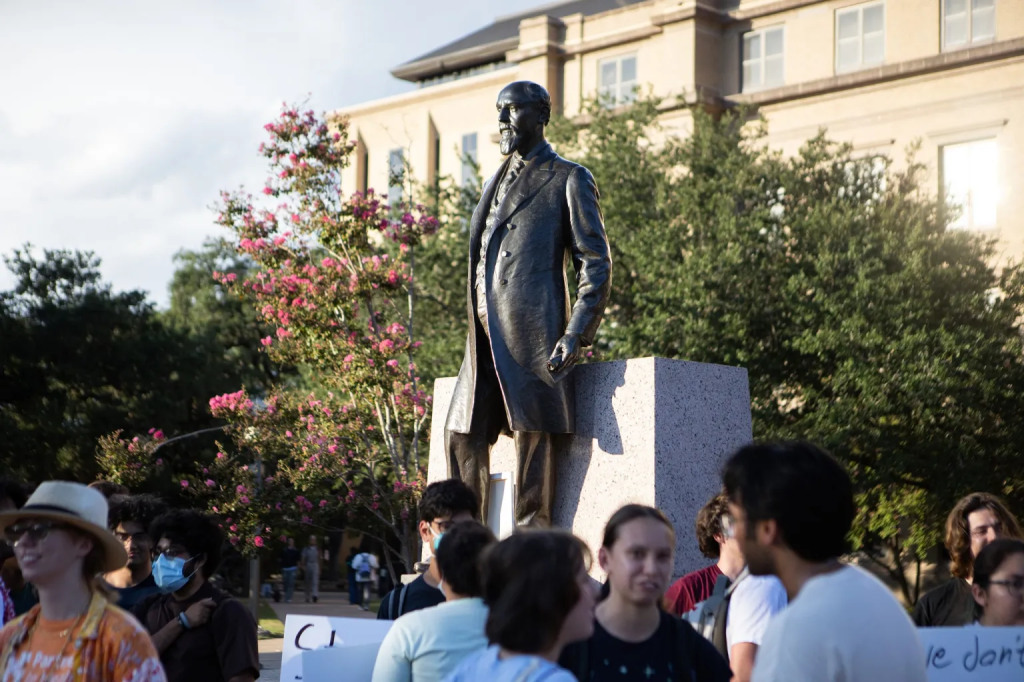
The Texas A&M University System’s board of regents will vote on Thursday on whether to prohibit faculty at its 12 universities from teaching “race or gender ideology” unless those lessons are pre-approved by each campus president or a delegate.

The proposal appears to be the first time that a Texas public university system offers definitions of what kind of instruction related to race and gender should not be permitted. 

“Race ideology,” the draft of the proposal says, would encompass any concept that “attempts to shame a particular race or ethnicity” or “promotes activism on issues related to race or ethnicity rather than academic instruction.” The proposal would define “gender ideology” as “a concept of self-assessed gender identity replacing, and disconnected from, the biological category of sex.” 

The policy does not say how the university would decide what constitutes “race ideology” or “gender ideology,” or what would happen if a faculty member is accused of violating the rule. A Texas A&M University System spokesperson did not respond to a request for comment.

The regents’ Committee on Academic and Student Affairs will hear presentations and consider the proposed policy on Thursday morning, according to the agenda for the meeting. The full board of regents will take public testimony on the proposal and vote on it later that day. The meeting will be livestreamed and the public is invited to testify.


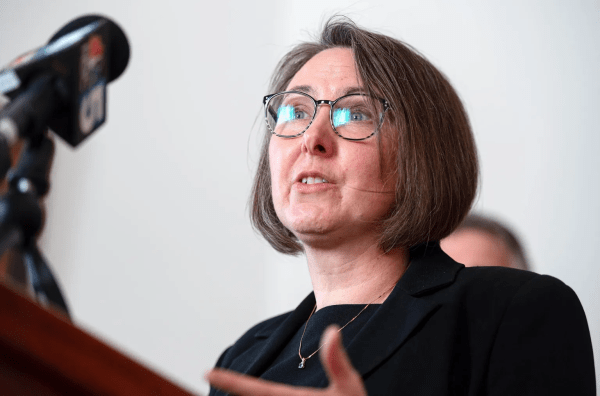
Leonard Bright, president of the Texas A&M Chapter of the American Association of University Professors, said faculty were not consulted on the proposed changes, which he called “a direct violation” of their expertise and freedom to teach. 

“And if that’s the case, there’s just going to be a further black eye on higher education here in Texas,” he said.

Robert Shilby, special counsel for campus advocacy at the Foundation for Individual Rights and Expression, said the proposal would “invite unlawful censorship, chill academic freedom, and undermine the core purpose of a university,”

“Hiring professors with PhDs is meaningless if administrators are the ones deciding what gets taught,” he said. “Faculty will start asking not, ‘Is this accurate?’ but ‘Will this get me in trouble?’ That’s not education, it’s risk management.”

In a Monday email to faculty, Simon North, interim dean of Texas A&M’s College of Arts and Sciences, acknowledged that the proposal raised many questions about its implementation, “such as the criteria that will determine when course content is considered relevant, controversial, or inconsistent with a syllabus; the mechanisms by which course material would be approved and compliance evaluated; and the timing of implementation.” He added that he is working with the provost’s office to answer those questions and that he will seek input on the proposal from other leaders in the college and department heads. 

“Approval of these revisions could have far-reaching implications for undergraduate education, and the scope of the implications will depend on the answers to these questions,” North said.

Faculty are already signaling they will show up in force to the regents’ meeting to push back against the proposal. Bright, a professor at Texas A&M’s Bush School of Government and Public Service, said professors are organizing testimony, drafting statements and coordinating with colleagues across Texas to oppose the revisions. 

He said the policy would affect disciplines across the university — from political science and history to public service and biology — and that some faculty fear it would shift control over classroom content from faculty to administrators. He added that some of his colleagues believe the revisions are an attempt to “institutionalize indoctrination” and that if the proposed changes are approved, they will likely be challenged in court.

The proposed prohibition comes two months after the system’s College Station flagship fired Professor Melissa McCoul, whose discussion of gender identity in a children’s literature class was secretly recorded by a student and later circulated online, drawing fire from Republican lawmakers and ultimately toppling the university’s former president

Since McCoul’s firing, other university systems have begun imposing their own restrictions on classroom content. 

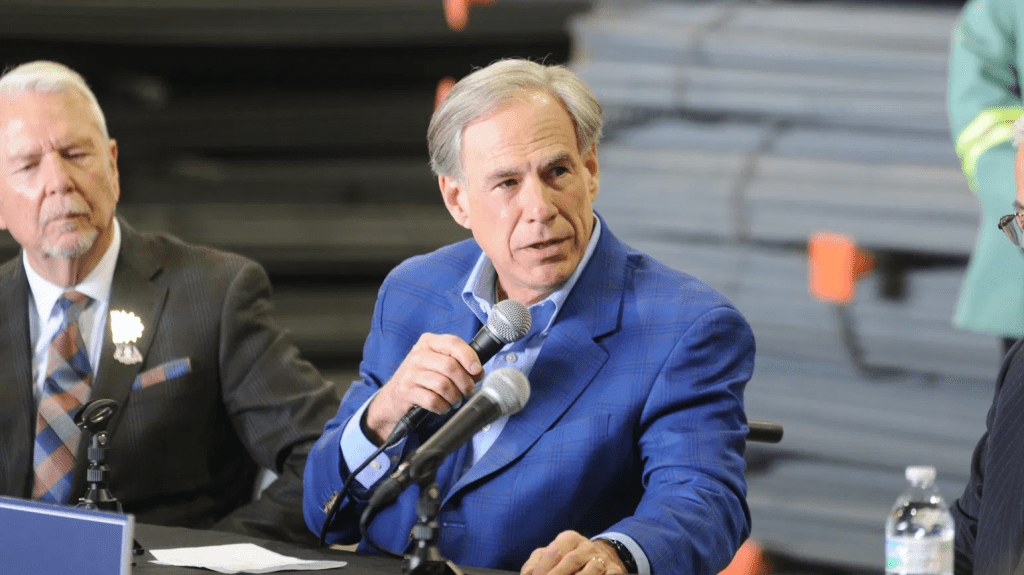
On Sept. 25, the Texas Tech University System instructed its faculty to ensure their courses comply with a federal executive order, a letter from Gov. Greg Abbott and a new state law that recognizes only two sexes. In the weeks that followed, Texas’ other public university systems — including the University of Texas, University of North Texas, Texas State and Texas Woman’s University — announced or began internal audits of their course offerings. All said they were acting to ensure compliance with state or federal law, though few detailed what they were looking for or what changes might follow. 

No state or federal law prohibits instruction on race, gender or sexual orientation in universities. However, recent state legislation has put direct and indirect pressure on how universities implement policies related to race and gender. 

In 2023, the Texas Legislature approved Senate Bill 17, which banned diversity, equity and inclusion offices and initiatives at the state’s public universities. Earlier this year, lawmakers approved Senate Bill 37, which gave governor-appointed university regents the final say on whether to approve new courses and prohibited lessons that “advocate or promote the idea that any race, sex, or ethnicity or any religious belief is inherently superior to any other.” An earlier version of the legislation would have required that college courses “not endorse specific public policies, ideologies or legislation,” but the proposal was narrowed down after pushback from professors who said such a restriction would lead to self-censorship and infringe on academic freedom. 

The Texas A&M Board of Regents will also consider on Thursday a new policy that would bar faculty from teaching material “inconsistent with the approved syllabus for the course.” The clause mirrors the reason university officials gave McCoul for firing her. They said she refused to change her course content to match the catalog description, but McCoul and other faculty have countered that course descriptions are often broad and that professors are expected to design their own syllabi and teach according to their expertise.

McCoul has appealed her termination through the university’s Committee on Academic Freedom, Responsibility and Tenure, which concluded its hearing last week. The committee is expected to share a recommendation with interim university President Tommy Williams in the coming weeks on how to respond to McCoul’s appeal, but Williams is not obligated to follow it.
Supreme Court rejects bid to overturn same-sex marriage ruling

Read more at The Hill.

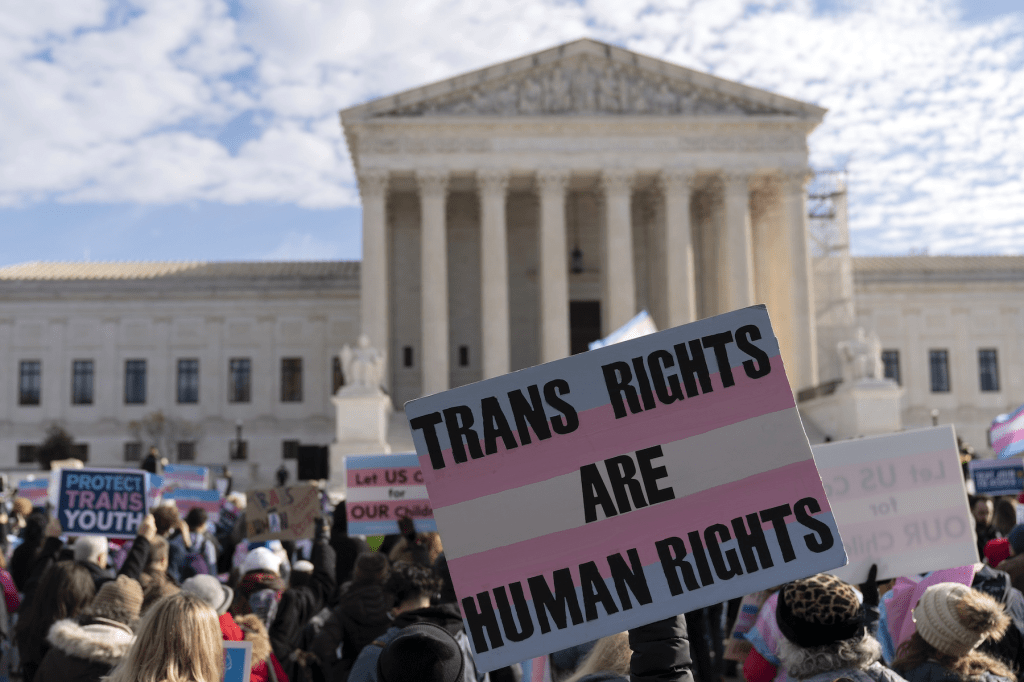
The Supreme Court rejected a longshot effort Monday to overturn its ruling guaranteeing same-sex marriage nationwide. 

Former Kentucky county clerk Kim Davis directly asked the justices to overrule the 2015 landmark decision after a jury awarded damages to a couple whom Davis refused to issue a marriage license. 

“The Court can and should fix this mistake,” her attorneys wrote in court filings. 

In a brief order, the justices declined to take up Davis’s appeal alongside dozens of other petitions up for consideration at the justices’ weekly closed-door conference. There were no noted dissents.

Court watchers viewed Davis’s appeal as a longshot effort, but it sparked trepidation among LGBTQ rights groups since several conservative justices who dissented in the decade-old case remain on the court. 

Davis gained national attention after she raised religious objections to issuing marriage licenses to same-sex couples despite the Supreme Court’s decision in Obergefell v. Hodges. 

Among the refused couples was David Ermold and David Moore, who sued. Davis was found to have violated a judge’s order in another case, which required her to keep issuing licenses. 

Davis was jailed for five days, the couple obtained their license and Kentucky later passed a law enabling clerks to keep their signatures off marriage certificates. 

But Davis kept fighting in court after the couple won $100,000 in emotional distress damages from a jury plus $260,000 in attorneys’ fees. 

Primarily, Davis’s appeal concerned arguments that she has a private First Amendment religious defense against the award, despite acting as a government official.  

She tacked onto it a request to overturn Obergefell outright, insisting the whole lawsuit would fall if the justices do so. 

LGBTQ+ residents are fleeing red states, taking their talent and tax dollars with them

Read more at LGBTQ Nation.

Up to an estimated $879 million in LGBTQ+ household and business income has left Missouri in recent years, as queer residents flee a hostile political environment, according to a recent analysis by the Movement Advancement Project (MAP).

The state lawmakers responsible for creating this financial drain were warned, the Missouri Independent reports.

For years, business organizations, advocacy groups, and individuals cautioned officials pushing discriminatory laws that the economic fallout would be one deleterious result.

Local officials and chambers of commerce raised red flags about impacts on workforce recruitment, employee retention, and the ability to lure businesses to the state.

Now, economic data is confirming those predictions.

The new $879 million estimate on Missouri’s losses is based on a survey conducted by MAP in collaboration with The Trevor Project, the LGBTQ+ youth nonprofit.

“When people feel unwelcome or uncertain about their future in a community, they often take their skills and their families elsewhere,” Tracey DeMarea, executive director of the Mid-America LGBT Chamber of Commerce, told The Independent. “That loss affects our workforce, our businesses, and our shared sense of community.”

2023 Wells Fargo report revealed that states with bigger LGBTQ+ populations have higher rates of economic growth, while the inverse is also true.

Multiple surveys and studies show that LGBTQ+ people — young adults in particular — have moved or are considering moving from states hostile to LGBTQ+ rights. An estimated 3% of cisgender young people and 5% of all trans people have already fled red states.

The economic impact of ideological legislation on the broader community is often lost on the lawmakers pushing it, according to Naomi Goldberg, MAP’s executive director.

“The responsibility of lawmakers is to represent communities across the state, and when they pass laws that target already vulnerable communities, they should consider their actions,” she said. “When families choose to leave the state, the loss is not only in the vitality and diversity of the community, but also in the economic power and resources that families provide.”

One example of the warnings came in 2024, during a marathon hearing on multiple bills, including proposed rules covering restrooms in private businesses. Lobbyists stayed up late explaining to lawmakers that the bills were a threat to “free enterprise” and “business development.”

“Businesses want to ensure that people feel comfortable and safe in their workplaces,” Kara Corches, president and CEO of the Missouri Chamber of Commerce and Industry, told committee members. “Their ability to recruit and retain talent is their top concern.”

Henry Eubank, governmental affairs coordinator for Greater St. Louis Inc., said that the discriminatory legislation before the committee depicted Missouri as unwelcoming.

“It sends a powerful negative signal to potential residents, investors, businesses, and workers,” he told lawmakers, “that the state of Missouri is not a place that they would want to visit, live, to do business, to start a business, or move their family.”

Missouri has passed a slew of anti-LGBTQ+ legislation since, while the state’s attorney general has sued to uphold conversion therapy, gone after trans women in locker rooms, and targeted healthcare workers for assisting trans youth.

The last was the final straw for St. Louis restauranteur Rob Connoley, who is gay. He was a newly awarded James Beard finalist for his Ozark cuisine when he was in London representing Missouri at an international food festival not long ago.

“It felt egregious and awkward to be promoting a state in a region that was actively working against my own personal interests,” he told The Independent.

So Connoley packed up his kitchen and headed to Oregon.

“It made more sense for me to take my entrepreneurial skills and go to a community that I think would be more supportive of what I’m trying to accomplish,” he said.

Chappell Roan launches Midwest Princess Project to support trans youth

Read more at LGBTQ Nation.

Music superstar Chappell Roan has announced the launch of her organization devoted to supporting trans youth.

The Midwest Princess Project — a nod to her album, The Rise and Fall of a Midwest Princess — has already raised more than $400,000 through fundraising efforts at Roan’s recent pop-up shows.

“Those funds will be donated to incredible organizations making a positive impact for trans youth in their communities,” Roan wrote on social media when launching the project in late October.

The post named six organizations to which it has already donated: The Ali Forney Center and The Center in New York City, the GLO Center and The Center Project in Missouri, and the TransLatin@ Coalition and Trans Wellness Center in Los Angeles.

The TransLatin@ Coalition and The Ali Forney Center are some of the first beneficiaries. The project’s website says its goal is to “uplift trans youth and LGBTQ+ communities through action, care, and connection.”

The project’s launch is in keeping with Roan’s pledge to donate a portion of ticket sales from her tour to trans organizations. During a red-carpet interview at the Grammy Awards in early February, Roan acknowledged the state of transgender rights in the U.S. in just the first month of the current presidential administration.

“It’s brutal right now,” Roan said, “but trans people have always existed, and they will forever exist, and they will never, no matter what happens, take trans joy away, and that has to be protected more than anything.”

“I would not be here without trans girls,” she added. “So, just know that pop music is thinking about you and cares about you. And I’m trying my best to stand up for you in every way that I can.”

During a live show in October, she also opened up about how she struggles with fame but that it’s all worth it to be able to spread queer joy.

She said she has questioned why she continues in her career when it makes her feel so “left out in public” and “so awkward all the time,” but that the tour helped her realize exactly why she keeps going.

“I always felt, actually, ‘Why am I putting myself through this? If this is taking so much away from me, what is this for?’ Then I started doing shows again and it all made sense, it was to literally bring queer people joy,” she said.

“There [are] so many things in the world that are so ‘F**k you’,” she continued, “and then there is this. It’s the only thing that matters is joy anymore to me, and protecting that, and peace and safety. So, I hope you know that when you are here, you are safe, and I want you here. You can be whoever you are tonight. You’re cherished for everything that you are.”

She said protecting that joy is one of the most important things, and “even if you’re not queer, I hope you know that I include you.”

Trans man kicked out of women’s bathroom at arcade: It was “dehumanizing”

Read more at LGBTQ Nation.

An incident at a gaming arcade and bar in the Chicago area recently had a transgender man and staff at odds over their definitions of safety and discrimination.

Lucien Bates, who is transgender and presents as alt-masculine with facial hair and piercings, was visiting Round1 Bowling & Arcade at the North Riverside Park Mall outside Chicago in September with his fiancé, when the pair decided to use the restroom before gaming.

Bates told the Windy City Times that he opted to use the women’s bathroom, where he said he feels more comfortable and less likely to be harassed.

“I typically feel safer in the women’s restroom, which I guess kind of bit me in the butt this time,” he said.

Before entering, Bates says he checked in with his fiancé and a friend to make sure they were okay accompanying him. 

“It’s something that we have to think about often — making that decision about which one to go in, which one’s going to be safer,” Bates said of his bathroom choice.

Within minutes, a female security guard entered the restroom and told Bates, “You know you can’t be in here, right?”

The security guard refused to clarify what she meant, Bates said, and only kept repeating that Bates was “not supposed to be in there.”

“Eventually it got to the point where she was like, ‘You need to be in the bathroom that matches your ID,’” Bates said.

Bates refused to share his ID with the guard, he said, explaining that his fiancé had shown his own, which matched the restroom they were in.

After the group declined to leave, the guard then called for backup, Bates said, and three more security guards entered.

That’s when things started getting ugly.

“They just kept saying, ‘You should know what you’re doing is wrong,’ but they wouldn’t say it outright,” Bates recounted. “Eventually, they said it was dangerous for us to be in the restroom because children visit the facility.”

When Bates and his escorts did leave the restroom, they were confronted with another group of guards now stationed outside the door.

One of the guards “started just screaming in my face,” Bates said. “He just kept saying, ‘You’re going to get arrested,’ but wouldn’t tell me why. I was already on my way out, and now they’re threatening to arrest me — for what exactly?”

Bates and his fiancé decided to leave the arcade but returned to ask for a manager’s contact information to file a complaint.

They were immediately confronted by another staff member, who yelled, “What do you guys want? You have to be out of here,” Bates recalled.

When Bates started recording a video as they were escorted back outside, the manager showed up and told Bates the issue was “loitering.” 

“That’s interesting, because I have not heard the word ‘loitering’ from anyone on your staff until right now,” he recalled telling her.

Bates told her the confrontation was “dehumanizing.” The manager responded, “Sorry this happened.” 

By all appearances, the security team didn’t share that sentiment.

“Every security guard was smiling and waving cheerfully as we were leaving,” Bates said, providing a pic of the group doing just that.

The guards continued to watch them while Bates and his fiancé sat in his car outside the venue. Guards in cars drove by them several times. 

Bates said he later filed complaints with both Round1 and the North Riverside Park Mall, and that a manager offered to add money to his arcade card.

In an emailed statement, a rep for Round1 said the company is “taking this matter very seriously, and that appropriate corrective measures have been taken.”

“Round1 does not tolerate discrimination of any kind — whether by or toward employees, guests, or third parties (such as security, vendors, or contractors),” the statement read. “This includes, but is not limited to, discrimination based on race, color, nationality, gender, sexual orientation, identity, religion, age, or disability.”

Despite those “corrective measures,” Bates is reluctant to return.

“They ruined my whole day,” the Dance Dance Revolution fan said.

“They ruined a place that I liked, and they had enough people who wouldn’t say anything to get away with what they did.”

New bill would send people to prison for 10 years for identifying as LGBTQ+ in Uganda

Read more at LGBTQ Nation.

Not content with holding title to one of the harshest anti-LGBTQ+ laws in the world, Uganda’s parliament is considering a bill that would outlaw identifying as lesbian, gay, bisexual, transgender, or queer.

The country’s Anti-Homosexuality Act, passed in 2023, already provides a sentence of life in prison for gay men who have sexual relations, and in extenuating circumstances, even death.

The new measure would criminalize Ugandans for simply saying they’re anything but straight.

Among more than 30 African nations that ban same-sex relations, the proposed law would be the first to criminalize just identifying as LGBTQ+, according to Human Rights Watch.

The proposed law was introduced with the goal of combating “threats to the traditional, heterosexual family,” according to a copy shared with Reuters

In an awkward mashup of identifying prohibitions, language in the bill echoes executive orders issued by the U.S. president in his crusade against the transgender community.

The measure mandates punishment of up to 10 years in prison for any person who “holds out as a lesbian, gay, transgender, a queer or any other sexual or gender identity that is contrary to the binary categories of male and female.”

The bill also criminalizes the “promotion” of homosexuality and “abetting” and “conspiring” to engage in same-sex relations.

Much of the bill’s content is revived from the original “Kill the Gays” law, passed in 2013 but overturned by Uganda’s high court on technical grounds.

That law criminalized lesbianism.

“One of the most extreme features of this new bill is that it criminalizes people simply for being who they are as well as further infringing on the rights to privacy, and freedoms of expression and association that are already compromised in Uganda,” said Oryem Nyeko, Uganda researcher at Human Rights Watch.

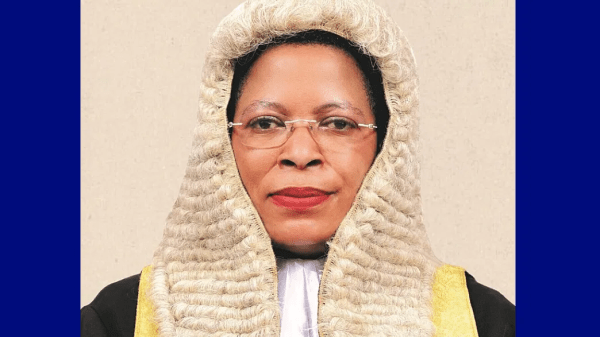
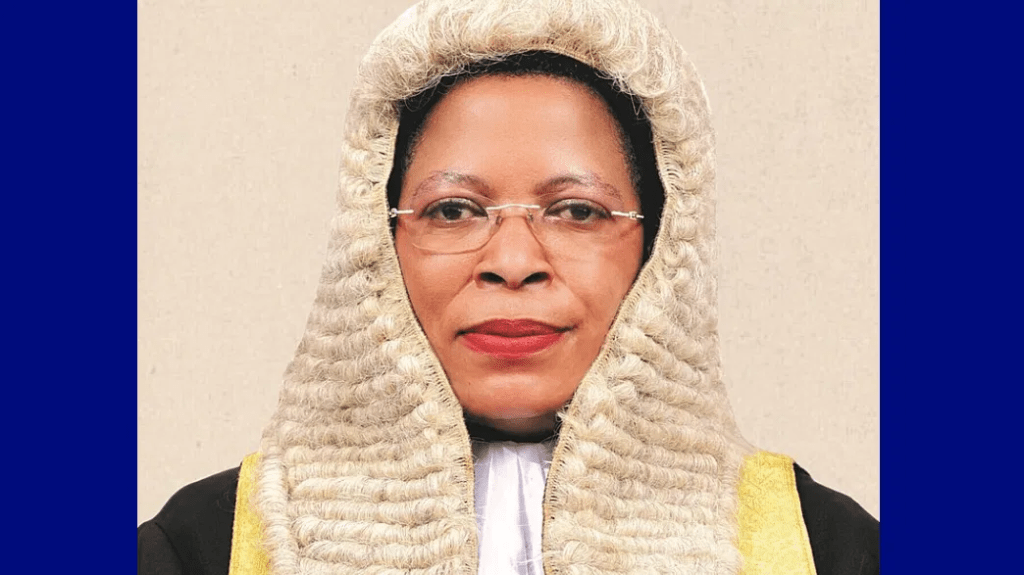
Speaker of the Parliament Anita Among, the rabidly homophobic lawmaker who helped usher the Anti-Homosexuality Act into law, sent the new bill to committee for debate and public hearings after it was read to legislators.  

Among urged fellow lawmakers to reject intimidation, referencing threats by Western countries to impose travel bans on those responsible for the legislation.

“This business of intimidating that ‘you will not go to America,’ what is America?” she asked.

Ugandan lawmakers, the speaker prominent among them, have for years warned of “degenerate Western values” threatening Ugandan families and sovereignty.

Among was urged on in her anti-Western pose by Russia’s ambassador to Uganda, who encouraged her to fast-track the “Kill the Gays” law through parliament in 2023. It passed overwhelmingly and was cheered by lawmakers.

“This is the time you are going to show us whether you’re a homo or you’re not,” Among told the packed chamber.

Federal appeals court revives Texas’ drag ban and lifts injunction

Read more at LGBTQ Nation.

A U.S. Court of Appeals just reversed a ruling made by a District Court judge in 2023, overturning his permanent injunction against Texas’ wide-reaching and vaguely worded drag ban, which the judge claimed infringed on First Amendment rights.

The plaintiffs in The Woodlands v. Paxton issued a joint statement, saying, “Today’s decision is heartbreaking for drag performers, small businesses, and every Texan who believes in free expression. Drag is not a crime. It is art, joy, and resistance — a vital part of our culture and our communities. We are devastated by this setback, but we are not defeated. […] We will not stop until this unconstitutional law is struck down for good.”

Texas S.B. 12 was signed into law in June 2023 by Gov. Greg Abbott (R) and was set to go into effect on September 1 of the same year. While the bill ostensibly made it a crime to provide “sexually oriented performances” in a commercial space, on public property, or in the presence of minors, the language of the bill and the rhetoric around it made it clear that it was intended to target drag shows in particular.

The law was quickly challenged by LGBTQ+ advocacy groups and drag groups, including The Woodlands Pride, Abilene Pride Alliance, and 360 Queen Entertainment. The case of The Woodlands v. Paxton went to U.S. District Court Judge David Hittner, who originally placed a temporary injunction on the law when plaintiffs’ arguments made it clear that the bill would impinge their First Amendment rights if it was allowed to go into effect. Hittner then doubled down by extending the injunction and then making it permanent in September 2023.

At the time, Hittner wrote that the bill “impermissibly infringes on the First Amendment and chills free speech,” while making it clear that he felt the bill discriminated on point of view, was overly broad, and vague. “Not all people will like or condone certain performances,” Hittner continued in his original decision. “This is no different than a person’s opinion on certain comedy or genres of music, but that alone does not strip First Amendment protection.”

The U.S. Court of Appeals for the Fifth Circuit made a majority ruling today to reverse Hittner’s ruling and remanded the case back to his court. The justices declared that most of the plaintiffs in the case did not have the requisite standing to bring the lawsuit in the first place, as they found the performances of The Woodlands Pride and Abilene Pride insufficiently sexual to have a real risk of punishment under the law’s wording.

They now require that Hittner revisit the case, focusing only on the claims from 360 Queen Entertainment, whose performances include simulated sexual acts and include other features more likely to be targeted by S.B. 12. They are also requiring Hittner to make his new decision under the standard established in the Supreme Court case for Moody v. NetChoice, which set the precedent for First Amendment challenges to only be viable if the law is unconstitutional more than it is constitutional.

One of the Appeals Court judges partially dissented, presenting concerns that the decision “turns a blind eye to the Texas Legislature’s avowed purpose: a statewide ‘drag ban.’” In doing so, he highlighted the rhetoric used by Republicans during the bill’s passage, which clearly expressed their intent, regardless of the letter of the law.

Both Texas and many of its cities already have laws on the books that protect minors from witnessing sexually explicit performances. Gov. Abbott shared on X/Twitter an article titled “Texas Governor Signs Law Banning Drag Performances in Public,” adding the words “That’s right.” Similarly, Lt. Gov. Dan Patrick (R) said it was to “ban children’s exposure to drag shows.” The author of the bill, state Sen. Bryan Hughes (R), provided “drag shows” as an example of the “sexually explicit performances” that would be prohibited.

While the intent is clear from the comments of those involved, the bill’s original text demonstrates the motivations that underpinned it. An earlier version of the bill has a line under the definitions of “features” in “sexual conduct” that includes “a male performer exhibiting as a female, or a female performer exhibiting as a male, who uses clothing, makeup, or other similar physical markers and who sings, lip syncs, dances, or otherwise performs before an audience.” That definition would include everything from Tom Holland’s Lip Sync Battle appearance to cosplayers.

The House Committee report from May 26, 2023, shows the line removed. Instead, the definition of “sexually oriented performances” is edited to include “exhibition of sexual gesticulations using accessories or prosthetics that exaggerate male or female sexual characteristics,” which clearly targets breast forms and packers common in drag shows.

Supreme Court reinstates Trump administration’s transgender passport policy

Read more at The Hill.

The Supreme Court on Thursday ruled President Trump’s State Department can prohibit transgender Americans from listing their gender identity on their passports, for now. 

It hands another legal victory for Trump in his efforts to eviscerate what his administration calls “gender ideology.” The Justice Department brought the emergency appeal after lower courts blocked the passport policy for being rooted in “irrational prejudice.” 

“Displaying passport holders’ sex at birth no more offends equal protection principles than displaying their country of birth—in both cases, the Government is merely attesting to a historical fact without subjecting anyone to differential treatment,” the majority wrote in its unsigned ruling

The ruling appeared to be along the court’s 6-3 ideological lines, though the justices do not have to publicly disclose their votes. 

In dissent, the court’s liberals called the ruling “pointless but painful perversion.” 

“Such senseless sidestepping of the obvious equitable outcome has become an unfortunate pattern,” wrote Justice Ketanji Brown Jackson, joined by Justices Elena Kagan and Sonia Sotomayor. 

“So, too, has my own refusal to look the other way when basic principles are selectively discarded,” the dissent continued. 

Solicitor General D. John Sauer called lower rulings blocking the administration’s policy “untenable,” casting them as infringing on Trump’s constitutional authority over foreign affairs. 

“The President’s choice to revert to prior policy and rely on biological sex—a choice that bound the State Department—should be the last place for novel equal-protection claims or Administrative Procedure Act objections,” Sauer wrote in court filings. 

The State Department policy requires passport holders to use their sex assigned at birth as their sex designation, prohibiting transgender people from matching it with their gender identity. The policy also removed the option for people to select “X,” leaving male and female as the only two options. 

“This new policy puts transgender, nonbinary, and intersex people in potential danger whenever they use a passport,” American Civil Liberties Union (ACLU) attorney Chase Strangio warned in court filings. 

Strangio and the ACLU represent transgender and nonbinary Americans who are suing over the State Department’s changes. 

They argue it violates federal law and constitutional equal protection rights, convincing a federal district judge appointed by former President Biden and later the 1st U.S. Circuit Court of Appeals to halt the policy.  

It marked the latest case implicating Trump’s Day 1 executive order that cracks down on what he calls “gender ideology” to reach the Supreme Court. Previously, the justices issued emergency orders allowing the administration to enforce its transgender troops ban and cancel diversity-linked health grants. 

Gay couple’s farm vandalized with medical waste & human feces on election night

As Virginia Democrats celebrated big wins both at home and in other closely watched races across the country following Tuesday’s off-year elections, one gay couple in the state woke Wednesday morning to find that their farm had been vandalized — and not for the first time.

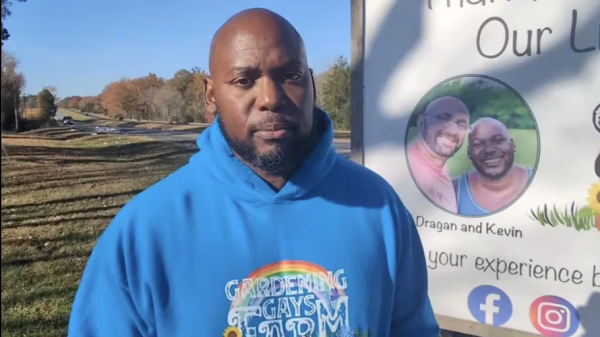
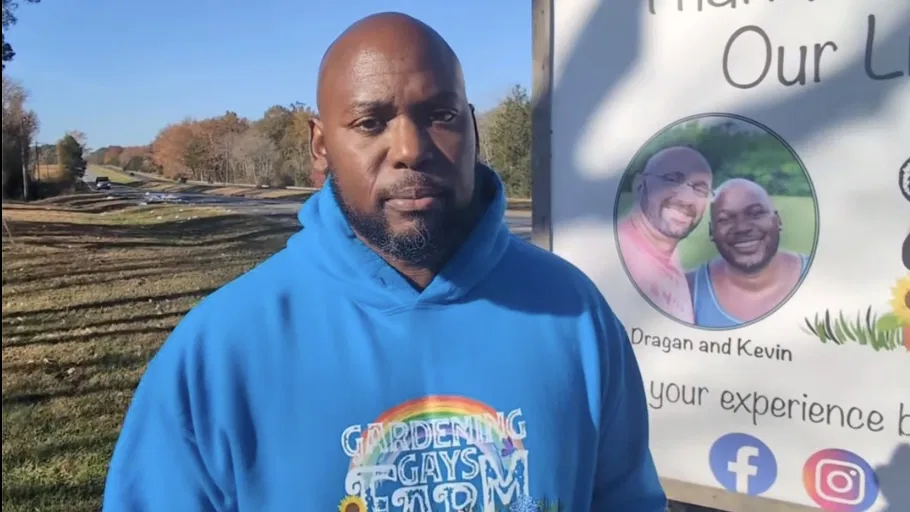
“It’s medical waste that is strewn all the way across the entrance of our farm,” Kevin Graham, the owner, along with his husband Dragan Kurbalija, of Gardening Gays Farm, told The Advocate. “There are bedsheets that have human feces and urine on them. You can smell the human waste while you’re out there standing near it.”

The couple, who bought the 27-acre farm on U.S. 301 in conservative King George County four years ago, told the outlet they believe this was an intentional act of anti-LGBTQ+ hate.

“It does not appear to be an accident,” Graham said. “You look up and down the roadway, and everywhere else is completely clear. The trash is only at our entrance.”

“Nobody puts human feces in a regular trash bag and drives it on the back of a truck to the dump,” Kurbalija added. “It definitely feels personal.”

King George County residents voted Gardening Gays Farm the county’s Overall Best Business, Best Family-Owned Business, and Best Agricultural Business this year.

But at the same time, this isn’t the first act of defacement they’ve endured. In a video posted to the farm’s Facebook account, Kurbalija explained that the couple found trash strewn at the farm’s entrance a few weeks ago.

“It seemed like an isolated incident, perhaps,” Kurbalija says in the clip, “but today, this is very intentional, very deliberate.”

The fact that the latest incident came on the heels of a Democratic sweep in Tuesday’s elections is not lost on Graham and Kurbalija. In Virginia, former U.S. Rep. and LGBTQ+ ally Abigail Spanberger (D) beat outgoing Republican Lt. Gov. Winsome Earle-Sears to become the state’s first female governor. Democratic candidates also won the races for the state’s lieutenant governor and attorney general, and Democrats also increased their majority in the Virginia House of Delegates, flipping at least 13 seats.

But, as The Advocate notes, Earle-Sears — whose campaign leaned heavily on anti-trans rhetoric cribbed from the president’s 2024 campaign — managed to carry King George County by a double-digit margin.

“We don’t lean into or talk politics with anybody,” Graham told the outlet. “But the fact that this happens after an election day, with what took place here in Virginia last night, really rubs you the wrong way even more than it would’ve on any other regular Wednesday.”

Still, Graham said he and Kurbalija are confident in their community’s support for Gardening Gays Farm. “They have our back, and there are people in this town who speak up for us when we’re not in the room.”

In the video posted to the farm’s Facebook account, Kurbalija explained that the couple called their business “Gardening Gays Farm” to make it clear to anyone who comes through their gates exactly who they are.

“When we moved into this community four years ago, we came, pulled up our boots, and got right to work, providing a safe space, providing a service, providing something that we thought this community needed and wanted,” Kurbalija said. “None of this is ever going to stop us from what we’re doing.”

Trump administration tells Vermont to change foster parent policies aimed at protecting LGBTQ youth 

Read more at Valley News.

President Donald Trump’s administration has warned Vermont that its policies meant to support LGBTQ foster youth may violate federal law, potentially threatening federal funding.

The Oct. 16 letter, written by Alex Adams, assistant secretary of the federal Administration for Children and Families, directed Vermont Secretary of Human Services Jenney Samuelson to provide a written response explaining how the state would address Adams’ concerns.

“It has been brought to my attention that certain policies and procedures in Vermont deny qualified foster and adoptive parents the opportunity to provide children a loving home solely because they cannot, in good conscience, commit to affirming a hypothetical child’s gender identity,” Adams wrote. “Such policies are contrary to the purpose of child welfare programs and inconsistent with our interpretation of federal diligent recruitment plans and constitutional protections, including the First Amendment.”

Other states, including Massachusetts, New York and California, have received similar letters. Vermont’s involvement was first reported by The Imprint, a nonprofit news publication focused on vulnerable children and families. About a third of foster youth identify as LGBTQ, according to multiple studies.

While Adams’ letter does not reference specific Vermont policies, in 2024, two Vermont couples sued the Department for Children and Families, arguing that policies requiring foster parents to affirm a foster child’s sexual orientation or gender identity are unconstitutional and discriminate against Christians. A second lawsuit related to foster parent policies was later brought by a separate family that year.

The prominent conservative legal firm Alliance Defending Freedom represented the couples in the first suit. Similar lawsuits have cropped up across the country, including in Oregon, where a federal appeals court eventually ruled the state’s policies intended to protect LGBTQ foster youth violated free speech. The Vermont lawsuits now sit with the 2nd U.S. Circuit Court of Appeals after the families appealed a lower court’s ruling against them.

Per Vermont’s Department for Children and Families policy, “discrimination and bias based on a child or youth’s real or perceived sexual orientation, gender identity, or gender expression” is prohibited.

A department spokesperson said no one was available Tuesday for an interview regarding the letter from the federal government and instead requested questions in writing.

In a statement, Aryka Radke, a Department for Children and Families deputy commissioner, wrote that the department “is committed to ensuring that young people in our custody are safe and supported. We are currently reviewing the letter with our legal team.”

Radke did not respond to questions about what funding could be at risk.

While Adams, in the letter, did not explicitly threaten to withhold federal funding from Vermont, he did allude to the possibility.

“Please provide a written response outlining how you will review and, where necessary, amend policies to bring them into alignment with these values and applicable law,” he wrote. “As you know, my responsibilities include monitoring the use of relevant federal funds and ensuring compliance with federal law.”

The Administration for Children and Families did not respond to a request for comment.

Blog at WordPress.com.

Up ↑