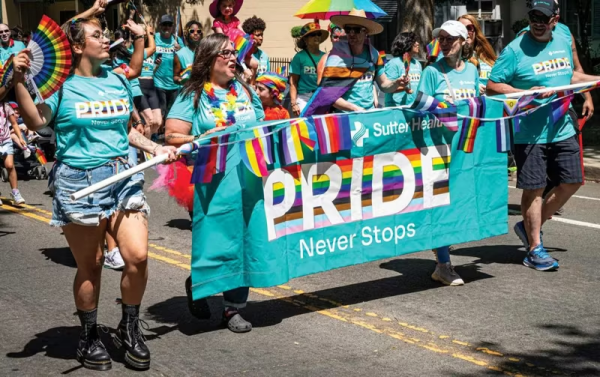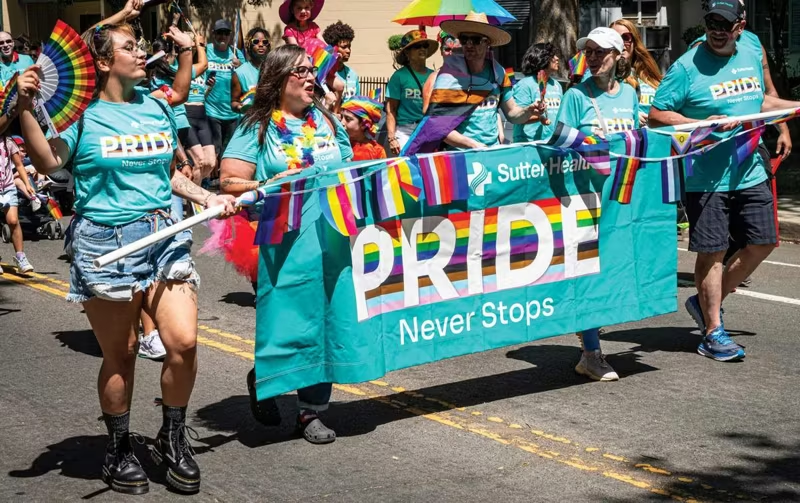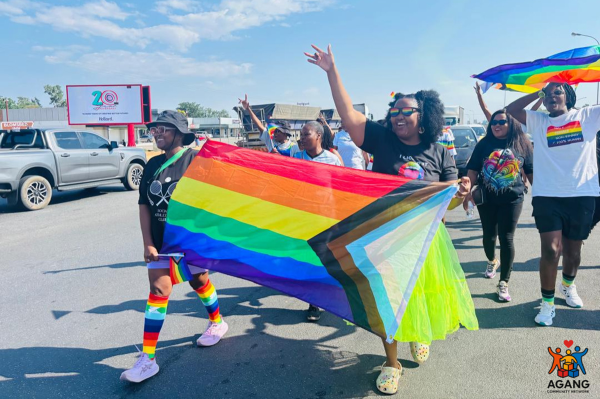
The first courageous annual Palapye Pride in Botswana

Read more at The Washington Blade.

“When the sun rose on 1 Nov., 2025, Pride morning in Palapye, the open space where the march was scheduled to begin was empty. I stood there trying to look calm, but inside, my chest felt tight. I was worried that no one would come. It was the first-ever Pride in Palapye, a semi-urban village where cultural norms, religious beliefs, and tradition are deeply woven into everyday life.

I kept asking myself if we were being naive. Maybe people weren’t ready. Perhaps fear was going to win. For the first 30 minutes, it was me, a couple of religious leaders and a handful of parents. That was it. The silence was loud, and every second felt like it stretched into hours. I expected to see the queer community showing up in numbers, draped in color and excitement. Instead, only the wind was moving.

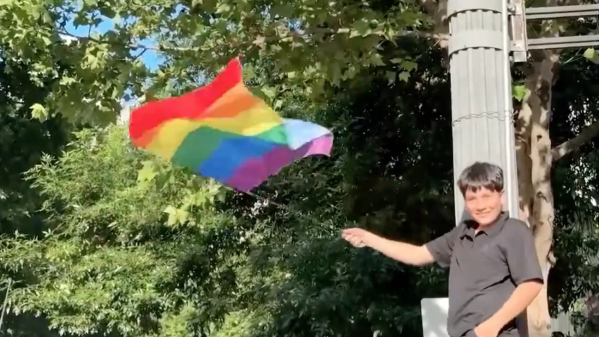
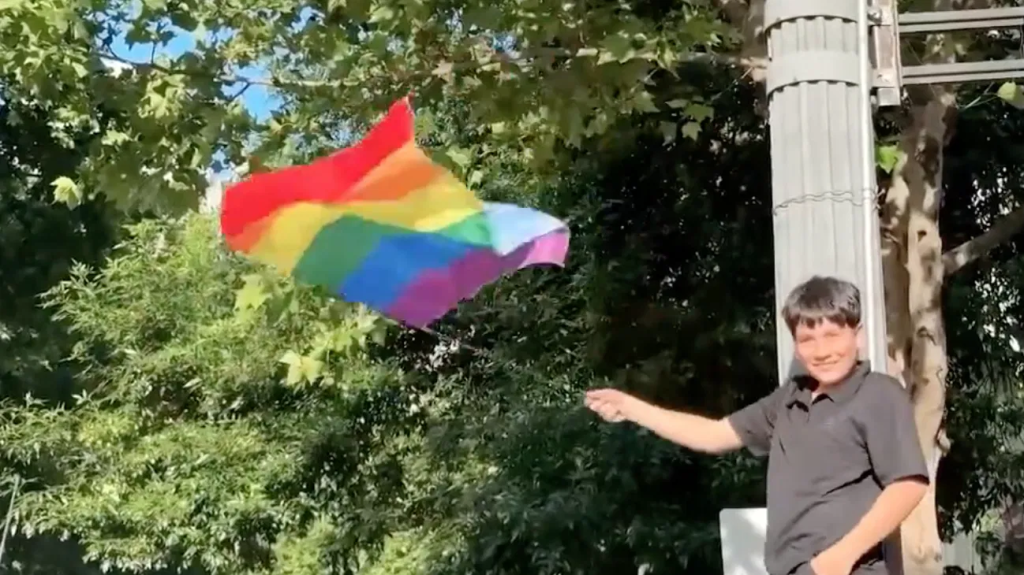
But slowly, gently, just like courage often arrives, people started to show up with a rainbow flag appearing from behind a tree and a hesitant wave from someone standing at a distance.

That’s when I understood that people weren’t late, just that they were afraid. And their fear made sense. Showing up openly in a small community like Palapye is a radical act. It disrupts silence. It challenges norms. It forces visibility. Visibility is powerful, but it is never easy. We marched with courage, pulling from the deepest parts of ourselves. We marched with laughter that cracked through the tension. We marched not because it was easy, but because it was necessary,” narrates activist Seipone Boitshwarelo from AGANG Community Network, which focuses on families and friends of LGBTIQ+ people in Botswana. She is also a BW PRIDE Awards nominee for the Healing and Justice Award, a category which acknowledges contributions to wellness, mental health, and healing for the LGBTIQ+ community across Botswana.

Queer Pride is Botswana Pride!

Pride is both a celebration and a political statement. It came about as a response to systemic oppression, particularly the criminalization and marginalization of LGBTIQ+ people globally, including in Botswana at some point. It is part of the recognition, equality, and assertion of human rights. It also reminds us that liberation and equality are not automatically universal, and continued activism is necessary. A reminder of the famous saying by Fannie Lou Hamer, “Nobody is free until everybody’s free.”

The 2023 Constitutional Review process made one thing evident, which is that Botswana still struggles to acknowledge the existence of LGBTIQ+ people as full citizens. Instead of creating a democratic space for every voice, the process sidelined and erased an entire community. In Bradley Fortuin’s analysis of the Constitutional review and its final report, he highlighted how this erasure directly contradicts past court decisions that explicitly affirmed the right of LGBTIQ+ people to participate fully and openly in civic life. When the state chooses to ignore court orders and ignore communities, it becomes clear that visibility must be reclaimed through alternative means. This is why AGANG Community Network embarked on Palapye Pride. It is a radical insistence on belonging, rooted in community and strengthened through intersectionality with families, friends, and allies who refuse to let our stories be erased.

Motho ke motho ka batho!

One of the most strategic decisions made by the AGANG Community Network was to engage parents, religious leaders, and local community members, recognizing their value in inclusion and support. Thus, their presence in the march was not symbolic, but it was intentional.

Funding for human rights and LGBTIQ+ advocacy has been negatively impacted since January 2025, and current funding is highly competitive, uneven and scarce, especially for grassroots organizations in Botswana. The Palapye Pride event was not funded, but community members still showed up and donated water, a sound system, and someone even printed materials. This event happened because individuals believed in its value and essence. It was a reminder that activism is not always measured in budgets but in willingness and that “motho ke motho ka batho!” (“A person is a person because of other people!”).

Freedom of association for all

In March 2016, in the the Attorney General of Botswana v. Rammoge and 19 Others case, also known as the LEGABIBO registration case, the Botswana Court of Appeal stated that “members of the gay, lesbian, and transgender community, although no doubt a small minority, and unacceptable to some on religious or other grounds, form part of the rich diversity of any nation and are fully entitled in Botswana, as in any other progressive state, to the constitutional protection of their dignity.” Freedom of association, assembly, and expression is a foundation for civic and democratic participation, as it allows all citizens to organize around shared interests, raise their collective voice, and influence societal and cultural change, as well as legislative reform.

The Botswana courts, shortly after in 2021, declared that criminalizing same-sex sexual relations is unconstitutional because they violated rights to privacy, liberty, dignity, equality, and nondiscrimination. Despite these legal wins, social stigma, cultural, and religious opposition continue to affect the daily lived experience of LGBTIQ+ people in Botswana.

The continuation of a declaration

AGANG Community Network is committed to continuing this work and creating safe and supportive spaces for LGBTIQ+ people, their families, friend, and allies. Pride is not just a day of fun. It is a movement, a declaration of queer existence and recognition of allyship. It is healing and reconciliation while amplifying queer joy.

“Catastrophic” potential as ‘Brit Card’ Digital IDs could out Trans+ people, campaigners warn

Read more at We Are Queer AF.

New digital IDs in the UK could be “catastrophic” for Trans+ people, who could be forced to out themselves when showing their ID – even if they don’t include a sex marker on them.

Keir Starmer announced the new scheme at a gathering of centre-left parties at the Global Progress Action conference. He said the move was designed to ‘crack down’ on people who don’t have the right to work in the UK getting jobs.

If the UK implements these IDs, it would join countries including Bosnia and Herzegovina, United Arab Emirates, China, Greece, France and Afghanistan.

However, within just hours of the announcement, he faced massive opposition to his ‘Brit Card’ system, with over a million people signing a parliamentary petition not to proceed. While we were monitoring the form, it was rising by around 200-300 new signatures every ten seconds.

The mock-ups shared do not include a sex marker, and only require name, date of birth, nationality or residency status, and a photo. So far, Ministers have stressed there will never be a reason to carry IDs around or to produce them other than for work.

Implications of mandatory ID for LGBTQIA+ people

Keyne Walker, TransActual strategy director, tells QueerAF that even before the plans were announced anti-trans groups have already been lobbying ministers, civil servants and right-wing parliamentarians “to ensure that the single governmental record held lists trans people as their ‘birth sex'”. 

Walker believes this scheme could easily be weaponised and hijacked by MPs who are already trying to push anti-trans policies through Parliament. “It could provide the answer to the fundamental unworkability of bathroom bans… you don’t need to ask people to show their birth certificate if instead they have to scan an ID card to take a pee.”  

Trans legal researcher, Jess O’Thomson, warns that the policy could have a “catastrophic” potential even just with the risk that it outs Trans+ people who haven’t yet got the legal recognition they need ahead of applying for a job:

“We know that anti-trans campaigning groups are looking for any opportunity to strip back trans people’s rights even further. I have no doubt that these groups will push for digital ID to record “biological sex”, forcibly outing trans people, and pushing them further out of public life.

“The real worry is that our government might go along with them, or else an amendment to the legislation could be forced through. These IDs could be catastrophic for the queer community.”

The UK’s history of ID cards

The UK hasn’t had a nationwide mandatory ID scheme since WWII, which ended after Lord Chief Justice Goddard said in a high court that the continuation of the wartime ID card scheme was an “annoyance” to much of the public and “tended to turn law-abiding subjects into law breakers”. Winston Churchill’s government scrapped them following the ruling and wider criticism over costs and police misuse – BBC

In more recent years, Tony Blair’s Labour government legislated for voluntary ID cards in the early 2000s, but the scheme was scrapped in 2011 by the Conservative-led coalition, which argued it was too costly and intrusive.

Analysis: Lists of queer people are incredibly vulnerable to being weaponised against us

“It is a big red flag when authoritarian governments that keep talking about putting people in camps start making lists of queer people,” Keyne Walker from Trans Actual remarked to QueerAF.

That, of course, is a big-picture view of this story – and we should be careful to see the news in its context at this stage, given there are scarce details on the scheme.

But the warnings from legal and privacy campaigners come amid a wider slide into authoritarian policies the UK has been adopting in recent years, including plans to make it possible to criminalise wearing a mask at Pride events.

Indeed, from reporting on queer news for the best part of a decade now, I know well that the privacy concerns about the danger lists of queer people can create, which we’re already hearing from campaigners are far from new. 

Privacy campaigner and founding member of QueerAF Kyle Taylor, says on the surface, digital ID cards may seem innocuous enough – but you need only look to history to see how easily marginalised groups become victims of state-sponsored discrimination or violence:

“The last thing you want is for the government to know who you are and where you are when they decide to, for example, make conversion therapy mandatory. Make no mistake, privacy is power and this puts everyone at risk. Especially our community.”

There has always been a present danger of bad actors weaponising central lists; it’s one of the reasons the Covid Track and Trace app was eventually decentralised amid opposition to how it could create a list of disabled people.

This is a development we should watch carefully, especially amid a growing focus and battleground on the right to privacy amid potential segregation of Trans+ people in public life.

To beat misinformation we need a well resourced queer led newsroom that can cut through the noise and get to the facts.

Our publisher is small, but mighty, and that’s because of some key principles in the way we produce news for you:

  • Our newsletter always has been, and always will be, free of adverts. That keeps us focused on what counts, not what drives clicks
  • Readers and members drive our news agenda, because that’s what our community deserves: news told both by and for us
  • Investing in a new generation of queer journalists, and packing the media full of us, is the best way to address the issue in the sector. Meanwhile, we’ll model the change we want to see and prove it’s possible to do justice to our community’s stories

Journalism is an expensive craft. It takes all week to put together this newsletter, so you can catch up on the queer world in five minutes. And we do that alongside mentoring creatives and lobbying the media sector.

If you believe in our unique model and the change we’re bringing to the queer news sector, please upgrade today if you can – and help us continue to grow.

Children given ‘discriminatory and offensive’ anti-LGBTQ+ leaflets while trick or treating

Read more at Pink News.

As first reported by Manchester Evening News, at least two children were given leaflets that featured the logo of Grace Fellowship Manchester, a group “dedicated to Biblical Christianity” and based at St Stephen’s Church in the town of Middleton, which is five miles northeast of Manchester. Its website shows that it appears to be linked to Grace Community Church in San Antonio, Texas.

The one leaflet, a photograph of which was shared by a parent on social media, was headlined “ARE YOU A GOOD PERSON?”

Underneath the header was a graphic of a mobile phone with a mimic text exchange.

“Hey, I’ve got a question for you. Are you a good person?” the first mock text message reads.

“YES! I’m good! Not perfect… but I’ve never done anything that bad!” the reply reads.

In response, the next text states: “The Bible says; Do not be deceived: neither the sexually immoral, nor idolaters, nor adulterers, nor homosexuals, nor thieves, nor the greedy, nor drunkards, nor revilers, no swindlers will inherit the Kingdom of God.”

“Is that really in the Bible?”

“Yes!” the text confirms. “It’s 1 Corinthians 6:9-10. But keep reading to find out how you can be forgiven and have eternal life.”

Surrounding the text exchange were the words including “Homosexuals”, “Drunkards”, “Idolators” and “Swindlers”.

“God designed marriage to be between one man and one woman”

Another leaflet including the statements: “God designed marriage to be between one man and one woman. And anyone who indulges in sex outside of marriage…. no such person will inherit the Kingdom of God. BE NOT DECEIVED!

“God isn’t being cruel in warning us. He shows us we’re in trouble so that we’ll realise how desperately we need his help to fix us.”

In Grace Fellowship Manchester’s Statement of Faith – which lists several pages of scripture from the Bible – whilst there are verses from Corinthians included, there is no direct citation from Corinthians 6:9-10.

The church says that its Statement of Faith was “written by the elders” of Grace Community Church in San Antonio, Texas, which does cite Corinthians 6:9-10 in its own Statement of Faith. A slightly differently worded version reads: “Or do you not know that the unrighteous will not inherit the kingdom of God? Do not be deceived: neither the sexually immoral, nor idolaters, nor adulterers, nor men who practice homosexuality, 10 nor thieves, nor the greedy, nor drunkards, nor revilers, nor swindlers will inherit the kingdom of God.”

Grace Community Church’s views on LGBTQ+ issues are not particularly inclusive, stating that God only created male and female, “God intends for sexual intimacy to occur only between a man and a woman who are so married to one another” and the “only acceptable alternative to marriage between one man and one woman is the faithful single life of celibacy”.

“Discriminatory and offensive”

Speaking to the Reach PLC outlet, mum Victoria Loop said she was “angry” with the content of the leaflets, saying it is “just not appropriate for young children”.

” I am not against people expressing their opinions for the most part but when it becomes discriminatory and offensive it is just wrong,” Loop said.

“There were other leaflets amongst the other children’s treats however they were more appropriately worded and not on this level. My views on the matter is that there was quite some degree of misjudgement when deciding to include this particular leaflet in treats to young children.

She added: “I have many friends and family that this would hurt very deeply and I am angry on their behalf as much as for my daughter having to ask questions as why some people haven’t yet got the message in this age that homophobia, no matter how benign this may seem to some, is not acceptable. Let alone giving this opinion to children with no consideration of their innocence or family circumstance.

“I am aware that this may be an unpopular stance from many different religious groups, however the method of delivery of their rhetoric and beliefs in this case needs questioning and scrutinising. We have age restrictions on many things such as films and television and restrictions on products and publications for the protection of children.”

“Blatantly homophobic literature”

Local councillor Dylan Williams, who is a gay man that attends church, criticised the leaflets for both their homophobic and sexually explicit content.

“I believe most Christians will be upset by this blatantly homophobic literature and would condemn it. I am also concerned that people think it acceptable to give literature on it with adult words and sexually explicit language to Children as young as six,” Williams told Manchester Evening News.

“Homophobia seems to be becoming more and more prevalent leading some members of the community to feel unsafe and this is and should not be acceptable in our society. We must say no to hate.”

PinkNews has approached Grace Fellowship Manchester for comment.

This mom had no resources when her trans son came out. So she launched a global support network.

Read more at LGBTQ Nation.

Roz Keith found out her son was transgender on his terms.

The suburban mom was asking about haircuts, and Hunter, just shy of 14 at the time, texted her some photos. “He started texting me pictures of boys with short haircuts. And I said, ‘Oh, these are very masculine. And Hunter said, ‘Uh huh,’ and walked out of the room.”

It was typical teenage behavior, but the conversation that followed was life-changing, Keith said.

“I went upstairs, knocked on his door, and said, ‘What’s going on?’ And that’s when he told me. He said, ‘I’m a boy. I’m transgender.’ That was how he came out to me.”

Keith was caught off guard on multiple fronts. “All the little things from the time he was super little then became the hammer over the head.” She thought about Hunter playing with boy dolls, preferring time with boys to girls, choosing Narnia’s Prince Caspian over all the Disney princess costumes.

“I saw this one male avatar in a game, this buff, masculine character that he had created, and I said, ‘Oh, that’s a guy.’ And he’s like, ‘Yeah, okay.’ You know, no explanation. So, all along, I just kept saying ‘Okay,’ too.”

Keith wasn’t a helicopter parent. “We really encouraged our kids to be independent,” she said, “and we wanted them to be happy and successful and productive, whatever that meant for them.” But she also said a transgender child “just wasn’t in my consideration set.”

“In my world, I didn’t have a friend who had a trans child. We didn’t have any adult in our community who was trans or in the process of coming out or identified in any way remotely that way. So it was really a foreign concept from that perspective.”

While those conversations weren’t happening in Keith’s world, they certainly were in her precocious online teenager’s.

“He figured it out because he was watching YouTube, and he saw a trans person on this show talking about their coming out. And that was his light bulb moment. And he said, ‘Oh my God, that’s me.’”

Hunter spent a long time contemplating his revelation and researching what to do about it before he shared anything with his family.

“He’d been researching for two years,” Keith recalled. “He had a checklist of everything he wanted to do.”

With Hunter’s declaration, his state of mind came into focus for his mom.

“Based on things he shared when he was younger, he felt different, and he didn’t know why he felt different, and he didn’t have language to explain it,” Keith realized. “And it created a lot of struggle and conflict, and, I think, anger for him.”

“He said, you know, ‘I just felt like the weird kid.’”

Keith decided to close that gap – for her son and for others.

In 2015, she founded Stand with Trans, a support network devoted to trans kids and their parents and caregivers. The nonprofit provides transgender and nonbinary youth with life-saving programs like mental health services, peer support groups, educational resources, and, most importantly, Keith says, “validation and empowerment.”

Stand With Trans also provides critical support to parents or guardians of trans youth. Its Ally Parents program allows loved ones to text, call, or email other parents of trans youth for connection and advice.

Letting go

“Parents can have a hard time when their child comes out and wants to transition to a different gender than the one they were assigned at birth,” Keith said.

“They struggle to let go of the child they thought they had and the dreams that they had, right? If a child was assigned female at birth, a parent might say, ‘I just imagined her walking down the aisle in the white dress,’ you know? And they grieve this child as if the child has died.”

“I never took that approach,” Keith said, “because I knew that my child was very much alive and that it was my job to make sure that he stayed that way. You know, it was my job to make sure that he was mentally well and that he got what he needed so he could thrive.”

For Hunter and his family, checking off those steps to transition wouldn’t come easily.

“There were no pediatric gender clinics who were seeing trans youth covered by our insurance. There were no therapists who we could find who were trained to see trans adolescents. There were no support groups. There were no parent groups. There was nothing for youth. Like, literally every phone call was a brick wall,” Keith said.

But Hunter wasn’t waiting on the details. He decided to come out on Facebook.

“My daughter came to me and said, ‘Did you see what Hunter posted?’ And I said, ‘No.’”

While Keith and her husband had talked to a few close friends about Hunter, the family hadn’t been sharing much “because it wasn’t our story to share — that was up to him.”

With Hunter’s announcement, “It was like the floodgates had opened,” Keith said.

The family agreed to tell their story.

They began speaking publicly about their experience. “And there was just like this swell of relief, I guess, and joy from families in the community who had been trying to manage this process with their kiddo and had no one to talk to. There was really nobody — medically, psychologically emotionally — just literally no one was there.”

“Families like mine, trans adults, multi-generational families, like, every member of the community were reaching out and saying, ‘Oh, my God, I could have uttered those words. Your son reminds me of my son.’”

Hunter’s story had inspired an outpouring of empathy and recognition, but the story he shared online didn’t address his lingering sense of isolation.

“Even my son said, ‘I don’t know anyone like me.’ And so as we started to meet families,” Keith said.

“I was literally arranging play dates for my 14-15-year-old. Like, I was inviting kids to come over and just hang out, and — fly on the wall — they talked about stupid stuff, like, ‘Oh, don’t you hate getting socks for Christmas presents?’ And it showed these kids that being trans didn’t mean that you weren’t like other kids. You know, you were just another teen.”

Those interactions became the heart of the mission that guides Stand with Trans today.

The rise of parents’ rights

The founding of Stand With Trans accompanied a rising awareness of gender diversity in the 2010s, but with that also came a conservative backlash wrought with anti-trans animus.

Before Hunter came out, “Nobody was talking about bathroom bills and trans girls in sports. Those conversations weren’t happening,” Keith said.

Since then, trans kids like Hunter have been buried under an avalanche of discriminatory legislation, from gender-affirming care bans to a trans-erasing, book-banning frenzy organized by groups like Moms for Liberty to an online hate campaign led by accounts like Libs of TikTok.

Adding fuel to the fire: the president’s obsession with “gender ideology” and his “us” vs “them” politics of division.

The right has hawked its anti-LGBTQ+ agenda under the same, one-sided banner: parents’ rights.

Keith said the phrase is self-serving.

“I don’t think that any government should be allowed to say what my child has or doesn’t have access to, because I’m the parent. They’re not in my home parenting my child, so they don’t know what they’re going through. How do you make that global statement?” she asked.

“It is up to me to make a decision about my child’s medical care,” Keith said. “And as far as my child goes, if he was denied the opportunity to go on testosterone and not medically transition, I think our conversation would be very different.”

Keith points to a perversion of theology as one basis of the far-right’s anti-trans animus.

“I’m not Christian. I was raised Jewish. But my understanding from my friends who are Christian and very affirming and very accepting, their response is, ‘The Jesus I know would open the door for everyone, and would welcome everyone to the table.’ There’s really a disconnect between saying you’re a Christian and then not being open to accepting people as they are, as they show up.”

“Far be it for me to tell anyone what they should believe,” Keith added, “but you don’t get to bring it into my home and tell me how to care for my child, because those aren’t my beliefs. That’s not what I understand, right? It’s a secular society.”

“Your belief system should not infringe on my rights.”

Seeing around the corner

Stand with Trans was born to help protect trans kids from the attacks by providing love, knowledge and support — and power over their own lives.

“Our mission is so simple,” Keith said. “It’s empowering and supporting trans youth and their loved ones. So that’s it. We know that if we educate and support the caregivers, the loved ones, the parents, that the young people are going to do better, and if we find ways to make life better and easier for them, they’re not only going to survive, but they’re going to thrive.

“I know with my own kid, they couldn’t see themselves having a future. I think it’s hard enough for young people who don’t see around the corners, right? It’s hard to even imagine, like, ‘What do I want to be when I grow up.’ But for trans kids, it’s even harder.

“So it’s really important for us to show these young people that they can do whatever they want to do,” Keith said.

“Being trans is one part of their identity. It doesn’t define who they are.”

These cities are stepping up to provide sanctuary to trans people

Read more at The Advocate.

Attacks on transgender rights didn’t start with Donald Trump — but neither did the movements resisting them.

Since 2022, 25 states have banned most gender-affirming care for trans youth, six of which make it a felony for doctors to provide the treatment. Two have banned surgery only. While only 14 and the District of Columbia have shield laws protecting the care, a small but growing coalition of “sanctuary cities” for trans people are filling in the gaps.

Many may know the term in reference to municipalities that limit cooperation with federal authorities like Immigration and Customs Enforcement that target immigrant communities, but “sanctuary cities” is also used to describe these places that aim to help transgender people.

These cities — of which there are an estimated fewer than 10 in the U.S. — are not superficial “safe spaces.” For trans kids and their families, they are meant to ensure that local resources aren’t used to aid officials from other jurisdictions prosecuting them or their doctors. They also prohibit officials from sharing information about someone’s gender, sex, or health care.

While the resolutions can’t overturn state or federal laws, “the closest point to the community is a council,” says Eric Guerra, mayor pro tem of Sacramento. The City Council voted unanimously to make Sacramento a sanctuary city in March 2024. It was the first state capital to adopt that status.

“It goes down to the fundamental belief that people are people, and we should respect people for who they are,” says Guerra, who was a council member at the time. “And that has helped let our cities move forward.”

Sanctuary city resolutions usually come when residents approach their city council members with evidence showing why they’re needed.

There wasn’t just one person who came forward and motivated officials to declare Olympia, Washington, a sanctuary city in January. Instead, several LGBTQ+ residents commented publicly that they were “feeling very fearful and unsafe” in the wake of Trump’s election, says Assistant City Manager Stacey Ray. The City Council initiated the resolution in response.

Public testimonials from community members about how they have been negatively impacted by anti-LGBTQ+ laws is what Guerra says can be legally considered “factual points of incidents that occur that go contrary to our nation’s fundamental beliefs.”

From there, resolutions go to city attorneys, who must make sure that they don’t go against the state or U.S. Constitution. Ray describes it as a “long, arduous process,” and says officials must consult with local law enforcement about “what we can do within our legal parameters” to enforce the resolution.

“One of the things our council said is they wanted something that was actionable. Not just ‘pretty words,’ but they really wanted something that would be seen as authentically providing the safety that folks were asking for,” Ray says.

California and Washington State have shield laws for abortion and gender-affirming care, making resolutions like those in Sacramento and Olympia in line with state law. Democratic-controlled cities passing local ordinances in Republican-controlled states can lead to more complications, like in Kansas City, Missouri.

The City Council there approved a sanctuary resolution for gender-affirming care in May 2023, shortly after the state legislature passed a bill banning the treatment for trans minors. While the city could not overturn state law, Mayor Quinton Lucas, who introduced the resolution, ordered local police and city personnel to make enforcement “their lowest priority.”

“It just means you have more fights, frankly,” Lucas says. “It also means that here in the red states, we have a little more experience with fighting.”

Sanctuary city resolutions are still helpful in blue states, especially under a federal government hostile to LGBTQ+ people. Since taking office in January, Trump has signed executive orders denying the existence of transgender people and banning federal support for gender-affirming care for those under 19.

“Trump has the authority over a bunch of federal employees, like with the civil rights protections he’s rolled back in hiring specifically for the federal government,” Guerra says. “I think people forget that those roles and those stages also exist in their local community.”

Trump has threatened to withhold federal funding from immigration sanctuary cities and could potentially do the same for cities that protect transgender health care and abortion access, prompting more than a dozen local governments — including the city of Sacramento — to file a lawsuit against the administration.

For Guerra, who is an immigrant, the benefits of protecting a marginalized group far outweigh the risk the Trump administration poses. Lucas also “encourage[s] every mayor with that opportunity to” stand up for LGBTQ+ rights.

“The thing that motivated me was our shared humanity,” he says. “When your state government or your federal government is saying you don’t deserve to exist and [is] trying to remove you as a human being, I think that those of us with whatever power, we have a duty to act.”

Jim Obergefell warns, ‘People should be concerned’ about Supreme Court considering marriage equality case

Read more at The Advocate.


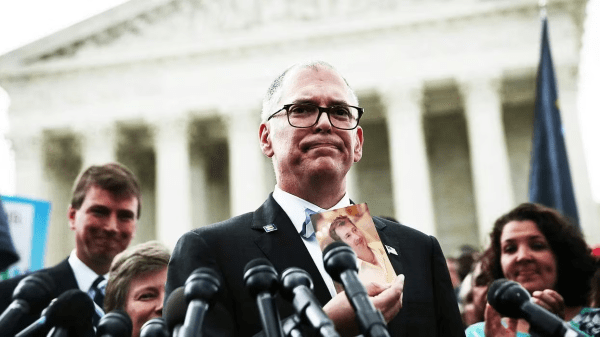
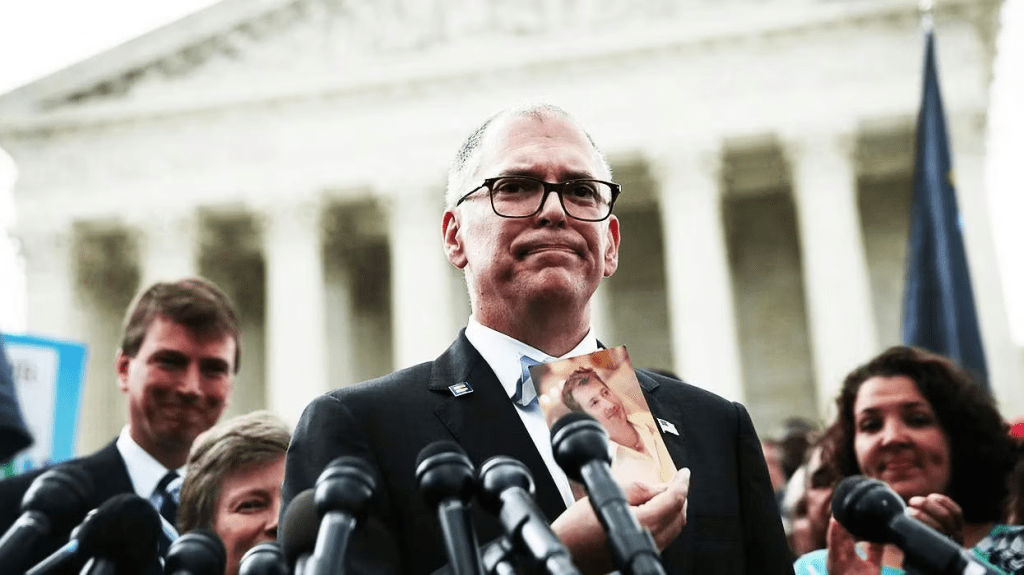
When the nine U.S. Supreme Court justices meet behind closed doors on Friday, the justices will decide whether to hear an appeal from former Kentucky county clerk Kim Davis, a name that became synonymous with anti-LGBTQ+ attitudes to marriage equality a decade ago.

Davis, who refused to issue marriage licenses to same-sex couples after Obergefell v. Hodges made marriage equality the law of the land in 2015, has asked the court not only to overturn her financial settlement in a civil case loss in lower courts but also to reconsider the landmark ruling itself.

While Davis’s petition centers on whether she can be held personally liable for emotional-distress damages, her legal team is also urging the justices to revisit the constitutional right to marry. For those who remember the culture war that surrounded Davis’s defiance, the possibility that her name might again appear on the Supreme Court docket has reignited deep anxiety across the LGBTQ+ community

In separate interviews with The Advocate, Jim Obergefell, the plaintiff whose name now defines that right, and GLAD Law legal director Josh Rovenger described the moment as both surreal and revealing. One is the man who stood before the Court ten years ago and won the right to have his marriage recognized. The other works at the organization that helped secure that victory. Both see the Davis petition not just as a legal maneuver but as a test of whether the country can sustain a principle it once declared settled.

“A narrow case, shoehorning a broad agenda”

Rovenger explained what this case is and what it isn’t.

“This is a narrow case with a technical legal question,” he said, emphasizing that it concerns emotional-distress damages and qualified immunity, not marriage equality itself. “Attorneys who want to overturn Obergefell are trying to shoehorn that into a very narrow case.”

Davis, a former Rowan County clerk, was found liable for denying marriage licenses to same-sex couples in violation of clearly established law. A jury awarded damages to those couples, and the Sixth Circuit Court of Appeals affirmed the decision. Davis’s petition now asks the Supreme Court to review that ruling, Rovinger explained. While she has framed the case as one about her religious freedom, Rovenger said the issue before the Court remains technical.

“The Supreme Court receives thousands of petitions a year,” he said. “It would really be anomalous for them to take a case with such a narrow fact pattern and use it to revisit Obergefell.”

Still, Rovenger acknowledged why people are uneasy.

“Given the rollback of rights we’ve seen in other areas, Dobbs being the most prominent, that fear makes sense,” he said. “But this case is not the vehicle for that kind of sweeping reversal.”

The limits of the Respect for Marriage Act

Part of the current confusion, Rovenger said, stems from uncertainty about how the Respect for Marriage Act interacts with the Obergefell decision. The 2022 law, signed by President Joe Biden, requires states and the federal government to recognize marriages performed in other states. However, it does not compel every state to issue marriage licenses if Obergefell were to be overturned.

“In a world where Obergefell didn’t exist,” he said, “a couple married in one state would still have their marriage recognized federally and by other states, but not necessarily be able to marry everywhere.”

He called that distinction significant, not only for its practical consequences but for what it would signal about equality itself.

“A patchwork approach across states,” he said, “is fundamentally different from a nationwide right.”

Rovenger also pointed to the Supreme Court’s own language on “reliance interests” — the idea that people build their lives on the stability of established rights. Trump-appointed Justice Amy Coney Barrett, he noted, has recently said marriage equality has created such interests, making it less likely to be undone. Barrett had told the New York Times that Obergefell created “concrete reliance interests.”

“Those interests,” Rovinger said, “remain one of the critical factors the Court considers when deciding whether to revisit precedent.” According to Gallup, 68 percent of Americans support marriage equality.

Jim Obergefell: “Disgusted by this twisting of religious freedom”

For Jim Obergefell, the case is personal. He said he was “disgusted” that his fellow citizens would work against another group’s well-being and happiness, using religious liberty as an excuse.

“This modern version of religious freedom — this belief that one’s personal religion trumps everything else — is a twisting and perverting of what our founders intended,” he said.

Obergefell said Davis’s refusal to follow the law was emblematic of a broader problem: public officials placing private faith above civic duty.

“She swore an oath to serve all people,” he said. “And yet she used her government position to persecute others.”

His frustration extends to the justices themselves and their recent decisions, which have often ignored established understandings of the law. Justice Clarence Thomas recently said that past decisions “aren’t gospel.”

“Why should anyone feel secure about the right to marry,” he asked, “when this Court has proven it doesn’t believe in precedent?”

He pointed to Thomas’s concurrence in the ruling that overturned Roe v. WadeRoe v. Wade, Dobbs v. Jackson Women’s Health Organization. Thomas explicitly suggested revisiting Obergefell.

“One of those justices’ own marriage exists because of a Supreme Court decision,” Obergefell said, referring to Loving v. Virginia, the 1967 ruling that struck down bans on interracial marriage. Thomas is Black, and his wife, Ginny, is white. “If this Court overturns Obergefell, then what does that say about their own logic?” Obergefell added.

“People should be concerned”

Obergefell said that the LGBTQ+ community’s fear is warranted.

“Absolutely, people should be concerned. I’m concerned,” he said on Saturday. “Yesterday I officiated a wedding for a cousin who asked whether they should get married now instead of waiting. My answer was yes.”

He explained that even with the Respect for Marriage Act in place, states could still move swiftly to block new marriages if Obergefell were struck down.

“Ohio [where I live] still has a Defense of Marriage Act on the books,” he said. “If Obergefell is overturned, Ohio could immediately say, ‘no more marriage licenses for queer couples.’”

Obergefell warned that political forces aligned against LGBTQ+ rights have shown a willingness to manipulate electoral systems to maintain power.

“We have a political party that has turned its back on democracy,” he said. “They’re doing everything they can solely to remain in power — to punish and to be vindictive.”

A fragile majority, a durable principle

Despite deep pessimism about the Court, Obergefell said he still finds hope in younger generations.

“They don’t see difference the way older generations do,” he said. “There are millions of people out there who share my values, who believe in humanity, who believe every person deserves happiness and rights. That gives me hope.”

Rovenger echoed the sentiment, though his version is more procedural.

“We’re all watching closely,” he said. “We’ll keep an eye on whether the case gets relisted and on any separate statements that come out. But we’re not panicking. We’re prepared for all possibilities and ready to meet that moment if it comes.”

For now, the fate of Obergefell doesn’t hinge on oral arguments or public hearings but on what happens in a private conference room inside the marble halls of the Supreme Court. Whether the justices see the Davis case as a technical dispute or a cultural flashpoint will determine not only one woman’s liability but perhaps the trajectory of a right that has defined a generation.

If the Court declines to hear the case, the lower-court rulings stand, and marriage equality remains intact. If it grants review, the nation will enter another defining chapter in its legal history.

Either way, Obergefell’s warning lingers: “They’ve turned the idea of freedom on its head,” he said. “And unless we stand up for what it truly means, we risk losing more than marriage, and we risk losing the very promise of equality itself.”

First-of-its-kind LGBTQIA+ hotline in Illinois offers support amid sweeping attacks

Read more at Prism.

Since the Trump administration took office in January, it has launched a sweeping attack on LGBTQIA+ people, and particularly on trans rights. In January, President Donald Trump signed an executive order designed to ban trans service members from the military. He has also attempted to prevent trans, nonbinary, and intersex people from obtaining passports with accurate gender markers and tried to withhold funds from hospitals that provide gender-affirming care to trans youth. 

These and other attacks have drawn lawsuits and been the subject of conflicting and ongoing court rulings. The result is that trans people and queer people face a bewildering, frightening, and chaotic legal landscape when they try to negotiate health care, travel, veterans’ benefits, education, employment, or just existence. Accessing resources, or even determining whether they can exist, can be difficult and disheartening.

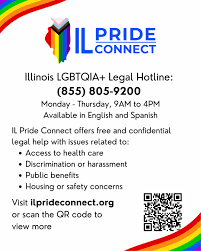
Illinois, in partnership with numerous state LGBTQIA+ organizations, is attempting to help. In August, the state launched Illinois Pride Connect, a legal resource hotline for queer people. The initiative was launched with $250,000 from the state and another $100,000 in private donations; it includes a website and a legal hotline—(855) 805-9200—which is available Monday through Thursday, 9 a.m. to 4 p.m. CT. 

According to Gov. J.B. Pritzker, Illinois Pride Connect makes Illinois “the only state in the nation to provide free legal advice and advocacy tools to protect the LGBTQ community.”

Illinois Pride Connect is led by the state’s Department of Human Services and the Legal Council for Health Justice (LCHJ), which runs and staffs the hotline. LCHJ Executive Director Julie Justicz said her organization began discussing the need for a resource hub last spring. 

“We were getting an increased number of calls from community members who were concerned about the number of executive orders that were coming down, impacting LGBTQ families in Illinois,” she told Prism. The organization was fielding more and more calls about gender-affirming care, education, and passports. “We talked with these other partner groups and decided that it would be good to establish an up-to-date, well-vetted hub of information.”

The state and other LGBTQIA+ organizations got on board quickly, and the resource hub launched in the summer. Justicz said LCHJ has five or six of its 30 staff members working extensively on the hotline. The website has had around 8,800 hits, and the staff receives two or three calls a day. She noted that the hotline also gets some calls from out of state, as LGBTQIA+ people and families consider moving into Illinois.

LCHJ is aware that people using the Illinois Pride Connect hub may be in a vulnerable position. The website offers a quick escape option in case someone does not want others to know they are seeking information on LGBTQ issues. Callers are also anonymous to protect them, though Justicz was able to provide Prism with descriptions of some conversations.

One caller to Illinois Pride Connect, according to the caller description, was “a parent of a trans adolescent seeking information on the risks and benefits of applying for a passport to reflect her child’s gender identity.” The family had updated birth certificates and state ID but had not changed their passport or Social Security record, and was worried about trying to get through customs with inconsistent gender information. Pride Connect was able to provide “detailed information on the current federal policies on gender marker changes to vital records, and on the Orr v. Trump court case concerning the State Department’s gender marker policy,” a staff attorney with LCHJ’s trans health law program said in an email.

Another caller was “a veteran living in rural IL who could no longer access transition-related medical care through [Veteran Affairs] and Tricare,” said the attorney, who requested to remain unnamed due to safety concerns about harassment and doxxing. The veteran was trying to determine if she could access Medicaid or other health insurance. Illinois Pride Connect provided information about Medicaid coverage in the state and referred her to local providers. This was especially helpful since the veteran had not been aware that local services were available.

Mike Ziri, the director of public policy at Equality Illinois, an organization on the Pride Connect Steering Committee, told Prism, “We get frequent requests for legal support, and those requests have accelerated in the last few years, particularly this year.” 

Equality Illinois is a lobbying and civil rights organization; it doesn’t provide individual legal advice. So, Ziri said, “having a resource like Illinois Pride Connect—it’s great, it’s important, it’s critical.” 

In the past, he said, Equality Illinois might have scrambled to connect people with someone at the Department of Human Rights or to another partner who might provide legal services. But, he said, “having a dedicated hotline … fills that gap.”

Kaitian Healey, gender diverse navigation specialist at Central Illinois Friends in Peoria, told Prism that he had found out about Pride Connect after it launched. 

“Our organization was not listed as a health care provider that offered gender-affirming care and LGBT, plus care. So I was a little offended.” He reached out to Pride Connect, and Central Illinois Friends was quickly added to the steering committee. 

“I work a caseload of about 100 folks that are accessing gender-affirming care,” Healey said. “And we do know of at least two clients” who reached out to Pride Connect for advice on navigating legal resources. Central Illinois Friends is an organization that focuses on health care, including sexual health testing, gender-affirming care, and mental health counseling. Illinois Pride Connect allows the group to easily direct the populations they serve in the central part of the state—including Peoria, Bloomington-Normal, and Galesburg—to resources that Central Illinois Friends does not provide directly.

Justiecz said that LCHJ is exploring an afterhours option so that people can leave legal questions when the hotline is not in operation and receive callbacks. As for the future, she said, they are looking to secure funding to sustain the initiative through the next two or three years at least under the current administration. After that, she said, the group will try to assess “are things getting worse for the community where they need this more?” 

Right now, there’s no question that the resource is needed. 

“We have challenges,” Ziri of Equality Illinois told Prism. “But the values of our state are equality, inclusion, and justice. And this project is just one way those values are manifested.”

LGBTQ+ people march against Javier Milei & for Pride in Buenos Aires this weekend

Read more at LGBTQ Nation.

The streets of Buenos Aires were filled with sounds of celebration and protest on Saturday as Argentina’s largest Pride march rolled from the city’s central Plaza de Mayo to the National Congress building. 

Hundreds of thousands turned out in support of the LGBTQ+ community and against right-wing Argentine President Javier Milei’s public attacks on it.

The political backdrop for the march was a resounding victory last week for Milei’s party, La Libertad Avanza (LLA), in legislative elections. Low voter turnout may have contributed to a strong showing that took pollsters and the opposition by surprise.

LLA won more than 40 percent of the vote nationwide and 15 of 24 districts, providing the Trump-aligned leader with a veto-proof number of votes in the legislature. It also promised delivery of Trump’s $20 billion bailout for Milei to address Argentina’s ailing economy.

Attendees on Saturday marched under the slogan “Against hate and violence: more pride and unity,” as they navigated packed downtown streets and boulevards toward the capital building.

“These days, with the current government, there is a lot of hate. You can see it in the streets and on social media,” Nahuel Vassallo, a 22-year-old university student, told the Buenos Aires Times. “That’s why standing here to defend our rights and who we are is so key.”

Milei has charted a course of division and blame similar to Trump’s.

Earlier this year, he took the international far-right’s “war on woke” to the World Economic Forum in Davos, Switzerland, with a fiery speech declaring that LGBTQ+ “gender ideology constitutes plain and simple child abuse.”

“They are pedophiles,” he said of the LGBTQ+ community.

“The mental virus of woke ideology” is “the great epidemic of our time that must be cured,” he added. “This is the cancer we need to get rid of,” along with “feminism, diversity, inclusion, abortion, environmentalism, and gender ideology.”

The rhetorical assault inspired a massive demonstration in Buenos Aires days later.

Milei responded by amending the country’s Gender Identity Law by decree. The groundbreaking measure, passed in 2012, dropped requirements for any diagnosis or treatment for someone to prove their gender identity, depathologizing transgender identity. The amended legislation banned gender-affirming hormone treatments and surgeries for trans people under 18. 

Mileie has also dissolved the government agencies responsible for gender equality and anti-discrimination efforts.

Argentina has a history of pro-LGBTQ+ legislation that is under attack by Milei and his far-right supporters. The country was the first in Latin America to legalize same-sex marriage in 2012.

According to the latest report from the National Observatory on LGBT+ Hate Crimes, hate crime incidence is up 70 percent in the first six months of 2025 vs. the same period last year. Perhaps more worrying, security forces perpetrated more than half, double the number last year.

Viviana Cardano, from the ATE state-workers union, said the LGBT+ community had suffered under Milei’s divisive politics.

“Today we are all here to reject the policies of this new government and the persecution that the LGBTQ+ community has been suffering since Milei’s statements in Davos,” she said on Saturday.

Among the thousands of signs at the march, one read: “There is no pride without justice.”

Judge nixes Justice Department subpoena of telehealth trans health care provider

Read more at The Advocate.

A federal judge has quashed the Department of Justice’s subpoena for the records of QueerDoc, a telehealth service that prescribes medications and offers consulting for gender-affirming care in 10 states.

The DOJ subpoenaed QueerDoc June 11, requesting personnel information, documents identifying patients, patients’ medical records, billing records, insurance claims, communications with drugmakers, and more. It was among more than 20 such subpoenas issued.

The same day, the DOJ’s Civil Division issued a memo saying it would “prioritize investigations of doctors, hospitals, pharmaceutical companies, and other appropriate entities” for “possible violations of the Food, Drug, and Cosmetic Act and other laws” regarding medications used in gender-affirming care and False Claims Act violations by health care providers who “evade state bans on gender dysphoria treatments by knowingly submitting claims to Medicaid with false diagnosis codes.”

These investigations derived from Donald Trump’s executive order recognizing only male and female sexes as assigned at birth and another denouncing gender-affirming care for minors as “a stain on our Nation’s history” that “must end” and threatening federal funding that provide such care. He also directed the DOJ to investigate providers. In April, Attorney General Pam Bondi released a memo saying the DOJ would “act decisively to protect our children and hold accountable those who mutilate them under the guise of care.” She used the same language about mutilation in a later press release. That a day after QueerDoc filed motions with a U.S. District Court in Washington State to quash the subpoena and seal the court proceedings, according to the court.

“DOJ issued its inflammatory press release declaring that medical professionals have ‘mutilated children in the service of a warped ideology,’ one day after QueerDoc filed these motions, effectively destroying any claim to investigative confidentiality while attempting to sway public sentiment against healthcare providers like QueerDoc,” Judge Jamal Whitehead wrote in his ruling, which came out Monday. “Such conduct appears calculated to intimidate rather than investigate.”

“The question before the Court is whether DOJ may use its administrative subpoena power to achieve what the Administration cannot accomplish through legislation: the elimination of medical care that Washington and other states explicitly protect. The answer is no,” he continued. He noted that gender-affirming care is supported by major medical groups and many courts.

Whitehead added, “When a federal agency issues a subpoena not to investigate legal violations but to intimidate and coerce providers into abandoning lawful medical care, it exceeds its legitimate authority and abuses the judicial process.”

He denied the motion to seal the proceedings “because, despite legitimate safety concerns, transparency in judicial proceedings remains paramount when challenging executive power,” he wrote.

QueerDoc welcomed the ruling. “The court affirmed that government power cannot be used to intimidate providers or breach the confidentiality of patients seeking medically necessary care,” the organization said in a statement on its website. “This is a win not just for QueerDoc, but for every clinician and patient fighting for the right to safe, private healthcare.”

The subpoena was “a calculated attempt by the Trump administration and Attorney General Pam Bondi to weaponize the Department of Justice against transgender people and the clinicians who care for them,” the statement noted. QueerDoc did not surrender any patient information to the DOJ, and care was not disrupted, the group said.

A federal judge in Massachusetts quashed a similar DOJ subpoena to Boston Children’s Hospital in September, and the department is appealing, Politico reports. The Children’s Hospital of Philadelphia and the University of Pittsburgh Medical Center are in court fighting DOJ subpoenas on gender-affirming care as well.

Asked by Politico for comment on the QueerDoc ruling, the DOJ issued this statement: “As Attorney General Bondi has made clear, this Department of Justice will use every legal and law enforcement tool available to protect innocent children from being mutilated under the guise of ‘care.’”

Netherlands Elects Its Youngest, First Openly Gay Prime Minister — and He’s Engaged to a Heartthrob Olympian

Read more at People.

The Netherlands just made history with their most recent election.

The country voted on Wednesday, Oct. 29, to elect Rob Jetten, 38, as prime minister, making Jetten both the youngest and very first openly gay candidate to hold the role, according to German outlet Deutsche Welle (DW).

Jetten, a member of the centrist-liberal D66 party, beat Geert Wilders, a member of the far-right Party for Freedom. Wilders ran on an anti-immigration campaign and has previously called to ban the Quran, among other Islamophobic remarks.

“I am incredibly happy that … we have become the biggest party in this election,” Jetten told reporters after election results came in, per DW. “A historic result for the D66. At the same time, I feel a great responsibility.”

He added, “I think we’ve now shown to the rest of Europe and the world that it is possible to beat the populist movements if you campaign with a positive message for your country.”

While Jetten is the projected winner of the election, DW notes that he will be officially confirmed the winner when the final results come in on Monday, Nov. 3, the day mail-in ballots are counted from Dutch citizens living abroad.

Jetten got plenty of support on election night from his fiancé, two-time Olympian Nico Keenan, who posted a sweet TikTok video of the couple preparing for the evening. In the clip, which was set to RAYE‘s “Where the Hell Is My Husband?,” Keenan, 28, stood solo in the frame while dressed in a suit.

When he looked offscreen, Jetten soon appeared, also dressed in a suit. As he buttoned his jacket, Keenan reached over and held him by the waist, before the two smiled at the camera then shared a quick kiss.

“Election night, let’s go🔥🫶🏽,” Keenan captioned the post.

Jetten has been equally supportive of Keenan. When his fiancé competed for Argentina in field hockey at the 2024 Paris Olympics, Jetten cheered him on from the stands at the Stade Yves-du-Manoir.

The couple announced their engagement in November 2024, when Keenan posted a photo of his engagement ring on Instagram and captioned the post, “Soon to be Mr&Mr💍.”

Keenan, who is bisexual, began playing field hockey for the Netherlands’ Hockey Club Klein Zwitserland in 2017, according to Out Sports. While speaking with the Dutch outlet Trouw in April, Keenan said he’s received messages of support and gratitude for competing as an openly bisexual athlete.

“People told me how happy they were that there was finally an openly bisexual hockey player playing in the Premier League,” he said.

Keenan and Jetten are set to marry next year, according to the BBC.

Blog at WordPress.com.

Up ↑