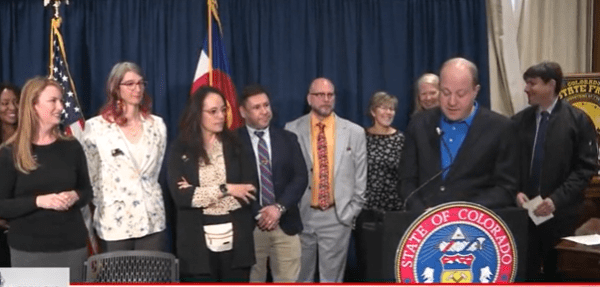
“Colorado is for everyone, no matter who you are or who you love,” Polis said in a press release. “Last November, the voters got rid of outdated language in our constitution that banned same-sex marriage. This is a long overdue step in the right direction and today’s law I’m signing ensures that Coloradans can marry who they love in our Colorado for all.”
“I am personally grateful to Senator Danielson, Representatives Garcia and Titone, and the countless community leaders and advocates whose hard work has made today possible,” Reis said. “This landmark legislation fulfills the hopes and dreams of so many across our LGBTQ+ and allied communities, and affirms that progress hard won is always worth defending, and in the end, love triumphs over all.”
Colorado’s previous same-sex marriage ban had been unenforceable since the U.S. Supreme Court’s 2015 Obergefell v. Hodges decision.
The Supreme Court announced Monday it will hear a case regarding whether state bans on “conversion therapy” trying to change minors’ sexual orientation or gender identity are legal—a case that could carry billions of dollars in repercussions, as a 2022 study found conversion therapy carries an economic burden of approximately $9 billion annually for patients and their families.
Key Facts
The Supreme Court took up Chiles v. Salazar, a case challenging Colorado’s ban on LGBTQ “conversion therapy” for minors, which asks the justices to more broadly decide whether laws that “[censor] certain conversations between counselors and their clients based on the viewpoints expressed” are constitutional.
LGBTQ “conversion therapy,” as it’s commonly known, refers to any practices—including both emotional efforts, like talk therapy, or physical efforts, like electroconvulsive therapy—that aim to influence a patient’s sexual orientation or gender identity, which are typically framed as efforts to “cure” homosexuality or being transgender.
Repeated studies have shown such efforts are ineffective at changing people’s sexual orientation or gender identity and carry a variety of harmful effects—such as elevated risks for suicide, drug abuse and mental health issues—which has led to bans on conversion therapy for minors being enacted in more than 20 states.
Conversion therapy and its negative effects also have an economic impact, as a 2022 study published in JAMA Pediatrics found conversion therapy and its “associated harms” result in an economic burden of approximately $9.23 billion per year.
Conversion therapy alone costs approximately $650 million for participants annually in the U.S., with individuals who undergo it paying an extra $97,985 for treatment as compared with people who don’t undergo any counseling, according to the study, which was based on data from LGBTQ youth ages 13-24.
There are also significant costs associated with knock-on effects from conversion therapy and the study estimates each conversion therapy patient pays an extra $83,366 on average to treat the “downstream consequences” associated with the procedure, which combined raise the total economic burden of conversion therapy to $9.2 billion.
What To Watch For
The Supreme Court will hear the case on conversion therapy at some point during its next term, which begins in October, so any ruling in the case is likely more than a year away.
What Did The Study Conclude?
The study, which was conducted by pro-LGBTQ rights organization The Trevor Project and research group Cytel, concluded there is a “high economic burden and high societal costs” that come along with conversion therapy, which the study refers to as sexual orientation and gender identity change efforts (SOGICE). Researchers analyzed the difference in costs between patients who underwent conversion therapy, LGBTQ youth who received no therapy and those who received therapy that affirmed their sexual orientation or gender identity. The study found conversion therapy carried the highest economic burden: In addition to the $650 million per year in total attributed to the therapy itself, there are also total annual costs of $190 million related to anxiety or “severe psychological distress” among those that underwent conversion therapy, $1.36 billion related to depression, $2.42 billion from suicide attempts, $1.17 billion from fatal suicides, $1.26 billion from alcohol use disorder and $2.18 billion from substance abuse. The likelihood of those negative outcomes was largely markedly higher among those who underwent conversion therapy as compared with other LGBTQ populations—except alcohol use disorder, where those without any therapy registered the highest number by one percentage point (42.26% among those with no intervention versus 41.26% among conversion therapy patients). As a result, the total costs incurred by conversion therapy patients were higher than the $4.85 billion in total annual costs among those who hadn’t received any treatment, and $3.04 billion among those who received affirmative therapy.
Contra
Researchers noted there were some limitations with the study’s methodology that may affect its results, such as being based on studies in which patients self-reported their experiences. That means it might not be fully representative of all LGBTQ patients, as many people may be unwilling to discuss their experiences. It also assumes the risks are the same across the LGBTQ population and for various types of conversion therapy, which may not be the case. Researchers argued they took a “conservative approach” with their findings, however, and noted the $9 billion figure is likely an underestimate of the total economic impact. The study only looked at adverse impacts from conversion therapy for three years after the treatment, for instance—though such effects could likely extend for much longer—and did not examine some other potential impacts, like post-traumatic stress disorder or medical consequences from various medications or electroconvulsive therapy.
Big Number
13%. That’s the share of LGBTQ youth who have either been subjected to or threatened with conversion therapy, according to a 2024 survey conducted by The Trevor Project among more than 50,000 Americans ages 13-24. That includes 5% who have been subjected to the therapy and 8% who were threatened with it. The 5% share is down from 10% who said in 2020 they were subjected to the therapy, though that number could rise again should the Supreme Court outlaw state bans.
Key Background
The Supreme Court case was brought by Kaley Chiles, a licensed counselor in Colorado who said in a court filing “she believes that people flourish when they live consistently with God’s design, including their biological sex.” Chiles objects to Colorado restricting her from counseling clients to change their sexual orientation or gender identity, claiming it violates her First Amendment rights and classifying state bans on conversion therapy as “silenc[ing] counselors’ ability to express views their clients seek on a topic of ‘fierce public debate.’” Chiles asked the Supreme Court to take up the case after a federal appeals court upheld Colorado’s policy restricting conversion therapy, ruling that it was regulating counselors’ professional conduct, rather than chilling First Amendment-protected speech. The case is the latest in a string of major cases related to LGBTQ rights the 6-3 conservative-leaning court has decided in recent years—such as cases over businesses being allowed to discriminate against same-sex couples or discriminate on the basis of sexual orientation and gender identity—and the court is deliberating on a case this term over gender-affirming care for minors.
Lucas and his son Alec share a laugh on the couch. Lucas and his family have deep roots in Texas, but they decided to move to Colorado out of fear for the safety of Alec, who came out as transgender years earlier.
Brianna went to bed Aug. 22 with a knot in her stomach.
That night, a Texas school board near her home passed a “Don’t Say Trans” policy barring employees from discussing what the district defined as “gender fluidity.”
The school board’s new policy was the latest entry in a growing, right-wing political playbook that targets transgender youth and the adults who support them.
Months before the school board’s decision, Texas Gov. Greg Abbott, a Republican, ordered the Texas Department of Family and Protective Services to conduct child abuse investigations into parents whose children received gender-affirming care such as puberty blockers and hormone therapy. Abbott’s decision was in line with the heavily conservative state legislature, which had introduced more anti-transgender bills than any other state.
In 2020, Brianna’s son, Rylee, came out as a transgender boy. He was 12 years old at the time.
Brianna and her family moved to Texas — which has one of the largest transgender communities in the country — in 2015 to be closer to their extended family. Brianna knew the small town they called home was far from progressive, but she expected to largely be left alone as she and her family kept their heads down and raised LGBTQ+ children.
But the state’s policies seemed to get crueler over time. Brianna knew her family wasn’t safe.
“I went to bed knowing what was happening and woke up the next day thinking, ‘we have to leave,’” Brianna recalled. “’We have to get out of Texas. This is not going to get better; it is just going to get worse.’”
She spent the following day researching states that were more welcoming to transgender people. The Pacific Northwest was too rainy, California was too expensive, Minnesota was too cold. She booked a 24-hour trip to Colorado — which received high marks from places like the Movement Advancement Project — to vet the state, making sure to ask folks she encountered about its safety for LGBTQ+ kids.
As she drove around Denver and saw rainbow flags plastered in business windows and hanging outside homes, Brianna knew where to move.
“It was so overwhelmingly positive and welcoming,” she said of Colorado. “In Texas, you couldn’t even talk about this stuff.”
The family voted in the Nov. 8 Texas election, feeling they owed their votes to friends in similar situations who couldn’t leave the state. Three days later, they packed their bags and started their journey to Aurora.
Tired of living in fear
Lucas and Sara had deep roots in Texas. Lucas worked at a nonprofit supporting kids in the foster care system; Sara taught music at a private school. The two had family and deep friendships in the state.
Sara, a mother and LGBTQ+ advocate, recently moved to Colorado from Texas in an effort to keep her transgender son safe.
But fear overwhelmed them in February 2022 after Abbott declared gender-affirming care for children a form of child abuse. The couple’s son, Alec, came out as transgender years earlier and began transitioning soon after.
Bullying and harassment were common for Alec in his small Texas town, but when laws began to threaten his safety, his parents knew something needed to change.
“There was a moment where I just imagined Alec being taken from our family,” Sara said. “Just having to process that was extremely scary and upsetting.”
Lucas and Sara became more outspoken in their LGBTQ+ allyship by helping plan Pride festivals and volunteering with Equality Texas.
Alec did his best to fit in at school. He wore baggy, unassuming clothes and tried to keep his head down.
“There were so many times where I was like ‘if I just de-transitioned and lived, I could live easier here,’ but the dysphoria makes things so hard,” said Alec, who is now 15 years old. “It wouldn’t have been a happy life for me.”
Other parents began complaining that Sara was using her position as a teacher to “push an agenda.” Sara maintains she never discussed politics in class.
“It was very clear that we were being targeted because this was a relatively small town and we had been outspoken,” Lucas said. “I knew this was really scary and we worried about what could happen to our family.”
Brianna and Rylee also remember living in fear.
“How exhausting it was, not knowing day-to-day what laws were going to be passed that would hurt my child and not understanding why it’s something that people care about,” Brianna said. “I don’t understand the vitriol towards these kids who just want to exist and the parents who just want their kids to survive.”
Brianna tried to educate those around her and give them the benefit of the doubt. But many people didn’t seem interested in learning.
“It’s extremely frustrating and there’s no amount of education I could do,” Brianna said. “You think you can educate people away from bad beliefs, but they’re not interested in the truth. They’re interested in their narrative and that’s it.”
Lucas and Sara remember having conversations with Alec where they reminded him not to stand out too much, which was a painful message to send for two parents who wanted nothing more than to affirm their child.
“We did a lot of apologizing to the kids and saying, ‘I’m sorry you can’t wear what you’d like to wear because we need to be careful right now,’” Sara recalled. “I remember saying that a lot. ‘We need to be careful right now.’”
The family also helped plan a kid-friendly Pride celebration in their town, hoping to show marginalized children that adults were on their side. However, several other adults, including an anti-LGBTQ+ Instagram “influencer,” showed up and chanted “groomer” at those participating in the festival.
“It was really weird because I grew up there and that place just turned on me,” Alec said.
The family had lived in their town for 14 years and felt it was important to stay and fight for other LGBTQ+ people. But as anti-transgender bills stacked up and hateful rhetoric grew louder, Lucas and Sara saw that their family’s safety was in jeopardy.
“It was a constant state of anxiety and fear,” Lucas said. “All it would take was one person in our town who didn’t like us and report us and we would’ve had a CPS case that we would be dealing with.”
In 2023, the family said goodbye to their longtime church, colleagues and friends and moved to Denver, where they felt safer in their new home.
Anderson Lee Aldrich, the shooter responsible for the tragic incident at a Colorado Springs LGBTQ nightclub, has pleaded guilty to multiple charges. On Monday, Aldrich admitted to five counts of murder, 46 counts of attempted murder, and two counts of bias-motivated crime. As part of a deal with prosecutors, the 23-year-old will serve life in prison for the Club Q shooting. The attack occurred during a drag show on the eve of Transgender Day of Remembrance in November 2022. Aldrich originally faced over 300 charges, including murder and hate crimes, related to this horrific mass shooting.
According to the criminal complaint, Aldrich entered Club Q wearing a bulletproof vest and armed with an AR-style rifle and handgun before firing into the crowd, killing Daniel Aston, Raymond Green Vance, Kelly Loving, Ashley Paugh and Derrick Rump.
The court moved to sentencing procedures immediately following Aldrich’s guilty plea, and survivors and loved ones of the victims shared how their lives were forever changed that night.
Vance’s mother, Adriana Vance, begged the judge to hand down a brutal sentence as she grieved the death of her son. She called Vance a kind, loving and gentle man who touched the lives of those who surrounded him.
“This man doesn’t deserve to go on,” she said of Aldrich. “What matters now is that he never sees the sunrise or a sunset.”
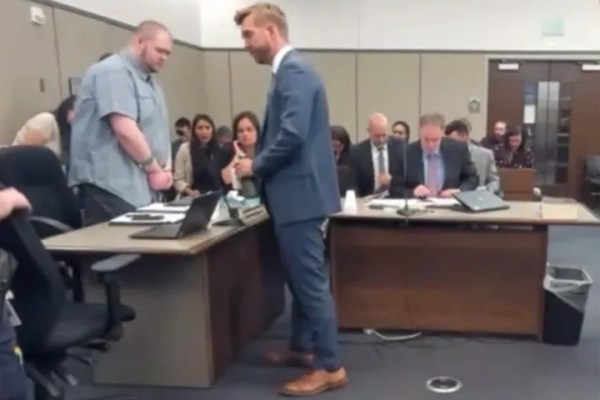
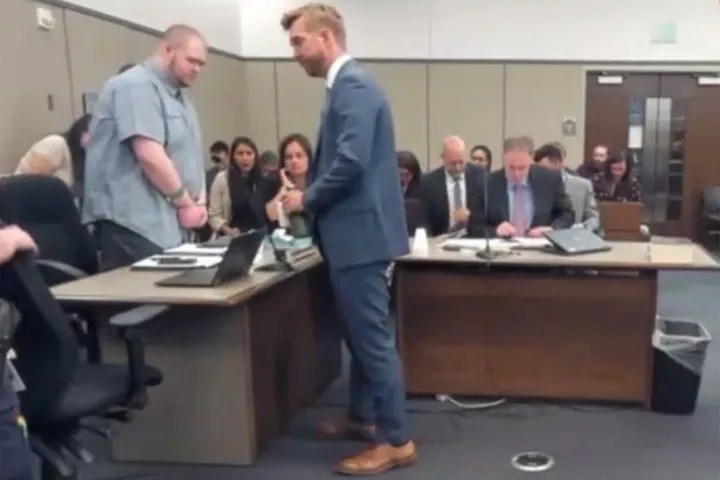
Wyatt Kent, a drag performer who was celebrating his 23rd birthday on the night of the shooting, survived but lost his partner, Daniel Aston. Kent stood in front of Aldrich and the judge to express his forgiveness. He added that he lost his sense of safety with the shooting.
“I forgive this individual as they are a symbol of a broken system of hate and vitriol pushed against us as a community,” Kent said. “It is inexcusable the action and the pain and trauma and holes that have been created from this tragic evening.”
Anderson Lee Aldrich takes a seat after pleading guilty to murder and other crimes in a still image from courtroom Webex video on June 26, 2023.




 fleeredstates.blog
You must be logged in to post a comment.