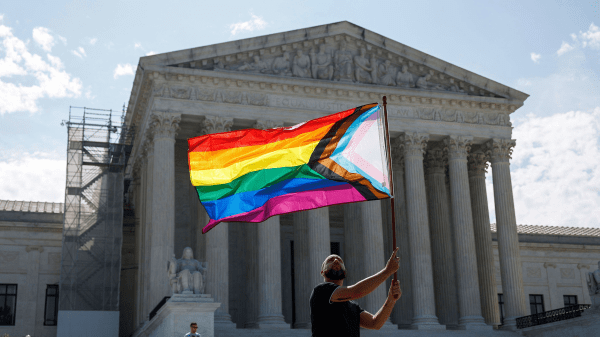
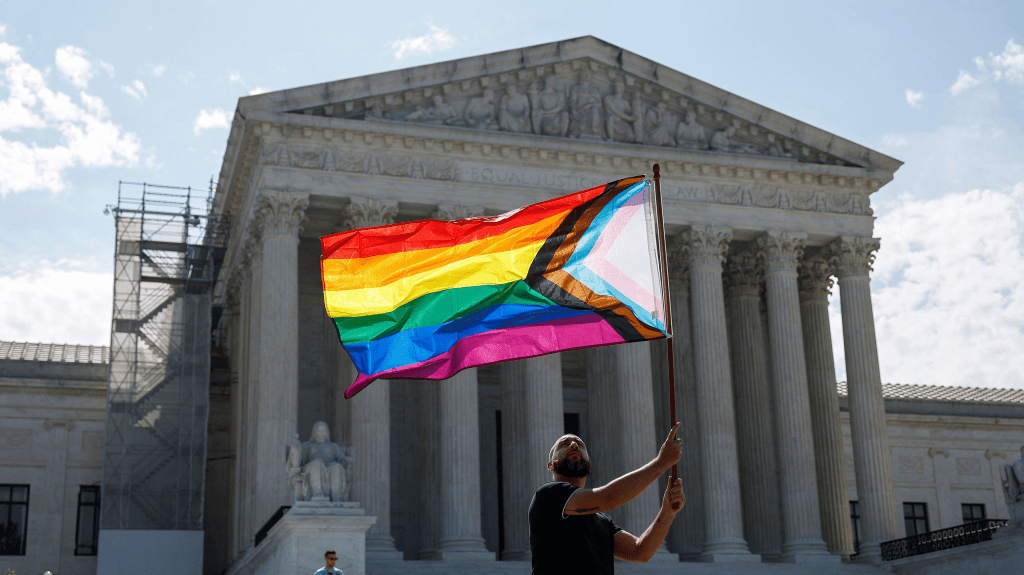
The United States Supreme Court has ruled in favour of a group of parents seeking to exempt their children from public school instruction that conflicts with their religious beliefs, in a 6-3 decision that reinforces constitutional protections for religious freedom.
The case was brought by Christian, Muslim, and Jewish parents in Montgomery County, Maryland, who objected to the use of LGBTQ-themed storybooks in elementary school classrooms, particularly books addressing same-sex marriage and gender identity.
Justice Samuel Alito, delivering the majority opinion, wrote that refusing to permit parents to opt their children out of such instruction “poses a very real threat of undermining their religious beliefs and practices” and violates the First Amendment’s guarantee of the free exercise of religion.
“The Montgomery County Board of Education’s introduction of the ‘LGBTQ+-inclusive’ storybooks, along with its decision to withhold opt outs, places an unconstitutional burden on the parents’ rights to the free exercise of their religion,” Alito wrote.
The justices found that the parents were likely to succeed in their legal challenge and should be granted a preliminary injunction while the case continues, meaning the school board must temporarily accommodate their request to be notified in advance of any related instruction and allow their children to be excused.
“In her dissent, Sotomayor accused the court of inventing a ‘constitutional right to avoid exposure to subtle themes contrary to the religious principles that parents wish to instill in their children.’” She was joined in dissent by Justices Elena Kagan and Ketanji Brown Jackson.
The dispute stems from a 2022 policy change when the school district introduced several LGBTQ-themed books into its language arts curriculum and initially allowed parents to opt out. A year later, the board reversed that decision, arguing the opt-out system was unmanageable and conflicted with the district’s commitment to inclusion.
The parents argued that mandatory exposure to the material, without an option to decline, amounted to “government-led indoctrination about sensitive matters of sexuality.” School officials, however, maintained that the books are intended to introduce children to “diverse viewpoints and ideas.”
During oral arguments in April, the court’s conservative majority signaled strong support for parental rights in such cases, indicating that allowing families to opt out of instruction on sensitive subjects should be “common sense.”
A Texas A&M committee agreed that the university was wrong to fire a professor earlier this year after a controversy over a classroom video that showed a student objecting to a children’s literature lesson about gender identity.
The internal committee ruled that the university didn’t follow proper procedures and didn’t prove there was good cause to fire Melissa McCoul, who was a senior lecturer in the English department with over a decade of teaching experience. Republican lawmakers, including Gov. Greg Abbott, had called for her termination after seeing the video.
The committee unanimously voted earlier this week that “the summary dismissal of Dr. McCoul was not justified.”
The university said in a statement that interim President Tommy Williams has received the committee’s nonbinding recommendation and will make a decision in the coming days or weeks after reviewing it.
McCoul’s lawyer, Amanda Reichek, said this dispute seems destined to wind up in court because the university appears to plan to continue fighting and the interim president is facing the same political pressure.
“Dr. McCoul asserts that the flimsy reasons proffered by A&M for her termination are a pretext for the University’s true motivation: capitulation to Governor Abbott’s demands,” Reichek said in a statement.
The video showing a student questioning whether the class discussion was legal under President Trump’s executive order on gender roiled the campus and led to sharp criticism of university president Mark Welsh, who later resigned, but he didn’t offer a reason and never mentioned the video in his resignation announcement.
The opening of the video posted by state Rep. Brian Harrison showed a slide titled “Gender Unicorn” that highlighted different gender identities and expressions.
Students in the class told the Texas Tribune that they were discussing a book called “Jude Saves the World” about a middle schooler who is coming out as nonbinary. That was just one of several books included in the course that highlights LGBTQ+ issues.
After a brief back-and-forth discussion about the legality of teaching those lessons, McCoul asked the student to leave the class. Harrison posted other recordings of the student’s meeting with Welsh that show the university president defending McCoul’s teaching.
The Tribune reported that McCoul had taught the same course at A&M at least 12 times since 2018. University officials decided to end this particular summer class early after the confrontation, but McCoul returned to teach in the fall until after the videos were published online.
Welsh had said when McCoul was fired that he learned she had continued teaching content in a children’s literature course “that did not align with any reasonable expectation of standard curriculum for the course.” He also said that the course content was not matching its catalog descriptions. But her lawyer disputed that, and said McCoul was never instructed to change her course content in any way, shape or form.
Earlier this month, the Texas A&M Regents decided that professors now need to receive approval from the school president to discuss some race and gender topics.
The new policy states that no academic course “will advocate race or gender ideology, or topics related to sexual orientation or gender identity” unless approved in advance by a campus president.
Various universities and their presidents around the country, including Harvard and Columbia have come under scrutiny from conservative critics and President Donald Trump administration over diversity, equity and inclusion practices and their responses to campus protests.
Two Denver-area Catholic parishes asked the U.S. Supreme Court on Thursday to reconsider a lower court decision that said parish preschools participating in Colorado’s state-funded preschool program couldn’t deny admission to LGBTQ children or children from LGBTQ families.
The appeal to the Supreme Court comes about six weeks after the 10th Circuit Court of Appeals ruled against the Catholic parishes, which had argued that enrolling children from LGBTQ families would conflict with their religious beliefs.
Gov. Jared Polis lauded the circuit court’s Sept. 30 ruling, which was a major win for the state.
If the Supreme Court agrees to hear the case, the justices could answer a question at the heart of the case: Can private religious schools that accept public education dollars refuse to enroll certain kids based on religious principles? The state and two lower courts have said no. The Supreme Court, which has a conservative majority, could give a different answer.
A spokesperson for Colorado Department of Early Childhood, which runs the state-funded preschool program, said officials won’t comment on pending or active litigation.
The Catholic preschools sued the state in 2023 as Colorado launched its new universal preschool program, which provides tuition-free preschool to 4-year-olds statewide. The $349 million program serves more than 40,000 children and allows families to choose from public, private, or religious preschools.
St. Mary Catholic Virtue School in Littleton and Wellspring Catholic Academy in Lakewood wanted to join the program when it started, but didn’t want to admit LGBTQ children or children from LGBTQ families.
They asked for an exemption from state rules banning discrimination based on sexual orientation and gender identity, but the Colorado Department of Early Childhood refused. The two preschools never joined the program, and in August 2023, the parishes that ran the preschools sued the state.
Of more than 2,000 preschools participating in Colorado’s universal preschool program this year, about 40 are religious.
Attorneys from The Becket Fund for Religious Liberty, which is representing the Catholic preschools in the case, have argued that Colorado is discriminating against the preschools based on religion.
“Colorado is picking winners and losers based on the content of their religious beliefs,” Nick Reaves, senior counsel at Becket, said in a press release Friday.
The release suggests that Colorado’s rules barring discrimination have hurt Catholic preschool enrollment.
Since universal preschool began, “enrollment at Catholic preschools has swiftly declined, while two Catholic preschools have shuttered their doors, including one that predominantly served low-income and minority families,” the press release said.
Wellspring, one of two parish preschools involved in the case, did close last year when the K-8 school it was part of closed because of low enrollment and financial problems. A Catholic preschool in Denver also shuttered when the K-8 school it was part of — Guardian Angels Catholic School — closed at the end of the 2024-25 school year. At the time the Archdiocese of Denver announced the closure of Wellspring and Guardian Angels, it also announced the consolidation of two Catholic high schools into one campus.
The Texas State Board of Education is reshaping how public schools will teach social studies for years to come, but its recent selection of the panelists who will advise members during the process is causing concern among educators, historians and both Democrats and Republicans, who say the panel’s composition is further indication that the state wants to prioritize hard-right conservative viewpoints.
The Republican-dominated education board earlier this year officially launched the process of redesigning Texas’ social studies standards, which outline in detail what students should know by the time of graduation. The group, which will meet again in mid-November, is aiming to finalize the standards by next summer, with classroom implementation expected in 2030.
The 15 members in September agreed on the instructional framework schools will use in each grade to teach social studies, already marking a drastic shift away from Texas’ current approach. The board settled on a plan with a heavy focus on Texas and U.S. history and less emphasis on world history, geography and cultures. Conservative groups like Texas Public Policy Foundation and the Heritage Foundation championed the framework, while educators largely opposed it.
In the weeks that followed, the board selected a panel of nine advisers who will offer feedback and recommendations during the process. The panel appears to include only one person currently working in a Texas public school district and has at least three people associated with far-right conservative activism. That includes individuals who have criticized diversity efforts, questioned school lessons highlighting the historical contributions of people of color, and promoted beliefs debunked by historians that America was founded as a Christian nation.
That group includes David Barton, a far-right conservative Christian activist who gained national prominence arguing against common interpretations of the First Amendment’s establishment clause, which prevents the government from endorsing or promoting a religion. Barton believes that America was founded as a Christian nation, which many historians have disproven.
Critics of Barton’s work have pointed to his lack of formal historical training and a book he authored over a decade ago, “The Jefferson Lies,” that was pulled from the shelves due to historical details “that were not adequately supported.” Brandon Hall, an Aledo Republican who co-appointed Barton, has defended the decision, saying it reflected the perspectives and priorities of his district.
Another panelist is Jordan Adams, a self-described independent education consultant who holds degrees from Hillsdale College, a Michigan-based campus known nationally for its hard-right political advocacy and efforts to shape classroom instruction in a conservative Christian vision. Adams’ desire to flip school boards and overhaul social studies instruction in other states has drawn community backlash over recommendations on books and curriculum that many felt reflected his political bias.
Adams has proclaimed that “there is no such thing” as expertise, describing it as a label to “shut down any type of dialogue and pretend that you can’t use your own brain to figure things out.” He has called on school boards to craft policies to eliminate student surveys, diversity efforts and what he considers “critical race theory,” a college-level academic and legal framework examining how racism is embedded in laws, policies and institutions. Critical race theory is not taught in K-12 public schools but has become a shorthand for conservative criticism of how schools teach children about race.
In an emailed response to questions from The Texas Tribune, Adams pointed to his earlier career experience as a teacher and said he understands “what constitutes quality teaching.” Adams also said he wants to ensure “Texan students are taught using the best history and civics standards in America” and that he views the purpose of social studies as forming “wise and virtuous citizens who know and love their country.”
“Every teacher in America falls somewhere along the political spectrum, and all are expected to set their personal views aside when teaching. The same goes for myself and my fellow content advisors,” Adams said. “Of course, given that this is public education, any efforts must support the U.S. Constitution and Texas Constitution, principles of the American founding, and the perpetuation of the American experiment in free self-government.”
Republicans Aaron Kinsey and LJ Francis, who co-appointed Adams, could not be reached for interviews.
David Randall, executive director of the Civics Alliance and research director of the National Association of Scholars, was also appointed a content adviser. He has criticized standards he felt were “animated by a radical identity-politics ideology” and hostile to America and “groups such as whites, men, and Christians.” Randall has written that vocabulary emphasizing “systemic racism, power, bias, and diversity” cannot coexist with “inquiry into truth — much less affection for America.” He has called the exclusion of the Bible and Christianity in social studies instruction “bizarre,” adding that no one “should find anything controversial” about teaching the role of “Judeo-Christian values” in colonial North America.
Randall told the Tribune in an email that his goal is to advise Texas “as best I can.” He did not respond to questions about his expertise and how he would work to ensure his personal beliefs do not bleed into the social studies revisions.
Randall was appointed by Republican board members Evelyn Brooks and Audrey Young, both of whom told the Tribune that they chose him not because of his political views but because of his national expertise in history and civics, which they think can help Texas improve social studies instruction.
“I really can’t sit here and say that I agree with everything he has said. I don’t even know everything that he has said.” Brooks said. “What I can say is that I can refer to his work. I can say that he emphasizes integrating civics.”
The advisory panel also consists of a social studies curriculum coordinator in the Prosper school district and university professors with expertise ranging from philosophy to military studies. The group notably includes Kate Rogers, former president of the Alamo Trust, who recently resigned from her San Antonio post after Lt. Gov. Dan Patrick criticized her over views she expressed in a doctoral dissertation suggesting she disagreed with state laws restricting classroom instruction on race and slavery.
Seven of the content advisers were selected by two State Board of Education members each, while Texas’ Commissioner of Higher Education Wynn Rosser chose the two other panelists. Board member Tiffany Clark, a Democrat, did not appoint an adviser, and she told the Tribune that she plans to hold a press conference during the board’s November meeting to address what happened.
Staci Childs, a Democrat from Houston serving on the State Board of Education, said she had anticipated that the content advisory group would include “extremely conservative people.” But her colleagues’ choices, she said, make her feel like “kids are not at the forefront right now.”
Pam Little, who is the board’s vice chair, is one of two members who appear to have chosen the only content adviser with active experience working in a Texas K-12 public school district. The Fairview Republican called the makeup of the advisory panel “disappointing.”
“I think it signals that we’re going in a direction where we teach students what we want them to know, rather than what really happened,” Little said.
The board’s recent decisions show that some members are more focused “on promoting political agendas rather than teaching the truth,” said Rocío Fierro-Pérez, political director of the Texas Freedom Network, a progressive advocacy organization that monitors the State Board of Education’s decisions.
“Whether your political beliefs are conservative, liberal, or middle of the road really shouldn’t disqualify you from participating in the process to overhaul these social studies standards,” Fierro-Pérez said. “But it’s wildly inappropriate to appoint unqualified political activists and professional advocates with their own agendas, in leading roles and guiding what millions of Texas kids are going to be learning in classrooms.”
Other board members and content advisers insist that it is too early in the process to make such judgments. They say those discussions should wait until the actual writing of the standards takes place, which is when the board can directly address concerns about the new framework.
They also note that while content advisers play an integral role in offering guidance, the process will include groups of educators who help write the standards. State Board of Education members will then make final decisions. Recent years have shown that even those within the board’s 10-member Republican majority often disagree with one another, making the final result of the social studies revisions difficult to predict.
Donald Frazier, a Texas historian at Schreiner University in Kerrville and chair of Texas’ 1836 Project advisory committee, who was also appointed a content adviser, said that based on the panelists’ conversations so far, “I think that there’s a lot more there than may meet the eye.”
“There’s people that have thought about things like pedagogy and how children learn and educational theory, all the way through this panel,” Frazier said. “There’s always going to be hand-wringing and pearl-clutching and double-guessing and second-guessing. We’ve got to keep our eye on the students of Texas and what we want these kids to be able to do when they graduate to become functioning members of our society.”
The makeup of the advisory panel and the Texas-heavy instructional framework approved in September is the latest sign of frustration among conservative Republicans who often criticize how public schools approach topics like race and gender. They have passed laws in recent years placing restrictions on how educators can discuss those topics and pushed for instruction to more heavily emphasize American patriotism and exceptionalism.
Under the new framework, kindergarteners through second graders will learn about the key people, places and events throughout Texas and U.S. history. The plan will weave together in chronological order lessons on the development of Western civilization, the U.S., and Texas during grades 3-8, with significant attention on Texas and the U.S. after fifth grade. Eighth-grade instruction will prioritize Texas, as opposed to the broader focus on national history that currently exists. The framework also eliminates the sixth-grade world cultures course.
When lessons across all grades are combined, Texas will by far receive the most attention, while world history will receive the least.
During a public comment period for the plan, educators criticized its lack of attention to geography and cultures outside of America. They opposed how it divides instruction on Texas, U.S. and world history into percentages every school year, as opposed to providing students an entire grade to fully grasp one or two social studies concepts at a time. They said the plan’s strict chronological structure could disrupt how kids identify historical trends and cause-and-effect relationships, which can happen moreeffectively through a thematic instructional approach.
But that criticism did not travel far with some Republicans, who argue that drastic changes in education will almost always prompt negative responses from educators accustomed to teaching a certain way. They point to standardized test results showing less than half of Texas students performing at grade level in social studies as evidence that the current instructional approach is not working. They also believe the politicization of education began long before the social studies overhaul, but in a way that prioritizes left-leaning perspectives.
“Unfortunately, I think it boils down to this: What’s the alternative?” said Matthew McCormick, education director of the conservative Texas Public Policy Foundation. “It always seems to come down to, if it’s not maximally left-wing, then it’s conservative indoctrination. That’s my perspective. What is the alternative to the political and policymaking process? Is it to let teachers do whatever they want? Is it to let the side that lost the elections do what they want? I’m not sure. There’s going to be judgments about these sorts of things.”
This is not the first time the board has garnered attention for its efforts to reshape social studies instruction. The group in 2022 delayed revisions to the standards after pressure from Republican lawmakers who complained that they downplayed Texan and American exceptionalism and amounted to far-left indoctrination. Texas was also in the national spotlight roughly a dozen years prior for the board’s approval of standards that reflected conservative viewpoints on topics like religion and economics.
Social studies teachers share the sentiment that Texas can do a better job equipping students with knowledge about history, geography, economics and civics, but many push back on the notion that they’re training children to adhere to a particular belief system. With challenges like budget shortfalls and increased class sizes, they say it is shortsighted to blame Texas’ academic shortcomings on educators or the current learning standards — not to mention that social studies instruction often takes a backseat to subjects like reading and math.
“I think we’re giving a lot more credit to this idea that we’re using some sort of political motivation to teach. We teach the standards. The standards are there. That’s what we teach,” said Courtney Williamson, an eighth-grade social studies teacher at a school district northwest of Austin.
When students graduate, some will compete for global jobs. Others may go to colleges across the U.S. or even internationally. That highlights the importance, educators say, of providing students with a broad understanding of the world around them and teaching them how to think critically.
But with the recent moves requiring a significant overhaul of current instruction — a process that will likely prove labor-intensive and costly — some educators suspect that Texas leaders’ end goal is to establish a public education system heavily reliant on state-developed curricula and training. That’s the only way some can make sense of the new teaching framework or the makeup of the content advisory panel.
“I’m really starting to notice an atmosphere of fear from a lot of people in education, both teachers and, I think, people higher up in districts,” said Amy Ceritelli-Plouff, a sixth-grade world cultures teacher in North Texas. “When you study history, you look at prior conflicts and times in our history when there has been extremism and maybe too much government control or involvement in things; it starts with censoring and controlling education.”
Donald Trump‘s Department of Education has unveiled a new policy that will make workers of LGBTQ+ nonprofits ineligible for student loan forgiveness.
The department will publish a rule tomorrow in the Federal Register that would allow the Secretary of Education, Linda McMahon, to disqualify government and nonprofit employers that do not align the Trump administration’s agenda from participating in the Public Service Loan Forgiveness (PSLF) program.
While no specific organizations have yet been named publicly as ineligible for PSLF under the rule, LGBTQ+ organizations operating as 501(c)(3) nonprofits are likely to be targeted. Even large legal groups like the American Civil Liberties Union or Lambda Legal working to legally protect gender-affirming care could be misconstrued as the “subsidization of illegal activities.”
“This is a direct and unlawful attack on nurses, teachers, first responders, and public service workers across the country,” Democracy Forward and Protect Borrowers said in a joint statement. “Congress created the Public Service Loan Forgiveness (PSLF) program because it is important for our democracy that we support the people who do the hard work to serve our communities.”
“This new rule is a craven attempt to usurp the legislature’s authority in an unconstitutional power grab aimed at punishing people with political views different than the administration’s,” it continued. “In our democracy, the president does not have the authority to overrule Congress. That’s why we will soon see the Trump-Vance administration in court.”
The Public Service Loan Forgiveness (PSLF) program forgives the student loans of those who work for federal, state, tribal, or local government, or for non-profit organizations, after they’ve made payments for ten years (120 payments). The program was created as part of the 2007 College Cost Reduction and Access Act and signed into law by President George W. Bush as a way to encourage students to pursue careers in public service.
Trump signed an executive order in March that drastically limits who qualifies for PSLF, preventing forgiveness for people who work at organizations that engage in the supposed “subsidization of illegal activities, including illegal immigration, human smuggling, child trafficking, pervasive damage to public property, and disruption of the public order.”
The order directly singled out organizations that assist trans people, including with gender-affirming care, which it falsely refers to as “child abuse, including the chemical and surgical castration or mutilation of children.”
More than one-third (35 percent) of LGBTQ+ adults ages 18 to 40 — an estimated 2.9 million — held more than $93.2 billion in federal student loans at the beginning of the Biden Administration, according to a March report from the Williams Institute and the Point Foundation, including over half (51 percent) of trans adults, 36 percent of cisgender LBQ women, and 28 percent of cisgender GBQ men.
Luis Vasquez, Senior Legal Writer for the Human Rights Campaign, told The Advocate that “this rule is simply about bullying LGBTQ+ people and nonprofits and other progressive groups and making life more difficult for those who Donald Trump dislikes.”
“The result is that it would keep talented people from pursuing careers in public service, fearing that they may suddenly lose eligibility for this program on a whim,” Vasquez said. “The administration is once again going beyond what Congress has authorized, pursuing a discriminatory policy without legal basis. This hurts innocent people and should be rescinded immediately.”
In June 2025, the Supreme Court issued a landmark ruling allowing parents to opt out of classes that teach material conflicting with their religious beliefs. The decision, which could affect lessons on everything from evolution to cultural diversity, was driven primarily by challenges to classroom instruction about LGBTQ+ people. The case, Mahmoud v. Taylor, originated in Maryland’s Montgomery County School District—the state’s largest—which had previously required lessons on LGBTQ+ inclusion without permitting opt-outs. The ruling was celebrated by far-right activists as a major victory in a deep-blue state. But months later, the results are in: of more than 160,000 students enrolled, only 43 families chose to opt out of LGBTQ+ education districtwide.
In a report released on October 2, the Montgomery County School District approved just 58 opt-out requests from 43 families—under 0.03 percent of the district’s 160,000 students. In other words, 99.97 percent of families, even when given the option, chose to let their children learn about LGBTQ+ people.
The books targeted by the handful of families include Uncle Bobby’s Wedding, about the marriage of two gay men; Intersectional Allies: We Make Room for All, which features a genderfluid character; and Planting the Rainbow: Places of LGBTQ+ History in Maryland, which teaches about key moments in the state’s queer history.
For the families choosing to opt out, their children will be placed in separate classrooms or given alternate assignments when LGBTQ+ topics arise. The arrangement underscores a point the school district made during the court fight: creating entirely new materials for such a vanishingly small group is disruptive to classrooms and burdens teachers with unnecessary extra work—all to accommodate the religious beliefs of a tiny minority. Still, because of the Supreme Court’s ruling, those accommodations will now have to be made.
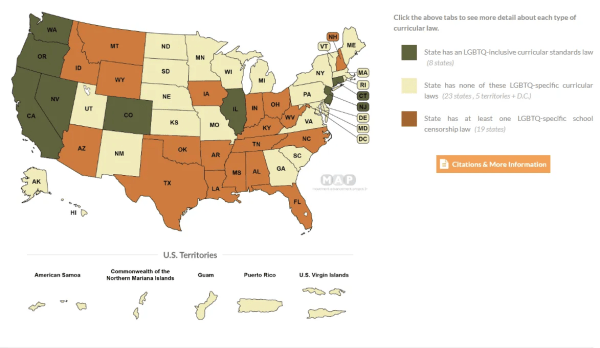
Meanwhile, in Republican-controlled states, officials have taken a far more oppressive approach to LGBTQ+ education. Rather than offering families the option to opt out, many states simply ban the material outright. Under “Don’t Say Gay or Trans” laws—first popularized in Florida and now enacted in 19 states—teachers are prohibited from acknowledging LGBTQ+ people in class instruction at various grade levels. In Texas, several colleges have gone even further, barring professors from recognizing that transgender people exist at all. When contrasted with the minuscule number of families opting out when given the choice, these policies look less like a reflection of public will and more like a top-down morality ban—one that would almost certainly be rejected if parents actually had the freedom to decide for themselves.
Anti-LGBTQ+ school policies remain among the most unpopular measures pushed by Republicans in red states and by the Trump administration. A Navigator Research poll published in August 2023 found that fewer than 25 percent of Democrats and independents—and only half of Republicans—named “protecting children from being exposed to woke ideologies about race and gender in school” as a major priority. Book bans ranked even lower: 92 percent of respondents said such bans were concerning. A more recent Knight Foundation poll echoed those findings, with two-thirds of Americans opposing efforts to restrict books in public schools.
Respondents from Montgomery County, Maryland expressed frustration and vindication after hearing the results of the opt-out process. “Every single one of these ‘anti-woke’ lawsuits and headlines comes from one or a few people making a stink,” said one commenter in a local subreddit dedicated to the county. “Imagine living in Montgomery County and thinking you can opt out of cultural diversity,” said another.
“It looks like most were from elementary schools, but there’s a few from middle schools and two from a high school. Can you imagine what these students’ classmates will think of them?” added a third.
The Supreme Court’s decision is just the latest example of how religious exemptions are being weaponized to roll back civil rights under the guise of “freedom.” Each new ruling gives a single person the power to disrupt an entire classroom, claiming that their beliefs are incompatible with learning about LGBTQ+ people, racial diversity, or any worldview outside their own. These carve-outs have already spread far beyond schools—empowering business owners to deny service to queer customers and pharmacists to refuse medication. But the data out of Montgomery County, Maryland makes one thing unmistakably clear: this crusade is not a mass movement. It’s the obsession of a vanishingly small minority, inflated by a Republican Party that has turned resentment of diversity—and especially of LGBTQ+ people—into the centerpiece of its politics.
Librarian Terri Lesley said she endured years of “pure hell” fighting to keep embattled books on the public library shelves of Gillette, a deeply conservative coal town in northeastern Wyoming.
After getting fired, Lesley fought two more years alleging public officials wrongfully terminated her for refusing to bow to their demands for censorship — all while being threatened, failing to find another librarian job and suffering so much stress she lost sleep and hair.
Now, the 62-year-old’s legal fight is over. On Wednesday, Lesley, who worked for Campbell County Public Library System for 27 years, including 11 as executive director, agreed to settle her federal lawsuit against Campbell County, the county’s library board and several officials for $700,000. In a 78-page complaint filed in April in the U.S. District Court for Wyoming, she accused them of helping to wage a years-long campaign to bully her into removing books about race and LGBTQ+ people from the library. After she refused, she said they fired her, which led to her lawsuit.
“I wanted to take a stand on it and try to put up a barrier from it happening to other librarians,” Lesley said Thursday in an interview. “I thought, ‘If I don’t do this thing, it’s just going to keep happening.’”
Campbell County, the county’s public library board, county commissioners and the lawyers who defended them against Lesley’s suit did not respond to requests for comment from The Washington Post. In court filings, they denied Lesley’s allegations and said she was fired because of “concerns with her performance,” not in retaliation for engaging in constitutionally protected activity. They described her lawsuit as “an improper run-on narrative combining fact, fable, self-praise, and a self-heroic, tale.”
The controversy in Campbell County happened amid a larger movement to target content available in public libraries around the country, particularly those aimed at children and having to do with race, gender or sexual identity. For years, the number of “book challenges” — efforts to remove or restrict access to books — remained flat. But in 2021, challenges spiked 1,300 percent to more than 3,900, according to American Library Association data. They increased each of the next two years to more than 9,000 in 2023 before falling to about 5,800 last year.
School libraries experienced the same thing during that stretch, leading the free-speech nonprofit PEN America to declare book censorship in the United States “rampant and common” and “unprecedented in modern times.”
“Not since the 1950s McCarthy era of the Red Scare has censorship become so entrenched in schools,” the group said Wednesday in a news release, referring to the period when anti-Communist paranoia intensified to a fever pitch.
Campbell County was part of the first wave of the “book-banning craze engulfing the country” in 2021 when several residents demanded county commissioners and library board trustees censor young adult and children’s books with LGBTQ+ content, according to Lesley’s lawsuit.
Those critics denounced books such as “This Book Is Gay” and “Not My Idea: A Book About Whiteness” as pornographic, obscene or racist. When Lesley resisted pressure to transfer such books out of the young adult and children’s sections or remove them from the library altogether, they targeted her for roughly two years, threatening her and accusing of criminal activity and endangering children, according to her lawsuit.
Instead of defending Lesley from that “campaign of fear and hate,” two county commissioners and four library board trustees allegedly joined it. In doing so, commissioners and trustees alienated LGBTQ+ people and propagated the hateful ideology that they are “dangers, abnormal, unwelcome, and their voices should be suppressed,” the suit states.
Over the next two years, Lesley kept resisting attempts to remove or restrict various books with LGBTQ+ themes, saying at library board meetings that doing so constituted censorship and violated the First Amendment, the suit states. Several lawyers agreed with that legal interpretation, which they shared with board trustees and county commissioners, according to the suit.
At one library board meeting, one of Lesley’s critics held up a sign that read “[Campbell County Public Library] Knowingly Encourages SEX for Minors and that’s a crime,” the suit alleges.
Amid the controversy, the American Library Association in March 2022 announced Lesley had won the John Phillip Immroth Memorial Award that recognizes “notable contributions to intellectual freedom and demonstrations of personal courage in defense of freedom of expression.”
Over the next five months, four of five library board members were replaced by county commissioners with ones more inclined to remove or restrict LGBTQ+ books, the suit states.
In July 2023, the library board voted to terminate Lesley.
“Their actions not only devastated Ms. Lesley professionally and personally, but also undermined the very mission of [the library system] and inflicted harm on the broader community,” the suit states. “For this, they must be held responsible.”
Lesley said she continues to be harmed by officials’ actions. More than two years after being fired, she hasn’t gotten a job in her field. A resident of Gillette since the second grade, she’s unwilling to move. She sought remote work in the field that wouldn’t require face-to-face interactions with patrons, but none of her efforts panned out.
Still, Lesley said she doesn’t regret standing up for what she believes was right, even if she’s paid a heavy price. She said she hopes the $700,000 settlement — more than five times what the county paid her annually — deters officials elsewhere from meddling with which books go on library shelves and where.
“They’ll see what happened here and maybe reconsider going down that road,” she said, with a pause, “is what I’m hoping for.”
Loudoun County School Board proclamations are typically noncontroversial, but a proclamation recognizing October as LGBTQ+ History Month drew three no votes at the board’s Sept. 30 meeting.
Language in the proclamation says it honors the “history, achievements, and contributions of lesbian, gay, bisexual, transgender, and queer people” and celebrates “the strength, resilience, and impact of the LGBTQ+ community, whose contributions have enriched the cultural, educational, and civic life of Virginia and the world.”
“We reject discrimination based on gender identity, sexual orientation, and gender expression, and instead affirm kindness, acceptance, and respect as the foundation of our learning community,” the proclamation states. “Our school division is stronger when every student and staff member can live authentically and feels a true sense of belonging, and when we embrace the full diversity of our community.”
April Chandler, Algonkian; Linda W. Deans, Broad Run; board Vice Chair Anne P. Donohue, At Large; Arben Istrefi, Sterling; board Chair Melinda M. Mansfield, Dulles; and Sumera Rashid, Little River, voted yes.
Deana L. Griffiths, Ashburn; Karen “Kari” LaBell, Catoctin; and Lauren E. Shernoff, Leesburg, voted no.
The proclamation was initially included in the board’s consent agenda, which has items that are approved en masse.
However, Griffiths, who typically has abstained from voting on proclamations since taking office in 2024, wrote in an email that she moved the proclamation to the regular agenda, so she could speak about why she was voting against it.
“There is a meaningful difference between formally recognizing a group in history and promoting that group for its lifestyle to our students,” Griffiths said at the meeting. “It crosses the line into advocacy and raises serious concerns under the (Trump) executive order protecting our children from inappropriate content in our schools.
“Our communications must remain age appropriate and leave conversations about sensitive information to parents. Schools exist to teach children how to read, write, and think critically. Not engage them in conversations about sexuality at any age where they are far too young to process it.”
The January executive order from President Donald J. Trump that Griffiths referred to says people cannot identify as the opposite sex they were born as. It says the administration will “enforce all sex-protective laws to promote this reality,” including cutting federal funding used to “promote gender ideology.”
The Trump administration said in August it was suspending or terminating funding to Loudoun County Public Schools over its policy allowing transgender students to choose which bathroom or locker room they use. Federal money accounts for about $47 million of the current $2 billion LCPS budget.
Shernoff wrote in an email that some constituents complained to her after she voted for the proclamation last year about the way LGBTQ+ History Month was celebrated in schools. Specifically, their complaints were about how “certain spirit days” were celebrated and the effect on young students.
“I did some research into it and that in conjunction with knowing that LCPS also proclaims LGBTQ+ Pride Month in June, I decided to not support this,” Shernoff said. “I did however support the anti-bullying proclamation which specifically names and protects students based on their gender identity. I remain committed to ensuring all students are protected, safe, and can achieve to their fullest potential.”
LaBell said in an interview that she supported the proclamation last year because it was on the consent agenda and voting against it would’ve meant voting against everything on the agenda.
She said she opposed the proclamation because some of the issues it raises are “too political” to promote in school and might be inappropriate for young students to discuss.
Like Shernoff, LaBell said she voted for the Pride Month and anti-bullying proclamations, but believes one proclamation related to LGBTQ issues annually is enough.
“You want history? Put it in Pride Month,” she said. “It just seems to me it’s being pushed more so than anything else in our school system at this point in time. And it’s a family issue. It shouldn’t be a political issue in our schools.”
Two groups that support LGBTQ rights criticized the rationale of Griffiths, LaBell and Shernoff.
Candice Tuck, an Equality Loudoun board member, said the proclamation isn’t about promoting sexuality.
“There have been many brave queer pioneers throughout history who have fought for civil rights, who have been inventors, and who have moved our democracy forward,” Tuck said in an interview. “There is no reason that the queer community cannot be recognized for those accomplishments without individuals in our community perverting their history.”
Meredith Ray, the head of Loudoun4All, noted in an email that Griffiths previously said she wouldn’t vote for any proclamations, but chose to single out the LGTBQ+ proclamation for criticism.
Ray called Griffiths’ decision “malicious” and said her remarks were “ignorant commentary” on the issue.
“Recognition of history is not ‘promotion of a lifestyle.’ LGBTQ+ students, staff, and families exist in Loudoun and deserve the same dignity as everyone else. Griffiths’ attempt to frame recognition as ‘inappropriate content’ is harmful, especially to young people who already face higher rates of bullying and mental health struggles when leaders stigmatize them,” Ray said. “In fact, decades of research show that inclusive education that teaches respect and representation is one of the most effective ways to prevent bullying and improve school climate.”
The President of Texas A&M University, Mark Welsh, resigned last week amid controversy over a viral video between a professor and a student debating gender ideology.
Welsh stepped down officially on Friday, September 19, according to a press release where the Chancellor Glenn Hegar thanked Welsh for his service to the university and the nation.
“President Welsh is a man of honor who has led Texas A&M with selfless dedication,” said Hegar. “We are grateful for his service and contributions. At the same time, we agree that now is the right moment to make a change and to position Texas A&M for continued excellence in the years ahead.”
The former president resigned while the university faces heated backlash after a video was posted of a student calling out a professor for teaching gender ideology in the classroom.
Professor Melissa McCoul was sharing an image of a “gender unicorn” that demonstrates concepts of gender expressions, identity and sexuality while reading “Jude Saves the World,” a novel about a 12-year-old who comes out as nonbinary, according to The Texas Tribune.
“[M]y Administration will defend women’s rights and protect freedom of conscience by using clear and accurate language and policies that recognize women are biologically female, and men are biologically male,” Trump wrote in the executive order.
State Rep. Brian Harrison, R-Texas, reposted the video on X.
“The governor and lieutenant governor and speaker have been telling everybody for two years now that we passed bans on DEI and transgender indoctrination in public universities,” Harrison wrote on his X account. “The only little problem with that? It’s a complete lie. … The state of Texas — despite what the governor said in his tweet yesterday, that this is a violation of law — there is no state law that we passed.”
Professor McCoul was later fired, according to press reports.
Former A&M President Welsh allegedly defended the inclusion of LGBTQ content in the classroom.
“Those people don’t get to pick who their clients are, what citizens they serve and they want to understand the issues affecting the people that they’re going to treat,” Welsh said in an audio recording posted by Harrison on X. “So there is a professional reason to teach some of these courses.”
In the past few years, Texas has been one of many states fighting LGBTQ and diversity, equity and inclusion efforts in schools.
The Trump administration directed 40 states, five territories and Washington, D.C., to remove references to transgender people from their sex education programs or risk losing federal funding.
The Administration for Children and Families (ACF), a division of the Department of Health and Human Services, sent letters Tuesday demanding that the health departments in these states and territories remove “all references to gender ideology” from their Personal Responsibility Education Program, or PREP. The program is a federally funded initiative created in 2010 to help prevent teen pregnancy and sexually transmitted infections.
“Accountability is coming,” acting Assistant Secretary Andrew Gradison said in a statement. “Federal funds will not be used to poison the minds of the next generation or advance dangerous ideological agendas. The Trump Administration will ensure that PREP reflects the intent of Congress, not the priorities of the left.”
The 40 states that received letters are: Alabama, Alaska, Arizona, Colorado, Connecticut, Delaware, Georgia, Hawaii, Illinois, Iowa, Kentucky, Louisiana, Maine, Maryland, Massachusetts, Michigan, Minnesota, Mississippi, Missouri, Montana, Nebraska, Nevada, New Jersey, New Mexico, New York, North Carolina, Ohio, Oklahoma, Oregon, Pennsylvania, Rhode Island, South Carolina, South Dakota, Tennessee, Utah, Vermont, Washington, West Virginia, Wisconsin and Wyoming. The five U.S. territories are: Guam, Northern Mariana Islands, Palau, Puerto Rico and the U.S. Virgin Islands.
Links to all 46 letters were included in the administration’s press statement. The ACF’s four-page letter to New York, for example, includes a bulleted list of course content that was flagged during a “medical accuracy review” earlier this year and “must be removed from New York’s PREP curricula and program materials.”
The content flagged for removal includes definitions of gender identity and gender expression and directives that program facilitators allow students to share their pronouns and “demonstrate acceptance and respect for all participants, regardless of personal characteristics, including race, cultural background, religion, social class, sexual orientation or gender identity,” according to the letter.
If New York’s health department declines to comply, it could lose more than $6 million in federal funds, according to data provided by ACF. The other states and territories stand to lose $300,000 to $4.6 million each.
The letters come just days after the ACF terminated $12 million of California’s remaining PREP funding after the state’s health department declined to remove references to trans people from the curriculum, arguing that the references had already been approved by the agency, the materials were medically accurate and relevant to the statute, and ACF does not have the authority to take such an enforcement action, according to ACF’s termination letter to the state.
California’s health department has 30 days to appeal.A spokesperson for the department said in a statement that the state maintains its position that its PREP curriculum “is medically accurate, comprehensive, and age-appropriate.”
“CA PREP sexual health education curriculum promotes healthy relationships and reduces the rates of sexually transmitted infections (STIs) and unintended pregnancy, as well as leads to delayed sexual activity in youth — all outcomes that lead to a healthier state,” the spokesperson said.
In an emailed statement, Elana Ross, a spokesperson for California Gov. Gavin Newsom, said, “If it’s a day ending in y, President Trump is attacking kids’ safety, health, and access to education as part of his culture war.”
The action from ACF is part of the Trump administration’s ongoing effort to prohibit federal recognition of trans people and penalize the use of federal funds for any program that includes or mentions them.
Federal officials have also removed mentions of trans or intersex people from agency websites, including from the website for the Stonewall National Monument commemorating the site of the 1969 Stonewall uprising in New York, which is widely considered a turning point in the modern gay rights movement.











 fleeredstates.blog
You must be logged in to post a comment.