An index that measures state-level LGBTQ+ inclusion for business leaders has measured a national decline in support for the LGBTQ+ community for the fourth consecutive year.
Released this month, the eighth annual State LGBTQ+ Business Climate Index examines states across five main categories: legal protections, family support, political and religious attitudes, health care and employment. The index is published by OutLeadership, an LGBTQ+ business network.
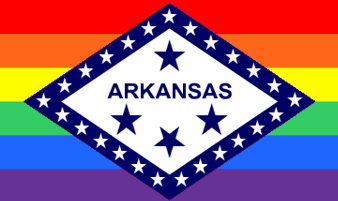
This year’s report found that states that rank low in the index are performing worse year over year, and that fewer states are placing toward the middle of the 100-point index scale. The states with the lowest rankings were Arkansas, Tennessee, Idaho, South Carolina and Florida in that order.
LGBTQ+ rights are under attack across the United States, especially in Republican-led states, and polling suggests that support for LGBTQ+ rights is declining nationally. The American Civil Liberties Union is tracking more than 530 anti-LGBTQ+ bills introduced in state legislatures in 2026 alone. The worsening support index this year was driven by states adopting anti-trans bans around bathrooms, sports, pronoun usage and gender-affirming care, plus efforts to restrict diversity, equity, and inclusion programming on the federal and state levels, according to the report.
“The gap between inclusive and hostile states is wider than it has ever been, and it is still widening,” wrote Out Leadership CEO Todd Sears in an introduction to this year’s report. “For businesses, this means the cost of operating across a fractured regulatory landscape has never been higher, and the return on choosing to lead has never been greater.”
The purpose of the report is to help business leaders make decisions and reflect on economic development as it relates to the LGBTQ+ community.
“Multinational companies face operational and reputational risks when they do business in places where the legal and social atmosphere makes it difficult for LGBTQ+ people to live openly,” the report states.
This year, Out Leadership expanded evaluation criteria for its report to assess issues like bathroom bans, book access, drag performance legality, and LGBTQ+-inclusive government data collection. “If we had kept the Index frozen in its original form, we would be measuring a country that no longer exists,” the report says.
Despite an overall performance decline, the report also found that top-performing states regarding LGBTQ+ rights are only strengthening their protections for LGBTQ+ residents. The 10 best-performing states in this year’s index include Massachusetts, New York, Connecticut, New Jersey, and Illinois, rounding out the top five, respectively, which have all “been fixtures in the top tier for the entire history of the index,” according to this year’s report.
Florida has already largely derailed the promotion of diversity by the state, and a new law now threatens Pride events across the state.
Florida Gov. Ron DeSantis signed legislation that prohibits any local government in Florida from making diversity, equity, and inclusion efforts. That’s part of a long battle against so-called DEI in the state, which has already banned the values in higher education. He deployed significant white grievance language as he signed legislation at a ceremony in Central Florida.
“I would think with DEI the disfavored groups, number one obviously, would be white males and I think they’ve been discriminated against,” DeSantis said.
The bill allows individuals to sue local governments that implement DEI programs.
The legislation, according to Florida Politics, defines DEI as efforts to “manipulate or otherwise influence the composition of employees with reference to race, color, sex, ethnicity, gender identity, or sexual orientation other than to ensure that hiring is conducted in accordance with state and federal anti-discrimination laws.”
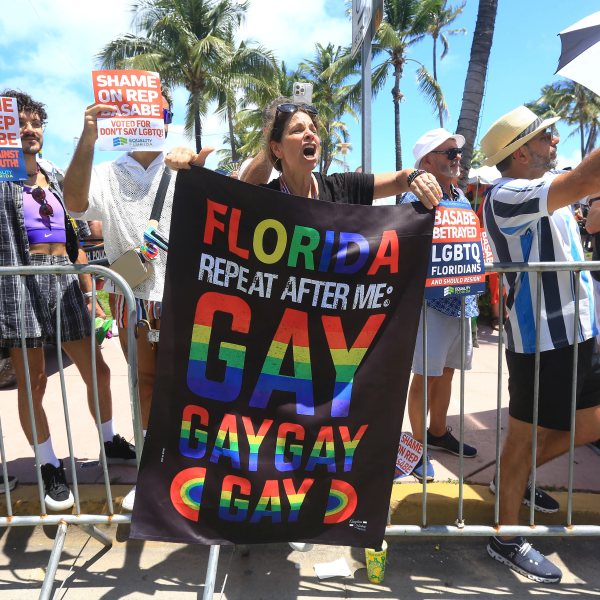
But LGBTQ+ advocates have specifically voiced concern that this could shut down Pride events.
“It threatens nondiscrimination ordinances, specialized community health programs, recognizing culturally significant events like Pride Month or Black History Month, and more,” reads an opposition statement from Equality Florida.
Florida Rep. Fabian Basabe, a Republican representing Miami Beach, has suggested otherwise.
“Pride is not under threat, and it definitely isn’t going anywhere,” he said. “If anything, this moment presents an opportunity to both strengthen and expand the event and ensure it continues to thrive for decades to come as a cultural festival that celebrates community, supports local businesses, and contributes to the vitality of Miami Beach.”
Critics say the new law still allows equal opportunity programs and for cultural events to take place in Florida cities. But it doesn’t allow cities to run programs promoting diversity.
“The bill is necessary because cities and counties have been funding and promoting divisive activities under the guise of DEI,” said Florida Sen. Clay Yarborough.
The law goes into effect on January 1.
Equality Florida did convince lawmakers to make carve-outs in the law to allow preservation of the Pulse memorial in Orlando and for states to issue permits, but not promote Pride. But the law remains an existential threat, the group’s leadership said.
“This law is deeply concerning and deliberately vague, sending a clear message that celebrating diversity and supporting LGBTQ Floridians can carry legal and political risk. It targets not only local governments but every community that works to create inclusive, welcoming spaces. Our communities have faced unjust laws before, and responded with resilience, strength, and solidarity,” said Jon Harris Maurer, Equality Florida’s Public Policy Director.
“Equality Florida will continue to stand with local leaders, community organizations, and residents to ensure that LGBTQ people remain visible, celebrated, and supported. Pride will continue, programs that support inclusion will continue, and our communities will remain strong despite attempts to intimidate or silence them.”
The 32-year-old trans high school English teacher has had enough of the state’s Don’t Say Gay vibes and the bigotry and silence they’ve inspired.
Ron DeSantis‘ discriminatory laws have instilled paranoia among the school system’s LGBTQ+ faculty, staff, students, and allies, Stone says.
Florida’s first Parental Rights in Education Act, passed in 2022, banned classroom discussion and “instruction” about sexual orientation or gender identity from kindergarten through 3rd grade. A subsequent bill in 2023 extended the policy through 12th grade, while new restrictions on LGBTQ+ content in libraries set off a book-banning frenzy. Rules around pronoun use have effectively banned free speech for all gender-nonconforming people in Florida schools.
A settlement between the state and groups challenging the laws in 2024 did little to allay LGBTQ+ faculty concerns about teaching while gay. Stone was the only Florida teacher who would go on the record with LGBTQ Nation.
She said she has nothing left to lose.
The Orlando-area English teacher is a Florida native. She earned a law degree from William & Mary in Virginia and started her teaching career six years ago as the Covid pandemic unfolded. She’s been at the same high school ever since.
Stone says that for the most part, she has the support of her colleagues and students — it’s pressure from those higher up in power that’s inspired her to leave her job at the end of this school year. She plans on moving to Maryland with her wife this summer.
Stone spoke with LGBTQ Nation at the end of her school day.
LGBTQ Nation: What made you decide to go into teaching?
Saoirse Stone: There’s a thing that made me decide to go into teaching, and there’s a thing that made me decide to stay in teaching.
I decided to go into teaching because I was out of work during COVID, and both my parents are teachers, and both my maternal grandparents were teachers. So I knew a lot about the profession, and I knew I could probably do a pretty good job. So I got my temporary teaching certificate and took a job teaching high school.
I stayed because it turned out I both really liked it and was rather good at it, and I found a lot of value in ways that I had not found in other jobs… like a feeling that I was doing something worthwhile.
How did your teaching work line up with your transition?
I had been teaching for two years when I transitioned. I had intended to come out fully publicly and had already begun to do that with faculty and staff on campus when all of the various and assorted anti-LGBTQ pieces of legislation passed in the spring of 2023.
And then I was cautioned by my school administration, who had gotten direction from my district’s legal department. For my own safety and well-being professionally, I was strongly encouraged to not come out and not tell my students.
So just to clarify, you had already started transitioning socially before this became a question?
Yes, but I present rather butch. I’m very much a dyke, you know, to use a preferred term. So I can fly under the radar if I want to, or at least at the time I could. Not so much now that I’m four years into this. But, you know, dressing a bit more masc, I could at the time still sort of pass [as a man]. At the time, that was what I felt I had to do.
And you were advised not to articulate anything having to do with your gender after legislation had passed and been signed by DeSantis?
Yes.
And you were still presenting as a man?
Yes.
Then what happened?
Essentially, radio silence. No one says anything more to me specifically about it, from the district or from the school-based administration – really, to this day.
Now, there are plenty of school and county-level trainings after all of this stuff had fully gone into effect. This was also in the midst of all that anti-critical race theory stuff, the book ban stuff. So we had to sit through all of these policy changes.
But I had been pretty careful to mostly keep anything about me out of writing – any official stuff – because while I wanted to move towards a more authentic presentation in life, I also knew the law well enough that I didn’t want there to be anything that was going to put me on a list.
And just for context, at this point, DeSantis is campaigning for president, as well, and a lot of this stuff was part of his platform, correct?
Yes. And whether it was going to be him or whether it was going to be another candidate at the time, there was a risk of stuff at the federal level.
I wasn’t at a point where I could go truly stealth at any level. That would have put me at risk of getting my teaching certificate revoked. That’s part of what’s so insidious about these things. My school-based administration, they don’t care. They would not fire me for being trans. But if the state gets an inkling of it, the state can revoke my teaching certificate.
Why would the state revoke your certificate?
So there’s no explicit prohibition on being trans, but there is on wanting to use pronouns that align with your new gender identity and not one from your sex assigned at birth. If I use honorifics or pronouns that don’t comport with my sex assigned at birth, that’s grounds to potentially have my teaching certificate revoked. And there’s nothing about a three-strike system, or getting a warning, or anything like that.
And as any teacher will tell you, a lot of students are going to just call you Mr. or Miss. And that’s particularly frequent at our school, which has a very high Hispanic population, and it’s a manner of address that’s seen as respectful. And I don’t get to dictate what that honorific is.
What honorific were your students using?
Well, that’s where I got a little creative that fall. The district was looking to expand an E-sports program – you know, video games – across all the high schools, and I volunteered. Both because I do play video games, and I know a fair bit about several, and also because I could be called “Coach.”
Excellent.
So I did that. I got my name plate, and everything on my door changed, and that’s kind of been the way I try to navigate around this.
How has Don’t Say Gay affected your ability to teach? Can you mention Harvey Milk?
That’s part of the insidious nature of these laws. There’s not clear guidance, just a very vague standard of what’s “developmentally appropriate.”
When the book ban stuff was going on, we had this whole system set up where we had to catalog every book in our classrooms, and then we got a list back of which of those books we had to remove from our classroom library. I lost almost every book by a Black author, almost every book by a queer author, every single book I had from a native author, most of the books I had from Hispanic authors, and probably half the books by women. I had to fight to keep The Scarlet Letter.
I had to remove, for instance, James Baldwin, because certainly the powers that be in Tallahassee don’t want kids learning about James Baldwin. Shockingly, Sappho, of all authors, somehow slipped through. No one challenged that one. I have to imagine that whoever was going over it somehow didn’t know.
Let’s talk about the reaction among your colleagues to these rules. Are there any other LGBTQ+ faculty at your school?
Yeah, there are. And look, in the schools, there are so many gay and bisexual teachers. I would not be shocked if some schools cleared 30 or 40% among the faculty. I don’t have statistics to back that up, but it’s certainly a large number.
Is there a sense of solidarity among that group? Are you trading war stories?
There’s certainly solidarity. There certainly are war stories, both about this and about the general struggles of public education. My relationships with my colleagues have been very positive, both among those who I’ve had conversations with and those I haven’t. I would describe myself as rather well respected among the faculty at my school. If anyone has had a serious problem with me among the faculty or staff, they have kept it to themselves. You know, there’s always a couple outliers that I’ve heard of, but none that really crossed my path in a meaningful way.
This is really a problem from the top. This is a problem from the state. It’s an enforced, hierarchical issue. It’s not one that would be a day-to-day problem in my life, if not for the state-level laws.
Who are you talking about when you say “outliers”?
There was buzz about one particular teacher in one of the sciences that had said some fairly overtly transphobic stuff. I think they just retired, and that’s the thing: Retirement is wiping away a lot of the old guard that might have felt strongly about enforcing a lot of this stuff on fellow staff and students.
Also, there are lots of trans students, and there always have been. Your average public school teacher in 2023 already had a trans student, or two, or three, or more. We all just got used to it. So it’s not that much different to see, I imagine, a member of the faculty identifying in the same way. It’s not news.
Have you encountered any hostility from students over the fact that your gender presentation isn’t super binary?
I’ve had to have students written up, and in a couple cases, removed from my class roster for calling me slurs in the classroom.
Like what?
F***ot, specifically.
Right in front of the other kids?
Yes. In one case, multiple times.
Did this kid have other behavioral issues, or was it just really directed at you?
It was my understanding that the discipline issues did not start or end with my classroom. But the targeted nature of the term was specific to me.
Do any other incidents like that stand out?
Nothing that severe. They’re not issues with most of the students, you know? Again, that was very much an outlier. And part of the reason it got resolved and the student got removed from my room was that other students reported that student. It didn’t require me making a thing out of it. They were appalled.
The general attitude among our current crop of high school students is either general apathy, in every real sense, or acceptance. Anything beyond that is very unusual.
You say you want to leave the state at this point, but you’re describing what sounds like a fairly supportive environment, at least on the local level. Why do you want to leave Florida?
So, two big reasons.
One, it’s supportive for now. It’s supportive because I have good relationships with fellow faculty, fellow staff, and because the laws haven’t changed that much over the last few years.
However, I started wanting to move because in the past few months, the machine of transphobic legislation at the federal and state levels has started spinning again, pretty seriously. Florida has been spared the worst of it so far, but I don’t know if I trust that, and that’s a big part of it. There were some very scary things up for votes in this legislative cycle. So there’s that, as far as the civil rights element.
And what’s the other reason?
So, while we might be in something of a state of detente, as far as those policies go, the economic situation here in Florida is getting a lot worse. My wife was out of work for months this year. We were having to get by on a single teacher salary, and that was very, very hard, and we barely managed that. We had to take some debt on to handle that. It kind of wiped out most of our savings. She’s got a job now, fortunately.
Another problem is that one of the bills that did pass the legislature was a bill that is undercutting the teachers’ unions. It’s very obviously meant as a union-breaking law. And if the teachers’ union dissolves, we would all be taking pretty substantial pay cuts. On top of that, the district is bargaining over an increase of thousands of dollars to our healthcare.
So as much as I love Florida, as much as I love Orlando, as much as I love my students, and as much as I like my school, I have to kind of balance and ask, can I do this without it ruining us financially or preventing us from accomplishing things we really want to accomplish financially?
You described a kind of detente when it comes to your civil rights. Do you worry that could change?
There’s the possibility of changes in the school board, which could very much mean big shifts for how safe I am at my school. There’s the possibility of school-based administrators changing. All it takes is an administrator suddenly becoming someone who’s not super cool with trans people, and I go from a pretty good job to a deeply hostile workplace, because there is no protection for me there.
And truthfully, all it would take is one false allegation that I requested that certain pronouns be used for me, and that could be it, you know – something deeply impossible to prove or disprove. And I don’t trust the state of Florida to give me due process.
It must be tough carrying the weight of those possibilities around, while all you want is just to do your job and be yourself.
There is a mental and emotional cost to going into work for seven and a half hours every day, having everyone treat you like someone you’re not, even in spite of the relatively supportive environment. You still feel like there’s something off.
Even people who work here that are generally supportive and that I have a good relationship with, they do not call me by preferred pronouns, because, frankly, they’re afraid. They’re afraid about drawing a target on their own back. So even if under other circumstances they might try and be supportive, they don’t feel like they can be.
An increasing number of U.S. states have passed laws that allow health care providers – including doctors, nurses and pharmacists – to refuse to treat patients based on their personal or religious beliefs. While these conscientious objection laws have long existed for issues such as abortion, their effects on LGBTQ+ people have not been well studied.
Specifically looking at sexual minorities, our research found that lesbian, gay, bisexual and queer adults living in states that passed conscientious objection laws were 28% less likely to report receiving a first-time HIV test, compared to peers in states without conscientious objection laws. These laws did not affect HIV testing rates for heterosexual adults.
We analyzed data from the Centers for Disease Control and Prevention on the health outcomes of more than 109,000 lesbian, gay, bisexual, queer and heterosexual adults from 2016 to 2018. We focused on eight states, comparing two that enacted conscientious objection laws during that period (Illinois and Mississippi) and six that did not (Louisiana, Minnesota, Ohio, Texas, Wisconsin and Virginia).
To isolate the effect of the laws themselves, we compared changes in health outcomes among LGBQ+ and heterosexual adults living in states with or without religious exemptions to health care, both before and after the laws passed. Making all these comparisons at once allowed us to identify differences in health outcomes due to the laws rather than preexisting differences between states.
Our findings highlight how laws permitting clinicians to refuse to provide health care to LGBQ+ patients deepen existing health disparities. Notably, conscientious objection laws are just one type of policy restricting LGBTQ+ people’s access to health care.
HIV preexposure prophylaxis, or PrEP, can lower the risk of contracting HIV from sex by 99%. However, patients are required to receive an HIV test before PrEP can be prescribed. If providers are unwilling or unable to engage with LGBQ+ patients on their sexual health, people who could benefit most from HIV prevention tools, such as PrEP, may never receive them.
Moreover, since the risk of contracting HIV is closely linked to the social determinants of health, such as having safe and stable housing and employment, barriers to HIV testing could further widen health gaps.
Acknowledging the health consequences of conscientious objection laws could help policymakers and the public better understand their impact.
A 2026 national study found that Americans were more motivated to support policies that address LGBTQ+ inequality when these laws were framed as improving health inequality rather than economic inequality or sense of belonging. This finding suggests that people perceive health inequality as unjust and are less likely to blame LGBTQ+ individuals for those circumstances.
Today (March 10), the Florida House passed the sweeping and dangerously vague “Anti-Diversity in Local Government” bill (HB 1001 / SB 1134) by a vote of 77-37, sending another bill rooted in anti-LGBTQ animus to Governor Ron DeSantis’s desk. Five Republicans joined House Democrats in opposing the legislation, including Representatives Hillary Cassel (R-Hollywood), Will Robinson (R-Bradenton), Chip LaMarca (R-Lighthouse Point), Jim Mooney (R-Key Largo), and Paula Stark (R-St. Cloud).
The legislation is designed to intimidate cities and counties that celebrate and support the diverse communities they serve. Written in broad and ambiguous language, the bill is the most extreme of its kind in the country, creating confusion and fear for local governments that recognize LGBTQ residents and other communities that contribute to the strength and vibrancy of Florida’s cities.
The bill advanced after a highly contentious legislative process that exposed its broad application and sweeping penalties for a perceived violation. Local elected leaders from across Florida – including mayors, commissioners, and county officials – stood alongside thousands of residents to oppose the legislation and warn lawmakers about the harm it would cause to their communities.
Debate over the bill made expressly clear that LGBTQ people were a central target of the legislation. The public record, the bill sponsors’ own statements, and hours of legislative debate revealed the animus driving the effort to pressure local governments into pulling back from recognizing or resourcing programs targeting LGBTQ residents and other historically marginalized communities.
Despite the sponsors’ stated intent to dismantle diversity programs — with House sponsor Representative Dean Black declaring that “Florida is where DEI goes to D-I-E” — sustained public pressure over two years opposing the bill forced lawmakers to concede dozens of carve-outs to avert repeal, defunding, and harm to numerous local policies, programs, and events. For the LGBTQ community, this included amendments to protect and preserve the Pulse Memorial in Orlando and amendments ensuring local governments can continue to permit Pride festivals, even while navigating new restrictions on supporting or promoting them.
Equality Florida’s Executive Director, Stratton Pollitzer, provided the following response:
“This bill is dangerous, vague by design, and part of a broader political agenda of censorship and government overreach. Once again, Florida lawmakers have manufactured a sweeping anti-LGBTQ law — legislation intended to bully local governments and have a chilling effect on how they celebrate and support the diverse communities they serve.
Florida’s LGBTQ community knows all too well how to fight back against unjust laws. Just as we did following the passage of Florida’s notorious ‘Don’t Say Gay or Trans’ law, we will fight every step of the way to limit the impact of this legislation, including in the courts.
Mayors and local elected officials from every corner of the state stood shoulder-to-shoulder with thousands of Floridians who showed up to oppose this legislation. We will continue to partner with local leaders who are committed to celebrating their LGBTQ residents and all of the diverse communities that make Florida strong.
The LGBTQ community is resilient. We stand alongside other impacted communities, firm in our resolve that no law can erase our presence or silence the millions of Floridians who believe in dignity, equality, diversity, and inclusion. Pride celebrations will continue. Communities will continue to gather. And LGBTQ people will remain visible in every part of Florida.”
House Speaker Daniel Perez has stated clearly that this bill does not ban Pride festivals or parades in Florida, while acknowledging new restrictions on supporting or promoting them.*
Implementation of the bill is marked for January 2027. As the bill heads to the Governor, it will now be up to cities and counties to determine how to navigate its sweeping scope and vagueness.
Equality Florida will continue working with local leaders, community organizations, and legal partners to monitor how the law is implemented and to challenge any attempts to use it to silence or erase LGBTQ communities.
The Florida Senate on March 4 voted 25-11 to approve an “Anti-Diversity in Local Government” bill that critics have called a sweeping and extreme measure that, among other things, could repeal local LGBTQ rights protections.
According to Equality Florida, a statewide LGBTQ advocacy organization, if approved by the Florida House of Representatives and signed by Republican Gov. Ron DeSantis, the bill “would ban, repeal, and defund any local government programming, policy, or activity that provides ‘preferential treatment or special benefits’ or is designed or implemented’ with respect to race, color, sex, ethnicity, sexual orientation, or gender identity.”
In a March 4 statement, Equality Florda added that the bill would also threaten city and county officials with removal from office “for activities vaguely labeled as DEI,” with only limited exceptions.
The Florida House was scheduled to vote on the bill on Monday, March 9, with opponents hopeful that a broad coalition of both Democratic and Republican lawmakers would secure enough votes to defeat the bill.
“Once again, Gov. DeSantis and Florida lawmakers are advancing one of the most sweeping and extreme bills in the country — this time threatening decades of local progress supporting diverse communities, including the LGBTQ community,” said Equality Florida Senior Political Director Joe Saunders. “This legislation is a sledgehammer aimed at cities and counties that recognize and address the diversity of the people they serve,” he said.
Among the LGBTQ organizations that could be adversely impacted by the bill is the highly acclaimed Stonewall National Museum, Archives and Library located in Fort Lauderdale.
Robert Kesten, the Stonewall organization’s president and CEO, told the Washington Blade the organization receives some funding from Broward County, in which Fort Lauderdale is located, and the city of Fort Lauderdale has provided support by purchasing tables at some of the museum’s fundraising events.
“Based on this legislation, hose things would be gone,” he said. “We also are based in a government building. So, we don’t know what potential side effects that could have.” He noted that the building in question is owned by Broward County and leased by Fort Lauderdale, with the bill’s vaguely worded provision making it unclear whether Stonewall would be forced to leave its building.
“It’s unknown, and we’re really in unchartered waters,” he said.
Two bills in Florida advanced out of committee last week that would give the state attorney general more power to investigate and press felony charges against health care professionals who provide gender-affirming care in the state, including against therapists who discuss gender issues with minor patients and pharmacists who fill prescriptions that may be used as gender-affirming care.
Last week, the Criminal Justice Subcommittee passed H.B. 743 in a 12-5 vote, Florida Politics reports. The bill would allow state Attorney General James Uthmeier to sue health care practitioners for up to $100,000 per violation for providing gender-affirming care to minors. Mainstream medical organizations support gender-affirming care for trans kids because it has been shown to be life-saving and safe.
S.B. 1010 would make it a felony for doctors, school counselors, or psychologists to advise minors on gender-affirming care or “aid or abet” another health care professional in helping minors get gender-affirming care. The bill gained near-unanimous support from the state senate’s Committee on Children, Families, and Elder Affairs, according to the Florida Phoenix.
If that version of the bill passes, medical professionals could get a $100,000 fine per violation and up to five years in prison.
“We have to uphold the principles and standards that made this country great, biblical, constitutional law, and order at all costs. And sometimes that stings,” state Rep. Taylor Yarkowsky said at last week’s hearing.
The bill’s sponsor, state Rep. Lauren Melo (R), stressed that pharmacists would be punished under her bill, something she says is necessary because, she claimed, health care professionals are “committing fraud” by prescribing gender-affirming care medications but recording the purpose of the medications as something other than gender-affirming care.
“What we’re seeing is there’s coding that’s actually being used that is becoming the problem, and hundreds of thousands of dollars is spent per child for them to transition and codes are being misrepresented where they are saying that it’s an indoctrination disorder instead of saying it’s a gender identity disorder,” she said.
Democrats stressed that the bill could have unintentional side effects. State Rep. Kelly Skidmore (D) said that the bill is not about gender-affirming care but is being pushed by state Attorney General Uthmeier to expand his power.
“It is about giving one individual and maybe his successors authority that they don’t deserve and they cannot manage,” she said, referring to Uthmeier’s involvement in the Hope Florida scandal, where state Republicans are accused of laundering money and committing fraud. “They’ve proven that they cannot be trusted. This is a terrible bill.”
State Rep. Mike Gottlieb (D) said that doctors might be scared from prescribing hormonal medications to people with severe menstrual symptoms lest a pharmacist misinterpret the reason for the prescription.
“You’re going to see doctors not wanting to prescribe those kinds of medications because they’re now subject to a $100,000 penalty,” he said. “We’re really not considering what we’re doing and some of the collateral harms that it’s having.”
Behavioral health care professional Savannah Thompson told WUSF that the bill would make it more difficult for doctors to even talk to trans patients.
“This could increase the feelings of fear from my clients who are under 18, but it also can increase the likelihood that these professionals won’t be able to talk with their clients, honestly and openly, to give them the care and the support that they deserve and need,” she said.
The City of St. Petersburg, Florida, has unveiled 11 Pride-themed bike racks to replace the rainbow crosswalks Gov. Ron DeSantis (R) forced officials to remove.
“Pride on the streets!” declared a social media post from the city and its mayor, Ken Welch (D), who called the bike racks “a vibrant way to honor the Pride street murals that were removed earlier this year due to state requirements.”
The post includes a video of construction workers installing the colorful racks, some of which are rainbow for the Pride flag and others that are the colors of the Trans Pride flag.
Folks celebrated the move in the comments, calling the new displays “amazing,” “clever,” “awesome,” “beautiful,” and “a smarter path forward.”
“Love our little inclusive, Sunshine City,” one person wrote.
“Now that’s what I’m talking about!” said another.
The state of Florida has become the epicenter of Republicans’ rainbow crosswalk crackdown. The DeSantis administration has heeded warnings from federal Transportation Secretary Sean Duffy, who has falsely claimed Pride art is distracting to drivers.
Duffy wrote in a July 1 letter to the nation’s governors that all non-freeway intersections and crosswalks must be kept “free from distractions.” In a subsequent X post, he said, “Taxpayers expect their dollars to fund safe streets, not rainbow crosswalks.”
In response, DeSantis signed a law directing the Florida Department of Transportation (FDOT) “to ensure compliance with FDOT’s uniform system for traffic control devices,” according to a July statement from a department spokesperson. The law effectively bans all pavement art and murals like rainbow crosswalks, regardless of their political message.
The DeSantis administration has been aggressive about ensuring the crosswalks are erased, despite protests and resistance from local leaders.
St. Petersburg officials ultimately complied with the order to remove its crosswalks upon the threat of losing state funding, but Mayor Welch made it clear in August that he would not stand down from defending progressive values.
In a press conference, Welch called the order to remove the crosswalks an attempt by the state “to usurp local values and priorities and instead mandate what our values should be.”
“We’ve seen the attempts to stifle our ability to express and celebrate our community values,” he added. “Yet time and time again, our community has risen to the occasion. And this latest challenge will be no exception.”
A post from the city’s official social media account said the murals that had to be removed – which included one declaring, Black History Matters – “reflect the soul of our community.”
“That message can’t be erased. This is our city, our voice, and our story… Together, we’ll continue building a community that is resilient, inclusive, and united.”
The study found that crashes involving pedestrians or cyclists drop 50% at painted intersections. It also reported a 25% decrease in conflicts between drivers and pedestrians, a 27% increase in drivers immediately yielding to pedestrians, and a 38% decrease in pedestrians crossing when the walk signal was not lit at intersections involving public art. The data also revealed that injuries resulting from crashes drop 37% in painted intersections.
State Representative David Borrero (HB 347) and Senator Clay Yarborough (SB 426) filed the first anti-LGBTQ bill of Florida’s 2026 legislative session — the Pride Flag Ban. The legislation seeks to prohibit state and local government buildings from displaying any flag representing “race, gender, or sexual orientation,” including the Pride flag. The bill also attempts to strip cities and counties of the power to design or adopt their own municipal flags, while carving out protections for “historical” flags — including Confederate symbols. This proposal follows a summer of state action to remove LGBTQ visibility, when Governor Ron DeSantis ordered the removal of rainbow crosswalks and street murals in cities across Florida. Now being introduced for the fourth year, the legislation has been widely rejected three years in a row.
Statement from Joe Saunders, Senior Political Director, Equality Florida:
“This bill is a direct attack on LGBTQ visibility and a textbook example of government overreach and censorship. The Pride flag is a symbol of safety, inclusion, and community for millions of Floridians. After DeSantis spent the summer ripping up rainbow crosswalks and street murals for his own political agenda, legislative extremists are now attempting to finish the job by banning Pride flags in public facilities. These bills prevent local cities and counties from using flags to recognize their own communities or make them welcoming to residents and tourists. Floridians deserve leaders focused on solving real problems, not weaponizing government to erase LGBTQ people from public life. We’ve defeated this bill before, and we will defeat it again.”
*Editor’s note: The following blog is purely informational and sourced by Savvy Nomad’s website itself. Flee Red States does not endorse any particular company, nor have we validated its claims. We suggest you always consult professionals such as a CPA or attorney before going through with changes such as these.We’re also aware they are suggesting a red state as your domicile.
For many modern professionals, location is no longer a limitation. The rise of remote work and the digital nomad lifestyle has made it possible to live anywhere in the world—yet many people still find themselves burdened by high state income taxes and complicated residency laws. This is where Savvy Nomad steps in. Designed for the globally minded U.S. citizen, Savvy Nomad offers a simple and fully legal way to minimize state taxes while maintaining compliance with federal requirements.
Understanding the Concept of Domicile
At the heart of Savvy Nomad’s service is the concept of changing your state of domicile. Your domicile determines where you’re subject to state taxes, where you vote, and even what estate laws apply to you. Many U.S. states impose significant income taxes, but others—such as Florida—do not. By establishing Florida as your legal domicile, you can eliminate your state income tax burden altogether while continuing to meet all federal obligations.
How Savvy Nomad Simplifies the Process
Traditionally, changing your domicile involves confusing forms, proof of residency requirements, and sometimes in-person bureaucracy. Savvy Nomad has streamlined this into a fast, online process. Their platform handles the legal documentation, registrations, and declarations needed to make your Florida domicile official. Users can even complete the process in about 15 minutes through the SavvyNomad app—something that could normally take weeks on your own.
To further simplify life, the service includes comprehensive mail forwarding, giving you a Florida address for official correspondence. This helps prove residency and ensures you receive important mail no matter where you’re traveling.
Financial and Lifestyle Benefits
The most obvious benefit is financial—no state income tax means keeping more of your hard-earned money. But there’s more than just savings. With extra disposable income and reduced administrative stress, users can fully embrace the flexibility of a nomadic lifestyle. Imagine running your business from a beach in Bali or a café in Lisbon—without worrying about state tax filings back home.
Savvy Nomad emphasizes compliance. Their team handles filings correctly and ensures users stay aligned with all relevant U.S. laws. For those with unique income or business structures, Savvy Nomad even connects users with certified CPAs who can identify additional tax credits and optimization opportunities.
Legality and Flexibility
Changing your domicile through Savvy Nomad is entirely legitimate. The company compares it to “snowbirds” who spend winters in Florida but remain residents there year-round for tax purposes. You’ll still file your federal taxes as usual; the only difference is that your state-level tax obligations will now be tied to Florida. And if you ever decide to move back to your original state, the transition is straightforward under state-specific guidelines.
The Bottom Line
Savvy Nomad provides more than a tax-saving strategy—it’s a lifestyle-enabling service. By taking the hassle out of domicile changes, it empowers remote workers to reclaim both their money and their freedom. In just minutes online, anyone can establish a Florida domicile, stay compliant with U.S. tax laws, and unlock a world of global flexibility.









You must be logged in to post a comment.