The suspect was killed in a confrontation with sheriff deputies.
Club Q shooting survivor remembers partner
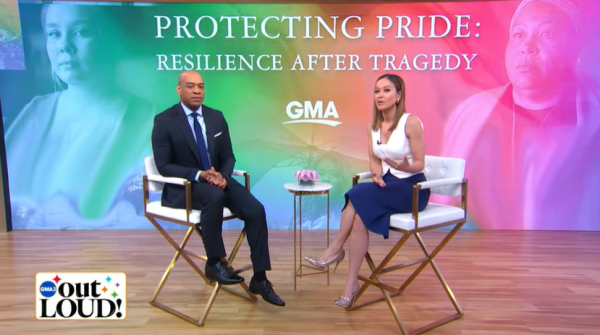
GMA Digital shares the story of drag performer Wyatt Kent who lost his boyfriend during the devastating shooting at Club Q in Colorado Springs.
A California clothing store owner and designer was killed allegedly by a gunman who confronted her about a rainbow Pride flag outside her business and shot her after making disparaging remarks about the display, according to police.
Laura Ann Carleton, a married mother of nine children, was killed Friday outside her clothing store in Cedar Glen, an unincorporated San Bernardino County community on the shores of Lake Arrowhead, according to a statement from the San Bernardino County Sheriff’s Office.
The suspected killer, who has not been publicly identified, fled the crime scene on foot, but was found by sheriff’s deputies near Carleton’s store, where he was fatally shot in a confrontation, authorities said. The sheriff’s office said the assailant was armed with a handgun and refused orders to drop the weapon.
“When deputies attempted to contact the suspect, a lethal force encounter occurred and the suspect was pronounced deceased,” according to a statement from the sheriff’s office.
In 2023, anti-trans bills continue to be introduced across the country. We track legislation that seeks to block trans people from receiving basic healthcare, education, legal recognition, and the right to publicly exist.
We’re tracking 28 national anti-trans bills in the United States in 2023. This sweeping introduction of legislation at the federal level is unprecedented, seeking to impact access to healthcare, student athletics, the military, incarceration, and education.
“We’ve shown that small states can do big things,” she said.
Sarah McBride is making history as she could become the first openly transgender person to be elected to Congress. However, she remains focused on delivering results and making positive changes for her constituents in Delaware. Advocating for healthcare, education, and workers’ rights, McBride’s campaign centers on addressing the needs of the community she aims to serve. While her groundbreaking candidacy is significant, she is determined to prioritize the well-being and progress of her state, highlighting the importance of her legislative agenda over her personal identity.
Sarah McBride vies to be the nation’s first openly transgender congressperson
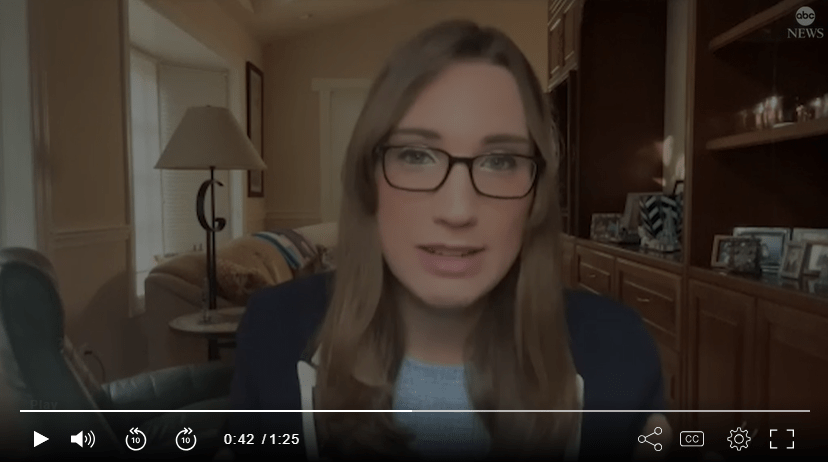
McBride, 32, has been serving as a Democrat in the first district of the Delaware state Senate since 2020.
Sarah McBride is used to being first. She was the first openly transgender person to work in the White House, the first to speak at the Democratic National Convention and the first to become a state senator, in Delaware.
If the campaign she announced on Monday is successful, she will be the first transgender person to serve in Congress — representing Delaware’s sole congressional district — and the first openly transgender person to be elected at the federal level.
Because Delaware’s at-large district is solidly Democratic, competition in the race will likely play out during the primary next fall. The seat is currently held by Rep. Lisa Blunt Rochester, who announced last week that she is running for the U.S. Senate to fill the seat held by retiring Tom Carper.
McBride, 32, enters the race with endorsements from high-ranking Delaware lawmakers, support from LGBTQ advocacy groups and relationships with the Biden family. President Joe Biden wrote the foreword to her 2018 memoir, and she has called his late son, Beau, one of her mentors.
“I’m incredibly confident and optimistic going into this campaign that we will win in September of 2024 [during the primary] and then win in November of 2024,” McBride said. “I believe that Delaware is ready. We’ve shown that small states can do big things, and it’s time for us to do that again.”
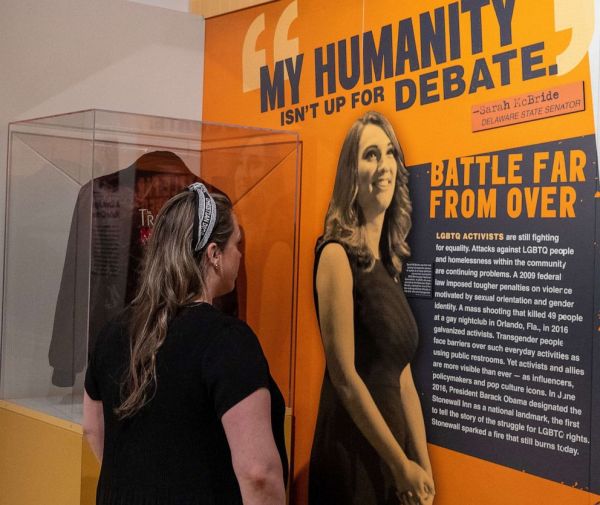
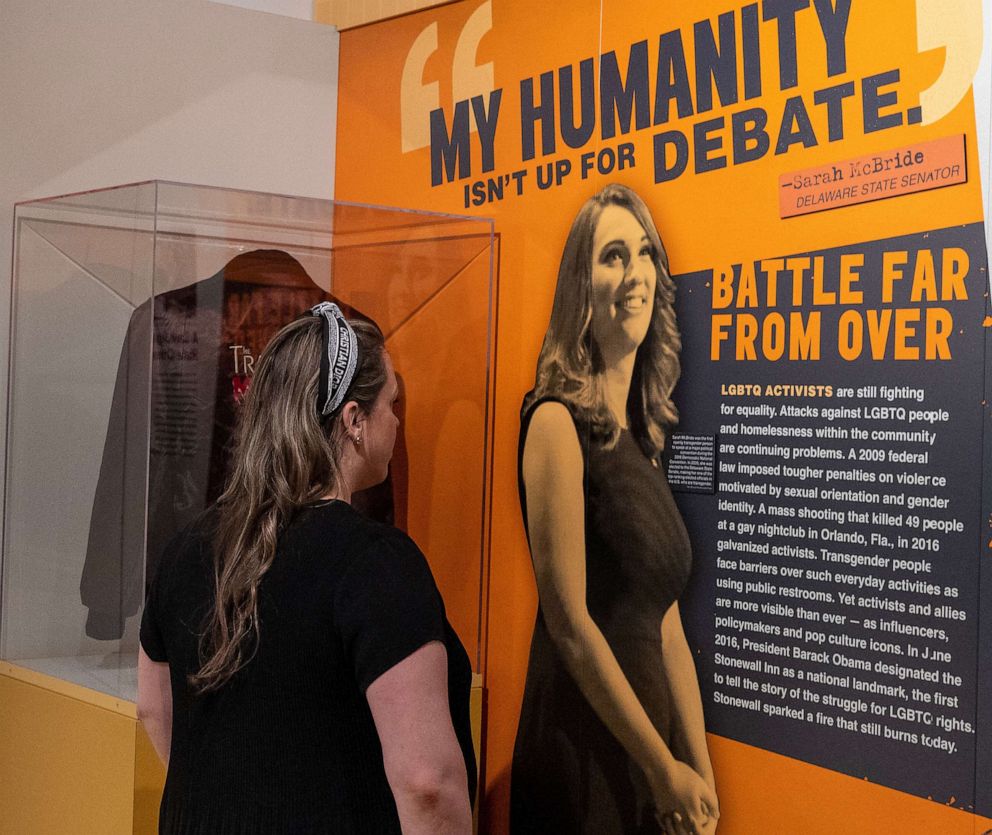
A person reads about Delaware Legislature Sarah McBride becoming the first transgender person to speak at a political convention, displayed in the Rise Up exhibition at the Dallas Holocaust and Human Rights Museum, on June 8, 2023, in Dallas, Texas.
Adam Davis/EPA via Shutterstock.
On the day she launched her campaign, she told ABC News that she has been happy to answer questions about her trans identity. But, she said with a smile, gender is not at the core of her job description as an elected official and she didn’t seek office to be “the trans senator.”
“My day-to-day focus is not explaining gender identity to people,” she said. “My day-to-day focus is delivering tangible results for the constituents that I serve.”
McBride is aware that trans candidates face increased scrutiny of their electability at the same time that the number of trans officeholders is growing, she said. She’s also running at a time of rising anti-LGBTQ extremism across the U.S., according to recent assessments from the Institute for Strategic Dialogue, the Anti-Defamation League and GLAAD.
While celebrations were held around the world for Pride month, there were no major LGBT events in China.
The country’s largest Pride event has been suspended since 2021.
The organiser, a group named ShanghaiPride, did not give a reason for the move, saying at the time it was “cancelling all upcoming activities and taking a break from scheduling any future events.”
People taking part in political protests in China often face punishment, so instead of holding parades, ShanghaiPride had organised dance parties, community runs and film screenings in the city.
Now, only a few low-profile events are available for the LGBT community such as “voguing balls”, where dancers execute moves inspired by model poses.
And ShanghaiPride is not the only major LGBT group to cease operations.
In recent years, several others have had to shut down, raising fears of a crackdown on activism in the world’s second largest economy.
The same year, a group which filed lawsuits on behalf of members of the LGBT community closed down. There were reports that its founder was detained by authorities, with the closure of the group being a condition for his release.
And last month, the Beijing LGBT Center became the latest group to stop operations “due to forces beyond our control”.
“With the closure of the Beijing LGBT Center, the last large LGBT organisation in China has decided to take a break,” Raymond Phang, the co-founder of ShanghaiPride, told the BBC.
Mr Phang left China after his group cancelled an annual celebration in Shanghai.
An Illinois city has emerged as a haven for the LGBTQ community seeking affordable housing options. With its welcoming atmosphere and relatively low cost of living, the city has become an attractive destination for LGBTQ individuals and families. By providing a safe and inclusive environment, the city is fostering a sense of belonging and promoting equality for all residents.
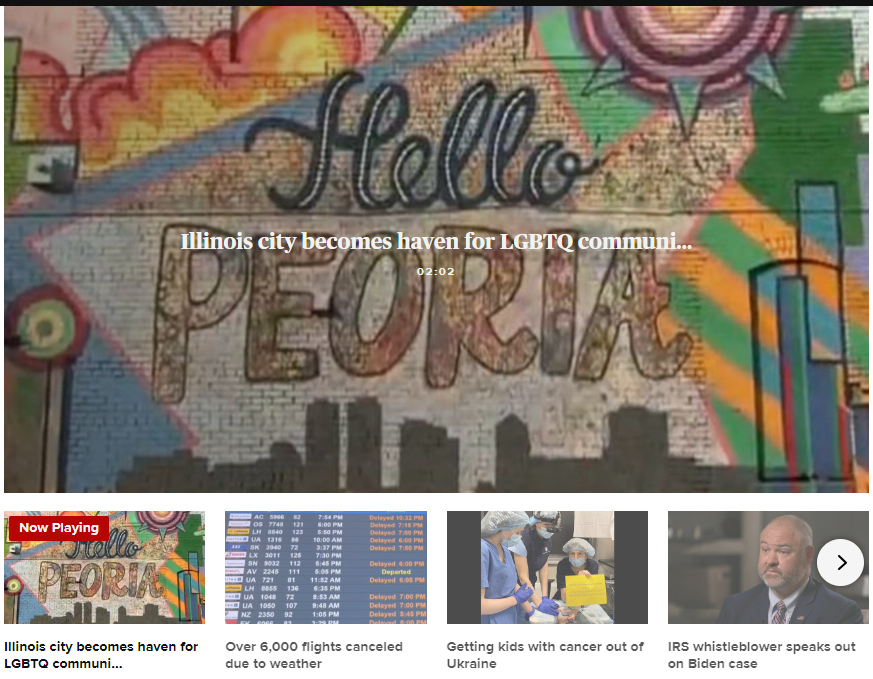
The dream of owning a home seems out of reach for millions of Americans, especially those in the LGBTQ+ community. But in Peoria, Illinois, Alex Martin owns a home at age 30 — something she never thought would be possible.
“I’m black. I’m trans, and I’m visibly so, and so having a space that, like, I made that I can just come in and recharge, I’m ready to face the world again,” she said.
And she’s not alone. In recent years, many LGBTQ+ people and people of color, who are statistically less likely to own homes because of discrimination and wealth gaps, are moving to the same city.
At first, they came from places like New York and Seattle, where home prices are sky-high. Now, many are coming from some of the 21 states that have passed anti-LGBTQ+ legislation.
Last year, realtor Mike Van Cleve sold almost 80 homes, and nearly one-third were sold to people moving from out of state.
Angie Ostaszewski says she has almost single-handedly grown Peoria’s population by about 360 in three years thanks to TikTok.
“When I first started making TikToks about Peoria, it was about ‘improve your quality of life,'” she said. “But in the last six months especially, people are relocating here more for survival, and that’s such a different conversation.”
Ostaszewski also said she would like for her posts to help spread the word even further.
“I love the idea of shaking up that big cities are the only places that LGBTQ+ people can thrive,” she said.
Amidst civil rights threats, the fight to openly discuss and embrace LGBTQ+ identities remains an uphill battle. The struggle to “say gay” and affirm diverse sexual orientations requires continued advocacy and resilience. By challenging discriminatory policies and promoting inclusive dialogue, we can work towards a more accepting society.
Pride month may be coming to an end, but the fight for queer rights is ongoing. Two days ago, Vice President Kamala Harris visited the site of Stonewall, the historic birthplace of the gay rights movement. On this day in 1969, there was a police raid on the Stonewall Inn in New York City. This raid marked a pattern of repeated harassment against the LGBT+ communities who patronized the bar. As a result, a multi-day riot ensued.
Although trans activist Marsha P. Johnson is credited as throwing the first brick, she said in an interview that “the riots had already started” prior to her arrival. According to them.us, there are competing accounts of who threw the first brick or Molotov cocktail at Stonewall. Nonetheless, Johnson’s impact is felt in the queer community and even beyond.
She and other activists like Sylvia Rivera, and Stormé DeLarverie were active during the riots. Fifty-four years later, their legacies are worth revisiting. Despite major strides like gay marriage and the end of sodomy laws, there has been a heavy backlash against the LGBT+ community in recent years.
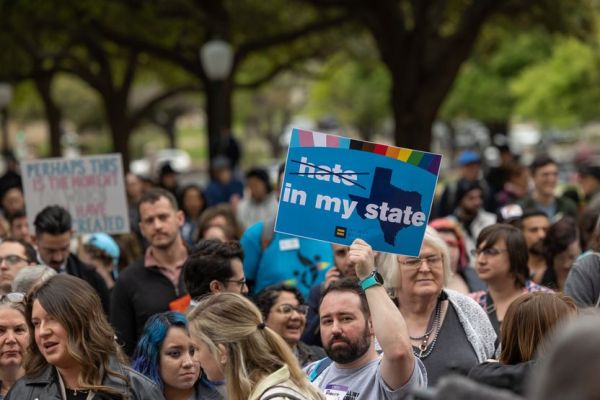
Bob McCranie, leader of Texas Pride Realty Group, said that of the 140 anti-gay and anti-trans bills presented to the Texas legislature, nine of them got through. While that number may seem small, he added, “It impacts our ability to live, to get healthcare, to run our businesses.”
When he came out in 1992, it would be eleven years before McCranie could live as a “legal person,” in his words. In 2003, the reversal of Lawrence v. Texas marked a new day for gay rights.
It would be another eleven years before gay marriage would become legal, through the Obergefell v Hodges case in 2014. Alas, these protections are now in danger. When the historic reversal of Roe v. Wade happened, the 14th Amendment came under judicial threat. McCranie stated, “We just saw the 14th Amendment get knocked away with the Roe v. Wade ruling.”
As a result, other civil liberties have come under the spotlight. Following the reversal of Roe v. Wade, Justice Clarence Thomas called for renewed interest in three other rulings: Griswold v. Connecticut (contraception access), Obergefell v. Hodges (gay marriage), and Lawrence v. Texas (same-sex relationships), Politico reported. Two of these rulings affect the LGBT+ community.
“If we become illegal people again…what does that do for us living in these states?” McCranie asked. To fight these regressive laws, McCranie founded Texas Pride Realty Group, which helps get people out of anti-LGBT+ states and relocates them to sanctuary states and countries. According to McCranie, sanctuary states and anti-LGBT+ states are divided along party lines.
So, typically blue states have been welcoming for the most part, and traditionally red states have been enacting harm. These states include Texas, where McCranie is from, and Florida. To McCranie, Governors Ron DeSantis and Greg Abbott are competing to see who can be the most harmful.
Abbott has called on Texas citizens to report parents of trans kids for abuse if they are providing gender-affirming care for their children. Simultaneously, DeSantis wanted to restrict Medicaid coverage for those seeking gender-affirming care.
As DeSantis vyes for a Presidential seat, he appeals to the same far-right base that elected and supported Donald Trump. McCranie mentioned that activists underestimated Senate Minority Leader Mitch McConnell’s decision to take away former President Barack Obama’s ability to appoint a Supreme Court justice and then turn around and grant that right to former President Trump.
This was all strategic, Bob mentioned. In my view, the trans bans, book bans, and abortion bans are part of the Republican strategy to revert the country to the right. We must resist that.
Bob said, “When I came out in 1992, I was an illegal person…it’s not my intention to go back to that.”
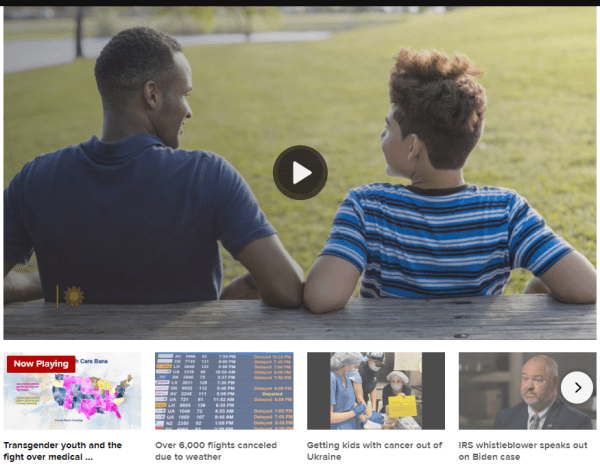
Facing challenges and barriers to healthcare, education, and acceptance in Texas, these families are making difficult decisions to provide a safer and more supportive environment for their transgender children.
Sara, a mother and LGBTQ+ advocate, recently moved to Colorado from Texas in an effort to keep her transgender son safe.
AURORA, Colo. — Brianna went to bed Aug. 22 with a knot in her stomach.
That night, a Texas school board near her home passed a “Don’t Say Trans” policy barring employees from discussing what the district defined as “gender fluidity.”
The school board’s new policy was the latest entry in growing, right-wing political playbook that targets transgender youth and the adults who support them.
Months before the school board’s decision, Texas Gov. Greg Abbott, a Republican, ordered the Texas Department of Family and Protective Services to conduct child abuse investigations into parents whose children received gender-affirming care such as puberty blockers and hormone therapy. Abbott’s decision was in line with the heavily conservative state legislature, which had introduced more anti-transgender bills than any other state.
In 2020, Brianna’s son, Rylee, came out as a transgender boy. He was 12 years old at the time.
Brianna and her family moved to Texas — which has one of the largest transgender communities in the country — in 2015 to be closer to their extended family. Brianna knew the small town they called home was far from progressive, but she expected to largely be left alone as she and her family kept their heads down and raised LGBTQ+ children.
But the state’s policies seemed to get crueler over time. Brianna knew her family wasn’t safe.
“I went to bed knowing what was happening and woke up the next day thinking, ‘we have to leave,’” Brianna recalled. “’We have to get out of Texas. This is not going to get better; it is just going to get worse.’”
She spent the following day researching states that were more welcoming to transgender people. The Pacific Northwest was too rainy, California was too expensive, Minnesota was too cold. She booked a 24-hour trip to Colorado — which received high marks from places like the Movement Advancement Project — to vet the state, making sure to ask folks she encountered about its safety for LGBTQ+ kids.
As she drove around Denver and saw rainbow flags plastered in business windows and hanging outside homes, Brianna knew where to move.
“It was so overwhelmingly positive and welcoming,” she said of Colorado. “In Texas, you couldn’t even talk about this stuff.”
The family voted in the Nov. 8 Texas election, feeling they owed their votes to friends in similar situations who couldn’t leave the state. Three days later, they packed their bags and started their journey to Aurora.
Tired of living in fear
Lucas and Sara had deep roots in Texas. Lucas worked at a nonprofit supporting kids in the foster care system; Sara taught music at a private school. The two had family and deep friendships in the state.
But fear overwhelmed them in February 2022 after Abbott declared gender-affirming care for children a form of child abuse. The couple’s son, Alec, came out as transgender years earlier and began transitioning soon after.
Bullying and harassment were common for Alec in his small Texas town, but when laws began to threaten his safety, his parents knew something needed to change.
“There was a moment where I just imagined Alec being taken from our family,” Sara said. “Just having to process that was extremely scary and upsetting.”
Lucas and Sara became more outspoken in their LGBTQ+ allyship by helping plan Pride festivals and volunteering with Equality Texas.
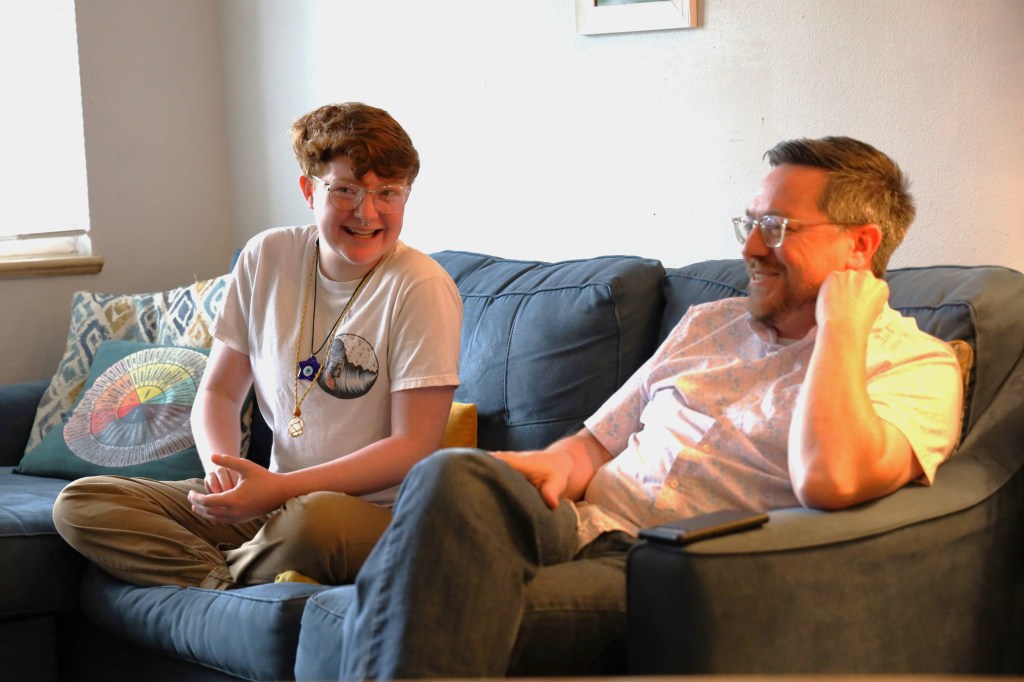
Alec and Lucas sit on their couch discussing their experience moving from Texas to Colorado.
Alec did his best to fit in at school. He wore baggy, unassuming clothes and tried to keep his head down.
“There were so many times where I was like ‘if I just de-transitioned and lived, I could live easier here,’ but the dysphoria makes things so hard,” said Alec, who is now 15 years old. “It wouldn’t have been a happy life for me.”
Other parents began complaining that Sara was using her position as a teacher to “push an agenda.” Sara maintains she never discussed politics in class.
“It was very clear that we were being targeted because this was a relatively small town and we had been outspoken,” Lucas said. “I knew this was really scary and we worried about what could happen to our family.”
Brianna and Rylee also remember living in fear.
“How exhausting it was, not knowing day-to-day what laws were going to be passed that would hurt my child and not understanding why it’s something that people care about,” Brianna said. “I don’t understand the vitriol towards these kids who just want to exist and the parents who just want their kids to survive.”
Brianna tried to educate those around her and give them the benefit of the doubt. But many people didn’t seem interested in learning.
“It’s extremely frustrating and there’s no amount of education I could do,” Brianna said. “You think you can educate people away from bad beliefs, but they’re not interested in the truth. They’re interested in their narrative and that’s it.”
Lucas and Sara remember having conversations with Alec where they reminded him not to stand out too much, which was a painful message to send for two parents who wanted nothing more than to affirm their child.
“We did a lot of apologizing to the kids and saying, ‘I’m sorry you can’t wear what you’d like to wear because we need to be careful right now,’’ Sara recalled. “I remember saying that a lot. ‘We need to be careful right now.’”
The family also helped plan a kid-friendly Pride celebration in their town, hoping to show marginalized children that adults were on their side. However, several other adults, including an anti-LGBTQ+ Instagram “influencer,” showed up and chanted “groomer” at those participating in the festival.
“It was really weird because I grew up there and that place just turned on me,” Alec said.
The family had lived in their town for 14 years and felt it was important to stay and fight for other LGBTQ+ people. But as anti-transgender bills stacked up and hateful rhetoric grew louder, Lucas and Sara saw that their family’s safety was in jeopardy.
“It was a constant state of anxiety and fear,” Lucas said. “All it would take was one person in our town who didn’t like us and report us and we would’ve had a CPS case that we would be dealing with.”
In 2023, the family said goodbye to their longtime church, colleagues and friends and moved to Denver, where they felt safer in their new home.
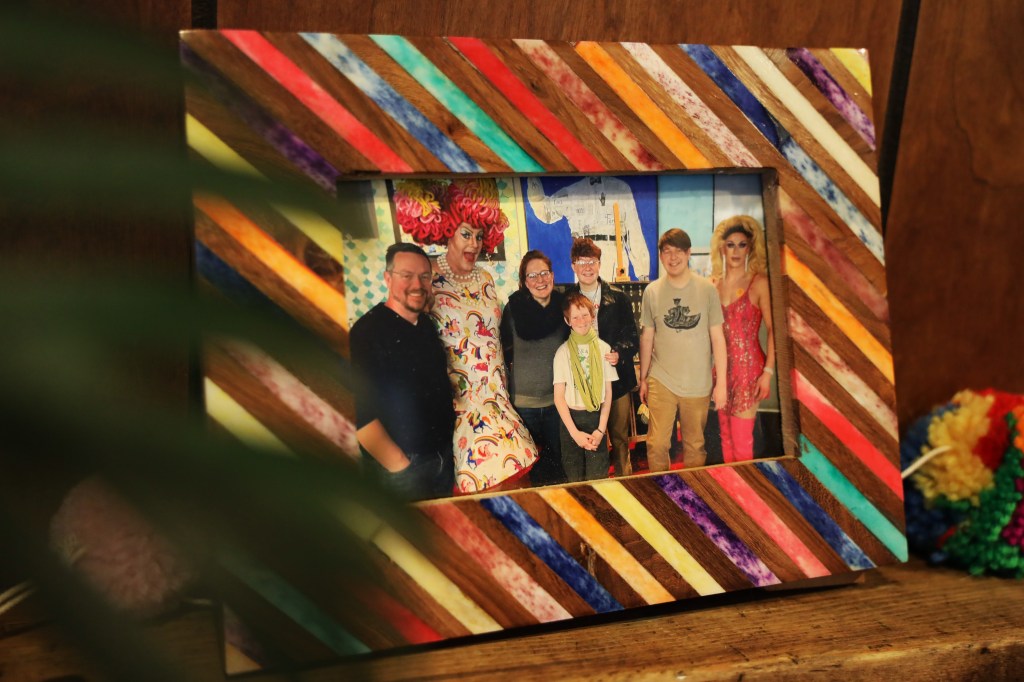
Alec, Lucas, Sara and other family members pose together next to drag queens.
Relaxing again
The contrast between living in fear and living in a state with codified LGBTQ+ rights has been immense, the families told Rocky Mountain PBS.
“I’ve met some really sweet people here,” Alec said. “It definitely feels like a whole reset.”
Though they know things are safer in Colorado, Alec, Sara and Lucas said it has been a struggle to shake the feeling of fear, as they lived in fight-or-flight mode for so long.
“We’ve only been in Colorado for a few months and I feel like I’m still letting go of some of those anxieties and fear and worries,” Lucas said.
Some of the anxiety and fear dissipated after the family connected with other LGBTQ+ Coloradans.
During their first week in town, they attended a drag brunch in which the performer affirmed the transgender kids in attendance.
“It was really emotional for me, because we had left a bad situation so recently,” Alec said. “It was really heartwarming to hear that.”
An abnormal childhood
As Alec navigates his transition, he said many of his peers treat him “like Google.” They ask him invasive questions, he said, which can sometimes make him feel like a political prop.
“I become their search engine and it’s so strange,” he added.
When he is not advocating for his rights, Alec enjoys watercolor painting. His family has a collection of chickens he painted on their walls.
Alec, 15, stands next to his watercolor paintings of the family’s chickens.
Sara tries to encourage Alec to simply be a kid.
“Having to speak to other adults about what it’s like to be trans, that’s a lot of responsibility,” Sara said. “I know it’s important but it’s very heavy and it’s not a normal childhood.”
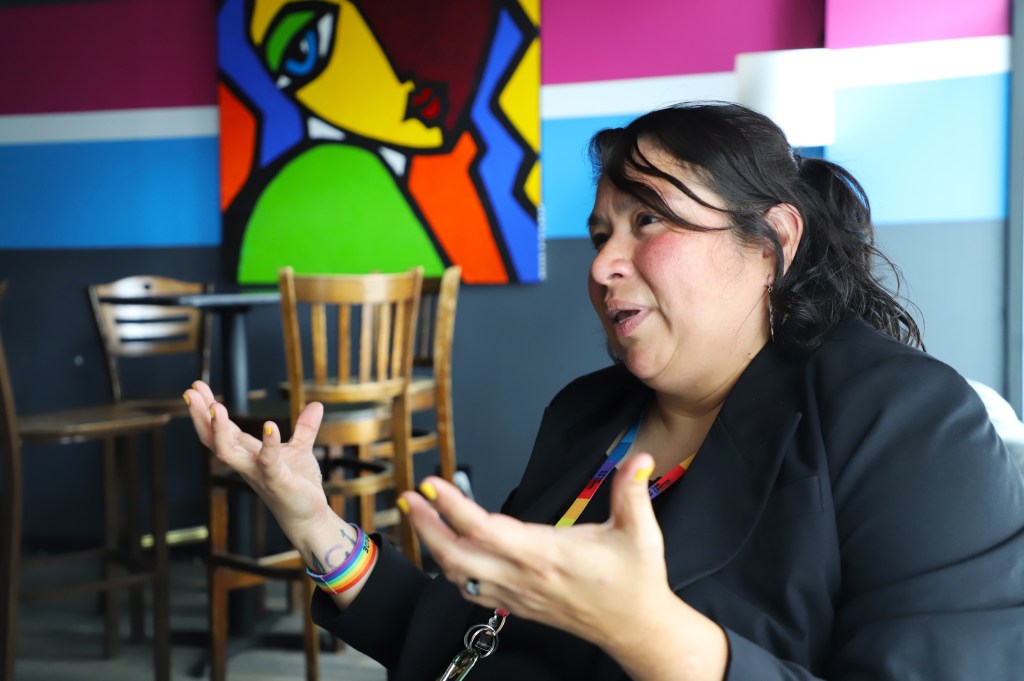
“We try to just make sure we’re doing the things that help them in life and society,” said Sandra Zapata, director of youth services at the Center on Colfax, an LGBTQ+ community center in Denver. “A lot of it is just making sure they know they have a space to come, and once they find us, it’s a good place to make connections so folks will create those personal relationships with each other.”
Zapata leads the Rainbow Alley, a youth program at the Center on Colfax. Both Rylee and Alec attend Rainbow Alley and said they’ve made many friends and connections there.
“It’s about giving them that space where there’s no rules, there’s no expectations of how you’re supposed to dress and what colors you’re supposed to like, and what kind of careers you’re supposed to have,” Zapata said. “So, then you’re left with this blank canvas.”
Zapata leads the Rainbow Alley program at The Center on Colfax.
Zapata said many of the children they meet come from states with anti-LGBTQ+ laws. Though moving can bring newfound safety, the process is often isolating, Zapata said.
“There’s a lot of sadness, maybe you lived in one place your whole life and now you’re having to move, not because you want to but because ultimately you know it’s going to be safer,” Zapata said. “It’s still hard to leave your friends and family and whoever you’re leaving behind.”
Zapata said housing is often the biggest barrier for those looking to move to safer states. Colorado’s housing prices skyrocketed in recent years, making a move to the state out of reach for many families.
Though many people see Colorado as a sanctuary for LGBTQ+ people, especially compared to its neighboring states, the state is far from perfect. The United States Supreme Court, to use a recent example, recently sided with a Denver website designer who argued that designing websites for same-sex couples violated her First Amendment rights. Moreover, several school districts have attempted to pass their own “don’t say gay,” bills as well.
Nevertheless, more families with LGBTQ+ children are deciding to move to places like Colorado.
“There’s a migration happening,” said Bob McCranie, owner of Texas Pride Realty Group, a realty group in Texas that focuses on selling homes to LGBTQ+ Texans. “This is a national state of emergency for LGBTQ people.”
McCranie also connects LGBTQ+ Texans looking to leave the state with affirming realtors in other states, something he said is necessary as dozens of states cut rights for queer people.
Eventually, McCranie said, LGBTQ+ people across the country could lose rights regardless of the state they live in. McCranie said he asks clients if they’ve considered moving abroad, should conservative politicians and Supreme Court justices continue to roll back long-held rights.
“If some of these cases get overturned and the court says you can’t have gay marriage in any state, the blue states won’t be safe either,” McCranie said. “Do you have a plan for when and if that happens?”
Differentiating medical facts from misinformation is vital. Rely on trusted sources, fact-check information, and consult medical professionals. Promote critical thinking and health literacy to combat misinformation.
Almost three weeks after Florida’s Republican governor, Ron DeSantis, signed a bill making it a felony for doctors to provide gender-affirming care to transgender minors, a judge issued a preliminary injunction preventing enforcement of the law for three children whose parents are part of an ongoing lawsuit.
Florida is one of at least 20 states that have limited gender-affirming treatment for minors. The legislators sponsoring some of these bills say their intent is to protect children and families from pressure “to receive harmful, experimental puberty blockers and cross-sex hormones and to undergo irreversible, life-altering surgical procedures,” as a new Montana law puts it.
“Gender transitions involving major surgeries not only result in sterility, but other irreversible negative biological effects,” said Montana state Sen. John Fuller, the Republican who introduced the bill.
Such laws and policies, and statements — such as Fuller’s — used to justify them, reflect misconceptions and misinformation that conflate treatments and strip trans youth of essential care.
What is gender-affirming care?
Gender-affirming care is a broad term for many distinct treatments provided to children, teens, and adults. Puberty blockers, for example, are medications that inhibit puberty by suppressing the body’s production of sex hormones, while hormone therapy is the administration of testosterone or estrogen to alter secondary sex characteristics.
One common misbelief heard when legislation is discussed is that gender-affirming medical interventions are provided immediately to any trans or nonbinary kid who walks into a gender clinic.
Kristen Chapman, 52, doesn’t know anyone in Virginia. She doesn’t have a job lined up or a home there. But this summer, the Tennessee mother of three will uproot her family from Nashville and move 600 miles away to Richmond, VA, so that her transgender daughter can continue receiving the gender-affirming care that Chapman believes has saved her child’s life.
In March, Tennessee banned gender-affirming care for transgender minors.
“My youngest child cannot get care here legally. I no longer feel welcome here. I no longer feel safe here,” says Chapman, a social worker and artist, who identifies as queer. “I literally feel targeted, like someone painted a big X on our door and we have to get out.”
Chapman is part of a growing number of lesbian, gay, bisexual, transgender, and queer people and their families fleeing neighborhoods, cities, and states where they are worried about their safety. Some have faced harassment as anti-LGBTQ+ rhetoric has spread throughout the country. Others are desperate parents of children whose gender-affirming health care has been outlawed by their state governments. Most are relocating to blue and purple cities and states, where housing costs are often much higher but they feel welcomed.
Since June 5 of this year, more than 525 anti-LGBTQ+ bills have been introduced in 41 states, creating a new record, according to the Human Rights Campaign. More than 220 of those bills targeted transgender individuals with at least 20 states now banning gender-affirming care. More than 76 bills have become law, more than double last year, according to the HRC.
While there are no official estimates of how many LGBTQ+ people and families are relocating, it’s a growing number, says Anita R. Blue, a Realtor® in Houston and president-elect of the LGBTQ+ Real Estate Alliance. It’s an issue that’s increasingly spilling over into the housing market.
“Housing’s going to suffer,” says Blue. “People don’t want to live or buy a home in a state where they don’t feel safe.”
In 2020, several months into the COVID-19 pandemic, Chapman received a three-word email from her daughter. It said, “I am trans.”
What followed was about a year of doctor’s visits, tests, and mental health evaluations before her child, now 15, began receiving puberty blockers.
Chapman explains that her child was suicidal before receiving treatment. Now, if her daughter misses a treatment, she will go through puberty—as a boy.
“If I don’t get her to a state in August where she can receive a shot, then she literally could resume puberty immediately. Her voice could drop, and there’s no fixing that,” says Chapman. “The more she passes as a [cisgender woman], the safer she is. That was our big motivation to move quickly.”
She chose Richmond because she hopes that her husband, whom she is separated from, will be able to transfer his job to one of his company’s offices there to be close to their 15-year-old and 17-year-old autistic daughter. Their oldest is away at college. Chapman started a GoFundMe campaign to help pay for moving costs.
“I’m really angry. But the overwhelming feeling is I’m just heartbroken,” Chapman says through tears. “I’m exhausted, and I’m scared for my family. At this point, my children deserve to feel some peace and stability.”
LGBTQ+ people and their families are fleeing neighborhoods, cities, and states where they are worried about their safety.
Dallas-area real estate broker Bob McCranie has helped 27 clients worried about anti-LGBTQ+ harassment and legislation move out of Texas. Most are going to blue states, such as Illinois, Connecticut, Massachusetts, and Colorado, or even abroad.
“There’s a migration going on right now,” says McCranie. “We’re trying to get people out of harm’s way and to a place that’s a little bit safer.”
But moving, especially cross-country, takes money.
Those leaving red states might find that home and rental prices, as well as everything else, are much higher in blue states. Transplants are often leaving behind their support networks and essentially starting over.
Callen Jones, a Realtor® with the Dalton Wade Real Estate Group and who is based in Tampa, FL, has seen many people leave Florida due to the state’s anti-LGBTQ+ laws. This spring Jones, who identifies as transgender, helped four people sell their homes. Jones’ clients, who were self-employed or worked remotely, relocated to the Midwest and Northeast.
Last year, Florida made headlines for banning classroom instruction on sexual orientation and gender identity in public schools for kindergarten through third grade. The law, which has since been expanded to higher grades, resulted in a teacher being investigated for showing her fifth-grade class the Disney movie “Strange World,” which has a gay character.
In May, Florida Gov. and Republican presidential candidate Ron DeSantis signed into law legislation to restrict gender-affirming health care for transgender minors. The law also allows children who undergo treatment to be placed in the state’s temporary custody.
“A lot of our folks who are openly LGBTQ and their parents are fearful,” says Jones. “Home is so vastly important to everyone, the ability to have a home and feel safe and feel settled. If you don’t feel safe, secure, and affirmed, you’re not going to be your best self.”
Nicole, who did not want to be fully identified, moved from the Fort Worth, TX, area to Denver with her husband and 14-year-old twin boys in mid-November.
One of their twins came out as bisexual in 2019 and then as transgender a year later. He began gender-affirming health care six months later.
In February of last year, Texas Gov. Greg Abbott directed the state’s Department of Family and Protective Services to investigate parents of transgender children receiving gender-affirming care. The order was successfully challenged in the courts but is now being appealed. On Sept. 1, it will become illegal for doctors in the state to provide gender-affirming care to those under 18.
“It was urgent that we needed to leave,” says Nicole. “The thought of both of [our kids] being taken from us because we support gender-affirming care was terrifying.”
She was advised to create a “safe” folder for affidavits from people who knew the family and could testify they were good parents. Their children were advised not to answer questions from adults they didn’t know unless Nicole and her husband were present.
“I couldn’t in good conscience stay any longer,” says Nicole.
The family chose Denver, despite not having family or friends there. They had searched online for LGBTQ+-friendly places, and Colorado kept coming up.
Their three-bedroom, two-bathroom house, which they purchased in 2019, took five months to sell. They barely broke even. In November, they moved into a rental house in Denver, which was considerably more expensive.
Nicole, who is a mortgage lender, was able to continue working remotely. Her husband is retired from the Air Force. Most importantly, their son is able to continue with his treatment.
“We didn’t realize how we were living down in Texas until we got up here. This massive weight was lifted, and the fear was gone,” she says. “We feel like we can take a deep breath.”
The Texas Supreme Court will review a case involving a Waco justice of the peace’s refusal to perform same-sex weddings.
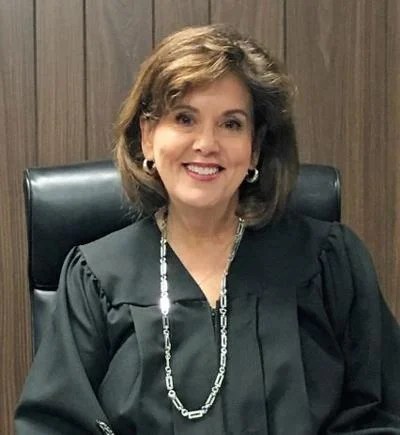
McLennan County Justice of the Peace Dianne Hensley sued the Texas State Commission on Judicial Conduct after it issued a public warning against her in 2019 for refusing to perform weddings for same-sex couples, citing her religious views, while continuing to perform weddings for opposite-sex couples. Hensley requested April 10 that the Texas Supreme Court consider the matter after a district court in Travis County dismissed her lawsuit and an appeals court upheld the dismissal.
The Texas Supreme Court agreed Friday to grant the request for judicial review from Hensley. She has been the Precinct 1, Place 1 JP since 2014, and was unopposed last year in her most recent reelection bid.
In addition to Hensley’s attorney in Travis County, Jonathan Mitchell, three attorneys from the Plano-based First Liberty Institute joined the lawsuit, including deputy general counsel Justin Butterfield.
“Judge Hensley always followed the law,” Butterfield said in a statement Monday. “She sought to follow her religious beliefs and accommodate everyone, yet the government chose to punish her. We look forward to the Texas Supreme Court correcting this injustice.”







 fleeredstates.blog
You must be logged in to post a comment.