On 18 June, the court ordered the South Asian country’s government to ensure equal marriage rights for queer and trans people. The ruling makes Nepal the 40th country worldwide to legally recognise equal marriage.
Equal marriage was previously recognised in Nepal following an interim ruling in 2023 from the Supreme Court, when a group of nine LGBTQ+ activists sued the country’s marriage laws that defined marriage as a union between a man and a woman.
The lawsuit led to the court ordering Nepal’s government to create a new marriage register for couples from gender minority communities.
This month, the court’s new ruling will provide certainty and security for Nepali LGBTQ+ couples wishing to marry in the future.
Speaking to Nepali non-profit Pahichan on 19 June, human rights activist, monk and former politician Sunil Babu Pant said: “This landmark ruling marks a historic milestone for equality, dignity, and human rights in Nepal, while providing crucial legal clarity and protection for the rights of same-sex couples.”
They continued: “The verdict reaffirms the constitutional principles established in Sunil Babu Pant vs Nepal govt, and strengthened through later cases, including Maya Surendra’s first-ever legal registration of non-traditional heterosexual marriage in Nepal.
“It confirms that gender and sexual minority couples are entitled to equal protection of the law and reinforces Nepal’s commitment to inclusion, equality, and non-discrimination.”
The Blue Diamond, an LGBTQ+ rights organisation based in Nepal, also celebrated the decision.
“The ruling is now the fourth Supreme Court decision over nearly two decades that makes clear: the freedom to marry the person you love is a guarantee under Nepal’s Constitution, and LGBTQIA+ couples and their families must be afforded the dignity, respect, and protections that only marriage can provide,” the group shared in a statement on Instagram.
“With this victory, a counter-writ petition filed by advocate Yuvraj Paudel aiming to block these rights was decisively dismissed by the court,” it continued.
“We, the Blue Diamond Society team, welcome this important milestone from the Supreme Court of Nepal towards ensuring marriage equality provisions in Nepal and are excited to witness the next steps from the Government in translating this ruling into practice.”
The Netherlands will ban conversion therapy after the Senate voted 75 to 57 in favor of legislation to eradicate the harmful practice. The Dutch House of Representatives has already approved the bill, which will reportedly punish anyone who practices conversion therapy on children or vulnerable adults with up to two years in prison and a fine of up to 27,500 euros (about $31,500). Therapists could also lose their licenses.
The country already bans some of the more extreme methods of conversion therapy, like medication and shock therapy, according to the NL Times, but the authors of the bill did not feel existing law was comprehensive enough.
During parliamentary debate about the bill, Senator Peter Nicolaï, a member of the left-wing Partij voor de Dieren, reportedly emphasized the need to also cover the dangers of exorcism, prayer-based therapy, psychological pressure, and pseudo-therapy sessions.
The D66 and VVD parties, who spearheaded the bill, celebrated the victory and declared that “years of commitment to freedom, equality, and human dignity have been rewarded.”
The Dutch LGBTQ+ Rights Group COC Netherlands celebrated the bill’s passage. “We have been fighting for the ban with victims and colleague organizations for almost 15 years and are very happy with this result. We see it as a victory for the victims,” the group said on social media, according to Facebook’s translation tool.
A 2013 survey, for example, showed that 84% of former patients who tried ex-gay therapy said it inflicted lasting shame and emotional harm, and in 2022, a report found that LGBTQ+ people who participated in sexual orientation or gender identity change efforts were more likely to experience negative impacts than those who did not, including serious psychological distress (47% vs 34%), depression (65% vs 27%), substance abuse (67% vs 50%), and attempted suicide (58% vs 39%).
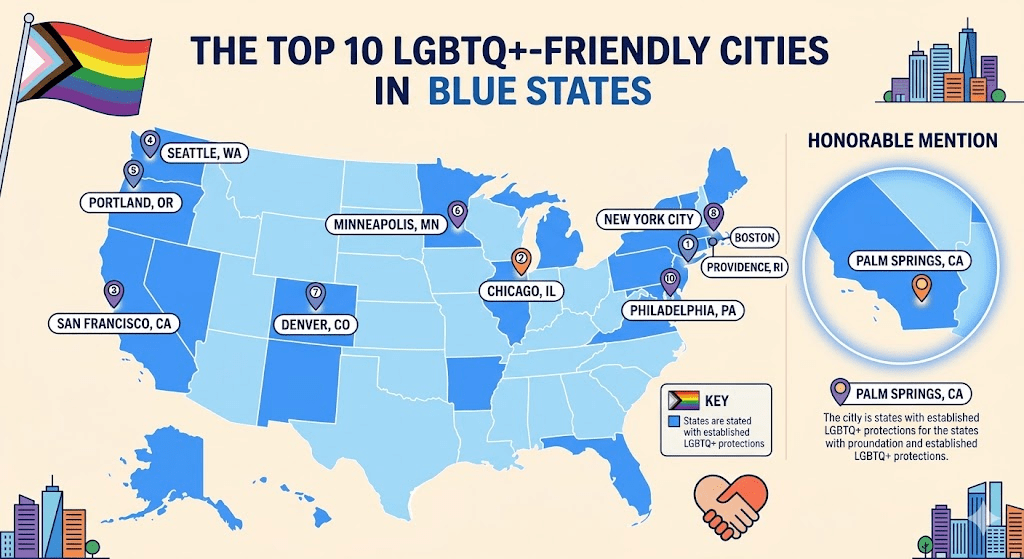
In states where equality is codified into law, these cities don’t just protect the queer community—they let it shape their cultural DNA. From coast to coast, these ten metropolitan hubs represent the absolute gold standard for LGBTQ+ visibility, safety, and community joy.
1. New York City, New York
You can’t talk about LGBTQ+ history without starting in New York City. As the birthplace of the modern gay rights movement at the Stonewall Inn, NYC is a global queer capital. From the historic streets of Greenwich Village to the bustling nightlife of Hell’s Kitchen, the city offers unmatched diversity, visibility, and endless community spaces.
2. Chicago, Illinois
Chicago holds a legendary spot on this list, boasting Northalsted (historically known as Boystown), the oldest officially recognized gayborhood in the United States. Beyond its incredible legal protections, the city radiates Midwestern warmth. For a slightly more relaxed, artsy, and family-friendly vibe, neighborhoods like Andersonville make Chicago one of the most livable, inclusive mega-cities in the world.
3. San Francisco, California
Historically, structurally, and culturally, San Francisco remains a global sanctuary of queer history.The Castro District is one of the world’s most famous gay neighborhoods, acting as a living monument to decades of activism. Roughly 6% of the city’s population identifies as LGBTQ+, and the sheer baseline of acceptance makes living here feel effortlessly normal.
4. Seattle, Washington
Earning top marks for its progressive oasis environment, Seattle combines a relaxed Pacific Northwest atmosphere with fierce community support. The Capitol Hill neighborhood is the historic epicenter of the city’s queer culture, packed with rainbow crosswalks, queer-owned bookstores, bars, and community centers. Seattle features exceptional legal protections and stands as a major leader in welcoming non-binary and trans residents.
5. Portland, Oregon
Portland takes pride in its eccentric, progressive spirit. It consistently scores a perfect 100 on municipal equality indices, reflecting decades of top-tier non-discrimination protections. The city is exceptionally welcoming to trans, non-binary, and queer artists, with neighborhoods like Alberta Arts District and the Pearl District serving as creative, inclusive safe havens.
6. Minneapolis, Minnesota
As a vital progressive anchor in the upper Midwest, Minneapolis consistently punches above its weight. The city pairs rock-solid statewide protections with a deeply rooted local arts scene. Neighborhoods like Loring Park (the historic home of Twin Cities Pride) and the Northeast Arts District offer a remarkably resilient, community-oriented lifestyle.
7. Denver, Colorado
Denver offers high-altitude harmony with a booming, stable progressive political climate and a massive outdoor culture. The city’s historic Capitol Hill and Five Points areas host an incredibly active queer population. Denver serves as a mountain sanctuary, offering excellent healthcare access and a highly visible, year-round LGBTQ+ community.
8. Boston, Massachusetts
Massachusetts was a historical pioneer as the first state to legalize same-sex marriage back in 2004, and Boston remains a brilliant hub for the community. Thanks to a massive academic presence, it’s a prime destination for young queer professionals and singles. The South End and Jamaica Plain (JP) neighborhoods are highly inclusive, offering an eclectic mix of historic charm, progressive values, and local queer activism.
9. Providence, Rhode Island
Rhode Island may be small, but Providence is a true hidden gem for the creative queer community. Driven by a massive artistic population from local design schools, the city is intensely artistic and highly secure. The city features a high density of LGBTQ+ adults, a lower cost of living than nearby Boston or New York, and a wonderfully tight-knit, welcoming vibe.
10. Philadelphia, Pennsylvania
While Pennsylvania can lean purple statewide, its biggest city is fiercely blue. Philadelphia is famous for its centrally located, historic “Gayborhood” right in Center City. Marked by rainbow street signs, this district is a culturally rich, highly walkable, and safe anchor for local businesses, nightlife, and community health centers.
Honorable Mention: Palm Springs, California
While technically a smaller resort city rather than a massive urban metropolis, Palm Springs deserves a legendary honorable mention. It features one of the highest concentrations of LGBTQ+ residents and city officials in the entire country. Effectively operating as a mid-century modern queer paradise, Palm Springs offers specialized local hospitality, sunny pool parties, and an entire city infrastructure built explicitly on LGBTQ+ joy and safety.
The Takeaway: In states where progressive values pave the way, these cities serve as blueprints for what happens when a community is allowed to truly thrive, create culture, and lead with unconditional inclusivity.
When you think of the premier LGBTQ+ destinations in America, coastal giants like San Francisco and New York usually dominate the conversation. But a massive shift has been happening. Attracted by a lower cost of living, growing tech hubs, and a desire to build grassroots communities, LGBTQ+ Americans have been moving to traditionally conservative states in record numbers.
Living in a red state doesn’t mean you have to sacrifice a vibrant, welcoming queer community. In fact, some of the most resilient, tight-knit, and celebratory LGBTQ+ scenes in the country exist right in the heart of the American South, Midwest, and Mountain West.
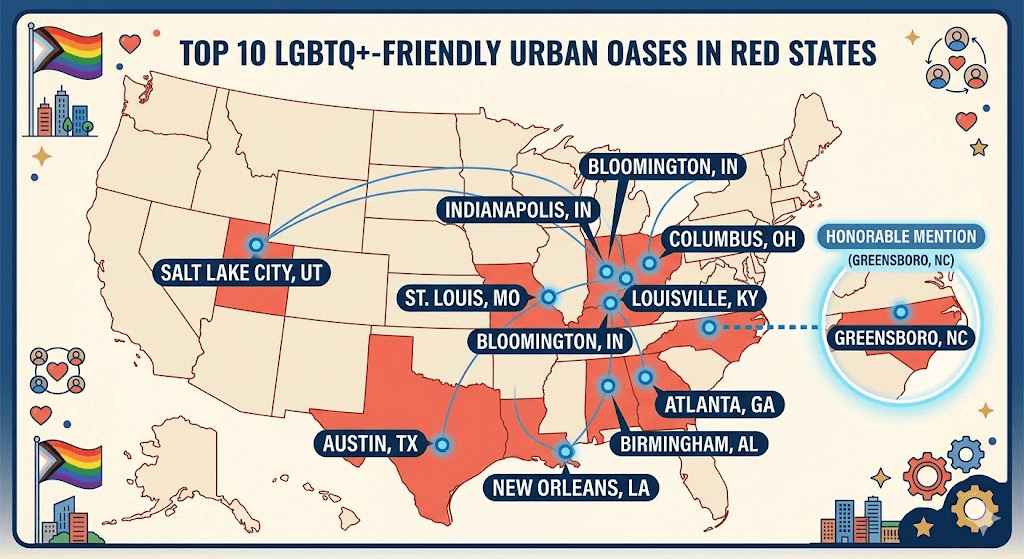
Here is a look at the top 10 LGBTQ+-friendly urban oases located in firmly red states.
1. Austin, Texas
Texas is a massive force in conservative politics, but its capital city operates on its own wavelength. Driven by the proud moniker “Keep Austin Weird,” Austin is a deeply progressive, diverse oasis. Nearly 6% of Austin’s population identifies as LGBTQ+, one of the highest concentrations in the country. The city features a dedicated LGBTQ Quality of Life Advisory Commission to advise local government, and the bars lining Fourth Street make the community highly visible and deeply woven into the city’s famous live-music fabric.
2. Salt Lake City, Utah
Perhaps the biggest surprise to outsiders is Salt Lake City. Despite being the global headquarters of the deeply conservative LDS (Mormon) Church, SLC has undergone a massive cultural transformation. It routinely ranks among the top ten cities in the nation for its percentage of LGBTQ+ residents, elected its first openly lesbian mayor back in 2015, and features the vibrant, inclusive Marmalade District as the historic epicenter of its queer culture.
3. St. Louis, Missouri
Missouri’s statewide political landscape tilts heavily conservative, but St. Louis stands out as a massive beacon for the LGBTQ+ community—especially for those looking for affordability. The city consistently scores a perfect 100 on the Human Rights Campaign’s Municipal Equality Index. Neighborhoods like The Grove feature miles of rainbow-painted crosswalks, queer-owned boutiques, lively nightlife, and active community centers.
4. Atlanta, Georgia
While Georgia has leaned “purple” in recent federal elections, its state legislature and rural areas remain firmly conservative. Atlanta, however, is frequently crowned the “LGBTQ+ Capital of the South.” It features an incredibly diverse, politically active queer population, anchored by a historic and massive Black queer community. The neighborhood of Midtown is the heart of the action, where rainbow flags fly year-round from restaurants, bars, and high-rises.
5. Louisville, Kentucky
Kentucky may be famous for coal and bluegrass, but Louisville is widely celebrated for its progressive, welcoming charm. Louisville has maintained a perfect 100 score on the Municipal Equality Index for years, thanks to local ordinances that protect LGBTQ+ residents in housing, employment, and public accommodations. The Highlands neighborhood is the city’s cultural heart, known for its eclectic, artsy vibe.
6. Columbus, Ohio
Ohio has solidified its status as a reliable red state in recent election cycles, but Columbus remains a booming, progressive powerhouse. Home to Ohio State University and a massive corporate tech presence, Columbus boasts one of the largest LGBTQ+ populations in the Midwest. The Short North Arts District is the epicenter of the community, packed with queer-owned galleries, bars, and businesses that make the city incredibly welcoming.
7. Indianapolis, Indiana
Indiana has a reputation for deeply conservative state politics, but its capital city is a distinct blue hub. Indianapolis has long held a perfect 100 on the Municipal Equality Index. The historic Mass Ave Arts District serves as the city’s progressive heartbeat, featuring a high concentration of inclusive theaters, bars, and restaurants. The city’s corporate pillars (like Eli Lilly and Salesforce) also actively champion local diversity initiatives.
8. New Orleans, Louisiana
Louisiana is culturally conservative, but New Orleans is a law unto itself. Long heralded as one of the most bohemian and accepting cities in the world, NOLA’s queer history runs deep. While the Faubourg Marigny neighborhood and the edge of the French Quarter host famous gay establishments, the entire city embraces an open, “live and let live” ethos. Events like Southern Decadence bring hundreds of thousands of queer travelers to the city every Labor Day weekend.
9. Bloomington, Indiana
While Indianapolis handles the big-city energy, Bloomington represents the classic, ultra-progressive college town oasis. Home to Indiana University, Bloomington punches way above its weight class for inclusivity. It features comprehensive local non-discrimination ordinances and a highly visible queer academic and local population. It consistently ranks as one of the most affordable and welcoming small cities for LGBTQ+ singles and families alike.
10. Birmingham, Alabama
Often a surprise addition for those unfamiliar with the modern deep South, Birmingham has built an incredibly resilient and active LGBTQ+ infrastructure despite a heavily conservative state environment. The city boasts a perfect 100 on the Municipal Equality Index and supports vital resources like the Magic City Acceptance Center, a sanctuary for queer and trans youth. The city’s progressive core ensures a vibrant local nightlife scene where community protection and grassroots activism go hand in hand.
The Takeaway: While statewide laws in red states can present hurdles, the local leadership, municipal protections, and fiercely supportive grassroots networks in these ten cities prove that you can find a safe, joyful, and thriving community just about anywhere in America.
Honorable Mention: Greensboro, North Carolina
While North Carolina frequently finds itself at the center of heated national political debates, Greensboro quietly serves as a masterclass in local progressivism and community building.
Greensboro has scored a perfect 100 on the Human Rights Campaign’s Municipal Equality Index for five consecutive years, consistently ranking as a top city for inclusivity in the state. Driven by a massive student population from local universities and an active grassroots network, the city boasts a thriving queer culture. Year-round events like Green Queen Bingo pack local venues, and institutions like Chemistry Nightclub and Twist Lounge anchor a welcoming nightlife scene. It’s a prime example of a mid-sized Southern city proving that inclusivity isn’t just a big-city trait.
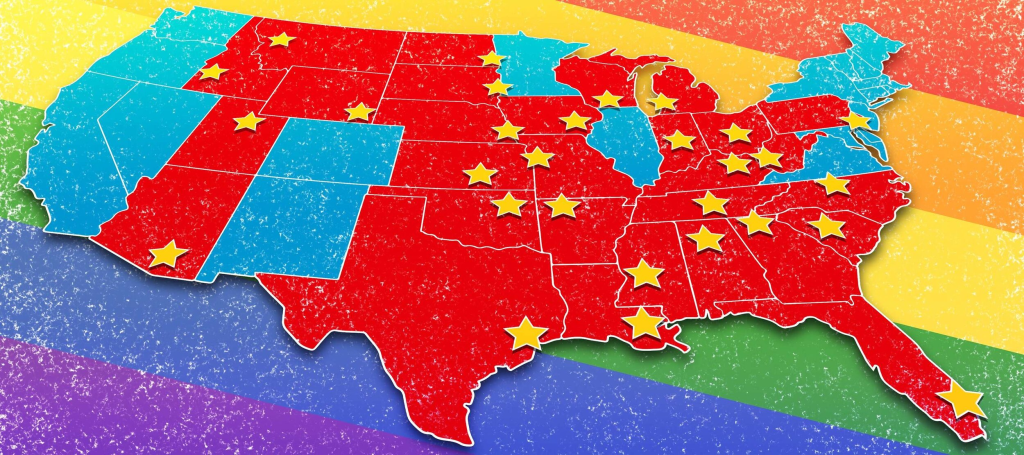
LGBTQ Americans aren’t just fleeing red states for blue enclaves. They are also building lives in cheaper, fast-growing metros where jobs, housing and politics collide.
Why it matters: The “red-state exodus” narrative misses a quieter reality. Affordability and work are keeping some LGBTQ+ people in — and drawing others to — places that may be politically complicated but economically viable.
By the numbers: Homebuyers needed to earn $150,364 annually to afford the median-priced home in states with LGBTQ housing protections as of 2024, per an Axios analysis of real estate company Redfin data.
That’s 46.8% more income needed than in states without such protections.
LGBTQ Americans have lower homeownership rates and face higher rates of poverty and housing instability than non-LGBTQ Americans, according to the Williams Institute.
The LGBTQ homeownership rate trails the rate for straight and cisgender Americans by about 20 percentage points, according to the Urban Institute.
Zoom in: There is evidence of strong LGBTQ populations in the Southern metros that complicate the old “blue enclave” frame.
The Atlanta metro had an estimated 194,000 LGBT adults, or 4.6% of adults, according to the Williams Institute.
The Raleigh-Cary metro area in North Carolina had an estimated 32,000 LGBT adults, and the broader Triangle’s LGBTQ footprint includes Durham’s long-running Pride infrastructure and LGBTQ networks.
The Charlotte metro had an estimated 74,000 LGBTQ adults, or 4% of adults.
State of play: Advocacy groups warn that conservative-led statehouses are making some states riskier for LGBTQ people, especially transgender people, as the ACLU tracks more than 500 anti-LGBTQ bills in 2026.
Groups now maintain emergency relocation resources for LGBTQ families and transgender people affected by hostile state laws.
Blue states are often framed as safer legal destinations because they tend to have stronger nondiscrimination laws and protections for health care access — in addition to friendlier rules on identity documents.
Yes, but: Cities with stronger LGBTQ protections like San Francisco and Boston often come with significantly higher housing costs, creating a tension between safety and affordability.
What they’re saying: “LGBTQ people across the country, just like everyone else across the country, are thinking about economics and affordability every day,” Logan Casey, director of policy research for the advocacy group Movement Advancement Project, tells Axios.
Casey said many LGBTQ Americans are weighing wages, health care and proximity to family while also navigating state policies over safety and legal protections.
“The point is less about the outcome of whether you choose to move or not. It’s more about the fact that LGBTQ people are being forced to think about it in the first place.”
Caveat: There is still no definitive national dataset proving LGBTQ Americans are relocating en masse to cheaper red-state metros.
Researchers caution that LGBTQ migration data remains limited because federal surveys have historically failed to consistently collect sexual orientation and gender identity data.
Flashback: After the 1969 Stonewall uprising, LGBTQ migration became closely associated with urban enclaves, like New York’s Greenwich Village, San Francisco’s Castro District and parts of Los Angeles, Chicago and Houston.
Those neighborhoods offered safety, political organizing, nightlife and community at a time when LGBTQ Americans had few alternatives.
LGBTQ people always lived in every state, congressional district and rural county, but it defined the public imagination of where queer life happened.
The bottom line: The tension between affordability, opportunity and rights is quietly reshaping the map of LGBTQ America.
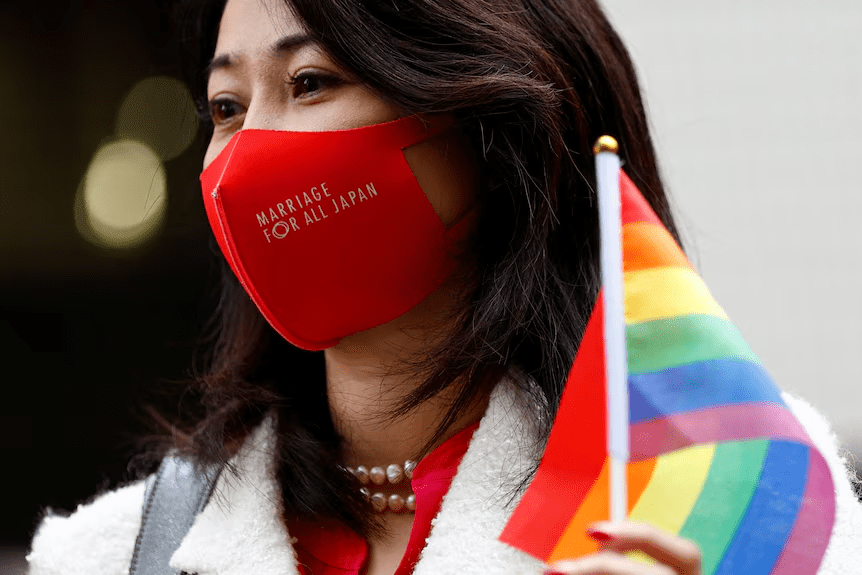
Japan is set to roll out nationwide LGBTQIA+ education for the first time in schools, workplaces, universities and homes.
Japanese media reports that the plan is designed to promote public understanding and awareness of gender and sexual diversity in the country, which has not legalised same-sex marriage.
The draft program reportedly notes that LGBTQIA+ people can “experience confusion, anxiety and difficulties in daily life due to insufficient public understanding.”
The scheme has been years in the making, with the Act on the Promotion of Public Understanding of the Diversity of Sexual Orientation and Gender Identity passed in 2023, requiring the creation of a plan.
The final plan is yet to be made public, with experts also awaiting more detail.
Reports suggest schools are set to provide information to students about sexually and gender-diverse people, while also ensuring that pupils have adequate access to social workers and counsellors.
Universities would revise curricula to ensure that people training to become healthcare professionals and teachers have in-depth knowledge of sexual diversity.
Videos, leaflets and training videos promoting awareness, diversity and academic research will be combined with stronger consultation schemes to measure the public’s understanding of sexual diversity.
Yearly reports on the program, public understanding and related policies will be introduced, with the overall scheme to be reviewed once every three years.
The plan was presented to and approved by the ruling Liberal Democratic Party (LDP) earlier this month, and is expected to be signed off by Prime Minister Takaichi Sanae’s cabinet soon.
‘Great initial step’
Alisha Khojanazar is a molecular neuroscience research technician at Okinawa Institute of Science and Technology and identifies as a “woman of transgender origin”.
She welcomed the education plan as a “great initial step”.
“I think it will help a lot, especially young adults and queer adolescents who are just discovering their identities or genders,”
she said.
“If it would lead to some kind of broader protection by law, that would be great. But with the current political climate in Japan, I would love it to be more inclusive.”
She told the ABC her university was very welcoming to the LGBTQIA+ community, with gender-neutral bathrooms and pride celebrations held regularly, but said the country had a long way to go.
“It’s very hard to meet someone who is open and queer and Japanese,” she said, adding many people in the country were reluctant to speak freely about their sexuality or gender.
Yui Oizumi, a student at Sophia University in Tokyo, identifies as queer.
She described the education plan as a “baby step” that would have some positive effects.
“Training teachers and employers to be mindful is good. But at the same time, I think it’s not really going to do much to change the perception of regular everyday people and how they think about queer people,” she said.
“I think that’s going to take more time and more conscious effort through media as well.”
She said outright homophobia was rare in Japan, but she constantly ran into people who did not understand that she was queer.
“That is such an alien concept that people are like, ‘What do you mean? That doesn’t make any sense.’ And that’s kind of where the struggle lies the most for me,” she said.
She added that friends of hers in a lesbian relationship had been denied rental properties because they were in a same-sex relationship, and believed an anti-discrimination law would better protect the community.
Gay rights in Japan
There are no national laws outlawing discrimination against gay people in Japan, but some local government areas and labour laws offer some protections.
Japan is the only member of the G7 to not legalise gay marriage.
The Japanese government also does not recognise the marriages of same-sex couples if they were legally married in other countries.
Kazuyoshi Kawasaka, an expert in LGBTQIA+ rights in Japan at The University of Tokyo, said the government had decided against anti-discrimination laws to appease conservative factions of the LDP.
Ms Takaichi opposes same-sex marriage, despite previously saying that “there should be no prejudice against sexual orientation or gender identity”.
“The LDP is very conservative, especially for promoting traditional family values. So that is very tricky for the LGBTQ activists in Japan,” Dr Kawasaka said.
“I think that a bigger [anti-discrimination law] protection is much more effective, actually,” he said.
Political scientist at Monash University Charles Crabtree said education was a good starting point.
“Misinformation or a cloudy sense of ‘the other’, whatever that ‘other’ is, impedes individuals’ ability to empathise with those who are different from them,” Dr Crabtree said.
“Education can have an effect, but it depends on what that content is and how much it foregrounds lived experiences, and potentially even highlights the experiences of discrimination that people within this community have felt.”
He described the issue of same-sex marriage in Japan as “rather dire” but said opposition to legalising it was possibly not as strong as it seemed.
In 2024, Dr Crabtree published a public opinion survey of people in Japan as part of the Stanford Japan Barometer, which is believed to be the largest semi-regular opinion poll published of the Japanese public.
Of the 8,000 respondents, 47 per cent were in favour of legalising gay marriage, with 16 per cent opposed and 37 per cent neutral on it.
“It’s hard to characterise exactly what that 37 per cent means, but it suggests to us that there are people who may be potentially malleable in terms of their views,” Dr Crabtree said.
“On the whole, we found this to be a much more rosy picture than what we had seen from other survey data.
“Education efforts might help nudge neutrals to more positive levels of support, which all might matter because higher levels of public support might encourage more dramatic and meaningful government action.”
He said the data found younger people were much more in favour of same-sex marriage than older people in Japan.
Ms Takaichi also received a lot of support from young people, he added, something that could have spurred on the draft education plan.
In November last year Tokyo High Court ruled in favour of Japan’s same-sex marriage ban, saying it did not violate key elements of the country’s constitution.
However the judge noted that “it is inevitable that constitutional violations will arise” and that “the issue should first be thoroughly deliberated in the Diet [Japan’s national parliament].”
It was the final ruling of six court cases across the country, with the issue now awaiting a Supreme Court ruling.
An Idaho man was arrested for allegedly assaulting a gay couple outside a restaurant. But despite allegations that Pedro Villareal hurled antigay slurs before beating two men, authorities charged him only with a misdemeanor and said the state’s hate crime law doesn’t apply.
Caldwell Police say Villareal and other men started shouting slurs at Eric Reed and Juan Olvera outside Acapulco, a restaurant in town, and then chased them from a plaza to nearby railroad tracks, according to Boise TV station KTVB. There, the victims told police, Villareal allegedly began assaulting them. The attack left Reed’s lip split and required six stitches.
Reed and Olvera later sat down with the TV station, where Reed described the fear he experienced during the attack. “I literally felt they were going to kill us for being gay,” Olvera said. “It’s a scary thing to live through, and I never would wish this on anyone.”
But police said Villareal won’t face hate crime charges, even though law enforcement officials said they would like to pursue them. That’s because Idaho state law doesn’t cover crimes based on sexual orientation or gender identity as acts of hate.
“We’re here to serve the citizens of Caldwell and Idaho, and unfortunately, when we’re unable to give them the justice that they feel that they need, under the application of the law, it is frustrating,” Lt. Jeffrey Peterson, a spokesperson for Caldwell Police, told the news outlet.
That’s not the first time the limitation in Idaho’s state law has prevented prosecutors from pursuing hate crime allegations.
Matthew Alan Lehigh was arrested by Boise Police in 2023 and charged with aggravated assault, malicious injury to property, and arson after a string of crimes that included allegedly trying to drive a car into a gay couple after vandalizing an LGBTQ+ center and a Pride flag at the couple’s home. It wasn’t until federal prosecutors stepped in, however, that Lehigh faced any hate crime charges despite clear evidence of anti-LGBTQ+ motivation.
But despite individuals being victimized based on gender identity and sexual orientation, Idaho’s hate crime statute covers only harassment and targeting of victims based on “race, color, religion, ancestry, or national origin.”
Civil rights groups, including the ACLU of Idaho, have campaigned for years to “add the words” and update the state’s hate crime and non-discrimination laws.
A recent court hearing on a lawsuit brought by six transgender Idahoans against the state’s latest bathroom bill has revealed just how unworkable the draconian new law would be. In fact, to enforce it, an attorney for the red state said restroom users might need to undergo forced DNA testing.
House Bill 752, which passed the Legislature this year with only Republican votes, prohibits trans people from using public restrooms that match their gender identity, both in government-owned buildings and private businesses that serve the public.
The law is set to take effect July 1.
The suit says the Idaho law — one of three recently passed by Republican legislatures that impose criminal penalties on offenders — violates the plaintiffs’ constitutional rights to due process, equal protection, and privacy. The challenge was brought by the American Civil Liberties Union (ACLU), the ACLU of Idaho, and Lambda Legal.
At the hearing, the judge in the case — Chief U.S. District Judge for the District of Idaho, Amanda K. Brailsford — questioned the state over how exactly they would determine the sex at birth of an individual accused of violating the law, The Idaho Capital Sun reports.
Kell Olson, a trans attorney for Lambda Legal, told the judge that if police confronted him and asked for his ID, officers would find that his ID lists him as male. Brailsford noted, for the record, that most of the plaintiffs suing the state also have state-issued IDs with gender markers that are aligned with their gender identity.
Idaho Solicitor General Michael Zarian suggested the solution was simple: “There is DNA testing.”
Pressed on whether DNA testing required consent, Zarian hedged, saying that wasn’t necessarily the case and that he doubted the accused would be asked to undergo DNA testing on the spot.
Lambda’s Olson told the court that DNA testing usually requires a warrant.
Both the Idaho Sheriffs’ Association and the Idaho Fraternal Order of Police called the proposed law impractical and unworkable.
There is no “clear or reasonable way” to determine a person’s sex at birth during a field contact without engaging in “invasive and inappropriate” questioning or searches, said one police group president.
Following the hearing, ACLU of Idaho attorney Emily Croston said the state didn’t help itself on the issue of enforcement.
“I don’t think the state has an answer for how you identify someone’s biological sex,” Croston told reporters. “Are we just going to look at folks as they enter a restroom and determine whether we think they look enough like a man or a woman? That’s ridiculous.”
The hearing only reinforced the plaintiffs’ argument that the law is unconstitutionally vague, and police organizations’ earlier doubts that it’s practically unenforceable.
Proving the former claim, Solicitor General Zarian tried using an exemption in the law to demonstrate how reasonable the ban is. The law allows individuals to use restrooms that don’t align with their sex if they are in “dire need” of going to the bathroom, he pointed out.
Pressed by Judge Brailsford, Zarian acknowledged that it “might be difficult to prove someone had a dire need,” but that vagueness, he claimed, doesn’t mean that the law itself is unconstitutionally vague.
Idaho law enforcement didn’t have to similarly tie themselves in knots when they formally opposed the ban during debate in the Legislature earlier this year. Both the Idaho Sheriffs’ Association and the Idaho Fraternal Order of Police called the proposed law impractical and unworkable.
There is no “clear or reasonable way” to determine a person’s sex at birth during a field contact without engaging in “invasive and inappropriate” questioning or searches, said one police group president.
The ACLU notes that analyses of public safety data have found policies inclusive of transgender people’s access to public accommodations have no impact on rates of harassment or violence, while policies that restrict access actually increase the risk of harassment and violence. Trans people are four times as likely as their cisgender peers to be the victims of violence.
Nine bathroom bans have passed by red state legislatures in recent years, but Idaho’s is the only one to cover private businesses as well as government buildings. A first offense is a misdemeanor, with up to one year in prison; a second offense jumps to a felony, with up to five years in prison.
A fourth violation would constitute a third felony conviction, punishable under Idaho’s persistent violator statute by a mandatory minimum of five years and up to life in prison.
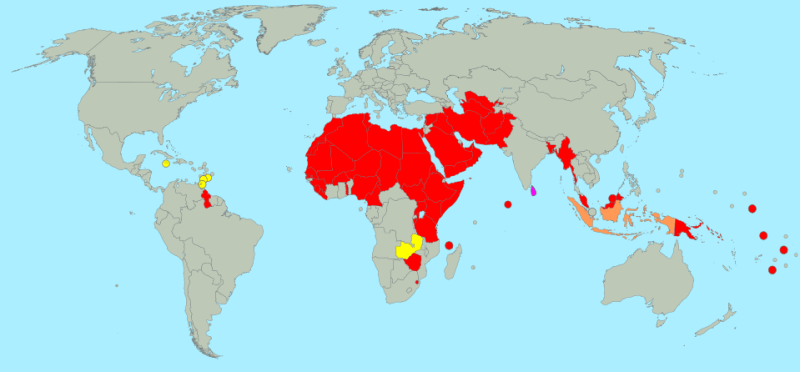
In adopting an anti-gay law on June 11, 2026, the West African nation of Niger strengthened a wave of anti-homosexuality legislation and proposed legislation in Africa that has reversed, at least temporarily, the slow decrease in the number of nations with anti-gay laws.
Previously, its neighbors Burkina Faso and Mali criminalized homosexuality in 2025. Together with a March 2025 decision by the Trinidad and Tobago Court of Appeal to reinstate that country’s laws against homosexuality, these countries have turned back a wave a progress on decriminalization.
A full list of nations with anti-homosexuality laws.
Recent history of many nations repealing or overturning those laws and a few nations newly adopting them.
A comparison of this site’s list with the similar list compiled by ILGA, the International Lesbian, Gay, Bisexual, Trans and Intersex Association.
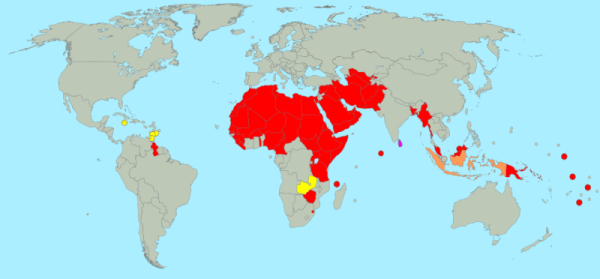
Map of the 66 countries where sexual relations between people of the same sex are illegal. YELLOW countries have sodomy laws that are currently being challenged before local courts. Sri Lanka, in PINK, currently has a bill before its parliament to repeal its sodomy law. Indonesia, in ORANGE, has laws that criminalize homosexuality only in some subnational jurisdictions. All states in RED have nationwide sodomy laws and no known legislative efforts or court challenges to remove them.
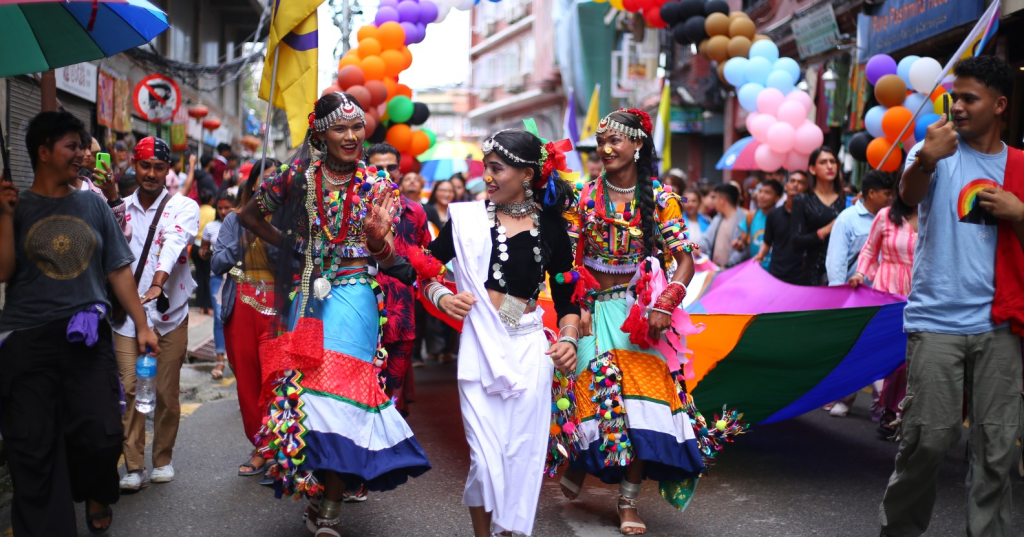
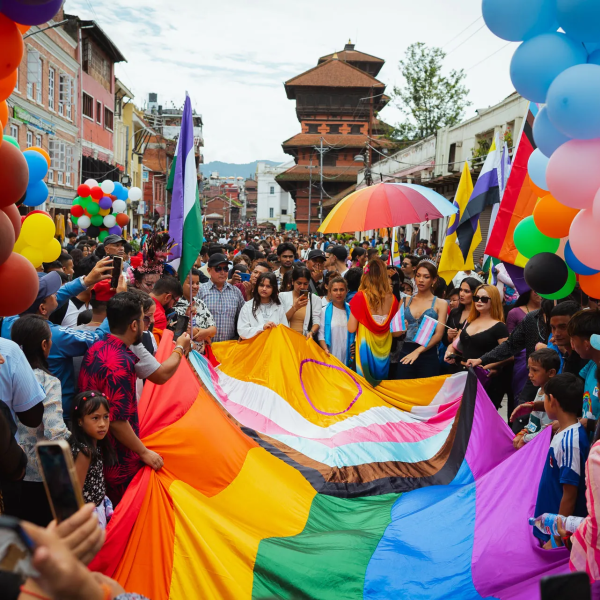
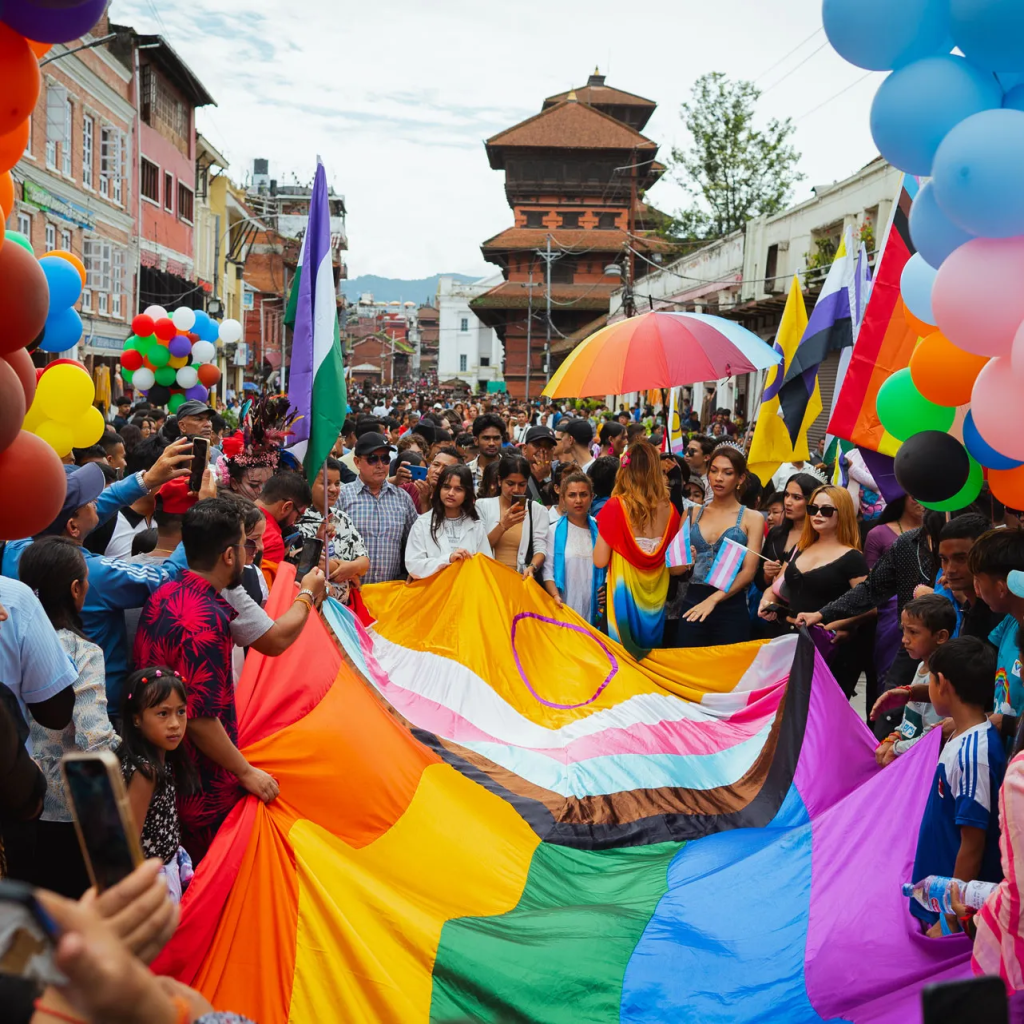
Hundreds of members of Nepal’s LGBTQ+ community and their supporters took to the streets of Kathmandu on Saturday to celebrate Pride Month.
Nepal has a growing LTGTQ+ community and has made significant gains for the rights of sexual minorities in the past few years.
The government elected in March under Prime Minister Balendra Shah has formed the Ministry of Women, Children, Gender and Sexual Minorities and Social Security, the first time a department has been dedicated to deal with the issues of women and sexual minorities.
Nepal became one of the first in Asia to allow same-sex marriage. The 2015 constitution explicitly states there can be no discrimination on the basis of sexual orientation.
A 2007 court decision required the government to make changes in favor of LGBTQ+ people. People who do not identify as female or male are now able to choose “third gender” on their passports and other government documents.









 fleeredstates.blog
You must be logged in to post a comment.