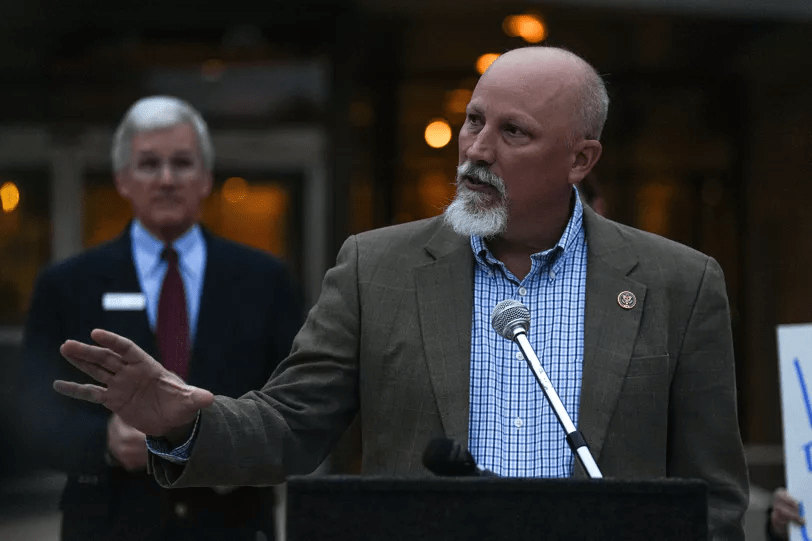
The US Supreme Court has lifted the ban on bump stocks, a rapid-fire gun accessory used in America’s deadliest mass shooting.
In a 6-3 decision, the court ruled that the government lacked the authority to ban these accessories. The Trump administration had prohibited bump stocks after they were used in the 2017 Las Vegas shooting, which killed 60 people. A Texas gun shop owner challenged the ban, arguing that the government overstepped by classifying bump stocks as machine guns, which are largely illegal under federal law with certain exceptions. According to US law, the transfer or possession of machine guns made after May 19, 1986, is prohibited, although those obtained before that date can be legally transferred or possessed.
The court determined that a semi-automatic rifle with a bump stock does not meet the federal definition of a machine gun. The opinion, written by Justice Clarence Thomas, stated that the Bureau of Alcohol, Tobacco, Firearms and Explosives (ATF) had exceeded its authority. The court cited the legal definition of machine guns, stating that rifles with a bump stock “cannot fire more than one shot ‘by a single function of the trigger,’ and even if they could, they would not do so ‘automatically.'”
The decision saw dissent from the court’s three liberal justices: Ketanji Brown Jackson, Elena Kagan, and Sonia Sotomayor. Justice Sotomayor warned that the ruling would have deadly consequences, noting, “When I see a bird that walks like a duck, swims like a duck, and quacks like a duck, I call that bird a duck.” She argued that bump stocks fall under the type of weapons Congress intended to ban due to their destructive capacity.
During the case’s hearing in March, some justices expressed skepticism about the ban, focusing on the technical differences between bump-stock guns and machine guns. Justice Neil Gorsuch remarked that while he could understand the rationale for making bump stocks illegal, it was Congress’s responsibility to do so explicitly. In contrast, Justice Jackson emphasized that bump stocks were precisely the kind of weapons Congress aimed to restrict.
Bump stocks use a rifle’s recoil to rapidly fire multiple rounds by allowing the gun to slide back and forth between the user’s shoulder and trigger finger, enabling continuous firing without the user moving their finger. The Las Vegas shooter used bump stocks on 12 of his semi-automatic rifles, allowing him to fire hundreds of rounds per minute, similar to many machine guns.
A spokeswoman for Donald Trump’s campaign stated that “the court has spoken and their decision should be respected.” Meanwhile, a spokesman for President Joe Biden, who is set to debate Trump on June 27 as both candidates seek re-election, criticized the decision, asserting, “Weapons of war have no place on the streets of America.” they said.
The high court, siding with the state, concluded that the laws adequately specify the circumstances under which an abortion to save the life of the mother is allowed.
AUSTIN, Texas (CN) — In a highly anticipated decision, the Texas Supreme Court ruled on Friday that the state’s total abortion ban permits the procedure if the pregnancy poses a risk of serious bodily impairment or death.
“Texas law permits a life-saving abortion,” wrote Justice Jane Bland in her 38-page majority opinion. “Under the Human Life Protection Act, a physician may perform an abortion if, exercising reasonable medical judgment, the physician determines that a woman has a life-threatening physical condition that places her at risk of death or serious physical impairment unless an abortion is performed.”
The unanimous opinion from the all-Republican high court vacated a lower court injunction that had blocked the state from enforcing the ban against doctors performing life-saving abortions, establishing a new standard for physicians to follow. The state had filed an accelerated appeal to the Texas Supreme Court, which stayed the injunction.
The lawsuit at the center of this case began over a year ago when five women who experienced life-threatening pregnancy complications, along with two doctors, sued Texas Attorney General Ken Paxton and the Texas Medical Board. Represented by the Center for Reproductive Rights, they sought clarity on the law. As the lawsuit gained attention, an additional 15 women with similar experiences joined. The plaintiffs argued that the laws as written deprived them of their right to equal protection under the state constitution.
The lawsuit challenges three laws: the Human Life Protection Act, the Texas Heartbeat Act, and a 1925 abortion ban that was revived following the U.S. Supreme Court’s reversal of Roe v. Wade in 2022.
The Human Life Protection Act and the 1925 ban impose both civil and criminal penalties for anyone found to have performed an abortion. Doctors face up to 99 years in prison, a minimum fine of $100,000, and the loss of their medical license if found guilty. The Texas Heartbeat Act, also known as Senate Bill 8, imposes a civil private right of action, allowing any citizen to sue anyone they believe performed or facilitated an abortion for a minimum of $10,000.
Molly Duane, senior staff attorney for the Center for Reproductive Rights and lead attorney in the case, described the court’s ruling as providing a “feeble answer” to the question of when a person in Texas can receive an abortion under the medical exception. Despite the ruling, she believes it falls far short of what is necessary to ensure the safety of pregnant individuals.
“I am disturbed that the court rejected so many of our clients’ claims to a constitutional right to life, health, and fertility,” Duane said on Friday. “These are women who came to court citing risks to their physical and mental health and continuing a pregnancy that would never result in a new baby joining their families. But now we know the courthouse doors are closed to them.”
The Center for Reproductive Rights argued that the exceptions in the state’s three abortion bans are too vague, causing doctors to avoid providing necessary care due to fear of prosecution. To address this, the group requested that courts establish a standard allowing the procedure when a doctor has a “good faith belief” that an abortion is necessary to save the mother’s life or prevent severe bodily impairment.
However, Justice Bland pushed back against the Center’s request to clarify what “reasonable medical judgment” means under the statute. The Center argued that a “good faith belief” standard would create uniformity in the standard of care among doctors, whereas “reasonable medical judgment” could vary from one physician to another.
While acknowledging that not all doctors would reach the same conclusion, the state must demonstrate that a reasonable physician would not have determined that a woman with pregnancy complications required a life-saving abortion.
“The Center’s ask is for a court to substitute a different standard for the one that is expressly written in the statute,” Bland wrote in Friday’s opinion. “This is a call for amending the law, not for interpreting it.”
The 20 women central to the case were not directly mentioned in Bland’s opinion. Instead, the court focused on explaining why it believes the exception to the laws, as written, is sufficient.
Justice Bland did, however, address lead plaintiff Amanda Zurawski’s experience, using it as an example of how the law should function. During her second trimester, Zurawski’s pregnancy became nonviable when the membrane surrounding her daughter, Willow, prematurely ruptured. Despite being informed by doctors that she faced a serious risk of infection, they refused to terminate the pregnancy because Willow still had a heartbeat, fearing prosecution. After being sent home, infection set in, causing damage to Zurawski’s reproductive organs and placing her life in jeopardy.
“Ms. Zurawski’s agonizing wait to be ill ‘enough’ for induction, her development of sepsis, and her permanent physical injury are not the results the law commands,” wrote Bland.
Zurawski said Friday that the ruling felt like a gut punch.
“The Texas Supreme Court had the opportunity to provide clarity, but they didn’t, and we are right back where we started. While this feels like the end of Zurawski v. Texas, it is not the last that you will be hearing from us in this fight for justice,” Zurawski said.
All but one of the plaintiffs’ claims survived the court’s ruling. Damla Karsan, an obstetrician from Houston, was found to have standing to sue the state because she was threatened with enforcement by Texas Attorney General Ken Paxton.
The threat came after a judge in Austin issued an order allowing Kate Cox, a mother of two from Dallas, to terminate her nonviable pregnancy. Karsan was set to provide the procedure when Paxton sent letters to three hospitals, warning they could be held liable if Karsan was allowed to perform the abortion at their facilities. The Center for Reproductive Rights is still determining how it will proceed with this final claim.
While the court did not provide guidance on the state’s abortion laws, it left open the possibility for the Texas Medical Board to intervene. The board is currently considering new guidance for physicians to clarify when a patient qualifies for the exception. However, this has sparked controversy, with abortion rights advocates arguing that the proposed plans do not sufficiently protect women.
In a statement praising the ruling, Paxton said he would continue to defend the state’s pro-life laws.
“Today, the Supreme Court of Texas unanimously upheld the Human Life Protection Act, one of our state’s pro-life laws,” Paxton said. “I will continue to defend the laws enacted by the Legislature and uphold the values of the people of Texas by doing everything in my power to protect mothers and babies.”
For abortion rights advocates, federal action remains the only viable solution to what they see as dangerous state laws. During Friday’s press call, Nancy Northup, president and CEO of the Center for Reproductive Rights, renewed calls for a law legalizing abortion nationwide.
“It is clear that the state of Texas and many other states are not going to protect their own pregnant people,” Northup said. “The federal government must step in and reestablish a nationwide right to abortion.”
A judge ruled on a guidance indicating that schools could lose federal funding if they discriminate against students based on gender identity or sexual orientation.
A federal judge in Texas on Tuesday determined that the Biden administration improperly attempted to reinterpret federal law prohibiting sex discrimination in schools by extending it to include LGBTQ students.
U.S. District Judge Reed O’Connor in Fort Worth, Texas, ruled in favor of a lawsuit filed by the state’s Republican Attorney General Ken Paxton. He declared that legal guidance issued by the U.S. Department of Education three years ago was invalid, asserting that the agency lacked the authority to implement it and that it could not be enforced in Texas.
The non-binding guidance indicated that schools could be denied federal funding if they discriminated against students based on gender identity or sexual orientation, such as by requiring students to use facilities that correspond to their sex assigned at birth.
A federal judge in Tennessee had already blocked the Education Department from enforcing this guidance in 20 Republican-led states that had also sued to overturn it in 2022. The Biden administration is currently appealing that decision.
The guidance was issued in response to a landmark 2020 U.S. Supreme Court ruling that extended federal workplace sex discrimination protections to LGBTQ employees. The Education Department argued that the same logic applied under Title IX, as both laws use similar language.
However, O’Connor, in a 112-page ruling, stated that the Education Department did not have the authority to apply that Supreme Court ruling to Title IX of the Education Amendments of 1972.
“To allow Defendants’ unlawful action to stand would be to functionally rewrite Title IX in a way that shockingly transforms American education and usurps a major question from Congress,” wrote O’Connor, an appointee of Republican former President George W. Bush.
The Department of Education and the U.S. Department of Justice did not immediately respond to requests for comment.
In a statement, Paxton said the ruling thwarts Democratic President Joe Biden’s “effort to weaponize Title IX for his extremist agenda.”
“Threatening to withhold education funding by forcing states to accept ‘transgender’ policies that put women in danger was plainly illegal,” Paxton stated.
In April, the Education Department adopted formal, binding regulations applying Title IX to LGBTQ students. Tuesday’s decision does not impact those rules, which Texas and other states are currently challenging in court. However, it does indicate that these regulations could be susceptible to future legal challenges.
Republicans propose legislation to prohibit DEI initiatives in the federal government.
Congressional Republicans have proposed legislation to eliminate diversity, equity, and inclusion (DEI) programs and funding within the federal government.
The Dismantle DEI Act, introduced on Wednesday by Senator JD Vance (R-Ohio), aims to abolish all federal DEI initiatives and cease DEI-related funding for agencies, contractors, organizations, and educational accreditation bodies that receive federal support.
“DEI is a harmful ideology that fosters hatred and racial division,” Vance stated. “It should not be present in our federal government or anywhere in our society. I am proud to introduce this bill to remove DEI from our federal system by terminating such programs and cutting off funding for DEI policies. Americans’ tax dollars should not be used to promote this radical and divisive ideology—this legislation ensures they will not be.”
In 2021, President Biden issued an executive order to “cultivate a workforce that draws from the full diversity of the Nation,” aiming to remove structural barriers faced by underserved and minority communities.
Representative Michael Cloud (R-Texas), the bill’s primary sponsor in the House, stated that DEI initiatives, while presented as promoting fairness, “have instead fostered division and racial bias within our institutions and culture.”
Cloud emphasized the necessity of the bill, framing it as a crucial measure to reinstate merit and equality, rejecting the concept of equity, within America’s government institutions. He argued that the DEI bureaucracy not only fosters division but also wastes taxpayer money. “It’s absurd to fund these divisive policies, especially using American tax dollars, and it’s time for Congress to put an end to them once and for all,” Cloud stated firmly.
Fifteen House Republicans have thrown their support behind the bill, reflecting the ongoing Republican resistance to DEI initiatives, often characterized as part of a broader “woke” agenda. This sentiment was underscored last year when Florida Governor Ron DeSantis signed legislation prohibiting public universities from funding DEI programs and requiring diversity commitments in hiring statements. The law also removed majors and minors related to critical race theory and what was deemed “radical” feminist or gender theories. In a similar vein, Texas Governor Greg Abbott instructed public universities in his state to cease considering DEI statements in their hiring procedures in February.
Across the nation, legislation aimed at reducing DEI spending and altering hiring guidelines at colleges and universities has been introduced in a dozen states. The Dismantle DEI Act represents the latest attempt to ban such programs at the federal level, following the disbandment of the House Office of Diversity and Inclusion in March as part of a government spending bill.
Senator Rick Scott, who co-introduced the act with Vance, criticized the Biden administration for promoting what he sees as far-left policies that prioritize ideology over merit. “Taxpayers shouldn’t be forced to foot the bill for federal government agencies to push their woke DEI agenda,” Scott asserted, highlighting the necessity of the Dismantle DEI Act.
In addition to revoking Biden’s 2021 executive order, the act would dismantle the Office of Diversity, Equity, Inclusion, and Accessibility within the Office of Personnel Management as well as the Chief Diversity Officers Executive Council. Senator Eric Schmitt, a co-sponsor, labeled DEI rhetoric and programs as “poisonous ideology,” expressing his commitment to eradicating DEI programs from federal institutions.
A Texas father told CBS News that he and his wife are living a nightmare after she suffered a miscarriage following multiple unsuccessful attempts to receive medical treatment.
DALLAS — Some families are experiencing medical challenges due to Texas’ abortion law, as highlighted in a CBS News report that featured one family’s struggles.
A Texas father shared with CBS News that he and his wife are enduring a nightmare after she suffered a miscarriage following numerous attempts to obtain medical treatment.
Ryan Hamilton, a 43-year-old radio host, garnered significant attention on social media after sharing about his wife’s miscarriage.
CBS News did not reveal his wife’s name in their report, and she remains not ready to discuss the incident publicly.
“When you find out your baby doesn’t have a heartbeat, that’s only the beginning,” Hamilton told CBS News. “So, the conversation becomes, what do we do?”
On May 16, Hamilton’s wife, over three months pregnant with their second child, learned that the baby no longer had a heartbeat.
Medical records obtained by CBS News indicate that Hamilton’s wife was treated at a North Texas emergency room, where doctors informed her that the baby had no heartbeat.
“We were told she could take medication to start the process to finish… to finish what had already started at home,” Hamilton explained to CBS News.
Doctors prescribed misoprostol, a labor-inducing drug used for miscarriages and abortions. She was instructed to take the medication at home and return if it did not work within two days.
Hamilton told CBS News that the medication didn’t work, and when they returned to the hospital, the doctor said they couldn’t prescribe the medicine.
Confused, Hamilton and his wife sought other options and went to another hospital, only to be denied treatment once again.
“You want to panic, but you can’t,” Hamilton told CBS News. “At this point, you’re just thinking, ‘Get my wife safe.'”
While waiting for answers at the second hospital, Hamilton sensed that the doctors were uncertain about what they were permitted to do.
“That’s what it feels like. They feel scared. The doctors feel scared,” he said in the interview.
Texas law prohibits abortions once a fetal heartbeat is detected, except in medical emergencies. Hamilton explained that the doctors told them it wasn’t a significant enough emergency to perform the procedure.
The procedure they were denied is called “dilation and curettage,” but the law does not require a medical emergency for it to be performed if there is no cardiac activity.
In a statement to CBS News, the hospital said they follow Texas and federal laws in accordance with national standards of care.
Hamilton and his wife still didn’t know what to do. Doctors gave her stronger medication and sent her home. In the following days, Hamilton found his wife unconscious on the bathroom floor, surrounded by blood. He rushed her to the hospital, where doctors confirmed the medication had worked.
Hamilton told CBS News they are not planning to sue any of the hospitals involved, but he hopes his story will help others in the future. He said his wife is focused on healing and therapy.
The justices will decide whether to impose new restrictions on the abortion pill mifepristone, and whether a federal law requiring emergency room treatment conflicts with a state abortion ban.
WASHINGTON — The Supreme Court is poised to rule this month on two significant abortion cases that could have nationwide repercussions. This marks the first time the justices are revisiting the issue since overturning Roe v. Wade.
The 2022 decision to revoke the right to obtain an abortion caused widespread upheaval, prompting a wave of new state-level abortion restrictions and encouraging anti-abortion activists to seek further limitations.
The most closely watched case involves the court deliberating whether to implement new restrictions on the widely used abortion pill mifepristone, including tighter regulations on mail-order access.
In a less publicized yet potentially impactful case, the justices are examining whether Idaho’s near-total abortion ban conflicts with a federal law mandating emergency medical care for patients, including pregnant women.
Rabia Muqaddam, a lawyer at the Center for Reproductive Rights, which supports abortion rights, referenced the 2022 ruling in Dobbs v. Jackson Women’s Health Organization “set off a chain reaction that we are seeing in all sorts of ways,” including the two cases now before the court.
Theories that were previously considered “the fringe of the fringe” are now “sufficiently mainstream to make it to the Supreme Court,” she added.
The new cases show that the court’s stated aim of getting out of the business of deciding what conservative Justice Brett Kavanaugh called “difficult moral and policy questions” was easier said than done. As such, the upcoming rulings will provide further evidence of how far the court, which has a 6-3 conservative majority, is willing to go in curbing abortion access.
In the mifepristone case, the court is weighing whether to impose new restrictions on the pills’ availability, including access by mail. Such a move would dramatically decrease the ability of women to obtain the pills, especially in states with new abortion restrictions.
The legal question in the Idaho case is whether a federal law that requires stabilizing treatment for patients in emergency rooms trumps the state restrictions in certain circumstances when doctors believe an abortion is required to protect the health of a pregnant woman.
Jim Campbell, chief legal counsel of Alliance Defending Freedom, the conservative Christian legal group that is representing anti-abortion interests in both cases, said the legal issues in each of them reflect overreach by the Biden administration in response to Roe being overturned.
“They’re both instances where the federal government is doing things, whether directly or indirectly, to interfere with state pro-life laws,” he added.
Based on oral arguments earlier this year, it seems likely that anti-abortion groups will lose in the mifepristone case, leaving the status quo unchanged. That means the Idaho case could have a bigger practical impact if the court backs the state, which seems possible based on questions asked by the justices.
Rulings are expected by the end of the month when the court traditionally concludes its nine-month term that begins in October. The court will also be issuing a slew of other rulings on hot-button issues, including former President Donald Trump’s claim of immunity from prosecution in his election interference case.
The announcement comes almost four years after the agency first moved to take over the district.
Millard House II, superintendent of the Houston Independent School District, delivers the HISD State of the Schools Address in Houston on March 3, 2023. The Texas Education Agency will replace House and the district’s school board as part of a state takeover. Credit: Joseph Bui for The Texas Tribune.
Sign up for The Brief, The Texas Tribune’s daily newsletter that keeps readers up to speed on the most essential Texas news.
After a prolonged legal battle and weeks of speculation, the Texas Education Agency on Wednesday confirmed it’s removing Houston Independent School District’s democratically elected school board and superintendent, effectively putting the state in charge of its largest school district.
Houston ISD, with 276 schools and an enrollment of nearly 200,000 students, will now be the largest district the agency has taken over since 2000, when it first intervened in a struggling school district.
Superintendent Millard House II and the current school board will finish out the school year, but the TEA will replace them after June 1 with “a board of managers.”
The Texas Tribune thanks its sponsors. Become one.
The TEA commissioner decides how long the board is in place. Usually, this sort of takeover has lasted two to six years.
The agency will host community meetings in the coming weeks to explain how the takeover will take place.
The move is in response to years of poor academic outcomes at a single campus in the district, Phillis Wheatley High School, and allegations of misconduct from school board members. TEA Commissioner Mike Morath said state law requires his agency to either close that campus or appoint a new board to oversee the district.
Texas passed a law in 2015 mandating a state takeover if a school district or one of its campuses receives failing grades from the TEA for five consecutive years. Phillis Wheatley reached that threshold in 2019.
Catch up on education news with our weekly newsletter
Morath and the agency moved to force out the district’s school board that same year. The district pushed back and sued, but the Texas Supreme Court ruled in January that the agency could move forward with its plan to take over the district.
“Even with a delay of three full years caused by legal proceedings, systemic problems in Houston ISD continue to impact students most in need of our collective support,”Morath wrote in a letter to district leaders Wednesday.
AUSTIN, Texas (AP) — The Texas Supreme Court on Friday rejected a closely watched challenge to the state’s restrictive abortion ban, ruling against a group of women who had serious pregnancy complications and became the first in the U.S. to testify in court about being denied abortions since Roe v. Wade was overturned.
In a unanimous ruling, the all-Republican court upheld the Texas law that opponents say is too vague when it comes to when medically necessary exceptions are allowed. The same issue was at the center of a separate lawsuit brought last year by Kate Cox, a mother of two from Dallas, who sought court permission to obtain an abortion after her fetus developed a fatal condition during a pregnancy that resulted in multiple trips to an emergency room.
Abortion rights activists have struggled to stem the tide of restrictions that have taken effect in most Republican-led states since the U.S. Supreme Court in 2022 overturned Roe vs Wade, which for nearly 50 years had affirmed the constitutional right to an abortion.
The court said the law’s exceptions, as written, are broad enough and that doctors would be misinterpreting the law if they declined to perform an abortion when the mother’s life is in danger.
“Texas law permits a life-saving abortion,” the court wrote in the order signed by Justice Jane Bland.
The decision appeared to close, at least for now, another pathway for opponents who have sought to force the state to provide more clarity about when exceptions are allowed. Last year, plaintiffs in the lawsuit gave emotional accounts in an Austin courtroom over how they carried babies they knew would not survive and continued pregnancies that put their health in worsening danger.
“Now we know the courthouse doors are closed to them,” said Molly Duane, a staff attorney for the Center for Reproductive Rights, which represented the Texas women. “It seems Texans have nowhere to go but the voting booth, in terms of what comes next.”
The Kansas Supreme Court delivered a mixed ruling on Friday regarding multiple challenges to a 2021 election law. The court sided with state officials on one provision, revived challenges to others, and suggested that at least one challenge could be resolved before this year’s general election.
However, the most contentious part of the ruling was the majority opinion on the ballot signature verification measure, which stated that the Kansas Constitution’s Bill of Rights does not guarantee the right to vote. This opinion sparked strong dissent from three of the court’s seven justices.
The ballot signature verification measure mandates that election officials compare the signatures on advance mail ballots with those in voter registration records. While the state Supreme Court overturned a lower court’s dismissal of the lawsuit challenging this measure, the majority rejected arguments from voting rights groups that it violates state constitutional voting rights.
In fact, Justice Caleb Stegall, writing for the majority, said that the dissenting justices wrongly accused the majority of ignoring past precedent, holding that the court has not identified a “fundamental right to vote” within the state constitution.
Justice Eric Rosen, one of the three who dissented, shot back: “It staggers my imagination to conclude Kansas citizens have no fundamental right to vote under their state constitution.”
“I cannot and will not condone this betrayal of our constitutional duty to safeguard the foundational rights of Kansans,” Rosen added.
Conversely, the high court unanimously sided with the challengers of a different provision that makes it a crime for someone to give the appearance of being an election official. Voting rights groups, including Kansas League of Women Voters and the nonprofit Loud Light, argued the measure suppresses free speech and their ability to register voters as some might wrongly assume volunteers are election workers, putting them at risk of criminal prosecution.
Local Bar Introduces Special Promotion in Celebration of ‘Heterosexual Awesomeness Month’
The Old State Saloon, nestled in Eagle, Idaho, has ignited a buzz by proclaiming June as “Heterosexual Awesomeness Month.” The establishment took to social media to announce its plans, promising special offers including discounts, complimentary brews, and even hosting a “straight male clothing” competition.
“Join us throughout the month to honor heterosexuals, whose existence is fundamental to us all!” proclaimed the bar in a Facebook post. “Every Monday, dubbed Hetero Male Monday, any heterosexual gentleman dressed in attire befitting his heterosexuality will be treated to a complimentary draft beer. Wednesdays are reserved for Heterosexual Couples Day, with all couples enjoying a 15% discount on their tab.”
Further, Thursdays were designated for all-day happy hour pricing exclusively for heterosexual women.
However, the event triggered a wave of criticism online, with many expressing disapproval of the bar’s stance. Among the dissenting voices was an op-ed published by the Idaho Statesman, condemning the event as a veiled promotion of intolerance.
Responding defiantly, the Old State Saloon stood firm in its position. “1) We cherish our LGBTQ+ patrons! 2) We stand resolute and will not yield to those responding with hostility. 3) ALL are welcome to commemorate heterosexuality with us in June!” declared the establishment.
Despite the backlash, the bar refused to retract its declaration, citing its right to celebrate heterosexuality. The controversy coincided with Pride Month, established in 1970 to celebrate and honor the LGBTQ+ community.
While criticism abounded, there was also notable support for the promotion. The original post garnered over 2,500 comments, with subsequent discussions generating up to 1,000 additional comments.
“Since announcing Hetero Awesomeness Month, we’ve faced significant backlash: theft, vendors refusing service, wedding catering cancellations, and even baseless accusations against the owner,” lamented the bar. “Yet, amidst the chaos, we’ve also received overwhelming support from individuals who appreciate our celebration of ‘Heterosexual Awesomeness Month’ as an expression of freedom and personal values.”
You must be logged in to post a comment.