South Korea made a quiet but meaningful policy change in October. For the first time, the national census now allows same-sex couples living together to identify each other as “spouse” in official records.
While this adjustment does not confer any legal rights, it marks a symbolic step in recognizing LGBTQ+ households in the state’s demographic data.
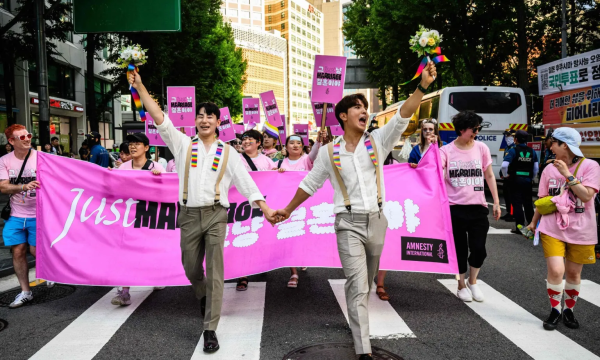
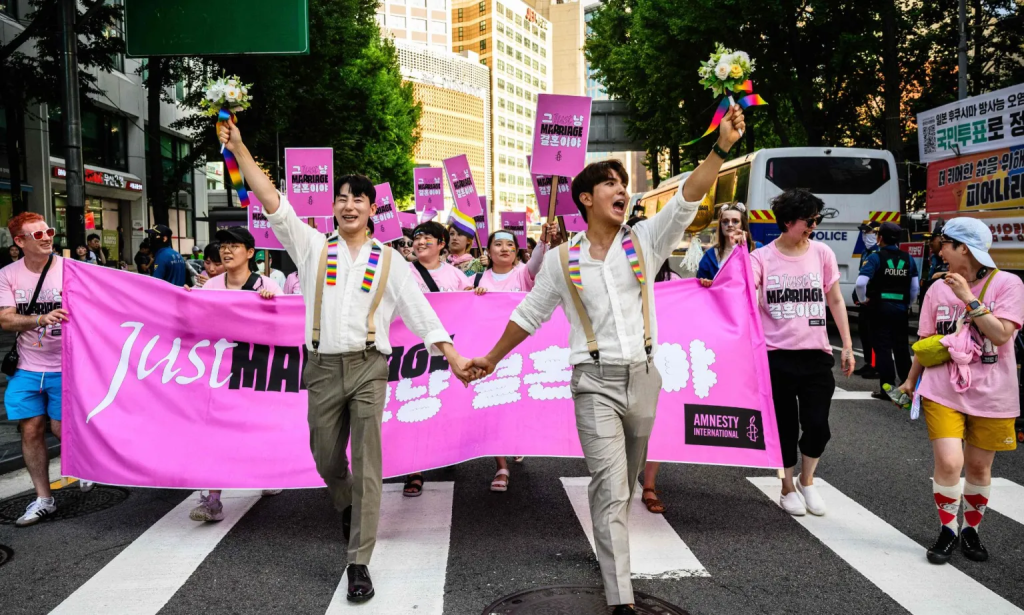
But as same-sex couples slowly appear in national statistics, legal marriage still remains out of reach. And public support for it is not growing. In fact, it is recently shrinking.
Two major opinion surveys in 2025 have confirmed the trend. In a Hankook Research poll, 31 percent of South Koreans said they supported the legalization of same-sex marriage, down from 36 percent in 2021. In a separate survey by Gallup Korea, 34 percent backed legalization while 58 percent opposed it, a reversal that returns the numbers to where they stood nearly a decade ago.
Although many advocates have long assumed that rising visibility and generational change would drive progress, the latest data presents a different picture. The Korea Herald consulted two advocates who argue that it may be time to ask a different question: Does same-sex marriage need broad public support to move forward, or can the law lead the way?
Public may seem unsure until ‘law decides for them’
Yi Ho-rim, executive director of Marriage for All Korea, a leading local LGBTQ+ advocacy group, sees this moment as a reminder that legal change is not always a popularity contest. “The support for legalization has declined somewhat, but that doesn’t mean the conversation is stagnant,” Yi said.
“In fact, we see the current moment as a result of political polarization, not public apathy.”
Yi links the decline to the broader social climate. “Far-right mobilization earlier this year, combined with heightened political tension and increased online radicalization among young men, likely influenced the shift,” she noted. “When public discourse is overwhelmed by noise and fear, minority issues like same-sex marriage naturally become sidelined.”
Yi has argued that laws can reshape public perception. “In Taiwan, support for same-sex marriage was limited before legalization in 2019. But once the law passed, social attitudes evolved quickly. That pattern is not unique to Taiwan. We’ve seen similar changes in many countries.”
This pattern is not just anecdotal. Yi points to a notable case in South Korea’s own polling history. “There’s no way to prove causality,” she said, “but it’s hard to see it as a coincidence that Gallup Korea’s support numbers jumped by 10 percentage points between 2013 and 2014, exactly when countries like New Zealand, France and several US states made headlines by legalizing same-sex marriage.”
Park Dae-seung, a political philosopher at Seoul National University and director of the Institute for Inequality and Citizenship in Seoul, agrees. “Constitutional democracies are designed to protect minority rights, even when those rights are unpopular,” Park said.
“Laws that affirm dignity and equality are rarely embraced by a majority at first. But they send a powerful social signal. They tell people what is ‘normal’. In other words, it’s the law that decides for them what’s acceptable.”
“Korean politicians routinely cite ‘lack of public consensus’ as a reason to delay bills like the Life Partnership Act or Marriage Equality Act, both of which remain stalled in the National Assembly for years,” he added. “But it’s an excuse.”
While younger South Koreans have historically been more supportive of LGBTQ+ rights, the generational divide is showing unexpected shifts. The latest Gallup Korea poll revealed that support for same-sex marriage among people in their 20s dropped by 15 percentage points between 2023 and 2025. At the same time, support among those over 70 nearly doubled, from 10 percent to 19 percent.
Yi sees this as a sign that older generations are not immovable. “These are people who still get most of their information from legacy media. When the 2024 Supreme Court ruling recognized same-sex cohabiting partners as eligible for health insurance benefits, it was widely reported. That may have helped normalize the issue.”
Groups like the Coalition Against Homosexuality and Same-Sex Marriage, backed by conservative Christian organizations, have actively resisted even symbolic shifts. In October, the group filed a criminal complaint against government officials who authorized same-sex partner recognition in the 2025 census. They claimed it violated the law by creating “false public records” and warned of a wider moral collapse.
Yi has contended that public discomfort should not be used to delay basic rights. “Many of these objections rely on the idea that LGBTQ+ people do not value love, care or long-term commitment,” she said.
“But that is only because most people have never met a same-sex couple in their daily lives. We are still largely invisible, and the numbers show it. In the 2025 Hankook Research survey, people who personally know an LGBTQ+ person were nearly twice as likely to support same-sex marriage. Visibility alone makes a real difference.”
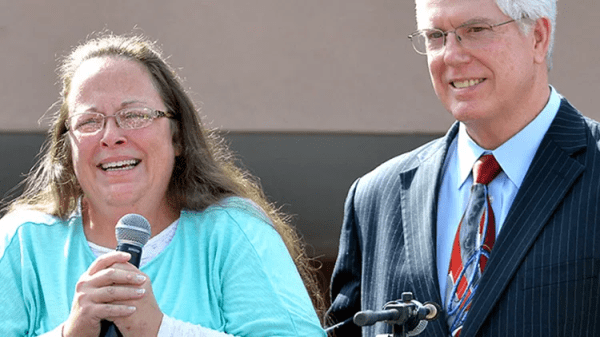
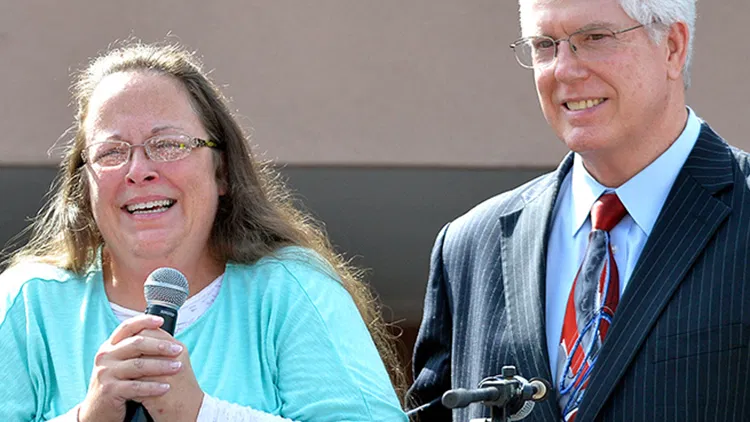
Liberty Counsel, the Christian hate group behind Kim Davis’s attempt to have the Supreme Court overturn its marriage equality decision, says their fight to end LGBTQ+ equality is far from over.
“I have no doubt that Davis’s resolve will serve as a catalyst to raise up many more challenges to the wrongly decided Obergefell opinion,” wrote Liberty Counsel President Mat Staver in a message on the group’s website. “Until then, we must pray, fight, and contend for when Obergefell is no longer the law of the land.”
The Supreme Court ruled in its 2015 Obergefell v. Hodges decision that people have a fundamental right to choose who to marry, regardless of their spouse’s gender. The decision legalized marriage equality in all 50 states.
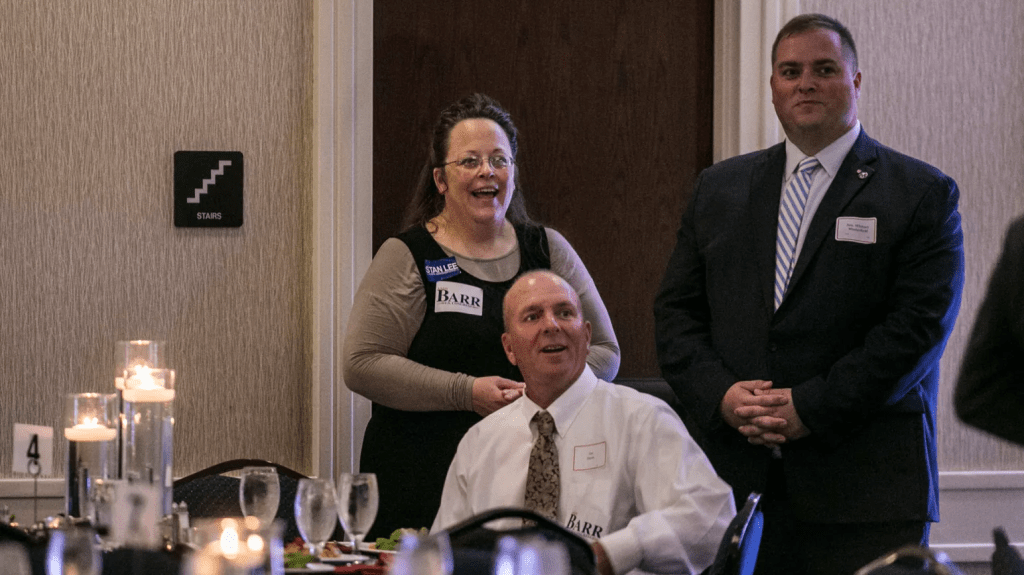
A county clerk in Kentucky, Kim Davis, refused to issue marriage licenses to same-sex couples, which led to a lawsuit and ten years of legal fights.
This year, with help from the lawyers at Liberty Counsel, she filed an appeal to the Supreme Court to overturn a judgment against her that required her to pay $360,000 to a gay couple whom she had illegally denied a marriage license. In that petition, she asked the Supreme Court to end marriage equality, arguing that her case proved that LGBTQ+ equality was inherently a threat to the rights of Christians like herself.
Last week, the Supreme Court rejected her appeal, leaving its decision in favor of marriage rights in place for at least another year.
Anti-LGBTQ+ activists, though, aren’t going to give up.
“This time, Kim Davis is the victim of religious animus and is being deprived of her constitutional freedom of religion,” Staver wrote. “Tomorrow, it could be you.”
“This may mark the end of an era in litigating Davis’s case, but the fight to overturn Obergefell and protect religious liberty has just begun.”
Staver’s argument is similar to an argument that Justices Clarence Thomas and Samuel Alito made in 2020 that the mere existence of married same-sex couples is a violation of Christians’ religious freedom because seeing married same-sex couples encourages people to judge Christians “as bigots.” (That opinion was delivered in the context of a different appeal filed by Davis.)
“Since Obergefell, parties have continually attempted to label people of good will as bigots merely for refusing to alter their religious beliefs in the wake of prevailing orthodoxy,” Thomas wrote at the time.
The Supreme Court rejected a longshot effort Monday to overturn its ruling guaranteeing same-sex marriage nationwide.
Former Kentucky county clerk Kim Davis directly asked the justices to overrule the 2015 landmark decision after a jury awarded damages to a couple whom Davis refused to issue a marriage license.
“The Court can and should fix this mistake,” her attorneys wrote in court filings.
In a brief order, the justices declined to take up Davis’s appeal alongside dozens of other petitions up for consideration at the justices’ weekly closed-door conference. There were no noted dissents.
Court watchers viewed Davis’s appeal as a longshot effort, but it sparked trepidation among LGBTQ rights groups since several conservative justices who dissented in the decade-old case remain on the court.
Davis gained national attention after she raised religious objections to issuing marriage licenses to same-sex couples despite the Supreme Court’s decision in Obergefell v. Hodges.
Among the refused couples was David Ermold and David Moore, who sued. Davis was found to have violated a judge’s order in another case, which required her to keep issuing licenses.
Davis was jailed for five days, the couple obtained their license and Kentucky later passed a law enabling clerks to keep their signatures off marriage certificates.
But Davis kept fighting in court after the couple won $100,000 in emotional distress damages from a jury plus $260,000 in attorneys’ fees.
Primarily, Davis’s appeal concerned arguments that she has a private First Amendment religious defense against the award, despite acting as a government official.
She tacked onto it a request to overturn Obergefell outright, insisting the whole lawsuit would fall if the justices do so.
When the nine U.S. Supreme Court justices meet behind closed doors on Friday, the justices will decide whether to hear an appeal from former Kentucky county clerk Kim Davis, a name that became synonymous with anti-LGBTQ+ attitudes to marriage equality a decade ago.
Davis, who refused to issue marriage licenses to same-sex couples after Obergefell v. Hodges made marriage equality the law of the land in 2015, has asked the court not only to overturn her financial settlement in a civil case loss in lower courts but also to reconsider the landmark ruling itself.
While Davis’s petition centers on whether she can be held personally liable for emotional-distress damages, her legal team is also urging the justices to revisit the constitutional right to marry. For those who remember the culture war that surrounded Davis’s defiance, the possibility that her name might again appear on the Supreme Court docket has reignited deep anxiety across the LGBTQ+ community
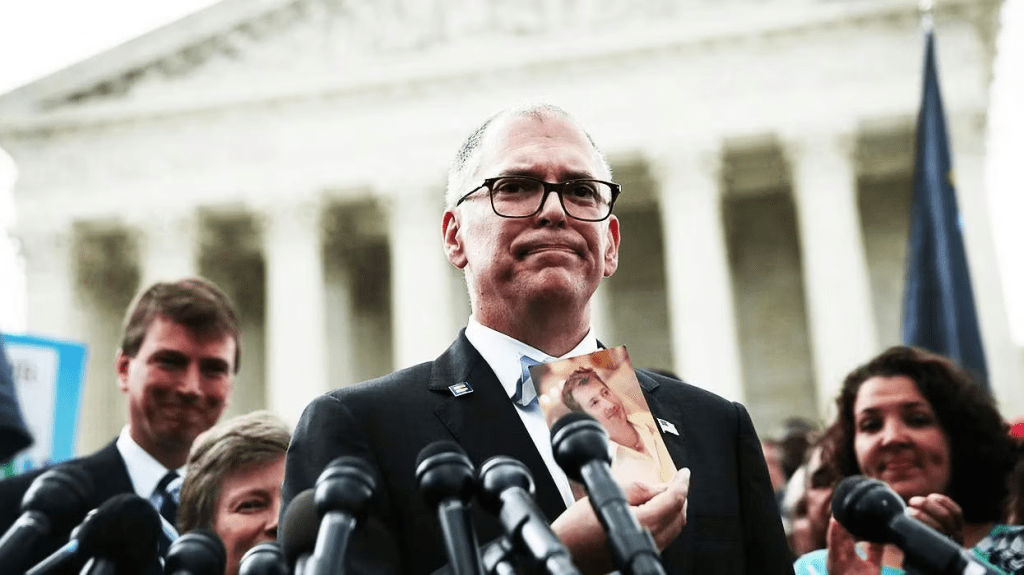
In separate interviews with The Advocate, Jim Obergefell, the plaintiff whose name now defines that right, and GLAD Law legal director Josh Rovenger described the moment as both surreal and revealing. One is the man who stood before the Court ten years ago and won the right to have his marriage recognized. The other works at the organization that helped secure that victory. Both see the Davis petition not just as a legal maneuver but as a test of whether the country can sustain a principle it once declared settled.
“A narrow case, shoehorning a broad agenda”
Rovenger explained what this case is and what it isn’t.
“This is a narrow case with a technical legal question,” he said, emphasizing that it concerns emotional-distress damages and qualified immunity, not marriage equality itself. “Attorneys who want to overturn Obergefell are trying to shoehorn that into a very narrow case.”
Davis, a former Rowan County clerk, was found liable for denying marriage licenses to same-sex couples in violation of clearly established law. A jury awarded damages to those couples, and the Sixth Circuit Court of Appeals affirmed the decision. Davis’s petition now asks the Supreme Court to review that ruling, Rovinger explained. While she has framed the case as one about her religious freedom, Rovenger said the issue before the Court remains technical.
“The Supreme Court receives thousands of petitions a year,” he said. “It would really be anomalous for them to take a case with such a narrow fact pattern and use it to revisit Obergefell.”
Still, Rovenger acknowledged why people are uneasy.
“Given the rollback of rights we’ve seen in other areas, Dobbs being the most prominent, that fear makes sense,” he said. “But this case is not the vehicle for that kind of sweeping reversal.”
The limits of the Respect for Marriage Act
Part of the current confusion, Rovenger said, stems from uncertainty about how the Respect for Marriage Act interacts with the Obergefell decision. The 2022 law, signed by President Joe Biden, requires states and the federal government to recognize marriages performed in other states. However, it does not compel every state to issue marriage licenses if Obergefell were to be overturned.
“In a world where Obergefell didn’t exist,” he said, “a couple married in one state would still have their marriage recognized federally and by other states, but not necessarily be able to marry everywhere.”
He called that distinction significant, not only for its practical consequences but for what it would signal about equality itself.
“A patchwork approach across states,” he said, “is fundamentally different from a nationwide right.”
Rovenger also pointed to the Supreme Court’s own language on “reliance interests” — the idea that people build their lives on the stability of established rights. Trump-appointed Justice Amy Coney Barrett, he noted, has recently said marriage equality has created such interests, making it less likely to be undone. Barrett had told the New York Times that Obergefell created “concrete reliance interests.”
“Those interests,” Rovinger said, “remain one of the critical factors the Court considers when deciding whether to revisit precedent.” According to Gallup, 68 percent of Americans support marriage equality.
Jim Obergefell: “Disgusted by this twisting of religious freedom”
For Jim Obergefell, the case is personal. He said he was “disgusted” that his fellow citizens would work against another group’s well-being and happiness, using religious liberty as an excuse.
“This modern version of religious freedom — this belief that one’s personal religion trumps everything else — is a twisting and perverting of what our founders intended,” he said.
Obergefell said Davis’s refusal to follow the law was emblematic of a broader problem: public officials placing private faith above civic duty.
“She swore an oath to serve all people,” he said. “And yet she used her government position to persecute others.”
His frustration extends to the justices themselves and their recent decisions, which have often ignored established understandings of the law. Justice Clarence Thomas recently said that past decisions “aren’t gospel.”
“Why should anyone feel secure about the right to marry,” he asked, “when this Court has proven it doesn’t believe in precedent?”
“One of those justices’ own marriage exists because of a Supreme Court decision,” Obergefell said, referring to Loving v. Virginia, the 1967 ruling that struck down bans on interracial marriage. Thomas is Black, and his wife, Ginny, is white. “If this Court overturns Obergefell, then what does that say about their own logic?” Obergefell added.
“People should be concerned”
Obergefell said that the LGBTQ+ community’s fear is warranted.
“Absolutely, people should be concerned. I’m concerned,” he said on Saturday. “Yesterday I officiated a wedding for a cousin who asked whether they should get married now instead of waiting. My answer was yes.”
He explained that even with the Respect for Marriage Act in place, states could still move swiftly to block new marriages if Obergefell were struck down.
“Ohio [where I live] still has a Defense of Marriage Act on the books,” he said. “If Obergefell is overturned, Ohio could immediately say, ‘no more marriage licenses for queer couples.’”
Obergefell warned that political forces aligned against LGBTQ+ rights have shown a willingness to manipulate electoral systems to maintain power.
“We have a political party that has turned its back on democracy,” he said. “They’re doing everything they can solely to remain in power — to punish and to be vindictive.”
A fragile majority, a durable principle
Despite deep pessimism about the Court, Obergefell said he still finds hope in younger generations.
“They don’t see difference the way older generations do,” he said. “There are millions of people out there who share my values, who believe in humanity, who believe every person deserves happiness and rights. That gives me hope.”
Rovenger echoed the sentiment, though his version is more procedural.
“We’re all watching closely,” he said. “We’ll keep an eye on whether the case gets relisted and on any separate statements that come out. But we’re not panicking. We’re prepared for all possibilities and ready to meet that moment if it comes.”
For now, the fate of Obergefell doesn’t hinge on oral arguments or public hearings but on what happens in a private conference room inside the marble halls of the Supreme Court. Whether the justices see the Davis case as a technical dispute or a cultural flashpoint will determine not only one woman’s liability but perhaps the trajectory of a right that has defined a generation.
If the Court declines to hear the case, the lower-court rulings stand, and marriage equality remains intact. If it grants review, the nation will enter another defining chapter in its legal history.
Either way, Obergefell’s warning lingers: “They’ve turned the idea of freedom on its head,” he said. “And unless we stand up for what it truly means, we risk losing more than marriage, and we risk losing the very promise of equality itself.”
The Texas Supreme Court on Friday gave judges in the state a pass if they don’t want to marry same-sex couples, unilaterally granting public officials the right to discriminate against queer couples.
In an end run around equal protection concerns, the high court amended the Texas Code of Judicial Conduct to read, “It is not a violation of these canons for a judge to publicly refrain from performing a wedding ceremony based upon a sincerely held religious belief.”
The change follows years of litigation that inspired a lawsuit by a county judge in Texas asking federal courts to declare that Texas law does not and cannot punish him for his practice of officiating opposite-sex, but not same-sex, marriages in the state.
Jack County Judge Brian Umphress, who sued in 2020 because he only wanted to perform weddings for opposite-sex couples, argued that his conduct would run afoul of the Texas State Commission on Judicial Conduct, despite protections he believed he enjoyed consistent with his religious freedom rights under the First and Fourteenth Amendments, Houston Public Media reports.
In response, the U.S. Court of Appeals for the Fifth Circuit put the lower federal-court proceedings on hold and asked the Texas Supreme Court to answer the question, “Does Canon 4A(1) of the Texas Code of Judicial Conduct prohibit judges from publicly refusing, for moral or religious reasons, to perform same-sex weddings while continuing to perform opposite-sex weddings?” That part of the code requires judges to refrain from behavior that would “cast reasonable doubt on the judge’s capacity to act impartially as a judge.”
The high court’s answer came with the amended code of conduct, bypassing public argument.
Judge Umphress’ fear of sanction for his discriminatory conduct was based on the case of McLennan County Justice of the Peace Dianne Hensley in Waco, who spent years in court arguing she had a right to refuse to marry gay couples.
Hensley replied to requests from gay couples with a statement that read, “I’m sorry, but Judge Hensley has a sincerely held religious belief as a Christian, and will not be able to perform any same-sex weddings.”
That conduct earned a public warning from the Judicial Conduct Commission, which said Hensley was violating a requirement that justices of the peace be impartial, even in extrajudicial duties like officiating weddings.
Her refusal to treat LGBTQ+ people equally cast “doubt on her capacity to act impartially to persons appearing before her as a judge due to the person’s sexual orientation,” the commission wrote.
Hensley claimed that no one’s rights were denied since a same-sex couple could have found another judge to marry them, despite the fact that she was the only justice of the peace performing marriages in Waco at the time.
Hensley filed a lawsuit against the commission with help from the First Liberty Institute, a Texas-based anti-LGBTQ+ legal organization, arguing for protections under the Texas Religious Freedom Restoration Act. The commission eventually dismissed its sanction a few months after the Texas Supreme Court allowed Hensley’s case to proceed.
That decision from the Texas high court earned Hensley a supportive concurring opinion from the chief justice, who publicly supported the Waco judge before his appointment.
“Judge Hensley treated them respectfully,” Chief Justice Jimmy Blacklock wrote of the couples she refused to marry. “They got married nearby. They went about their lives. Judge Hensley went back to work, her Christian conscience clean, her knees bent only to her God. Sounds like a win-win.”
Jason Mazzone, a law professor at the University of Illinois at Urbana-Champaign who’s familiar with both cases, said the Texas Supreme Court’s code of conduct workaround still leaves open the possibility for a gay couple with standing to challenge a judge’s decision not to marry them on constitutional equal protection grounds.
“One of the claims that I think will be made in response to litigation that is likely is that, ‘Well, there are other people who can perform the wedding ceremony, so you can’t insist that a particular judge do it,’” Mazzone said. “But that, of course, is not how equal protection works, and it’s not how we expect government officials to operate.”
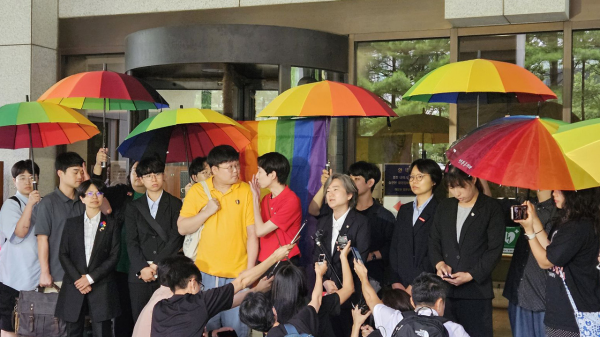
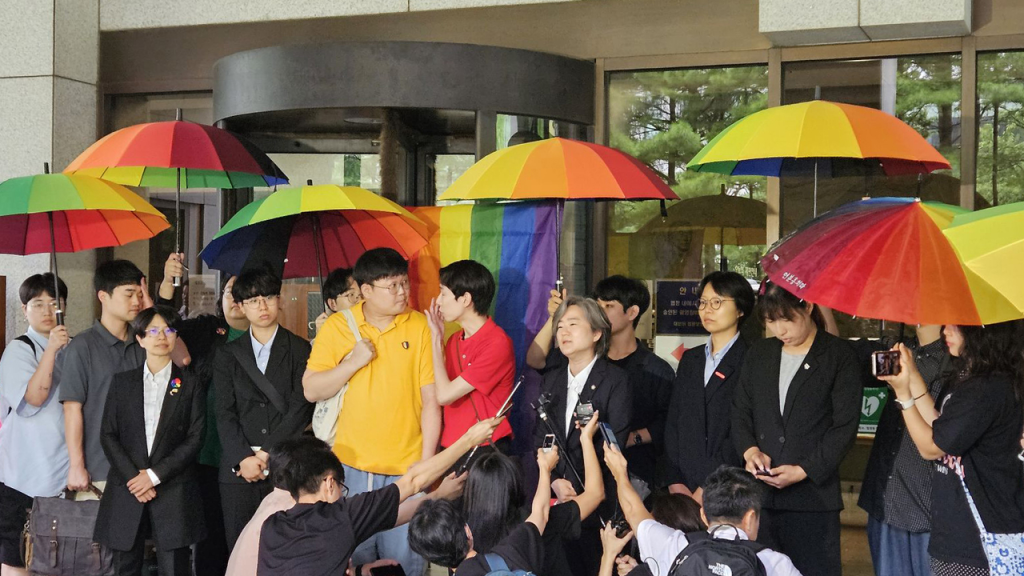
Under newly announced policy changes, the Ministry of Data and Statistics will recognise same-sex couples living in the same household in the Population and Housing Census.
The government confirmed on Tuesday (21 October) it would allow same-gender housholds to pick “spouse” and “cohabiting partner” options on the census, which circulates every five years.
Previous iterations flagged the options as errors and rejected, according to Rainbow Action Korea – a coalition of 49 LGBTQ+ organisations.
“In past surveys, couples of the same gender could not select ‘spouse’ even if they lived together as such. The system would return an error,” They said in a statement reported by Straits Times.
“This is the first step towards having LGBTQ+ citizens fully reflected in national data.”
Same-sex marriage is not currently legal in South Korea. As of 2023, cohabiting couples can receive spousal coverage under the National Health Insurance Service (NHIS).
A 2024 ruling upholding same-sex couple’s rights to access health insurance benefits was heralded as a “significant step” towards LGBTQ+ equality, with many arguing it paves the way towards legalising same-sex marriage.
The centre-left Justice Party similarly commended the government’s decision to update the census, arguing it could lead to “further change.”
“The day will come when even transgender citizens are visible in national statistics,” a spokesperson continued.
LGBTQ+ rights progress remains slow in the East Asian country. LGBTQ+ people are banned from adoption and military service, while hate crime protections are non-existent.
While legally changing gender has been permitted without sterilisation since 2020, gender-affirming care remains heavily restricted.
An Ipsos survery found that, as of May 2025, 31 per cent of South Koreans are anti-LGBTQ+, while 51 per cent oppose same-sex public displays of affection.
Despite this, nearly a quarter believe the country is a “good place” for LGBTQ+ people.
Rainbow Action argued that, while the move was a positive step, the government hadn’t done enough to inform the public about the change which could limit participation.
The Japanese government has expanded legal protections to same-sex couples.
According to The Japan Times, the government has decided to recognise same-sex couples as being in “de facto marriages” under nine additional laws, including the Disaster Condolence Grant law.
This follows a decision earlier this year to extend 24 existing laws – including the Domestic Violence Prevention Act, Land and House Lease Act, Child Abuse Prevention Act, and Public Housing Act – to same-sex couples.
Japan’s LGBTQIA+ community has long been engaged in a battle for marriage equality.
Currently, the country’s constitution defines marriage as “mutual consent between both sexes” and does not recognise marriage equality.
“From the perspective of individual dignity, it can be said that it is necessary to realise the benefits of same-sex couples being publicly recognised through official recognition,” the court said on 20 June.
“Public debate on what kind of system is appropriate for this has not been thoroughly carried out.”
A few months later, a Tokyo court upheld the ruling.
However, despite the court doubling down on its stance, the presiding judge also stated that the lack of a legal system and protections for same-sex couples infringes on their human rights (per CNN).
While the marriage equality movement in Japan has suffered a handful of setbacks, it has also seen a few notable wins over the last three years.
Last month, it was reported that the Supreme Court will formally consider a petition for a case calling on them to overturn their 2015 ruling in Obergefell v. Hodges, the historic ruling that made gay marriage legal nationwide. The petition comes from former Kentucky county clerk Kim Davis, who has made headlines and been embroiled in legal battles since she refused to sign marriage licenses for gay couples.
While Davis has been fighting against gay marriage since it was made legal, her lawyers have been doing it for longer. Davis is being represented by Liberty Counsel, a far-right Christian legal group and Southern Poverty Law Center-designated anti-LGBTQ hate group.
Since its inception in 1989, the group has opposed gay rights causes, including fighting against gay marriage, the legalization of homosexuality, and bans onconversion therapy. In one instance, the group’s Facebook cover photoreferenced the Bible verse Leviticus 20:13, which reads, “If a man has sexual relations with a man as one does with a woman, both of them have done what is detestable. They are to be put to death; their blood will be on their own heads.”
When asked about the cover photo, the group responded in an email that “Liberty Counsel has never promoted or condoned the killing of anyone or asked anyone to ‘like’ any quote about killing gays.”
Experts say Liberty Counsel is arguably more powerful than ever in 2025, fueled by publicity from Davis’ case and the opportunity to capitalize on a moment when American politics are stacked toward the right-wing—something that could upend gay marriage.
“The alignments will never be as favorable as they are at this moment,” Anne Nelson, author of “Shadow Network: Media, Money, and the Secret Hub of the Radical Right,” told Uncloseted Media. “That’s why they’re going for broke.”
History
Liberty Counsel was founded by preacher turned lawyer Mat Staver and his wife, Anita.
Mat Staver, who now serves as the chairman, senior pastor, and primary spokesperson for the group, authored the 2004 book “Same-sex Marriage: Putting Every Household at Risk,” where he wrote that “homosexuality is rooted in fractured emotions” and “a common thread in virtually every case is some sort of sexual or emotional brokenness.”
While the organization started operations solely in Florida, Mat Staver told the Orlando Sentinel shortly after Liberty Counsel launched that the group “would be a Christian antithesis to the ACLU” and that he “always felt the Lord calling [him] to combine [ministry and law] together.”
Liberty Counsel was active throughout the 1990s, with a focus on First Amendment cases, but Staver and his group didn’t gain national attention until 1994, when he argued before the Supreme Court for a case that challenged the constitutionality of a Florida court ruling that barred anti-abortion protests outside of a clinic. Some parts of the ruling were successfully overturned while others remained in place.
After that, the group built up a reputation for taking up cases related to religion in schools and other public institutions, including one instance where they threatened a lawsuit against one school for changing the lyrics of a Christmas song in a school play.
Attacking Gay Rights
After the turn of the century, Liberty Counsel became more active on gay issues. In 2003, they filed an amicus brief in Lawrence v. Texas, the case that decriminalized gay sex nationwide, arguing in favor of state laws banning it by saying that “deregulating human sexual relations will erode the institution of marriage.”
When California was taken to court over Proposition 8, a 2008 state constitutional amendment that sought to ban gay marriage in the state, Liberty Counsel attempted to be among the lawyers defending it. The group publicly criticized fellow far-right Christian legal group Alliance Defending Freedom for, in their view, arguing the case poorly.
One lawyer for Liberty Counsel also disagreed with legal positions taken by one pro-Prop 8 lawyer, who reportedly refused to argue that homosexuality is an “illness or disorder.” In their amicus brief in support of the proposition, Liberty Counsel argued that homosexuality “presents serious physical, emotional, mental, and other health-related risks.”
And in 2015, just months before the Obergefell ruling, the group offered to represent Alabama judges who refused to perform gay marriages after a state ban was overturned.
Once gay marriage became legal nationwide, Liberty Counsel took up Kim Davis’ case, which brought them more media attention than ever before.
“Kim Davis was a boon to Liberty Counsel,” says Peter Montgomery, research director at People for the American Way, an advocacy group aimed at challenging the far right. “[She] got them a huge amount of publicity, and I think they’ve really grown since they first took up her case.”
Much of the earned media from the Davis case, however, was negative. Liberty Counsel received criticism for encouraging Davis to continue refusing gay marriage licenses in violation of a court order. And even a Fox News panel of legal experts called Davis a “hypocrite” and Mat Staver’s legal arguments “stunningly obtuse” and “ridiculously stupid.”
In an email to Uncloseted Media, Liberty Counsel took issue with criticism of the group’s past litigation, writing that “[they] have 40 wins [they] briefed or argued at the US Supreme Court, including a 9-0 win in Shurtleff v. City of Boston.”
Liberty Counsel has created their own media, including a daily 11-minute radio broadcast, Faith and Freedom. Launched in 2010, the program is syndicated on 145 stations across the country and frequently contains anti-LGBTQ rhetoric, including assertions that LGBTQ-inclusive policies in the Boy Scouts create “a playground for pedophiles”; that gay people “know intuitively that what they are doing is immoral, unnatural, and self-destructive”; and that gay people are “not controlled by reason,” but rather “controlled by … lust.”
And after being boosted in popularity by Kim Davis, a 2016 CBS News investigation found that the group had worked with lawmakers in at least 20 states to author anti-LBGTQ bills, including trans bathroom bans.
“They’re pretty much anti-LGBT in every way you can be,” Montgomery told Uncloseted Media. “Staver is pretty shameless in lying about gay people and the laws.”
Why Now?
Davis’ case has fallen in and out of public attention over the years, with the Supreme Court rejecting a previous petition in 2020. Despite this, Liberty Counsel has remained confident in the case’s potential to upend gay marriage. In 2023, the group told their supporters in an email that they planned to use Davis’ case to persuade the Supreme Court to overturn Obergefell. These comments came a year after Supreme Court Justice Clarence Thomas expressed interest in reconsidering Obergefell in his opinion on the case that overturned Roe v. Wade.
“[The far right have] been working for decades to get their pieces in place, so at this particular moment, looking at the chessboard, they’ve got a critical mass of conservative states with Republicans in the state house, they’ve got the White House, they’ve got both houses of Congress, and they’ve got a majority on the Supreme Court,” says Nelson. “In a year, that could change.”
Increasing Notoriety
Montgomery says that Liberty Counsel’s popularity and influence has been on the rise since the start of the pandemic, when the group gained traction by opposing restrictions on churches meeting during COVID lockdowns. During this period, Staver claimed that COVID-19 vaccines are designed to “prevent people from procreating.”
“One of the ways that [Staver] has boosted his visibility and influence was riding that parade, which a number of people on the religious right did, and took advantage of the resentment of public health restrictions,” says Montgomery.
Since then, the group has falsely claimed that the Respect for Marriage Act “would allow pedophiles to marry children,” and Staver wrote in a newsletter that “the LGBTQ agenda seeks nothing less than to eliminate all religious freedom rights that might make them feel bad about their choices.”
In the meantime, affiliates of the group have been cozying up to the Supreme Court. In 2022, a representative of the Liberty Counsel-owned D.C. ministry Faith & Liberty was caught bragging about praying with Supreme Court justices just weeks after the court overturned Roe v. Wade. Staver told Rolling Stone these allegations are “entirely untrue.”
In his majority opinion on the case, Justice Alito cited an amicus brief filed by Liberty Counsel where the group argues that “the birth control and abortion movements are racist and eugenic.”
Part of a Bigger Picture
Liberty Counsel’s website reports that it generated nearly $28 million in revenue between July 1, 2023 and June 30, 2024. While their internal team has roughly 40 employees listed on LinkedIn, they have claimed to have anywhere from 90 to 700 affiliate attorneys across the country. Some of the group’s larger and more consistent donors reportedly include fracking baron Farris Wilks; the Christian TV network Good Life Broadcasting; and Liberty University, where Staver previously worked as dean of the law school.
“The big Christian nationalist and plutocratic donors understand that the Supreme Court, and the judiciary in general, are central to their aims … so over the past few decades they spent enormous sums grooming and promoting candidates for the judiciary whose interpretation of the law is favorable to their interests,” Katherine Stewart, an author and expert on religious nationalism, told Uncloseted Media in an email. “Liberty Counsel has successfully positioned itself as one of the players in that space. It only picks up a slice from the total pie, but the pie is so well-funded that even a slice is rich indeed.”
Beyond this, Liberty Counsel is affiliated with a number of other right-wing groups, several of which operate directly under the group’s umbrella. Staver holds leadership positions in other conservative groups, including Salt & Light Council and National Hispanic Christian Leadership Conference—the former of which has been outspokenly anti-LGBTQ. Liberty Counsel is also a member of the Remnant Alliance, a coalition of groups known for coordinating to elect Christian nationalist candidates to local school boards. A leaked membership directory from 2020 also listed Staver as a member of the Council for National Policy, a secretive group that includes Republican politicians and major leaders of Christian right organizations, though Staver told Uncloseted Media that Liberty Counsel and the Council for National Policy are not affiliated.
Nelson says connections like these allow different groups on the far right to coordinate together on anti-LGBTQ policies.
“They’ll have coordinated messaging about whatever campaign they’re launching at the moment. And it’s highly coordinated, as in the same story, the same language, the same spokespeople. It’s really quite impressive. And so all of a sudden there’ll be a story that will just erupt.”
The Council for National Policy did not respond to a request for comment.
When Liberty Counsel filed its most recent petition for Davis’ case to the Supreme Court, multiple right-wing media outlets whose leadership have been members of the Council for National Policy quickly covered the story with a favorable spin, including Salem Media Group, the WashingtonTimes and WorldNetDaily. And earlier this year, Staver networked at the National Religious Broadcasters conference, where he discussed plans to overturn Obergefell.
Montgomery says that this coordination is especially powerful because different groups are able to influence different spheres. For example, while Liberty Counsel pressures the courts, a group like Salt & Light Council works to activate supporters in ministry.
“They have this broader vision of wanting to change the culture and change the country,” he says. “They are all different approaches to moving the country in the direction they want: courts, legislative advocacy, lobbying, organizing, and media outreach.”
Nelson says the far right’s recent legal success is thanks in part to the influx of right-wing judges since the start of Trump’s first term.
“It’s worked initially with trying to get local and political opposition to these laws, and it’s linked to getting the appointments of judges who’ve had to pass a litmus test,” she says. “And then [their strategy involves] mounting the lawsuits, starting usually at the state level and working their way up the court system, specializing in states where they believe they’ll have sympathetic judges. … It’s gaming [the system].”
In an email to Uncloseted Media, Liberty Counsel says this characterization does not describe their litigation strategy.
What Does This Mean for Marriage Equality?
Despite all of this, many legal experts believe that this latest challenge to marriage equality is a long shot. Liberty Counsel’s arguments were largely rejected by a federal appeals court panel earlier this year, and several of the justices have shown little to no interest in revisiting Obergefell. Just this month, conservative Justice Amy Coney Barrett wrote that the right to marriage is “fundamental” and called for people to “tune … out” concerns about gay marriage being overturned.
However, given the current political moment, Nelson says that the threat to Obergefell should not be underestimated.
“This long-range strategy is coming to fruition, and a lot of the pieces are in place,” she says. “Under the current circumstances, with the current judiciary, they’ve got a reasonable chance of allowing states to ban same-sex marriages on a state level with an eye towards eventually banning it [on a nationwide level] in the future.”
Ten years after the Supreme Court extended marriage rights to same-sex couples nationwide, the justices this fall will consider for the first time whether to take up a case that explicitly asks them to overturn that decision.
Kim Davis, the former Kentucky county clerk who was jailed for six days in 2015 after refusing to issue marriage licenses to a gay couple on religious grounds, is appealing a $100,000 jury verdict for emotional damages plus $260,000 for attorneys fees.
In a petition for writ of certiorari filed last month, Davis argues First Amendment protection for free exercise of religion immunizes her from personal liability for the denial of marriage licenses.
More fundamentally, she claims the high court’s decision in Obergefell v Hodges — extending marriage rights for same-sex couples under the 14th Amendment’s due process protections — was “egregiously wrong.”
“The mistake must be corrected,” wrote Davis’ attorney Mathew Staver in the petition. He calls Justice Anthony Kennedy’s majority opinion in Obergefell “legal fiction.”
The petition appears to mark the first time since 2015 that the court has been formally asked to overturn the landmark marriage decision. Davis is seen as one of the only Americans currently with legal standing to bring a challenge to the precedent.
“If there ever was a case of exceptional importance,” Staver wrote, “the first individual in the Republic’s history who was jailed for following her religious convictions regarding the historic definition of marriage, this should be it.”
Lower courts have dismissed Davis’ claims and most legal experts consider her bid a long shot. A federal appeals court panel concluded earlier this year that the former clerk “cannot raise the First Amendment as a defense because she is being held liable for state action, which the First Amendment does not protect.”
Davis, as the Rowan County Clerk in 2015, was the sole authority tasked with issuing marriage licenses on behalf of the government under state law.
“Not a single judge on the U.S. Court of Appeals showed any interest in Davis’s rehearing petition, and we are confident the Supreme Court will likewise agree that Davis’s arguments do not merit further attention,” said William Powell, attorney for David Ermold and David Moore, the now-married Kentucky couple that sued Davis for damages, in a statement to ABC News.
A renewed campaign to reverse legal precedent
Davis’ appeal to the Supreme Court comes as conservative opponents of marriage rights for same-sex couples pursue a renewed campaign to reverse legal precedent and allow each state to set its own policy.
At the time Obergefell was decided in 2015, 35 states had statutory or constitutional bans on same-sex marriages, according to the National Conference of State Legislatures. Only eight states had enacted laws explicitly allowing the unions.
So far in 2025, at least nine states have either introduced legislation aimed at blocking new marriage licenses for LGBTQ people or passed resolutions urging the Supreme Court to reverse Obergefell at the earliest opportunity, according to the advocacy group Lambda Legal.
In June, the Southern Baptist Convention — the nation’s largest Protestant Christian denomination — overwhelmingly voted to make “overturning of laws and court rulings, including Obergefell v. Hodges, that defy God’s design for marriage and family” a top priority.
Support for equal marriage rights softening
While a strong majority of Americans favor equal marriage rights, support appears to have softened in recent years, according to Gallup — 60% of Americans supported same-sex marriages in 2015, rising to 70% support in 2025, but that level has plateaued since 2020.
Among Republicans, support has notably dipped over the past decade, down from 55% in 2021 to 41% this year, Gallup found.
Davis’ petition argues the issue of marriage should be treated the same way the court handled the issue of abortion in its 2022 decision to overturn Roe v Wade. She zeroes in on Justice Clarence Thomas’ concurrence in that case, in which he explicitly called for revisiting Obergefell.
The justices “should reconsider all of this Court’s substantive due process precedents, including Griswold, Lawrence, and Obergefell,” Thomas wrote at the time, referring to the landmark decisions dealing with a fundamental right to privacy, due process and equal protection rights.
“It is hard to say where things will go, but this will be a long slog considering how popular same-sex marriage is now,” said Josh Blackman, a prominent conservative constitutional scholar and professor at South Texas College of Law.
Blackman predicts many members of the Supreme Court’s conservative majority would want prospective challenges to Obergefell to percolate in lower courts before revisiting the debate.
The court is expected to formally consider Davis’ petition this fall during a private conference when the justices discuss which cases to add to their docket. If the case is accepted, it would likely be scheduled for oral argument next spring and decided by the end of June 2026. The court could also decline the case, allowing a lower court ruling to stand and avoid entirely the request to revisit Obergefell.
“Justices Brett Kavanaugh and Amy Coney Barrett seem wildly uninterested. Maybe Justice Neil Gorsuch, too,” said Sarah Isgur, an ABC News legal analyst and host of the legal podcast Advisory Opinions.
“There is no world in which the court takes the case as a straight gay marriage case,” Isgur added. “It would have to come up as a lower court holding that Obergefell binds judges to accept some other kind of non-traditional marital arrangement.”
Ruling wouldn’t invalidate existing marriages
If the ruling were to be overturned at some point in the future, it would not invalidate marriages already performed, legal experts have pointed out. The 2022 Respect for Marriage Act requires the federal government and all states to recognize legal marriages of same-sex and interracial couples performed in any state — even if there is a future change in the law.
Davis first appealed the Supreme Court in 2019 seeking to have the damages suit against her tossed out, but her petition was rejected. Conservative Justices Thomas and Samuel Alito concurred with the decision at the time.
“This petition implicates important questions about the scope of our decision in Obergefell, but it does not cleanly present them,” Thomas wrote in a statement.
Many LGBTQ advocates say they are apprehensive about the shifting legal and political landscape around marriage rights.
There are an estimated 823,000 married same-sex couples in the U.S., including 591,000 that wed after the Supreme Court decision in June 2015, according to the Williams Institute at UCLA Law School. Nearly one in five of those married couples is parenting a child under 18.
Since the Obergefell decision, the makeup of the Supreme Court has shifted rightward, now including three appointees of President Donald Trump and a 6-justice conservative supermajority.
Chief Justice John Roberts, among the current members of the court who dissented in Obergefell a decade ago, sharply criticized the ruling at the time as “an act of will, not legal judgment” with “no basis in the Constitution.” He also warned then that it “creates serious questions about religious liberty.”
Davis invoked Roberts’ words in her petition to the high court, hopeful that at least four justices will vote to accept her case and hear arguments next year.
Support for marriage equality varies greatly around the world, with Western European countries most heavily in favor, according to a new Pew Research Center analysis.
Pew has conducted surveys in 32 countries in the past two years. Support was highest in Sweden, where 92 percent of respondents favored equal marriage rights for same-sex couples. Other countries Western Europe were not far behind, with 89 percent support in the Netherlands, 87 percent in Spain, 82 percent in France, and 80 percent in Germany. Each of those countries has legalized same-sex marriage.
In Italy, where legalization is being debated but hasn’t yet happened, 73 percent of respondents endorsed marriage equality. In the United Kingdom, support stood at 74 percent, and all parts of the U.K. have enacted marriage equality.
The situation was much different in the Eastern European countries Pew has surveyed, with just 41 percent support in Poland and 31 percent in Hungary.
In North America, 79 percent of Canadians and 63 percent of both U.S. residents and Mexicans backed marriage equality. In the U.S., there were stark differences along party lines. Eighty-two percent of Democrats and Democratic-leaning independents were supportive, compared to 44 percent of Republicans and Republican leaners. Age differences showed up in the U.S. too, with 73 percent of respondents under 40 being supportive, compared to 57 percent of those 40 and older.
In the two South American countries surveyed, there was majority endorsement of marriage equality — 67 percent in Argentina and 53 percent in Brazil. Both countries have legalized same-sex marriage.
Surveys of the Asia-Pacific region showed 75 percent support of equal marriage rights in Australia, which OK’d marriage equality in 2017. In Taiwan, the only Asian country with marriage equality, 45 percent of respondents were in favor and 43 percent still opposed, with the rest undecided. There was majority support in Japan, Vietnam, Hong Kong, Cambodia, and India; the latter’s highest court “recently rejected a petition to legalize same-sex marriage,” Pew notes. The survey there was conducted before the ruling. Indonesia had the lowest amount of support among Asian countries, with 5 percent.
In Africa and the Middle East, Pew found 38 percent of both South Africans and Israelis in favor of marriage equality, but just 9 percent of Kenyans and 2 percent of Nigerians. Nigeria came in lowest of all the countries surveyed.
Around the world, Pew found that younger people were more likely to support marriage equality than older ones, women more likely than men, and liberals more likely than conservatives. The ideological split is greatest in the U.S., with 90 percent of liberals endorsing marriage equality and just 36 percent of conservatives. Globally, people with higher levels of education and income were more supportive than those with lower levels.








 fleeredstates.blog
You must be logged in to post a comment.