
Read more at NPR.
The tree-lined neighborhood near Nollendorfplatz square in central Berlin is as gay today as it was a century ago.
It’s where Christopher Isherwood wrote novels chronicling the rise of the Nazis amid the city’s rich queer nightlife that inspired the musical Cabaret.
Every summer, the neighborhood throws its own smaller-scale LGBTQ+ Pride event separate from the city’s main annual parade taking place this weekend.
It’s just one of more than 200 Pride events taking place in Germany this year. But with far-right extremist groups staging anti-Pride protests, many Pride attendees fear for their safety.
Sipping on a cocktail as the street party gets underway, 62-year-old Georg Schmidt says he’s relieved that this event is a relaxed affair. He says he attended a different local pride parade last month across town in the district of Marzahn and the mood there was tense.
“There was a massive police presence to shield us from anti-Pride protests. We only felt safe because the police kept us apart,” Schmidt says.
The counter demonstration was organized by far-right groups designated by Germany’s domestic intelligence agency as violent and extremist. It’s one of 17 extreme-right anti-Pride demonstrations that have taken place so far this year, according to the Center for Monitoring, Analysis and Strategy — an organization that monitors extremism. Some cities have even canceled pride because of threats.
Sabine Volk, a researcher at the Institute for Research on Far Right Extremism at the University of Tübingen, says these groups attract young men who promote what they call traditional family values — a kind of pride that has little to do with rainbow flags.
“The key slogan is that the German flag and Germany itself is already colorful enough,” Volk says. “And the overall message is that queer life does not have a place in Germany.”
But it’s not just far-right extremists who are exacting about flags.
The new president of the German parliament, Julia Klöckner — who is a member of Chancellor Friedrich Merz’s conservative party — says the rainbow flag will no longer be raised on top of the legislature building during Pride month, which runs every year in Germany from June 28 until July 27. She has also prohibited parliamentary public servants from attending Pride in an official capacity and lawmakers have been asked to take down rainbow flags and stickers from office doors.
Speaking on public broadcaster ARD, Merz signaled his support for the rule at Germany’s parliament, the Bundestag, with the words, “the Bundestag is not a circus tent” — a remark to which many have taken umbrage.
Merz backs his colleague’s argument that the lower house must maintain neutrality and cannot support events with a political agenda.
Opposition Green Party lawmaker Nyke Slawik criticized the move. “Declaring the rainbow a political symbol is highly problematic” stressing that “queer people are not an ideology; they are people!” Slawik told public broadcaster ZDF.
Slawik argues they are people increasingly in need of protection. Germany’s federal police report an almost tenfold increase in reported queerphobic hate crimes since 2010 and they believe the majority of cases go unreported.
The issue is not divided by party political lines; criticism of Merz’s choice of words has come from within his own party. Sönke Siegmann, the chair of the Christian Democrats’ LGBTQ+ Association, says some within his party are still catching up on terminology.
“If you say queer in my party, most people take a deep breath and say: ‘Oh, that’s a left-wing term,’ ” Siegmann observes. He says he has spoken with Merz since he made his “circus tent” comments.
“We explained to him what queer really means and two days later when asked in Parliament about LBGTQ+ hate crimes and what his government will do about them, Merz actually used the term queer,” Siegmann says.
Back in the Nollendorfplatz area, rainbow flags fly every month of the year. But local resident Chris Kelly says the mood here is not as “live and let live” as it once was. He recently opened a boutique that sells high-end garments made from industrial strength rubber. He says business is good and he has a broad customer base, but it was almost impossible trying to find premises for the boutique.
“We found plenty of suitable spaces to rent and our finances are solid, but a lot of landlords rejected us, saying they didn’t want people like us,” Kelly remembers. “Real estate agents had warned us, but I was flabbergasted to encounter such prejudice in Berlin’s queerest, gayest neighborhood.”
Kelly’s store is located just down the street from Romeo and Romeo, a gay bar whose owner was attacked last month. Kelly says he too gets more verbal abuse than he used to and he hears again and again of attacks on members of the LGBTQ+ community.
“I’m almost 40 and have seen so much progress like equal marriage,” Kelly says. “But something is changing. Hatred towards people like me is becoming mainstream again.”
Kelly points out that a few doors down in the other direction is where the legendary nightclub Eldorado stood until the Nazis closed it down in 1933, eventually sending its queer clientele to concentration camps.
As preparations for Berlin’s main Pride parade get underway, the city police say they’ve received a permit request for a counterdemonstration protesting “against Pride terror and identity disorders.”
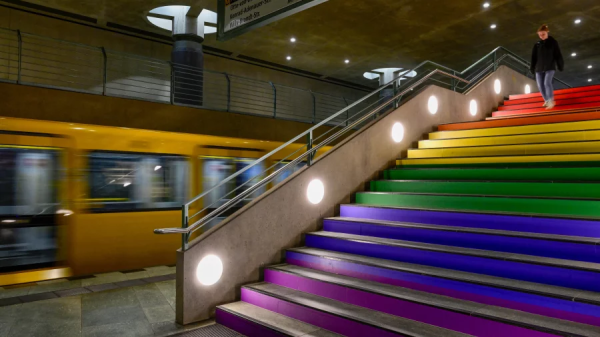
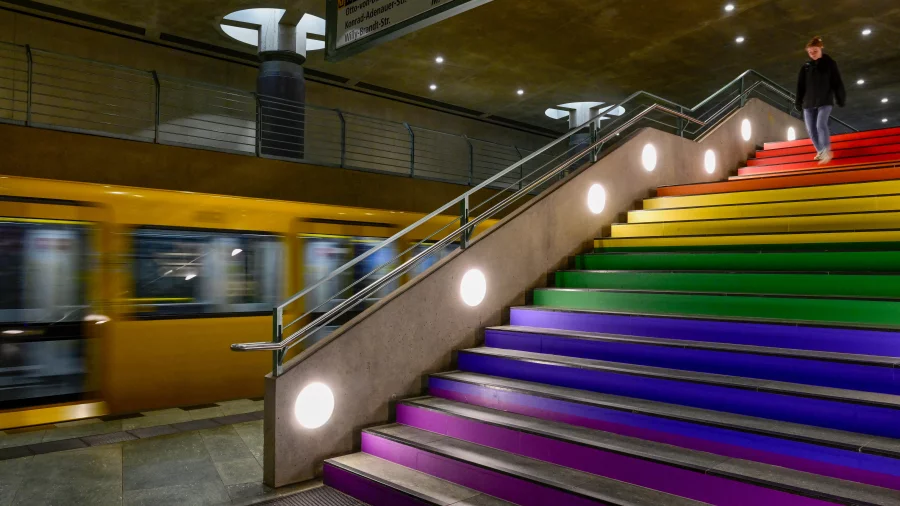
In reaction to the Bundestag president’s decision not to fly the rainbow flag on top of parliament this year, Berlin’s transport authority has decorated its Bundestag subway station stop in rainbow colors, writing on Instagram: “So our Bundestag is ready for Pride.”
Kelly urges people to attend Pride and stand up to a new generation of the far-right. He has no desire to say Goodbye to Berlin and the neighborhood around Nollendorfplatz, as Isherwood was forced to do.




You must be logged in to post a comment.