Texas AG Paxton ‘opinion’ claims courts lack authority to order gender marker changes, tells state agencies to ‘immediately correct’ any such changes

*This is being reported by the Dallas Voice. A response by the Texas House LGBTQ Caucus is here.

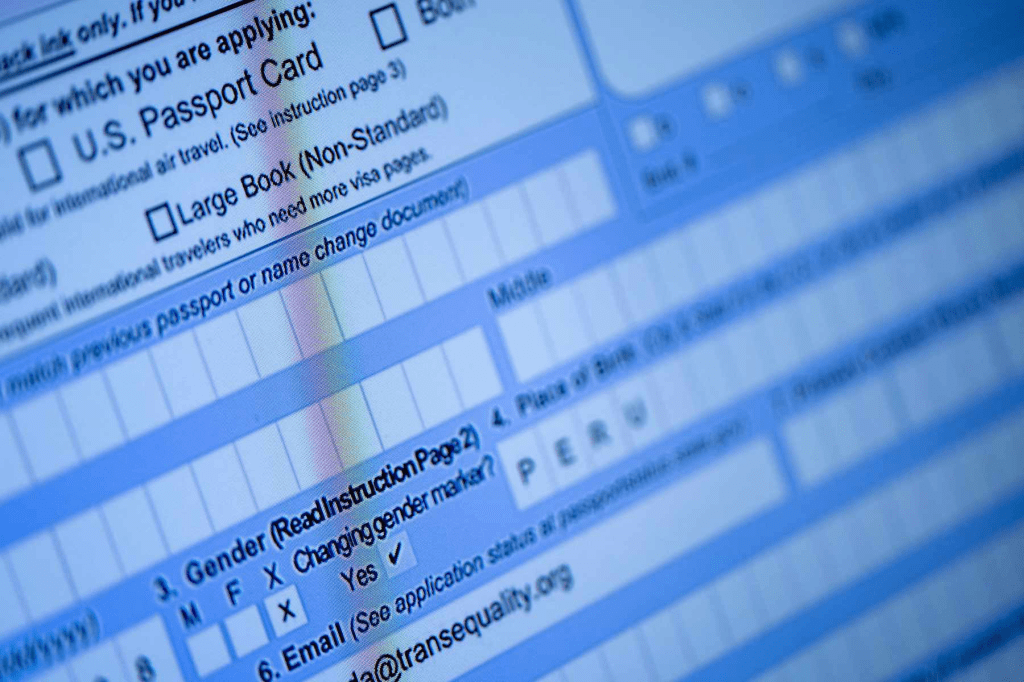
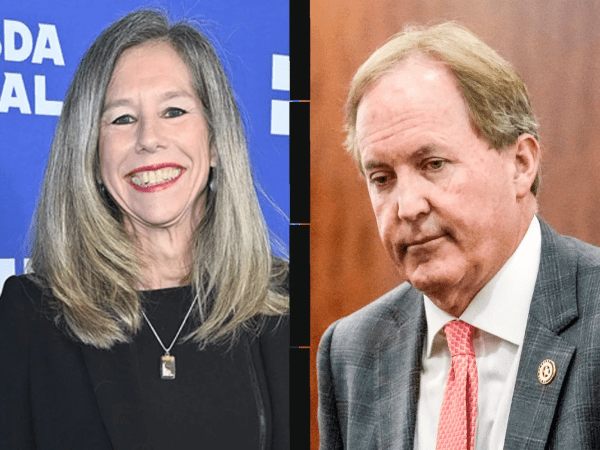
Texas Attorney General Ken Paxton ramped up his war on transgender Texans yet another notch today (Friday, March 14), issuing a “legal opinion” declaring that state district courts do not have the judicial authority to order governmental agencies to change the gender markers on a trans person’s government-issued identification documents to reflect their actual gender identity rather than their gender assigned at birth.

Paxton also instructed state agencies to “immediately correct any unlawfully altered driver’s licenses or birth certificates that were changed pursuant to such orders.”

But the AG’s “opinions” are not legally binding on the courts, and Lambda Legal’s South Central Regional Director Shelly Skeen noted that her organization, as well as the ACLU, already have legal challenges in the works.

Paxton’s “opinion” was issued in response to a request made last September by the Texas Department of Public safety, the state agency which issues driver’s licenses in this state. A summary of the “opinion” reads:

“The ‘judicial power’ endowed to district courts does not countenance ex parte orders directing state agencies to amend a person’s biological sex on driver’s licenses or birth certificates. The underlying proceedings are coram non judice, and the resulting orders are void. State agencies must immediately correct any unlawfully altered driver’s licenses or birth certificates that were changed pursuant to such orders.”

(Ex parte means “on one side only; by or for one party.” Coram non judice means “not before a judge,” or “before one not a judge.”)

What Paxton is saying, Skeen explained, is that courts have been issuing orders directing state agencies to change gender markers on official documents such as birth certificates and driver’s licenses “without the agency being a part of the case.”

But, she added, “Courts have the authority to issue court orders based on what they find given the facts in any given case. The state doesn’t need to be party to that case.”

Skeen continued, “A court order is part of what the judiciary gets to do — interpret the law. The legislature makes the law, and the executive branch [of which Paxton is a part in Texas] is supposed to enforce the law. When a court issues an order, that order [applies to] the executive branch, and that order is entitled to full faith and credit under the U.S. Constitution.”

That means, basically, that Texas is required to honor court orders issued in other states, with a very few exceptions.

“We know the attorney general’s opinion is non-binding. But we also know state agencies will try to comply with it. Nevertheless, his opinion — in my opinion — is wrong. He is choosing to issue a non-binding opinion that is contrary to many legal doctrines, including separation of powers.” Shelly Skeen, Lambda Legal South Central Region director

“We know the attorney general’s opinion is non-binding. But we also know state agencies will try to comply with it,” Skeen said. “Nevertheless, his opinion — in my opinion — is wrong. He is choosing to issue a nonbinding opinion that is contrary to many legal doctrines, including separation of powers.”

Ash Hall, policy and advocacy strategist on LGBTQIA+ rights for the ACLU of Texas, said in a written statement, “We condemn Ken Paxton’s misuse of his office to repeatedly target transgender Texans. Attorney general opinions are non-binding and cannot supersede court orders. State agencies have no authority to retroactively change anyone’s valid legal documents.

“If state agencies attempt to implement this non-binding opinion, it would be an unlawful waste of resources that will not hold up in court nor stand the test of time,” Hall said. “We should all have identity documents that match who we are as a matter of basic safety and Paxton cannot erase transgender Texans’ right to exist.”

“We condemn Ken Paxton’s misuse of his office to repeatedly target transgender Texans … State agencies have no authority to retroactively change anyone’s valid legal documents.” Ash Hall, policy and advocacy strategist on LGBTQIA+ rights for the ACLU of Texas

An ACLU of Texas spokesperson added that there “not much more we can comment on beyond that yet since we don’t know how they plan to enforce this.”

Skeen said that anyone who finds their government-issued IDs have been or are being changed should contact the Lambda Legal Help Desk or the ACLU of Texas as soon as possible. She also stressed that legal challenges are already moving through the courts, including Fowler et al v. Stitt et al which is currently pending before the U.S Supreme Court.

According to the website, Lambda Legal filed that lawsuit in the U.S. District Court for the Northern District of Oklahoma on behalf of three transgender people born in Oklahoma — Rowan Fowler, Allister Hall and one plaintiff identified by his initials C.R.  — after Oklahoma Gov. Kevin Stitt issued an executive order in late 2021 that other state officials have invoked in denying transgender people’s applications to correct their birth certificates. That order is a reversal of prior policy, which had permitted such corrections for years, the lawsuit says, arguing that the government’s actions violate equal protection, privacy and liberty under the Equal Protection and Due Process Clauses of the U.S. Constitution and that forcing transgender people through their birth certificates to identify with a sex that conflicts with who they are violates their free speech rights under the First Amendment.
Kentucky GOP Lawmakers Approve Bill to Reverse Governor’s Ban on Conversion Therapy

*This is being reported by Gayety.

Kentucky state Representative David Hale, a Republican, has introduced legislation aimed at overturning a 2024 executive order issued by Democratic Governor Andy Beshear that bans conversion therapy. This controversial practice, which attempts to change a person’s sexual orientation or gender identity, has been widely discredited by medical and psychological experts. Despite numerous opponents testifying against Hale’s bill, the lawmaker insists that his research supports the need for the legislation, although he declined to disclose the organizations that helped him draft the bill.

Governor Beshear’s Executive Order and Its Impact

In September 2024, Governor Beshear signed an executive order that outlaws conversion therapy for minors in Kentucky. The executive order not only prohibits state-funded programs from supporting the practice, but it also calls for licensing boards for counselors to consider disciplinary action against those who engage in conversion therapy. Beshear’s order aims to protect minors from a practice that has been shown to have detrimental effects on mental health.

At the time of signing the order, Beshear emphasized that conversion therapy “has no basis in medicine or science” and cited research linking the practice to increased rates of suicide and depression. “This is about doing what is right and protecting our children,” Beshear said in a statement. “Hate is not who we are as Kentuckians.”

Hale’s Proposed Bill and its Justifications

On February 15, 2025, Hale introduced House Bill 495, a measure designed to reverse Beshear’s executive order. Hale, who is known for his conservative stances, argues that his bill would protect counselors, therapists, and pastors who offer conversion therapy from government interference. He insists that parents should have the right to seek therapy that aligns with their beliefs and the needs of their children.

During a committee meeting, Hale claimed that his bill would protect mental health providers offering “therapy to relieve discomfort or distress caused by an individual’s sex or romantic or sexual attraction.” He further added that the bill would also safeguard practitioners who offer other forms of therapy, including pro-LGBTQ or gender-affirming care. Despite the claims, Hale did not specify which organizations assisted in drafting the bill’s language.

The bill, which was approved in a 15-4 party-line vote by the committee’s Republican members, is now one step closer to being debated by the full Kentucky legislature. Some Republicans on the committee argued that the bill would ensure mental health professionals could offer care that respects both LGBTQ+ individuals and those seeking therapy to change their sexual orientation.

Opposition Voices and Concerns

Numerous witnesses spoke out against Hale’s bill, citing the harm caused by conversion therapy and the damage it can do to vulnerable individuals. Eric Russ, a licensed clinical psychologist and executive director of the Kentucky Psychological Association, testified that the bill “directly threatens the trust between a mental health provider and our clients” by legitimizing practices that are widely considered harmful.

Rev. Brandon Long, an ordained minister and former victim of conversion therapy, shared his personal experience of being subjected to the practice after coming out as gay. He described how conversion therapy had attempted to alter his sexual orientation by blaming it on childhood trauma and demonic influence. “Conversion therapy weaponized sacred pastoral practices,” Long said, adding that it was “spiritual and psychological abuse.”

Chris Hartman, executive director of the Fairness Campaign, an LGBTQ+ rights group, questioned why the committee responsible for overseeing state government functions was involved in passing legislation related to mental health care.

Hale, who said he had found “no evidence” supporting the personal testimonies of those who spoke against his bill, went on to shake hands with several of the witnesses who had opposed it. Rev. Long refused to shake his hand, accusing Hale of dismissing their lived experiences and framing their testimony as lies.

Political Landscape and Future of the Bill

Hale’s bill is part of a broader culture war in Kentucky, where conservative lawmakers have made several attempts to restrict LGBTQ+ rights. In 2023, Kentucky Republicans successfully passed a ban on gender-affirming medical care, though it is currently on hold due to ongoing court challenges. While this ban focuses on medical care, it does not address gender-affirming psychological counseling.

Conversion therapy has been banned in 23 states, and the practice has faced widespread condemnation from major U.S. medical and psychological associations. Research has consistently shown that conversion therapy leads to increased emotional distress, including depression and suicidal thoughts, particularly among LGBTQ+ youth. According to the Trevor Project, nearly 21% of LGBTQ+ youth in Kentucky have reported being subjected to conversion therapy, with 83% of those experiences occurring before the age of 18.

A Divisive Issue for Kentucky’s Future

Hale’s bill comes at a time when Republicans hold supermajorities in both chambers of Kentucky’s legislature, which could threaten the future of Beshear’s executive order. If passed, the bill would reverse the protections set forth by Beshear, allowing the practice of conversion therapy to continue in the state.

As the bill moves through the legislative process, it is clear that the debate over conversion therapy is far from settled. Advocates for LGBTQ+ rights are committed to fighting the bill, while opponents argue that parents should have the freedom to choose therapeutic options that align with their values. With the state’s political climate increasingly polarized, Kentucky’s legislature is set to remain at the center of a larger national conversation about the rights of LGBTQ+ individuals and the role of government in regulating mental health practices.

For those struggling with issues related to conversion therapy, several resources are available, including the Trevor Project (1-866-488-7386) and the Trans Lifeline (1-877-565-8860). These organizations provide safe, confidential support for LGBTQ+ youth and adults.

Supreme Court Could Legalize LGBTQ Conversion Therapy—The Consequences Could Cost Billions

*This is being reported by Forbes

The Supreme Court announced Monday it will hear a case regarding whether state bans on “conversion therapy” trying to change minors’ sexual orientation or gender identity are legal—a case that could carry billions of dollars in repercussions, as a 2022 study found conversion therapy carries an economic burden of approximately $9 billion annually for patients and their families.

Key Facts

The Supreme Court took up Chiles v. Salazar, a case challenging Colorado’s ban on LGBTQ “conversion therapy” for minors, which asks the justices to more broadly decide whether laws that “[censor] certain conversations between counselors and their clients based on the viewpoints expressed” are constitutional.

LGBTQ “conversion therapy,” as it’s commonly known, refers to any practices—including both emotional efforts, like talk therapy, or physical efforts, like electroconvulsive therapy—that aim to influence a patient’s sexual orientation or gender identity, which are typically framed as efforts to “cure” homosexuality or being transgender.

Repeated studies have shown such efforts are ineffective at changing people’s sexual orientation or gender identity and carry a variety of harmful effects—such as elevated risks for suicide, drug abuse and mental health issues—which has led to bans on conversion therapy for minors being enacted in more than 20 states.

Conversion therapy and its negative effects also have an economic impact, as a 2022 study published in JAMA Pediatrics found conversion therapy and its “associated harms” result in an economic burden of approximately $9.23 billion per year.

Conversion therapy alone costs approximately $650 million for participants annually in the U.S., with individuals who undergo it paying an extra $97,985 for treatment as compared with people who don’t undergo any counseling, according to the study, which was based on data from LGBTQ youth ages 13-24.

There are also significant costs associated with knock-on effects from conversion therapy and the study estimates each conversion therapy patient pays an extra $83,366 on average to treat the “downstream consequences” associated with the procedure, which combined raise the total economic burden of conversion therapy to $9.2 billion.

What To Watch For

The Supreme Court will hear the case on conversion therapy at some point during its next term, which begins in October, so any ruling in the case is likely more than a year away.

What Did The Study Conclude?

The study, which was conducted by pro-LGBTQ rights organization The Trevor Project and research group Cytel, concluded there is a “high economic burden and high societal costs” that come along with conversion therapy, which the study refers to as sexual orientation and gender identity change efforts (SOGICE). Researchers analyzed the difference in costs between patients who underwent conversion therapy, LGBTQ youth who received no therapy and those who received therapy that affirmed their sexual orientation or gender identity. The study found conversion therapy carried the highest economic burden: In addition to the $650 million per year in total attributed to the therapy itself, there are also total annual costs of $190 million related to anxiety or “severe psychological distress” among those that underwent conversion therapy, $1.36 billion related to depression, $2.42 billion from suicide attempts, $1.17 billion from fatal suicides, $1.26 billion from alcohol use disorder and $2.18 billion from substance abuse. The likelihood of those negative outcomes was largely markedly higher among those who underwent conversion therapy as compared with other LGBTQ populations—except alcohol use disorder, where those without any therapy registered the highest number by one percentage point (42.26% among those with no intervention versus 41.26% among conversion therapy patients). As a result, the total costs incurred by conversion therapy patients were higher than the $4.85 billion in total annual costs among those who hadn’t received any treatment, and $3.04 billion among those who received affirmative therapy.

Contra

Researchers noted there were some limitations with the study’s methodology that may affect its results, such as being based on studies in which patients self-reported their experiences. That means it might not be fully representative of all LGBTQ patients, as many people may be unwilling to discuss their experiences. It also assumes the risks are the same across the LGBTQ population and for various types of conversion therapy, which may not be the case. Researchers argued they took a “conservative approach” with their findings, however, and noted the $9 billion figure is likely an underestimate of the total economic impact. The study only looked at adverse impacts from conversion therapy for three years after the treatment, for instance—though such effects could likely extend for much longer—and did not examine some other potential impacts, like post-traumatic stress disorder or medical consequences from various medications or electroconvulsive therapy.

Big Number

13%. That’s the share of LGBTQ youth who have either been subjected to or threatened with conversion therapy, according to a 2024 survey conducted by The Trevor Project among more than 50,000 Americans ages 13-24. That includes 5% who have been subjected to the therapy and 8% who were threatened with it. The 5% share is down from 10% who said in 2020 they were subjected to the therapy, though that number could rise again should the Supreme Court outlaw state bans.

Key Background

The Supreme Court case was brought by Kaley Chiles, a licensed counselor in Colorado who said in a court filing “she believes that people flourish when they live consistently with God’s design, including their biological sex.” Chiles objects to Colorado restricting her from counseling clients to change their sexual orientation or gender identity, claiming it violates her First Amendment rights and classifying state bans on conversion therapy as “silenc[ing] counselors’ ability to express views their clients seek on a topic of ‘fierce public debate.’” Chiles asked the Supreme Court to take up the case after a federal appeals court upheld Colorado’s policy restricting conversion therapy, ruling that it was regulating counselors’ professional conduct, rather than chilling First Amendment-protected speech. The case is the latest in a string of major cases related to LGBTQ rights the 6-3 conservative-leaning court has decided in recent years—such as cases over businesses being allowed to discriminate against same-sex couples or discriminate on the basis of sexual orientation and gender identity—and the court is deliberating on a case this term over gender-affirming care for minors.

Further Reading

Humanistic and Economic Burden of Conversion Therapy Among LGBTQ Youths in the United States (JAMA Pediatrics)

Survey: Over two-thirds of LGBTQ youth in Florida want to move out of state

*This was reported by the Tallahassee Democrat.

Less than half of young LGBTQ Floridians feel accepted in their communities, according to a new report released by The Trevor Project.

The Trevor Project, a nonprofit that provides crisis support for LGBTQ young people, surveyed almost 1,000 young LGBTQ Floridians about their mental health, and 48% felt the community they live in was accepting of their gender identity or sexual orientation.

But more than two-thirds, or 69%, say they or their family members have considered moving out of Florida because of LGBTQ-related politics and laws. It wasn’t clear where they considered moving.

“Florida might be free, but Florida is not welcoming,” said Sen. Shevrin Jones, D-Miami Gardens.

Since 2022, the Republican-led Legislature and Gov. Ron DeSantis have pushed multiple anti-LGBTQ laws in what they call the “Free State of Florida,” including banning “gender ideology” from K-12 schools, criminalizing trans people for using the bathroom that corresponds with their gender identity and restricting health care for trans people.

Florida’s Log Cabin Republicans, an organization of LGBTQ+ conservatives and allies within the Republican Party, did not respond to the USA TODAY Network-Florida’s request for comment in time for publication.

The Trevor Project also reported the following data about Florida’s LGBTQ youth. In the past year:

  • 37% contemplated suicide
  • 11% attempted suicide
  • 67% reported experiencing symptoms of anxiety
  • 54% reported experiencing symptoms of depression
  • 24% were physically threatened or harmed because of their sexual orientation or gender identity
  • 63% experiences discrimination because of their sexual orientation or gender identity

Jones said the passage of the Parental Rights in Education Act, called “Don’t Say Gay” by critics, and the “Stop WOKE Act” created a hostile environment for minorities in Florida. “Don’t Say Gay” prohibits the teaching of classroom instruction on gender identity and sexual orientation, and the “Stop WOKE Act” restricts how race is discussed in schools, colleges and workplaces.

The legislation also prohibits any teaching that could make students feel they bear personal responsibility for historic wrongs because of their race, color, sex or national origin.

DeSantis inveighed against ‘oppressive ideologies’

“We believe an important component of freedom in the state of Florida is the freedom from having oppressive ideologies imposed upon you without your consent,” DeSantis said when he signed the bill in 2022. “Whether it be in the classroom or in the workplace. And we decided to do something about it.”

On Tuesday in DeSantis’ State of the State speech, he made fun of Canada’s travel boycott of the U.S. and of Canadians who say they are canceling their vacations over President Trump’s tariffs and policies.

“We continue to set tourism records; 2024 saw more than 142 million visitors come to the state of Florida. This includes 3.3 million visitors from Canada,” DeSantis said. “That’s not much of a boycott in my book.”

LGBTQ Refugees May Apply for Asylum in Sweden

The Swedish Migration Board has posted the following information for LGBTQ asylum seekers.

If you have a well-founded fear of being persecuted because of your sexual orientation, gender, gender expression, gender identity or other membership in a certain social group, you may be a refugee and have the right to protection in Sweden. This is stated in the Refugee Convention, Swedish law and EU rules.

Asylum application and rules

Persecution can be threats or violence against your life or health. It can also be about laws and regulations or people’s views that mean that you are subjected to serious violations because of your sexual orientation. It can be, for example, punishment or extensive discrimination such as not being able to go to school, choose a job or receive healthcare.

The right to express yourself and engage politically without fear of persecution regardless of ethnicity, religion, gender or sexual orientation are also examples of what can give you the right to stay in Sweden.

It does not matter whether the persecution comes from the authorities of your home country or if your family or other people threaten you. The Swedish Migration Board will then investigate what could happen to you if you return to your home country in the future and whether the authorities there are unable or unwilling to protect you against the persecution that you say you are at risk of.

The Swedish Migration Board will register you as an asylum seeker with the name, date of birth and legal gender that appears on your identity documents. Swedish law does not allow us to register you with a different name, but if you wish to use a different address or pronoun, you should tell us so that we can make a note of this.

Investigation

When the Swedish Migration Board decides whether you need protection and can therefore be granted a residence permit in Sweden, an investigation will be carried out with you to understand what your life has been like and why you are afraid of returning to your home country. If the reason is your sexual orientation, gender expression or gender identity, it is important that you tell us as early as possible.

Read more about how to apply for asylum

The Swedish Migration Board knows that it can be difficult to tell someone you have never met about such things. It may even be the first time you have talked about it with someone and the boundaries of what feels personal and private are different for everyone. It is important that you still tell us as much as possible about all your reasons for asylum. The more details you can talk about, the better basis the Swedish Migration Board has for its decision. The investigator will also ask questions about your sexual orientation, your gender expression or gender identity, the thoughts and feelings you have had about it and your relationships with family, friends and the society you have lived in. We are bound by confidentiality and do not tell people who are not working on your case about what you tell us.

If you feel that the officer conducting your investigation does not understand what you are saying, or if you have information that the officer does not ask for, you must tell them as soon as possible. Do not wait until you have received a decision on your case.

You have the opportunity to express your gender preferences for the interpreter, caseworker and assistant so that you feel safe during the asylum process, and the Swedish Migration Board will then try to help you with your preferences. If you are over 18 years of age, you will meet your assistant and your caseworker alone without other co-applicants. You can request an assistant with special knowledge of the situation of LGBTQ people if you know of, or receive help in finding, such an assistant.

If you are under 18 years old

The Swedish Migration Board must listen to all children seeking asylum and find out whether the children need protection here. It is therefore important that you tell the Swedish Migration Board about your life in your home country and what you think would happen to you if you went back there. If you are under 18 and have guardians with you in Sweden, the Swedish Migration Board must ask them if we can talk to you without them being in the room. If you do not have your parents with you in Sweden, it is your guardian who decides whether we can talk to you alone. If you want to talk to your case officer without your parents or guardian, it is important that you say so.

The interpreter

Words and concepts in Swedish and your own language can mean different things. The most important thing is that you describe your own feelings and experiences and explain how they relate to why you are afraid.

If you do not understand the interpreter or if you think the interpreter may not be translating everything you say impartially, you should speak up. Also, keep in mind that the interpreter may not always know the specific words used to talk about sexual orientation, gender identity or gender expression. It may therefore be a good idea to also explain to the interpreter what the words you are using mean to you.

Accommodation

In most of the Swedish Migration Board’s accommodation, two or more people of the same gender share a room. The wait during the asylum process can make the accommodation situation stressful and conflicts can arise in the accommodation.

It is important that you tell us as soon as possible about what you need or if you feel unsafe where you live. If there are problems in the accommodation that you need help solving, you must tell us. Speak to the caseworker at the reception unit or the staff at the accommodation where you are registered.

Health

In some cities there are clinics for, for example, sexual health and counselling for specific target groups. Examples of target groups could be women, young people or LGBTQ people. Ask your caseworker for more information.

Voluntary organizations

You always have the right to contact voluntary organisations during the asylum process for advice and support. The more information you have about your rights and possible options, the better prepared you are for the different stages of the asylum process. RFSL is one such voluntary organisation that works for LGBTQ rights, providing special support and social meeting places for LGBTQ asylum seekers.

RFSL NewcomersLink to another website, opens in a new window.

RFSL Youth, Newcomers youth

Iowa approves bill removing gender identity protections despite massive protests

*This is reported by PBS

DES MOINES, Iowa (AP) — Iowa moved to remove gender identity protections from the state’s civil rights code Thursday despite massive protests by opponents who say it could expose transgender people to discrimination in numerous areas of life.

The Iowa House approved the bill that would strip the state civil rights code of protections based on gender identity, less than an hour after the state Senate backed the legislation. First introduced last week, the measure raced through the legislative process.

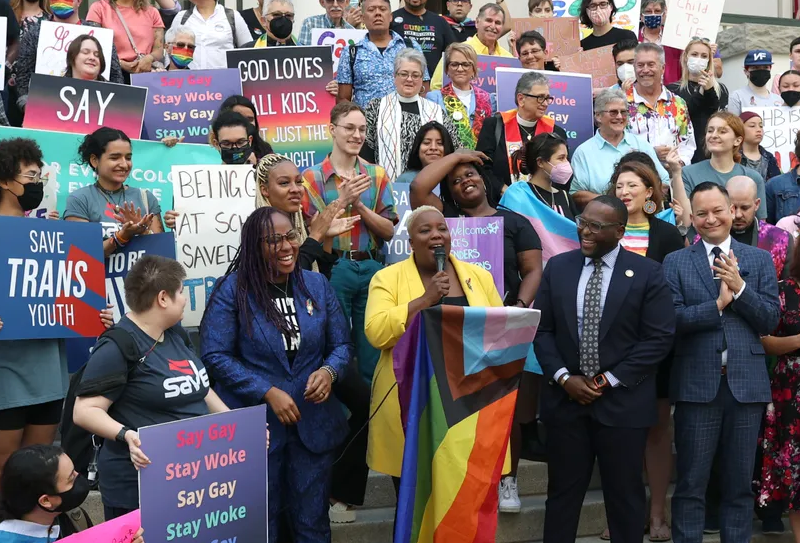
Hundreds of LGBTQ+ advocates streamed into the Capitol rotunda on Thursday waving signs reading “Trans rights are human rights” and chanting slogans including “No hate in our state!” There was a heavy police presence, with state troopers stationed around the rotunda. Of the 167 people who signed up to testify at the public hearing before a House committee, all but 24 were opposed to the bill.

Protesters that watched the vote from the House gallery loudly booed and shouted “Shame!” as the House adjourned. Many admonished Iowa state Rep. Steven Holt, who floor managed the bill and delivered a fierce defense of it before it passed.

The bill would remove gender identity as a protected class from the state’s civil rights law and explicitly define female and male, as well as gender, which would be considered a synonym for sex and “shall not be considered a synonym or shorthand expression for gender identity, experienced gender, gender expression, or gender role.”

The measure would be the first legislative action removing nondiscrimination protections based on gender identity, said Logan Casey, director of policy research at the Movement Advancement Project, an LGBTQ+ rights think tank.

Supporters of the change say the current law incorrectly codified the idea that people can transition to another gender and granted transgender women access to spaces such as bathrooms, locker rooms and sports teams that should be protected for people who were assigned female at birth.

The legislation now goes to Republican Gov. Kim Reynolds, who has been supportive of efforts to limit gender identity protections.

The Iowa lawmakers’ actions came on the same day the Georgia House backed away from removing gender protections from the state’s hate crimes law, which was passed in 2020 after the death of Ahmaud Arbery.

Iowa’s current civil rights law protects against discrimination based on race, color, creed, gender identity, sex, sexual orientation, religion, national origin or disability status.

Sexual orientation and gender identity were not originally included in the state’s Civil Rights Act of 1965. They were added by the Democratic-controlled Legislature in 2007, also with the support of about a dozen Republicans across the two chambers.

Iowa Republicans say their changes are intended to reinforce the state’s ban on sports participation and public bathroom access for transgender students. If approved, the bill would go to Republican Gov. Kim Reynolds, who signed those policies into law. A spokesperson for Reynolds declined to comment on whether she would sign the bill.

V Fixmer-Oraiz, a county supervisor in eastern Johnson County, was the first to testify against the bill at the public hearing. A trans Iowan, they said they have faced their “fair share of discrimination” already and worried that the bill will expose trans Iowans to even more.

“Is it not the role of government to affirm rather than to deny law-abiding citizens their inalienable rights?” Fixmer-Oraiz said. “The people of Iowa deserve better.”

Among those speaking in support of the bill was Shellie Flockhart of Dallas Center, who said she is in favor as a woman and a mother, a “defender of women’s rights” and someone “who believes in the truth of God’s creation.”

“Identity does not change biology,” Flockhart said.

About half of U.S. states include gender identity in their civil rights code to protect against discrimination in housing and public places, such as stores or restaurants, according to the Movement Advancement Project. Some additional states do not explicitly protect against such discrimination but it is included in legal interpretations of statutes.

Iowa’s Supreme Court has expressly rejected the argument that discrimination based on sex includes discrimination based on gender identity.

Several Republican-led legislatures are also pushing to enact more laws this year creating legal definitions of male and female based on the reproductive organs at birth following an executive order from President Donald Trump.

More Americans than ever identify as LGBTQ+

*This was reported by LGBTQNation.com

The number of Americans identifying as LGBTQ+ continued to rise, according to the latest Gallup poll.

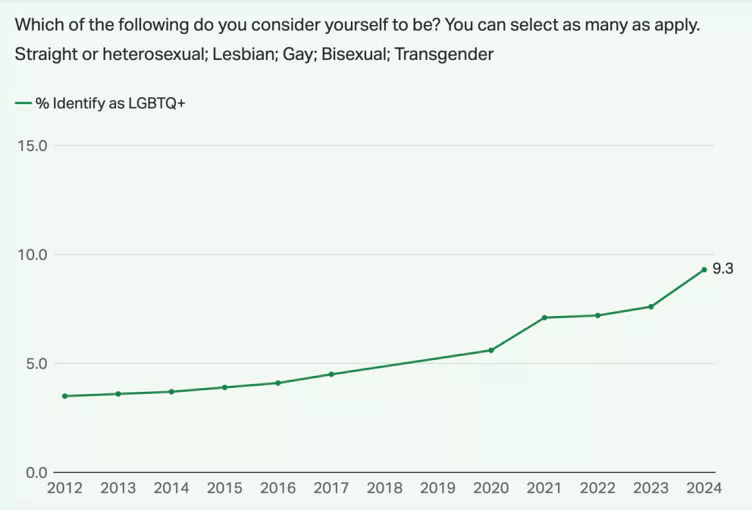
In 2024, 9.3% of U.S. adults identified as lesbian, gay, bisexual, transgender, or something other than heterosexual.

That’s an increase of more than one point since a 2023 survey, double the number from 2020, and up from 3.5% when Gallup first asked about sexual identity in 2012.

14,000 respondents in a phone survey were asked, “Which of the following do you consider yourself to be? You can select as many as apply. Straight or heterosexual; Lesbian; Gay; Bisexual; Transgender.”

Overall, 85.7% say they are straight, 5.2% are bisexual, 2.0% are gay, 1.4% are lesbian, and 1.3% are transgender. Just under 1% mention another LGBTQ+ identity, such as pansexual, asexual, or queer. Five percent of respondents declined to answer the question.

The survey found LGBTQ+ identification is increasing as younger generations of Americans enter adulthood. Younger people are much more likely than older generations to say they are something other than heterosexual.

Both Gen Z and millennials came of age with the expansion of LGBTQ+ rights, marriage equality, and greater representation in the culture.

More than one in five Gen Z adults — those born between 1997 and 2006, who were between the ages of 18 and 27 in 2024 — identify as LGBTQ+. Each older generation of adults, from millennials to the Silent Generation, has successively lower rates of identification, down to 1.8% among the oldest Americans, those born before 1946.

The largest increase was among younger people identifying as bisexual. 59% of LGBTQ+ Gen Z Americans (ages 18-27) called themselves bisexual, along with more than half (52%) of LGBTQ+ millennials (ages 28-43).

Among the nearly 900 LGBTQ+ individuals Gallup interviewed last year, more than half, 56%, said they were bisexual. Twenty-one percent said they were gay, 15% lesbian, 14% transgender, and 6% something else. These figures total more than 100% because the survey allows respondents to report multiple LGBTQ+ identities.

The overall estimate of 9.3% of U.S. adults who identify as LGBTQ+ counts each respondent only once, even if they have multiple identities.

The survey broke down LGBTQ+ identification associated with sex, politics, and geography, as well.

Democrats (14%) and independents (11%) are far more likely than Republicans (3%) to identify as LGBTQ+.

21% of liberals, compared with 8% of moderates and 3% of conservatives, say they are lesbian, gay, bisexual, or transgender.

LGBTQ+ identification is higher among people living in cities (11%) and suburbs (10%) than in rural areas (7%).

College graduates (9%) and nongraduates (10%) are about equally likely to identify as LGBTQ+, while 10% of women versus 6% of men say they are LGBTQ+. That gender gap is most pronounced in younger generations.

31% of Gen Z women versus 12% of Gen Z men identify as LGBTQ+, with most of those younger women saying they are bisexual.

Kansas Lawmakers Override Veto of Ban on Transition Care for Minors

*This was reported by the NY Times

The Republican-controlled Kansas Legislature on Tuesday overrode the Democratic governor’s veto of a bill that bans gender-transition treatments for minors, fulfilling a longtime goal of conservative lawmakers and joining about half of the country’s states in enacting bans or sharp limits on those procedures.

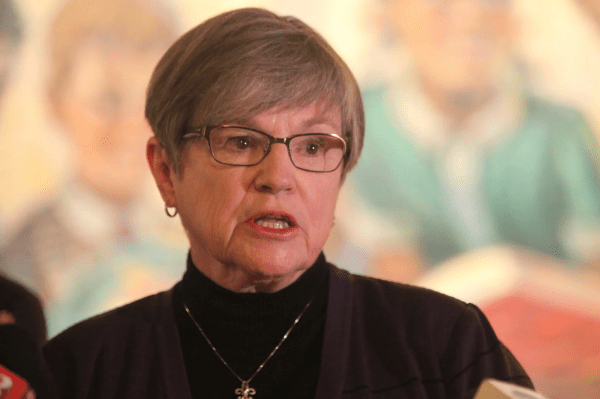
The Kansas bill had broad Republican support, but its status had been uncertain because of the opposition of Gov. Laura Kelly, who said it was “disappointing that the Legislature continues to push for government interference in Kansans’ private medical decisions.” Ms. Kelly vetoed similar bills in each of the last two years, and lawmakers had previously failed to override her.

This time, Republicans in both chambers mustered the two-thirds margin necessary to override her and celebrated the decision as following President Trump’s lead on the issue. Kansas had been among the only states where Republicans hold significant legislative power without such a law.

“Today, a supermajority of the Kansas Senate declared that Kansas is no longer a sanctuary state” for those procedures, Senator Ty Masterson, the chamber’s president, said in a statement.

Republican supporters of the measure, which bans hormone treatments, puberty blockers and transition surgeries for transgender patients younger than 18, described it as guarding young people from life-altering choices that they could later regret. Under the new law, doctors who provide those treatments to minors could lose their licenses and be sued by patients or their parents.

The shift in Kansas comes as President Trump and his administration crack down on gender transitions for minors nationally, seeking to end funding for hospitals that provide those treatments. The Trump administration has also moved to ban trans women and girls from competing in women’s sports, to bar trans people from serving openly in the military, to house trans women who are federal prisoners with men, and to no longer reflect the gender identities of trans people on passports.

Democrats and L.G.B.T.Q. advocates called the Kansas legislation an invasion of privacy that would have devastating health consequences. In her veto message, Ms. Kelly said “infringing on parental rights is not appropriate, nor is it a Kansas value,” and warned that enacting the measure could have economic consequences.

“This legislation will also drive families, businesses, and health care workers out of our state, stifling our economy and exacerbating our workforce shortage issue,” the governor wrote.

The new law comes as part of a broader push by Republicans in Kansas, a state that Mr. Trump carried last year by 16 percentage points, to place limits on transgender people. Kansas stopped changing birth certificates to reflect gender identity in 2023 after lawmakers overrode another veto by Ms. Kelly and passed a law defining male and female as a person’s sex at birth.

But as Republicans across the country have moved in recent years to restrict transition treatments for minors, Kansas had remained an outlier on the Great Plains. Bans or severe limits are already in place in three of its four bordering states — Colorado is the exception — and across much of the rest of the Midwest.

Bans elsewhere have been challenged in state and federal courts with a range of preliminary outcomes. Many expect the U.S. Supreme Court to ultimately decide whether there is a national right to access such treatments.

Trans youth care ban vetoed by Kansas governor again

*This was published by ABC News.

Kansas Gov. Laura Kelly has vetoed Senate Bill 63, which would have restricted gender-affirming care for transgender youth.

“Right now, the legislature should be focused on ways to help Kansans cope with rising prices,” Kelly said in a statement emailed late Tuesday. “That is the most important issue for Kansans. That is where my focus is.”

The bill would bar health care providers from administering gender-affirming medical care – including puberty suppressants and hormone therapies – for someone under the age of 18, only for the purposes of gender transitioning. The ban would also apply to gender-affirming surgeries.

“Infringing on parental rights is not appropriate, nor is it a Kansas value,” said Kelly in her veto message. “As I’ve said before, it is not the job of politicians to stand between a parent and a child who needs medical care of any kind. This legislation will also drive families, businesses, and health care workers out of our state, stifling our economy and exacerbating our workforce shortage issue.”

This is the third time Kelly has vetoed similar transgender youth care bills, but the bill may now have the support to pass.

The bill passed the state legislature with flying colors – passing the House 83-35 and the Senate 32-8.

In 2023, the attempt to override a past trans care ban veto lost in the House 82-43.

State Republicans quickly denounced Kelly’s veto.

“The governor’s devotion to extreme left-wing ideology knows no bounds, vetoing a bipartisan bill that prevents the mutilation of minors,” said State Sen. Ty Masterson in an online statement. “The Senate stands firmly on the side of protecting Kansas children and will swiftly override her veto before the ink from her pen is dry.”

Top national medical associations such as the American Medical Association, American Academy of Child and Adolescent Psychiatry, and American Academy of Pediatrics and more than 20 others argue that gender-affirming care is safe, effective, beneficial, and medically necessary for transgender populations.

Kelly joins governors past and present in Ohio and Arkansas in vetoing bills that targeted gender-affirming youth care. However, both of their vetoes were overridden.

Across the country, trans youth care restrictions have faced legal hurdles in their enforcement.

The battle and debate has most recently made its way to the national stage, with the Supreme Court considering U.S. v. Skrmetti, which will decide if Tennessee’s law banning some gender-affirming care for transgender minors violates the Equal Protection Clause of the U.S. Constitution.

The State Department is blocking new passports for trans Americans

*This was originally published on 19thNews.org

The State Department is no longer issuing U.S. passports with “X” gender markers and has suspended processing all applications from Americans seeking to update their passports with a new gender marker. This suspension, made in response to President Donald Trump’s executive order signaling his administration’s opposition to gender diversity, affects all transgender and nonbinary Americans, including those currently traveling or overseas. 

The agency says that it will issue guidance on previously issued passports with an “X” marker and that more information will be available on its travel website. However, no formal policy has been released, which is fueling confusion among trans and nonbinary people trying to update their documents. 

That includes Ash Lazarus Orr, a trans activist living in West Virginia. Orr applied to update their name and gender marker on their passport on January 16 — days before Trump was sworn into office. He paid $300 for expedited service, but his paperwork wasn’t processed until January 22. When Orr called the agency’s hotline for Americans waiting on passports who have upcoming international travel, they were told that the agency had no guidance to offer and that their documents had been “set aside.” 

Now Orr is without his passport, without his birth certificate and without his marriage license. Over the phone, he was told that his documents are being held in San Francisco, where they were originally being processed. 

“They have my documentation that is very personal to me, and they cannot tell me if I’m going to be getting that back,” they said. 

The American Civil Liberties Union has warned trans and nonbinary Americans that if they submit a new application to change the gender marker on their passport, they risk losing access to their passport and supporting documents while their application is being processed. An ACLU spokesperson attributed this information to reports of discrimination received through the organization’s online intake form, as well as direct conversations with people who have described this happening to them. 

Trump’s executive order directed federal agencies to require that government-issued identification documents, including passports and visas, reflect sex assigned at birth. Since this order states that it is the policy of the United States to recognize two sexes, male and female, and that these sexes are not changeable, “the department’s issuance of U.S. passports will reflect the individual’s biological sex,” an agency spokesperson said in an emailed statement on Friday evening. Under Trump’s executive order, “sex” explicitly excludes gender identity.

Secretary of State Marco Rubio reportedly instructed agency staff on Thursday to implement that executive order as it pertains to passports immediately, as first reported by The Guardian and The Intercept. Now, Orr is without his personal identity documents six weeks before pre-planned international travel and in the middle of planning a move out of West Virginia. 

The Biden administration made it easier for trans and nonbinary people to update their federal identity documents. Accurate and consistent gender markers on identity documents dramatically reduces the risk that trans people will face violence, harassment and discrimination, according to the Movement Advancement Project, which tracks LGBTQ+ policy.

The dismantling of this policy has radical consequences, said a former State Department official who spoke on condition of anonymity due to fear of lingering retaliation from the agency under the Trump administration. Not only does it force transgender people to carry identity documents that don’t accurately reflect their identity, this move also signals globally that U.S. policy on trans rights is moving backward, they said. 

“The confusion that this decision creates is intentional. It is designed to make things harder for trans and nonbinary people,” they said.

When The 19th called the National Passport Information Center on January 23 to ask for more information, an employee on the technical support desk said that the State Department is aware of Trump’s executive order and that guidance will be posted online once information is available. 

Erin Ryan Heyneman, a nonbinary person living in Massachusetts, called that same hotline. They don’t need to renew their passport; they said they just wanted to find out what was going on. Although they feel safe in their state, which has nondiscrimination protections in place for LGBTQ+ people, they still felt the need to act because of the way confusion can endanger their wider community.

“People just really don’t know who to believe or what to believe,” they said. More LGBTQ+ people need to seek information from trusted sources, they said. But when trying to seek that information from an official source, Heyneman was met with more uncertainty. The employee on the phone was sympathetic, but they had no information about passports being confiscated. 

As Orr waits to learn whether they will get their passport back due to federal anti-trans policies, they are facing down the prospect of leaving their home because of transphobia within the state. 

West Virginia has become increasingly hostile to trans and nonbinary people like himself amid a surge in anti-trans rhetoric across the country, and Orr expects a surge in state anti-trans bills introduced in West Virginia’s next legislative session. After receiving death threats and recently being attacked inside a men’s bathroom, he doesn’t leave the house without his spouse. 

“I can’t stay in the state. And it’s heartbreaking, because I love it here. I love the people, but it is truly, at this point in time, it’s either I leave or I die,” they said.

Blog at WordPress.com.

Up ↑