The State Department announced on Monday a new policy that will ban trans employees from using the restroom that matches their gender identity.
Right-wing news site, The Daily Signal, reports that they obtained a memo from the State Department titled “Updates Regarding Biological Sex and Intimate Spaces, Including Restrooms.” The memo says, “ACTION: Post must abide by the President’s directive in E.O. 14168, ensuring intimate spaces are designated by biological sex.”
The memo is designed to update the State Department’s policies in line with Donald Trump’s January 2024 anti-trans executive order, which declared that there were only “two sexes” and that they were immutable. While not a legal action in its own right, an executive order instructs the federal government on how Trump would like laws to be implemented.
Several federal agencies had already implemented an anti-trans bathroom ban, but the State Department had not previously made its own policy.
In July of 2025, the acting director of the Office of Personnel Management (OPM) sent out a memo instructing all federal agencies to bring themselves in line with the executive order, with the stated goal of “Ending Gender Ideology in the Federal Workplace and Protecting Women.”
That order included a note that all agencies should have “ensured that intimate spaces (such as bathrooms, locker rooms, and lactation rooms) at Federal worksites designated for women, girls, or females (or for men, boys, or males) are designated by biological sex and not gender identity.”
The State Department’s delay in implementing a bathroom ban likely doesn’t stem from Secretary of State Marco Rubio having empathy for the trans community, but rather from a case before the Equal Employment Opportunity Commission (EEOC).
Last summer, a transgender person filed a complaint with the EEOC after being denied access to the appropriate restrooms and “intimate spaces.” A decision was reached by the commission in February, which upheld that “Title VII permits a federal agency employer to maintain single-sex bathrooms and similar intimate spaces,” and “permits a federal agency employer to exclude employees, including trans-identifying employees, from opposite-sex facilities.”
Title VII is the federal law that bans job discrimination on the basis of sex. In 2020, the Supreme Court ruled in Bostock v. Clayton Co. that Title VII’s ban on sex-based discrimination also bans anti-LGBTQ+ discrimination, since it’s impossible to discriminate against trans or queer people without taking their sex assigned at birth into account.
The guidance goes against previous recommendations from OSHA, which stated: “The core belief underlying these policies is that all employees should be permitted to use the facilities that correspond with their gender identity. For example, a person who identifies as a man should be permitted to use men’s restrooms, and a person who identifies as a woman should be permitted to use women’s restrooms.”
Those guidelines were removed from the Department of Labor’s website at some point between January 15, 2025, and February 1, 2025.
“Banning transgender people from using facilities in alignment with their gender identity deprives them of the ability to participate in public life,” Advocates for Trans Equality’s website notes. “Without the ability to use a public restroom, trans people are less able to live their lives and travel outside their home. Trans employees need to be able to use the restroom at work to keep their jobs without risking their health and safety.”
“Transgender people cannot safely use the bathroom of the gender they were assigned at birth just because the law requires them to. Trans people are routinely subjected to harassment and assault in bathrooms. Sixty-eight percent of trans people have been verbally harassed, and 9% have been physically assaulted when using a public restroom in the past 12 months. And sadly, 8% of trans people have faced a kidney or urinary tract infection from having to avoid restrooms for their safety.”
Colorado Governor Jared Polis (D) has signed a law to protect trans children by sealing name changes for those who are under 18 when they file for one. The legislation will protect trans children
“Passing this bill is simple, but its impact is profound,” Colorado state Senator Katie Wallace (D), a sponsor of the bill, said in February. “It gives children the safety and dignity they deserve, and it treats their private life with the same care we afford in other sensitive cases.”
Colorado’s Senate Bill 18, “Legal Protections for Dignity of Minors,” simply makes it so that starting July 1, when anyone who is under 18 years old petitions for a name change, the court is required to suppress the record. That means the petition will not be part of the public record and cannot be collected through searches or data harvesting.
The only exception to the process is if the petitioner was previously convicted of a felony.
While the court will keep a record for administrative purposes, it cannot publish the petitioners’ names or their deadnames. The record can only be accessed by the petitioner or by someone who has obtained the petitioner’s verbal consent and submitted an affidavit to that effect.
The bill will easily benefit anyone who might want to change their name as a child, whether to have a name they feel more connected to or to distance themselves from a family name. While the language of the bill itself does not mention trans people, it will have a huge impact for trans kids, which has always been the mission of the legislation.
At a senate committee hearing in February, Z Williams, co-director of Bread and Roses Legal Center, spoke of how a parent thought someone in their child’s class might be trans and was able to search for their name change document online and out the second grader to the school, Colorado Newslinereported.
Williams said the parent “exposed that child is transgender in second grade to the entire school community through flyers and through her own children, not only practicing hate herself, but teaching others how to. That is why we asked the senators and representatives to run this bill.”
At the same hearing, Elsie Fierro, the political and policy director at LGBTQ+ advocacy organization One Colorado, shared the story of a Colorado family who had petitioned for a name change on behalf of their trans child. But when they searched the new name online, a search engine returned results that included the child’s deadname along with identifying information that had been scraped from public court documents. “That family spent months trying to remove it and protect their minor child in an increasingly hostile political climate. This is the reality some families are navigating,” Fierro told the committee.
In the face of Republican opposition, state Sen. Wallace said, “This bill will protect children from AI data-scraping of those public records, the potential of bullying if they should be found and from hostile individuals in the wider world.”
The bill was originally intended to do even more good, but had a section stripped from it in February. It originally sought to instruct family court judges to consider acceptance of a child’s gender identity when determining custody cases. Several studies, including one by The Trevor Project, have linked trans children being connected to accepting adults to lower risk for depression and suicide attempts.
The custody clauses had originally been included in an earlier bill, HB 1312, which passed last year and introduced legal protections for trans people against deadnaming, misgendering, and more. However, they were removed before it passed after LGBTQ+ groups raised concerns that the language could erode existing protections.
For SB 18, the clauses had been reworked, but Polis threatened to veto the bill unless the clauses were removed, claiming to have received word of similar concerns once again. However, state Sen. Wallace and Williams both suggested that Polis’ view of the provisions being “substantially the same” was incorrect and that they had been amended to assuage concerns.
Colorado Republicans have opposed this bill and other pro-trans legislation, pushing anti-trans bills in their place. However, Democrats currently hold a supermajority in the state and have been defending trans rights with new protections.
“We decided to call her ‘Amada’ because she came into our home to be cherished,” said Lorena Bonilla, whose transgender daughter was recently authorized to change her identity documents under a ruling by Ecuador’s Constitutional Court.
Her case — alongside another decided in March — has opened the door for Ecuadorian adolescents seeking to modify their name and sex in official records. Adults gained that right after years of advocacy efforts culminating in a 2024 reform.
“In Ecuador there are still political, religious and social sectors that portray gender recognition for adolescents as a threat,” said Cristian González Cabrera, an LGBTQ+ rights researcher at Human Rights Watch. “That climate can translate into institutional hostility, delays and unjustified denials.”
Bonilla and her daughter, 17, experienced that firsthand in 2018. Their legal battle began when Amada was 9 and school authorities refused to admit her because her legal documents did not match her gender identity.
“We went through 14 schools and none would take her in,” Bonilla said. “We then knew we needed to change her name.”
A court initially granted Amada the right to modify her identity documents. But the civil registry appealed the decision and a higher court later ruled that her passport and ID card should reflect her birth name and sex.
“It was a step backward for our rights,” Bonilla said.
LGBTQ+ rights in Ecuador have largely been shaped by court rulings rather than by lawmakers or government officials. A similar dynamic has unfolded in other Andean countries such as Colombia and Peru.
“The legislative and executive branches represent the country’s broad majorities, yet LGBTQ people are often overlooked,” said Christian Paula, president of the Pakta Foundation, which provides legal support in cases like Amada’s. “Turning to the courts reflects a lack of openness and sensitivity within our institutions.”
Among Ecuador’s most important advances in LGBTQ+ rights, three have come through the courts. They include the decriminalization of homosexuality in 1997, a 2009 ruling that allowed an Ecuadorian transgender woman to change her name, and the legalization of same-sex marriage in 2019.
Those court decisions sparked a backlash from right-wing and religious groups.
In a post on X following the Constitutional Court’s 2026 rulings, André Santos, president of one of Ecuador’s most vocal conservative groups, said the court had overstepped its authority. He has also spoken against school protocols allowing students to use uniforms and bathrooms that align with their gender identity.
The country’s Catholic bishops conference also expressed concern over the court’s action. “Allowing adolescents to make decisions of this nature poses serious risks to their overall development,” it said.
President Daniel Noboa has not been as outspoken against transgender causes as some other conservative leaders in Latin America, but his administration has shown little support for LGBTQ+ rights.
As a candidate, he pledged to defend the traditional family. Since taking office, violence and economic instability have overshadowed gender and diversity issues in his political agenda.
“What worries us are his ministers,” said Diane Rodríguez, a lawyer and president of Ecuadorian LGBTQ+ organization Silueta X.
Rodríguez, a trans woman, pointed to officials in the Education Ministry, including current minister Gilda Alcívar, who has rejected the inclusion of what she calls “gender ideology” in education. That climate, Rodríguez said, is reflected in her daily interactions.
From Guayaquil, where she raises a 4-year-old daughter with her partner, a trans man, Rodríguez has faced difficulties at her child’s school.
“We had trouble enrolling her because people see me and assume I’m going to turn children transgender because of how I look,” Rodríguez said.
Throughout her career, she has provided legal support for people facing sex-based discrimination and backed a program providing hormone treatment for trans people. Her work has also focused on raising awareness about violence against her community.
Silueta X publishes an annual record of killings of LGBTQ+ people. Its first report in 2013 documented two killings and the numbers have risen every year. The 2025 publication reported 30 deaths, 21 of them trans women.
Amada told her parents that she was a girl at age 3. She asked for a princess-themed birthday party. But Bonilla and her husband — both raised Catholic — assumed she was confused and dressed her as a prince instead.
It took them a few years to understand their daughter and dismiss psychologists who said something was wrong with her or that they had done a poor parenting job.
“Comments can be ruthless and people have no idea what families like ours go through,” said Mauricio Caviedes, Amada’s father. “I hope education on this issue changes so people can understand.”
As they learned more about the trans community, their fight to modify Amada’s identity documents evolved into a broader cause. Bonilla and Caviedes became activists, bringing their kids with them to protests and conferences. They supported other LGBTQ+ causes such as same-sex marriage and founded an organization for families of trans children like their own.
“That became the only way we could fight the state,” Bonilla said. “We were 25 families with transgender children of different ages, the oldest being 12.”
Her family moved to Canada during the COVID-19 pandemic. And while she treasures how welcoming their new home has been for her daughter, she keeps advocating for LGBTQ+ rights in Ecuador.
Amada, now a strong student who dreams of becoming a nurse, was shaped by years of watching her parents support trans friends and community members struggling to access health care without discrimination. She has never appeared publicly on camera, but the visibility of her case feels like a lifelong legacy for Bonilla.
“People think the destiny of transgender people is to become sex workers or live in hiding,” Bonilla said. “But we want every parent to know that one day their child can become whatever they want to be.”
The parents of a young trans woman in Idaho say that they’re leaving their state after it passed a law to criminalize trans people who use the restroom.
“Obviously, this law is a disaster for families like ours,” Michael Devitt, the father of 20-year-old Eve, wrote in a letter notifying his patients that his physical therapy practice would be shutting down. “We can no longer take a road trip across our beloved state, or even enjoy a family night out at a restaurant, or a movie, without running the risk of Eve being charged and sent to a prison merely for using the facilities.”
The law he’s referring to is H.B. 752, which Gov. Brad Little (R) signed into law on March 31, the Trans Day of Visibility. The hostile law makes it a criminal offense for trans people to use the restroom that aligns with their gender identity, even in private businesses. Multiple offenses could get a trans person life in prison.
While several states have passed bathroom bills, Idaho is one of only four states – along with Florida, Kansas, and Utah – to introduce criminal penalties for using the restroom.
Eve Devitt, who is attending college in New York, testified against a different transphobic bill several years ago.
“Since I started estrogen almost three whole years ago, my mental health has gotten significantly better,” she told the Idaho House Judiciary, Rules, and Administration committee in 2023. “I’ve been able to get myself off of a cliff that I wasn’t sure if I would ever find myself off of. I feel so much better and more complete with myself.”
But today the Devitts say they’ve had enough, comparing their state to an abusive partner.
“We say ‘We’re in an abusive relationship with the state of Idaho’ — all people with transgender relatives, or all transgender people. And you always think, ‘Oh, they’ll stop hitting me.’ But they’re not gonna,” Michael Devitt told the Idaho Capital-Sun. He said that H.B. 752’s penalties for multiple offenses are more than the prison sentence someone in the state could get for manslaughter.
“I mean, there are all kinds of things you can do in Idaho that will get you prison time that are less than the second offense for using the bathroom that aligns with your gender identity.”
He said that even though his daughter is in New York at the moment, he worries about how she’ll be treated when she comes home to Boise. For example, he’s worried she’ll be forced to undergo a physical exam in public.
“Every single day when I’m out in public, I have to decide: Do I feel like going to jail today, or do I feel like being attacked?” said Nikson Mathews, a trans man and the chair of the Idaho Democratic Queer Caucus, about the new law.
Eve’s mother, Dr. Angie Devitt, said that she would continue to see patients in Idaho even after the family moves to another state.
H.B. 752 is one of three anti-LGBTQ+ laws passed in Idaho this year. H.B. 561, which was also signed on the Trans Day of Visibility, bans local governments from flying Pride flags. The state passed a similar ban last year that had an exemption for official city flags, so the city of Boise made the Pride flag one of its official flags. The GOP-controlled legislature responded this year by passing another flag ban that said flags had to be officially adopted before 2023 to count, just to keep Boise from flying the Pride flag.
And last Friday, Gov. Little signed the “Pediatric Secretive Transitions Parental Rights Act,” which requires doctors and teachers to report gender non-conforming kids to their parents without investigating whether those children will face abuse if outed.
The Idaho Capital-Sun reports that a fourth anti-LGBTQ+ bill could still be passed by the legislature. House Bill 557, which would ban local governments from enacting LGBTQ+ anti-discrimination protections, passed the Idaho House of Representatives but has stalled in the state Senate. Twelve local governments have passed ordinances that would be repealed by this bill if it passes.
Idaho Gov. Brad Little (R) signed a severe anti-trans bill into law last Friday that will require child care providers, health care providers, and educational institutions to out trans kids to their parents if they express any desire to act in a way perceived as discordant with their sex assigned at birth.
The Pediatric Secretive Transitions Parental Rights Act, which will take effect in July, bans folks who care for minors “from facilitating a pediatric sex transition or social transition without informing and obtaining informed consent from a minor child’s parents or guardians.”
The bill aims to close a “loophole” in the state’s anti-trans laws, as cosponsor state Sen. Ben Toews (R) reportedly put it during the state Senate’s debate on the legislation. That loophole, Toews said, is the fact that the state’s gender-affirming care ban does not cover social transitions, which he referred to as “the process by which vulnerable children are led into the pipeline.”
The legislation defines social transition as “the process by which an individual goes from identifying with and living as a gender that corresponds to the individual’s sex to identifying with and living as a gender different from the individual’s sex and may involve social, legal, or physical changes, including adopting a name, pronouns, appearance, or dress that does not correspond to the individual’s sex.”
The covered entities, then, must notify a student’s parents within 72 hours if they request to be referred to using new pronouns or a different name than their legal name; if they ask to use facilities like bathrooms and locker rooms that don’t correspond with their sex assigned at birth; or if they ask to join a sports team that does not align with their birth sex.
Not doing so, the bill says, means “aiding and abetting” a child’s transition before parental consent is obtained. Parents will also be allowed to sue entities for violating the bill, and the attorney general will be authorized to seek civil penalties of up to $100,000.
Democrats argued against the bill for its vague language and the possibility that it would put children with unaccepting families in unsafe situations.
“When we write these bills, we write these statutes, we’re writing them for all families,” argued state Sen. James Ruchti (D), according to the Idaho Statesman. “And so when nurses, when doctors, when educators, tell us we need a little room to be able to handle these situations carefully… and being required to report this within 72 hours takes that out of our hands, and it means that we have to possibly go to a family… and tell them something that that family may not be in a great place to hear.”
State Sen. Melissa Wintrow (D) called the bill “one more that’s just overcontrolling overreach and just goes far beyond what’s necessary.”
“Life isn’t that black and white,” she said.
A lone Republican, state Sen. Jim Guthrie, spoke out against the bill, saying it will “force our teachers to be tattletales” and “put additional stress on teachers that are already stressed… already overworked, and more and more they have to deal with laws like this that are going to force them within 72 hours to make a judgment.”
After the legislature passed the bill, ACLU of Idaho spokesperson Rebecca De León called it an “example of unconstitutional, big government overreach into our private lives.”
“HB 822 threatens to undermine bedrock free speech protections for students, teachers, and health care professionals and is clearly unconstitutional,” she said. “Politicians who stand for small government and personal liberties should not regulate how people dress or express themselves.”
Jane Migliara Brigham, a writer for trans news publication The Needle, slammed the bill for turning doctors, teachers, and the like into “a kind of gender secret police.”
“The language is written such that there is no clear limit on what does not constitute social transition,” Brigham explained. “As a result, whether or not some behavior which is not listed here actually constitutes social transition will be in the eye of the beholder, or more accurately, in the eye of whoever is reporting the behavior to the child’s parents. This ambiguity leaves room for personal judgment, especially where that judgment is informed by anti-trans bigotry.”
Brigham questioned whether a boy wearing pink could count as evidence of a social transition and whether the legislation does not make clear where such an act would fall.
“Most casual observers cannot reliably tell the difference between a child who is trans, gay, gender non-conforming, or one who is simply socially awkward. As a result, what does and does not get reported to parents will, in all likelihood, be determined by bigotry and stereotypes, rather than any clear guidelines.”
At the end of March, Little also signed the nation’s most extreme bathroom ban. The law is the fourth in the U.S. to criminalize trans people’s use of bathrooms and other sex segregated spaces that don’t match the sex they were assigned at birth — similar laws have been enacted in Florida, Kansas, and Utah.
Guthrie was again the lone Republican against the bill. “If [a trans woman goes] in the bathroom of their biological sex, they’re going to upset a lot of people and freak people out,” he told the Associated Press. “If they go in the bathroom that is consistent with their looks — they are knowingly and willingly going into the bathroom — that is breaking the law.”
“They’re human beings,” he said, “just like us, and what are they supposed to do?”
Under a recently elected conservative government, opposition lawmakers are saying Portugal is backsliding on LGBTQ+ rights with a set of three new measures that erase several advances under the country’s previous Socialist governments.
On Friday, Parliament took a step toward approving the repeal of a 2018 law that enshrines a right to gender self-determination and the protection of individual sex characteristics. It was one of the most far-reaching laws of its kind when it was introduced in its original form in 2011.
Three bills to amend the law were advanced by a far-right conservative coalition that now holds a controlling majority in Portugal’s Parliament.
Among other provisions, the repeal of the original law would reinstate a requirement for “medical validation” for anyone changing their name and gender in the country’s civil registry, Euronews reports.
Those changes are currently possible for any citizen without a medical certificate. 16- to 18-year-olds only need parental authorization and a report from a health professional attesting to their “capacity for decision-making and informed will.” The amended law would again require the approval of a “certified” medical board.
According to language in the new proposal, a report that “proves the diagnosis of gender incongruence” must be prepared by a specialized multidisciplinary clinical team in a public or private health establishment and must be signed by at least one specialist physician and one specialist psychologist.
Portugal’s government has seen a tilt toward the right over the last several years. In 2024, a center-right coalition called the Democratic Alliance won a plurality of seats in legislative elections, ending eight years of Socialist rule. Prime Minister Luís Montenegro won a renewed mandate in a snap election on May 18, 2025, again forming a minority government. In the meantime, the far-right nationalist, anti-immigrant Chega party has become the main opposition party in the 230-seat Parliament.
A proposal from that party also revokes the current legislation but introduces new articles for the “protection of children and young people,” including a ban on the inclusion of “gender ideology” in education curricula for minors. “Education in this field is reserved exclusively for parents or legal guardians,” the proposal reads.
Another far-right party coalition introduced a measure that “protects the integrity of children” by banning puberty blockers and/or hormone therapy in the treatment of gender dysphoria for trans youth.
“A man is a man, and a woman is a woman,” declared Madalena Cordeiro, a Chega member of Parliament. “The differences between them are clear and evident. It’s 9th-grade science. Now, all it takes is one consultation for a child to be diagnosed with gender dysphoria in five minutes.”
“It’s not care, it’s not medicine, it’s not science,” he claimed.
On the left, Livre party member Filipa Pinto questioned right-wing members over their previous opposition to marriage equality. Would they feel “comfortable about once again being on the wrong side of history, as they were when same-sex marriage was approved?” she asked.
“What wrong have trans and intersex people done to deserve being denied their existence?”
“There is no single reason for these changes, other than ideological obsession,” said another Livre member, Paulo Muacho, who asserted that trans people don’t need to be diagnosed by anyone, because being trans isn’t an illness.
“They don’t need doctors to tell them,” he said.
Socialist Party deputy Isabel Moreira lamented the turn in the tide away from democratic freedoms with the ascension of Chega and their allies.
“Fifteen years after the 2011 law” was passed, she said, “three parties in this house claim that transgender people should not have the autonomy to express their identity.”
“Democracy is being destroyed,” she said. “The playbook is well-known, and it comes from the far-right.”
Iceland, birthplace of the literary tradition of the saga, is a nation of just 390,000 people. It is renowned for its progressive values: peace, wellbeing and human rights. At present, however, this small island is home to a monumental division.
After a chequered history with lesbian and gay rights, things looked positive when the country legalised same-sex marriage in 2010. But having achieved its aims, the gay rights movement turned to genderism. And this is now having serious consequences for anyone who refuses to believe that it is safe (or indeed possible) to change sex.
I arrive in the capital city of Reykjavik on a freezing February morning, and meet with Eldur Smári Kristinsson at the end of an hour’s drive through lava fields. As the international liaison for LGB Alliance Iceland – a group of about 10 women and men keen to prioritise same-sex rights over gender identity – he is keen to discuss the ideological capture of the nation he refers to as “Gender Gilead” [a reference to the dystopian regime in Margaret Atwood’s novel The Handmaid’s Tale].
Kristinsson is tall, smartly turned out, and would not look out of place in a university lecture theatre. Proudly gay, he travels far and wide, speaking at conferences on the harms of transitioning gender-nonconforming children. “Who knows if these kids would end up being lesbian or gay? But even if they don’t, we should allow children to play with the toys they wish to, and not tie them to sex stereotypes,” he says.
He is currently under police investigation for alleged hate speech in three posts on X, one of which criticises men taking the medication domperidone to induce lactation and “breastfeed” infants. “I am facing two years in prison,” he tells me, “for speaking out about child safeguarding.” It was the LGBT organisation Samtökin ’78 (originally the Lesbian and Gay Association of Iceland) that reported him to police.
My mission is to establish whether Iceland has, as Kristinsson claims, signed up to the most extreme version of transgender ideology on the planet, and whether or not it could come to pass in Britain, bearing in mind the level of pushback from feminists here, which resulted in the Supreme Court ruling in April 2025 that references to “sex”, “man” and “woman” refer to biological sex only.
At my hotel in central Reykjavik, I meet a number of Kristinsson’s allies – all of whom have encountered hostility and social exclusion for speaking out. Anna*, a 40-year-old lesbian who teaches at a primary school in northern Iceland, tells me: “Iceland is, without a doubt, the most captured country in terms of trans madness.”
Like Kristinsson, Anna is a member of LGB Alliance Iceland. As things stand, she says, schools tell young children they can change sex, which confuses and distresses them.
The 2010 marriage equality law plunged the Lesbian and Gay Association of Iceland into an existential crisis which culminated with its rebranding – as the National Queer Organisation of Iceland (Samtökin ’78) – and expanded its agenda to include the “trans child”.
A further controversial decision came in 2015, when Samtökin ’78 classified BDSM (bondage, discipline and sadomasochism) as a sexual orientation. It also partnered with Reykjavik city council to produce sex education posters for schools which promoted both BDSM and multiple-partner relationships to children as young as five.
Four years later, following lobbying by Samtökin ’78 and others, the Gender Autonomy Act was introduced, making it possible for anyone over the age of 15 to self-identify as the opposite sex, without requiring medical, psychiatric or judicial approval. This extends to name changes on all legal documents, including birth certificates.
Freyja* is a legal scholar, based in neighbouring Norway, who attempted to meet with Icelandic lawyers to advise on how the law might be halted on the grounds that it flouted international human rights treaties. She says the laws were introduced “almost secretly – there was barely any consultation with the general public, and it appeared to be a stitch-up between Samtökin ’78 and the government”.
Kristinsson tells me that this change in the law led to an exponential surge in numbers of “trans children”, most of whom were young girls from upper-class backgrounds, many of them under the “neurodivergence” umbrella. The statistics bear him out; by 2025, 0.5 per cent of Icelandic children had changed their sex markers with the National Registry – approximately 13 times the per-capita rate of neighbouring Denmark.
As the only country in the World Economic Forum to have eliminated more than 90 per cent of wage and opportunity inequality, Iceland is proud of its record on gender equality. Women now hold 48 per cent of seats in Iceland’s parliament, and comprise 60 per cent of its law students.
Iceland is often classed as the best country in the world in which to be a woman, yet those hard-won rights are being given away in the name of trans inclusion; Icelandic feminists have caved in to bullying and gaslighting.
This former beacon of gender equality has become a totalitarian regime, and the top-down ideological capture is affecting children, institutions and society at large – with chilling implications.
The children’s ombudsman, Salvör Nordal, grants me an interview. When I ask whether she has come across the issue of children wishing to identify as the opposite sex, she tells me that, post-Covid, her office has seen a significant decrease in interest and lobbying relating to gender identity and the trans issue.
Citing a national Icelandic medical survey, she says: “There was a group of children that were one third maybe with autism, one third truly trans, and one third with some other complication or other.
“It has been two or three years since this issue was on my desk,” she adds. Back then, she says, there were parents of three- and four-year-olds who were claiming to have a trans child. “And they had changed their names. So, we were concerned about that.”
Nordal’s comment about survey data showing that some children are “truly trans” leads me to ask whether, in her opinion, trans children exist, in that they are trapped in the wrong body? “It’s not my role to decide,” she says, explaining that her job is to think about children’s rights, rather than to have opinions about medical or psychological issues. “We have other professionals to do that. I focus on what is important for my job. We need to listen to children. This is a very difficult track to take.”
Icelandic law also recognises the sex changes of foreign visitors. In 2025, a trans “refugee” from the United States turned up in Iceland, attempting to claim asylum. “Alexandra” (a “stay-at-home mother”) claimed to be fleeing anti-trans persecution in Minnesota. His claim was not upheld. After Alexandra was told by police to go to the US Embassy in Iceland for help, his appointed spokesman said it was like “deporting Afghan women to the Taliban”.
My earlier trips to Iceland were to speak at conferences on male violence, organised by Stígamót, a well-known women’s organisation. But when I attempted to make contact with old friends in the feminist world, I was either ghosted or subjected to lecturing about “inclusivity” and “trans rights”. Even the hard-line feminists have capitulated – including those previously brave enough to take on pimps and pornographers.
In 2020, lesbian singer-songwriter Iva Marín Adrichem sang in the national final of the Eurovision Song Contest. Born blind, she had been included – as a high-profile Icelander – in an Icelandic tourist board film to encourage more disabled visitors to the country.
“I was cut out of the film because someone made a fuss about my views on gender,” she tells me when we have lunch together in Reykjavik, “ironically, in the name of diversity and inclusion.”
The trans trend spreads from the elite: both the bishop of Iceland and the rector of the Iceland Academy of the Arts have spoken proudly of being mothers to “trans children”.
The head of transgender medicine at Iceland’s state hospital is Asa Radix, a Canadian living in Iceland, who was appointed in 2025. Radix is also the president of WPATH, the World Professional Association for Transgender Health. WPATH was exposed by investigative journalists as a group of trans rights activists whose practice raises significant questions about the nature of gender-affirming care and the evidence base for WPATH’s widely followed guidelines.
Iceland’s reputation in transgender healthcare is seen by other countries with self-ID laws, and those looking to establish them, as a gold standard model. In 2025, Mary Butler, junior health minister for mental health in Ireland, travelled to Iceland to take part in a “knowledge exchange” project organised by the Icelandic ministry for health. The Irish delegation met with gender clinicians and people with “lived experience” of gender medicine. The official purpose of that visit was to inform the development of the new model for gender healthcare in Ireland.
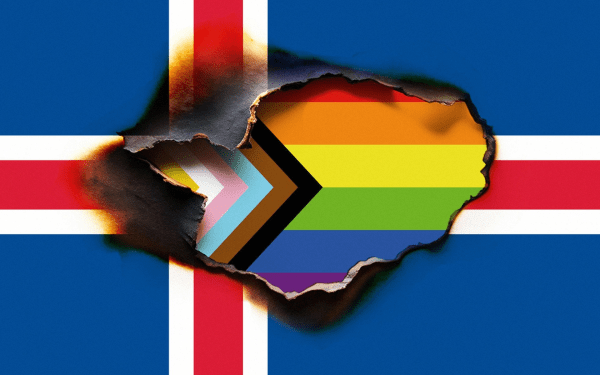
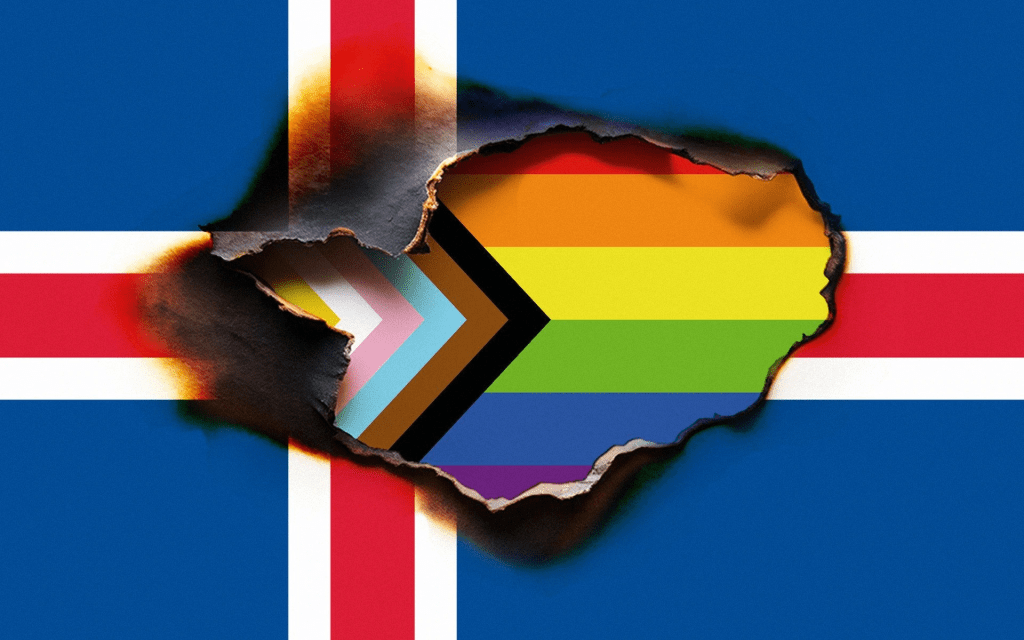
Iceland’s national flag is fast being replaced by the “Progress flag” – on churches, schools, government buildings and police stations. And the fact that rainbows painted on road surfaces are commonplace, even in tiny villages with fewer than 200 residents, signals a quasi-religious reformation: the teachings of postmodernist theorists Michel Foucault and Judith Butler have supplanted those of Jesus Christ.
The headquarters of the bishop of Iceland is in a purpose-built building in Reykjavik’s centre. I cold-call, hoping to catch Gudrún Karls Helgudóttir, who has been outspoken in support of her own trans-identified child and her commitment to the LGBT community. The church once ran an advertisement campaign featuring a trans Jesus Christ, complete with breasts, on Reykjavik’s buses.
Helgudóttir is unavailable, but her secretary, Eva Björk Valdimarsdóttir, invites me into a space generously adorned with pride, progress and trans flags, as well as an ornament of the drag act RuPaul. Valdimarsdóttir is a “big fan” of Drag Race.
When I ask how the Icelandic church became so focused on the inclusion of LGBT people, she explains that both the former bishop and the church had poor reputations as a result of having denied equal marriage rights to lesbians and gay men, and wanted to compensate for this stain on the church’s history. She says that the Bible, if read properly, does not pour scorn on same-sex couples, and that it is not God’s will to deny same-sex people who love each other to marry. “God does not discriminate,” she says.
Next, I ask about child safeguarding – for example, if a trans-identified man were to accompany children on a church trip. As a “trans woman”, would he be assigned to the girls’ sleeping quarters? “Those people are valid and their identities are valid,” she tells me. We go back to the Bible and what Jesus said. “He especially stood with marginalised people.”
I ask her whether God ever makes mistakes, and whether a child can be born in the wrong body. Before answering, she wants to make sure it will be specified that this is only her opinion. “There are not just two sexes, male and female. It is not that simple.”
How does that work, though, for children who want to be medicalised? “They have a long waiting list, then they have their specialists. I don’t think the church needs to decide anything for them.”
At this stage, Valdimarsdóttir asks if she can speak personally, rather than in her role as secretary to the bishop. She says trans women are as trustworthy as “cis” (biological) women, and that some people are “in between” male and female.
I ask, can a baby be born in the “wrong body”? “Should that child not live?” she replies. “And is this child not perfect as they are also in their minds and in their spirit, in what they say they are?”
Reykjavik-based father Alexandre Da Rocha meets me for coffee to talk about the conflict between him and his former partner over their son. When the child came home from school saying he wanted to be a girl, and was affirmed by his mother, Da Rocha made it clear that he disagreed, resulting in the case being referred to the family court by the mother. In November last year, the court decided that the boy’s mother would have sole custody, having previously shared it with the father.
“In the judgment, it was made clear that I am a good father, a good parent, and that there was no question over that. It is, I am certain of it, because I have refused to affirm my son as a girl,” Da Rocha says.
His lawyer, Hilmar Gardars Thorsteinsson, tells me that the problem in such cases, where one parent is in dispute with the other over children who wish to change sex, is halting the process before the prescribing of puberty blockers.
“It is almost always affirmed by teachers, for example, and then they are recommended to get puberty blockers at around 11 or 12,” he says. “I don’t know exactly the number, but I think it’s around 100 kids under 18 undergoing something like this.”
The following morning, I head to Laugardalslaug swimming baths, one of many across the city. Swimming is sacred to Icelandic people and a big part of their culture. The rules are strict: you are not allowed into the water until you have thoroughly showered. There are posters of stick figures on the walls with arrows pointing towards the armpits and genitalia. How will this work with “trans women” using the female showers, I wonder?
After explaining my purpose in visiting Iceland, I have a conversation with a young, muscle-bound man who works there. “Do you have single-sex communal showers?” I ask. “Yes,” he replies, “there are female showers and male showers.”
“But if I said I was a trans man, would I be allowed to go and shower in the men’s shower room?” His female colleague answers: “The communal showers are not single-sex but you can ask for a private cubicle if you wish.”
I seek clarification: “So are there no single-sex facilities at all?” This question is met with bafflement, so I try again. “Do any women ever ask for the mixed facilities?”
“No,” comes the response.
Ina Steinke has travelled a considerable distance across Iceland to meet with me. She got to know Kristinsson and the others speaking out because she hates the idea that the right to free speech is under threat. After our visit to the swimming pool, she appears angry at what she heard.
“There’s not even a warning,” says Steinke.“Being at risk of seeing a naked man in the women’s showers is this new reality. In our culture, it’s not an issue to be naked in front of other women, it’s part of our heritage. Also, sex offences – it’s nothing new to Icelandic people, but now, we can’t complain about the naked man; we can’t point out the sex of the person that rapes you.”
My final stop before leaving Reykjavik is to the mayoral hustings, where Ari Edwald, the candidate for the socially conservative Midflokkurinn (“Centre”) party, is due to give a speech. During the Q&A, I ask what he would do, if elected, to end the inclusion of gender ideology in schools. His is the only party to have spoken out against gender ideology and its effects on children.
School should not be a place of indoctrination, he responds, adding that contested ideas from sociologists and queer theorists in universities should not be taught as fact. If elected, he will do his part to wind this nonsense up.
With the help of lawyers, LGB Alliance Iceland is preparing various legal routes to challenging transgender practices against Icelandic youth. It is also looking at how to reverse so-called “conversion therapy” legislation, which would effectively criminalise any therapist or counsellor that doesn’t affirm a child presenting as transgender.
Da Rocha, the father desperately trying to stop his child from starting on a path towards changing his sex, is appealing the decision of the family court to deny him joint custody of his son. “If he decided to be gay when he grows up, then fine,” he tells me, but to do something he can never reverse would be terrible for him.”
Meanwhile, Kristinsson is keen to find out what is happening with his criminal case, as it has been several months since he was charged with hate crime offences. I accompany him to the main police station in Reykjavik.
Article 233A of the penal code forbids ridicule, slander and hatred towards those with protected characteristics: in this case, trans-identified people. As he awaits his turn at the security screen, he tells me: “I have the legal label of ‘criminal suspect.’”
“We’ve been looking for you,” says a uniformed officer when she finally appears. “You need to come back and be interrogated for another crime, on Friday.”
The American Medical Association (AMA) reaffirmed its support for gender-affirming care and said media outlets that reported a change in its policy (including LGBTQ Nation) misinterpreted a recent statement from the organization.
AMA’s March 2026 newsletter devoted a section to the debacle and explained that it all started in February when Dr. Mehmet Oz, the head of the Centers for Medicare and Medicaid Services, held a meeting for the leaders of the nation’s major medical organizations to discuss why they all endorsed medical interventions for trans teenagers.
Sources told the Times that Dr. Oz’s tone was measured, rather than hostile, but that it was clear he hoped to sway the organizations away from supporting gender-affirming care for young trans people. At the meeting, the American Society of Plastic Surgeons (ASPS) reportedly shocked everyone by announcing it was indeed changing its stance on gender-affirming care.
The ASPS announced the change in its stance publicly on February 3, releasing a statement advising against conducting “gender-related breast/chest, genital, and facial surgery” on people under the age of 19. The ASPS based its statement on two recent reports from the U.K. and the U.S. that were widely criticized by transgender healthcare advocates as being biased.
Surgical interventions, however, are already almost never performed on minors. Trans minors don’t receive bottom surgery, though some teenagers who meet certain rigid requirements get top surgery or facial procedures.
The AMA newsletter explained that once ASPS released its statement, the AMA’s Executive Committee of the Board met to craft a statement to provide to probing media outlets.
“During our Board discussion, we were clear that we were not changing AMA policy,” the newsletter said, emphasizing that the statement was exclusively to be used if media outlets contacted the organization, rather than preemptively.
“While some media coverage characterized this as agreement with the ASPS statement, that phrasing did not come from the AMA,” the newsletter continued. “Unfortunately, how reporters frame their stories is beyond our control.”
The newsletter emphasized that the statement did not reflect a policy change or an endorsement of ASPS’s policy change: “AMA policy on gender-affirming care is unchanged. Our recent response to questions about ASPS’s position statement was intended to preserve—not diminish—access to gender-affirming care, and to clarify and reinforce what our policy has long reflected and standards of care. The AMA supports gender-affirming care as medically necessary per our policy.”
The language in AMA’s initial statement sowed chaos because it does state: “In the absence of clear evidence, the AMA agrees with ASPS that surgical interventions in minors should be generally deferred to adulthood.”
But because gender-affirming surgery is already rare for minors, it seems AMA is trying to say it was merely reaffirming the position it has always held, which is that it supports non-surgical interventions for minors and, in rare cases, surgical ones.
At the time the ASPS walked back support for gender-affirming care, and many at least believed AMA did, too, the American Academy of Pediatrics (AAP) released its own statement emphasizing it still fully endorses gender-affirming care. “The AAP continues to hold to the principle that patients, their families and their physicians — not politicians — should be the ones to make decisions together about what care is best for them,” the statement read, according to the New York Times.
The World Professional Association for Transgender Health (WPATH) also spoke out: “There is no definitive age or one-size-fits-all approach for every patient, which is why they are built on case-by-case assessments, involve experts on adolescent development, and are designed to support thoughtful and ethical shared decision-making in a multidisciplinary field.”
Recent studies have shown that trans youth tend to be consistent in their identities, even after a decade. The findings mirror what has overwhelmingly been found in studies on trans adults, that very few people detransition. A 2024 study found that 97% of trans youth don’t regret transitioning, and another study from the same year showed that fewer than 1% of patients who undergo gender-affirming surgical procedures end up regretting it. In fact, rates of regret are higher for people who get tattoos, elective plastic surgeries, bariatric weight loss surgeries, or have children, the study found.
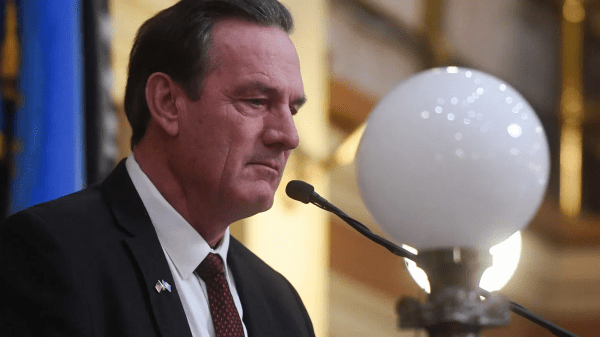
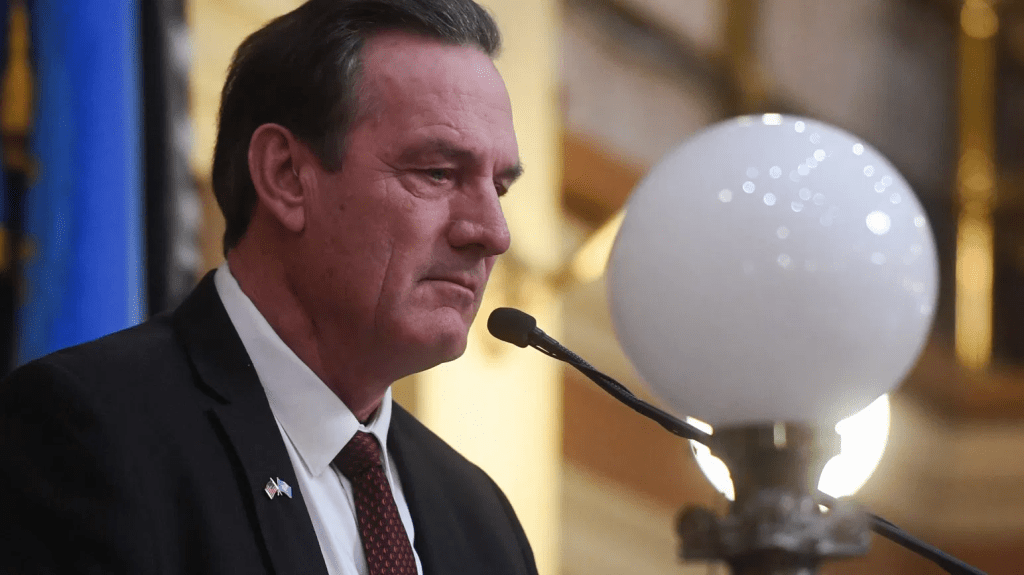
South Dakota Gov. Larry Rhoden (R) signed two anti-trans bills into law on Friday, touting them as “South Dakota values bills.” In a press release announcing the signings, Rhoden proclaimed that “South Dakota has always stood for truth.”
“My Administration will continue to uphold the values that make our state strong, safe, and free,” he added. “These bills reflect our commitment to carry those values forward for future generations.”
The two anti-trans bills – HB 1184 and HB 1161 – respectively ban legal recognition of trans identities and require people in the state to use facilities like bathrooms and locker rooms based exclusively on sex assigned at birth.
Also on Friday, Rhoden signed three bills rolling back reproductive rights in the state. In a statement, he called South Dakota “the most pro-life state in America” with laws that “reflect the fact that an unborn child is a person – and that child is worthy of our protection and respect.”
Artemis T. Douglas of the pro-trans publication The Needle, called the slew of bills a “show of force for reactionary patriarchy’s anti-trans political movement.”
“Anti-trans politics protects social control,” Douglas added, “including men’s position in the gender hierarchy and the status of everyone else as either property or incubator.”
South Dakota has long been a hostile state for LGBTQ+ people. The Movement Advancement Project gave it an overall ranking of -9.5/49 on LGBTQ+ rights, with a -9/26 for trans rights, specifically.
The state bans trans students from playing on sports teams consistent with their gender identity and also bans gender-affirming care for trans youth. It bans changing gender markers on birth certificates and also has no statewide nondiscrimination laws in place for gender identity or sexual orientation.
Trans Kansans are reportedly leaving the US state in droves after thousands had their driving licences forcibly revoked.
The midwestern state revoked more than 1,700 IDs this month after handing letters to thousands of citizens demanding they surrender their driving licences.
It comes after lawmakers passed SB244, a sweeping anti-trans bill banning Kansans from using public toilets and locker rooms consistent with their gender identity. The bill also allows resident to submit bounty-style lawsuits against anyone they spot in facilities who they believe are transgender or non-binary.
Trans people in Kansas could face up to six months in jail if they don’t surrender their IDs. (Getty)
In response, the Kansas Division of Vehicles informed trans residents that their licences were now “invalid immediately” and must be exchanged for new licences documenting their birth sex.
Those who continue to drive without surrendering the licences could face “additional penalties”, including a $1,000 fine or even imprisonment.
Trans Kansan Jaelynn Abegg, who received a letter demanding her licence be revoked, said she plans to move to another state later this month and refuses to surrender her ID.
“I’m pretty heartbroken,” the 41-year-old told NBC News. “It is a continuation of the message that the Legislature has been sending out for years now, and that is that transgender people are not welcome in Kansas.”
Another woman, Andrea Ellis, said that, upon travelling to the DMV to have her licence changed, staff were confused over what to do, eventually giving her a temporary license with no changes.
Matthew Neumann, a Kansas-born trans man, said he refuses to leave the state over the legislation despite being threatened for using public toilets.
“I’m just disappointed and frustrated,” he said. “I’m just hoping that maybe this is the wake up call we need.”
Lawmakers passed the widely criticised bill despite governor Laura Kelly vetoing it in February, which was overturned by the Republican majority.
The Democratic governor said the law was “poorly drafted” and that its provisions were ripe for abuse that would have consequences “far beyond the intent to limit the right for trans people to use the appropriate bathroom”.
“[The law] will undoubtedly impact many others who are targeted with animus whether or not they are transgender. Meanwhile, leaders ignore real challenges facing families,” she continued. “This was sadly politics over people, but we will keep fighting for dignity and freedom for all LGBTQ+ people.”
Multiple cases have emerged across the UK and US over the past year, as anti-trans furore over toilet usage has grown louder, with many involving cisgender and transgender individuals.
In August last year, an 18-year-old cisgender lesbian said she was forced to expose her breasts to a staff member in a Buffalo Wild Wings who began banging on the toilet stall she was occupying and yelling that the “man needs to get out of here”.
Two anonymous trans Kansans sued the state over the bill’s passage last month, arguing that it violates human rights laws on autonomy and personal freedoms.
Douglas County District Judge James McCabria declined to grant a temporary restraining order against the law’s enforcement while the case proceeds earlier this week.
Harper Seldin, an attorney for the American Civil Liberties Union (ACLU) representing the plaintiffs said that Kansas was singling out trans residents “for unique social stigma”.
“They were suddenly required, with no notice or opportunity to be heard, to present themselves to the DMV to obtain driver’s licenses that announced to everyone – the teller at the bank, the clerk at the hotel, the poll worker on election day – that they are transgender,” Seldin said.











You must be logged in to post a comment.