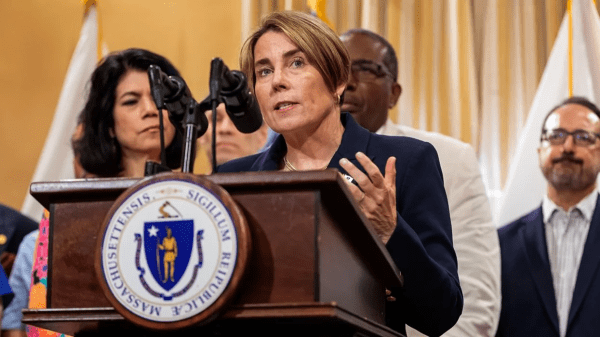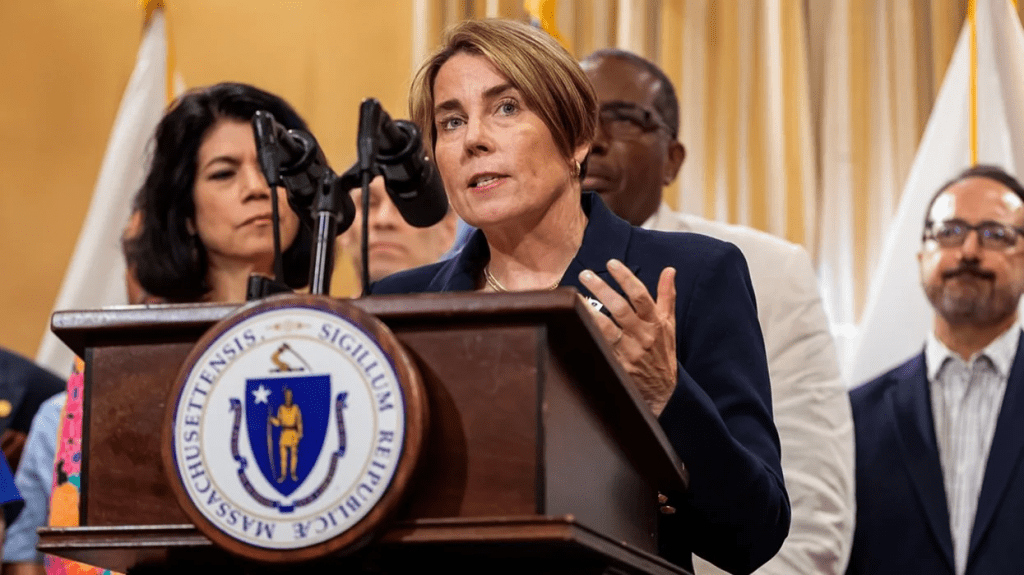
Democratic Gov. Maura Healey, the first out lesbian governor in the U.S., signed the Shield Act 2.0 into law Thursday. The bill further strengthens protections for patients and providers of reproductive healthcare, while explicitly mandating that abortions be performed when deemed medically necessary.
“Massachusetts will always be a state where patients can access high-quality health care and providers are able to do their jobs without government interference,” Healey said in a statement. “From the moment Roe was overturned, we stepped up to pass strong protections for patients and providers, and with President Trump and his allies continuing their assaults on health care, we’re taking those protections to the next level. No one is going to prevent the people of Massachusetts from getting the health care they need.”
The state’s original shield law, enacted by Democratic Gov. Charlie Baker in July, 2022, prohibits states that have banned the life-saving treatment from punishing those who travel to Massachusetts to receive it by preventing the release of information or the arrest and extradition of someone based on another state’s court orders.
The new law further prevents the disclosure of sensitive data, such as a physician’s name, and prohibits local law enforcement from cooperating with other jurisdictions in their investigations. It also directs the Department of Public Health to create an advisory group to help guide businesses as they implement privacy protections for storing or managing electronic medical records.
“Massachusetts is home to the best health care providers in the country, and we aren’t going to let them be intimidated or punished for providing lifesaving care,” said Lieutenant Governor Kim Driscoll. “Together with the Legislature, we are reminding the entire country yet again that Massachusetts is a place where everyone can safely access the health care they need and deserve.”
Healthcare professionals in the United States now have a faster and easier path to work in British Columbia. If you’re a U.S.-trained nurse looking for meaningful work and a stable healthcare system, B.C. just made the move more attractive than ever.
In 2025, the province launched a streamlined credential recognition process, slashing wait times from months to mere days. The result? A massive 127% surge in applications from U.S. nurses. This isn’t just policy on paper, it’s creating real change for health professionals and Canadian patients alike.
If you’ve ever considered working in Canada as a nurse, there has never been a better time.
Why B.C. Is a Top Destination for U.S. Nurses
British Columbia offers more than beautiful landscapes and mild winters. It provides a public healthcare system that values stability, team-based care, and inclusivity, qualities many U.S. nurses now actively seek.
This combination of speed, support, and stability is why over 1,200 healthcare professionals from the U.S., including 413 nurses, have already shown interest.
How the New System Works
Instead of going through multiple layers of red tape, U.S. nurses can now apply directly to the college. B.C.’s healthcare authorities work closely with American regulators to confirm your credentials using shared systems.
This efficient model is designed not only to bring in talent faster but also to ensure quality and safety remain intact. The ultimate goal? More boots on the ground in critical care areas such as cancer treatment, emergency departments, and rural clinics.
Here’s a quick comparison:
Process Step
Old System
New System
Registration Timeline
3–4 months
Few days
Third-party Assessment
Required
Eliminated
Credential Verification
Manual
Automated via database
Support for Applicants
Limited
Full support via Health Match BC
Real Opportunities for Real People
Whether you’re from Washington, Oregon, or California, B.C. wants you. A major recruitment campaign is launching soon in these states, targeting areas where interest is already high.
This isn’t just about filling vacancies. It’s about building a better healthcare system, one that supports team-based care and is culturally aware, inclusive, and patient-first.
Take the new Victoria Primary Care Network Allied Health Centre as an example. Here, nurses, physicians, social workers, and Indigenous wellness providers work side by side to offer complete care. It’s the kind of environment many nurses dream of but struggle to find in the U.S.
Who Is Eligible to Apply?
To qualify for this fast-tracked process, U.S. nurses need:
Proof of nursing education from an accredited U.S. institution
Active nursing license in good standing
No disciplinary action on record
Willingness to live and work in British Columbia
Want to check your eligibility? Book a consultation with RCIC through ImmigCanada and speak with a licensed expert who can guide you every step of the way.
Besides the improved process, many American healthcare professionals are leaving behind the U.S. system for reasons like:
Political uncertainty affecting healthcare rights
Rising health insurance costs
Limited access to team-based care in underfunded facilities
British Columbia offers a safe, stable, and inclusive alternative. Plus, with competitive salaries, government support, and fast registration, it’s not just an option, it’s a smart move.
Ready to Start Your New Life in Canada?
If you’re a qualified nurse in the U.S. and looking for a rewarding career shift, this is your chance. British Columbia is actively welcoming U.S. nurses with open arms and an efficient path to employment.
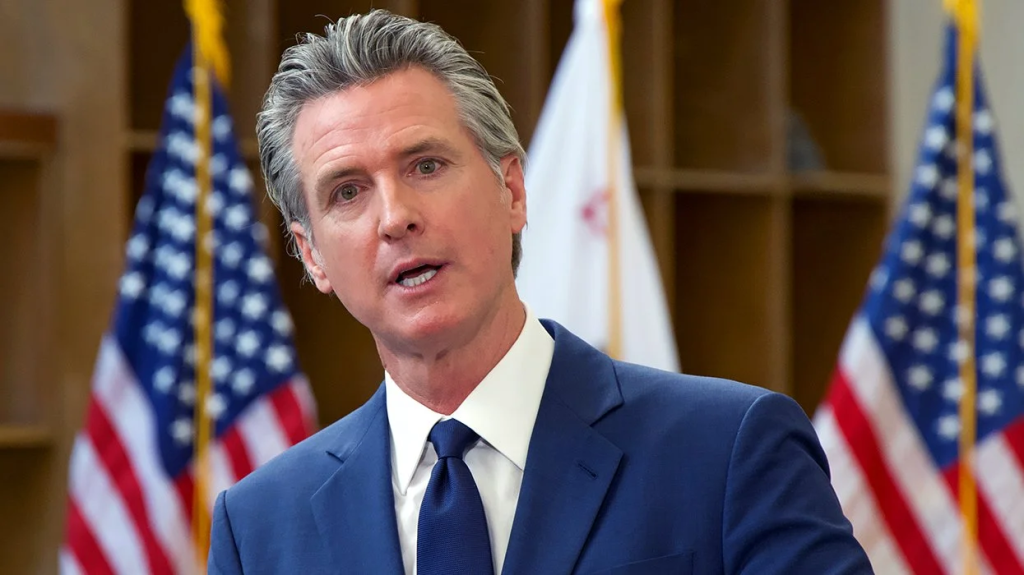
The California legislature is expected to restore $40 million in the state budget for LGBTQ+ health programs that was cut by Democratic Gov. Gavin Newsom.
Lawmakers are set to approve their revisions to the governor’s budget today, according to the Bay Area Reporter, which will restore funding for the California Department of Public Health’s Office of Health Equity (OHE). Newsom had eliminated the funds in his revised budget proposal released last month, drawing heavy condemnation from both lawmakers and LGBTQ+ groups.
The office funds several programs for LGBTQ+ youth, women, and transgender people through its Gender Health Equity Section (GHES), which is “dedicated to eliminating systemic bias that impacts health outcomes based on gender, gender identity, and sexual orientation.” In pausing funds, the governor also paused enrollment for undocumented adults in state healthcare programs.
The Los Angeles LGBT Center, which has been a recipient of some of the funds, including $1.9 million in 2022 for its Audre Lorde Health Program, sharply criticized Newsom’s proposed budget. CEO Joe Hollendoner said in a statement that the cuts were “a betrayal of queer and trans Californians.”
“Let’s be clear: balancing the state budget on the backs of vulnerable queer communities is a moral failure,” he said. “In cutting this funding, Governor Newsom has chosen to sacrifice the health and dignity of those already navigating intersecting barriers of misogyny, racism, transphobia, and xenophobia — including undocumented LGBTQ+ people. These cuts, along with the pausing of enrollment for adult undocumented Californians, are a clear attack on our healthcare system and the people who depend on it.”
The governor must still approve the legislature’s revisions to the state budget, which has has until June 30 to sign into law. Newsom, who is set to negotiate with lawmakers over the next few days, has not indicated whether or not he will agree to leave the funds.
The Trump administration has opened a new “snitch line” to report what it calls violations of Trump’s executive order “Protecting Children From Chemical and Surgical Mutilation.”
In twin actions this week, the Department of Health and Human Services (HHS) continued its efforts to end gender-affirming care for trans youth with the new whistleblower portal and the launch of an investigation of “a major pediatric teaching hospital” over the alleged firing of a nurse because she sought a religious exemption to avoid administering puberty blockers and hormones to minor patients.
Though unnamed, the nurse is likely whistleblower Vanessa Sivadge, who worked at Texas Children’s Hospital and provided testimony to Congress this week about her alleged termination.
The “snitch line” was shared publicly on Monday with guidance for potential whistleblowers published on the HHS website.
“You have three options to report a tip or complaint related to the chemical and surgical mutilation of children or whistleblower retaliation,” the guidance states, with instructions to provide identifying information of those involved in the alleged order violation.
“Please reference EO 14187 in your complaint,” the guidance states, referring to Trump’s “Chemical and Surgical Mutilation” order.
That order has been blocked by multiple federal judges with temporary restraining orders, but the Trump administration continues to invoke it in its crackdown on doctors and hospitals.
One ruling, by U.S. District Judge Lauren King in the Western District of Washington, termed the order a violation of constitutional protections by “treating people differently based on sex or transgender status.” Those cases continue to make their way through the courts.
The concurrent hospital investigation is designed to showcase the administration’s weaponization of 50-year-old federal anti-abortion provisions known as the Church Amendments to protect anti-trans whistleblowers. Those allow religious accommodation to anti-abortion healthcare providers based on “religious beliefs or moral convictions respecting sterilization procedures.”
Trump’s order characterizes gender-affirming care as “maiming and sterilizing.”
In January, the Justice Department dropped charges against Dr. Eithan Haim, a Texas surgeon accused of leaking private medical information about minors who received gender-affirming care at the same Texas hospital where Sivadge worked. He shared that information with rightwing media outlets.
The DOJ had previously charged Haim with violating HIPAA laws with “intent to cause malicious harm.” He called himself a whistleblower.
The Trump administration continues to characterize evidence-based trans healthcare as “mutilation”, despite every major medical association, including the American Academy of Pediatrics, the American Medical Association, and the Endocrine Society, supporting the practice.
Mehmet Oz, the newly confirmed administrator of the Centers for Medicare & Medicaid Services (CMS), is telling state Medicaid officials to stop covering gender-affirming care for transgender youth. Medicaid is the joint state-federal program that covers health care for people with low incomes, including 40% of minors in the U.S.
A letter sent from the CMS to state Medicaid directors said that the program should stop reimbursing gender-affirming care for minors, including puberty blockers, hormone therapy, and surgical interventions. The letter says that there is an “underdeveloped body of evidence” supporting gender-affirming care despite the research showing that it’s a safe and effective treatment for gender dysphoria, which is supported by all major medical organizations in the U.S. The letter also cites the U.K.’s “Cass review,” a report on gender-affirming care that has been criticized for its bias against transgender people.
In a statement, Oz – who was confirmed by the Senate earlier this month – said that gender-affirming care can lead to sterilization, and that’s why the CMS is cracking down on it.
“Medicaid dollars are not to be used for gender reassignment surgeries or hormone treatments in minors – procedures that can cause permanent, irreversible harm, including sterilization. CMS will not support services that violate this standard or place vulnerable children at risk.”
Republicans in the Senate at first balked at Oz’s nomination, not due to his lack of qualifications for leading the agency but because he had, on television, expressed more liberal views when it came to acknowledging that trans kids exist and supporting reproductive freedom. The White House assured Senate Republicans that Oz is now transphobic.
Taking away health care from trans minors in low-income families just a week into his tenure at the CMS may reassure Republicans of Oz’s conservative credentials.
In January, the president signed an executive order targeting gender-affirming care for trans minors and some young adults. The order told the Department of Health and Human Services (HHS) – under which the CMS is organized – to “take all appropriate actions to end the chemical and surgical mutilation of children,” including by changing “Medicare or Medicaid conditions of participation or conditions for coverage.” Referring to gender-affirming care as “mutilation” is a tactic used by anti-transgender activists to sway public opinion against the care that has been shown to save lives.
Former HHS official Adrian Shanker, who worked at the department under former President Joe Biden, said that the CMS letter misuses regulations to limit gender-affirming care coverage.
“I don’t think this letter is using those regulations in good faith,” Shanker told Advocate. “This letter is using highly politicized language that is not grounded in the mountain of evidence that supports the underlying health and well-being of trans youth.”
“It frankly looks like a campaign document,” he continued. “It looks like a document written by anti-trans activists rather than by public health professionals and health care leaders.”
Shanker pointed out that the letter itself is not legally binding but that it will lead states to cut off coverage for gender-affirming care.
“The significant fear here is that this ‘Dear State Medicaid Director’ letter will be utilized to preclude access to care even further in some states,” he said. “And the risk of that is actually very significant because we have incredible amounts of data that confirms the health impacts of denying access to care for trans youth.”
In 2015, trans reality TV personality and author Jazz Jennings appeared on Oz’s talk show, and he complimented her mother for being supportive.
“I love the support you’ve given your daughter,” Oz said. “It’s wonderful. And you can see the beautiful young woman she’s becoming because of it.”
This was before Oz entered the political realm. The exchange, though, led to Sen. Josh Hawley (R-MO) sending a letter demanding the administration explain the ten-year-old episode.
“Have your views on this issue changed since you hosted your television show?” Hawley’s letter demanded, asking if Oz supports the administration’s position that “gender transition procedures for minors should be banned.”
In a statement, a spokesperson for the White House said that Oz would follow the president’s views on the matter, saying that everyone in the administration will follow his “playbook.”
The well-being of LGBTQ+ young people suffers not because of who they are but due to mistreatment and stigmatization, a leading suicide-prevention organization contends.
The Trevor Project has released a state-by-state analysis of the mental health of LGBTQ+ teens and young adults. The survey of 18,000 LGBTQ+ young people ages 13 to 24 examines suicide risk, access to care, discrimination, bullying and the impact of anti-LGBTQ+ policies, among other factors.
The Trump administration has impacted support and awareness for LGBTQ+ students across colleges and universities. A recent Dear Colleague letter has demanded institutions to dismantle diversity, equity and inclusion programs, which usually house support for LGBTQ students. GOP lawmakers across Florida, Texas and Iowa have also targeted academic programs related to gender studies.
Young people made the following statements about where they live:
I live in a community that is accepting of LGBTQ+ young people.
Arkansas: 36%
Hawaii: 88%
Idaho: 31%
Puerto Rico: 60%
Washington, D.C.: 97%
I or my family have considered leaving for another state because of LGBTQ-related topics politics and laws.
Connecticut: 19%
Kentucky: 56%
Montana: 53%
Texas: 58%
West Virginia: 46%
Percentage of LGBTQ+ youth who have seriously considered suicide in the past year:
Arizona: 39%
Colorado: 41%
Louisiana: 32%
Michigan: 37%
Vermont: 44%
LGBTQ+ young people were physically threatened or harmed:
Alaska: 16%
New York: 22%
Rhode Island: 17%
South Carolina: 25%
Wyoming: 29%
LGBTQ+ youth who reported experiencing symptoms of depression:
Alabama: 56%
Kansas: 49%
Maryland: 48%
Tennessee: 57%
Utah: 53%
LGBTQ+ young people who wanted and received mental health care:
*This commentary by Matt Keeley was originally published by LGBTNation.
Some cisgender people think the recent Republican fad of banning of transgender people from sports and bathrooms won’t affect them, and that if people just conform closely to gender stereotypes, they won’t have trouble. But these don’t realize that random nuts have confronted cis women in the ladies’ room just for wearing pants and having short hair.
Gender policing goes from controlling how we look to controlling how we behave. And cis people who have never been misgendered may not realize just how much it can hurt… but as a cis man who has been misgendered, I do.
As a kid, I had gynecomastia, a condition where prominent breasts develop on a boy or man. And my breasts were indeed prominent — probably a C- or D-cup in bra size. It started around when I was 10 or so. While we never figured out the reason, it doesn’t really matter when you’re in middle school and kids confront you in the bathroom, calling you “titty boy.”
Even friends would make the occasional crack to my chagrin. I remember once talking about how my uncle’s internal organs were backwards; one of my friends immediately joked, “And you’ve got two hearts: here and here,” gesturing at each breast. It didn’t feel great!
I hated my breasts. I often fantasized about chopping them off. It was never gory or gross in my mind — it usually was more like picking off a scab — a little bit of pain at first, but then perfectly fine with a normal chest just like every other boy.
The teasing changed my relationship with my body. My nipples usually inverted into my areolas by nature. But whenever they weren’t, I’d push them back in because, in my weird kid mind, women’s breasts had outward-facing nipples for babies to feed. If mine pointed inward, then that meant they weren’t breasts like what women had, and were…. something different.
I didn’t know the word “dysmorphia” at the time, but looking back, it seems like a manifestation of that. Most of all, I wanted to ignore that my breasts even existed. I hated even using the word “breast” in any context. While taking swimming lessons, I’d refer to the breaststroke as the “whip-kick stroke” based on the leg movements. When I wore collared shirts, they had chest pockets — men had chests, women had breasts.
While the teasing and bullying was bad, unintentional cruelty was somehow even worse. One expects bullies to be mean and to focus on one’s flaws. But if someone unintentionally misgendered me, it felt like they couldn’t help but hurt me, based solely on my appearance, infringing on my misguided attempts to ignore and feel indifferent to my own body.
One moment that’s seared in my brain (and will be for the rest of my life) happened around age 11 one afternoon at an office supply store. I needed a new graphing calculator for math class. I approached a worker kneeling on the floor, re-stocking the bottom shelf.
“Pardon me, do you know where the graphing calculators are?” I asked.
“Oh, sure, sir,” he said, turning and seeing my shoes.
His eyes raised to my chest and said, “…ma’am…”
His eyes then hit my face and he quickly went back to “sir,” before telling me where they were located.
I could tell he wasn’t being mean, he was just processing the visual stimuli in the order presented. I could tell he was embarrassed and neither of us wanted to call attention to his error, so I thanked him, and went to pick up the TI-85 calculator I needed.
I have no idea if he remembers that day at all. Probably not. But it’s a moment I relive over and over. I was wearing my standard uniform of jeans and a loose-fitting green/yellow Hypercolor T-shirt — it was the early ‘90s after all.
It’s hard to explain why it hurt so much to be mistaken for a woman. It wasn’t merely that it proved I was “different” from other boys. It wasn’t shame at being seen as a woman or less than “manly” — in fact, I don’t think real-or-perceived misogyny played a part in what happened or how I felt. I’ve always had various “feminine”-coded interests even as a kid: In first grade, I loved The Baby-Sitter’s Club book series (which features mostly girl characters) and I’d often pretend to be the magical Mrs. Piggle-Wiggle from the classic children’s novels.
The misgendering bothered me more so because it just wasn’t me — I wasn’t being perceived correctly. I couldn’t put it into words; I wasn’t necessarily “manly” and had no real desire to be seen as such, but I was a man (or at least, I would be one day when I grew up).
I was lucky; I was able to get a breast reduction — top surgery in trans masc parlance — the summer I turned 13. My surgeon, Dr. Kropp — whose name somewhat matched his surgical specialty — was excellent, and confirmed that I had excess breast tissue, not just fat.
That fall, I came into a new school as a high school freshman, and no one ever commented on my chest again; I was thankfully average. Friends even seemingly forgot about it, and no one asked about the change.
It took me a very long time to get over it — my chest was the one thing I was sensitive about. I’m pushing 45 now; it’s been 30 years, and the wounds have finally scabbed over. (The figurative ones, I mean. As for the actual surgical scars, those healed very nicely and relatively quickly after the procedure.)
But it took decades for me to get over the misgendering. And I immediately “passed as male” otherwise, if you wanted to call it that. It was just: one day boobs, one day none. So I can only imagine the pain that accumulates over when a trans person gets misidentified for so long, sometimes even after transitioning.
Misgendering can lead to depression and psychological distress. (It certainly did for me.) It can also create a sense of emotional exhaustion. I know that when I came home from a particularly bad day at school, I just wanted to shove everything out of my mind, and just veg in front of the TV. But the teasing made me think about self-obliteration. I never attempted suicide — but the idea of just not existing for a while definitely appealed to me.
Truthfully, these days, when I start feeling very anxious, stressed, or depressed, the idea of not existing for a while still appeals to me. And I can’t help but think that this desire to disappear first began when people mocked and mistook me for having “female” body parts.
I have just a glimpse of how cruel Trump and his transphobic followers have been in their constant crusade to demonize and misgender trans people. I can’t imagine feeling the full force from a lifetime of this meanness — the years I endured it was enough for me.
Jan 31 (Reuters) – The U.S. Centers for Disease Control and Prevention and other federal health agencies on Friday took down webpages with information on HIV statistics and other data to comply with Trump administration orders on gender identity and diversity, raising concerns among physicians and patient advocates.
CDC webpages that appear to have been removed include statistics on HIV,among transgender people and data on health disparities, among gay, lesbian, bisexual and transgender youth. A database tracking behaviors,that increase health risks for youth was offline.
The Office of Personnel Management gave agencies more specific guidance on how to comply with the orders in a Jan. 29 memo,saying they were to be completed by 5 p.m. ET (2200 GMT) on Jan. 31.
It specified that agencies must end all programs that promote or reflect “gender ideology extremism” by recognizing a self-determined gender identity rather than biological sex. The measures include removing references to gender identity online.
A spokesperson for the Health and Human Services Department, which oversees the CDC, said any changes to websites follow this guidance.
“There’s a lot of work going on at the agency to comply,” said a source who was not authorized to speak publicly, adding that the CDC is “taking down anything on the website that doesn’t support this executive order.”
Deletions from the CDC’s site include pages with data on HIV in the United States in general, as well as pages with statistics on HIV in Hispanic/Latino people, women, by age, and by race and ethnicity.
The elimination of such data “creates a dangerous gap in scientific information and data to monitor and respond to disease outbreaks,” the Infectious Diseases Society of America and the HIV Medicine Association said in a joint statement.
For example, a page with information about how people can get HIV tests was offline on Friday, according to the Internet Archive, as was a page for doctors with information about testing for HIV and treating patients.
“This is very alarming,” said John Peller, head of the AIDS Foundation Chicago. “In many cases, basic health information is going dark.”
Timothy Jackson, senior director of policy and advocacy at the group, said they are going through the CDC website and printing out information used to educate people about HIV that may not be accessible after Friday.
Also missing from the CDC’s website was the Youth Risk Behavior Surveillance System, which tracks trends in tobacco use, teen pregnancy, unsafe sexual behavior and other aspects of teen health.
At the National Institutes of Health, a senior employee this week urged agency leaders to refuse to implement the Trump administration’s guidance in an email to acting NIH Director Matthew Memoli and other top officials that was seen by Reuters.
The employee, Nate Brought, director of the NIH executive office, said Trump’s orders ran contrary to years of NIH research and findings about sexuality and gender.
“By complying with these orders, we will be denigrating the contributions made to the NIH mission by trans and intersex members of our staff, and the contributions of trans and intersex citizens to our society,” he wrote.
“These policies will lead to mental health crises or worse for tens of thousands of Americans who contribute productively to our communities.”
Reporting by Julie Steenhuysen in Chicago and Ted Hesson in Washington; Additional reporting by Jaimi Dowdell in Los Angeles and Brad Heath in Washington; Editing by Leslie Adler and Bill Berkrot.
President Trump on Tuesday signed a sweeping executive order meant to broadly restrict access to gender-affirming care for transgender children and teenagers younger than 19, inching closer to fulfilling a key campaign promise to ban treatments that he and his administration have cast as experimental and dangerous, in conflict with major medical associations and transgender health experts.
“Across the country today, medical professionals are maiming and sterilizing a growing number of impressionable children under the radical and false claim that adults can change a child’s sex through a series of irreversible medical interventions,” Tuesday’s order states. “This dangerous trend will be a stain on our Nation’s history, and it must end.”
“Accordingly, it is the policy of the United States that it will not fund, sponsor, promote, assist, or support the so-called ‘transition’ of a child from one sex to another, and it will rigorously enforce all laws that prohibit or limit these destructive and life-altering procedures,” the order states.
Every major medical organization supports gender-affirming care for transgender adults and minors, although not every trans person chooses to medically transition or has access to care.
Trump’s executive order, titled “Protecting Children from Chemical and Surgical Mutilation,” tasks federal agencies with rescinding or amending policies that rely on guidance from the World Professional Association for Transgender Health (WPATH), including the organization’s latest standards of care, released in 2022.
WPATH, a nonprofit professional organization devoted to transgender health care, did not immediately return a request for comment.
Trump’s order tasks the incoming Secretary of Health and Human Services (HHS) with publishing a review of existing literature on best practices “for promoting the health of children who assert gender dysphoria, rapid-onset gender dysphoria, or other identity-based confusion.”
Rapid-onset gender dysphoria, which claims that adolescents identify as transgender because of influence from friends or social media, is not recognized as a valid medical diagnosis by major professional medical organizations. In 2021, 61 professional health care organizations, including the American Psychological Association, signed a letter stating the condition lacks “rigorous empirical support for its existence.”
According to Tuesday’s order, heads of executive departments and agencies that provide research and education grants to medical institutions, including medical schools and hospitals, should take immediate steps to block funding for institutions that continue providing gender-affirming care to minors.
Meredithe McNamara, an assistant professor of pediatrics at Yale University specializing in adolescent medicine, said the provision amounts to “an immediate de facto ban on medical care” for trans youth who receive care at academic medical centers.
“It basically defunds those medical centers if they continue to provide that care,” McNamara said of the order.
“This is a stunning example of how all health care is tied together, and how the most effective way to attack gender-affirming care is to attack the entire health care apparatus as a whole,” she added in an interview. “They’re holding everyone hostage and saying, ‘We’re going to take away everyone’s healthcare unless you systematically deprive just these people.’”
Trump’s executive order additionally directs the HHS Secretary — a position he wants for Robert F. Kennedy, Jr. — to bar access to gender-affirming care for transgender minors through federal programs like Medicaid and Medicare and withdraw the department’s 2022 guidance supporting gender-affirming care. The secretary should issue new guidance, in consultation with the incoming attorney general, “protecting whistleblowers who take action related to ensuring compliance with this order,” according to Tuesday’s order.
The executive order also directs Defense Secretary Pete Hegseth to draft a rule to exclude coverage for gender-affirming care for minors from TRICARE, the military’s health program. Former President Biden in December signed a $895 billion defense policy bill barring TRICARE from covering transition-related care for transgender children of active-duty service members, a provision that military families with transgender kids called a “slap in the face.”
Tuesday’s order similarly tasks the director of the Office of Personnel Management with taking steps to remove coverage for gender-affirming care for trans youth from federal health plans.
It also asks the attorney general to prioritize enforcement of existing federal laws against female genital mutilation, which carry a penalty of up to 10 years in prison. The attorney general should also “prioritize investigations and take appropriate action to end deception of consumers, fraud, and violations of the Food, Drug, and Cosmetic Act” by entities that may be “misleading the public” about the long-term side effects of transition-related care.
Republican state attorneys general have, in recent years, used consumer protection laws to investigate individuals and organizations that provide gender-affirming care to minors. A Senate Finance Committee report released in April claimed that at least four GOP attorneys general — Ken Paxton of Texas, Todd Rokita of Indiana, Jonathan Skrmetti of Tennessee and Andrew Bailey of Missouri — abused their oversight authorities to “further ideological and political goals.”
Trump’s executive order additionally directs the attorney general to work with Congress to “draft, propose, and promote legislation” to enact a private right of action for children, as well as their parents, “whose healthy body parts have been damaged” by medical professionals practicing transgender health care.
The attorney general should also take “appropriate action,” the order states, “to end child-abusive practices by so-called sanctuary States,” including through the potential application of the Parental Kidnapping Prevention Act, a federal law preventing one parent from interfering with another parent’s custody rights.
Conservative organizations celebrated Trump’s executive order Tuesday evening. In a joint statement, Independent Women’s Forum and Independent Women’s Voice said the move restores the “true meaning of ‘care’ for America’s youngest generation.”
Kristina Rasmussen, executive director of Do No Harm, a health policy group that opposes gender-affirming care for minors, said Trump’s order prioritizes “safety, scientific integrity, and family autonomy.”
Omar Gonzalez-Pagan, senior counsel and health care strategist at the LGBTQ civil rights organization Lambda Legal, called the order “morally reprehensible and patently unlawful” and said the group would sue.
“The federal government — particularly, this administration — has no right to insert itself into conversations and decision-making that rightly belongs only to parents, their adolescent children, and their medical providers,” he said.
The executive order comes after Trump signed separate orders declaring that the federal government recognizes only two sexes, male and female, and barring transgender people from serving openly in the military.
You must be logged in to post a comment.