Even in States Where You’re Supposed to ‘Say Gay,’ Fear Often Outweighs the Law
‘Inclusive curriculum’ laws are supposed to create welcoming school climates for LGBTQ and other marginalized students. Making it work is really hard
By Beth Hawkins
This story first appeared at The 74, a nonprofit news site covering education. Sign up for free newsletters from The 74 to get more like this in your inbox.
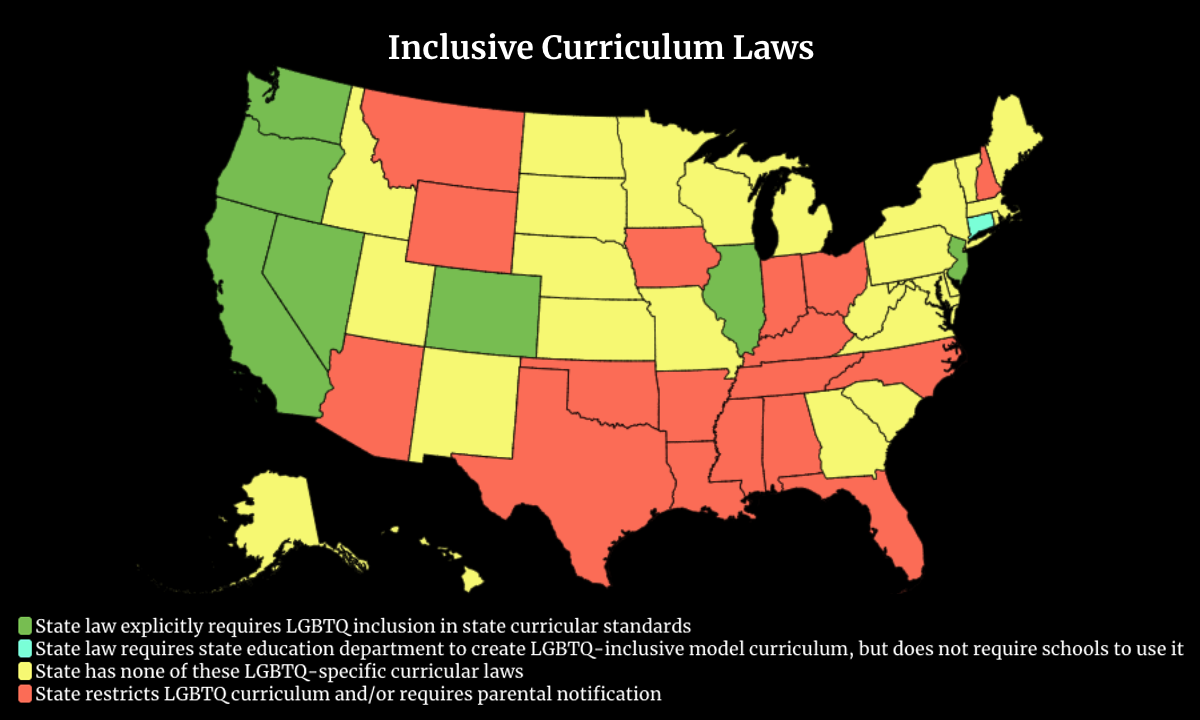
Lost amid headlines about hundreds of bills seeking to curtail protections for LGBTQ students over the last five years is a surprising fact: More LGBTQ teens live in states that require schools to teach LGBTQ people’s historical and cultural contributions to society than in places that ban their mention in classrooms.
More than 1 in 4 queer 13- to 17-year-olds attend school in the seven states that now mandate this inclusive instruction, versus 20% who live in the 20 states that have passed what advocates call Don’t Say Gay laws.
Research shows schools are safest for LGBTQ children and educators, and that students learn best, when they see themselves in classroom materials. They are far less likely to hear homophobic and transphobic slurs, to feel unsafe because of their identity or gender expression, to miss school or to be victimized. They attend school more consistently, get better grades and are more likely to say they have multiple teachers who are supportive.
The presence of clubs known as gay-straight alliances improves school climates for all students — especially those from marginalized backgrounds. And straight, cisgender educators report feeling more confident in their ability to meet students’ needs when they themselves learn about LGBTQ people and topics.
But the question of whether laws requiring accurate and positive portrayals of LGBTQ people, history and events make schools more welcoming is a complicated one. The first state to adopt a mandate, California, has seen only incremental change after 15 years. Other states that more recently began requiring inclusive instruction — most notably Illinois and Oregon — took note, wrote stronger laws and have seen more rapid progress.
Policymakers and advocates are amassing research pinpointing practical reasons why the mandates succeed or fail. Perhaps a law didn’t include funding for new resources, set deadlines or require state officials to follow up to make sure schools complied. Maybe it gave few specifics about which changes to textbooks would fulfill the requirements and even less guidance to help educators and the public understand why they are important for LGBTQ students’ well-being and academic success. Or it could be that districts found it easier to comply with policies that identified or created free, optional materials, called for training teachers and principals on their use and on incorporating students’ feedback, and issued step-by-step guidance on implementation.
Whatever the factors involved, the fact is that during the last two decades, the number of LGBTQ students who say they are exposed to inclusive instruction has dropped nationwide, from 20% to 16%. Nearly 15% say they are taught negative depictions. And though it’s early in the implementation process in some places, the number of students who say their classes included positive lessons in the seven states that mandate them ranges from 15% to 32%, with an average of 22.5%.
Even in communities where educators are eager to make the called-for changes, school board meetings have become contentious, as organized groups charge that allowing discussion of LGBTQ topics leads to the “grooming” of students to become gay or trans.
The resulting fear and confusion are frequently more powerful than the letter of the law. And administrators and even district attorneys often lack clarity on what the law is, including in places with strong protections for LGBTQ kids and educators.
It’s a tough political reality that is about to get even harsher.
President Donald Trump has repeatedly threatened to withhold funding from “any school pushing critical race theory, transgender insanity and other inappropriate racial, sexual or political content on our children.”
Well-tested legal limits on federal involvement in what schools teach may make it difficult for Trump to starve schools that teach “woke” concepts. But the constant drumbeat of threatening headlines demonstrates that in practice, he may well get his way.
A culture of fear and intimidation
“There is a lot of talk happening now about clamping down on inclusive learning coming from the incoming administration,” says Brian Dittmeier, policy director of GLSEN, which has been monitoring school climate for LGBTQ students for 25 years. “I just want to make clear that there’s a long bipartisan record, and requirements from Congress, that the U.S. Department of Education not dictate curriculum to the states.”
But classroom materials are just one element of what makes a school welcoming, he adds. School leaders need to take a number of steps to build trust with marginalized students — which can be hard to do in the face of ideological assaults.
“You can adopt policies, you can put books on the library shelves,” says Dittmeier, “but if there is a culture of fear and intimidation, and there’s not the follow-through of inclusion, it’s going to impact the success of those interventions when it comes to reducing adverse mental health outcomes and diminished academic performance.”
U.S. education policy has long put local leaders in charge of many decisions, so long as school systems meet thresholds set by state and federal officials. So while states create curricular standards — guidelines spelling out what students are expected to learn in each grade and subject — for the most part, district leaders can decide how to include those required topics in classroom lessons.
Because of this, there are countless places where things can fall apart between a governor signing a bill into law and a teacher feeling safe enough to mention, for example, that astronaut Sally Ride was a lesbian or that Pride Month recognizes the revolt at the Stonewall Inn.
It’s long been understood that all children learn best when they see themselves in classroom materials. One popular theory describes curricula featuring people of different races, abilities and backgrounds as providing “windows and mirrors” — a mirror so a child feels connected to the material and a window for learning about other cultures.
In the case of LGBTQ students, inclusive curriculum — instruction that includes the societal contributions of queer people — also makes schools safer. According to GLSEN, which advocates for policies making schools more welcoming, 4 in 5 queer youth ages 13 to 17 feel unsafe in school, making a third uncomfortable enough to miss at least one day a month.
Last year, GLSEN analyzed 20 years of data comparing the experiences of LGBTQ students in schools that use inclusive curriculum and those that don’t. Researchers found dramatic differences in student mental health and academic engagement, as well as overall school climate. The positive impacts are also felt by LGBTQ students of color and gender-nonconforming students, who typically report the highest levels of victimization.
Compared with students in schools that don’t use inclusive curriculum, they are far less likely to routinely hear homophobic and transphobic remarks. Less than half (49%) hear the word “gay” used in a negative way, compared with almost three-fourths (72%) in schools that don’t use inclusive curriculum. One in 4 (27%) hear slurs such as “fag” or “dyke,” compared with almost half (48%).
LGBTQ students in schools that use inclusive curriculum are almost twice as likely (67% vs. 35%) to say their classmates are accepting. They are dramatically less likely to feel unsafe, half as likely to be victimized in person and less likely to miss school. Consistent attendance is particularly important in light of past GLSEN surveys that put the LGBTQ dropout rate at 35% — three times the national average.
California’s glacial pace
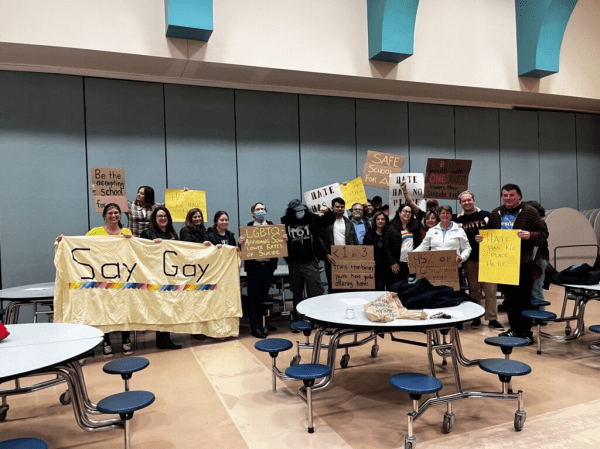
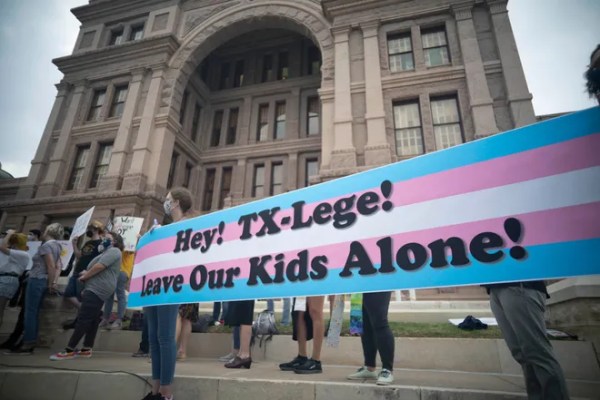
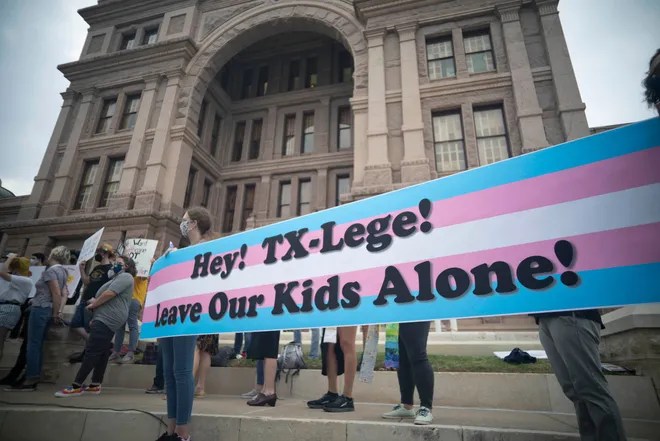
Armed with early versions of this research and with stories of being bullied, in 2006 some 500 students, accompanied by friends and families, descended on the California statehouse to demand passage of a law that would require schools to use “bias-free” curriculum. Then-Gov. Arnold Schwarzenegger ultimately vetoed the initial bill.
In 2011, the state Assembly passed the law, the first in the country requiring schools to include the contributions of LGBTQ people in their instruction. As he signed the FAIR Education Act, which also called on educators to teach about people with disabilities, then-Gov. Jerry Brown said he expected it to take four years for textbooks and other materials reflecting the mandated changes to reach classrooms.
In fact, that estimate was wildly optimistic. Notably, the law did not include a deadline for compliance, a mechanism for monitoring implementation or consequences if schools did not shift instruction. Fifteen years after its passage, it remains unimplemented in most of the state’s nearly 1,000 school systems.
A recent survey by the advocacy group Equality California found that fewer than a third of districts had adopted all the required changes, though 60% had taken at least one step toward compliance. In 2021, just 27% of California LGBTQ students aged 13 to 17 told GLSEN they had been exposed to positive representations of LGBTQ people in class, an increase of only 5 points since the law’s passage.
To be fair, implementation of curricular standards is never quick. Once a law calling for change is passed, state officials typically appoint a group of educators and subject-matter experts to decide which facts or skills should be taught in each grade. The potential revision is then shared with the public for feedback.
In the case of the FAIR Act, California’s updated history and social studies standards were published in 2017, six years after the law’s passage. In deference to local control, districts were left to decide what materials to use.
But determining whether a textbook meets standards is painstaking work that exceeds the capacity of many districts. And materials featuring diverse people are scarce.
For example, a 2018 review by University of Wisconsin researchers of the 3,000 children’s books published the previous year found that half of characters were white, 27% were animals, 10% Black, 7% Asian or Pacific Islander, 5% Latino and 1% Native American.
Last year, The Education Trust reviewed 300 K-8 books that are part of five curricula that received favorable ratings from EdReports, an organization that evaluates classroom materials for quality. Less than 40% of the texts reviewed featured people of color. In most of those that did, reviewers found “limited representation, such as through stereotypes or as background to the stories of others.”
When the FAIR Act was passed in 2011, suitable resources were even harder to find. The books Education Trust reviewed included two gay men and six individuals with disabilities, for example. The law required state officials to screen and approve textbooks that districts could voluntarily adopt.
State academic standards vary widely and are often met with political opposition, making the process of approving materials contentious. Publishers are under pressure to customize materials to meet each state’s parameters. Because of their size and tendency to adopt standards at opposite ends of the ideological spectrum, California, with 6.7 million K-12 students, and Texas, with 5.8 million, have outsized influence on what publishers produce.
A January 2020 New York Times piece contrasted textbooks printed for both markets, finding discordant recountings of the history of capitalism, Reconstruction, immigration, white flight and what one Texas volume called the “Americanization” of Native Americans. A month later, a CBS investigation found seven states did not directly mention slavery in their standards, and 16 listed states’ rights as the cause of the Civil War.
In California, advocates and members of the state commission reviewing classroom resources scrapped over how to identify historical figures such as Emily Dickinson, James Buchanan and Ralph Waldo Emerson; how to characterize people who were not out when they were alive; and whether to include context regarding sexual orientation or gender identity in texts given to students, or only in teachers’ guides.
At one point, for example, McGraw-Hill pushed back against the commission’s request to describe Ellen DeGeneres as “a lesbian and humanitarian,” suggesting the materials instead say DeGeneres “works hard to help people. She and her wife want all citizens to be treated fairly and equally,” according to the news site EdSource.
Ultimately, the state rejected two sets of materials from one commercial publisher, Houghton Mifflin Harcourt, and accepted 10. Examples of age-appropriate lessons the state advisory board approved include a section titled “Different Kinds of Families” in a second-grade book, an entry on the legal recognition of same-sex marriage for fourth-graders and a lesson for 11th-graders on homosexual life under Nazi rule.
In 2018, appropriate curricula were ready for classroom use. A year later, the number of California LGBTQ students ages 13 to 17 surveyed by GLSEN who said they were exposed to positive representations of queer people had risen from 22% to 33%.
But the next time GLSEN administered its school climate survey, in 2021, the culture wars were in full swing and the rate had fallen to 27%. Last fall, an Equality California survey found that fewer than one-third of schools had fully implemented the law’s requirements.
Illinois, Oregon learn from California’s missteps
In 2019, New Jersey, Colorado, Illinois and Oregon adopted inclusive curricular standards. Nevada would follow in 2021, and Washington state in 2024. Like California’s, the new laws require instruction about other rarely discussed groups as well, such as Native Americans and people with disabilities. During the same time period, three other states — Vermont, Connecticut and Delaware — passed legislation requiring state officials to create model curricula and updated standards.
The new policies vary in approach, with several states taking steps to avoid problems that dogged implementation in California. Colorado lawmakers, for example, set aside money to pay for textbooks. A number of districts, including Denver Public Schools, did not wait for the state review process and instead turned to Teaching Tolerance, the Human Rights Campaign and other outside groups for model lesson plans.
In Illinois, officials appointed an advisory council composed of advocates, academic subject-matter experts and health officials to come up with curricula and resources for schools and professional development programs to use. Like California’s, the law leaves the question of whether to adopt the materials up to local officials, but it mandates checks on whether the instruction is being provided as part of a process of monitoring whether districts are following a number of state requirements. So far, no Illinois district has been found to be out of compliance, according to the state Board of Education.
Mollie McQuillan is an assistant professor of educational leadership and policy analysis at the University of Wisconsin-Madison who studies the implementation of LGBTQ school policies. Illinois has a lot of work left to do, says McQuillan, who uses they/them pronouns. “But they’ve filled some of these holes that we see in other states.”
The same committee of advocates and experts that screened classroom materials, the Illinois Inclusive Curriculum Advisory Council, also wrote the guidance for how school systems could meet the new standards. Essentially a how-to manual, the document explains why inclusion is important, how to determine whether a lesson is age-appropriate and how to gain teacher buy-in. For example, it suggests back-to-school night is a good time to let parents know about the new law and its goal of a safe and supportive school climate, and to encourage families to ask questions.
If inclusive standards requirements are not accompanied by anti-bullying and anti-discrimination policies — and similarly specific instructions for implementation — confusion can arise. Faced with uncertainty, McQuillan says, local leaders often default to the status quo.
Few principal and superintendent licensure preparation programs include training on sexual orientation or gender, they say. Because of this, school leaders may not be aware of their students’ needs, much less have a sense of urgency about meeting them.
Far from having considered how transgender and nonbinary students may experience school, administrators and district leaders often don’t realize how strong traditional gender norms can be. They may never have questioned how their schools’ physical spaces and activities are organized.
A member of the advisory council that has guided the implementation of the Illinois law, Julio Flores trains educators, school administrators and families on LGBTQ topics. Demand, he says, has been strong — and often, the information sought is much more basic than how to frame a lesson.
In his workshops, the mere mention of new curricular standards often triggers a much broader conversation among teachers and school leaders who, depending on the demographics of their communities, might have questions ranging from what constitutes respectful speech to how to make their classrooms safe. One of the topics most frequently raised is the difference between sexual orientation and gender.
“One common question is, ‘How do young people know that their gender identity does not align with the sex they were assigned at birth?’ ” he says. “ ‘How can I support young people, especially if their parents are not supportive?’ That’s a huge challenge for adults, wanting to support their young people but also recognizing parents also have their own process.”
Data on how quickly school climates shift after an inclusive curriculum mandate is adopted are scant. In the four states that passed requirements in 2019, implementation was sometimes held up as school leaders scrambled to figure out how to respond to COVID-19, and the most recent school climate research from GLSEN — the most detailed data available — was published in 2021. (A new dataset is expected later this year.)
But there are early suggestions that enacting several LGBTQ student protection policies at the same time — and being explicit about how they are to be enacted — can be effective. The second state to pass a curriculum law was New Jersey, which requires the teaching of accurate representations of queer and disabled people but leaves it to individual school boards to decide what inclusive means. Compared with 2011, the state saw a 3 percentage point drop in the number of students who said they were exposed to positive representations.
By contrast, Oregon, where standards will not be mandatory until the 2026-27 school year, saw a 9-point gain. In its recent analysis, GLSEN noted that the degree of specificity and the comprehensive nature of the state’s directions to school systems are likely key reasons why. In addition to the kinds of advice included in Illinois’ guidance, Oregon’s encompasses other steps educators should take to make schools more welcoming. For example, after explaining that fostering trust between students and administrators is crucial, the state’s guidance directs school leaders to create a process for youth and staff to report incidences of bias and to spell out what steps will be taken.
Based on the data the organization has gathered over the last 25 years, GLSEN researchers say that to make the most difference in student welfare, inclusive curriculum should be accompanied by teacher training — both in colleges of education and in on-the-job professional development — by the adoption of non-discrimination and anti-bullying laws and by the creation of forums where LGBTQ youth can express their needs.
According to GLSEN’s Dittmeier, six states now require that teachers be trained on LGBTQ inclusion, and seven have developed materials for educator professional development.
“All of these supports are really key to ensuring that LGBTQ youth feel included in their school environment and can obtain the success of their peers,” says Dittmeier. “When these interventions are available in the school, it really results in a dramatically different school experience for LGBTQ youth.”
But other research has documented an increase in ambivalence about inclusive instruction among teachers. A 2022 survey administered by Educators for Excellence found that 1 in 3 do not support including LGBTQ topics in instruction, while 11% believe their school does not enroll any queer children at all.
Support for inclusive instruction was weakest among older educators and white ones, with 82% of teachers under age 50 expressing support and 97% of Black, Latino and Indigenous educators saying they are in favor. Educators also told the researchers they fear the wave of state legislation curtailing classroom speech and are unsure what they can say.
Over the last two years, Oregon has trained 1,000 educators and staff at universities and nonprofits that work with schools to implement the new standards. The state has awarded grants to organizations to provide professional development, instructional materials, affirming drop-in spaces for homework help and youth summits, and it requires districts to have formal community engagement processes.
Uniquely, Oregon also recognized that discussions of LGBTQ school inclusion typically focus on bullying, suicidality and other negative experiences. So officials asked students where they feel most accepted and has helped community groups create opportunities — many of them tailored to young people of a particular race or ethnicity — for queer youth to have fun and spend time with affirming adults.
School board pushback — and a lawsuit
In May 2023, a newly elected conservative school board majority in California’s Temecula Valley Unified School District overruled a group of teachers who had selected new, state-adopted social studies textbooks for grades 1-5. The reviewers had solicited feedback from parents, which was overwhelmingly positive or neutral.
The three new board members — who earlier banned instruction on critical race theory, which is not taught in K-12 schools — said they opposed the curriculum because they did not want students to learn about Harvey Milk, the first openly gay man elected to public office in California.
A tug of war with state officials ensued. The state Department of Education and California Attorney General Rob Bonta launched investigations, and Gov. Gavin Newsom threatened consequences. But the FAIR Act did not set deadlines for schools to shift their instruction, require state officials to monitor implementation or spell out what would happen in districts that ignored the mandate.
In July, the Temecula Valley board doubled down, again voting to reject the curriculum. Within a day, the governor said he planned to order the books and send the district the $1.6 million bill. Newsom also said that if the Assembly passed a bill that would create consequences for flaunting the FAIR Act and other laws requiring inclusive instruction, he would fine the district $1.5 million.
The second law would, in fact, pass, but not until two months after the Temecula Valley board backed down and agreed to adopt most of the curriculum. A few days later, the district’s teachers union, a group of educators and parents sued the board, charging that its votes rejecting instruction required by state standards and a variety of other edicts involving race, sexuality and gender violated students’ constitutional rights. The case is wending its way through courts.
‘Anti-LGBTQ animus is still socially acceptable’
Even if federal law continues to curtail Trump’s ability to force the elimination of inclusive curriculum, the culture wars may ultimately stymie implementation in many places.
A survey released last spring by University of Southern California researchers Anna Saavedra and Morgan Polikoff found deep partisan divides in which topics Americans feel are appropriate for classroom discussions, with the biggest gulf on LGBTQ subjects.
Unlike many polls, the survey asked about hypothetical scenarios in which students’ ages and the content of possible lessons varied from exposing elementary-aged children to stories with a variety of kinds of families to topics that include sex.
Depending on the scenario, 4 in 5 Democrats said they support inclusive instruction in high school and half or fewer in lower grades. Republicans, by contrast, were comfortable with LGBTQ topics less than 40% of the time at the high school level and less than 10% in elementary school.
Blue state government notwithstanding, Polikoff wrote in a commentary for CalMatters, California has the same partisan divides on inclusive curriculum as other places. The political right, he noted, had “fixed its gaze” on LGBTQ issues in schools.
“The reason for this shift is obvious: Anti-LGBTQ animus is still socially acceptable,” Polikoff wrote. “The reality is that LGBTQ issues in schools are a thorny problem, and Californians are intensely divided on what to do about them.”
The range of responses, he told The 74, does suggest a path forward, albeit a long one: “We really do need to have a discussion about what’s age-appropriate, what parents want and kids need. And that’s probably not going to be one conversation. That’s probably going to be 50 conversations, one in each state. Or maybe 13,000 conversations, one in each district.”












You must be logged in to post a comment.