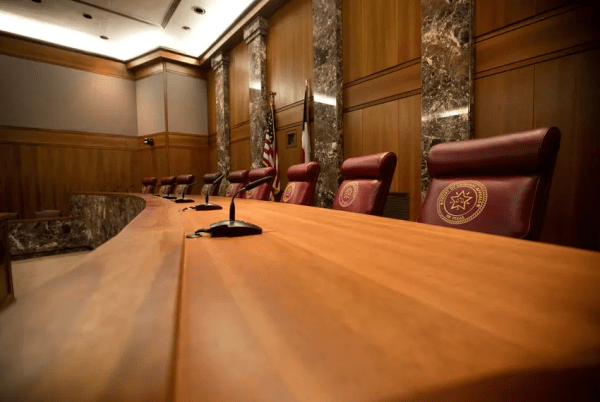
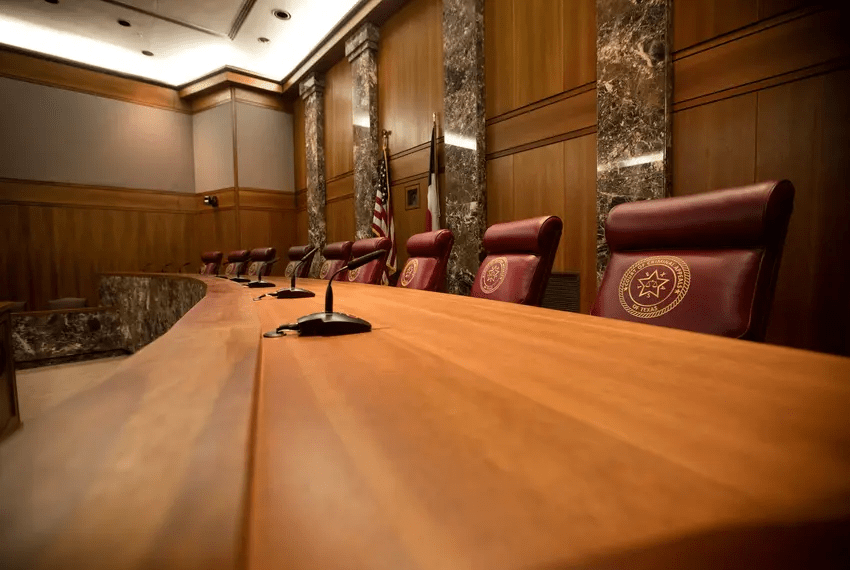
Three sitting judges, boasting almost a century of collective experience in criminal law, became casualties of Paxton’s retaliatory political campaign following their ruling against the attorney general in a 2021 voter fraud case.
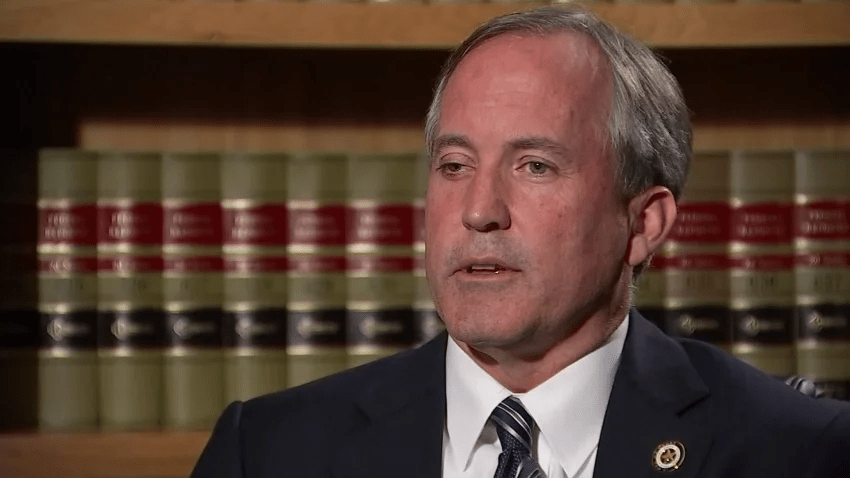
On Tuesday, three incumbent judges on Texas’ highest criminal court failed in their reelection bids after Attorney General Ken Paxton focused his attention on these Republicans due to a 2021 ruling that nullified the attorney general’s authority to independently prosecute voter fraud.
According to the Associated Press, David Schenck, Gina Parker, and Lee Finley emerged victorious in their races, defeating Judges Sharon Keller, Barbara Hervey, and Michelle Slaughter respectively. Presiding Judge Keller has held her position since 1994.
Paxton singled out these judges as part of a broader political vendetta, aiming to remove Texas House members who had voted to impeach him in May.
In 2021, Keller, Hervey, and Slaughter aligned with five other Republican judges on the Court of Criminal Appeals in a voter fraud case. Their 8-1 decision determined that the Office of the Attorney General had breached the separation of powers outlined in the Texas Constitution by attempting to prosecute election cases without authorization from a local prosecutor.
However, in various media appearances and primary advertisements, Paxton portrayed the three incumbents as renegade Republicans who curtailed the attorney general’s authority to pursue voter fraud—a political issue significant to the modern GOP, especially given former President Donald Trump’s unsubstantiated claims of election interference.
Combined, the trio of incumbents boasted nearly a century of experience in criminal law, having served as prosecutors and judges. The Court of Criminal Appeals, Texas’ highest criminal court, comprises nine judges, while civil cases are heard by the Texas Supreme Court.
While the Texas attorney general holds the position of the state’s chief lawyer, the prosecution of crimes, including voter fraud, falls under the jurisdiction of locally elected county attorneys and district attorneys.
Despite Keller, Hervey, and Slaughter no longer serving on the bench, there remain five judges on the court whom Paxton previously targeted for removal due to their opposition to him in 2021. Among them, David Newell and Bert Richardson could seek reelection in 2026, should they decide to run. Kevin Patrick Yeary, the lone pro-Paxton vote, will also face reelection in the same year.
In a statement issued by Paxton late Tuesday evening, the attorney general hailed the defeat of the incumbents as a triumph for democratic ideals.
“To those who attempt to impede justice or subvert our legal system, take heed: The people of Texas will not stand for it,” Paxton asserted in his statement. “Your days of judicial overreach are numbered, and Texans are prepared to demand accountability.”
The all-Republican court is expected to continue under GOP control, given that the three elections are open to voters across the state. It has been thirty years since a Democrat secured victory in a statewide election.
The involvement of school board trustees in apologizing suggests a recognition of responsibility for the incident involving Evangelische Omroep (EO) filming students. Their apologies likely aim to address any concerns or distress caused by the filming and to reassure the community that steps will be taken to prevent similar incidents in the future. The apologies may also reflect a commitment to transparency and accountability in addressing the situation.
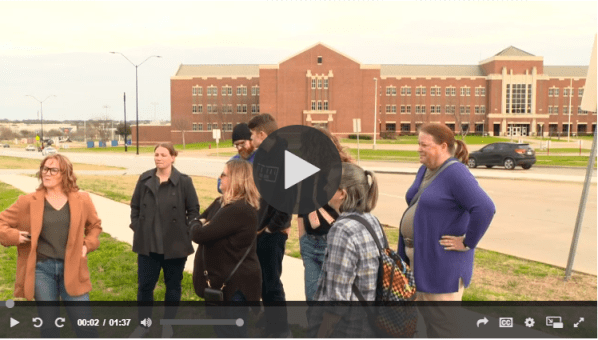
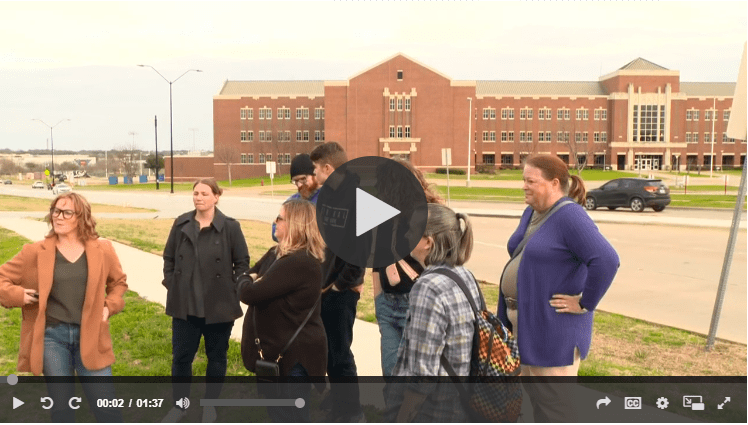
The gathering of parents near Keller ISD’s Central High School likely signifies a unified response to a specific issue or concern within the school district. Their anger and frustration suggest that they feel strongly about the matter and are seeking to voice their discontent publicly. This kind of collective action often serves as a way for community members to express their grievances and advocate for change within educational institutions.
“I’m livid,” said Laney Hawes, a parent whose child attends Central HS. “Our rights and our kids rights have been violated.”
The district’s confirmation of events on February 9 likely brought to light an incident or situation that has caused significant distress among the parents. The specificity of the date suggests that something notable occurred on that day, prompting the parents’ reaction.
The involvement of school board trustees in bringing an Evangelical-based film crew into the high school without obtaining consent from students and parents is likely the source of the anger and frustration expressed by the group of parents near Keller ISD’s Central High School. This breach of privacy and potential violation of consent rights could have serious implications for the trustees involved and has understandably elicited strong reactions from the community.
It seems there might be some confusion. Evangelische Omroep (EO) is indeed a Netherlands-based Evangelical broadcast television network, but there is no known documentary titled “God, Jesus, Trump” produced by EO. It’s possible that another production company or network created such a documentary. However, it’s essential to verify the accuracy of the information before drawing conclusions about the involvement of EO or any other organization in specific documentary productions.
“We don’t want politics in our kids schools,” Hawes said. “If kids wanna bring God into schools, beautiful, but it cannot be the administration. There is a separation of church and state.”
Thank you for providing additional context. Elliot Mullaney’s eyewitness account sheds light on the situation at Central High School.
“It’s an invasion of privacy,” said Mullaney. “I think that it’ll be used to spread hate and spread untrue opinions.”
It’s crucial to address such incidents transparently and responsibly, especially given the concerns raised by parents and students.
alker apologized in a post, saying: “I recently participated in a foreign documentary focused on public schools in Texas. Some filming took place while students were present. I take safety and privacy of our students seriously. I apologize for allowing students to be captured on film.”
Young, who said he “briefly assisted my colleague in an interview about Texas public schools,” said in a Facebook post: “I regret if any students were captured on film. My understanding is the District has been assured by the crew that no student will appear in the footage. The safety and privacy of our students is of utmost importance to me.”
Parents rightfully expect accountability from school officials, particularly when their actions compromise student privacy and well-being.
The absence of the principal on the day of the incident underscores the need for clear protocols and supervision to ensure that such breaches of student privacy do not occur in the future.
“If they’re bypassing certain rules, it’s time that they need to resign,” Mullaney said.
Friday evening, Keller ISD Superintendent Dr. Tracy Johnson sent a letter to Central HS parents. In the letter, Johnson confirmed that a production company from the Netherlands visited the campus to film an interview with trustees Walker and Young. Johnson confirmed the crew toured the school and talked to some students and employees.
According to Johnson, “the district and the board were not aware of the scheduled interview.”
Despite district officials’ saying they weren’t aware of the scheduled interview, the film crew said in a statement to WFAA that it “obtained permission to record at the school in advance.”
“The Evangelical Broadcasting, a channel that broadcasts on National Television in the Netherlands, has recorded at Central High School, part of Keller ISD, for a program called ‘God, Jesus, Trump!’. This program is a neutral journalistic program that examines Christian culture in the USA,” the statement from the film crew read. “The film crew obtained permission to record at the school in advance. The film crew went through all standard registration and administration procedures upon entering the building, and the crew was warmly welcomed by the staff that day. As stated prior, all children will be unrecognizable, and all ethical and journalistic guidelines were applied during the recording and will be applied in the process of making this program.”
Johnson’s letter said the matter is under review and that the district is “taking proactive steps to safeguard the privacy and security of our students. KISD administrators have been in contact with the film company who have assured us that no students or teachers would be visible in the video they are producing.”
Hawes said she spoke about the incident with the school’s principal, Liz Russo.
“Russo apologized. She let me know that policies were broken and this wasn’t done with permission, and it would’ve never been allowed,” Hawes said.
It’s concerning that the school board members and the principal did not respond to inquiries about the incident. Transparency and accountability are essential in addressing such breaches of protocol and maintaining trust within the school community.
It’s distressing to hear that a parent’s request for privacy was seemingly disregarded by the district, especially considering the circumstances they described. Respecting the privacy and safety of students should be a top priority for schools, and any failure to uphold such requests erodes trust and can have serious consequences for individuals’ well-being.
“It’s sickening, the parent said. “It’s very concerning. Now she’s being exposed. “It’s already tough enough trying to make sure our kids are safe, and if you can’t trust the people in the school building are gonna keep your kids safe, who can?”
It’s understandable that parents would demand accountability from the trustees involved and seek to address the situation through official channels such as filing grievances with the district. Trust in school leadership is crucial for maintaining a safe and respectful learning environment, and actions that undermine this trust must be addressed promptly and transparently.
The Human Rights Campaign State Equality Index (SEI) is a comprehensive state-by-state report that offers a review of statewide laws and policies impacting LGBTQ+ individuals and their families.
The SEI rates all 50 states plus Washington, D.C. in six areas of law and assigns the states to one of four distinct categories.
Check your state’s scorecard by texting SEI to 472472 from your mobile phone. (msg & data rates may apply. Text STOP to quit, HELP for info.)
The Texas Supreme Court has temporarily halted a lower court’s decision that granted a pregnant woman the right to proceed with an abortion.
The Texas Supreme Court has issued a temporary stay on a district court’s decision that permitted Katie Cox, a 31-year-old woman, to undergo an abortion. Cox, who is 20 weeks pregnant, is carrying a fetus diagnosed with full trisomy, a condition associated with high risks of miscarriage, stillbirth, or infant death shortly after birth.
“The petition for mandamus and motion for temporary relief remain pending before the Court,” stated the Texas Supreme Court in response to the ongoing legal proceedings related to Katie Cox’s case.
Cox’s physicians have indicated that continuing her pregnancy would necessitate a cesarean section or induction, posing a risk of serious injury. Inducing labor could lead to a uterine rupture, especially considering Cox’s previous C-sections, and another cesarean section could further jeopardize her future fertility.
Molly Duane, senior staff attorney at the Center for Reproductive Rights, expressed concern that justice delayed could result in justice denied in this case. She emphasized the urgency of medical care, especially given that Katie Cox is already 20 weeks pregnant. Duane stated that individuals should not have to plead for healthcare in a court of law.
Texas prohibits all abortions from the moment of fertilization, and it enforces a “bounty law” that incentivizes private citizens to file lawsuits against those who aid or facilitate someone in obtaining an abortion.
“The Attorney General’s office in Texas argued to the court that future criminal and civil proceedings cannot restore the life that is lost if the plaintiffs or their agents proceed to perform and procure an abortion in violation of Texas law,” according to The Associated Press.
The Hill has contacted the Texas Attorney General’s office and the Center for Reproductive Rights for comments.
It is the second law of its kind to be declared unconstitutional.
A federal judge has issued a permanent injunction against a Texas bill that restricted “sexually oriented performances” and has been criticized for limiting public drag performances in the state.
U.S. District Judge David Hittner said the law is an “unconstitutional restriction on speech” and “violates the First Amendment as incorporated to Texas by the Fourteenth Amendment of the United States Constitution.”
A similar law in Tennessee, the first state to restrict drag performances in public, was also blocked and ruled unconstitutional.
The law was set to go into effect on Friday, Sept. 1, but a preliminary injunction halted its enforcement.
“LGBTQIA+ Texans, venue owners, performers, and our allies all came together to uphold free expression in our state — and we won,” the ACLU of Texas said in a social media post. “This work isn’t done but for now we celebrate. Long live Texas drag!”
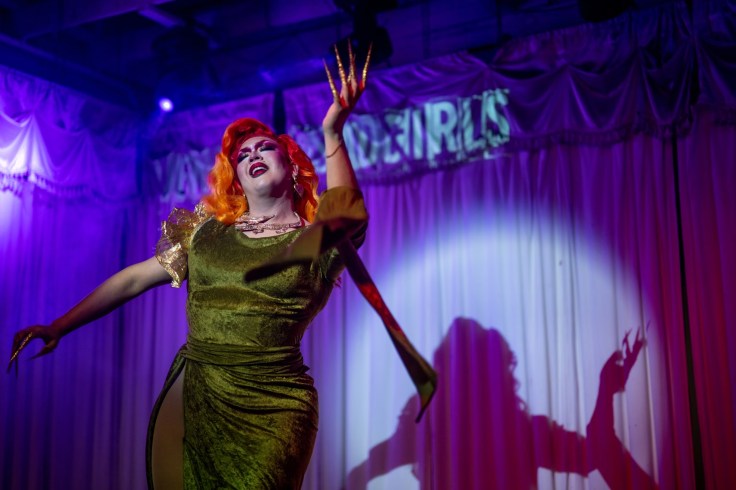
A Drag Queen performs during a show at the Swan Dive nightclub on March 20, 2023 in Austin, Texas.
The Texas law doesn’t specifically mention drag shows, but Lt. Gov. Dan Patrick said the bill would prohibit “sexualized performances and drag shows in the presence of a minor.”
The ACLU of Texas represented local LGBTQ groups, businesses and a performer in a lawsuit against state officials.
The “exhibition or representation, actual or simulated, of male or female genitals in a lewd state” as well as “the exhibition of sexual gesticulations using accessories or prosthetics that exaggerate male or female sexual characteristics” would have been restricted under the law.
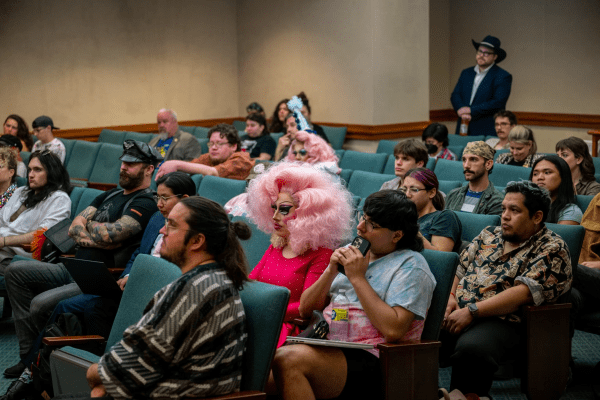
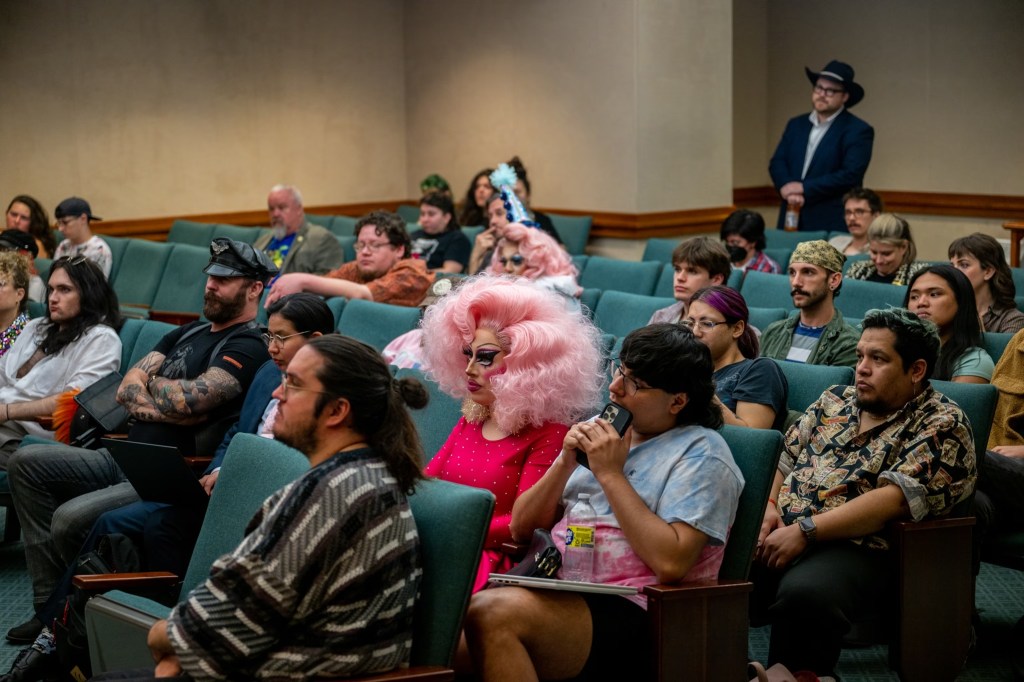
Members of the Drag Show community listen in during a meeting at the Texas State Capitol on March 23, 2023 in Austin, Texas.
Performances would be restricted from public properties or in the presence of someone under the age of 18.
Under the law, businesses would have faced a $10,000 fine for hosting such a performance. Performers could be charged with a Class A misdemeanor, which is punishable by up to one year in jail and/or a fine of $4,000.
Critics of the bill said traveling Broadway plays, theater performances, professional cheerleading routines and drag shows would have been impacted.
Republican Governor Greg Abbott has sent a letter requesting that Texas education institutions take books out of classrooms that he has labeled “pornography,” mentioning in particular two memoirs featuring LGBTQ+ protagonists that contain explicit descriptions of sex.
Following a letter to the Texas Association of School Boards requesting it to ban porn and “inappropriate content” from public schools, Abbott sent a letter to the Texas Education Agency, Texas State Library and Archives Commission, and State Board of Education.
Florida first. Alabama follows. Legislators in Louisiana and Ohio are currently debating legislation that is similar to the Florida statute. A similar bill will be his top priority during the following session, according to Texas Governor Greg Abbott.
At least a dozen states across the country are proposing new legislation that, in some ways, will resemble Florida’s recent contentious bill, which some opponents have dubbed “Don’t Say Gay.”
The nation’s second-most populous state’s Republican governor, Greg Abbott of Texas, on Monday signed House Bill 25, a bill that would prohibit transgender girls from competing in interscholastic athletics. The bill will become operative on January 18, 2022.
Texas becomes the tenth state since March 2020 to do so via floor vote or executive order. In addition to Florida, Alabama, Mississippi, Tennessee, Arkansas, West Virginia, South Dakota, Montana, and Idaho, the state now joins the group. In later verdicts, federal justices barred implementation in West Virginia and Idaho.
A lawsuit was launched on Tuesday against President Joe Biden’s administration over a Department of Agriculture school food program that forbids discrimination based on sexual orientation and gender identity by more than 20 Republican attorneys general, including Texas’ Ken Paxton.
In the lawsuit, Herbert Slatery, the attorney general of Tennessee, asserts that the federal government is trying to compel states and educational institutions to adhere to anti-discrimination standards that “misconstrue the law.”
When Roe v. Wade was overturned by the Supreme Court, Texas Attorney General Ken Paxton (R) seemed to agree with Justice Clarence Thomas’s concurring opinion that other precedents that might be deemed “demonstrably erroneous,” such as those affecting the LGBTQ community, could be reviewed by the court.
Thomas referred to Lawrence v. Texas as one of the cases that forbade states from outlawing intimate same-sex relationships. The historic 2003 decision invalidated a 1973 Texas law that made sodomy a crime. However, once Roe was overruled, Paxton declared he would support the state’s abolished sodomy ban if the Supreme Court followed Thomas’s advice and ultimately decided to reconsider Lawrence.








 fleeredstates.blog
You must be logged in to post a comment.