Paxton blocks Biden’s Title IX rule protecting LGBTQ+ students in Texas
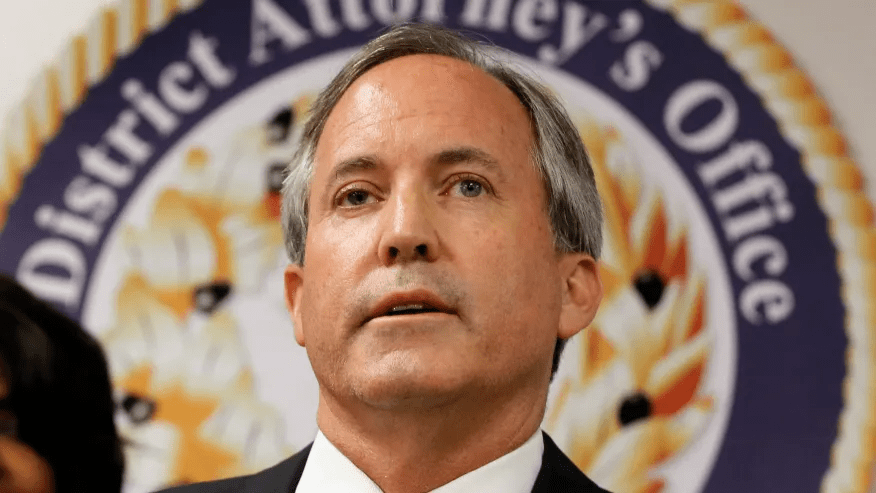
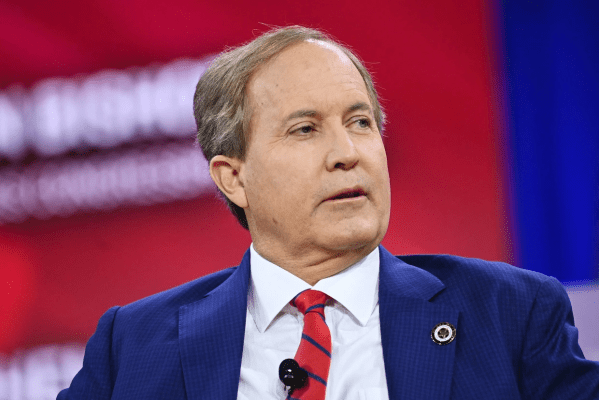
FILE – Texas Attorney General Ken Paxton speaks at a news conference in Dallas on June 22, 2017. Paxton says he’s investigating a key Boeing supplier that is already under scrutiny by federal regulators over the quality of its work on Boeing planes, Friday, March 29, 2024. (AP Photo/Tony Gutierrez, File)
AUSTIN (KXAN) — Texas Attorney General Ken Paxton has blocked the Biden Administration’s Title IX rule aimed at protecting LGBTQ+ students from sex-based discrimination and harassment, according to a Tuesday release from Paxton’s office.
The rule was designed to protect all students and employees from sex discrimination, including providing comprehensive protections against sexual violence and other forms of sex-based harassment.
In the release, Paxton claimed a “major” victory against the Biden Administration’s Department of Education’s attempt to amend Title IX, alleging it would force Texas schools to adopt radical “transgender” policies that violate state and federal law.
“Joe Biden’s unlawful effort to weaponize Title IX for his extremist agenda has been stopped in its tracks,” Paxton stated. “Threatening to withhold education funding by forcing states to accept ‘transgender’ policies that put women in danger was plainly illegal. Texas has prevailed on behalf of the entire Nation.”
The Biden Administration’s changes to Title IX are scheduled to take effect nationwide on Aug. 1, except in states where it has been blocked.
Democrats warn that Texas could forfeit billions in federal funds due to Abbott’s LGBTQ directive.
Texas colleges and universities face the imminent risk of losing billions in federal funding if they adhere to Governor Greg Abbott’s directive to disregard a new federal rule strengthening nondiscrimination protections for LGBTQ students, according to Democrats who addressed a state education board on Monday.
In a letter of congressional inquiry to Texas’s Higher Education Coordinating Board, which oversees public post-secondary education, four House Democrats from Texas cautioned that public colleges could jeopardize students’ civil rights and forfeit government funding by following Abbott’s orders to ignore amendments to Title IX. This federal civil rights law prohibits sex discrimination in schools and educational programs receiving federal funding and was updated by the Education Department in April to include protections based on sexual orientation and gender identity.
The rule, set to take effect on August 1, has faced temporary injunctions in ten states led by Republicans, including Texas, where Abbott labeled the changes as “illegal” in an April letter to President Biden.
Led by Rep. Jasmine Crockett (D-Texas) and signed by Democratic Reps. Sylvia Garcia, Al Green, and Sheila Jackson Lee, the letter accused Abbott and other officials of using educational institutions as “political pawns.”
“If Texas educational institutions fail to adjust their policies in accordance with the forthcoming Title IX revisions, the consequences would be devastating,” the lawmakers wrote. “Losing billions of dollars of federal funding would prevent institutions from offering scholarships crucial for students to afford and access higher education. Hundreds of thousands of potential Texas students would face a threat to their educational opportunities.”
Democrats argued that failure to comply with the Biden administration’s rule, which also strengthens protections for pregnant students and changes how schools handle sexual misconduct claims, could undermine students’ civil rights. They referenced a recent lawsuit by University of Texas at Austin professors challenging provisions allowing student absences for out-of-state abortions and mandating respect for transgender and gender-nonconforming students’ pronouns.
“A federal judge recently sided with Texas Attorney General Ken Paxton (R) by blocking similar changes proposed by the Biden administration last year,” the letter noted. Despite Title IX being a federal law, enforcement methods vary by administration, impacting schools that receive federal funding.
Efforts by House and Senate Republicans to challenge the rule through disapproval resolutions and lawsuits in numerous Republican-led states remain ongoing, reflecting broader opposition to the Biden administration’s regulatory changes.
Mother of Transgender Girl Athlete Says Florida’s Investigation Has Ruined Her Daughter’s Life
FORT LAUDERDALE, Fla. (AP) — A Florida public school employee, who faces termination for allowing her transgender daughter to play on a girls’ high school volleyball team, criticized those who outed her child, stating on Tuesday that the resulting investigation has devastated her daughter’s life.
Jessica Norton explained that her daughter was thriving at Monarch High School in suburban Fort Lauderdale until an anonymous tipster informed a Broward County school board member in November that the 16-year-old was participating on the girls’ varsity volleyball team, allegedly in violation of state law. The 2021 Fairness in Women’s Sports Act prohibits students assigned male at birth from competing in girls’ sports.
The tip triggered a school district investigation, resulting in Norton potentially losing her job as a computer information specialist at Monarch for permitting her daughter to play. Investigators also reported that Norton failed to revert her child’s gender designation in school records from “female” to “male,” as mandated by district policy.
Norton informed the school board on Tuesday that her daughter had been an elected freshman and sophomore class president, was chosen as the student body’s director of philanthropy, and was a homecoming princess. However, these accomplishments ceased when the investigation commenced, leading the girl to leave Monarch High School.
“They destroyed her high school career and her lifelong memories,” Norton lamented. “I saw the light in my daughter’s eyes gleam with future plans of organizing and attending prom, participating in and leading senior class traditions, speaking at graduation, and going off to college with the confidence and joy that any student like her would have after a successful and encouraging high school experience. And 203 days ago, I watched as that life was extinguished.”
Currently, the girl attends school online.
None of the board’s nine members responded to Norton, a seven-year district employee who had received exemplary evaluations prior to November.
The treatment of transgender children has become a contentious issue nationwide over the past few years. Florida is one of at least 25 states that have implemented bans on gender-affirming care for minors and one of at least 24 states that have enacted laws prohibiting transgender women and girls from participating in certain women’s and girls’ sports.
The board was scheduled to vote on Tuesday regarding Superintendent Howard Hepburn’s recommendation to terminate Norton’s employment, but this decision has been postponed for at least a month. A district committee had recommended a 10-day suspension for Norton, but Hepburn overruled it without providing an explanation. The board could choose to fire Norton, suspend her, or take no action.
Monarch Principal James Cecil and three other administrators were temporarily reassigned when the investigation began but were reinstated following student protests. The state’s athletic commission fined the school $16,500.
Broward is one of Florida’s most politically liberal counties, with twice as many Democrats as Republicans, and it has a significant LGBTQ+ community. The countywide school district is the nation’s fifth-largest, serving nearly 255,000 students across 327 schools.
According to the district investigative report, board member Daniel Foganholi contacted the district’s police department after receiving the anonymous tip. Republican Gov. Ron DeSantis appointed Foganholi last year following the disqualification of the elected board member.
Since 2021, DeSantis has enacted the Fairness in Women’s Sports Act and other legislation targeting the transgender community. The Nortons are plaintiffs in a federal lawsuit challenging the act.
Foganholi did not respond to emails seeking comment last week and on Monday.
Norton’s child began taking puberty blockers at age 11 and estrogen but has not undergone gender-affirming surgery, which is rarely performed on minors.
Her parents assert that she often sat on the bench for Monarch’s volleyball team and does not have athletic advantages from being born male. When investigators asked Principal Cecil to describe the child, he said, “She looks like a girl to me. … she seems very small, very skinny.”
In response to Foganholi’s complaint, Broward schools assigned two officers to investigate. The state education department also appointed an investigator.
The investigation involved pulling and securing school records for Norton’s daughter, interviewing officials at Monarch and the daughter’s previous schools to determine who knew about her being transgender and when and how her records were changed. Investigators also interviewed Norton and three Monarch volleyball players.
Norton, who has two older children, said she enrolled her youngest child in kindergarten as a boy in 2013, four years before starting her employment with the district. The child transitioned to a girl in first grade, and this was known by other parents and children, so it was never a complete secret.
When her child was in second grade, Norton asked a school employee to change the child’s gender on school records. She claimed then-Superintendent Robert Runcie told her that was the procedure. Runcie, who left the district in 2021 after an unrelated controversy, was not contacted.
The district maintains that such changes are only permissible if the parent first amends the child’s birth certificate. Norton amended her child’s birth certificate in 2021, after she began working for the district. The district asserts that Norton should have reverted her child’s gender to male on school records in 2017 upon learning the policy.
Norton told investigators she didn’t comply because the amended records were accurate—her child is a girl.
Aware of the new state law barring transgender girls from playing girls’ sports when her daughter entered high school in 2022, detectives asked why she allowed her daughter to play volleyball and marked “female” on a permission form asking the child’s “sex at birth.”
“Because she’s my child and she wanted to play,” Norton replied. Norton also coached the junior varsity volleyball team.
Investigators interviewed Monarch volleyball players, who said the team did not change clothes or shower together, so they were never disrobed with Norton’s daughter. All three players knew or suspected Norton’s daughter was transgender but were not bothered by her participation. The Knights had a 13-7 record last season.
“I didn’t really have a problem with it because I didn’t think she was a threat or anything to anyone else,” one girl told investigators.
Authorities in Minnetonka, Minnesota are currently investigating the reported assault on 17-year-old Cobalt Sovereign as a potential hate crime.
The following contains graphic descriptions of violence against a transgender child.
Last week, a 17-year-old transgender student in Minnesota found herself hospitalized following an attack by a classmate in the school restroom. The disturbing incident, captured on video, unfolded at Hopkins High School in Minnetonka, MN.
Cobalt Sovereign, a junior at the school, recounted to NBC affiliate KARE that on May 30, she encountered verbal abuse from a fellow student while attempting to use the restroom. Despite the availability of gender-neutral facilities, Sovereign, who prefers she/they pronouns, opted for the boys’ restroom due to convenience, though it caused considerable discomfort.
Recalling the ordeal, Sovereign shared how the assailant peered over the stall and hurled derogatory slurs, including the use of the word “faggot,” which was allegedly repeated several times. Upon leaving the restroom, Sovereign was confronted by three students, one of whom initiated an unprovoked attack. Subsequent examination revealed Sovereign suffered a broken jaw in two places, with a shattered molar and potential traumatic brain injury (TBI). Hospitalized for two days, Sovereign continues to grapple with the physical and psychological aftermath, including recurring nightmares.
Hopkins High School promptly addressed the situation, initiating disciplinary measures against the alleged attacker. Further legal action rests with the Hennepin County attorney’s office, while local authorities are investigating the incident as a possible hate crime. Citing student privacy laws, the identity of the alleged perpetrator remains undisclosed.
Reflecting on the incident, Cobalt’s brother, Wilder Sovereign, expressed dismay over the escalation of transphobia, emphasizing the severity of the assault as an unprecedented manifestation within their community.
At Hopkins High on Wednesday, another segment of Sovereign’s community gathered in solidarity, demanding justice and accountability. Local LGBTQ+ organizations, such as the Queer Equity Institute, mobilized alongside Minnesota Rep. Leigh Finke, the state’s pioneering openly transgender legislator.
Addressing the assembly, Finke underscored the fundamental right to restroom usage without fear of violence, lamenting the fact that such a basic act has become perilous for marginalized communities. “The simplest act imaginable for a human is to just pee in peace, and our community is beaten and killed because that’s what we are trying to do,” Finke articulated, emphasizing the pervasive nature of such incidents. “We are here at Hopkins because this happened here, but this happens everywhere.”
In an Instagram post shared on Wednesday, Rep. Leigh Finke drew attention to what they described as “frightening similarities” between the violence endured by Cobalt Sovereign and the February assault on Oklahoma teenager Nex Benedict. While officials have stated that Benedict’s subsequent death was attributed to suicide, purportedly linked to medications found in their system, this narrative has been met with skepticism by some LGBTQ+ advocates, who demand further investigation.
Highlighting the disparities in official response, Finke expressed concern over the lack of immediate action taken by the school following both incidents. “The school did not call an ambulance. The school did not file a police report. Students and families were not notified. It wasn’t until our rally was announced yesterday that authorities began to move,” Finke wrote, juxtaposing the contrasting reactions to the two attacks. “Cobalt lived. Thank goddess. Nex did not. Please help us make sure there is no next time.”
A judge ruled on a guidance indicating that schools could lose federal funding if they discriminate against students based on gender identity or sexual orientation.
A federal judge in Texas on Tuesday determined that the Biden administration improperly attempted to reinterpret federal law prohibiting sex discrimination in schools by extending it to include LGBTQ students.
U.S. District Judge Reed O’Connor in Fort Worth, Texas, ruled in favor of a lawsuit filed by the state’s Republican Attorney General Ken Paxton. He declared that legal guidance issued by the U.S. Department of Education three years ago was invalid, asserting that the agency lacked the authority to implement it and that it could not be enforced in Texas.
The non-binding guidance indicated that schools could be denied federal funding if they discriminated against students based on gender identity or sexual orientation, such as by requiring students to use facilities that correspond to their sex assigned at birth.
A federal judge in Tennessee had already blocked the Education Department from enforcing this guidance in 20 Republican-led states that had also sued to overturn it in 2022. The Biden administration is currently appealing that decision.
The guidance was issued in response to a landmark 2020 U.S. Supreme Court ruling that extended federal workplace sex discrimination protections to LGBTQ employees. The Education Department argued that the same logic applied under Title IX, as both laws use similar language.
However, O’Connor, in a 112-page ruling, stated that the Education Department did not have the authority to apply that Supreme Court ruling to Title IX of the Education Amendments of 1972.
“To allow Defendants’ unlawful action to stand would be to functionally rewrite Title IX in a way that shockingly transforms American education and usurps a major question from Congress,” wrote O’Connor, an appointee of Republican former President George W. Bush.
The Department of Education and the U.S. Department of Justice did not immediately respond to requests for comment.
In a statement, Paxton said the ruling thwarts Democratic President Joe Biden’s “effort to weaponize Title IX for his extremist agenda.”
“Threatening to withhold education funding by forcing states to accept ‘transgender’ policies that put women in danger was plainly illegal,” Paxton stated.
In April, the Education Department adopted formal, binding regulations applying Title IX to LGBTQ students. Tuesday’s decision does not impact those rules, which Texas and other states are currently challenging in court. However, it does indicate that these regulations could be susceptible to future legal challenges.
Local Bar Introduces Special Promotion in Celebration of ‘Heterosexual Awesomeness Month’
The Old State Saloon, nestled in Eagle, Idaho, has ignited a buzz by proclaiming June as “Heterosexual Awesomeness Month.” The establishment took to social media to announce its plans, promising special offers including discounts, complimentary brews, and even hosting a “straight male clothing” competition.
“Join us throughout the month to honor heterosexuals, whose existence is fundamental to us all!” proclaimed the bar in a Facebook post. “Every Monday, dubbed Hetero Male Monday, any heterosexual gentleman dressed in attire befitting his heterosexuality will be treated to a complimentary draft beer. Wednesdays are reserved for Heterosexual Couples Day, with all couples enjoying a 15% discount on their tab.”
Further, Thursdays were designated for all-day happy hour pricing exclusively for heterosexual women.
However, the event triggered a wave of criticism online, with many expressing disapproval of the bar’s stance. Among the dissenting voices was an op-ed published by the Idaho Statesman, condemning the event as a veiled promotion of intolerance.
Responding defiantly, the Old State Saloon stood firm in its position. “1) We cherish our LGBTQ+ patrons! 2) We stand resolute and will not yield to those responding with hostility. 3) ALL are welcome to commemorate heterosexuality with us in June!” declared the establishment.
Despite the backlash, the bar refused to retract its declaration, citing its right to celebrate heterosexuality. The controversy coincided with Pride Month, established in 1970 to celebrate and honor the LGBTQ+ community.
While criticism abounded, there was also notable support for the promotion. The original post garnered over 2,500 comments, with subsequent discussions generating up to 1,000 additional comments.
“Since announcing Hetero Awesomeness Month, we’ve faced significant backlash: theft, vendors refusing service, wedding catering cancellations, and even baseless accusations against the owner,” lamented the bar. “Yet, amidst the chaos, we’ve also received overwhelming support from individuals who appreciate our celebration of ‘Heterosexual Awesomeness Month’ as an expression of freedom and personal values.”
“I hope it stands as a beacon for the rest of the state and the entire country.”
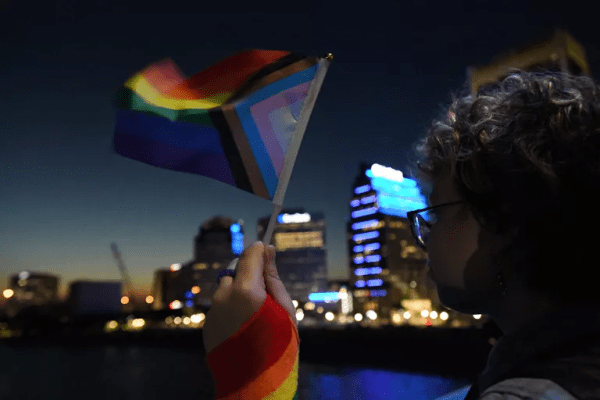
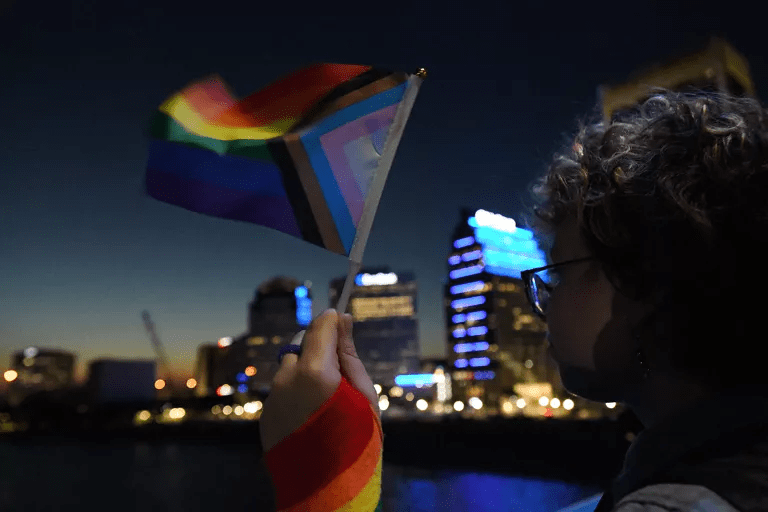
After Florida Republicans tried unsuccessfully to pass a law banning government buildings from flying Pride flags earlier this year, several cities around the state hoisted the rainbow stripes over the weekend to mark the start of Pride Month.
Late last year, state Rep. David Borrero (R) introduced legislation aimed at banning flags “that represent a political viewpoint, including, but not limited to, a politically partisan, racial, sexual orientation and gender, or political ideology viewpoint.” House Bill 901 would have prohibited such flags from being displayed not only at schools but also above government buildings and universities.
But the bill died during the most recent legislative session, leaving local governments free to fly Pride flags this month.
On Friday, the city of St. Petersburg got an early start to Pride Month by raising the Progress Pride flag at City Hall. U.S. Rep. Kathy Castor (D-FL), state Reps. Lindsay Cross (D) and Michele Rayner (D), Mayor Ken Welch (D), and the St. Petersburg City Council attended the flag-raising ceremony.
“Together, by raising the Pride flag at City Hall, our city boldly and unapologetically acts on its commitment to inclusivity, the celebration of diversity, and the simple but profound idea that people should have the freedom to love who they love,” Cross said. “This is in stark contrast to attempts at the state level to stifle our celebrations and to dim the light of beautiful members of our community.”
Cross noted the proposed flag ban and her vote against it. “Gratefully, due to the loud and proud voices that opposed the bill, it did not pass,” she said. “So, this year, as we stand under this Pride flag, we celebrate this small but important victory. Because we should not live in fear of repercussions from safe self-expression.”
“This marks the beginning of a celebration for equal rights for all across St. Petersburg, and I hope it stands as a beacon for the rest of the state and the entire country,” Castor told the crowd.
On Saturday morning, nearly 100 people gathered to see the Progress Pride flag hoisted above the Gulfport Public Library in the city of Gulfport, Pinellas County. The ceremony was attended by Vice Mayor and City Council member Ian O’Hara, members of the city council, Pinellas County Commissioner Charlie Justice, Pinellas County School Board member Caprice Edmond, Gecko Queen Robert Daunch, and candidates for Florida’s 13th Congressional District Whitney Fox and John Liccione.
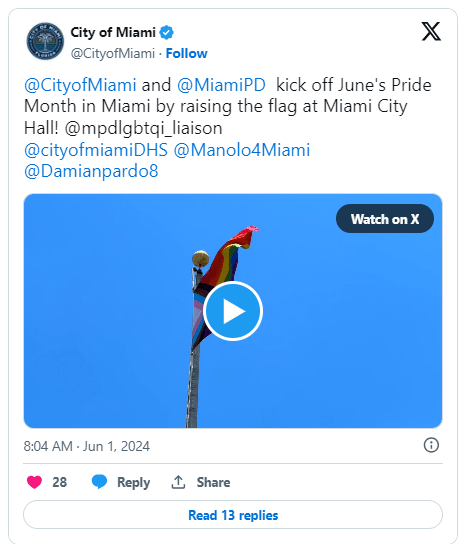
The same day, the City of Miami raised the Progress Pride flag over its City Hall. “It’s important to understand that it’s a celebration because of how far the LGBTQ community has come,” Commissioner Damian Pardo said in a video posted to the City of Miami’s official X account. “It’s incredibly important to thank the city of Miami for creating a safe space for us in the LGBTQ community.”
The flag-raisings continued on Monday in Tampa and Orlando.
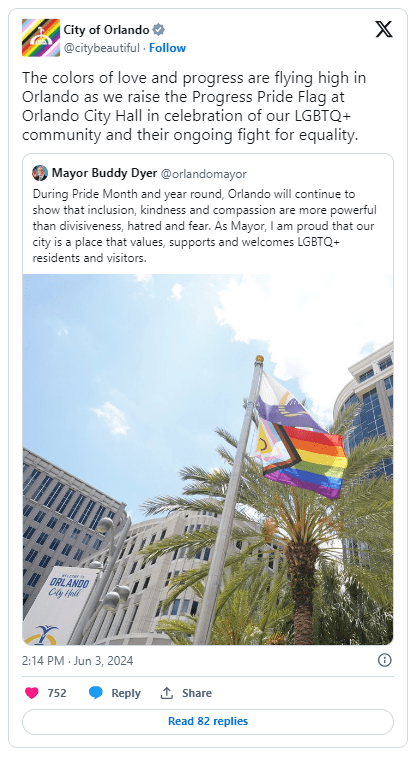
“During Pride Month and year-round, Orlando will continue to show that inclusion, kindness, and compassion are more powerful than divisiveness, hatred, and fear,” Orlando Mayor Buddy Dyer wrote in an X post, along with a photo of the intersex-inclusive Progress Pride flag flying over City Hall. “As Mayor, I am proud that our city is a place that values, supports, and welcomes LGBTQ+ residents and visitors.”
“The colors of love and progress are flying high in Orlando as we raise the Progress Pride Flag at Orlando City Hall in celebration of our LGBTQ+ community and their ongoing fight for equality,” read a post on the city’s official X account.
In Tampa on Monday morning, Mayor Jane Castor (D) gave a brief history of the original rainbow Pride flag’s origins before raising the rainbow-striped flag above the city’s Old City Hall.
“It really is a wonderful definition and proclamation of our community and the pride that we have,” Castor said of the flag. Members of Tampa’s LGBTQ+ community “are our police officers, our firefighters, our paramedics, the individuals that protect our country down at MacDill Air Force Base, they are our teachers, our nurses. They are our neighbors, our friends, and our family. It is our community, and we’re very, very proud of that.”
Castor also called on those gathered to “continue to stay focused on ensuring that everyone is treated with dignity and respect” in the face of the recent rise in anti-LGBTQ+ rhetoric in Florida and across the nation.
On Tuesday morning, Miami-Dade County Mayor Daniella Levine Cava (D), County Commissioner Eileen Higgins, and other local leaders will raise the Pride flag about the city’s Stephen P. Clark Government Center. According to a press release, this will mark the fourth consecutive year that the Miami-Dade County government has raised the Pride flag “to reaffirm our commitment to making Miami-Dade an inclusive, welcoming County that celebrates our rich diversity.”
Four anti-trans bills are the target of the protests, which call for the governor to veto them.
Protests over measures that target transgender people erupted in front of the New Hampshire State House on Wednesday.
With posters like “Let Trans Kids Live” and “#letkidsplay,” the activists formed a line outside the building in an attempt to persuade Governor Chris Sununu (R) to veto four measures that pose a threat to transgender adolescents.
Grace Murray, Political Director of the New Hampshire Youth Movement, stated, “Back in 2018, Gov. Sununu chose to do the right thing and protect trans people in NH from discrimination.” She was alluding to the year that Sununu signed HB 1319, an anti-discrimination bill, into law. “It’s time for him to do the right thing again and veto these bills now that several horrifying, discriminatory pieces of legislation have reached his desk,” Murray continued.
Murrau went on, “NH is the ‘live free or die’ state, and those values should apply to everyone.” “Transgender individuals ought to be free to live in this state without having their rights violated on a regular basis. Gov. Sununu must veto these legislation in order to protect the liberties that we value highly in New Hampshire.
Alissandra Murray, a Democratic state lawmaker, told NBC 5 that “we need him to know that he needs to stand up like he did in 2018.” He asserted that acting in that manner was morally correct both then and now.
The governor allegedly received a petition from the protestors, but he declined to meet with them. The demonstrators were forced to go inside the building in response to his denial in order to keep calling for him to veto the laws.
Speaking to NBC 5, Sununu stated, “I think the voices around fairness and safety are being heard not just here in New Hampshire, but all across the country.” And this is something we’re going to treat with extreme seriousness.
A measure called HB 1205 would prohibit trans girls from participating in girls’ sports from the fifth to the twelfth grades. The law would demand birth certificates as verification of the biological sex of student-athletes. Additionally, kids and families who think a transgender athlete plays for a girls’ team would be able to sue the state and school under the proposed law.
The mild “Don’t Say Gay” bill, HB 1312, requires teachers to provide parents with a two-week notice to opt out of any curriculum that includes references to “sexual orientation, gender, gender identity, or gender expression.” The measure designates this content as “objectionable.”
Gender affirming surgery is prohibited for minors under HB 619. Notably, gender-affirming procedures are nearly never performed on minors, unless, following years of medical treatment, both parents and doctors determine that the procedure is medically essential.
In a single day, these three bills were passed.
The most recent bill to reach the governor’s desk is HB 396, which would practically forbid transgender persons from using public restrooms and threatens to revoke the legal status of transgender people. Many are worried that this measure undoes some of the non-discrimination provisions of HB 1319, a bill from 2018.
Regarding LGBTQ+ rights, Sununu has a conflicted past. She has blocked anti-trans measures in the past and opposed a plan that would have made legal transitioning easier.
“I fundamentally don’t believe that biological boys should be competing in girls’ sports,” he stated in March. I believe it to be risky.
His vote on these proposals is still up in the air.
According to Ezra Brown, Community Press Liaison for the New Hampshire Youth Movement, “the people want Sununu to keep his word.” “He made it very clear in 2018: It is morally right to defend the rights and safety of trans people.”
“We implore him to veto these harmful bills as written. We will never forget what he does for us right now, nor what he did for us in the past. The populace remembers things well.
Conservative activists in California are frustrated that their bill, which would have mandated that schools accept transgender students, did not receive enough signatures to be included on the ballot in November.
“We would have easily qualified for the ballot if we had a little more time and a little more money,” the initiative’s leader, Roseville school board member Jonathan Zachreson, told the LA Times.
If the bill had been approved, schools would have been obligated to notify parents if a student adopted a new pronoun or nickname while attending class, or if they requested to use facilities unrelated to their official sex. The bill also forbade the state from providing kids with care that is gender affirming.
Although some states have already implemented similar policies, California has traditionally supported young people who identify as transgender. Governor Gavin Newsom (D) signed legislation in 2022 designating the state as a safe haven for transgender minors and their families.
According to Zachreson, the measure’s campaign gathered $200,000 to assist in obtaining the 546,651 signatures required for it to be placed on the ballot. However, the campaign had only collected 400,000 signatures before yesterday’s deadline.
The activists wanted the ballot measure to be named the “Protect Kids of California Act of 2024,” despite the fact that their initiative would have jeopardized the safety of trans children with unsupportive parents who might abuse or kick them out of the house if they discover they have not been adhering to their assigned sex while attending school. Earlier this year, the activists sued California Attorney General Rob Bonta (D) for naming their ballot measure the “Restricts Rights of Transgender Youth Initiative.”
The judge dismissed the case after originally siding with Bonta, stating that the measure’s name, “Restrict Rights of Transgender Youth Initiative,” accurately describes it.
LGBTQ+ activists, meanwhile, applauded the measure’s defeat.
Equality California Executive Director Tony Hoang released a statement saying, “We are relieved that anti-LGBTQ+ extremists have failed to reach the required signature threshold to qualify their anti-transgender ballot initiatives to the November 2024 ballot.” “Equality California will not stop fighting for the rights of LGBTQ+ youth around the globe and opposing any and all attempts by radical organizations to discriminate against them.”
Once the death threats began, the drag queen felt she had “no choice” but to file a lawsuit.
The right was protesting drag shows across the nation during Pride Month in 2022, calling the queens “groomers” and worse. To “prove” that drag queens shouldn’t be permitted to perform in public, conservative influencer Summer Bushnell shared a doctored video of a drag queen purportedly exposing herself to children.
She is now required to pay $1.1 million in damages for slandering drag performer Mona Liza Million, who, when not in drag, goes by Eric Posey.
In 2022, Bushnell wrote on Facebook, “Why did no one arrest the man in a dress who flashed his genitalia to minors and people in the crowd?” in reference to Posey’s Pride performance in Idaho. “There is video and no one commented on it. I’ll provide a hazy video to demonstrate it.
It turns out that the reason “no one said anything about it” is that it never did. Posey was completely clothed in the “blurred video” she shared, but it was obscured enough for the thousands of viewers to miss that fact.
After reading Bushnell’s post, people began reporting Posey to the Coeur d’Alene, Idaho, police. None of the allegations, according to the police, came from anybody who were present while Posey performed.
The City of Coeur d’Alene Prosecuting Attorney’s Office issued a statement following their assessment of the original, unblurred footage, stating that the evidence did not support the charges of indecent exposure or other crimes. As a result, prosecution is dismissed.
However, that did not quiet the internet backlash. Posey said at trial that he got death threats and that images from Bushnell’s doctored video of him became a symbol utilized by the right in their quest to get drag shows outlawed.
Conservative influencers such as Chaya Raichik, the creator of Libs of TikTok, have dedicated their careers to accusing LGBTQ+ individuals, particularly drag artists, of “grooming” youngsters. However, Bushnell’s attempt to make the same accusation was met with opposition. Posey made the decision to sue her for slander.
In September 2022, he stated in a press statement, “It is now my turn to speak after three months of silence.” “Provocateurs have persisted in circulating the manipulated video of my performance even after I was found not guilty, spreading hate speech against the LGBTQIA+ community throughout the state and damaging my reputation.”
“I am forced to pursue legal action in order to punish the people who spread the lies accountable for their deeds. I’m hoping that this civil lawsuit will end the divisive misinformation efforts being carried out in Idaho.
This summer, Coeur d’Alene’s Pride in the Park garnered national notice when police detained 31 members of the Patriot Front, a group that supports white supremacists, as they attempted to disrupt the celebration. Bushnell, according to Posey, tried to take advantage of that attention.
Bushnell’s attorney attempted to claim that although his client’s acts were “almost” defamatory, they didn’t quite fit the criteria.
Bushnell’s admission that she never saw Posey expose himself was even worse for the defense. In other words, she knew she was lying and wasn’t in error.
After the decision on Friday, Posey declared, “The judicial system did what needed to be done.” Imagine yourself alone and in a dark hole, feeling as though everyone is ignoring you. However, you found yourself surrounded by warriors—true Idahoans, not transplants—who were native to this land. I am lucky to be surrounded by those who have encouraged and uplifted me.
The jury debated for three and a half hours this past Friday during the five-day trial, according to The Guardian. The judge informed the jury that they were unable to compel Bushnell to remove the Facebook post and issue a public apology. The video is still accessible on the social media network.










You must be logged in to post a comment.