For seven months, Red Oak ISD was a sanctuary for Rosalyn Sandri. She described it as a place where she pursued her lifelong dream of being a teacher.
But today, she’s no longer in the classroom.
Sandri, an English teacher, shared a video on TikTok talking about how her students had embraced her pronouns and showed respect by addressing her as “ma’am.”
“When I told them I changed my pronouns, they jumped right into it,” she said on Tuesday.
But Sandri said when the post was reposted on X, formerly known as Twitter, by the account Libs of TikTok, it went viral, racking up 3.2 million views.
That’s when the backlash began.
Sandri said she began receiving death threats and hateful emails, even through her school email account.
“I got a notice that told me to eat a bullet,” she said.
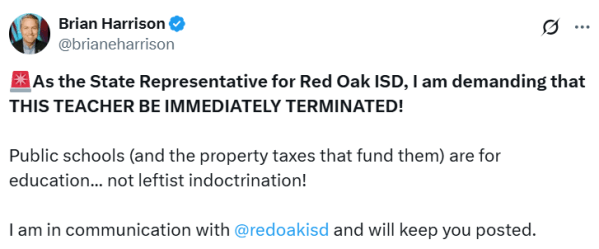
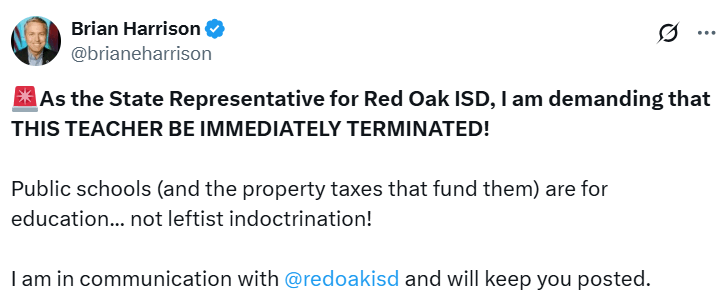
The video also caught the attention of Texas State Representative Brian Harrison, who publicly called for her resignation.
“Schools are for education, not indoctrination,” Harrison said over Zoom on Tuesday.
“Teaching children, minors, that boys can become girls, and girls can become boys is at odds with objective reality. And the biological reality is that there are only two sexes,” said Harrison.
In a statement to WFAA, Red Oak ISD confirmed that Sandri resigned effective immediately on Monday, March 31.
“In light of recent attention, Red Oak High School English teacher Sandri has resigned, effective March 31, 2025. Any other information is a personnel matter, and we are not at liberty to discuss.”
Sandri said she felt she had no choice but to step away for her safety and the safety of the school and students.
“When I resigned, I felt like I was signing away my ability to teach in the state of Texas. I don’t know that another school will touch me now,” she said.
“Being a teacher is all I ever wanted to do since I was five years old,” she said.
Karma Yoakum had been part of a community of political activists in Texas for years. However, as the relentless tide of anti-trans legislation kept rising, it became clear that it was time for them to relocate, recover their energies, and take on a different role in the larger fight.
Finding a new home in the Pacific Northwest, Karma was able to do just that. But the road wasn’t without its challenges, and finding their new community required intention and perseverance once they had recovered a little bit of who they were by living in a state that wasn’t trying to persecute them for their existence.
As anti-trans sentiment and legislation have been on the rise across the United States in recent years, many trans and nonbinary people have made the difficult decision to flee red states. In moving to a bluer state, trans people are making a choice based on safety, but that doesn’t make it an easy choice. It means leaving behind a home and community you have built over years or your whole life because of the machinations of people who hate you. While a new state can fix a lot of problems, building a new community doesn’t happen overnight. The president’s re-election and the introduction of federal anti-trans bills have created a flashpoint for even more trans people to seek safer pastures in states that might protect them.
I wanted to understand the challenges and opportunities that trans people face when starting over and building a new community in a blue state. I spoke with four trans and nonbinary people who have relocated in the last six to twelve months. They shared the challenges, the successes, and advice for others who are considering relocating to a sanctuary state.
Why trans people are leaving their red state communities
Major relocations often happen around an institution, such as going to college or starting a new job. But moves like those come with some built-in community-building support.
Relocating as a refugee from a red state can be a more lonely affair. Most of the people I spoke with found that building a new community felt like work exacerbated by not having the same connections and support systems they had in the communities they left behind.
Clark Roman had been well-established in St. Louis. Both Clark and his boyfriend had owned their own houses and had a strong community of friends and chosen family in the city. But he says he saw the writing on the wall in 2023 when the Missouri attorney general enacted a de facto ban on trans hormones and trans healthcare that included adults. While his emergency rule was blocked by a judge and then withdrawn, the legislature went on to pass a gender-affirming care ban for trans youth. It was clear where things were headed, and Clark moved to Minneapolis a few months later.
Leaving behind a large community, both queer-centric and otherwise, Clark has found it hard to make more connections in his new city. At the center of it is the challenge of the modern age: balancing work and social life. “The honest truth is I have a very, very stressful job and I have not had the space in my life to build community the way I want.” He noted that it felt like he had to “treat building a new community as a second job.”
Karma also struggled to make connections when they first relocated from Texas to Washington state. After living in Texas for years, they reached a point where they found themselves saying, “I’m feeling scared and trapped and there’s absolutely nothing keeping me in Texas anymore.”
Karma moved 2,000 miles to Seattle but found a problem when they arrived. While their new home was more welcoming to the gender diverse, there was still culture shock to get over. “Where is everybody? I heard it was this wonderful panacea, a place where I would be welcomed. So, I looked around and I learned what the Seattle chill was. And it’s not a horrible thing, it’s just a difference in culture, because I’m used to southern culture.”
Chris (his name has been changed to protect his privacy) echoed Karma’s frustrations over Washington state’s laid-back attitude to building community. Like Clark, Chris was living in St. Louis, saw the anti-trans legislation in Missouri in 2023, and concluded that “living in Missouri as a trans human, [he] was at risk.” He made the move to Washington state in 2024 while watching the coming election without much hope.
While St. Louis had its flaws, Chris was leaving behind a lot of queer community and resources. He had worked with the St. Louis Metro Trans Umbrella Group for nearly 20 years, enjoyed events and meetups, and collected queer friends through meets at clubs, bars, and drag shows. But the same culture shock that Karma experienced has made it hard to build new connections: “It’s been honestly a huge struggle, much more than I anticipated.”
While it’s important to know that people are struggling with finding new communities in their new states, it’s not all doom and gloom. Clark and Chris have both been able to stay in touch with parts of their communities from before their moves through travel and online communication. While that’s not always the same, it’s a nice option to have. I also spoke with Mira Lazine – an LGBTQ Nation contributor – who relocated from Cincinnati to Minneapolis and had a different sort of experience.
While the Ohio governor vetoed HB 68, which banned gender-affirming care for minors, he then introduced care guidelines for the state. “These rules were basically going to amount to a total care ban for all adults in Ohio,” explained Mira. “And it even would include some aspects of conversion therapy and mental health treatment.”
It was time to relocate, and someone recommended Minneapolis. For Mira, finding a new community in this queer-friendly space came a lot easier.
“Within the first week of moving here, I went to a few coffee shops, and everyone, like the baristas, were trans, and they were recommending me support groups to join, discord servers I can join, like the whole nine yards. And it’s just been way easier to meet people and meet other queer people and form connections here.”
While Karma and Chris suffered from culture shock, Mira found herself among other transplants to the state who had their relocation in common: “Probably like 80% of the queer people I’ve met aren’t originally from Minnesota, so we’re all like, yeah, we need community, let’s build one.”
Finding new communities in blue states
All of the people that I spoke with had been in their new homes for less than a year. While there have been struggles, they have been able to find resources and spaces to start that community-building process and are in different places in their journeys.
Clark noted that his struggle to find community in Minneapolis is probably the biggest dissatisfaction in his life right now. But he can see a light at the end of the tunnel through some of the community spaces that he is attending. “The synagogue I go to is very open and trans-friendly. So that was helpful.” Clark is also looking at getting more involved with Transplants, a group for LGBTQ+ people who have relocated to Minneapolis and St. Paul.
Chris has found that his work at a university in Washington provides some space for community building. “Their DEI office held a holiday event for, I guess, everyone, but the folks who showed up to that event were primarily queer folks and persons of color. And that was fantastic.”
Chris still faces challenges, even at the events. He told me that he has been going to meet-up groups, Portland Pride, the Ingersoll Gender Center, and more, but he wasn’t satisfied with the results. Chris suggested that part of that problem might be visibility: “I am stealth, so at my workplace, I’m not fully out [as trans]. Where I landed is sort of a purple city in a blue state. I’m typically able to pass as male and not be questioned at all, which is, is nice, but at the same time, it’s hard because I think visibility might help me connect with more queer people.”
For Karma, their initial struggles with community-building in Seattle began to bear fruit around the one-year mark. “I did the things that I’ve tried before, and I figured, if they’ve worked everywhere else, they ought to work here. Maybe it just takes a little longer. And yeah, that was it. It takes a little longer.”
Karma found that organizations were the key. They found like-minded people when they returned to playing music with the local band that is part of the LGBTQ+ band organization, Pride Bands Alliance, an international group that Karma has worked with since the 1990s. Similarly, local chapters of a national support network have provided success in community building: “PFLAG, all you have to do is show up to a meeting. There are people there that if you need a hug, they are instant family. And people that aren’t instant family are there because they want support.”
Karma also reached into her past in political activism and found that, post-move, they had the energy to continue in their new home. “The third place that I decided to get involved was the Gender Justice League. Dealing with legislation, dealing with victims of violence here in the Seattle area. So, supporting our community, advocating like crazy.” After months of struggling to find their people, Karma now finds that barely a day on their calendar doesn’t include a community event, a catch-up, or a coffee meet.
No regrets
Everyone’s experience with relocating to a bluer state will be unique. However, there was one ringing agreement amongst all the people that I spoke with: no regrets. When asked what advice they had for someone considering a move, Clark, Chris, Mira, and Karma all urged people to relocate if they felt it might help.
Clark grieves what he left behind but recognizes that it was the right call for him, and he’s going to keep trying to find his new community. “I think it’s dissatisfying at first. But it’s important to [show] up repeatedly because I think that repeated showing up [is] how I made my community originally in St. Louis.”
Chris echoed those sentiments, noting that he has no regrets and that it has been “completely worth it.” Watching recent election results come in wouldn’t have been fun anywhere, but he was glad to be in a safe space for it all “despite challenges and some loneliness.”
Karma isn’t even considering going back. “I would say do it. The relief that I felt by at least being in a community where I know that I’d no longer have to deal with local politics.”
“In Texas, the local politics were against me,” they said. “At least here, I know locally and statewide, my representatives really do represent everybody, and they have my back. And that has made so much a difference in my life.”
Florida state Republican lawmakers have advanced a bill that would allow public employees and state contractors to openly discriminate against LGBTQ+ co-workers without fear of punishment.
The so-called “Freedom of Conscience in the Workplace Act” (S.B. 440) would forbid public employers from requiring workers to use transgender people’s personal pronouns and forbid employers from punishing any employee for expressing “a belief in traditional or Biblical views of sexuality and marriage, or … gender ideology.”
The legislation would also remove “nonbinary” gender options from employment forms and forbid any entities from requiring workers to undergo LGBTQ+ cultural competence training. The bill would not apply to private employers.
“The bill really does promote government employees and contractors to harass transgender individuals by allowing them to intentionally misgender them by using disrespectful pronouns and having no consequences,” Florida state Sen. Kristen Arrington (D) said, according to Advocate. “And this is a license to discriminate free from accountability.”
The Senate Government Oversight and Accountability Committee initially declined to vote on the bill last week after receiving hundreds of comment cards opposing it. However, the committee ultimately voted 5-2 along party lines to advance it. It now heads to the state’s Senate Judiciary Committee for consideration.
Florida resident Claudia Thomas, the first out gay commissioner of Sanford City, said the bill insults LGBTQ+ people like her and wastes government resources, Florida Politics reported.
“I would love to get back to trying to solve my city’s problems about water, clean water, housing, etc,” Thomas said. “And if I have to start wasting my time talking about pronouns and people not respecting my friends, it would make me sad.”
One bill would ban local governments from enacting diversity, equity, and inclusion (DEI) policies (including any recognition of Pride Month) by defunding these initiatives and removing local officials who promote them. Another would prohibit any taxpayer funds from supporting DEI initiatives in state agencies, among state contractors, or grantees.
Yet another bill would ban Pride flags on government property, and another would restrict the ability of people under the age of 18 to seek reproductive healthcare without parental consent.
However, Democratic lawmakers have also introduced legislation that would formally repeal the state’s ban on same-sex marriage, repeal the so-called “Don’t Say Gay” law, which forbids instruction on LGBTQ+ issues in K-12 schools, eliminate so-called “LGBTQ+ paníc defenses in queer-bashing criminal cases and restore parents’ rights to access gender-affirming care for trans kids.
Kentucky’s legislature has overridden Gov. Andy Beshear’s veto of a bill that allows conversion therapy to resume in the state and that bans Medicaid funds from being used for gender-affirming care, including for adults. Beshear also allowed a bill banning incarcerated people from receiving or continuing to receive publicly funded gender-affirming care to pass into law without his signature.
On Wednesday, the Kentucky House and Senate, which are both controlled by Republicans, voted to override Beshear’s veto of House Bill 495, per the Lexington Herald-Leader. The bill reverses the governor’s September 2024 executive order, which banned so-called conversion therapy from being practiced on youth in the state. Though HB 495 was originally only meant to roll back the ban on the harmful, discredited practice, the bill was additionally amended to add a ban on the use of Medicaid funds for gender-affirming care for trans adults, per the Herald-Leader. HB 495 has an emergency clause, meaning that it takes effect immediately. According to the Kentucky Lantern, the House voted to override the veto 78-20, and the Senate voted 31-6.
However, Beshear did not veto Senate Bill 2, which bans gender-affirming care for incarcerated trans people. At a press conference in December, Beshear stated that “convicted felons do not have the right to have any and all medical surgeries paid for entirely by tax dollars, especially when it would exceed the type of coverage available to law-abiding citizens in the private sector,” according to The Hill. As the publication noted, though, the state has never provided a gender-affirming surgery for an incarcerated person. Even so, gender-affirming care, including surgery, is medically necessary. As the ACLU’s Chase Strangio told Them in September, “Courts have consistently held that blanket denials of medical care, including medical treatment related to gender dysphoria, are unconstitutional,” since the denial of that care could violate the Eighth Amendment, which prohibits cruel and unusual punishment.
According to the Kentucky Lantern, there are only 67 trans people incarcerated in Kentucky prisons, all of whom will be forced to stop gender-affirming hormone therapy if that care is paid for with public funds. At a February hearing, Louisville psychologist Jacks Gilles testified against the bill, stating that stopping that care “will result in negative outcomes, including increased anxiety, disturbances in social and familial relationships, depression, suicidality and death,” according to the Lantern. “Gender-affirming medical care is not experimental, it’s not elective, and it’s not cosmetic,” Gilles said.
Beshear has previously been hailed as an outspoken advocate for the trans community. In a November 2024 op-ed for the New York Times, the governor pleaded with his fellow Democrats to not scapegoat trans people for the party’s loss. Though the legislature overrode his veto, in 2023 Beshear did attempt to put a stop to a wide-sweeping anti trans bill that banned minors from receiving gender-affirming care, prohibited trans kids from using the bathrooms that align with their identities at school, and banned discussion of LGBTQ+ topics in elementary schools.
In a statement posted to Facebook, Chris Hartman, the executive director of statewide LGBTQ+ advocacy organization Fairness Campaign, called the passage of the bills “a sad day in Kentucky.”
“Two anti-LGBTQ+ bills will become law with devastating consequences for our community,” he said, calling both bills “cruel” and that they “have no place in our Commonwealth.”
Finnish Prime Minister Petteri Orpo (NCP) has told the Uutissuomalainen news group that he considers it unlikely a proposal to ban conversion therapy will move forward during his government’s term in office.
Conversion therapy is the practice of attempting to turn members of sexual minorities into heterosexuals using a variety of different methods. The practice is usually carried out by priests, pastoral care workers, youth workers and others in some conservative religious communities.
Among Finland’s coalition government’s parties, the ban was supported by the NCP and the Swedish People’s Party, while it was opposed by the Finns Party and the Christian Democrats.
“Since there is no government programme document about the matter, and government parties do not share a unified position about banning conversion therapy, I do not believe the matter will progress during this governmental term,” Orpo told Uutissuomalainen, according to the news group.
Justice Minister Leena Meri (Finns) said on Friday that the justice ministry does not have time to prepare legislation to ban conversion therapy, as there is a long list of projects listed in the government programme that are waiting to move forward.
Ohio’s “Parents’ Bill of Rights” won’t go into effect for two more weeks, but House Republicans are already proposing amendments, including one that would penalize districts that used students’ chosen names and pronouns without parent permission.
Reps. Jonathan Newman (R-Troy) and Josh Williams (R-Sylvania Township) introduced House Bill 190 on Monday, which would require public schools to have parent permission to refer to a student by a name or pronoun that differs from what is listed on their birth certificate. Schools that violate the “Given Name Act” would be denied state funding and open themselves to lawsuits.
“It’s to make sure that parents can exercise, reconstitute the right to control the upbringing of their children, even inside of school buildings,” Williams said.
The bill also bans public school employees or contractors from requiring students or staff to respect students’ chosen names or pronouns. Even with parent permission, schools would not be allowed to subject staff or students to “adverse action” for declining to use a student’s preferred name and pronouns.
Although students older than 18 could personally request to be addressed differently under HB 190, teachers could not. The proposed bill would ban school employees from sharing their pronouns or titles if they differ from what is listed on the employee’s personal birth certificate. Williams said requiring students to use teachers’ pronouns makes young students affirm that genders can be changed.
After Florida enacted a similar ban in 2023, the state faced lawsuits from transgender and gender variant teachers, including high school teacher Katie Wood. A federal judge issued a preliminary injunction that said the state’s ban on preferred pronouns violated Wood’s First Amendment rights, and a federal court heard oral arguments in October 2024. However, the court withdrew its interest in the case on Feb. 26, before a ruling was issued.
The law would not apply to derivatives, or generally accepted nicknames, of birth names. For instance, if director Spike Lee were an Ohio student, he could be called Shelton or Shel, from his given name Shelton Jackson Lee. However, he would need written permission to be called Spike under HB 190.
“We’ve got big problems and issues to deal with in our schools, in higher education,” Ohio House Minority Leader Rep. Allison Russo (D-Upper Arlington) said. “What we’re seeing and this sort of going back to pronouns and attacking diversity, equity and inclusion, it’s a distraction.”
The Given Name Act also establishes a complaint system through the Department of Education and Workforce. If the department determines a school district violated the law, the state would then withhold 10% of the school’s funding every month until the state determined they were now compliant. The bill also allows families to sue for monetary relief if a district or staff member knowingly violates it.
“There’s always discretionary funds that the Supreme Court has noted that we provide to school districts that we’re not constitutionally required to provide,” Williams said. “So that’s a funding mechanism that if school districts don’t want to comply with state law, there has to be some repercussions.”
HB 190 would update the Parents’ Bill of Rights, which will go into effect on April 9 and already requires schools to alert parents and guardians if a student requests to go by a name or pronoun that is different from what was assigned at birth.
Columbus City Schools students with preferred names in the district system had their names reverted back to what is on their birth certificate.
This mainly affected transgender and nonbinary students, and they were not notified that this was happening.
Students and teachers were caught off guard on March 19 when attendance was called and they realized preferred names were changed in the district’s system, called Infinite Campus.
“He found out about the rescinded name change policy at school,” one parent with a transgender son said. “His fourth-period teacher advised him to go to the office because his preferred name was not listed in Infinite Campus. My son started to go to the office and in a panic ran to the bathroom to call me at work.”
“To have that happen on such a grand scale and to not even see it coming, I don’t think that there are any words to describe the feelings that folks had when that happened,” said Izetta Thomas, the lead organizer with the Columbus Education Justice Coalition.
Thomas said she has been talking to parents and students since the day of the change.
“Those names that were in the system were actually there with parent consent and permission, because there was a form that parents had to fill out for that change to even be in the system at all,” Thomas said.
The parent said the past few weeks since the name changes have been long and difficult for their son and their family.
“My son has not physically been back to school since March 19,” the parent said. “For his safety, we unenrolled from his previous school. Now, his educational opportunities have been taken from him.”
Columbus Schools Superintendent Dr. Angela Chapman sent out a letter to students, parents and staff on Friday acknowledging that no warning was given. In the letter, Chapman said in part, “We did not provide prior notice this was occurring, nor did we ensure support was in place to prioritize the emotional well-being of everyone impacted.”
Chapman also apologized for how the district handled this situation.
The letter cited recent Ohio laws like the bathroom bill and the Parents’ Bill of Rights as reason why the names were changed, but Thomas said that none of these laws require school districts to revert trans students’ names.
“A lot of the information that we’ve been getting from folks at the district is that it was anticipatory,” Thomas said. “An apology is not enough. An apology is not accountability, and that’s what we’re looking for, is accountability.”
The parent did say Chapman called them personally to apologize, but they said she offered little in solutions.
Thomas said a number of people from the Columbus Education Justice Coalition will be at the next Columbus Board of Education meeting to show their support for impacted students and families.
Scrolling through Facebook is sometimes repetitive, thanks to an algorithm that feeds you what Mark Zuckerberg thinks is best for you. Sometimes, you get pleasantly surprised by pages that seemingly post things out of nowhere you would not expect.
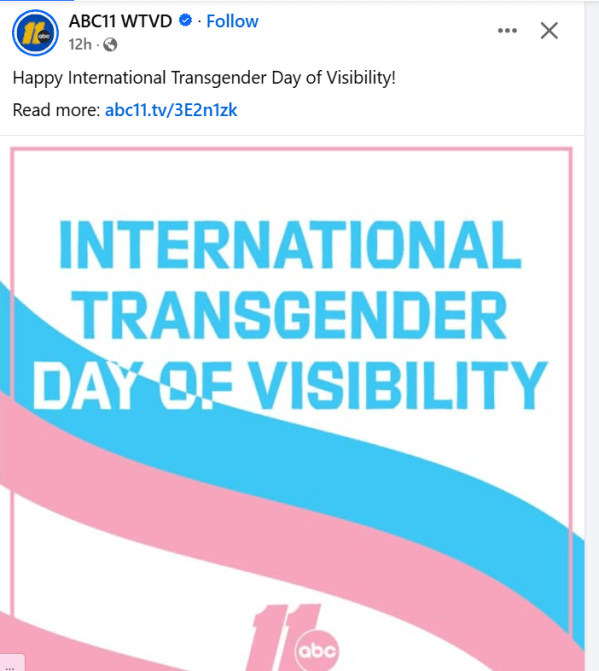
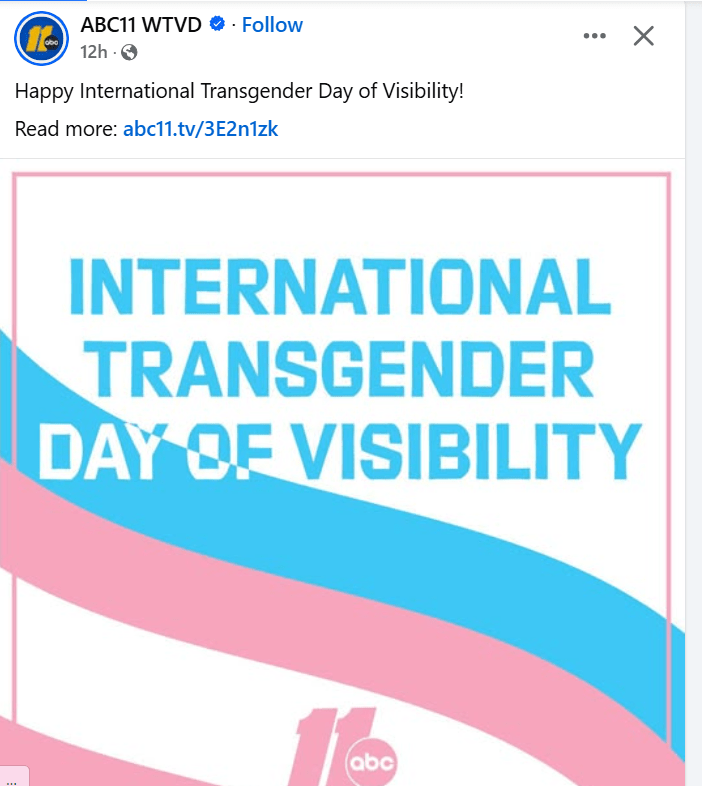
March 31 is the International Transgender Day of Visibility. You might expect the usual suspects, like HRC or your local LGBTQ organization to acknowledge it– maybe even hold a vigil. But would you expect a mainstream TV channel to post about it? And not just for the news of the day itself?
Local Raleigh North Carolina ABC affiliate channel 11 WTVD posted a Facebook message and photo wishing everyone a happy International Transgender Day of Visibility. The post then oddly links to a cushy story about a troupe of trans and nonbinary folks who are running an improv show in Hollywood at the Upright Citizens Brigade. Personally, I would have preferred a story about transgender folks in North Carolina and what they go through on a daily basis. But, we got something, dammit.
As one would imagine, the post has also earned over 11,000 comments and 16,000+ reactions. They go both directions and if you would like to read them you can on their Facebook post. Showing support as you read by clicking like or love, and a positive comment, would also be appreciated by many.
Texas Attorney General Ken Paxton announced in a press release today (Monday, March 31) that his office has filed a legal petition to “conduct depositions on key Dallas Independent School District officials as part of an ongoing investigation to ensure that the district is not violating Texas law by permitting biological males to participate in girls’ sports.”
In February, Paxton demanded that Dallas ISD turn over “extensive records … related to alarming evidence that the District had implemented an unwritten policy of encouraging students to alter their birth certificates to play sports in violation of the Texas law prohibiting a student from competing in interscholastic athletic competitions designated for the opposite biological sex.”
“Biological sex,” by the way, is the catchphrase that certain political elements living on the extreme right of the political spectrum to give a scientific-sounding cover for their basic transphobia. As Psychology Today notes: “What is biological sex? It seems like a question with an obvious answer: male and female, of course. You might point to internal or external sex organs, or sex chromosomes (XX for females, XY for males), or genes (such as SRY, the maestro responsible for kicking off male development).
“These answers are only part of the story — and they work well enough for most humans. But for all humans? Not quite. And when it comes to the rest of the biological world, those explanations crumble like sandcastles under the tide of nature’s diversity.”
But back to Paxton’s attack of the day: The AG’s press release says the list of individuals he intends to depose includes Dallas ISD Superintendent Stephanie Elizalde, LGBT Youth Program Coordinator Mahoganie Gaston and the members of the Board of Trustees.
Paxton claims that “Gaston has been filmed telling a parent that a male student would be allowed to participate in girls’ sports if the parent changed the birth certificate of their son to ‘female,’” that the district “find[s] the loopholes in everything” and that she is “willing to go to jail for defying Texas law.”
A statement attributed to Paxton in the press release declares, “School districts must follow the law, keep our children safe and end these insane ‘gender theory’ policies that ignore reality and encourage illegal actions. ISD officials who have participated in this madness will be held accountable.
“The systematic effort by Dallas ISD officials to circumvent Texas law will be exposed and stopped.”
Dallas Voice has reached out to Dallas ISD officials for comment.
(P.S. This press release came from the AG’s office on the same day Paxton sent a press release explaining how his office is going to make certain local district attorneys report to him so he can make sure they are doing things his way. We’re still waiting on a comment from Dallas District Attorney John Creuzot’s office for some sort of official response, but a quick Google search indicates that Ken Paxton has no supervisory authority of local DAs who, by the way, are themselves public officials elected by the public, same as Paxton.)
Trinidad and Tobago has reinstated its ban on homosexuality, which was lifted by the Caribbean nation’s High Court in 2018.
That year, the High Court in the Christian-majority nation ruled in a lawsuit brought by LGBTQ+ activist Jason Jones that Sections 13 and 16 of the Sexual Offenses Act are “irrational and illegal” because they violate the rights to privacy and freedom of expression.
“What I think the judge pointed out was ‘here every creed and race find an equal place,’ and I think we must all come together now and embrace each other in true love and respect,” Jones said at the time.
But on March 25, the Court of Appeals reversed that decision, saying that only Parliament can overturn the country’s ban on homosexuality. The Court of Appeals also reduced the maximum sentence associated with homosexuality to five years in prison. Prior to 2018, the maximum penalty was 25 years in prison.
“Judges cannot change the law,” Tuesday’s ruling states. “We give effect to Parliament’s intention…. It is, therefore, left to Parliament to repeal the criminalization of buggery and the related offense of gross indecency by legislation. It is an emotive issue which engages vibrant discussion in the court of public opinion.”
“Parliament is ultimately responsible for ensuring that laws reflect the evolving standards of a democratic society. That is their role and function. Any provisions found to be unconstitutional must be taken from the statute books by Parliament through legislative reform and not by judicial overreach.”
Jones spoke out against the Court of Appeals decision.
“We are talking about the rights of some 100,000 LGBTQIA+ citizens in [Trinidad and Tobago],” he told Trinidad and Tobago Newsday. “Why are we spending all this money and retaining these laws?”
“The modernization of our democracy is at stake here, and this is the beginning of this modernization.”
In the original 2018 case, religious conservatives argued that God’s wrath would be visited on Trinidad and Tobago if the anti-homosexuality laws were overturned. Conservatives argued that legalizing homosexuality would violate their religious beliefs.
The judge said the ruling “is not an assessment or denial of the religious beliefs of anyone.”
Christian conservatives also told the press that they’re worried about “homosexual rights trumping heterosexual rights.”
















You must be logged in to post a comment.