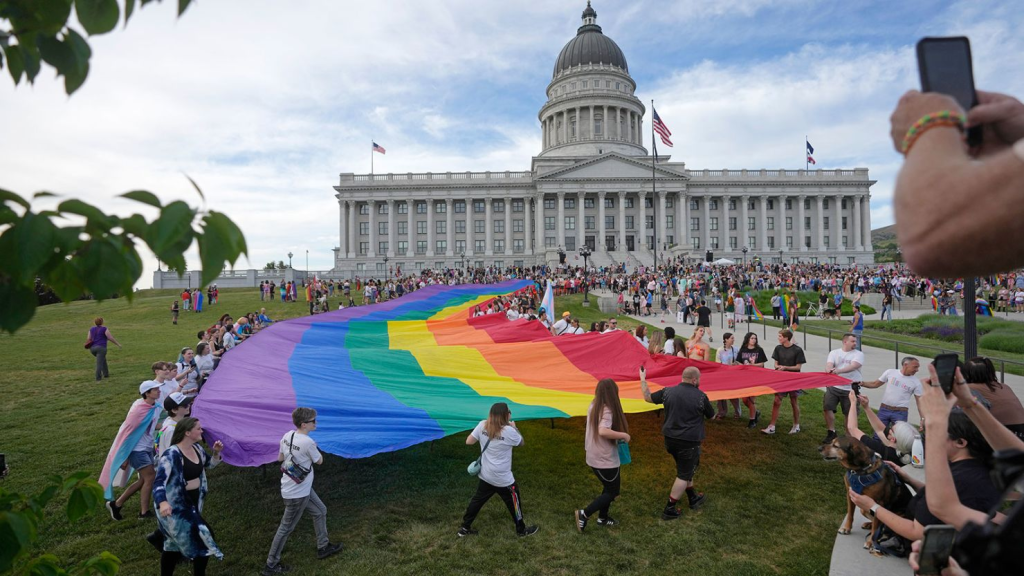
Utah became the first state to prohibit flying LGBTQ+ pride flags at schools and all government buildings after the Republican governor announced he was allowing a ban on unsanctioned flag displays to become law without his signature.
Gov. Spencer Cox, who made the announcement late Thursday night, said he continues to have serious concerns with the policy but chose not to reject it because his veto would likely be overridden by the Republican-controlled Legislature.
Starting May 7, state or local government buildings will be fined $500 a day for flying any flag other than the United States flag, the Utah state flag, military flags or a short list of others approved by lawmakers. Political flags supporting a certain candidate or party, such as President Donald Trump’s signature “Make America Great Again” flags, are not allowed.
The ban also prohibits teachers from hanging any restricted flag in their classroom.
The new law could stoke conflict between the state and its largest city. City buildings in liberal Salt Lake City typically honor Pride Month each June by displaying flags that celebrate its large LGBTQ+ population. Local leaders have illuminated the Salt Lake City and County Building in rainbow lights to protest the flag ban each night since the Legislature sent it to Cox’s desk.
Andrew Wittenberg, a spokesperson for Salt Lake City Mayor Erin Mendenhall’s office, said their attorneys are evaluating the law and the capital city does not yet have information on what it will do once the law takes effect.
The bill’s Republican sponsors, Rep. Trevor Lee and Sen. Dan McCay, said it’s meant to encourage “political neutrality” from teachers and other government employees. Opponents argued it aims to erase LGBTQ+ expression and take authority away from cities and towns that don’t align politically with the Republican Legislature.
In a letter to legislative leaders explaining his decision, Cox said he agreed with the “underlying intent” of the bill to make classrooms politically neutral but thought it went too far in regulating local governments. He also noted that by focusing narrowly on flags, the law does not prevent other political displays such as posters or lighting.
“To our LGBTQ community, I know that recent legislation has been difficult,” Cox said. “Politics can be a bit of a blood sport at times and I know we’ve had our disagreements. I want you to know that I love and appreciate you and I am grateful that you are part of our state. I know these words may ring hollow to many of you, but please know that I mean them sincerely.”
Cox’s decision came hours after the Sundance Film Festival announced it was leaving its home of four decades in Park City, Utah, for Boulder, Colorado. The flag bill created eleventh-hour tensions as some residents worried it would push the nation’s premier independent film festival out of state. Festival leaders said state politics ultimately did not influence their move from conservative Utah to liberal Colorado. They did, however. make “ethos and equity values” one of their criteria in a nationwide search for a new home and referred to Boulder in their announcement as a “welcoming environment.”
Utah’s flag law goes further than one signed last week in Idaho that only applies to schools. But Idaho Republicans are also advancing a separate bill to ban government buildings from displaying certain flags.
Florida lawmakers have advanced a proposal to ban pride flags and others that represent political viewpoints in schools and public buildings after similar measures failed in the past two legislative sessions. Some federal agencies, including the Department of Veterans Affairs, also have limited which flags can fly at their facilities.
Other flags permitted under the Utah law include Olympic and Paralympic flags, official college or university flags, tribal flags and historic versions of other approved flags that might be used for educational purposes.
The first nine residents of Mary’s House For Older Adults, D.C.’s first LGBTQ home for seniors, are expected to move into the newly built group home within the next week or two, according to Mary’s House founder and CEO Imani Woody.
Located at 401 Anacostia Rd., S.E. in the city’s Fort Dupont neighborhood, a write-up on its website says the house includes 15 single-occupancy residential units and more than 5,000 square feet of shared communal living space.
Woody said construction of the three-story house was completed in January and leases have been obtained by the first nine of the 15 residents, with the remaining six still available for interested seniors. She points out that Mary’s House, which is a nonprofit operation, is not an assisted living facility.
A large sign hanging near the top of the front wall of the Mary’s House building says, “Now Leasing! Single Bedroom Communal Living—LGBTQ+ Affirming Housing for Adults 62+”
The sign also includes the Mary’s House phone number and website address that Woody said interested seniors or those who may know a senior who would be interested should use to contact the LGBTQ supportive seniors residence.
Woody said each of the individual units or suites includes a sleeping area, living room, bathroom, and kitchenette with a sink, microwave, and refrigerator but no stove. According to the Mary’s House website, the shared communal areas of the house include a “fully equipped kitchen, separate dining area and living room.”
It says the communal area also includes a computer room, arts and crafts room, an exercise room, laundry facilities, community meeting space for gatherings, a “tranquil quiet room for relaxation,” and an outdoor terrace with seating.
Woody said the monthly rent for Mary’s House residents, depending on their income, is currently set at $812 or $886.
“Our mission extends beyond providing housing,” a statement on the Mary’s House website says. “We strive to build welcoming communities that address affordability, accessibility, and the unique needs of LGBTQ/SGL [Same Gender Loving] older adults.”
The statement adds, “Through health and wellness programs, connections to community services, and advocacy efforts, Mary’s House for Older Adults endeavors to ensure that all elders, regardless of identity, can enjoy fulfilling and secure lives in their golden years.”
Woody said a ribbon-cutting ceremony to celebrate the opening, to be led by D.C. Mayor Muriel Bowser is planned for early May, with a specific date to be announced soon.
Further information about Mary’s House, including a lease application, can be obtained at MarysHouseDC.org or at 240-972-2500.
The University of Michigan is immediately shutting down two offices and an effort dedicated to diversity, equity and inclusion, and shifting the resources to other student programs, university officials said Thursday, after the Trump administration had threatened to cut off funding.
The email announcement by top UM officials, including President Santa Ono, said UM is closing its Office of Diversity, Equity and Inclusion, the Office for Health Equity and Inclusion as well as discontinuing its DEI 2.0 Strategic Plan. The moves came as the university has taken other actions, such as ending diversity statements in faculty hiring, in a bid to stop “litmus tests” that restrict the diversity of thought.
It is unclear how many people are employed at UM in DEI work, but the conservative Heritage Foundation ranked UM in 2021 as having the most DEI staff members in the nation, with 163 employees. The regents told The Detroit News the number has since grown, but they are not sure by how much.
A report in 2024 by the New York Times on UM’s DEI initiatives estimated them to cost $250 million. UM Chief Diversity Officer Tabbye Chavous later said the New York Times story was “filled with misinformation, disinformation and, sadly, sexism.”
UM officials said Thursday they will shift the DEI resources to programs for students, “such as financial aid, mental health resources, pre-professional counseling and other efforts that strengthen community, promote a sense of belonging and expand accessibility.”
“These decisions have not been made lightly. We recognize the changes are significant and will be challenging for many of us, especially those whose lives and careers have been enriched by and dedicated to programs that are now pivoting,” said the message, which also was signed by Laurie McCauley, provost and executive vice president for academic affairs; Marschall Runge, executive vice president for medical affairs; and Geoffrey Chatas, executive vice president and chief financial officer.
“We are deeply grateful for the meaningful contributions of leaders, faculty and staff who have advanced our ongoing efforts to create an ever-moreinclusive and respectful community.”
But Robert Sellers, the James S. Jackson distinguished professor of psychology and an education professor at the University of Michigan, said he was extremely disappointed, angry and bewildered at the university’s decision.
“The university has framed diversity, equity and inclusion as a core set of values that resulted in many, many, many efforts that have been successful at the university to make it more welcoming,” Sellers said Thursday. “Every particular measure of importance the university has increased as its diversity increased.”
On X, UM Regent Sarah Hubbard posted a tweet announcing the change as she noted that the regents ended the use of diversity statements in faculty hiring, which is “now expanded university wide and statements related to a person’s identity or commitment to DEI will no longer be solicited or considered in admissions, hiring, promotion, awards or reviews for faculty and staff.” Hubbard supported the move as a way to promote ideological diversity on campus.
“We are eliminating bureaucratic overspending and making Michigan more accessible,” the Republican regent said. “I will continue to push for even greater financial support for talented students with financial need.”
Derek Peterson, a UM history professor and member of the Senate Advisory Committee on University Affairs, called the decisions “a pretty dramatic policy change put through without any attempt to engage faculty government.”
“It’s a capitulation, an embarrassment, a departure from our mission as a university,” Peterson said. “It turns the university’s back on what we thought were core values of this institution in the name of expediency.”
UM’s moves followed a mid-February Trump administration order giving Michigan schools and universities until the end of the month to dump diversity initiatives or risk losing federal money.
In a memo to educational institutions, the U.S. Education Department gave an ultimatum to stop using “racial preferences” as a factor in admissions, financial aid, hiring or other areas. Schools were given 14 days to end any practice that treats students or workers differently because of their race or lose their eligibility for federal money.
The Chronicle of Higher Education reported it has since tracked DEI changes at 270 college campuses in 38 states.
Among them are Ohio State University, which is closing its Office of Diversity and Inclusion and canceling some of its services. The University of Southern California, meanwhile, has announced plans to dissolve its university-wide Office of Inclusion and Diversity, the Los Angeles Times reported.
Other schools have said they will remain committed to building diversityon campus, while still nodding to the Trump administration’s push to dismantle DEI efforts.
Northeastern University’s Office of Diversity, Equity and Inclusion has changed its name to “Belonging in Northeastern.”
Some institutions are distancing themselves from the PhD Project, an organization that helps Black and Latino students pursue business degrees. The U.S. Education Department cited the nonprofit when it announced March 14 it was investigating dozens of universities, including UM, for alleged racial discrimination.
The University of Kentucky, the University of Wyoming and Arizona State University all said they were discontinuing support for the PhD Project.
Student: ‘My heart is broken’
The move in the progressive Ann Arbor community Thursday sparked a backlash. Some students, such as junior Pragya Choudhary, said they feel betrayed by the university.
“How do you say you’re removing the office of DEI, but pledging to continue all of these things as if that’s not what the office of DEI was there for?” said Choudhary, who was in class when he heard the news. “How are you going to say that ‘Oh, we’ll still have these cultural events,’ when clearly we’re not going to, because you’re getting rid of the office that would help us put those events on?”
Choudhary chose to attend UM because the university celebrated diversity and he had hoped this would continue. In his first address to the university community in 2022, Ono pledged his commitment to diversity and inclusion efforts, promising to invest in and develop staff.
“This is, it’s flying in the face of every value I held this university to. My heart is broken,” Choudhary said.
The UM’s Thursday email acknowledged progress since the launch of the university’s DEI strategic plan in 2016. First-generation undergraduate students have increased 46%, while undergraduate Pell recipients rose more than 32%, driven in part by programs such as the Go Blue Guarantee free tuition program and Wolverine Pathways, a free college readiness course offered by seventh through 12th graders in poorer areas such as Detroit and Ypsilanti, according to UM officials.
“Over the course of our strategic efforts, we have heard strong pride in the university’s support for student-facing programs,” the UM message said. “We have also heard concerns about the balance of resources between administration and direct student support. Some in our campus community have voiced frustration that they did not feel included in DEI initiatives and that the programming fell short in fostering connections among diverse groups.”
University web pages will be evaluated for compliance with federal executive orders and guidance, the Thursday release said, and theuniversity’s general counsel will start an “expedited review” to make sure policies, programs and practices comply with federal law.
UM professor Sellers said he found it particularly disappointing that the university insinuated that DEI programs were not as successful as the data shows.
“If they choose to run and hide from DEI, at least have the courage to say they’re running and hiding from DEI,” Sellers said.
The decision to disband DEI efforts will affect the university’s ability to serve the broader state of Michigan, he said.
“This is how we like to refer to ourselves as ‘leaders and best,’ when, in fact, we are not leading and we are definitely not the best,” Sellers said.
Where savings will go
Savings from the shuttering of the two DEI offices will be used for the Go Blue Guarantee and go to families with incomes of $125,000 or less as well as to expand efforts like the Blavin Scholars Program, which helps undergraduate students who have experienced foster care or kinship care, according to the UM release.
The university will also maintain multicultural student spaces and residence halls like the Trotter Multicultural Center and the Spectrum Center for gender and sexuality resources.
Another initiative is to explore ways to help student achievement through “improved advising, counseling and pre-professional guidance, as well as continue investing in innovative approaches, such as 24/7 AI tutors and a personal AI assistant for every member of the community,” the university said.
Hubbard emphasized that there are benefits to ending the DEI offices and moving the money elsewhere.
“Ending DEI programs will also allow us to better expand diversity of thought and free speech on our campus,” the regent said. “The end of litmus test hiring and curtailment of speech stops now. People from all walks of life, representing a variety of ideologies, will be welcome at Michigan.
Among the moves was the UM board’s decision in October to adopt an institutional neutrality policy that prohibits university officials from taking a stance on political or social issues unless they are related to the internal governance of the university. Critics disagreed, saying university policy-making requires leaders to take stances on issues.
“As we move forward with creation of the Institute on Civil Discourse, I look forward to hosting a variety of perspectives on campus,” Hubbard said. “Today’s announcement follows a number of policy and process changes that are making our campus safer and stronger as a place of learning and academic excellence. I’m honored to be a leader at this amazing institution.”
Transgender people in Montana can no longer use bathrooms in public buildings that do not align with their sex assigned at birth after Republican Gov. Greg Gianforte signed new restrictions into law Thursday.
The law, which takes effect with its approval, requires public buildings including the state Capitol, schools, jails, prisons, libraries and state-funded domestic violence shelters to provide separate spaces for men and women.
It defines the sexes in state law based on a person’s chromosomes and reproductive biology, even as a district court ruling earlier this year declared the definitions unconstitutional.
The new law also declares that there are only two sexes, male and female, going against a judge’s 2024 ruling that struck down that same definition.
Under the law, transgender people cannot use public restrooms, changing rooms and sleeping areas that align with their gender identity. The law does not explain how people in charge of public facilities should verify someone’s sex.
Rep. Kerri Seekins-Crowe, the Republican sponsor, said it was not meant to be exclusionary but to preserve safe spaces for women.
A transgender man who has undergone a medical transition to develop more masculine features such as facial hair, muscle definition and a deeper voice is now required by law to use the women’s restroom.
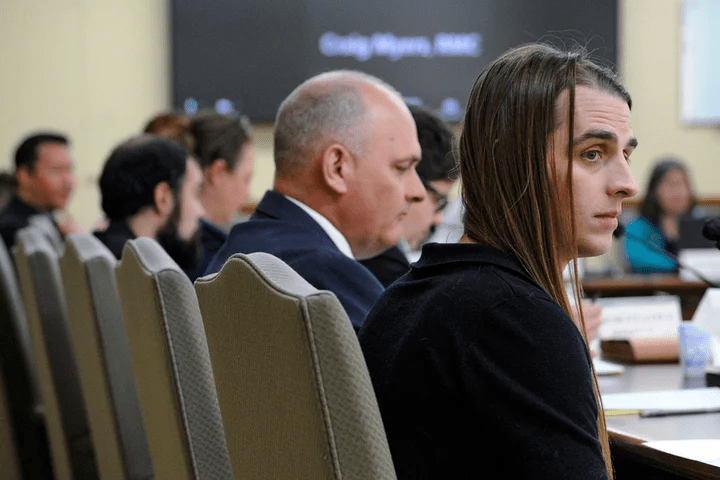
Republican lawmakers swiftly approved the measure despite vocal opposition from Democrats who worried it would complicate daily life for two fellow lawmakers who are transgender and nonbinary. Among them was Rep. Zooey Zephyr, the Missoula Democrat who was silenced and sanctioned by her Republican colleagues in 2023 for comments she made on the House floor.
Zephyr warned it would embolden some to police another person’s gender in public, which she said could create hostile situations for everyone.
The law allows people to sue a facility for not preventing transgender people from using a certain restroom or changing room. They can recover nominal damages, generally $1, and the entity could be required to pay the plaintiff’s legal fees.
A state lawmaker is calling on the Legislature to “completely” defund the University of Texas if it doesn’t shutter its Women’s, Gender and Sexuality Studies Department and LGBTQ studies program, which he has decried as liberal indoctrination that taxpayers should not fund.
The demand by Rep. Brian Harrison on Wednesday comes after a barrage of posts on X from the Republican lawmaker from Midlothian that draw attention to public universities’ LGBTQ+ and gender-related course offerings, despite no law barring such curriculum.
After an “undercover” visit to the UT campus Tuesday, Harrison criticized the university’s exhibit on “Black queer ecstasy,” which showcases art that has often been excluded from historical representation; Pride flags flying around campus; books on gender, transgender issues and queerness; and event flyers for roundtables on Black feminism, transgender people’s well-being and multiple resource posters for LGBTQ+ people.
In doing so, Harrison has amassed 45,500 followers on X whom he calls “liberty bots” — more than triple the followers Texas House Speaker Dustin Burrows has accumulated.
In its recently approved budget proposal, the Senate does not call to defund UT.
In an interview Wednesday, Harrison told the American-Statesman that his impromptu visit to UT was spurred by an event hosted by the Department of Women’s Gender and Sexuality Studies on disparities in health outcomes and gender-affirming care for transgender and nonbinary people of color.
“The voters of Texas do not want their money spent on gender ideology,” Harrison said. “It’s a very visible embarrassment. The state of Texas is supposedly run by all the Republicans down here. We can’t do the basics.”
UT and the head of the LGBTQ studies program declined to comment. The chair of the Women’s and Gender Studies Department did not return Statesman requests for comment.
But queer organizations doubt Harrison’s threat has standing.
Brad Pritchett, interim CEO of Equality Texas, the largest LGBTQ+ advocacy organization in the state, said government intervention in what universities can teach could constitute viewpoint discrimination, a violation of the First Amendment. It would also infringe on the academic freedom that makes UT “top of their class,” he said.
“Freedom requires that we allow ideas that are different from our own, ideas that might even make us uncomfortable,” Pritchett said in a statement to the Statesman. “Harrison wants conformity, but Texans believe in Freedom at all costs.”
Harrison said painting his demands as government censorship is “absurd,” saying anyone can study anything as long as taxpayers aren’t funding the material.
“This is scary for my community, absolutely, but for the Republican Party because they’re showing their hand,” Adeeko said. “It’s telling us that state officials, people who are passing laws, don’t understand who we are, and they’re using that lack of understanding as their primary basis to deny us the right to have well-being and our needs” met.
Harrison and other lawmakers should talk to queer students and organizing groups if they want to understand what being transgender and being queer in Texas means, Adeeko said. Until then, LGBTQ+ people will continue fighting against legislative threats.
“This isn’t like the power boss (go) girl slay he thinks it is. It’s worn out,” Adeeko said of Harrison’s crusade. “It’s really just trying to dog pile all this hopelessness onto the people they go after, and it’s not working.”
Adeeko said Harrison has a duty to serve queer and transgender Texans as a state representative, and the queer community will continue supporting one another until then.
Harrison: ‘Past time the Republican Government of Texas grows a backbone’
Harrison’s visit to UT, according to his X thread, included entering inside buildings, sneaking into a conference and stealing a pamphlet on nonmedical gender transition resources that he called “one of the most disturbing things I’ve ever read.”
UT is a public university, but there are rules on who can access its buildings for security purposes. According to the university’s emergency management website, “with few exceptions such as museums, libraries and during certain events, university-owned buildings and facilities are not considered open to the public.”
When asked if he had legislative support to cut UT’s budget if the programs remain, Harrison criticized state elected members from the Republican Party for not publicly supporting his demands and said that many lawmakers privately agree with him. He said he will continue demanding that public money not be used to fund LGBTQ+ studies and will look to find support.
“The voters of Texas do not want their money spent on DEI, they do not want their money spent on liberal gender ideology,” Harrison said. “It’s past time the Republican government of Texas grows a backbone.”
The Osaka High Court held that Japan’s lack of recognition of same-sex marriage is unconstitutional on Tuesday. The Osaka High Court is the fifth court to rule that the ban on same-sex marriage is unconstitutional after similar rulings in the high courts of Sapporo, Tokyo, Fukuoka and Nagoya.
While Presiding Judge Kumiko Honda upheld the Osaka District Court’s decision not to award damages, Honda ruled that Japan’s Civil Code and Family Register Act that do not allow same-sex marriage violates the right to equality as set out in Article 14 of the Constitution of Japan, which states: “All of the people are equal under the law and there shall be no discrimination in political, economic or social relations because of race, creed, sex, social status or family origin.” The court also ruled that the marriage ban breaches Article 24, where laws involving marriage and family “shall be enacted from the standpoint of individual dignity and the essential equality of the sexes.”
In 2019, three same-sex couples filed a lawsuit against the Japanese government, requesting 1 million yen (about $7,400) in damages per person from the state. They were among 14 couples who filed lawsuits in Sapporo, Tokyo, Nagoya, Fukuoka and Osaka. The plaintiffs had appealed to the High Court after the Osaka District Court in June of 2022 ruled that the lack of same-sex marriage recognition was constitutional under the 1947 constitution as marriage was for heterosexual unions only, making the same-sex marriage ban lawful.
Japan is the only International Group of Seven (G7) country that does not recognise same-sex marriage. Human Rights Watch put out a dispatch highlighting how the other G7 countries are encouraging Japan to enact laws to allow same-sex marriage, counter discrimination and uphold protections for sexual and gender minorities. Prior to the May summit in 2023, LGBTQ groups called for Japan’s government to legalise same-sex marriage and while support for the LGBTQ community grows and the Japanese Diet, Japan’s national legislature, passed the Act on Promotion of Public Understanding of Diversity of Sexual Orientation and Gender Identity, promoting understanding of the LGBTQ.
Amnesty International indicated in a report that protections for sexual and gender minorities are still absent. Currently, in Japan, same-sex couples have some recognition from local governments, such as “partnership certificates,” offering some rights, but these do not give rights such as inheritance, spousal visits or parental recognition.
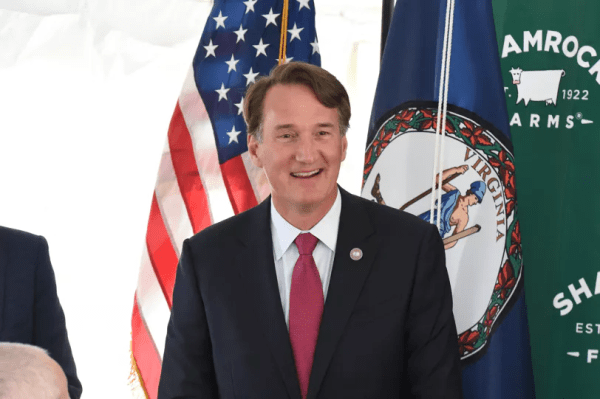
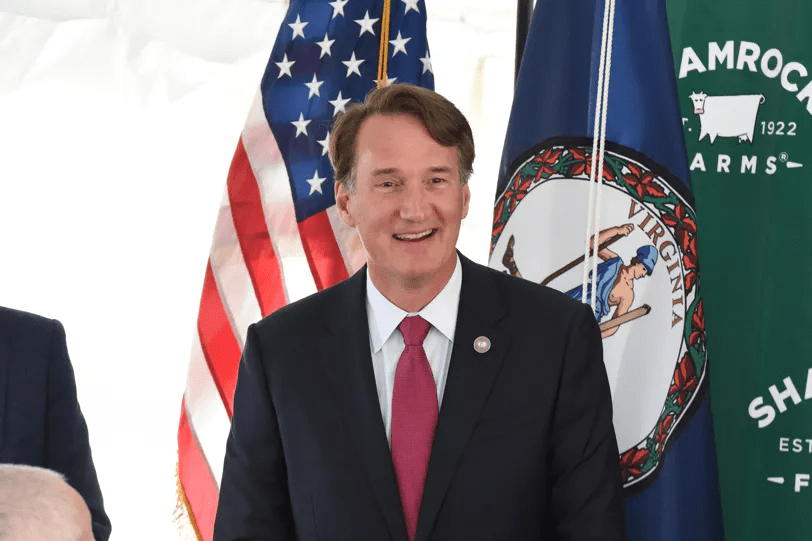
Virginia’s anti-LGBTQ+ Gov. Glenn Youngkin (R) vetoed a bill seeking to ban health and life insurance companies from discriminating against people taking the HIV prevention drug regemin PrEP.
H.B. 2769 amends the current insurance anti-discrimination law by explicitly stating a company cannot “Refuse to insure, refuse to continue to insure, or limit the amount or extent of life insurance or accident and sickness insurance coverage available to an individual or charge an individual a different rate for the same coverage based solely and without any additional actuarial risks upon the status of such individual as having received pre-exposure prophylaxis for the prevention of human immunodeficiency virus”.
Both chambers of the Virginia General Assembly have Democratic majorities. The bill passed the state Senate 24-15 and the House of Delegates 53 to 44. The veto was one of 157 bills the governor vetoed on Monday as part of what the Virginia Mercury called his “veto storm to drown progressive legislation.”
He also vetoed a bill that would have incrementally raised the minimum wage to $15 per hour and one that sought to expand voter turnout by making state and local elections at the same time as the presidential primary during election years.
Youngkin did, however, sign a landmark campaign finance reform bill that passed with bipartisan support. H.B. 2165 bans personal use of campaign funds.
Youngkin has supported numerous policies attacking LGBTQ+ students under the guise of so-called “parents’ rights” in education. His policies for trans youth in schools include the forced misgendering or deadnaming of kids who don’t have parents’ permission, allowing youth to “opt-out” of being near trans kids in gendered spaces, and forced outing of trans kids to their parents.
In an October 2021 interview with the Associated Press, Youngkin said he didn’t personally support same-sex marriage. In 2024, however, he signed a bill codifying same-sex marriage in the Commonwealth.
Senate Bill 516, filed by Sen. Vickie Sawyer from Iredell County and Sen. Brad Overcash from Gaston County, would require transgender individuals to use the bathroom or locker room of their biological sex in public schools and prisons.
However, the bathroom rules aren’t as extensive as House Bill 2. Some institutions that receive government funding, such as domestic violence shelters, would be impacted, but many government buildings would be exempt. It would also allow individuals to sue facilities if they believe these rules have been violated.
Senate Bill 516 also goes a step further, defining sex strictly as male and female and preventing individuals from changing their birth certificates or driver’s licenses after gender reassignment surgery.
The controversial 2016 bill, House Bill 2 was often referred to as the “bathroom bill.” However, former North Carolina Gov. Pat McCrory said that was a misleading description that he hopes is changed this time around.
“It’s much more complex than that. We’re dealing with locker rooms and showers and women’s sports and fairness and even security regarding what your driver’s licenses say,” McCrory said. “It’s a very complex issue. It’s a very emotional issue.”
McCrory acknowledged that many cite this controversy as the reason he narrowly lost his reelection campaign in 2016. It put North Carolina in the national spotlight due to the nationwide boycotts that followed, leading to an estimated $3.76 billion in economic losses. The law was partially repealed after a letter signed by more than 200 CEOs pushing for the change.
In the time since, many other states have passed similar legislation without such sweeping boycotts. McCrory said the companies owe North Carolina an apology.
“PayPal, Bruce Springsteen, Ringo Starr, you name it. And frankly, I think a lot of them owe North Carolina an apology,” McCrory said. “I don’t think corporations are ever going to get involved in this issue again, because public opinion now has turned, although it is still an extremely complex issue, and we ought to have good dialogue on it.”
Critics still worry this bill will cause an uptick in discrimination against the LGBTQ+ community, especially transgender youth.
Time Out Youth, a Charlotte-area nonprofit that provides support for LGBTQ+ kids and young adults including housing and mental health counseling, says it’s already seeing a steep increase in need.
“We saw more new young people last month than we’d seen all of the previous year in one month,” spokesperson Elissa Miller said.
While they are not able to comment on this specific bill, Miller says this is a reminder of what transgender youth are facing right now.
“Being a queer young person right now is very difficult,” she said. “Their very identities are kind of under debate, in the spotlight. Decisions are being made about them, without them.”
Equality NC also sent WCNC Charlotte a statement, saying in part: “We were disheartened to learn of yet another attack on our transgender community — this time in the form of SB 516.”
McCrory says he expects this version of the bill to face less scrutiny and hopes the people on both sides of the debate can avoid it as well.
“My family and I got a lot of physical and verbal threats during that three-month period, and it was not right, and I wanted to have good conversation,” he said. “It’s not time for anyone to spike the ball saying we were right 10 years ago. It’s time for respect and dignity.”
The bill’s sponsors did not immediately respond to requests for comment.
German and Finnish authorities have taken similar steps, and Belgium is planning to do the same, as the Trump administration removes some protections for sexual minorities.
The Netherlands has tightened its travel advice to the United States for LGBTQ+ people, highlighting an unease among European nations about Washington’s policies toward sexual minorities.
The Dutch foreign ministry’s travel advice portal now notes that people belonging to a sexual minority should take into account that “laws and customs in the US towards LGBTQI+ people may differ from those in the Netherlands.”
Dutch public broadcaster NOS points out that the travel advisory previously stated that U.S. laws were “comparable to those in the Netherlands,” with its liberal, progressive stance on LGBTQ+ rights.
Following the Dutch notice, the Belgian government announced that it is also working on adjusting the travel advice in light of stricter border controls and changing attitudes toward transgender people and the wider LGBTQ+ community, Flemish public broadcaster VRT reported.
German and Finnish authorities have also tightened their travel warnings for the U.S. after President Donald Trump took steps to remove some protections for sexual minorities, such as only accepting M or F (male or female) as gender identification on passports and visas.
”It reflects a sad and completely needless reality,” Dutch MEP Kim van Sparrentak, from the Greens group, told POLITICO.
Van Sparrentak, who also heads the European Parliament’s LGBTIQ+ intergroup, stressed that the liberal European fears are “not only for people traveling to the U.S. but for a large part of the U.S. population too, trans and intersex people in particular.”
North Carolina Democrats filed a slew of bills Tuesday all centered around reproductive health and LGBTQ+ protections.
According to Democratic lawmakers, some of the bills will guarantee the rights to use contraception to prevent pregnancy and access fertility treatments through IVF. Others will ban conversion therapy and the use/perception of gender and sexual orientation as a defense in assault and homicide cases. An equality for all bill is also proposed.
“We need to be done with treating people as anything less than full human beings deserving of respect and dignity,” state Sen. Julie Mayfield said.
State Sen. Sophia Chitlik said, “Contraception is taken to support people with a variety of health challenges, including polycystic ovary syndrome.”
While state Democrats said they’re pushing their priorities, Republicans filed Senate Bill 516 Tuesday. Entitled the Women’s Safety and Protection Act, it is sweeping legislation that would limit a transgender person’s access to bathrooms and their ability to change legal documents.
Republicans have previously said banning biological men from women’s bathrooms is a safety measure.
According to Democrats, Republicans are only attacking marginalized communities and putting LGBTQ+ and transgender communities in danger.
“If you don’t believe it, just look out there at all those people who just want to be recognized as humans,” state Rep. Allison Dahle said. “They don’t care if you recognize their pronouns, they just want to be human and live their lives.”
















You must be logged in to post a comment.