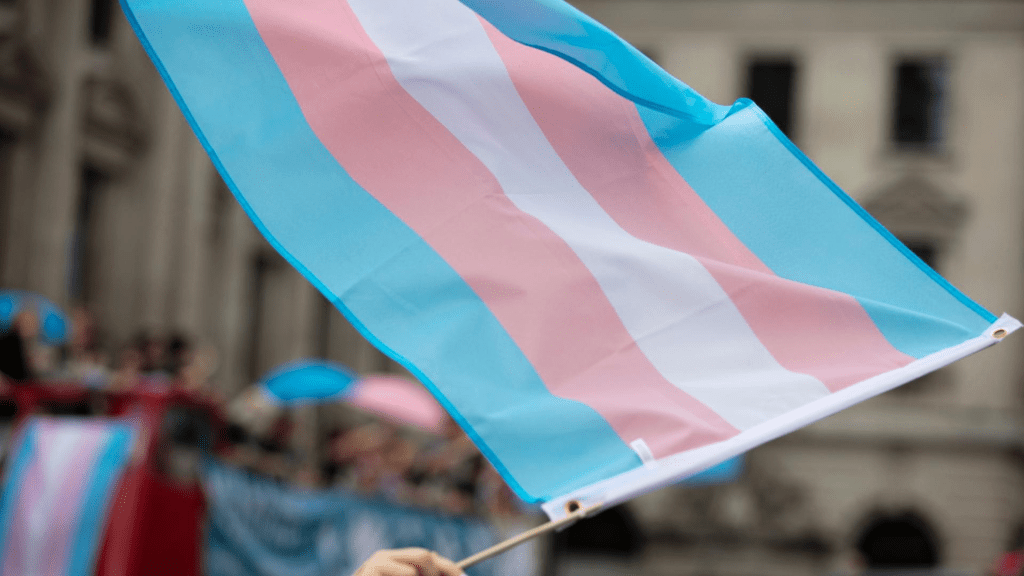
A federal judge on Friday blocked the Trump administration from enacting a policy that bans the use of “X” marker used by many nonbinary people on passports as well as the changing of gender markers.
In an executive order signed in January, the president used a narrow definition of the sexes instead of a broader conception of gender. The order says a person is male or female and it rejects the idea that someone can transition from the sex assigned at birth to another gender. The framing is in line with many conservatives’ views but at odds with major medical groups and policies under former President Joe Biden.
U.S. District Judge Julia Kobick, who was appointed by President Joe Biden, sided with the American Civil Liberties Union’s motion for a preliminary injunction, which stays the action while the lawsuit plays out.
“The Executive Order and the Passport Policy on their face classify passport applicants on the basis of sex and thus must be reviewed under intermediate judicial scrutiny,” Kobick wrote. “That standard requires the government to demonstrate that its actions are substantially related to an important governmental interest. The government has failed to meet this standard.”
The ACLU, which sued the Trump administration on behalf of five transgender Americans and two nonbinary plaintiffs, said the new policy would effectively mean transgender, nonbinary and intersex Americans could not get an accurate passport.
“We all have a right to accurate identity documents, and this policy invites harassment, discrimination, and violence against transgender Americans who can no longer obtain or renew a passport that matches who they are,” ACLU lawyer Sruti Swaminathan said.
In response to the lawsuit, the Trump administration argued the passport policy change “does not violate the equal protection guarantees of the Constitution.” They also contended that the president has broad discretion in setting passport policy and that plaintiffs would not be harmed by the policy, since they are still free to travel abroad.
Christine Jardine said she wanted to see a potential “fast lane” for skilled US citizens.
She presented a motion on “Trump and the UK’s place in the world” to the Scottish LibDem conference in Inverness, which was backed by party members.
It called for a new customs union with the EU and a summit of Commonwealth nations to respond to US tariffs.
Her motion also called for a “visa route to allow highly skilled Americans who wish to flee the Trump presidency to come to the UK”.
Speaking to the PA news agency about her motion, the Edinburgh West MP said: “I think if there are people in America who are unhappy with a lot of the things [Trump] is talking about domestically – the LGBT community for example, a lot of minorities – they have skills, we could welcome them here.
“And I think we would be a much more welcoming society for an awful lot of people who are finding America, at the minute, difficult.”
While visas are already available for US citizens, she said the Government should encourage Americans to take up a skilled visa route.
Jardine said: “Americans could do it at the moment, they could apply, we could create a special fast lane if you like for the Americans to do it.”
On Donald Trump’s trade tariffs, she said: “We need to stand up to him, we need to say we’re not going to be dictated to.”
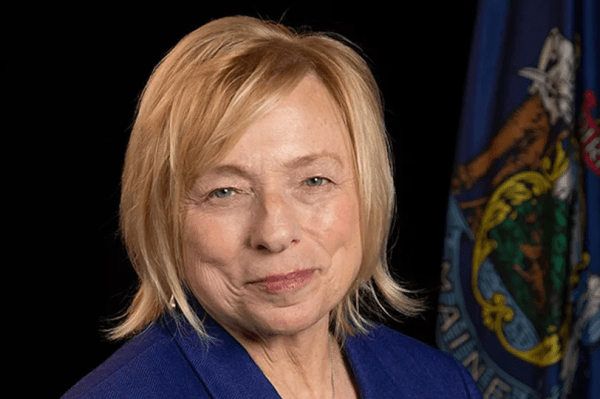
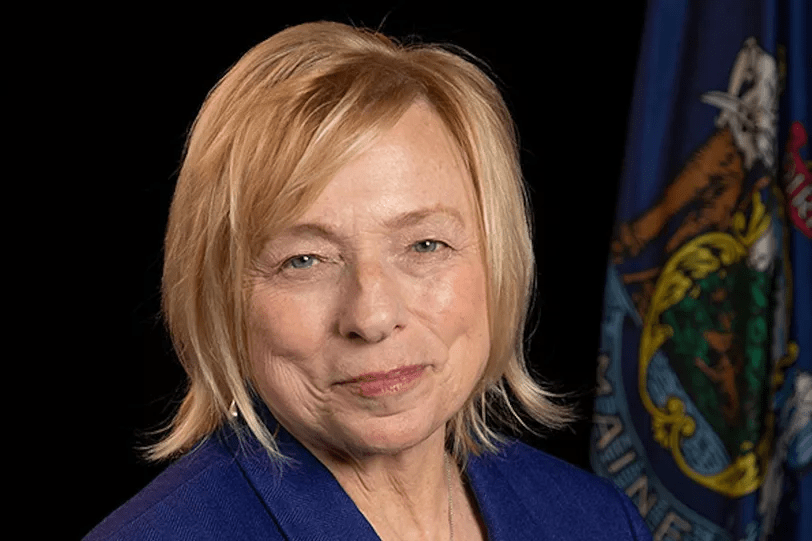
When Maine Gov. Janet Mills (D) told President Donald Trump, “See you in court,” she meant it.
On Monday, Maine sued the U.S. Department of Agriculture (USDA) and Secretary of Agriculture Brooke Rollins over the department’s halt on federal funding for education programs in the state in retaliation for its refusal to ban transgender women and girls from school sports.
As Reuters notes, Rollins announced the funding freeze in an April 2 letter to Mills, saying that the decision was “only the beginning” but that the governor could “end it at any time by protecting women and girls in compliance with federal law.” The funding freeze jeopardizes programs that provide free or reduced-price meals to children in Maine schools, childcare centers, and after-school programs.
Mills has publicly clashed with the administration, and with Trump specifically, over its assertion that allowing transgender women and girls to participate in women’s and girls’ sports violates Title IX, the federal civil rights law that prohibits discrimination on the basis of sex in schools that receive federal funding.
In February, the Maine Principals Association announced that it would not comply with Trump’s February 5 executive order banning transgender student-athletes from participating in girls’ and women’s sports. After Trump threatened to cut off the state’s funding, Mills and Maine Attorney General Aaron Frey accused the president of using school children “as pawns in advancing his political agenda” and vowed to “take all appropriate and necessary legal action to restore that funding and the academic opportunity it provides.”
“The State of Maine will not be intimidated by the president’s threats,” Mills said.
During a February 21 meeting with Democratic and Republican governors at the White House, Trump singled out Mills, asking whether she planned to comply with his anti-trans executive order. Mills said that her state was “complying with the state and federal laws.” When Trump continued to petulantly insist that Mills comply with his order, the governor told the president she would see him in court.
In its lawsuit, Maine calls the USDA’s funding freeze a “blatantly unlawful action” in violation of the Administrative Procedures Act. Rollins, the state argues, “took this action without following any of the statutory and regulatory requirements that must be complied with when terminating federal funds based on alleged violations of Title IX.”
The state argues that Rollins provided no legal basis for her assertion that by allowing trans students to participate in women’s and girls’ sports, Maine is in violation of Title IX and that her interpretation of the law is wrong. “Indeed, several federal courts have held that Title IX and the Equal Protection Clause require schools to permit transgender girls and women to play on girls’ and women’s teams,” the complaint reads.
However, the state is not asking the court to interpret Title IX. It merely asks the court to vacate Rollins’s “arbitrary, capricious” funding freeze for failing to meet the “statutory and regulatory requirements that the federal government must comply with before it may freeze federal funds owed to a state.”
In a statement, Frey said that Trump “and his cabinet secretaries do not make the law, and they are not above the law, and this action is necessary to remind the president that Maine will not be bullied into violating the law.”
President Trump‘s decision to target transgender care in a proclamation declaring April National Child Abuse Prevention Month “betrays” the month’s purpose, LGBTQ advocates said.
Why it matters: Framing the trans youth experience as “abuse” further stigmatizes an already vulnerable community, as the Trump administration tries to erase trans people from American life through policies limiting access tohealth care, careers, sports, education and more.
Driving the news: Trump’s Thursday proclamation singled out transgender care, labeling it a form of child abuse without acknowledging the most common risk factors for neglected or abused children.
“It is deeply disingenuous for Trump to use National Child Abuse Prevention Month as a platform to attack and stigmatize the trans community,” Ash Lazarus Orr, a spokesperson for Advocates for Trans Equality, told Axios.
Reality check: Gender-affirming care is supported as both medically appropriate and potentially life saving for children and adults by major medical associations, including the American Medical Association, the American Academy of Pediatrics and the American Psychiatric Association.
Drugs like puberty blockers are temporary and reversible. They are given to trans youth and non-trans youth who experience early onset puberty.
What they’re saying: Trump’s proclamation “is vile and upsetting but importantly it is just a press release,” Chase Strangio, co-director of the ACLU’s LGBT & HIV Project said in a statement on Instagram.
“It does not change the law or direct any agency action. But it does continue to suggest that the government is moving towards efforts to explicitly criminalize trans life and support of trans people.”
“Using the language of ‘child protection’ to justify the oppression of trans youth betrays the very values this month is meant to uphold,” Orr said.
“Denying trans youth medical care won’t change who they are.”
“Supporting a child — regardless of their gender identity — is an act of love, period,” Jarred Keller, a Human Rights Campaign spokesperson, said.
“The idea that affirming a child’s gender identity constitutes something harmful is an insult to the parents who support their transgender children with compassion and understanding.”
Threat level: Trump wrote that “a stable family with loving parents” is a safeguard against child abuse, but most victims are abused by a parent, according to the National Children’s Alliance.
By the numbers: In 2022, a reported 434,000 perpetrators abused or neglected a child, per the alliance.
76% of children were victimized by a parent or legal guardian in substantiated child abuse cases, meaning that child protective services agencies determined that abuse or neglect occurred.
Zoom out: Trump in January signed an executive order to defund youth gender-affirming care and a separate one threatening funding for K-12 schools that accommodate transgender children.
American hostility toward trans people has prompted U.S. allies to issue travel advisories for trans travelers, warning them that they must designate one “sex” on their travel forms and it has to reflect the gender they were assigned at birth.
An estimated 60,000 Canadian citizens flock to Florida each year, including many “snowbirds” who spend their winters in the Sunshine State.
In the wake of a new Trump administration policy requiring background checks and fingerprints if they plan to stay more than 30 days, as well as an ongoing trade war with our neighbors to the north, some Canadians say they’re leaving Florida for good.
“I live here six months. This is my home, but I’m leaving April 2nd,” a Canadian woman named Susan told NBC affiliate WBBH. She wasn’t comfortable giving her last name, fearing Canadians could become targets amid escalating tensions with U.S. leadership.
Susan was just one of several Canadians who said they’re selling their properties with no plans to return to Florida.
“We don’t want to be the 51st state, but we just want to be very good allies and wants things to go back to the way they were,” Canadian Janet Rockefeller said.
One family had plans to put down permanent roots in Florida, but have been eyeing other sunny locations like Mexico.
“The truth of the matter is, if I hadn’t prepaid everything and wasn’t here and your weather wasn’t so damn nice, I’d go home now,” Canadian Barry Presement told WBBH.
Presement’s wife, Ruth, wants to make clear that Canadian citizens still have plenty of love for Americans.
“We love the Americans,” Ruth Presement said. “No issue, but its very disturbing to have the president that he doesn’t need Canada for anything.”
Some Canadian homeowners are taking a wait-and-see approach, but some business owners said they’re worried this could affect their bottom line.
“It’s not only having a negative impact on the tourism market, but business as a whole,” Cole Peacock, who owns a business called Seed and Bean Market, told WBBH. “You need those extra visits to kick that profit margins to another level.”
More than three-quarters of scientists in the U.S are weighing leaving the country and are looking at Europe and Canada as their top relocation spots, according to a survey released Thursday.
The scientific journal Nature poll found that 75.3 percent of scientists are considering leaving the U.S. after the administration cut funding for research. Nearly a quarter of respondents, 24.7 percent, disagreed.
The highest contingent of researchers who are looking to move out of the country were those who are early in their careers. Nearly 550, out of 690 who responded to the survey, said they are considering leaving the U.S. Out of the 340 Ph.D. students, 255 shared the same inclination, the poll found.
The administration, along with tech billionaire and close Trump adviser Elon Musk, with the help of the Department of Government Efficiency, has terminated entire agencies and made cuts in the last two months in an effort to shrink the size and scope of the federal government.
Some of those reductions were felt at the National Institutes of Health (NIH), where all grants for equity issues, which encompass studying Black maternal health and HIV, were canceled. The cap on indirect costs of NIH grants was capped at 15 percent.
The NIH was also ordered recently to halt efforts to terminate the funding for grants intended for hospitals, universities and other institutions by a federal judge after numerous lawsuits.
Former Health and Human Services (HHS) Secretary Kathleen Sebelius said she was concerned about the recent cuts to grants flowing through the NIH.
“I’m worried on a lot of fronts,” Sebelius said Wednesday. “The kinds of cuts that were just announced are devastating and will set science back and set research back.”
These cuts have also affected the National Oceanic and Atmospheric Administration (NOAA), which has been hit with layoffs.
More than three-quarters of Americans, 76 percent, said they have a great or fair amount of confidence in scientists to do what is best for the public, according to a Pew Research Center survey that was published in mid-November last year. The figure was a minor uptick from October 2023, when 73 percent of respondents said the same.
Around 1,650 people responded to Nature’s survey. The margin of error and the dates the survey was conducted were not available to The Hill.
A surge of grant cancellations hit researchers focused on the health of gay, lesbian and transgender people last week, as the Trump administration continues to target what it describes as ideologically driven science.
Last week the U.S. government terminated at least 68 grants to 46 institutions totaling nearly $40 million when awarded, according to a government website. Some of the grant money has already been spent, but at least $1.36 million in future support was yanked as a result of the cuts, a significant undercount because estimates were available for less than a third of grants.
Most were in some way related to sexual minorities, including research focused on HIV prevention. Other canceled studies centered on cancer, youth suicide and bone health.
Health and Human Services spokesman Andrew Nixon said the agency is “dedicated to restoring our agencies to their tradition of upholding gold-standard, evidence-based science.” The grants were awarded by the National Institutes of Health, an agency under HHS.
One canceled project at Vanderbilt University had been following the overall health of more than 1,200 LGBTQ people age 50 and older. Most of the money has been spent from the grant funding the project, but it was up for renewal in April, said Tara McKay, who leads Vanderbilt’s LGBTQ+ Policy Lab.
She said the grant won’t be renewed because of the termination, which jeopardizes any long-term results. Still, the Vanderbilt project had already generated two dozen published papers, including work used to train doctors to provide better care to LGBTQ people, increasing the likelihood of cancer screenings and other preventive care.
“That saves us a lot of money in health care and saves lives,” McKay said.
Insights from minority populations can increase knowledge that affects everyone, said Simon Rosser, who studies cancer in gay and bisexual men at the University of Minnesota.
“We now no longer have anywhere studying LGBT cancer in the United States,” said Rosser, who saw his grants canceled on Friday.
“When you decide to cancel all the grants on sexual minorities, you really slow down scientific discovery, for everyone,” Rosser said. Young researchers will lose their jobs, and the field as a whole will suffer, he added.
“It’s a loss of a whole generation of science,” Rosser said.
Termination letters seen by The Associated Press gave as reasons that the research was “unscientific” or did “nothing to enhance the health of many Americans.”
That language felt personal and stinging, McKay said.
“My project’s been accused of having no benefit to the American people. And, you know, queer and trans folks are Americans also,” McKay said.
Denmark is advising its transgender and nonbinary citizens to proceed with caution when traveling to the U.S., according to a new advisory.
An update made Thursday to the Danish foreign ministry’s webpage on travel to the U.S. recommends trans people contact the U.S. embassy in Copenhagen before visiting the country, which under the new Trump administration has enacted several policies targeting transgender rights.
The advisory does not explicitly mention President Trump or his administration but comes as the State Department suspended a policy allowing trans, nonbinary and intersex Americans to update the sex designations on their passports, causing confusion and concern among travelers over whether it is safe for them to fly. The department previously allowed U.S. passport holders to self-select their sex designations, including an “unspecified” gender marker denoted by the letter X.
Seven trans and nonbinary Americans are challenging the new policy, which stems from a Jan. 20 executive order declaring the U.S. recognizes only two sexes — male and female — in federal court.
“If your passport has the gender designation X or you have changed gender, it is recommended to contact the U.S. embassy prior to travel for guidance on how to proceed,” reads the advisory from the Danish foreign ministry.
The addition comes one week after Finland issued a similar advisory for transgender residents seeking visas to the U.S.
“If the gender listed on the applicant’s passport does not match the gender assigned at birth, the US authorities may deny the application for a travel permit or visa,” Finland’s Ministry of Foreign Affairs said, citing Trump’s executive order. “Please check the entry requirements with the US authorities in advance.”
Other countries, including Germany and the United Kingdom, recently issued travel advisories to the U.S. after reports of citizens being detained at the border.
A federal judge on Tuesday indefinitely blocked implementation of President Trump’s executive order effectively barring transgender people from serving openly in the military, a stark blow to the administration’s efforts to curb transgender rights.
U.S. District Judge Ana Reyes, an appointee of former President Biden, barred Defense Secretary Pete Hegseth and other military officials from implementing Trump’s order or otherwise putting new policy into place effectuating it. She also said the plaintiffs’ military statuses must remain unchanged until further order of the court.
The judge said her order intends to “maintain the status quo” of military policy regarding transgender service that existed before Trump signed the order titled “Prioritizing Military Excellence and Readiness.” She stayed her order until Friday to give the administration time to appeal.
“The Court knows that this opinion will lead to heated public debate and appeals,” Reyes wrote in her opinion. “In a healthy democracy, both are positive outcomes.”
Six active service members and two individuals seeking to enlist in the military sued the Trump administration soon after the Jan. 27 order was signed, asserting it violates their constitutional rights. Two similar lawsuits are moving through the courts.
Trump’s order suggests that transgender people cannot “satisfy the rigorous standards necessary for military service” because they threaten the lethality of the armed forces and undermine unit cohesion, an argument long used to keep marginalized communities from serving.
“A man’s assertion that he is a woman, and his requirement that others honor this falsehood, is not consistent with the humility and selflessness required of a service member,” the executive order states.
Reyes wrote in her opinion that the president has both the power and obligation to ensure military readiness but noted that leaders of the armed forces have long used that justification to “deny marginalized persons the privilege of serving.”
“‘[Fill in the blank] is not fully capable and will hinder combat effectiveness; [fill in the blank] will disrupt unit cohesion and so diminish military effectiveness; allowing [fill in the blank] to serve will undermine training, make it impossible to recruit successfully, and disrupt military order,’” Reyes wrote.
“First minorities, then women in combat, then gays filled in that blank,” she continued. “Today, however, our military is stronger and our Nation is safer for the millions of such blanks (and all other persons) who serve.”
A 2016 RAND Corp. study commissioned by the Pentagon found that allowing trans individuals to serve in the military had no negative impact on unit cohesion, operational effectiveness or readiness.
During several hearings across multiple weeks, Reyes tore into Justice Department lawyers over Trump’s order and Hegseth’s policy effectuating it, which was set to go into effect on March 26.
A Department of Defense memo dated Feb. 26 said individuals with a “current diagnosis or history of, or exhibit symptoms consistent with, gender dysphoria” are not fit for military service. It added that the Pentagon recognizes only two sexes, male and female, in compliance with another Trump executive order, and requires service members to “only serve in accordance with their sex.”
Reyes noted that symptoms of gender dysphoria could “mean anything,” from “cross-dressing” to mental health conditions like depression, which are also common among members of the military who do not identify as transgender.
“How can I say that a policy is limited, when on its own terms, it could include almost any transgender person?” the judge asked Justice Department lawyers during a March 13 hearing.
Department of Justice (DOJ) lawyer Jason Manion argued that judges must accede to the “current” military, not those under the leadership of past administrations.
“You defer to the military,” he said. “You do not reassess the evidence they are doing.”
Nonetheless, the judge questioned the Defense Department’s use of “cherry-picked” studies to back up its new policy, which she said were “totally, grossly” misrepresented by Hegseth.
In her ruling Tuesday, Reyes pointed to that lack of evidence as reason to take a different course.
“Yes, the Court must defer,” the judge wrote. “But not blindly.”
At an earlier hearing last month before Hegseth’s policy was announced, Reyes sparred with DOJ lawyer Jason Lynch over the breadth of Trump’s order, suggesting it amounted to “unadulterated animus” backed up by little evidence.
She directed Lynch to sit down and purported she would ban all graduates of the University of Virginia School of Law — his alma mater — from appearing before her because they’re “liars” and “lack integrity,” terms mimicking Trump’s executive order.
“Is that animus?” she asked, calling Lynch back to the podium.
Following that hearing, the Justice Department filed a complaint against Reyes accusing her of misconduct. Attorney General Pam Bondi’s chief of staff, Chad Mizelle, claimed the judge sought to “embarrass” Lynch with her hypothetical scenario.
Another seven transgender service members, backed by two LGBTQ civil rights organizations, are challenging Trump’s order on transgender troops in a separate lawsuit filed earlier this month in Washington state. Two more active-duty members challenged the order in a suit filed Monday in New Jersey.
In a statement, Jennifer Levi, senior director of transgender and queer rights at GLBTQ Legal Advocates & Defenders, one of the groups representing the plaintiffs at the center of Reyes’s ruling, said Tuesday’s decision “speaks volumes.”
“The Court’s unambiguous factual findings lay bare how this ban specifically targets and undermines our courageous service members who have committed themselves to defending our nation. Given the Court’s clear-eyed assessment, we are confident this ruling will stand strong on appeal,” Levi said.
The church reportedly delayed a police investigation and then harassed a member after her child was sexually assaulted.
Gateway Church, an evangelical megachurch located in Southlake, Texas, has reached a legal settlement concerning allegations that five church pastors and a youth leader covered up a child sexual assault perpetrated by another church member. The pastors reportedly failed to report the assault to law enforcement or the child’s mother, delayed investigating the incident, and subjected both the victim and her mother — devoted church members — to punitive measures.
This settlement follows the recent resignation of Robert Morris, the church’s founder and a former member of Donald Trump’s evangelical executive advisory board. Morris stepped down shortly after publicly acknowledging that he had molested a 12-year-old girl during his tenure as a 20-year-old pastor.
In August 2020, an unnamed mother filed a recently settled lawsuit on behalf of her daughter. According to The Christian Post, both frequently attended worship services, church-sponsored functions, and participated in various ministries. The alleged sexual assault by an unnamed church member took place around March 14, 2018, at the member’s residence.
The recently settled lawsuit, filed in August 2020 by an unnamed mother on behalf of her daughter, detailed concerning allegations involving Church youth leader Logan Edwards. Edwards reportedly learned of the assault from conversations with the alleged assaulter and two other young church members, as stated in the lawsuit. Despite this knowledge, five church pastors — Kelly Jones, Rebecca Wilson, Samantha Golden, Mondo Davis, and Sion Alford — allegedly took no legal action. They reportedly spoke multiple times with the accused member and their parents but did not file a formal complaint with child protective or law enforcement agencies, nor did they inform the victim’s mother about the alleged assault.
“When the mother discovered the assault, she reported it to the Haltom City Police Department,” the lawsuit stated. Subsequently, the pastors allegedly engaged in efforts to conceal, distort, and discredit the assault accusations during the police investigation. This purported concealment, according to the lawsuit, allowed significant evidence of the alleged criminal assault to degrade, hampering law enforcement’s ability to conduct an accurate investigation.
Additionally, church leaders purportedly encouraged Gateway members to ostracize the minor’s mother and removed her from ministries where she had served diligently. As a result, the mother and daughter reportedly experienced profound shame, embarrassment, and emotional distress.
Although the lawsuit sought damages ranging from $200,000 to $5,000,000, the church settled for an undisclosed amount on April 18. The church emphasized it admitted no liability and settled solely to “buy peace,” according to a public statement.
Previously, the church reportedly settled a 2016 lawsuit involving allegations that church leaders destroyed video footage showing a boy sexually assaulting another in the church’s child care program, as reported by WFAA.
Last month, Gateway Church’s founder, Robert Morris, publicly admitted to molesting a 12-year-old girl on Christmas night in 1982 when he was 20 years old and staying with her family. Morris, who was married with a young son at the time of the molestation, is now 62 years old. He resigned shortly after his admission garnered national attention.
You must be logged in to post a comment.