The New York City Department of Health and Mental Hygiene (NYC DOHMH) will provide almost $9 million to nonprofits in the city that provide gender-affirming care for minors to fill the gap left by major hospitals that have capitulated to the Trump administration and stopped providing these essential services.
City records explaining the funding emphasize the “compelling need for gender-affirming care services” that necessitates the expedited process NYC DOHMH plans to use – called a negotiated acquisition.
“NYC Health will contract with organizations providing or facilitating the provision of gender-affirming care to patients under age 18,” the department states. “This includes the prescription and administration of puberty-blockers and hormone replacement therapy to all minor patients for whom such services are medically necessary based on the prevailing standards of care. Services will be performed by qualified medical providers with current New York State licensure, and will be provided consistent with state laws governing parental consent.”
The department has identified two potential groups, Callen-Lorde Community Health Center and Nonprofit Organization for Philanthropic Initiatives (NOPI), to enter into a three-year contract to help direct funds to vendors that offer the proper services. The contract would begin on February 1, 2027. The department also invited others who believe they can provide these services to email Tamala Watson at twatson2@health.nyc.gov by October 16 at 2:00 pm.
According to Gothamist, the money is part of Mayor Zohran Mamdani’s (D) $15 million plan to expand access to gender-affirming care for trans youth. Announced in June, the plan includes three initiatives: establishing a direct access care fund; creating a call and text line to connect people with resources; and research to identify health care access gaps.
Trans journalist and activist Erin Reed celebrated the $9 million investment on Bluesky. “I do believe the city can be doing much more, but this is a wonderful start from Mayor Mamdani,” she said.
News of the funding dropped only two weeks after dozens of protesters – including trans actor Elliot Page – gathered outside NYU Langone Health, one of three New York City hospitals that recently caved to the Trump administration by ending gender-affirming care for trans youth. Two weeks before that, hundreds gathered outside New York City’s Mount Sinai Hospital to express their anger at its decision to permanently stop gender-affirming care for youth in a move many said was “bending the knee” to the Trump administration.
The DOJ began issuing civil subpoenas to hospitals around the country in 2025, attempting to obtain personal medical records for trans youth and threatening federal funding for hospitals that continued to provide the care.
According to the DOJ, its “nationwide investigation into the child gender-transition industry” has examined “potential violations of the Food, Drug, and Cosmetic Act, the False Claims Act, and other federal health care laws, including fraudulent billing practices such as the use of false diagnosis codes to obtain payment from federal health care programs and private insurers.”
But critics say these investigations amount to “fishing expeditions” aimed at finding reasons to prosecute health care providers in states where pediatric gender-affirming care remains legal, and to intimidate providers into ending pediatric gender-affirming care programs.
This November, voters in six states will decide on eight LGBTQ+-related ballot measures, including four anti-trans sports bans in Colorado, Arizona, Nebraska, and Washington; two measures restricting gender-affirming care for transgender youth in Colorado and Missouri; a measure that could out LGBTQ+ kids to their potentially unsupportive parents in Washington; and one pro-LGBTQ+ measure to remove a state same-sex marriage ban in Virginia.
“This isn’t actually about giving voters a say in democracy. It’s a political tactic by a small but vocal minority of extremists who want to turn out their base, driven by the fear and misunderstandings about people who are transgender,” said Adam Snipes, the director of strategic partnerships at the Ballot Initiative Strategy Center, during a September 30 GLAAD media briefing attended by LGBTQ Nation.
Snipes is correct: anti-trans measures are being used as “ballot candy” to increase Republican turnout at the polls.
But statewide anti-trans proposals have dramatically increased since 2015, the year that the US Supreme Court legalized marriage equality. In 2016, North Carolina passed an anti-trans bathroom bill. Since then, similar anti-trans measures have expanded to sports, educational policies, healthcare, and other areas.
Approximately 91% of anti-trans bills fail in state legislatures, GLAAD’s senior director of news and campaigns Barbara Simon said. But such legislation and ballot measures give anti-LGBTQ+ politicians and activists “a permission slip” that emboldens them to use marginalizing and dehumanizing rhetoric that harms vulnerable youth, Simon said.
“This is really part of a national MAGA playbook, which is about distracting voters from real issues facing families — like high healthcare costs, gas costs, housing costs — and instead just flaming fears about a small, really already vulnerable group of people… in this case, LGBTQ+ kids,” Washington’s first out lesbian state House Speaker, Rep. Laurie Jinkins (D), told the press briefing.
Anti-trans sports bans in Colorado, Arizona, Nebraska, & Washington
Colorado, Arizona, Nebraska, and Washington are all considering ballot measures with nearly identical language that would ban students who are transgender from playing school sports on sex-segregated teams that differ from the sex they were assigned at birth. None of these measures take intersexuality into account, leaving intersex students unsure about their place on the sports field.
Generally speaking, these measures fall largely on young girls and women to “prove” their sex, often with invasive medical exams that aren’t usually part of standard athletic exams. (Athletic medical exams usually focus on athletes’ eyesight, bone health, as well as respiratory, cardiovascular, or other issues that could affect overexerted athletes.)
Medical examinations to verify athletes’ sex can violate the privacy of all young girls and women — causing a decrease in their sports participation overall. Furthermore, such exams may not be covered by patients’ health insurance plans, adding an extra financial burden for low-income families.
These measures undermine local control by overriding policies and recommendations already put in place by local school boards and associations that have articulated what’s best for their students’ needs. These ballot measures also do nothing to address the sexism, abuse, and poor funding that harm girls and women and discourage them from participating in sports to begin with.
Arizona’s Proposition 318
Based on a 2022 Arizona law that federal courts had blocked from enforcement (before the US Supreme Court ruled such bans as constitutional last June), the so-called “Protect Girls’ Sports in Arizona Act” would require K-12 schools and private sports leagues to designate which sports are sex-segregated and then decide participation based on the sex listed upon each player’s birth certificate.
Additionally, schools and private leagues would have to ban trans athletes from restrooms, showers, and locker rooms that don’t match the sex they were assigned at birth. The measure would allow athletes to sue schools or leagues that violate its provisions.
Darrell Hill, the policy director for ACLU of Arizona, told KTAR that facilities and cities could interpret the law too broadly and restrict restroom and locker room access to trans kids and adults in various situations that have nothing to do with sports participation. “It can really act as a big barrier for trans people to participate in public life,” he said.
While the measure seems to “verify” athletes’ sex via birth certificates, state Sen. Mitzi Epstein (D) said it would “subject girls to invasive inspections and questions about their gender,” effectively harming all girls and women (and communicating that they are less valued than boys and men), “in an effort to score political points by discriminating against trans girls.”
The Arizona Interscholastic Association says no trans student-athletes have tried to compete in the state since the 2022 law was signed. It’s unclear whether any tried to compete before the 2022 law was signed.
Colorado’s Proposition 134
Proposition 134 would then require K-12 schools, colleges, and athletic associations to designate sex-segregated and co-ed sports and then forbid boys from participating on girls’ teams and vice versa.
The measure would define girls as people with female reproductive organs and boys as those with male reproductive organs, but it’s unclear how sex would be determined. While some supporters say a doctor-signed form or a DNA cheek swab could suffice, opponents warn that it could subject girls to invasive genital inspections.
Z Williams, a school parent and director of Bread and Roses Legal Center, told The Colorado Sun, “Kids have been playing sports with trans kids for decades…. Playing sports is an important and healthy part of growing up: People building a sense of who they are, learning how to work with a team, learning to lose. To take that away from kids simply for who they are is absurd. It is socially and politically cruel.”
Chris Cook, the father of an 11-year-old transgender girl, told the aforementioned publication, “It would tell kids that simply participating in school sports could mean being questioned, scrutinized, or subject to invasive gender inspections to prove who they are. No child should have to live with that fear, and this doesn’t affect (just) transgender kids. When schools are asked to police students’ gender, any child who looks too tall, too strong, or doesn’t fit someone’s idea of what a girl should look like could be singled out.”
Nebraska’s Measure 442
Measure 442 would write into the state constitution a 2025 law, sponsored by state Sen. Kathleen Kauth (R), that already requires public K-12 and college athletes to play on teams matching their sex at birth. The measure defines one’s sex at birth as having a reproductive system that “does or at some point will produce, transport, and utilize” either eggs ( for a woman or girl) or sperm (for a man or boy).
The measure would apply to all athletic teams or sports sponsored by public schools, postsecondary educational institutions, private schools, or educational institutions that compete against public schools.
Interestingly, the state Supreme Court recently heard arguments challenging the measure’s legality. Opponents say that the ballot measure’s sponsors failed to “adequately inform the public of what they are trying to accomplish” when collecting signatures for the effort. The measure will appear on ballots regardless of the court’s decision; if the court rules against it, all votes upon it will simply be invalidated.
Washington’s Initiative IL26-638
IL26-638 would bar students who are “biologically male” from competing in K-12 schools and nonprofit sports teams designated for girls and women. The initiative would require every student who wants to compete in girls’ sports to obtain a signed statement from a health care provider verifying their sex. Students wanting to play on boys’ teams wouldn’t have to obtain any such statement.
The initiative permits three verification methods: genetic testing, testosterone measurement, or a visual examination of reproductive anatomy. Seeing as the first two methods are expensive and not covered by insurance, most parents will likely go for the third option, requiring kids to expose their genitals to adult medical professionals.
Over 100 doctors and other medical professionals recently released a statement against the initiative, with some saying they would refuse to conduct invasive exams to verify the sex of young girls and women.
“IL26-638 would make every girl in Washington who wants to compete in a female-only interscholastic sport prove her sex to a doctor, regularly, in order to play,” the Washington State PTA noted, calling the initiative “discriminatory,” “harmful,” and “disproportionate.”
Trans journalist Erin Reed noted that even if the measure passes, it could still face constitutional challenges under the longstanding legal precedent of Washington laws protecting trans students.
“Washington adopted an Equal Rights Amendment in 1972 declaring that ‘equality of rights and responsibility under the law shall not be denied or abridged on account of sex,’” Reed wrote. “That provision triggers strict scrutiny for claims of sex discrimination, a standard that would likely render a categorical ban on transgender participation in sports unconstitutional — particularly given the state’s more liberal judiciary.”
Restricting gender-affirming healthcare in Colorado and Missouri
Two states, Colorado and Missouri, both have ballot measures to restrict gender-affirming healthcare for trans youth. However, they differ in significant ways.
Colorado’s Proposition 135
Colorado’s Proposition 135 is a vaguely written measure that would forbid doctors from performing surgeries on anyone under 18 “for the purpose of altering biological sex characteristics,” including changes to sexual organs, body shape, facial appearance, or voice (even though such surgeries on minors are rare to nonexistent).
The measure would also ban state or federal funds, Medicaid, and private insurance from paying for these surgeries. Though the measure’s language doesn’t specifically mention transgender youth, its restrictions would apply to any young person. However, the law wouldn’t place any restrictions on prescribing hormone therapy, puberty blockers, counseling, or support for social transition.
The measure includes exceptions for male circumcision, people born with a “medically verifiable disorder of sex development,” and “acquired physical or chemical abnormalities,” meaning that intersex individuals could still be eligible for augmenting surgeries.
Nevertheless, the Colorado Medical Society opposes the measure (along with dozens of other LGBTQ+ and allied organizations statewide), saying it would interfere with doctors’ medical judgment. The measure is backed by Protect Kids Colorado, an organization led by anti-LGBTQ+ activist Erin Lee.
Jax Gonzalez, political director at One Colorado, said the measure’s vague language around a minor’s “perception of sex or gender” leaves both patients and providers unclear about what procedures would be prohibited.
“All of us have gender and have lots of ideas about that, and so, does that mean that if a patient brings up a conversation about their own gender, regardless of their general identity, does that mean that that provider can’t treat them anymore?” Gonzalez, who is trans, told News From the States.
Missouri’s Amendment 3
Missouri’s Amendment 3 main purpose is to repeal the abortion-rights amendment that voters approved in 2024 and to make most abortions illegal in the state, except for ones that are conducted in cases of medical emergencies, fetal anomalies, and within the first 12 weeks of pregnancies caused by rape or incest.
The final clause in the measure would “prohibit gender transition procedures for minors,” which is curious, seeing as the state has banned gender-transition surgeries for minors since August 2023. The measure would also ban puberty blockers and hormone replacement therapy for minors.
Currently, state law forbids any new prescriptions of the aforementioned medications for trans youth until 2027; the measure would write this ban into the state constitution, meaning it would continue indefinitely.
Forcibly outing trans students to their parents in Washington
Washington voters will consider IL26-001, a measure that would repeal the state’s current parents’ rights laws and replace them with language taken verbatim from Louisiana. The measure would give parents unrestricted access to school, medical, and mental health counseling records without requiring student consent, including information on confidential conversations about a child’s sexual orientation or gender identity.
“When a student … is dealing with anxiety, they need trusted adults and mental health resources they can turn to that help them make sense of their world,” the American Civil Liberties Union (ACLU) of Washington wrote in opposition to the measure. “[Allowing parents to view sensitive counseling records is a] violation of privacy [that] can undermine the relationships that students may have with counselors and other trusted adults in schools.”
“The sad truth is not all students have a supportive adult they can turn to and talk about their sexuality, gender identity, or mental health without fear. Allowing schools to disclose private health information — as IL26-001 proposes — would severely impact a student’s stability at home, at a time when they need love and support, not punishment and rejection,” the ACLU of Washington added.
Indeed, statistics show that 40% of homeless queer youth say they were kicked out of their homes when their families learn of their identities, meaning that the measure could worsen at-home conflicts for LGBTQ+ students with unsupportive or abusive parents.
This initiative and the state’s ballot measure banning trans athletes are opposed by state Gov. Bob Ferguson (D), the state’s US Sen. Patty Murray (D), the Washington State Parent-Teachers Association (PTA), by the Washington State Nurses Association, the League of Women Voters, and domestic violence prevention groups, because they put kids at greater risk of violence and harm.
Defending marriage equality in Virginia
A bright spot on the somewhat gloomy horizon, Virginia’s Question 2 asks voters to remove the state’s 2006 constitutional ban on same-sex marriage and to add a right to marry regardless of a partner’s sex, gender, or race.
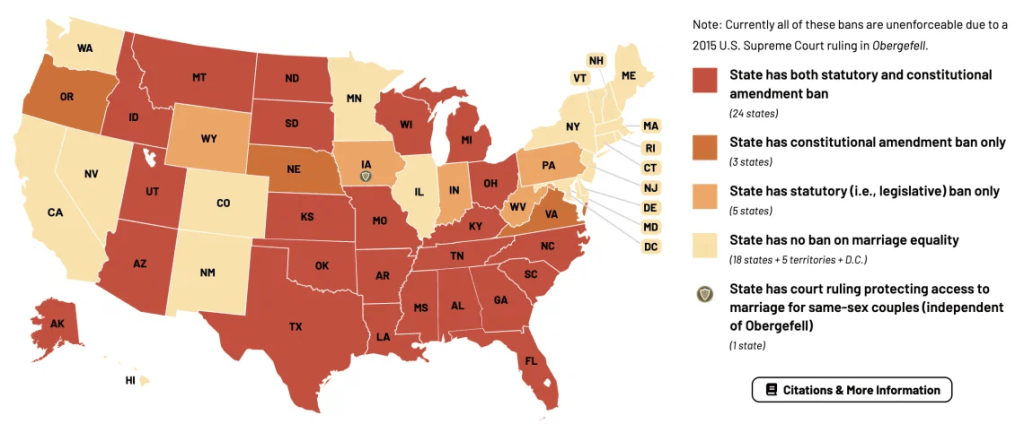
The state’s current ban, rendered inactive by the US Supreme Court’s 2015 Obergefell v. Hodges decision legalizing marriage equality, defines marriage as “only a union between one man and one woman” and bans any union, partnership, or legal status for unmarried couples that carries the rights and benefits of marriage. Question 2 would remove all of this language and acknowledge that “Marriage is one of the vital personal rights essential to the orderly pursuit of happiness.”
Virginians approved their state’s same-sex marriage ban in 2006, with 57% voting yes. A federal judge struck it down in 2014, but it stayed in the state constitution. State election officials say the ban would become enforceable again if the US Supreme Court ever overturned Obergefell v. Hodges, as some of the court’s conservative justices have threatened.
Currently, 24 states have dormant bans against same-sex marriage in both their state constitution and their statutes, five have such a ban in their statutes only, and three have such a ban in their constitution only, according to the Movement Advancement Project.
Since 2020, voters in four states have voted to repeal previously approved same-sex marriage bans. Nevada did in 2020, and California, Colorado, and Hawaii all did the same in 2024.
These ballot measures are about LGBTQ+ involvement in civic life
“As somebody who grew up trans, sports and other activities represented more than just competition,” Adrianna Suluai, the Policy & Advocacy Director at UTOPIA Washington, an organization dedicated to uplifting queer and transgender Pacific Islanders, told the press briefing.
“They were opportunities for me to participate, build confidence, and be around other young people and feel like I was a part of something. And when you’re a young person who may already feel different, sometimes simply having a place where you can show up and belong means everything,” Suluai added.
Suluai’s comment applies not only to the sports field but also to LGBTQ+ youth in classrooms, doctors’ and counselors’ offices, and the general public.
Because these ballot measures are often sold as ways to “protect children’ and strengthen “parental rights,” it’s all the more imperative that LGBTQ+ voters and allies understand them and share their potentially harmful consequences with other sympathetic voters.
For nearly two decades, LGBTQ+ students looking for a college could turn to the Campus Pride Index for something most college rankings didn’t provide: a way to evaluate how welcoming and safe a campus might actually be for them.
Launched in 2007, the free database evaluated participating colleges on more than 50 measures across eight areas, including LGBTQ-inclusive policies, housing, campus safety, student life, counseling, health services and institutional support. Students and families could search hundreds of participating schools and compare their LGBTQ+ resources and policies.
However, there are some with short lists of favorites.
The Princeton Review publishes a list of 25 LGBTQ-friendly colleges based on student surveys, while BestColleges released a 2026 list of schools meeting criteria including nondiscrimination protections, gender-inclusive housing and restrooms, and an LGBTQ+ resource center. The Consortium of Higher Education LGBT Resource Professionals also maintains a directory of campus LGBTQ+ centers.
But those resources don’t allow a student to investigate and compare hundreds of individual campuses using the same detailed criteria. A 2025 study published in the Journal of Homosexuality examined 1,756 four-year nonprofit U.S. colleges and universities and found that only 14 percent had a dedicated LGBTQ+ resource center.
College admissions professionals have begun discussing how to fill the void that Campus Pride created. In a 2026 newsletter for the New York State Association for College Admission Counseling, Erica Padilla and Marie Nocella called the Campus Pride Index “a useful tool” and noted that, for many LGBTQ+ students, “this was the only tool at their disposal, especially if their environment lacked supportive adults.”
Students with supportive families can share that work with parents or guardians. Students who aren’t out at home may have to conduct it quietly and alone. For them, determining whether a college is affordable and academically appropriate may not be enough. They also have to answer another question: Will I be safe here?
Unless someone else creates a comprehensive solution, much of the work will continue to fall on students. That can mean digging through individual college websites for nondiscrimination policies, gender-inclusive housing, healthcare, LGBTQ+ organizations, bias-reporting procedures and other indicators of campus climate. For LGBTQ+ students, these steps add layers of research — and uncertainty — to an already complicated and stressful college search.
Transgender students are absorbing the consequences of a growing fight in Cabarrus County Schools, where two federal lawsuits and a Trump administration investigation are challenging how the district handles bathroom access, LGBTQ advocates say. For months, parents, elected officials and community members clashed over whether transgender students should be allowed to use bathrooms and locker rooms that align with their gender identity. But advocates say another question has received less attention: What does the fight mean for LGBTQ students going to school every day?
“When I think about a trans girl going into a girl’s restroom, I worry about her harassment, not what she will do to other young people,” said Sarah Mikhail, CEO of Time Out Youth. Time Out Youth serves LGBTQ young people ages 13 to 24 in Charlotte and surrounding communities. Within the organization, young people regularly talk about the broader social climate surrounding bathrooms, sports and LGBTQ issues in schools, she said. Mikhail said the effect shows up in basic routines. Some young people Time Out Youth works with avoid school bathrooms entirely because they do not feel safe using them. She said that kind of vigilance does not stay confined to the restroom. Students who are constantly calculating where they can go, who might be watching them or whether an adult will support them can have a harder time concentrating, asking for help or feeling comfortable enough to learn. “We have young people that do not go to the bathroom all day at school,” Mikhail said. “This is not uncommonly reported.”
LGBTQ students not only face school rules, they also hear messages from politicians, social media, family members and community leaders about what gender means and what transgender people should be allowed to do. For some students, those messages arrive before they even figure out how they identify or whether they feel safe coming out. That uncertainty, she said, can impact whether students feel comfortable telling a teacher they had a hard night, asking for help on an assignment or using the name and pronouns that feel right to them. “You need to feel emotionally okay to share and be yourself at school,” Mikhail said. “So then you can be open to learning.” How Cabarrus became a legal battleground Cabarrus County Schools does not have a separate policy governing transgender students’ bathroom access. School board attorney William Isenhour has said the district handles the relatively rare situations on a case-by-case basis while attempting to comply with federal law.
The district has repeatedly pointed to a 2020 Fourth Circuit Court of Appeals ruling, Grimm v. Gloucester County School Board. In that case, the court ruled a Virginia school board violated Title IX and constitutional protections when it required a transgender boy to use bathrooms based on his sex assigned at birth or use a private restroom. Because the Fourth Circuit includes North Carolina, Cabarrus officials have said the ruling binds the district. The Trump administration now takes a different view. The U.S. Department of Education’s Office for Civil Rights opened a Title IX investigation into Cabarrus in June after complaints that the district allowed transgender students to use girls’ bathrooms and locker rooms. Federal officials said the administration interprets Title IX based on biological sex and is investigating whether the district violated the privacy and safety rights of female students. On July 31, three anonymous 17-year-old Cox Mill High School students and their parents sued the district. Represented by the conservative legal organization America First Legal, they argue transgender students should not be permitted to use multi-person bathrooms and locker rooms corresponding with their gender identity.
A second lawsuit followed one week later. Cabarrus father Brandon Matthews sued after school officials declined to promise they would notify him if transgender students were permitted to use the same sex-segregated bathrooms or locker rooms as his children. He argues parents have a constitutional and religious right to receive that information and request another arrangement. The Cabarrus controversy comes as transgender rights have become a major national political talking point, with fights over girls’ sports, bathroom access and school policies playing out in courts and school board meetings. ‘Stop arguing about bathrooms’ Rebecca Herrick, a mother of three Cabarrus County Schools students, said she sees the bathroom fight as a distraction from other issues in the district. Her own children have thrived socially in CCS, Herrick said, and she wants transgender students to be treated the same. She said the controversy pulls energy away from issues that affect students more, including the district’s ongoing financial and operational challenges.
“It is time to stop arguing about bathrooms,” Herrick said. “By shifting the conversation to social issues, they are successfully diverting public energy.” Herrick said she worries that it sends a message about who belongs in school when adults devote so much attention to policing which bathrooms students use. She said the repeated lawsuits and public fights over bathrooms risk turning transgender students themselves into the subject of controversy. “These bathroom bills and the resulting lawsuits create a climate of fear and exclusion that treats transgender students as problems rather than children who deserve support,” Herrick said. ‘They’re just kids’ Joshua Jernigan said he is already hearing that fear from families. Jernigan founded the Gender Education Network, which works with transgender and gender-diverse children age 12 and younger and their families across North and South Carolina.
Jernigan said his organization has heard directly from families since the lawsuits and federal investigation intensified attention on the district. Some have reached out worried about what the legal fight could mean for their children and whether it will make school feel less safe. “We’ve had a lot of families reach out in a bit of a panic,” Jernigan said. He said transgender and gender-diverse children may not follow the legal arguments themselves, but they hear how adults in their communities talk about people like them. When they hear phrases like “these people” or “those people,” Jernigan said, they understand they are being singled out. That can be especially unsettling for children approaching middle school, he said, when situations involving locker rooms and trying to fit in already feel scary. “There’s nothing sinister or nefarious about trans kids,” Jernigan said. “They’re just kids who want to go out for recess and hate math.”
The Human Rights Campaign Foundation today released updated population estimates showing that a record-high 12% of U.S. adults – roughly 25.6 million people – identify as lesbian, gay, bisexual, transgender, or gender diverse. The analysis, drawn from more than 2.4 million responses to the U.S. Census Bureau’s Household Pulse Survey collected between 2021 and 2024, is one of the most comprehensive looks at the LGBTQ+ population to date. The Household Pulse Survey is one of the last major federal data sources to include a gender identity measure before the Trump Administration removed sexual orientation and gender identity questions from roughly 360 federal data collections.
Key Data Points:
40: Number of states with an LGBTQ+ population of greater than 10% (plus the District of Columbia).
That includes electoral battleground states such as Arizona (13.34%), Georgia (11.46%) Michigan (10.95%), New Hampshire (11.88%), North Carolina (10.56%), Ohio (11.29%), Pennsylvania (11.14%), and Texas (12.54%),
25.6 million: Number of U.S. adults who identify as LGBTQ+
12%: Percentage of adult population who identify as LGBTQ+
More than half of all LGBTQ+ adults (53.8%) are between 18 and 34 – a signal of sustained, long-term growth in political and economic power as this generation ages into peak spending and voting years.
Growing diversity across the community: Hispanic adults make up a larger share of the LGBTQ+ population (18%) than of non-LGBTQ+ adults (13%); Black adults make up a smaller share, about 9%, compared to 12%, reinforcing that LGBTQ+ identity cuts across every racial and ethnic community.
Bisexual+ people are the largest group at over 7% of all U.S. adults.
Why It Matters:
HRCF’s estimate is notably higher than Gallup’s most recent 9% figure, a gap that researchers attribute to differences in survey methods rather than a sudden shift in identification. The new population figures come as midterm 2026 elections ramp up across the nation and LGBTQ+ people are a deciding voting bloc for many tight races that will determine control of Congress. At the same time, federal agencies have stripped sexual orientation and gender identity questions from hundreds of data sets. This is a disturbing Trump Administration trend meant to erase the LGBTQ+ community from the statistics that shape public policy, community resource development, corporate strategy, and campaign outreach.
“Reliable data are essential for understanding who lives in this country and what our communities need to thrive. Removing sexual orientation and gender identity questions from surveys like the one used for this analysis introduces significant gaps in this understanding. These findings show that LGBTQ+ people are a substantial and growing segment of the population, underscoring the need for our continued inclusion in data collection efforts, said HRC Foundation Sr. Director of Research and Education Tari Hanneman.
The economic influence of the LGBTQ+ community continues to grow at a time when diversity and inclusion initiatives are under federal attack. A recent HRCF consumer report showed LGBTQ+ consumers wield over $1.4 trillion in spending power, with 7 in 10 already putting it behind companies that invest in inclusive policies and practices that lead to stronger consumer trust, market share growth, and better talent retention.
The federal agency that runs Medicaid and the Children’s Health Insurance Program will no longer pay for gender-affirming care for minors who don’t identify with the sex they were assigned at birth.
The Department of Health and Human Services announced Aug. 12 that it finalized a rule after more than a year of taking steps to use the federal government’s power to limit this type of medical care.
“We are not going to pay for our innocent children to undergo these barbaric surgeries and practices, which result in unthinkable and irreversible harm to their young bodies,” President Donald Trump wrote in a social media post.
The rule goes into effect Oct. 13 and includes a six-month grace period for children with government insurance who are currently using hormone therapy, according to HHS. It does not affect mental health coverage.
“Children deserve our protection, not experimental interventions that pose serious risks and convey no proven benefits,” Dr. Mehmet Oz, who runs the Centers for Medicare and Medicaid Services, said in a news release. He said the move is “protecting children from potentially irreversible harm.”
HHS did not say how much federal money it currently spends on surgeries, puberty blockers or hormone therapy, or how many children enrolled in government health insurance are receiving gender-affirming care.
Most gender-affirming care is sought by young adults, not children, but as many as one in four people getting this type of care are covered by Medicaid.
Rep. Mark Takano, a Democrat who chairs the Congressional Equality Caucus, called the move “another cruel, overreaching attack” on transgender youth.
“Decisions about a young person’s care should be between the patient, their parents, and their provider – not politicians,” Takano wrote.
Trump first took action against gender-affirming care for minors with an executive order in January 2025. In April 2025, Oz told states not to use Medicaid funding for surgeries or hormone treatment.
In December, HHS Secretary Robert F. Kennedy Jr. announced his department was beginning an administrative process to end funding for hospitals who provide gender-affirming surgeries.
The Food and Drug Administration, which regulates medical devices, also sent warning letters to manufacturers of breast binders telling them not to market their devices to children with gender dysphoria.
Connecticut Children’s Medical Center in Hartford has agreed to stop providing gender-affirming medical treatments to minors, including puberty blockers and cross-sex hormones, as part of a settlement with the U.S. Department of Justice.
The DOJ announced the agreement Wednesday as part of its ongoing national investigation into gender-affirming care for children and adolescents.
According to the DOJ, Connecticut Children’s agreed not to perform gender-affirming procedures or surgeries on minors. The hospital also agreed to pay a monetary penalty and provide an additional $500,000 in medical care for people who previously received gender-affirming treatment at the facility.
The DOJ alleged that the hospital violated federal law in connection with its pediatric gender-affirming services.
“The Department of Justice will stop at nothing to protect America’s children,” Associate Attorney General Stanley Woodward said. “This resolution is a reminder to hospitals, medical providers, and pharmaceutical companies that the Justice Department will vigorously enforce federal law, especially where the lives of children are endangered.”
Connecticut Children’s confirmed the settlement in a statement and said the agreement allows the hospital to remain focused on its mission of improving children’s health.
The hospital said protecting patient privacy was its “foremost concern” throughout the process and that the matter was resolved without providing protected patient information to the federal government.
“We have complied and will continue to comply with all federal and state laws,” the hospital said.
The settlement is the latest agreement reached by the DOJ involving gender-affirming care for minors.
In May, Texas Children’s Hospital agreed to establish a “detransition clinic,” according to the DOJ. In June, the Cleveland Clinic Foundation agreed to provide detransition care.
The agreements come amid a broader federal effort to investigate and restrict gender-affirming care provided to children and adolescents.
Maine’s Secretary of State Shenna Bellows (D) ruled on Tuesday that Protect Girls’ Sports in Maine, an anti-transgender campaign, submitted invalid and forged signatures in its bid for a November ballot measure that sought to ban trans students from school sports and restrooms. As a result, the measure will not appear on the voting ballot this November, Erin in the Morning reported.
The campaign, bankrolled by out-of-state billionaire Richard Uihlein, submitted 79,692 signatures — well over the 67,682 required to qualify. However, a court review of the campaign’s petitions in May invalidated 12,542 of the signatures, leaving the campaign 532 signatures short of the required number.
Some of the signatures were thrown out because the collectors didn’t witness the signing (as required by state law). Others were invalidated because the signatures did not match the voters’ signatures on voter registries, because the signatories signed more than once, because the signers weren’t registered voters, or because the signatures were forgeries. Collectors were paid $3 to $4 per signature.
Though Bellows approved the signed petitions as valid in March, following a court evidentiary review, she ruled on Tuesday that the petitions fell short of the required number of signatures to get the measure on the November ballot.
The ballot measure would’ve defined a student’s sex as “a biological status as male or female recorded at birth on the person’s original birth certificate,” effectively ending any legal recognition of trans students, not just in the cases of restrooms and sports. It also would’ve carved trans students out of legal protections enshrined in the Maine Human Rights Act (a statewide anti-discrimination law), and would’ve allowed cisgender students to sue any school that allowed trans students to use sex-segregated school spaces alongside them.
In a statement celebrating Bellows’ ruling, David Farmer, campaign manager for the Campaign for Free and Fair Schools coalition, said, “The paid, out-of-state signature gatherers and the billionaire who paid to try to put this question on the ballot failed to follow the rules. We believe that the appeals process and the reviews by the Secretary of State are working as the law intends. They are protecting the integrity of our elections.”
Even if voters had approved the measure in November, it would likely have faced legal challenges, since it would’ve resulted in trans students and their families facing harassment and discrimination.
Transgender journalist Erin Reed noted that Uihlein is a major funder of the American Principles Project, a right-wing conservative organization that has spent tens of millions on anti-trans election ads. Reed also noted that an independent analysis published by Atmos and HEATED found that 80% of the nation’s 45 major anti-trans organizations have gotten funding from billionaires or fossil fuel companies.
Reed also noted that anti-trans ballot measures will go in front of voters in both Washington and Colorado.
“Both efforts are also funded by conservative megadonors,” she wrote, “and both are part of the same strategy that produced the Maine initiative: Use ballot initiatives to roll back trans rights in states whose elected legislatures have refused to do so.”
Uihlein and Protect Girls Sports in Maine’s efforts came after Maine Gov. Janet Mills (D) repeatedly refused to comply with the president’s extortive attempts to withhold federal education funding in retaliation for the state’s trans-inclusive school policies.
The U.S. Department of Justice has sued Maine, challenging the state’s trans-inclusive interpretation of Title IX. That legal battle is currently ongoing.
The European Union rejected a call to ban conversion therapy on Wednesday, even after over a million people petitioned for the ban in its 27 member states.
Last month, the European Parliament voted in favor of a ban on conversion therapy. The vote came after the European Citizens’ Initiative petitioned the European Parliament to take up the matter after 1.2 million people signed a petition.
The matter was then sent to the European Commission, the only body that can introduce binding legislation in the EU. But the European Commission has rejected the call, saying that the EU does not have the authority to force member states to ban the harmful practice.
European Commission President Ursula von der Leyen said that conversion therapy has “no place in our union” and that the EU will push each individual member state to ban the practice in a recommendation to be published next year. That recommendation will be non-binding.
The European Commission flew the rainbow flag outside its headquarters in Brussels, Belgium, yesterday, Le Monde reports.
The EU’s Agency for Fundamental Rights said in 2024 that one in four LGBTQ+ European citizens is the victim of conversion therapy practices, which have been linked to depression, low self-esteem, substance abuse issues, anxiety, suicidality, and other mental health issues. Ten of the 27 EU member states already ban the practice.
The group Against Conversion Therapy, which launched the original petition, called the decision a “missed opportunity” in a statement.
“In an international political context where the rise of reactionary ideas is affecting the entire world, it is urgent the European Union acts,” the group said.
European Commissioner for Equality Hadja Lahbib hailed the decision to encourage member states to ban the practice as “historic,” the LA Times reports.
“Conversion practices are built on a lie, the lie that LGBTQ+ people need to be fixed, that there is something wrong with who they are,” Lahbib said after listening to victim testimony. “And there is, of course, nothing to fix, there is nothing to cure, and there is no one to change.”
“You cannot torture away a person’s identity, and you cannot legislate it away. And yet these practices continue, unfortunately.”
Last month, the European Economic and Social Committee (EESC) held a debate on conversion therapy before it voted to recommend that Europe ban the practice.
“These so-called conversion practices or therapies are not only harmful, they are a profound violation of human dignity and fundamental rights,” said EESC President Séamus Boland during the debate, according to an EESC release. “Let us be absolutely clear: there is nothing to fix or cure. What needs to change is not people, but the systems, attitudes, and structures that deny them their dignity.”
Graeme Reid, the United Nations independent expert on sexual orientation and gender identity, also spoke during the debate, saying that banning conversion therapy is key to the EU meeting its human rights obligations and that “every person has the right to live free from coercion, fear and shame.”
The United Nations has called for conversion therapy to be banned worldwide. Last month, the U.S. Supreme Court ruled that conversion therapy practices are protected by the First Amendment and can only be banned if states can meet the high legal requirements involved in curtailing religious free exercise.
The Texas attorney general has secured an unusual settlement over child transgender care that compels Texas Children’s Hospital to create the nation’s first ever “detransition clinic” in addition to paying the state $10 million.
According to Attorney General Ken Paxton, the multidisciplinary clinic would offer medical care to patients “who were subjected to ‘gender-transition’ procedures.” The care would be free to patients for the first five years of the clinic’s operation. The move follows an investigation that began in 2023 by the attorney general’s office into Texas Children’s Hospital in Houston. That same year, Gov. Greg Abbott signed Senate Bill 14 that bars transgender children from receiving puberty blockers and hormone therapies.
Gender-affirming care is an umbrella term for the treatment of gender dysphoria, or the discomfort that comes when someone’s gender identity does not align with the sex they were assigned at birth. Gender-affirming care ranges from “socially transitioning” — using different pronouns or dressing differently — to puberty blockers, hormone therapy and surgical interventions.
“Today is a monumental day in the fight to stop the radical transgender movement,” Paxton said in a statement issued Friday. “I applaud Texas Children’s Hospital for changing course and committing to being a part of the solution by agreeing to form a first-of-its kind Detransition Clinic that will help provide free care to those who have been victimized by twisted, morally bankrupt transgender ideology.”
Texas Children’s will fund all services provided through the “detransition clinic” for the first five years.
The settlement also requires the hospital to pay $10 million for billing Texas Medicaid after the state accused the hospital of illegal ‘gender-transition’ interventions, including by using false diagnosis codes. It also required Texas Children’s to terminate and revoke the medical privileges of five physicians. Paxton and the hospital have not released the name of the physicians or a copy of the settlement.
Texas Children’s, the nation’s largest pediatric hospital, said in a statement that it made the “difficult decision” to settle with the attorney general’s office to close a legal chapter that has been, “wrought with falsehoods and distractions.”
The hospital said it spent three three years producing more than 5 million documents to both the state and the U.S. Department of Justice.
“All reviews and investigations continue to support the facts – we have been compliant with all laws,” the hospital statement said. “To be clear – we are settling to protect our resources from endless and costly litigation … We stand proud knowing we will always put our purpose over politics and that we have and will continue to follow the law.”
The Texas Medical Association and Texas Hospital Association declined to answer questions for the story.
Unclear what services clinic will provide
Texas Children’s, one of the world’s leading pediatric hospitals based in the heart of Houston’s medical center, did not say how it will roll out its clinic or what services it will provide, though the hospital said in the statement that the clinic will include “supportive, multidisciplinary services we already deliver to all patients who need our care.”
Detransitioning is the stopping or reversal of transitioning care by social, medical or legal means, and it is rare for people to regret transitioning after taking hormone therapy and surgical interventions.
On the clinical side, detransitioning could mean stopping hormone treatment or procedures to reverse previous surgeries. Similar to transitioning, detransitioning requires intensive mental health assessments to root out other factors that might be creating the desire to stop transitioning, according to research. Common reasons for destransitioning include lack of family support, financial barriers and social pressure.
When someone chooses to detransition, “it is not normally because of healthcare complications,” said Andrea Segovia, senior field and policy director for the Transgender Education Network of Texas.
Segovia is concerned that access to mental healthcare will not be woven into the clinic’s services. In March, Paxton released an opinion saying that mental health providers licensed by the state cannot provide gender-transitioning care to minors under state law. It’s not clear if Paxton believes state law bars detransitioning mental healthcare as well.
For those who do want to detransition, the resources already exist, said Kellan Baker, senior advisor for the Movement Advancement Project, a national think tank that focuses on LGBTQ policies.
Detransitioning services, although they are rarely needed, can and have been offered properly when accompanied with mental health resources. But Baker said he’s not confident that this clinic, born out of a heated conflict between a hospital and the attorney general, has the best intentions for the transgender community.
“Texas Children’s is not creating this clinic — the Texas attorney general is creating it,” Baker said. “A clinic created by a politician via legal intimidation is not in the best interests of any patient. Doctors should be the ones making decisions about how to provide medical care, not politicians.”
‘Resource that no one is asking for’
Brad Pritchett, CEO of Equality Texas, a nonprofit that advocates for the LGBTQ community, said in a statement that the attorney general is “blackmailing a hospital system into creating a resource that no one is asking for.”
Pritchett said Texas’ politically-motivated detransition clinic “ignores the actual science and years of data about the overwhelming benefits of gender-affirming care.”
Several medical associations including the American Medical Association, American Academy of Pediatrics, American Academy of Child and Adolescent Psychiatry and American Psychiatric Association, have supported evidence-based gender-transitioning care as appropriate and medically necessary for children.
Pritchett added that it is “embarrassing that a hospital once revered for its care has lost its integrity and put politics over patients.”
Dallas state Rep. Jessica González who chairs the Texas House LGBTQ Caucus said in a statement that the settlement is “shameful, and is the furthering of an agenda to eradicate transgender people from the eyes of society.”
Transgender people make up about 1% of the population, which is why, Segovia said, it is “infuriating” that the state is creating the detransition clinic as access to other healthcare services are struggling — such as rural hospitals and reproductive care.
Texas Children’s has to fully fund the clinic for five years, which will take away attention and limited resources from the hospital’s other departments such as care for children with cancer and infants with heart conditions, González said.
“Using a settlement to compel a hospital to build an ideologically framed clinic opens the door to more state interference in medical practice, more dangerous stigmatization that truly harms
young Texans, and, sadly, more lives lost in our nation’s suicide epidemic,” said González, one of the few only queer representatives in Texas.
Houston state Sen. Molly Cook, who is also openly queer, said Paxton is manufacturing a political spectacle because providers know how to help someone detransition and the state doesn’t need a clinic to train them on it.
“This is an asinine waste of money that is typical of Texas’s out-of-touch statewide leadership,” Cook said in a statement. “Texas Children’s already provides care for patients who choose to change a course of treatment.”
The need for such a clinic in Texas is made even smaller by the fact that the state’s ban on gender-transitioning care for minors has resulted in very few Texas children receiving such care statewide.
The five doctors that Paxton said Texas Children’s will need to fire adds to the four doctors he’s already sued to stop providing gender-affirming care. He’s also sued Children’s Health System of Texas, headquartered in Dallas, accusing them of violating SB 14. Some parts of Texas already suffer from a pediatric endocrinologist shortage in the wake of SB 14.
Segovia with the Transgender Education Network of Texas said she’s worried that other states will follow Texas’ lead in forcing more of these clinics to open.
“It’s terrifying what other states will take from this.”











You must be logged in to post a comment.