
This blog originally appeared at NBC News.
In the state, Republican legislators have already submitted a minimum of twelve bills that LGBTQ advocates argue could adversely impact the community.
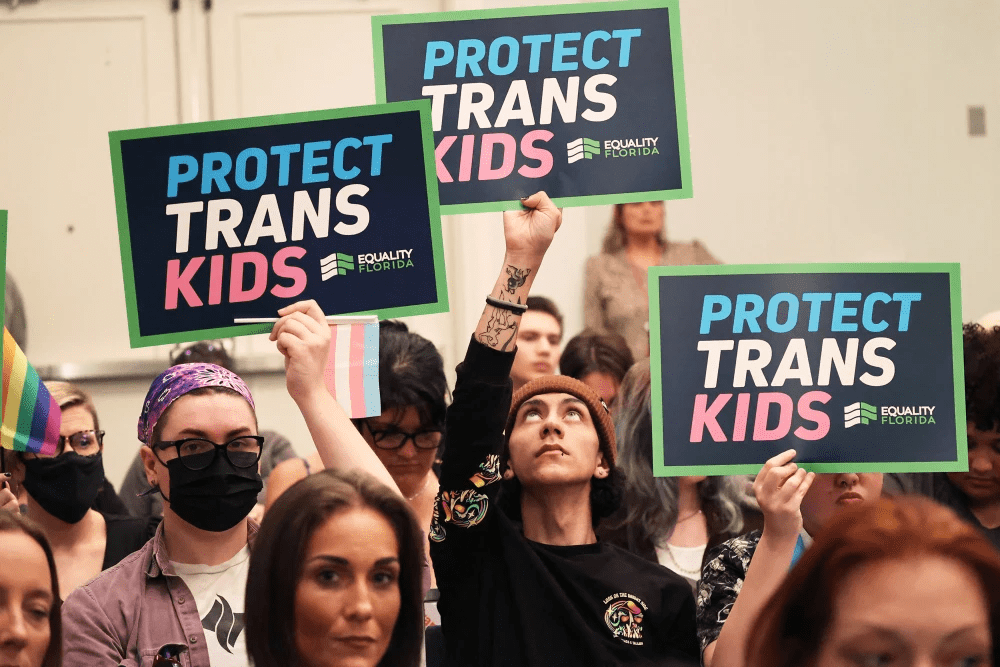
The legislative session in Florida commenced just this week, and within the first few days of the new year, Republican lawmakers have already presented more bills aimed at the LGBTQ community than there are days elapsed.
Certain bills, such as one seeking to alter the state’s definition of sex and another intending to criminalize “lewd or lascivious grooming,” stand out as some of the most extreme among the hundreds introduced in state Legislatures this year. Additionally, there’s a proposal to prevent government employees from being compelled to use their colleagues’ requested pronouns, and another bill aims to shield children from “harmful material” online. However, the ambiguous nature of what constitutes harmful material raises concerns among advocates, as it could potentially encompass LGBTQ content.
Moreover, a proposal put forth by Republican state Senator Jason Brodeur aims to classify almost all public allegations of anti-LGBTQ bias as “defamation per se.” This legislation would prohibit journalists from defending such claims by referencing the subject’s “constitutionally protected religious expression or beliefs” or scientific beliefs. Those found liable in successful lawsuits would face damages of no less than $35,000.
“Florida has consistently led in introducing new challenges to freedom and equality, and this year’s array of bills continues the trend,” remarked Brandon Wolf, a representative for the Human Rights Campaign, an LGBTQ advocacy group, and a survivor of the Pulse nightclub mass shooting in Orlando, Florida. “During this session, we anticipate heightened assaults on education, medical freedom, and the basic right of transgender individuals to live authentically.”
One of the most far-reaching bills comes from Republican Representative Dean Black, introducing a comprehensive measure that mandates Floridians to submit an affidavit confirming that their driver’s license or other state ID aligns with the sex indicated on their original birth certificate. Consequently, transgender individuals in Florida would be compelled to surrender any existing ID reflecting their gender identity and would be barred from obtaining such identification in the future.
Additionally, Black’s proposal mandates that any health insurance policy in the state covering transition-related “prescriptions or procedures” must also include coverage for “treatment to detransition” from such procedures. The bill further necessitates the inclusion of so-called conversion therapy in health insurance policies, compelling coverage for mental health services that aim to address a person’s perception that their gender is inconsistent with their sex assigned at birth, thereby affirming their birth sex.
Furthermore, the legislation would compel any school district or state agency engaged in collecting vital statistics for anti-discrimination compliance or accurate data on public health, crime, economics, or other purposes to include the identification of individuals’ birth sex in the dataset. This provision has the potential to impose limitations on the comprehensive collection of data concerning transgender individuals.
Black stated that the purpose of the bill is to address the “defining question of this decade: ‘What constitutes a woman?'”
“In truth, this legislation merely seeks to formalize what is already universally accepted but has unfortunately been manipulated by an extremist political movement determined to alter the laws of nature to suit their distorted agenda,” Black declared in a press statement.
Gillian Branstetter, a communications strategist with the American Civil Liberties Union, noted that Florida is not the inaugural state to contemplate a measure restricting transgender individuals from obtaining driver’s licenses reflecting their gender identity. Montana, North Dakota, Kansas, and Tennessee have already implemented comparable laws, with the ACLU presently involved in legal action against Kansas’ restriction. Additionally, Nebraska and Oklahoma have instituted executive orders that similarly define sex within state law.
Branstetter asserted that the bills represent a “clear attempt” to counter the Supreme Court’s decision in Bostock v. Clayton County, which established that federal employment law safeguards LGBTQ individuals from discrimination. Justice Neil Gorsuch’s opinion explicitly clarified that discrimination grounded in sex encompasses both sexual orientation and gender identity.
“In essence, these bills are designed to provide extensive authority to the state to erase the existence of ‘transgender,'” Branstetter stated.
A new proposal introduced by Republican Representative Taylor Yarkosky criminalizes “lewd or lascivious grooming,” categorizing it as an offense. The bill defines this as an individual “preparing or encouraging a child to participate in sexual activity through overtly sexually themed communication with the child or engaging in conduct with or in the presence of the child without permission from the child’s parent or legal guardian.”
While the bill doesn’t explicitly mention LGBTQ individuals, one of its Republican sponsors has publicly voiced criticism of all-ages drag performances. Additionally, the term “grooming” has been recently employed by some conservative officials to characterize LGBTQ
Florida’s series of legislative measures extends a trend that has persisted for several years. In the previous year, state Republican legislators presented 10 bills specifically addressing LGBTQ individuals, and four of them were enacted into law. Among these was a measure that extended the reach of Florida’s Parental Rights in Education Act, commonly criticized as the “Don’t Say Gay” law.
“Florida might serve as a testing ground for anti-LGBTQ+ hostility, but it is not isolated,” remarked Wolf, the advocate from the Human Rights Campaign. “The bills originating from the state are indicative of a broader agenda orchestrated by a national extremist network seeking to enforce these measures nationwide.”
Last year, conservative legislators introduced an unprecedented number of bills aimed at LGBTQ individuals, surpassing 500 filings nationwide, as reported by the ACLU. An analysis by NBC News revealed that seventy-five of these bills were enacted into law.
As of last month, Branstetter mentioned that the ACLU has documented 212 bills of such nature for the year 2024.
 fleeredstates.blog
You must be logged in to post a comment.