
This blog originally appeared at HAWAII PUBLIC RADIO.
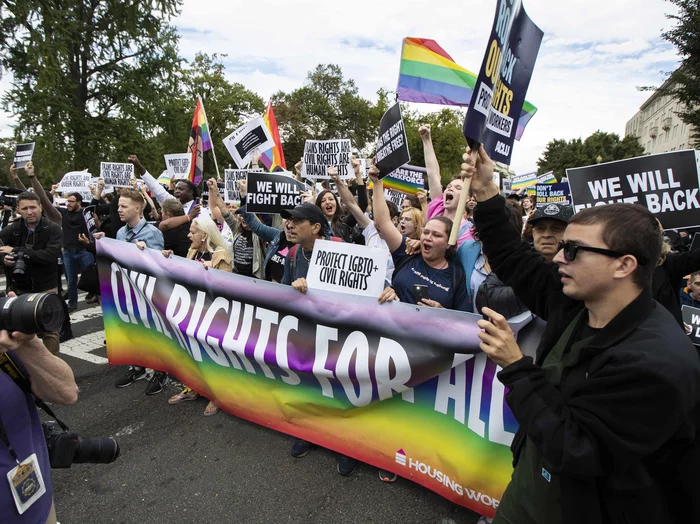
Cases concerning transgender rights have been making their way through the courts for years. Here, people demonstrated in support of trans rights in front of the Supreme Court in 2019.
A federal appeals court decision on Monday mandated that state health insurance plans in North Carolina and West Virginia must offer coverage for gender-affirming care. Transgender advocates view this ruling as a significant triumph, particularly amid a surge in state legislative proposals aiming to limit the rights of transgender individuals.
The 4th Circuit Court of Appeals in Richmond, Virginia, rendered its decision on two cases, one of which was filed by transgender North Carolina state employees and their dependents. They were denied coverage for gender-affirming care.
The second lawsuit was filed by transgender individuals in West Virginia who are enrolled in Medicaid. While they could receive coverage for certain treatments such as hormones, they were denied coverage for surgery.
These cases were heard en banc by the 4th Circuit Court last fall, meaning that all the judges on that appeals court participated in the hearing.
During oral arguments, the judges raised questions about procedures like mastectomies. While these are covered for patients with breast cancer, they were not covered by the health insurance plans for transgender patients.
In an 8-6 decision, the majority of the 4th Circuit ruled that these patients were entitled to health insurance coverage for their care. Judge Roger Gregory, who wrote the majority opinion, labeled the denial of coverage as “obviously discriminatory.”
West Virginia Attorney General Patrick Morrisey, in response to the court’s decision against the state’s stance on gender-affirming surgeries in Medicaid, stated, “Decisions like this one, from a court dominated by Obama- and Biden-appointees, cannot stand: we’ll take this up to the Supreme Court and win.”

North Carolina State Treasurer Dale Folwell labeled the ruling as “unabashed judicial activism” in a statement.
The 4th Circuit comprises seven judges appointed by Republican presidents and eight judges appointed by Democratic presidents.
“We’re delighted that the court affirmed that discriminatory treatment has no place under the law,” said Tara Borelli, senior counsel with Lambda Legal, who presented the case for the plaintiffs.
Borelli points out that the policies have already been updated. Both state health programs have been required to cover transgender healthcare since lower federal district courts ruled in favor of the patients in 2022.
With the appeals court issuing its decision, Borelli emphasizes that it establishes a significant precedent. She urges other states across the country to closely observe this ruling.
Attorneys representing North Carolina and West Virginia contended that the denial of coverage was rooted in fiscal considerations aimed at saving taxpayer funds, rather than bias.
Borelli pointed out that appealing to the Supreme Court would incur additional costs for taxpayers.
The Supreme Court’s recent decisions regarding transgender issues are varied.
Earlier this month, the justices permitted Idaho’s prohibition on gender-affirming care for minors to be implemented.
However, the Court has chosen not to review other cases concerning transgender students’ access to bathrooms and participation in school sports. Observers interpret this as a reluctance to intervene in the contentious issue.
On Friday, the Biden administration implemented a regulation bolstering protections against discrimination for transgender patients nationwide. This regulation extends to all healthcare services, ensuring that transgender individuals, including those seeking treatment unrelated to their gender, such as a broken arm in the emergency room, are not subject to mistreatment.
A coalition of Republican-led states has vowed to contest the regulation in court.
 fleeredstates.blog
You must be logged in to post a comment.