
*This is reported by Them.
Republicans in Congress have introduced a bill that would dramatically redefine the U.S. legal definition of “obscenity” to include any sexual content, escalating the right-wing campaign to define transgender people as inherently pornographic and obscene.
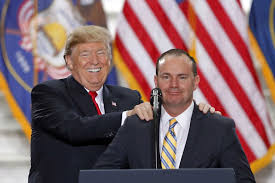
On May 8, Utah Sen. Mike Lee reintroduced his “Interstate Obscenity Definition Act” (IODA) with support in the House from Illinois Rep. Mary Miller. Lee is a fervent anti-trans Republican, having previously pressured Amazon to stop selling a trans-themed children’s book and supported legislation to ban trans students from school sports leagues. Miller, meanwhile, is perhaps best known for intentionally misgendering trans Rep. Sarah McBride earlier this year, and for declaring in 2022 that the overturning of Roe v. Wade was a “historic victory for white life.”
The bill would add a new definition of “obscene” speech to the Communications Act of 1934: if passed, obscenity would be redefined as anything which “appeals to the prurient interest in nudity, sex, or excretion”; “depicts, describes, or represents, an actual or simulated sexual act […] with the objective intent to arouse, titillate, or gratify the sexual desires of a person”; and “lacks serious literary, artistic, political, or scientific value.” (Legally, appealing to the “prurient interest” means that something elicits sexual desire in the viewer.)
The bill was referred to the Senate Committee on Commerce, Science, and Transportation. This is the third time Lee has introduced IODA, as Mashable noted, following IODA’s defeat in 2022 and 2024.
IODA had not yet received any cosponsors at time of writing, meaning it’s uncertain whether the bill will gain enough Congressional support to pass. But its intent is nevertheless chilling for U.S. free speech law, advocates say. “Obscene” speech — which is not protected by the First Amendment — was defined in the 1973 Supreme Court case Miller v. California, in which the Court established a three-pronged test to determine whether a given image or statement is legally obscene. Under the “Miller test,” speech is considered obscene if “the average person, applying contemporary community standards,” would consider it appealing to the prurient interest, and if it also depicts sexual activity “in a patently offensive way.”
IODA’s text would effectively remove the Miller test’s reliance on “community standards” and whether material is “patently offensive” from obscenity law, making it significantly easier to bring legal cases against any depiction of sexual activity — whether through photography, film, or even the written word.
Jacob Mchangama and Ashkhen Kazaryan, representing the think tank The Future of Free Speech, called IODA “dangerous” in an editorial for MSNBC on Tuesday. “By discarding the concept of community standards, the IODA removes a key safeguard that allows local norms to shape what counts as obscenity,” Mchangama and Kazaryan wrote. “Without it, the federal government could impose a single national standard that fails to account for regional differences, cultural context or evolving social values.”
By making standards for obscenity more subjective, IODA could also open the door for conservatives to legally declare trans people in general to be “obscene.” Lee is a longtime ally of the Heritage Foundation, the far-right think tank responsible for drafting Project 2025, a massive policy blueprint for President Donald Trump’s second term. (Trump tapped Project 2025 architect Russell Vought to head the Office of Management and Budget in February.) The sprawling 920-page document falsely declares that trans people are a threat to children, that transitioning itself is equivalent to pornography, and that pornography must be outlawed in the U.S.
“Pornography [is] manifested today in the omnipresent propagation of transgender ideology and sexualization of children,” Project 2025’s forward reads in part. “Its purveyors are child predators and misogynistic exploiters of women [….] Pornography should be outlawed. The people who produce and distribute it should be imprisoned. Educators and public librarians who purvey it should be classed as registered sex offenders. And telecommunications and technology firms that facilitate its spread should be shuttered.” The document also claims that children in public schools “suffer the toxic normalization of transgenderism with drag queens and pornography invading their school libraries,” referencing right-wing campaigns against Drag Story Hour events and LGBTQ+ books of any kind.
“If you pull back and you look at the broad picture of censorship that’s going on, from any information about trans people to sexual health information, certainly to anything that has adult content, they are following their promises in Project 2025. And this is just another attempt,” Ricci Levy, president and CEO of the sexual freedom nonprofit Woodhull Freedom Foundation, told Mashable this week.
The right-wing campaign against “obscenity” and anything deemed “pornographic” is moving forward at the state level as well. In January, Oklahoma State Sen. Dusty Deevers, a Republican, introduced legislation that would ban all pornography across the board and establish a maximum sentence of 30 years in prison for “trafficking” in porn. New age verification laws made Pornhub inaccessible in 16 states earlier this year, covering most of the Southern U.S.
It’s not just Republicans who are pushing for such laws, however. Arizona Gov. Katie Hobbs, a Democrat, signed another such age verification bill into law earlier this week. And in Congress, Republican Sens. Marsha Blackburn and Majority Leader John Thune joined with Democrats Richard Blumenthal and Minority Leader Chuck Schumer to reintroduce the Kids Online Safety Act on Wednesday, which free speech advocates say would threaten LGBTQ+ speech while failing to protect children online.
“Its outrageous that Democrat lawmakers are still willing to go along with this charade just to score ‘protect the children’ political points,” wrote Evan Greer, director of the free speech nonprofit Fight for the Future, in a Bluesky post reacting to KOSA’s return on Wednesday.
 fleeredstates.blog
Leave a comment