
Read more at South China Morning Post.
In Chow Kit, a crowded district of Kuala Lumpur forever caught between progress and prejudice, Amy* moves quietly through narrow alleys – a transgender outreach worker tending to lives the city prefers not to see.
Her evenings begin with small rituals: a backpack filled with condoms, test kits and pamphlets; a quick text to let her friends know that she is safe.
Then, when she steps out, much of her work happens in passing conversations – careful not to draw too much attention.
“The girls know they’re high-risk,” Amy said of the transgender sex workers she visits. “They want to stay healthy. But also … they just want to live.”
Yet even basic healthcare work can feel dangerous when you’re constantly looking over your shoulder. And furtiveness comes naturally if your very existence can be construed as a crime. Some of the women worry about being seen entering clinics for fear of who might recognise them.
“When people are scared to be seen, they stop showing up,” Amy told This Week in Asia. “Fear doesn’t just affect our lives; it affects public health.”
Malaysia does not legally recognise LGBTQ identities. Same-sex relations are federally banned under colonial-era anti-sodomy legislation, while parallel Islamic laws in Muslim-majority states prohibit cross-dressing and “posing” as another gender.
Such laws are often used not to intimidate as much as to prosecute. Over the years, Amy has watched how enforcement ebbs and flows – and how it always seemingly comes back stronger.
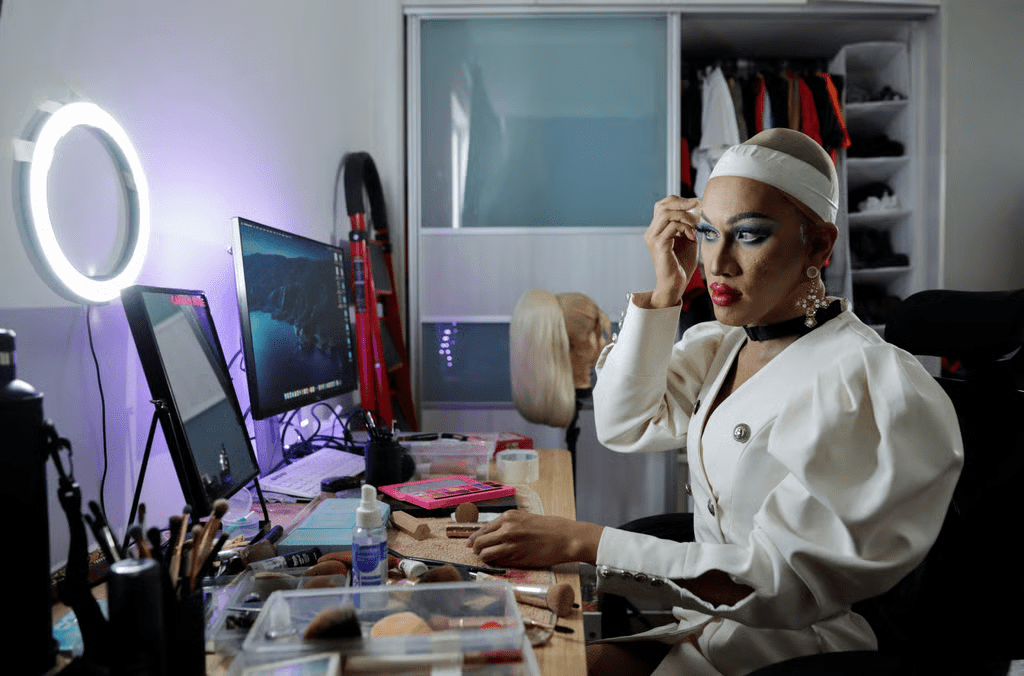
Few know that cycle better than Erina*, 55, a transwoman who spent decades performing in Kuala Lumpur’s drag circuit. She remembers when the scene was small but defiant, when glitter and high heels meant joy instead of danger.
“There was a time when we could perform without constantly looking over our shoulders,” she said. “It wasn’t easy, but there was space. That space has shrunk.”
The contraction feels literal now. Venues where she once worked have closed. Others stopped booking drag performers, terrified of raids. The most recent ones, on November 28 and 29, still ripple through the LGBTQ community. Police and religious officers stormed two men-only spas in Chow Kit and Penang, detaining hundreds.
It was the largest crackdown on queer spaces since a Halloween-themed party raid in 2022, activists say.
‘Shells of people’
Police later released the men who were rounded up in Kuala Lumpur, saying they had found no evidence of exploitation, coercion or “abnormal sexual activity”. Muslim detainees remained under investigation by Islamic authorities, however.
In Penang, the spa owner was fined 8,000 ringgit (US$1,960) after pleading guilty to owning obscene material and exposing others to HIV. Several other men were charged with offences ranging from gross indecency to possessing pornography.
For the community, the raids came as a shock. “People are now more afraid to go out,” Erina said. “Honestly, we’re not asking for special treatment … we’re asking to live without fear.”
Community groups rallied in support of the detainees. Members of Jejaka – a network supporting gay and bisexual men in Malaysia – gathered outside the police station in Kuala Lumpur where the men were being held, joined by volunteers, lawyers and family members calling for their release. They also pooled resources to provide legal aid, food and temporary housing.
In a statement, the group condemned the raids, arguing that the law used to justify them was “a relic of colonial morality” wielded to “target, stigmatise and endanger LGBTQ communities”.
“People are hiding,” said Pang Khee Teik, co-founder of LGBTQ organisation Seksualiti Merdeka (Sexuality Independence). Discriminatory laws had reduced members of the community to “shells” of people who “are navigating life with constant vigilance”, he said.
“It’s very sad to see that this is what we have done to our fellow Malaysians in the name of protecting ‘morality’.”
Amir*, a gay man in his twenties, remembers the brief sense of liberation he felt dancing in a club before what he called “the infamous raid”.
“It felt empowering,” he told This Week in Asia. “For a moment, I forgot I was in Malaysia. That’s how free it felt.”
Now, such gatherings are invite-only, with locations shared selectively through personal networks, often at the last minute. Amir says he has stopped going after the raids.
“This is Malaysia,” he said. “Hatred towards the LGBTQ community isn’t just normalised, it’s encouraged.”
Upholding morality
Authorities insist enforcement actions are necessary to uphold public morality. Days after the raids, members of the Malay nationalist group Pekida gathered outside one spa, plastering stickers and planting banners describing the venues as “immoral”.
Home Minister Saifuddin Nasution Ismail later said Malaysia might “revisit” certain provisions of its Penal Code, but only in ways consistent with “religious and moral values”.
Prime Minister Anwar Ibrahim has ruled out legal recognition of LGBTQ rights during his tenure.
Advocates say the result of the crackdown has been a deepening atmosphere of fear. In June, police raided what NGOs said was an HIV awareness event in Kelantan, calling it a “gay sex party”. Authorities have also cracked down on cultural symbols, seizing rainbow-themed Swatch watches and banning books deemed to “promote” LGBTQ lifestyles.
Through it all, Amy keeps walking her route through Chow Kit, never knowing when the next knock on a clinic door might provoke suspicion, or when a familiar face might vanish for weeks.
*Name changed to protect interviewee’s identity
 fleeredstates.blog
Leave a comment