A blog for LGBTQIA+ migrating to more welcoming states or counties
Author: Bob McCranie
I am so proud to run Texas Pride Realty Group. We set out on a mission in 2009 to serve the diverse communities of Texas and to hire kick-ass agents who practice the highest ethics and professionalism. I believe that the agent's role is to help the consumer make well-educated decisions, even if those decisions lead away from a purchase or sale.
I believe that education is vital in this industry. I currently have over 1300 hours of real estate courses on my transcript with the State of Texas. Additionally, I am a Real Estate Business Coach at Tom Ferry International, the largest-real-estate specific coaching company in the world. I coach agents in the US and Canada, and have coached clients in Australia, New Zealand, Brazil, and Switzerland. I also have knowledge of the UK and Irish markets.
Opening Texas Pride Realty was always a goal of mine and I am working night and day to be sure it is successful. The best way to do that is to be sure clients are satisfied and agents are busy. What better legacy could someone leave in this industry than a group of well-trained, high-quality brokers who do your job better than you?
A federal appeals court has temporarily reversed a lower court’s ruling that had prohibited Tennessee from enacting a ban on gender-affirming care for transgender youth
Advocates gather for a rally at the state Capitol complex in Nashville, Tenn., to oppose a series of bills that target the LGBTQ community, Tuesday, Feb. 14, 2023. A federal appeals court has temporarily reversed a lower court’s ruling, Saturday, July 8, that had prohibited Tennessee from enacting a ban on gender-affirming care for transgender youth.
FALLS CHURCH, Va. — Tennessee’s ban on gender-affirming care for transgender youth can go into effect — at least for now — after a federal appeals court on Saturday temporarily reversed a lower court ruling.
Last month, a district court judge in Tennessee found that the state’s new law banning transgender therapies like hormone blockers and surgeries for transgender youth was unconstitutional because it discriminated on the basis of sex. The judge blocked large swaths of the law from taking effect.
On Saturday, however, the Sixth U.S. Circuit Court of Appeals in Cincinnati granted an emergency appeal from Tennessee. In a 2-1 ruling, the majority wrote that decisions on emerging policy issues like transgender care are generally better left to legislatures rather than judges.
“Given the high stakes of these nascent policy deliberations — the long-term health of children facing gender dysphoria — sound government usually benefits from more rather than less debate,” wrote Chief Judge Jeffrey Sutton, an appointee of former President George W. Bush.
Tennessee’s attorney general, Jonathan Skrmetti, praised the ruling, saying the ban can now be fully enforced. “The case is far from over, but this is a big win,” he said in a statement.
A judge has temporarily halted a law proposed by Ron DeSantis, the governor of Florida, that aimed to restrict drag performances in the state. The law, which drew significant criticism from the LGBTQ+ community and civil rights advocates, would have imposed new regulations and requirements on drag performers, including fines and potential penalties for violations. The judge’s decision to halt the implementation of the law is seen as a victory for those advocating for freedom of expression and equal rights. The ruling acknowledges the importance of protecting artistic and creative performances and underscores the ongoing fight for LGBTQ+ rights and inclusivity.
Florida Gov. Ron DeSantis
Chris duMond/Getty Images
Florida Gov. Ron DeSantis suffered his third high-profile legal setback in the past month today as Judge Gregory A. Presnell of the Federal District Court in Orlando issued a preliminary injunction blocking a new DeSantis-backed law that prohibits businesses from allowing children to attend “adult performances.” DeSantis signed the bill into law just last month.
The Florida governor, who is running for the Republican nomination for president, has been an outspoken proponent of restricting LGBTQ+ rights. Of course, a big part of that has been the tug-of-war with Disney over his so-called “Don’t Say Gay” bill, which has cost the state about 2,000 relocated jobs and a $1 billion construction project that Disney had in the works.
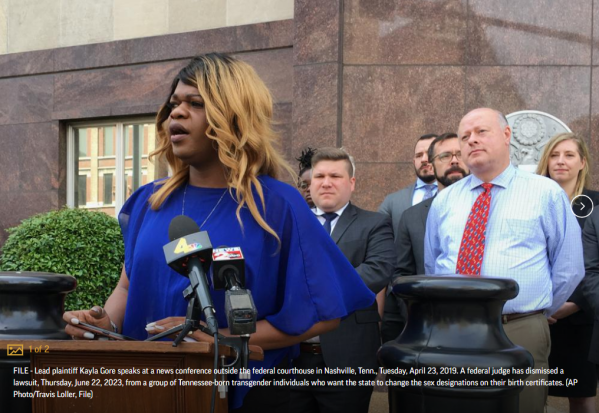
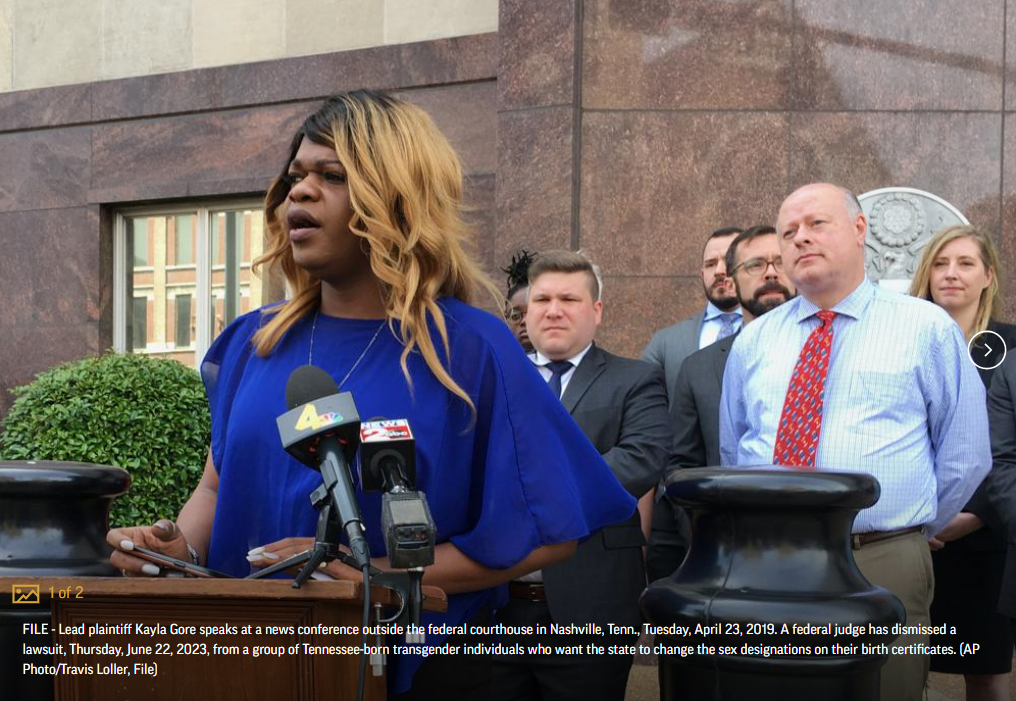
In a recent ruling, a judge in Tennessee has rejected the request of transgender plaintiffs to change their birth certificates. This decision has sparked controversy and raised concerns about the rights and recognition of transgender individuals. The plaintiffs had sought to update their birth certificates to reflect their gender identity, a step that is crucial for their personal identity and everyday life. The judge’s ruling underscores the ongoing challenges faced by the transgender community in obtaining legal recognition and highlights the need for continued advocacy for transgender rights.
The plaintiffs had sought to overturn a 1977 law that generally prohibits such changes. They said it unconstitutionally discriminates against transgender people and the sex designation on their certificates is inaccurate because it does not reflect their gender identities.
The lawsuit also argued that the policy is harmful, saying that when transgender people show their birth certificates for identification, the mismatch between the documents and their gender identities exposes them to possible harassment and even violence.
U.S. District Judge Eli Richardson wrote in his decision to dismiss that while there are varying definitions of “sex,” the term “has a very narrow and specific meaning” for the purpose of birth certificates: “external genitalia at the time of birth.”
Based on that limited definition, the designation does not later become inaccurate “when it is eventually understood to diverge from the transgender person’s gender identity,” Richardson said.
The plaintiffs had argued that “sex” should be defined by gender identity.
Lambda Legal, which brought the lawsuit on their behalf, criticized the ruling in a statement and said it was evaluating possible next steps. It said the decision comes as Tennessee’s Republican supermajority is targeting transgender rights.
Such efforts include banning gender-affirming care for minors; protecting teachers who don’t use transgender students’ pronouns from lawsuits; definining “male” and “female” in a way that prevents driver’s licenses and birth certificate changes; and banning private schools from letting transgender girls compete on female sports teams.
Richardson sought to sidestep politics in his decision, writing that the case “is not grist for a broad-based discussion” about transgender rights but rather “a discrete legal dispute over the constitutionality of a specific alleged policy” of the state.
Lead plaintiff Kayla Gore said she was devastated by the ruling denying her and her fellow complainants an opportunity to even plead their case.
“Tennessee’s discriminatory birth certificate policy has not only gravely impacted my life, but also presents a roadblock for all transgender Tennesseans,” she said in a statement.
When the suit was filed in 2019, Tennessee was one of three states that did not let transgender people change the sex designation on their birth certificates. Since then, federal courts in the other two, Kansas and Ohio, have found those policies unconstitutional.
Meanwhile states including Montana, North Dakota and Oklahoma have adopted policies like Tennessee’s, according to Lambda Legal.
ORLANDO, Fla. (AP) — The oldest historically Black collegiate fraternity in the U.S. says it is relocating a planned convention in two years from Florida because of what it described as Gov. Ron DeSantis’ administration’s “harmful, racist and insensitive” policies towards African Americans.
Alpha Phi Alpha Fraternity said this week that it would move its 2025 convention from Orlando to another location that is yet undecided. The convention draws between 4,000 and 6,000 people and has an economic impact of $4.6 million, the fraternity said.
The decision comes after the NAACP and other civil rights organizations this spring issued a travel advisory for Florida, warning that recently passed laws and policies are openly hostile to African Americans, people of color and members of the LGBTQ+ community.
Willis Lonzer, the fraternity’s general president, said in statement on Wednesday that the decision was motivated in part by Florida’s new education standards that require teachers to instruct middle school students that slaves developed skills that “could be applied for their personal benefit.”
“Although we are moving our convention from Florida, Alpha Phi Alpha will continue to support the strong advocacy of Alpha Brothers and other advocates fighting against the continued assault on our communities in Florida by Governor Ron DeSantis,” Lonzer said.
An email seeking comment on Saturday about the fraternity’s decision was sent to Jeremy Redfern, the governor’s press secretary and the governor’s office.
DeSantis, who is running for the 2024 GOP presidential nomination, has come under fire this week over Florida’s new education standards. Among those criticizing the Florida governor on Friday was a rival for the Republican nomination, U.S. Sen. Tim Scott of South Carolina, the sole Black Republican in the Senate.
Responding to the criticism, DeSantis said Friday that he was “defending” Florida “against false accusations and against lies. And we’re going to continue to speak the truth.”
In May, the NAACP joined the League of United Latin American Citizens (LULAC), a Latino civil rights organization, and Equality Florida, a gay rights advocacy group, in issuing travel advisories for the Sunshine State, where tourism is one of the state’s largest job sectors. The groups cited recent laws that prohibited state colleges from having programs on diversity, equity and inclusion, as well as critical race theory, and the Stop WOKE Act that restricts certain race-based conversations and analysis in schools and businesses.
They also cited laws that they say made life more difficult for immigrants in Florida and limited discussions on LGBTQ topics in schools.
At least nine other organizations or associations have pulled the plug on hosting conventions in Orlando and Fort Lauderdale, two of the state’s most population convention cities, because of Florida’s political climate, according to local media reports.
Florida is one of the most popular states in the U.S. for tourists, and tourism is one of its biggest industries. More than 137.5 million tourists visited Florida last year, marking a return to pre-pandemic levels, according to Visit Florida, the state’s tourism promotion agency. Tourism supports 1.6 million full-time and part-time jobs, and visitors spent $98.8 billion in Florida in 2019, the last year figures are available.
A swath of adjoining states in the South now ban transition-related care for minors, forcing families of trans youth to travel long distances for care.
Like any family, Katie and her son Ray had their road trip staples. They always packed sour peach candy. They talked more than they listened to music, and they played a game they called Nature. Anyone who spotted an animal racked up points, though the exact number depended on the species and an in-the-moment car vote.
Katie wanted to win. She looked for turtles as she pulled her SUV onto the highway around 9 one morning in early May, but her eyes went blurry with fear. She couldn’t make out anything in the distance.
“I’ll play once we get closer,” she told Ray.
Katie had done all she could to prepare for this trip. She’d asked a relative to pick up her two younger boys from school. She’d researched how to change a tire, and she’d spent hours on Google Maps, searching for the closest Walgreens in Alabama. She’d finally found a destination in Thomasville, a rural town nearly 200 miles from their suburban Mississippi home, but much remained unclear. Would they make it by noon for Ray’s telehealth appointment? Would the pharmacy give him testosterone?
Katie looked at her boy, a thin 17-year-old with wavy hair and an easy grin, and she asked herself the question that had begun to matter least: Was she breaking the law?
Two months earlier, Mississippi had banned transgender young people, like Ray, from accessing hormones or other gender-transition treatments. By mid-spring, nearly half the country had passed similar bills, according to the Movement Advancement Project, and now, 1 in 3 trans children lives in a state with a ban. Conservative lawmakers said they’d pushed the bills to protect young people, but Katie felt like they’d done the opposite. Testosterone had allowed her son to embody himself for the first time. Ray was present, happy. The ban would take that happiness away.
Across the country, families were doing everything they could to protect their trans children. Some uprooted their lives in red states for the promise of protections in blue ones. Others filed lawsuits. Katie couldn’t afford to move, and she needed a solution faster than the courts could offer, so she’d settled on a cheaper, quicker plan: She’d take a day off from her nursing job, and she and Ray would travel out of state for his medical care.
“It says we’ll be there by 11:48,” she said.
Katie and Ray on the road on May 4. Mississippi passed a law in late February banning transgender minors from accessing gender-transition treatments.
She knew that Mississippi’s law contained a rare aid-and-abet clause that prohibited adults from helping a minor transition. She didn’t understand the particulars, and she didn’t know what would happen to her if she broke it, but she cared less about penalties than she did about Ray, and so, the day the ban passed, she decided she’d do anything to keep her son well. (Katie and her family spoke to The Washington Post on the condition that they be identified by only their first names out of concern they could face legal consequences.)
Initially, Katie didn’t know where to go. Nearly every state within 700 miles had banned gender-affirming care for minors, and a trip to Illinois would have taken three days. She didn’t have vacation time or hotel money to spare, so the Midwest was out. The best option, she decided, was a tenuous one. A year earlier, Alabama lawmakers had passed one of the country’s first bans, but a judge had temporarily blocked the legislation, which meant teenagers could still get hormones there, at least for now.
“I guess I’m just going to Meridian, then a little farther,” she said. “I know how to get to Meridian, right?”
“I have faith in you,” Ray said.
He reached across the console, and Katie’s stomach twisted. She had told Ray she would fix this one way or another, and he believed her. But Katie couldn’t control lawmakers, and she had no idea what the pharmacist would do.
The border appeared a few minutes after 11, and Katie relaxed just a bit. She grabbed Ray’s hand.
“Welcome to sweet home Alabama,” she said. “Where you’re safe, for now.”
Katie drives across the state line into Alabama, one of the few places they could go to get Ray’s medication.
Care disrupted
Katie used to think Ray was lucky to be born when he was. Earlier generations of trans people had little or no access to gender-affirming care, but by 2019, when 13-year-old Ray told Katie he was a boy, even conservative states like Mississippi had a handful of providers who knew how to help him.
Nearly every major medical association has endorsed gender-affirming care for minors since 2012, and by the time Katie and Ray’s dad, Jody, found a pediatric endocrinologistat an LGBTQ clinic at the University of Mississippi Medical Center, the treatment was fairly standardized. Ray saw a therapist for a year, then, when he turned 15, a doctor prescribed Depo-Provera, an estrogen suppressantsometimes used as a puberty blocker. The clinic staff monitored his bloodwork and bone density.
At the time, no state prohibited transgender children from taking puberty blockers or cross-sex hormones. But in March 2021, a month after Ray started blockers, Arkansas passed a ban.
Katie figured Arkansas was an anomaly. A year passed, and in February 2022, she gave Ray his first testosterone shot. Then, seemingly overnight, the mood shifted. Texas authorities opened child abuse investigations into families with transgender children, and Alabama lawmakers approved the country’s second ban. Human Rights Campaign workers told Katie they believed Mississippi might be next.
No, Katie told them. Mississippi wouldn’t do that. The trans community was so small, it hardly seemed worth the public resources. Ray didn’t know any other kids receiving gender-affirming care, and public hospital data shows that the LGBTQ clinic treated just nine minors in fiscal 2020, and only 15 in fiscal 2023. None had surgery.
Katie understood some Mississippians might be slow to accept trans people. She hadn’t wanted to believe Ray at first, and her heart broke when he first cut his hip-length blonde hair to his chin. But she’d listened to him, and she’d trusted his doctors, and she’d seen the difference the care made in his life.
Citizenship offers greater rights, participation in governance, security, travel privileges, national identity, and intergenerational benefits compared to residence.
In comparing citizenship to residence, it becomes clear that citizenship holds a distinct advantage in terms of belonging, rights, and opportunities. This essay delves into the legal, political, and social benefits of citizenship, highlighting why it surpasses mere residence. By recognizing these differences, we gain a deeper understanding of how citizenship fosters integration and personal fulfillment within a country.
Citizenship offers numerous advantages and surpasses mere residence status in several ways. Firstly, citizens enjoy a wide range of legal rights and protections granted by the country’s constitution and laws. These include freedom of speech, voting rights, access to public services, and protection against deportation. Additionally, citizenship enables individuals to actively participate in the political process, influencing policy decisions and contributing to the governance of their country. Citizens also experience greater security and stability, benefiting from the diplomatic support, consular services, and defense forces of their home country. Moreover, citizenship provides enhanced mobility and travel privileges, access to a broader range of government benefits and services, a sense of national identity and belonging, and the ability to pass on nationality to future generations. Overall, citizenship offers a deeper connection and commitment to a nation and its values, providing individuals with a more comprehensive and enduring status within their country of choice.
The measure is one of several recently enacted by states aiming to expand access to medication abortion for patients who live where it is outlawed.
Under new legislation, New York’s courts and officials would not cooperate if another state with an abortion ban tries to prosecute or sue a New York health care provider who offers telemedicine abortion to a patient in the state with the ban.Credit…Kelly Burgess for The New York Times.
On Tuesday, the New York State Legislature approved a groundbreaking legislation that grants legal protection to doctors in New York to prescribe and deliver abortion pills to patients residing in states where abortion is prohibited. This measure, coupled with similar laws in several other Democrat-controlled states, has the potential to significantly expand access to medication abortions. It enables more patients in states with restrictive abortion laws to terminate their pregnancies at home, eliminating the need to travel to states where abortion is legal.
The New York bill now awaits the approval of Governor Kathy Hochul, who has expressed her support for the concept of a shield law. The legislation stipulates that New York courts and officials will not cooperate with any attempts by states with abortion bans to prosecute, sue, or penalize healthcare providers in New York who offer telemedicine abortions to patients in those states, as long as the providers adhere to New York law. The bill passed the State Assembly with a vote of 99 to 45 on Tuesday evening, following its approval in the Senate by a vote of 39 to 22 last month.
Since the Supreme Court’s decision last year to end the nationwide right to abortion, various states have enacted telemedicine abortion shield laws, including Massachusetts, Colorado, Vermont, and Washington. However, New York’s legislation is expected to have a particularly notable impact. Multiple providers in New York have expressed their intention to send abortion pills to patients in all states with abortion restrictions, and some providers are speaking publicly about it, which is a step that providers in other states with shield laws have not taken thus far.
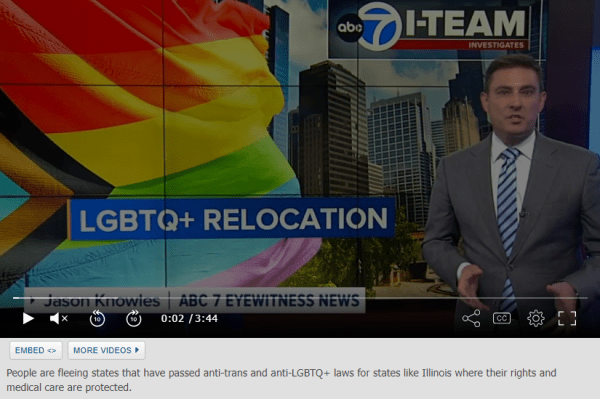
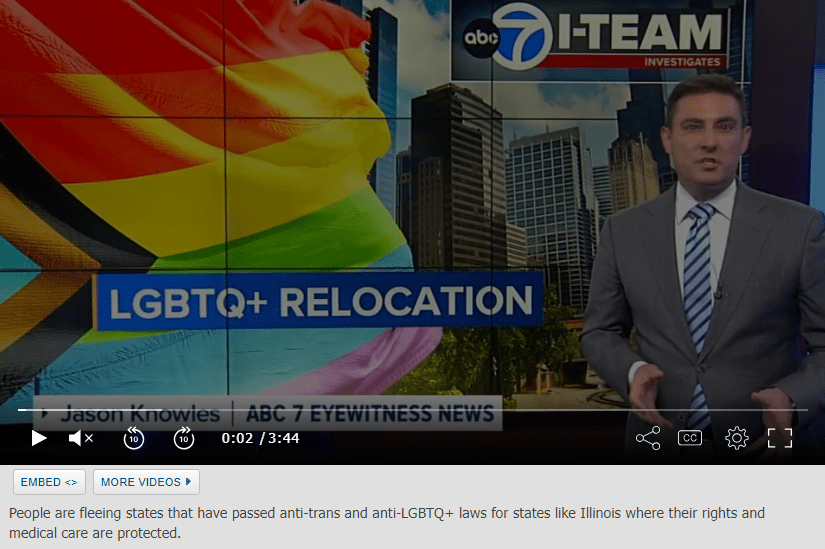
Illinois (WLS) — Some people are leaving states with anti-trans or anti-LGBTQ+ laws and relocating to LGBTQ+ friendly states like Illinois. They said it’s an issue of safety.
A realtor and some local organizations said they’ve seen an uptick in people looking to move to the Land of Lincoln to escape anti-LGBTQ+ legislation in other states. That includes one father who told the I-Team his family is moving to Illinois because he believes it will help ensure his son’s well-being and safety.
“As a parent, you have one job, love your kid. That’s your only job and your kids telling you something over and over and over again. If you love them. You believe them,” said Mark, who asked that his last name not be used.
His family is moving to Illinois for the sake of his 7-year-old son, who is transgender. To protect his son’s identity, Mark is using another name, Connor.
“Connor just wants to be a boy. And so, you know, we weren’t dismissive, but we were sort of quiet about it the first couple times Connor said this. And we would listen to him and say, you know, ‘We can deal with that later. You’re a little young.’ But it became sort of a common thing. Maybe once a month, that maybe once a week,” Mark said.
Mark and his wife and their son are leaving Kentucky and moving to the Chicago area due to anti-trans legislation recently passed there.
“The first concern is around teachers or other employees of the school being able to deadname my child or misgendering them,” he said. “Second concern is use of a bathroom. Either they’ll have to use the nurse’s bathroom or the bathroom that is not their gender, so that would out them. A third concern is around medication. So doctors in Kentucky will lose their license if they treat my son.”
Gender-affirming care for minors will also be banned in Kentucky by late June.
“So that means we have to travel across state lines to get medicine,” Mark said. “And my fourth concern is what law comes next. And what harsher penalties and loss of right will my son experience.”
Mark is working with realtor June Allen-Smith to find a home in the Chicago area.
The Supreme Court on Tuesday denied a private Christian college’s bid to revive its lawsuit challenging a federal directive prohibiting housing discrimination based on gender identity or sexual orientation.
In a brief, unsigned order, the justices declined to take up the College of the Ozarks’s appeal of a lower ruling that found the school had no legal standing to move forward with its pre-enforcement challenge.
In a brief, unsigned order, the Supreme Court declined to hear the appeal of the College of the Ozarks, a private Christian college, regarding its challenge to a federal directive on housing discrimination based on gender identity or sexual orientation. The college had argued that the directive violated its religious beliefs and sought to assign dormitory housing based on students’ biological sex rather than their gender identity.
The lower courts had previously ruled that the college lacked legal standing to proceed with its challenge. They found that the college had not demonstrated a concrete injury and that there was no imminent risk of enforcement against the institution. The college appealed to the Supreme Court, asserting that the administration had denied them the right to comment on the directive before its implementation.
The Supreme Court’s decision not to take up the case means that the lower court’s ruling stands, and the federal directive remains in place. The directive, issued by the Department of Housing and Urban Development (HUD) following President Biden’s executive order, interprets sex-discrimination provisions in federal laws to include protections for sexual orientation and gender identity.
The College of the Ozarks was represented by the Alliance Defending Freedom, a conservative legal group known for challenging policies related to LGBTQ rights and other issues, such as abortion access.
Please note that as an AI language model, I don’t have real-time information or the ability to provide the latest news updates. Therefore, for the most accurate and up-to-date information on this topic, I recommend referring to reliable news sources or conducting a search for recent developments on the subject.
A year after the reversal of Roe v. Wade, medical professionals describe a world of uncertainty in the field of reproductive healthcare. The landmark decision, which gave states the right to ban abortion, has led to a patchwork of abortion access across the country, with some states imposing severe restrictions or outright bans on abortion. This has created significant challenges for healthcare providers and patients seeking reproductive care.
Protesters gather outside the Supreme Court in Washington, Friday, June 24, 2022, following the Supreme Court’s decision to overturn Roe v. Wade.
(CNN)_ It’s been over a year since Roe v. Wade was overturned by the US Supreme Court, eliminating the constitutional right to abortion nationwide. The opinion was one of the most consequential Supreme Court decisions in decades and paved the way for states to pass laws to limit or ban access to the procedure.
Abortion has already become one of the defining issues of the 2024 campaign and is expected to continue to be a key topic as candidates face questions about whether they support banning the procedure on the local and national level.
CNN spoke with doctors and medical professionals who responded to a request for stories about how people’s lives have changed in the wake of the ruling. Those who responded all shared stories of their professional lives being disrupted by abortion bans and severe restrictions — including in Idaho and Arizona.
Some no longer want to practice in states with limitations on the procedure. Others worry about the safety of their patients as more bans loom in the future.
Below we share the stories of three medical professionals who agreed to give us full interviews about their experiences.
Katie A., Michigan
Idaho native Katie A. had plans of returning to her home state to practice as an obstetrician/gynecologist, but after Roe v. Wade was reversed and the state passed a near-total abortion ban, she is unsure of where she will go when she completes her residency in Michigan.
Katie, who asked CNN not to use her full name due to safety concerns, was born and raised in Boise, Idaho, and went to medical school in Washington state to specialize in rural patient care.
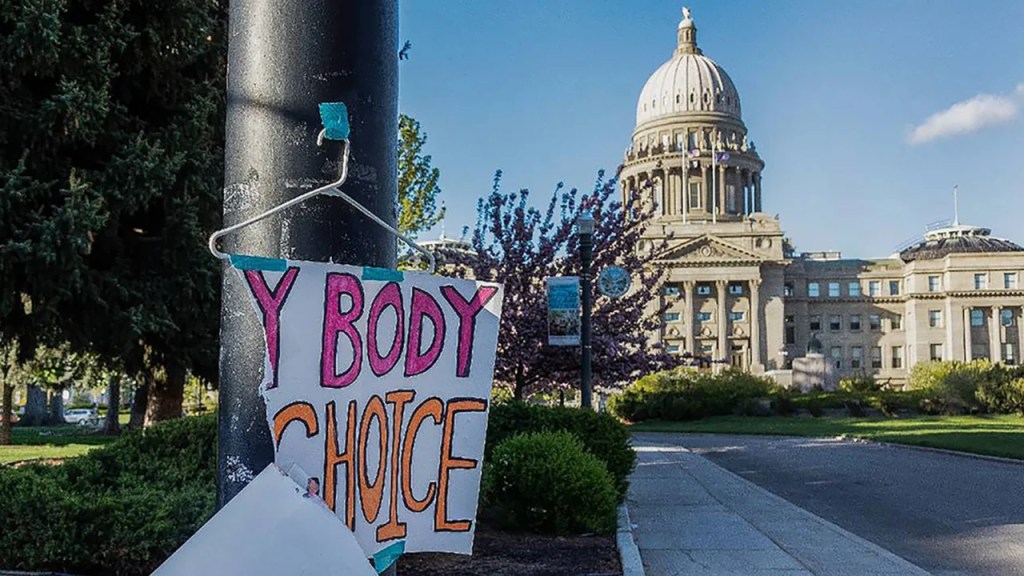
A sign taped to a hanger hangs near the Idaho Capitol in Boise after protests against the state’s new abortion laws, which effectively banned the procedure.
“As I was doing my clinical rotations in Idaho, I could really see myself working with the population there,” she told CNN. “Idaho is a state that for a long time has had a shortage of physicians. There’s a huge centralization of medicine in Idaho, most of the hospitals and specialists are in Boise.” Because of this, Katie said many people outside of the city do not have easy access to care.
The medical resident told CNN that she envisioned making a difference in the state, especially by specializing in gynecological and obstetrics care.
“I was really excited about the idea that I get to move home with this population that I grew up with — I could make a difference,” she said.
When Roe v. Wade was overturned, Katie’s plans to practice in her native state quickly changed as she witnessed the medical landscape transform there.
“I really felt called, like I felt that was where I could still make the most difference and it was really important to me to continue to pursue obstetrics and gynecology — whatever that might look like,” she said.
“But for my safety and for my ability to really treat my patients, I knew as soon as Idaho started passing laws, criminalizing transportation across state lines and all that sort of thing that it would not be a hospitable place for me to practice medicine. And that you know is sort of heartbreaking, right?” the medical resident added.
Idaho made abortions illegal last August — with only two exceptions: if the mother’s life is in danger, and in the case of rape or incest, but only after a police report has been filed and provided to the doctor. Since then, doctors who care for pregnant people and perform abortions have been fleeing the state due to new abortion restrictions.
In April, health care providers sued the state’s attorney general after he wrote in a legal opinion that the state’s abortion ban prohibits medical providers from referring patients out-of-state for abortion services. Gov. Brad Little, a Republican, also approved legislation that makes it much harder for minors in the state to obtain out-of-state abortions without parental consent. The law creates an “abortion trafficking” crime that makes it illegal for adults in the state to assist a minor with obtaining an abortion without informing the pregnant person’s parents or guardians.
Katie hopes that once she finishes her residency in four years, the situation will have evolved, helping her to more easily decide where she could eventually practice.
“I think wherever I practice; it might be Michigan, it might be Washington — I don’t know, it could be anywhere — will really depend on what local politics are and what protections are in place for physicians and patients,” she told CNN.
For the time being, she feels a sense of relief for matching with a program in a state without restrictive abortion laws.
Katie’s decision is on trend with new data which suggests that these restrictions are having an impact on where — and what — future doctors plan to practice.
The number of medical school seniors who applied to residency training programs went down by nearly 2% last year, and applications to programs in states with abortion bans dropped the most, dipping by 3%, according to an analysis in April from the Association of American Medical Colleges.
Interest in the Ob-Gyn specialty took a notable dip, according to the analysis, with applications dropping 5% nationwide and twice as much in states where abortion is banned.
















 fleeredstates.blog
You must be logged in to post a comment.