Dr. Oz is trying to take gender-affirming care coverage away from trans Medicaid recipients

*This is being reported by LGBTQNation.

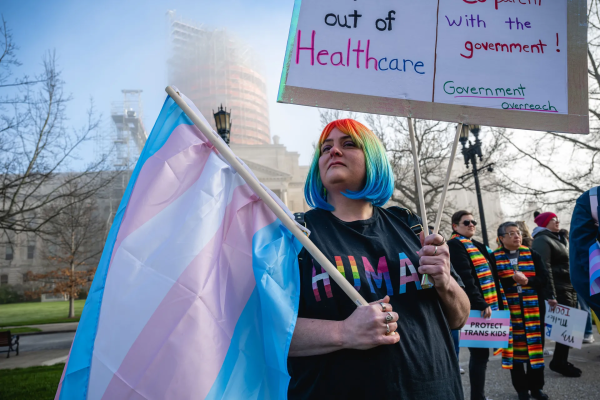
Mehmet Oz, the newly confirmed administrator of the Centers for Medicare & Medicaid Services (CMS), is telling state Medicaid officials to stop covering gender-affirming care for transgender youth. Medicaid is the joint state-federal program that covers health care for people with low incomes, including 40% of minors in the U.S.

letter sent from the CMS to state Medicaid directors said that the program should stop reimbursing gender-affirming care for minors, including puberty blockers, hormone therapy, and surgical interventions. The letter says that there is an “underdeveloped body of evidence” supporting gender-affirming care despite the research showing that it’s a safe and effective treatment for gender dysphoria, which is supported by all major medical organizations in the U.S. The letter also cites the U.K.’s “Cass review,” a report on gender-affirming care that has been criticized for its bias against transgender people.

In a statement, Oz – who was confirmed by the Senate earlier this month – said that gender-affirming care can lead to sterilization, and that’s why the CMS is cracking down on it.

“Medicaid dollars are not to be used for gender reassignment surgeries or hormone treatments in minors – procedures that can cause permanent, irreversible harm, including sterilization. CMS will not support services that violate this standard or place vulnerable children at risk.”

Republicans in the Senate at first balked at Oz’s nomination, not due to his lack of qualifications for leading the agency but because he had, on television, expressed more liberal views when it came to acknowledging that trans kids exist and supporting reproductive freedom. The White House assured Senate Republicans that Oz is now transphobic.

Taking away health care from trans minors in low-income families just a week into his tenure at the CMS may reassure Republicans of Oz’s conservative credentials.

In January, the president signed an executive order targeting gender-affirming care for trans minors and some young adults. The order told the Department of Health and Human Services (HHS) – under which the CMS is organized – to “take all appropriate actions to end the chemical and surgical mutilation of children,” including by changing “Medicare or Medicaid conditions of participation or conditions for coverage.” Referring to gender-affirming care as “mutilation” is a tactic used by anti-transgender activists to sway public opinion against the care that has been shown to save lives.

Former HHS official Adrian Shanker, who worked at the department under former President Joe Biden, said that the CMS letter misuses regulations to limit gender-affirming care coverage.

“I don’t think this letter is using those regulations in good faith,” Shanker told Advocate. “This letter is using highly politicized language that is not grounded in the mountain of evidence that supports the underlying health and well-being of trans youth.”

“It frankly looks like a campaign document,” he continued. “It looks like a document written by anti-trans activists rather than by public health professionals and health care leaders.”

Shanker pointed out that the letter itself is not legally binding but that it will lead states to cut off coverage for gender-affirming care.

“The significant fear here is that this ‘Dear State Medicaid Director’ letter will be utilized to preclude access to care even further in some states,” he said. “And the risk of that is actually very significant because we have incredible amounts of data that confirms the health impacts of denying access to care for trans youth.”

In 2015, trans reality TV personality and author Jazz Jennings appeared on Oz’s talk show, and he complimented her mother for being supportive.

“I love the support you’ve given your daughter,” Oz said. “It’s wonderful. And you can see the beautiful young woman she’s becoming because of it.”

This was before Oz entered the political realm. The exchange, though, led to Sen. Josh Hawley (R-MO) sending a letter demanding the administration explain the ten-year-old episode.

“Have your views on this issue changed since you hosted your television show?” Hawley’s letter demanded, asking if Oz supports the administration’s position that “gender transition procedures for minors should be banned.”

In a statement, a spokesperson for the White House said that Oz would follow the president’s views on the matter, saying that everyone in the administration will follow his “playbook.”

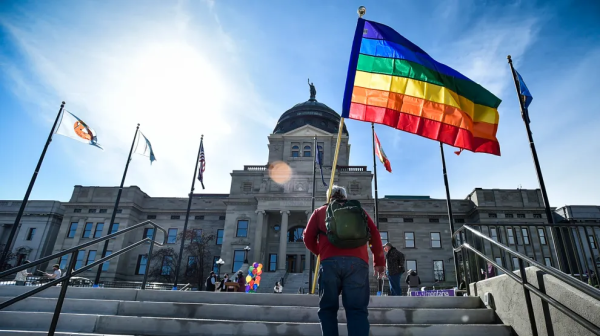
Montana Republicans Say No to Prosecuting Parents for Trans Care

*This is reported by Mother Jones.

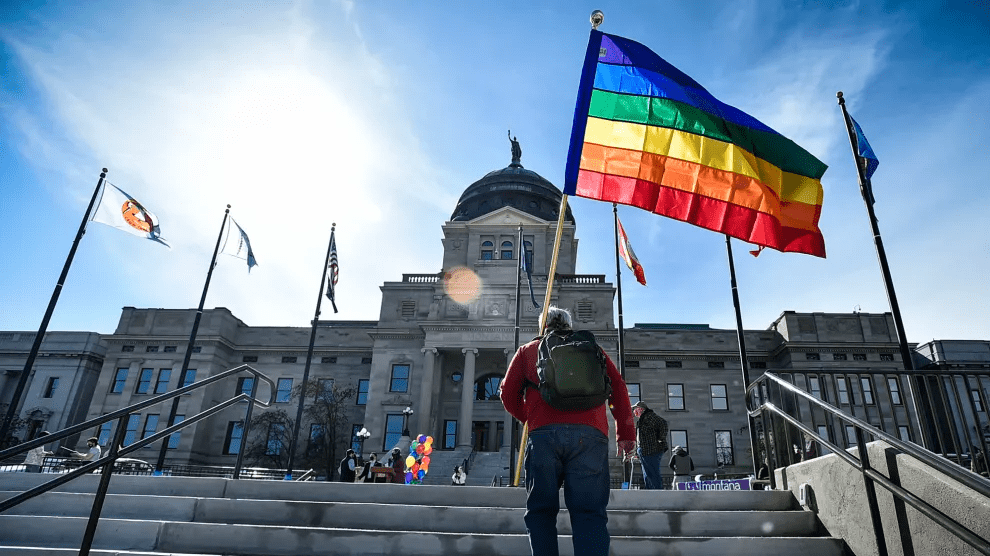
Five days after President Donald Trump declared “gender ideology” to be “one of the most prevalent forms of child abuse,” Montana’s Republican-controlled House of Representatives killed a bill that would have enshrined much the same idea into state law by criminalizing parents and medical providers.

Montana Senate Bill 164 would have made it a felony for any adult to help transgender children under 16 to gain access to gender-affirming medical care—including hormones, puberty blockers, and surgeries—classifying such help as child endangerment. On Tuesday, House lawmakers voted 58-40 to reject the proposed law, with 17 Republicans joining Democrats to block it from advancing to its final reading. 

“I think it’s overly broad,” the lone Republican to speak against the bill, Rep. Brad Barker, said Tuesday. Barker said that while he generally opposes gender-affirming care for trans youth, SB164 was “the wrong approach.” 

“I don’t like the thought of criminalizing parents,” Barker added, entreating fellow Republicans to “vote with your conscience.” 

The bill carried penalties of up to five years in prison and $10,000 in fines for any adults, including parents and doctors, who provided children with surgery, puberty blockers, or hormone replacement therapy for the purpose of “altering the appearance” of the child or affirming the child’s gender. If “serious bodily injury” occurred, the maximum punishment was 10 years imprisonment and $25,000 in fines.

“Turning parents and doctors into felons is absolutely not the approach that best serves this state,” Democratic Rep. SJ Howell, the first non-binary person to be elected to the Montana legislature, said on the House floor.

The bill cleared the Senate in February, 30-20, with two Republicans voting against it. In that floor debate, the legislation’s sponsor, Republican Sen. John Fuller, called it a “simple bill” to protect Montana’s children. “The state does have a compelling interest, a very compelling interest, to avoid the sterilization and sexual mutilation of children,” he said. In 2023, Fuller sponsored a law that threatened medical providers’ licensing if they offered gender-affirming care to minors, a law that courts have blocked while litigation proceeds.

“This bill is not about politics, it’s about safeguarding the health and innocence of Montana youth,” one of SB164’s House supporters, Republican Rep. Braxton Mitchell, said Tuesday. But more than a quarter of members of his own party disagreed, suggesting a potential turning point for the Montana legislature, at least on trans issues.

Tuesday’s vote was the second time this year a large swath of Republicans crossed party lines to block an anti-trans bill. Last year, Montana’s first openly transgender lawmaker, Rep. Zooey Zephyr, said her Republican colleagues often privately bemoan the transphobic culture wars and apologize to her for their votes on anti-LGBTQ legislation. 

Even so, Republican Gov. Greg Gianforte signed two anti-trans bills into law last month—a bathroom ban and a law prohibiting trans girls and women from playing on women’s sports teams from kindergarten through college. The bathroom ban has been temporarily blocked. A state law that prohibited trans women from participating in female collegiate sports was ruled unconstitutional in 2022.

The right to privacy is enshrined in the Montana constitution, and state courts have strongly affirmed its application to healthcare laws. Last December, the Montana Supreme Court upheld a lower court’s preliminary injunction on a law that would have made gender-affirming medical care providers vulnerable to licensing board disciplinary proceedings. And last summer, it ruled that a parental consent law for minors seeking abortion was unconstitutional. (In January, Montana Attorney General Austin Knudsen asked the U.S. Supreme Court to declare that ruling an unconstitutional infringement on parental rights. The Supreme Court has not decided whether to hear the case.)

If it had passed, SB164 would have become the first law in the country defining gender-affirming care as a form of felony child endangerment. (Child endangerment and abuse fall under different statutes, but both evoke the same myth that gender-affirming care is dangerous for youth.)

Montana, however, wouldn’t have been the first state to direct child welfare workers to investigate families of trans children. In 2022, Texas Republican Gov. Greg Abbott ordered the state’s Department of Family and Protective Services to open child abuse investigations into parents who seek gender-affirming care for their children. That directive remains partially blocked after families of trans children and the LGBTQ advocacy group PFLAG sued. 

Trump uses child abuse awareness proclamation to bash transgender people

*This is reported by Axios.

President Trump‘s decision to target transgender care in a proclamation declaring April National Child Abuse Prevention Month “betrays” the month’s purpose, LGBTQ advocates said.

Why it matters: Framing the trans youth experience as “abuse” further stigmatizes an already vulnerable community, as the Trump administration tries to erase trans people from American life through policies limiting access to health carecareerssportseducation and more.

Driving the news: Trump’s Thursday proclamation singled out transgender care, labeling it a form of child abuse without acknowledging the most common risk factors for neglected or abused children.

  • “It is deeply disingenuous for Trump to use National Child Abuse Prevention Month as a platform to attack and stigmatize the trans community,” Ash Lazarus Orr, a spokesperson for Advocates for Trans Equality, told Axios.

Reality check: Gender-affirming care is supported as both medically appropriate and potentially life saving for children and adults by major medical associations, including the American Medical Association, the American Academy of Pediatrics and the American Psychiatric Association.

  • Drugs like puberty blockers are temporary and reversible. They are given to trans youth and non-trans youth who experience early onset puberty.

What they’re saying: Trump’s proclamation “is vile and upsetting but importantly it is just a press release,” Chase Strangio, co-director of the ACLU’s LGBT & HIV Project said in a statement on Instagram.

  • “It does not change the law or direct any agency action. But it does continue to suggest that the government is moving towards efforts to explicitly criminalize trans life and support of trans people.”

“Using the language of ‘child protection’ to justify the oppression of trans youth betrays the very values this month is meant to uphold,” Orr said.

  • “Denying trans youth medical care won’t change who they are.”

“Supporting a child — regardless of their gender identity — is an act of love, period,” Jarred Keller, a Human Rights Campaign spokesperson, said.

  • “The idea that affirming a child’s gender identity constitutes something harmful is an insult to the parents who support their transgender children with compassion and understanding.”

Threat level: Trump wrote that “a stable family with loving parents” is a safeguard against child abuse, but most victims are abused by a parent, according to the National Children’s Alliance.

By the numbers: In 2022, a reported 434,000 perpetrators abused or neglected a child, per the alliance.

  • 76% of children were victimized by a parent or legal guardian in substantiated child abuse cases, meaning that child protective services agencies determined that abuse or neglect occurred.

Zoom out: Trump in January signed an executive order to defund youth gender-affirming care and a separate one threatening funding for K-12 schools that accommodate transgender children.

  • American hostility toward trans people has prompted U.S. allies to issue travel advisories for trans travelers, warning them that they must designate one “sex” on their travel forms and it has to reflect the gender they were assigned at birth.

Kentucky Re-Legalizes Conversion Therapy, Restricts Adult Access to Gender-Affirming Care

*This is being reported by THEM.

Kentucky’s legislature has overridden Gov. Andy Beshear’s veto of a bill that allows conversion therapy to resume in the state and that bans Medicaid funds from being used for gender-affirming care, including for adults. Beshear also allowed a bill banning incarcerated people from receiving or continuing to receive publicly funded gender-affirming care to pass into law without his signature.

On Wednesday, the Kentucky House and Senate, which are both controlled by Republicans, voted to override Beshear’s veto of House Bill 495, per the Lexington Herald-Leader. The bill reverses the governor’s September 2024 executive order, which banned so-called conversion therapy from being practiced on youth in the state. Though HB 495 was originally only meant to roll back the ban on the harmful, discredited practice, the bill was additionally amended to add a ban on the use of Medicaid funds for gender-affirming care for trans adults, per the Herald-Leader. HB 495 has an emergency clause, meaning that it takes effect immediately. According to the Kentucky Lantern, the House voted to override the veto 78-20, and the Senate voted 31-6.

However, Beshear did not veto Senate Bill 2, which bans gender-affirming care for incarcerated trans people. At a press conference in December, Beshear stated that “convicted felons do not have the right to have any and all medical surgeries paid for entirely by tax dollars, especially when it would exceed the type of coverage available to law-abiding citizens in the private sector,” according to The Hill. As the publication noted, though, the state has never provided a gender-affirming surgery for an incarcerated person. Even so, gender-affirming care, including surgery, is medically necessary. As the ACLU’s Chase Strangio told Them in September, “Courts have consistently held that blanket denials of medical care, including medical treatment related to gender dysphoria, are unconstitutional,” since the denial of that care could violate the Eighth Amendment, which prohibits cruel and unusual punishment.

According to the Kentucky Lantern, there are only 67 trans people incarcerated in Kentucky prisons, all of whom will be forced to stop gender-affirming hormone therapy if that care is paid for with public funds. At a February hearing, Louisville psychologist Jacks Gilles testified against the bill, stating that stopping that care “will result in negative outcomes, including increased anxiety, disturbances in social and familial relationships, depression, suicidality and death,” according to the Lantern. “Gender-affirming medical care is not experimental, it’s not elective, and it’s not cosmetic,” Gilles said.

Beshear has previously been hailed as an outspoken advocate for the trans community. In a November 2024 op-ed for the New York Times, the governor pleaded with his fellow Democrats to not scapegoat trans people for the party’s loss. Though the legislature overrode his veto, in 2023 Beshear did attempt to put a stop to a wide-sweeping anti trans bill that banned minors from receiving gender-affirming care, prohibited trans kids from using the bathrooms that align with their identities at school, and banned discussion of LGBTQ+ topics in elementary schools.

In a statement posted to Facebook, Chris Hartman, the executive director of statewide LGBTQ+ advocacy organization Fairness Campaign, called the passage of the bills “a sad day in Kentucky.”

“Two anti-LGBTQ+ bills will become law with devastating consequences for our community,” he said, calling both bills “cruel” and that they “have no place in our Commonwealth.”

GOP Virginia governor vetoes bill seeking to protect PrEP users from insurance discrimination

*This is being reported by LGBTNation

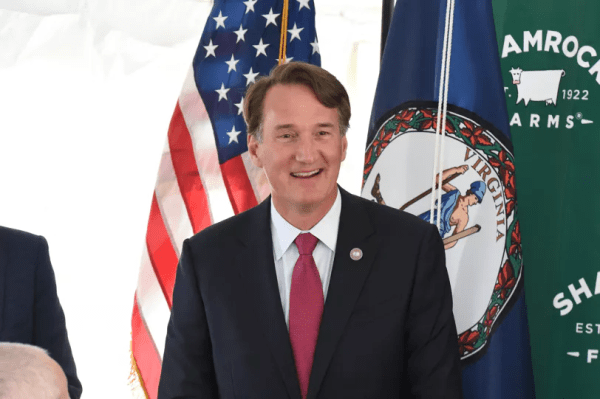
Virginia’s anti-LGBTQ+ Gov. Glenn Youngkin (R) vetoed a bill seeking to ban health and life insurance companies from discriminating against people taking the HIV prevention drug regemin PrEP.

H.B. 2769 amends the current insurance anti-discrimination law by explicitly stating a company cannot “Refuse to insure, refuse to continue to insure, or limit the amount or extent of life insurance or accident and sickness insurance coverage available to an individual or charge an individual a different rate for the same coverage based solely and without any additional actuarial risks upon the status of such individual as having received pre-exposure prophylaxis for the prevention of human immunodeficiency virus”.

Both chambers of the Virginia General Assembly have Democratic majorities. The bill passed the state Senate 24-15 and the House of Delegates 53 to 44. The veto was one of 157 bills the governor vetoed on Monday as part of what the Virginia Mercury called his “veto storm to drown progressive legislation.”

He also vetoed a bill that would have incrementally raised the minimum wage to $15 per hour and one that sought to expand voter turnout by making state and local elections at the same time as the presidential primary during election years.

Youngkin did, however, sign a landmark campaign finance reform bill that passed with bipartisan support. H.B. 2165 bans personal use of campaign funds.

Youngkin has supported numerous policies attacking LGBTQ+ students under the guise of so-called “parents’ rights” in education. His policies for trans youth in schools include the forced misgendering or deadnaming of kids who don’t have parents’ permission, allowing youth to “opt-out” of being near trans kids in gendered spaces, and forced outing of trans kids to their parents.

In an October 2021 interview with the Associated Press, Youngkin said he didn’t personally support same-sex marriage. In 2024, however, he signed a bill codifying same-sex marriage in the Commonwealth.

North Carolina Democrats push bills for reproductive rights and LGBTQ+ protection

*This is being reported by WFMY 2.

North Carolina Democrats filed a slew of bills Tuesday all centered around reproductive health and LGBTQ+ protections.

According to Democratic lawmakers, some of the bills will guarantee the rights to use contraception to prevent pregnancy and access fertility treatments through IVF. Others will ban conversion therapy and the use/perception of gender and sexual orientation as a defense in assault and homicide cases. An equality for all bill is also proposed.

“We need to be done with treating people as anything less than full human beings deserving of respect and dignity,” state Sen. Julie Mayfield said.

State Sen. Sophia Chitlik said, “Contraception is taken to support people with a variety of health challenges, including polycystic ovary syndrome.”

While state Democrats said they’re pushing their priorities, Republicans filed Senate Bill 516 Tuesday. Entitled the Women’s Safety and Protection Act, it is sweeping legislation that would limit a transgender person’s access to bathrooms and their ability to change legal documents.

Republicans have previously said banning biological men from women’s bathrooms is a safety measure.

According to Democrats, Republicans are only attacking marginalized communities and putting LGBTQ+ and transgender communities in danger.

“If you don’t believe it, just look out there at all those people who just want to be recognized as humans,” state Rep. Allison Dahle said. “They don’t care if you recognize their pronouns, they just want to be human and live their lives.”

Trump administration cancels at least 68 grants focused on LGBTQ health questions

*This is reported by WFMY 2.

 A surge of grant cancellations hit researchers focused on the health of gay, lesbian and transgender people last week, as the Trump administration continues to target what it describes as ideologically driven science.

Last week the U.S. government terminated at least 68 grants to 46 institutions totaling nearly $40 million when awarded, according to a government website. Some of the grant money has already been spent, but at least $1.36 million in future support was yanked as a result of the cuts, a significant undercount because estimates were available for less than a third of grants.

Most were in some way related to sexual minorities, including research focused on HIV prevention. Other canceled studies centered on cancer, youth suicide and bone health.

Health and Human Services spokesman Andrew Nixon said the agency is “dedicated to restoring our agencies to their tradition of upholding gold-standard, evidence-based science.” The grants were awarded by the National Institutes of Health, an agency under HHS.

One canceled project at Vanderbilt University had been following the overall health of more than 1,200 LGBTQ people age 50 and older. Most of the money has been spent from the grant funding the project, but it was up for renewal in April, said Tara McKay, who leads Vanderbilt’s LGBTQ+ Policy Lab.

She said the grant won’t be renewed because of the termination, which jeopardizes any long-term results. Still, the Vanderbilt project had already generated two dozen published papers, including work used to train doctors to provide better care to LGBTQ people, increasing the likelihood of cancer screenings and other preventive care.

“That saves us a lot of money in health care and saves lives,” McKay said.

Insights from minority populations can increase knowledge that affects everyone, said Simon Rosser, who studies cancer in gay and bisexual men at the University of Minnesota.

“We now no longer have anywhere studying LGBT cancer in the United States,” said Rosser, who saw his grants canceled on Friday.

“When you decide to cancel all the grants on sexual minorities, you really slow down scientific discovery, for everyone,” Rosser said. Young researchers will lose their jobs, and the field as a whole will suffer, he added.

“It’s a loss of a whole generation of science,” Rosser said.

Termination letters seen by The Associated Press gave as reasons that the research was “unscientific” or did “nothing to enhance the health of many Americans.”

That language felt personal and stinging, McKay said.

“My project’s been accused of having no benefit to the American people. And, you know, queer and trans folks are Americans also,” McKay said.

NIH at DOGE Behest Cancels Nearly $2.2 Million in University Minority Research Grants

*The below is part of a larger report from Ohio’s NBC4.

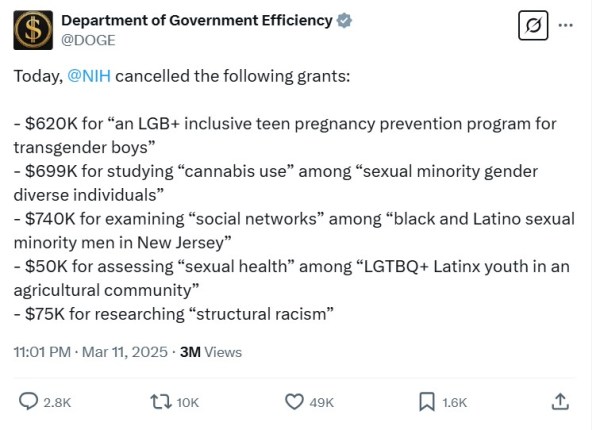
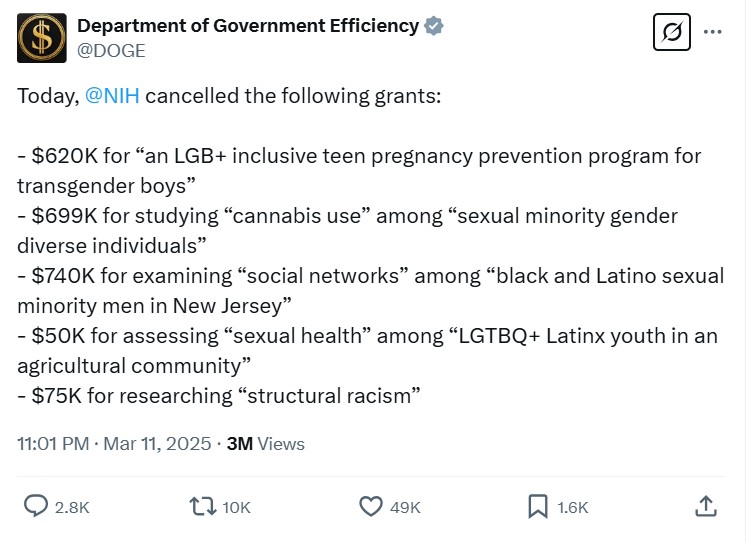
Nearly $2.2 million worth of grant funding for university research was cancelled earlier this month by the NIH at the behest of DOGE. The majority of the funding dealt with the LGBTQ community. The remainder was specific to structural racism.

The report of course stems from a post on X by DOGE “itself”. The news article does confirm the cancellation of the cannabis use study funding. Others have not been independently verified as having been cancelled.

A 50-state look at the well-being of LGBTQ+ young people

*This is being reported by University Business.

The well-being of LGBTQ+ young people suffers not because of who they are but due to mistreatment and stigmatization, a leading suicide-prevention organization contends.

The Trevor Project has released a state-by-state analysis of the mental health of LGBTQ+ teens and young adults. The survey of 18,000 LGBTQ+ young people ages 13 to 24 examines suicide risk, access to care, discrimination, bullying and the impact of anti-LGBTQ+ policies, among other factors.

The Trump administration has impacted support and awareness for LGBTQ+ students across colleges and universities. A recent Dear Colleague letter has demanded institutions to dismantle diversity, equity and inclusion programs, which usually house support for LGBTQ students. GOP lawmakers across Florida, Texas and Iowa have also targeted academic programs related to gender studies.

Young people made the following statements about where they live:

I live in a community that is accepting of LGBTQ+ young people.

  • Arkansas: 36%
  • Hawaii: 88%
  • Idaho: 31%
  • Puerto Rico: 60%
  • Washington, D.C.: 97%

I or my family have considered leaving for another state because of LGBTQ-related topics politics and laws.

  • Connecticut: 19%
  • Kentucky: 56%
  • Montana: 53%
  • Texas: 58%
  • West Virginia: 46%

Percentage of LGBTQ+ youth who have seriously considered suicide in the past year:

  • Arizona: 39%
  • Colorado: 41%
  • Louisiana: 32%
  • Michigan: 37%
  • Vermont: 44%

LGBTQ+ young people were physically threatened or harmed:

  • Alaska: 16%
  • New York: 22%
  • Rhode Island: 17%
  • South Carolina: 25%
  • Wyoming: 29%


LGBTQ+ youth who reported experiencing symptoms of depression:

  • Alabama: 56%
  • Kansas: 49%
  • Maryland: 48%
  • Tennessee: 57%
  • Utah: 53%

LGBTQ+ young people who wanted and received mental health care:

  • Florida: 44%
  • Massachusetts: 58%
  • Mississippi: 41%
  • New Jersey: 55%
  • Wisconsin: 53%

Kentucky GOP Lawmakers Approve Bill to Reverse Governor’s Ban on Conversion Therapy

*This is being reported by Gayety.

Kentucky state Representative David Hale, a Republican, has introduced legislation aimed at overturning a 2024 executive order issued by Democratic Governor Andy Beshear that bans conversion therapy. This controversial practice, which attempts to change a person’s sexual orientation or gender identity, has been widely discredited by medical and psychological experts. Despite numerous opponents testifying against Hale’s bill, the lawmaker insists that his research supports the need for the legislation, although he declined to disclose the organizations that helped him draft the bill.

Governor Beshear’s Executive Order and Its Impact

In September 2024, Governor Beshear signed an executive order that outlaws conversion therapy for minors in Kentucky. The executive order not only prohibits state-funded programs from supporting the practice, but it also calls for licensing boards for counselors to consider disciplinary action against those who engage in conversion therapy. Beshear’s order aims to protect minors from a practice that has been shown to have detrimental effects on mental health.

At the time of signing the order, Beshear emphasized that conversion therapy “has no basis in medicine or science” and cited research linking the practice to increased rates of suicide and depression. “This is about doing what is right and protecting our children,” Beshear said in a statement. “Hate is not who we are as Kentuckians.”

Hale’s Proposed Bill and its Justifications

On February 15, 2025, Hale introduced House Bill 495, a measure designed to reverse Beshear’s executive order. Hale, who is known for his conservative stances, argues that his bill would protect counselors, therapists, and pastors who offer conversion therapy from government interference. He insists that parents should have the right to seek therapy that aligns with their beliefs and the needs of their children.

During a committee meeting, Hale claimed that his bill would protect mental health providers offering “therapy to relieve discomfort or distress caused by an individual’s sex or romantic or sexual attraction.” He further added that the bill would also safeguard practitioners who offer other forms of therapy, including pro-LGBTQ or gender-affirming care. Despite the claims, Hale did not specify which organizations assisted in drafting the bill’s language.

The bill, which was approved in a 15-4 party-line vote by the committee’s Republican members, is now one step closer to being debated by the full Kentucky legislature. Some Republicans on the committee argued that the bill would ensure mental health professionals could offer care that respects both LGBTQ+ individuals and those seeking therapy to change their sexual orientation.

Opposition Voices and Concerns

Numerous witnesses spoke out against Hale’s bill, citing the harm caused by conversion therapy and the damage it can do to vulnerable individuals. Eric Russ, a licensed clinical psychologist and executive director of the Kentucky Psychological Association, testified that the bill “directly threatens the trust between a mental health provider and our clients” by legitimizing practices that are widely considered harmful.

Rev. Brandon Long, an ordained minister and former victim of conversion therapy, shared his personal experience of being subjected to the practice after coming out as gay. He described how conversion therapy had attempted to alter his sexual orientation by blaming it on childhood trauma and demonic influence. “Conversion therapy weaponized sacred pastoral practices,” Long said, adding that it was “spiritual and psychological abuse.”

Chris Hartman, executive director of the Fairness Campaign, an LGBTQ+ rights group, questioned why the committee responsible for overseeing state government functions was involved in passing legislation related to mental health care.

Hale, who said he had found “no evidence” supporting the personal testimonies of those who spoke against his bill, went on to shake hands with several of the witnesses who had opposed it. Rev. Long refused to shake his hand, accusing Hale of dismissing their lived experiences and framing their testimony as lies.

Political Landscape and Future of the Bill

Hale’s bill is part of a broader culture war in Kentucky, where conservative lawmakers have made several attempts to restrict LGBTQ+ rights. In 2023, Kentucky Republicans successfully passed a ban on gender-affirming medical care, though it is currently on hold due to ongoing court challenges. While this ban focuses on medical care, it does not address gender-affirming psychological counseling.

Conversion therapy has been banned in 23 states, and the practice has faced widespread condemnation from major U.S. medical and psychological associations. Research has consistently shown that conversion therapy leads to increased emotional distress, including depression and suicidal thoughts, particularly among LGBTQ+ youth. According to the Trevor Project, nearly 21% of LGBTQ+ youth in Kentucky have reported being subjected to conversion therapy, with 83% of those experiences occurring before the age of 18.

A Divisive Issue for Kentucky’s Future

Hale’s bill comes at a time when Republicans hold supermajorities in both chambers of Kentucky’s legislature, which could threaten the future of Beshear’s executive order. If passed, the bill would reverse the protections set forth by Beshear, allowing the practice of conversion therapy to continue in the state.

As the bill moves through the legislative process, it is clear that the debate over conversion therapy is far from settled. Advocates for LGBTQ+ rights are committed to fighting the bill, while opponents argue that parents should have the freedom to choose therapeutic options that align with their values. With the state’s political climate increasingly polarized, Kentucky’s legislature is set to remain at the center of a larger national conversation about the rights of LGBTQ+ individuals and the role of government in regulating mental health practices.

For those struggling with issues related to conversion therapy, several resources are available, including the Trevor Project (1-866-488-7386) and the Trans Lifeline (1-877-565-8860). These organizations provide safe, confidential support for LGBTQ+ youth and adults.

Blog at WordPress.com.

Up ↑